


Journal of Computer Applications ›› 2026, Vol. 46 ›› Issue (8): 2485-2493.DOI: 10.11772/j.issn.1001-9081.2025070864
• Data science and technology • Previous Articles Next Articles
Pengyu CHEN1, Baojun TIAN1,2( ), Lichang ZHAO1, Jiandong FANG2,3
Received:2025-07-31
Revised:2025-10-11
Accepted:2025-10-14
Online:2025-11-05
Published:2026-08-10
Contact:
Baojun TIAN
About author:CHEN Pengyu, born in 2000, M. S. candidate. His research interests include recommendation system, machine learning.Supported by:
陈鹏宇1, 田保军1,2(), 赵利畅1, 房建东2,3
通讯作者:
田保军
作者简介:陈鹏宇(2000—),男,重庆人,硕士研究生,主要研究方向:推荐系统、机器学习基金资助:CLC Number:
Pengyu CHEN, Baojun TIAN, Lichang ZHAO, Jiandong FANG. Learning path recommendation model integrating multi-behavior modeling and reinforcement learning[J]. Journal of Computer Applications, 2026, 46(8): 2485-2493.
陈鹏宇, 田保军, 赵利畅, 房建东. 融合多行为建模与强化学习的学习路径推荐模型[J]. 《计算机应用》唯一官方网站, 2026, 46(8): 2485-2493.
Add to citation manager EndNote|Ris|BibTeX
URL: https://www.joca.cn/EN/10.11772/j.issn.1001-9081.2025070864
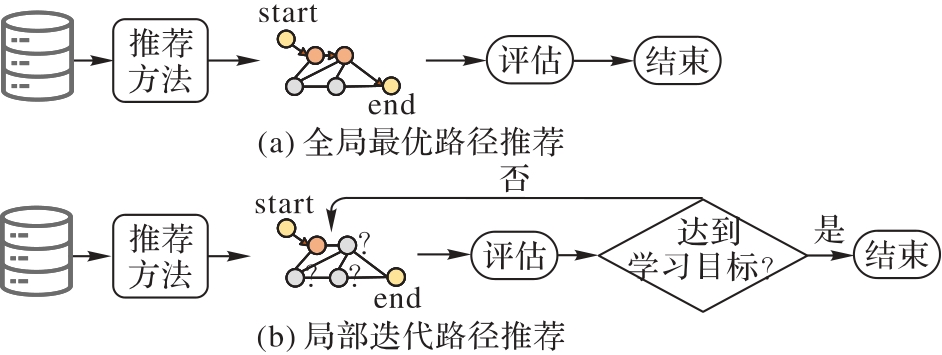
Fig. 1 Classification of learning path recommendation
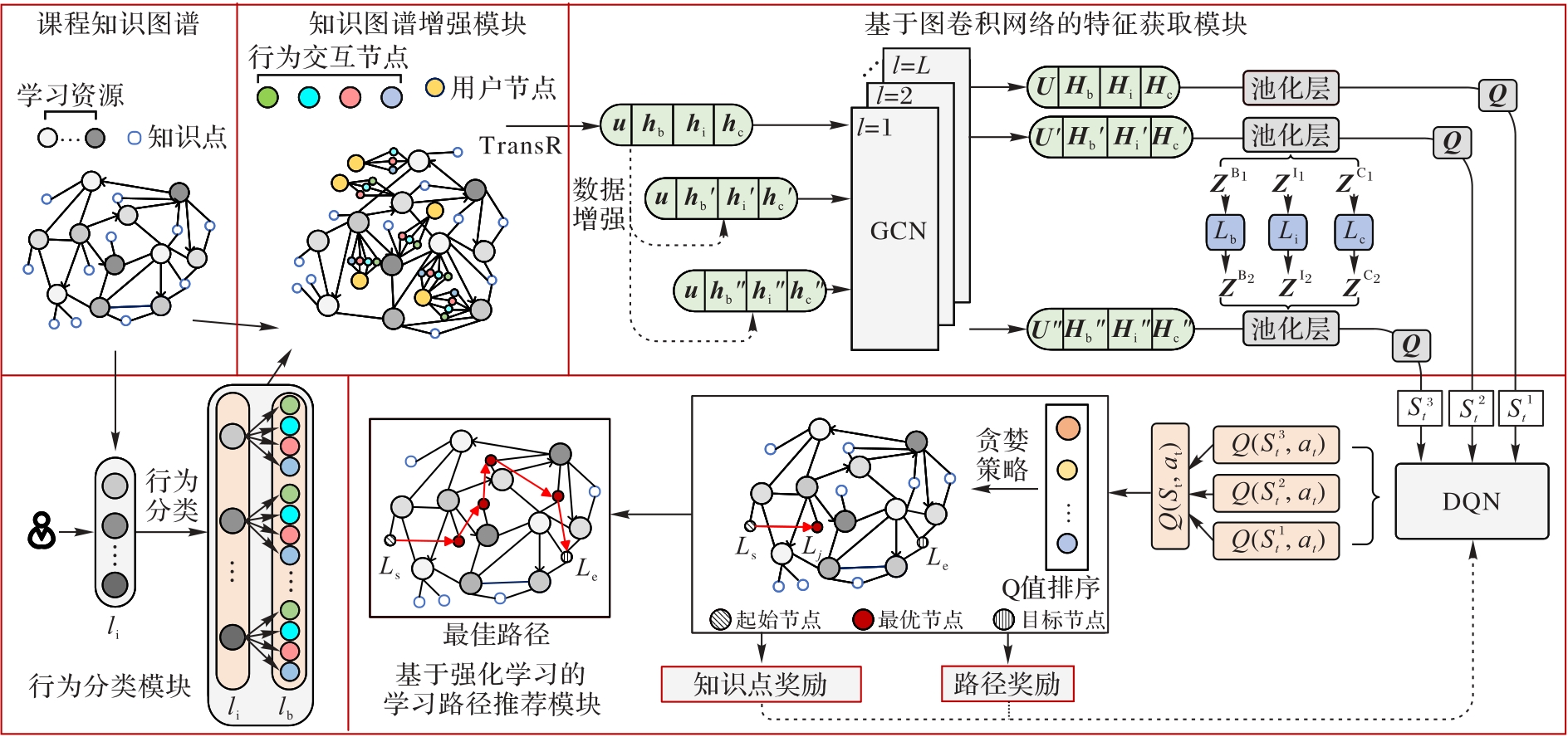
Fig. 2 Structure of proposed model
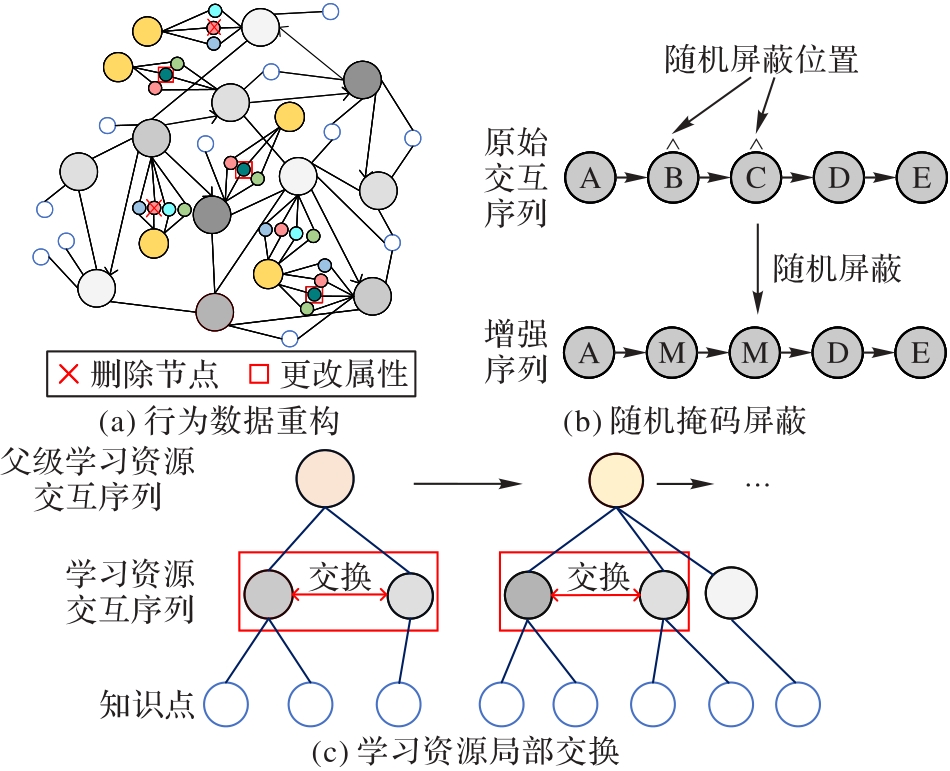
Fig. 3 Data augmentation strategies
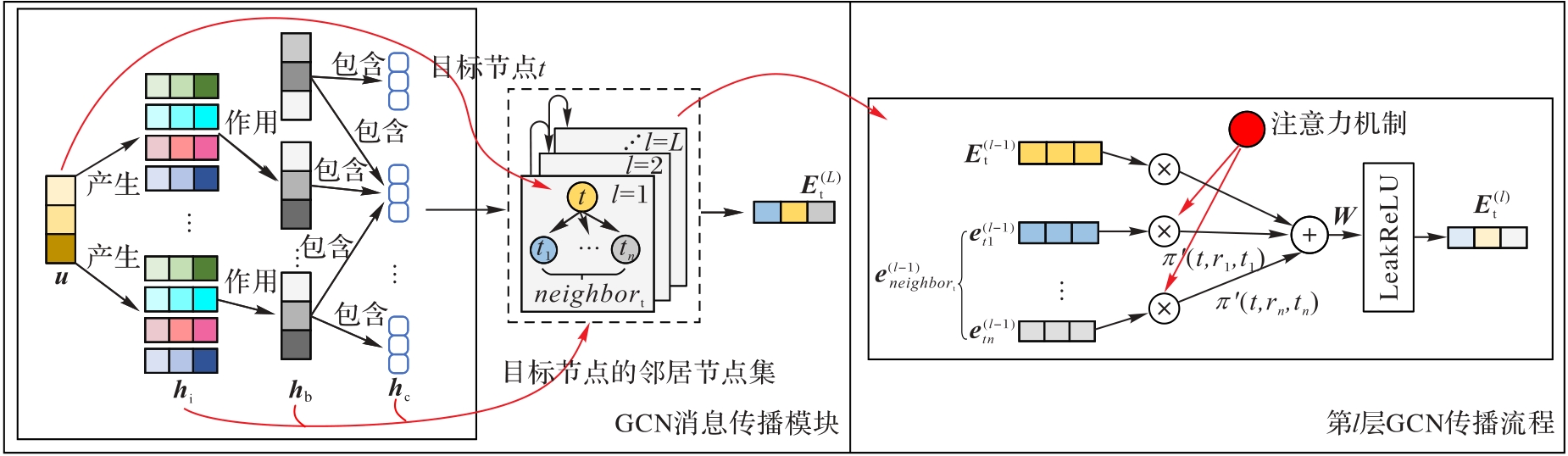
Fig. 4 GCN-based feature extraction module
| 数据集 | 课程 | 知识点数 | 学习资源数 | 交互数据数 | 用户数 | 平均路径长度 | 稀疏性 |
|---|---|---|---|---|---|---|---|
| MOOPer | JavaScript | 121 | 78 | 61 858 | 2 689 | 23.0 | 0.71 |
| Linux | 96 | 50 | 32 854 | 2 493 | 13.2 | 0.74 | |
| MOOCCubeX | DS | 1 484 | 511 | 26 961 | 2 844 | 9.5 | 0.98 |
| OS | 1 563 | 207 | 28 719 | 2 940 | 9.8 | 0.95 |
Tab. 1 Datasets used in experiments
| 数据集 | 课程 | 知识点数 | 学习资源数 | 交互数据数 | 用户数 | 平均路径长度 | 稀疏性 |
|---|---|---|---|---|---|---|---|
| MOOPer | JavaScript | 121 | 78 | 61 858 | 2 689 | 23.0 | 0.71 |
| Linux | 96 | 50 | 32 854 | 2 493 | 13.2 | 0.74 | |
| MOOCCubeX | DS | 1 484 | 511 | 26 961 | 2 844 | 9.5 | 0.98 |
| OS | 1 563 | 207 | 28 719 | 2 940 | 9.8 | 0.95 |
| 模型 | JavaScript | Linux | DS | OS | ||||||||
|---|---|---|---|---|---|---|---|---|---|---|---|---|
| Precision | Recall | F1 | Precision | Recall | F1 | Precision | Recall | F1 | Precision | Recall | F1 | |
| LPG | 0.188 2 | 0.034 3 | 0.058 0 | 0.226 3 | 0.022 3 | 0.040 6 | 0.069 7 | 0.014 9 | 0.024 6 | 0.122 3 | 0.020 4 | 0.035 0 |
| KTKDM | 0.206 3 | 0.035 8 | 0.061 0 | 0.228 8 | 0.023 4 | 0.042 5 | 0.072 3 | 0.015 8 | 0.025 9 | 0.126 6 | 0.026 4 | 0.043 7 |
| 文献[ | 0.250 3 | 0.039 1 | 0.067 6 | 0.260 6 | 0.028 5 | 0.051 4 | 0.074 3 | 0.017 7 | 0.028 6 | 0.130 4 | 0.030 9 | 0.050 0 |
| 文献[ | 0.274 4 | 0.046 1 | 0.078 9 | 0.259 2 | 0.034 5 | 0.060 9 | 0.077 6 | 0.136 3 | 0.037 8 | 0.059 2 | ||
| DCQN | 0.024 0 | 0.036 8 | ||||||||||
| LPRMMMRL | 0.307 6 | 0.049 7 | 0.085 6 | 0.276 3 | 0.036 8 | 0.064 9 | 0.082 5 | 0.026 8 | 0.040 5 | 0.144 2 | 0.039 4 | 0.061 9 |
Tab. 2 Experimental results on MOOPer and MOOCCubeX datasets
| 模型 | JavaScript | Linux | DS | OS | ||||||||
|---|---|---|---|---|---|---|---|---|---|---|---|---|
| Precision | Recall | F1 | Precision | Recall | F1 | Precision | Recall | F1 | Precision | Recall | F1 | |
| LPG | 0.188 2 | 0.034 3 | 0.058 0 | 0.226 3 | 0.022 3 | 0.040 6 | 0.069 7 | 0.014 9 | 0.024 6 | 0.122 3 | 0.020 4 | 0.035 0 |
| KTKDM | 0.206 3 | 0.035 8 | 0.061 0 | 0.228 8 | 0.023 4 | 0.042 5 | 0.072 3 | 0.015 8 | 0.025 9 | 0.126 6 | 0.026 4 | 0.043 7 |
| 文献[ | 0.250 3 | 0.039 1 | 0.067 6 | 0.260 6 | 0.028 5 | 0.051 4 | 0.074 3 | 0.017 7 | 0.028 6 | 0.130 4 | 0.030 9 | 0.050 0 |
| 文献[ | 0.274 4 | 0.046 1 | 0.078 9 | 0.259 2 | 0.034 5 | 0.060 9 | 0.077 6 | 0.136 3 | 0.037 8 | 0.059 2 | ||
| DCQN | 0.024 0 | 0.036 8 | ||||||||||
| LPRMMMRL | 0.307 6 | 0.049 7 | 0.085 6 | 0.276 3 | 0.036 8 | 0.064 9 | 0.082 5 | 0.026 8 | 0.040 5 | 0.144 2 | 0.039 4 | 0.061 9 |
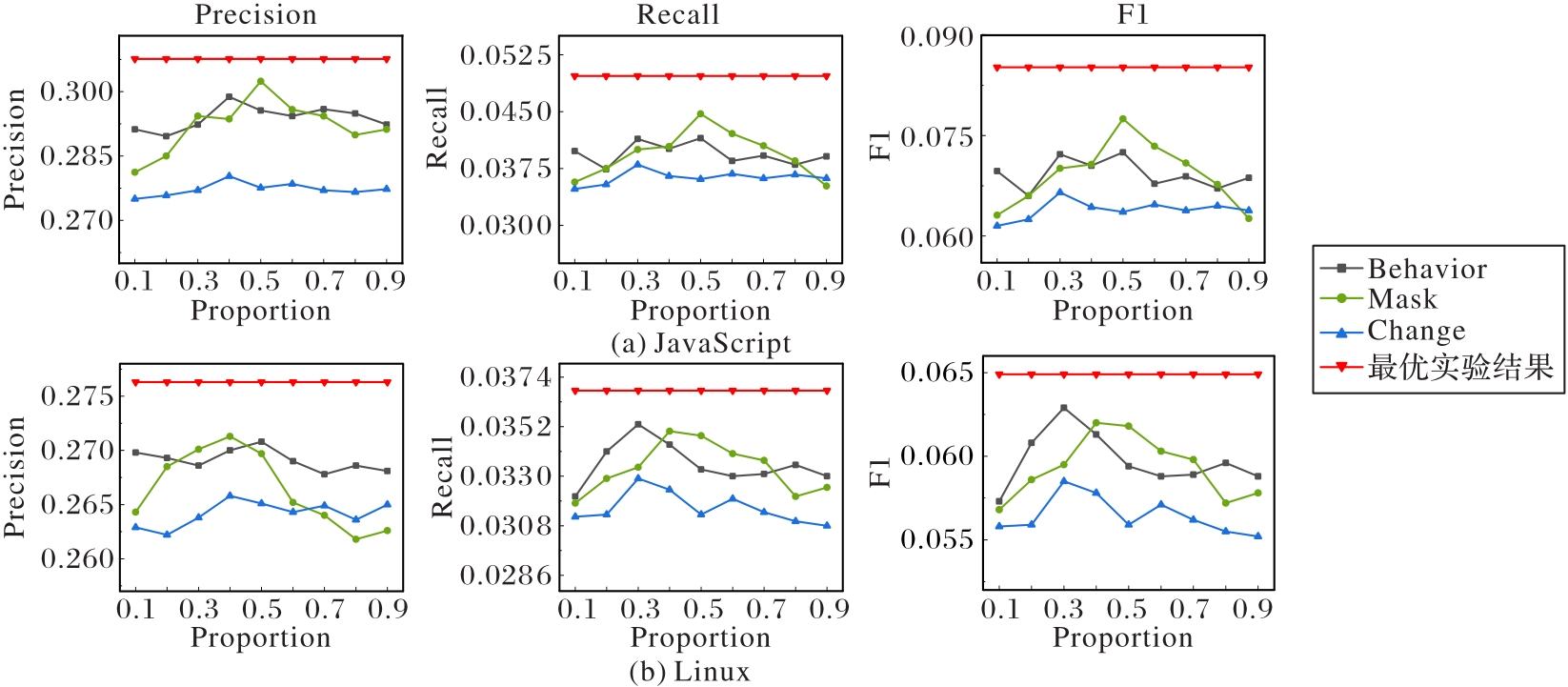
Fig. 5 Experimental results with various proportions on MOOPer dataset
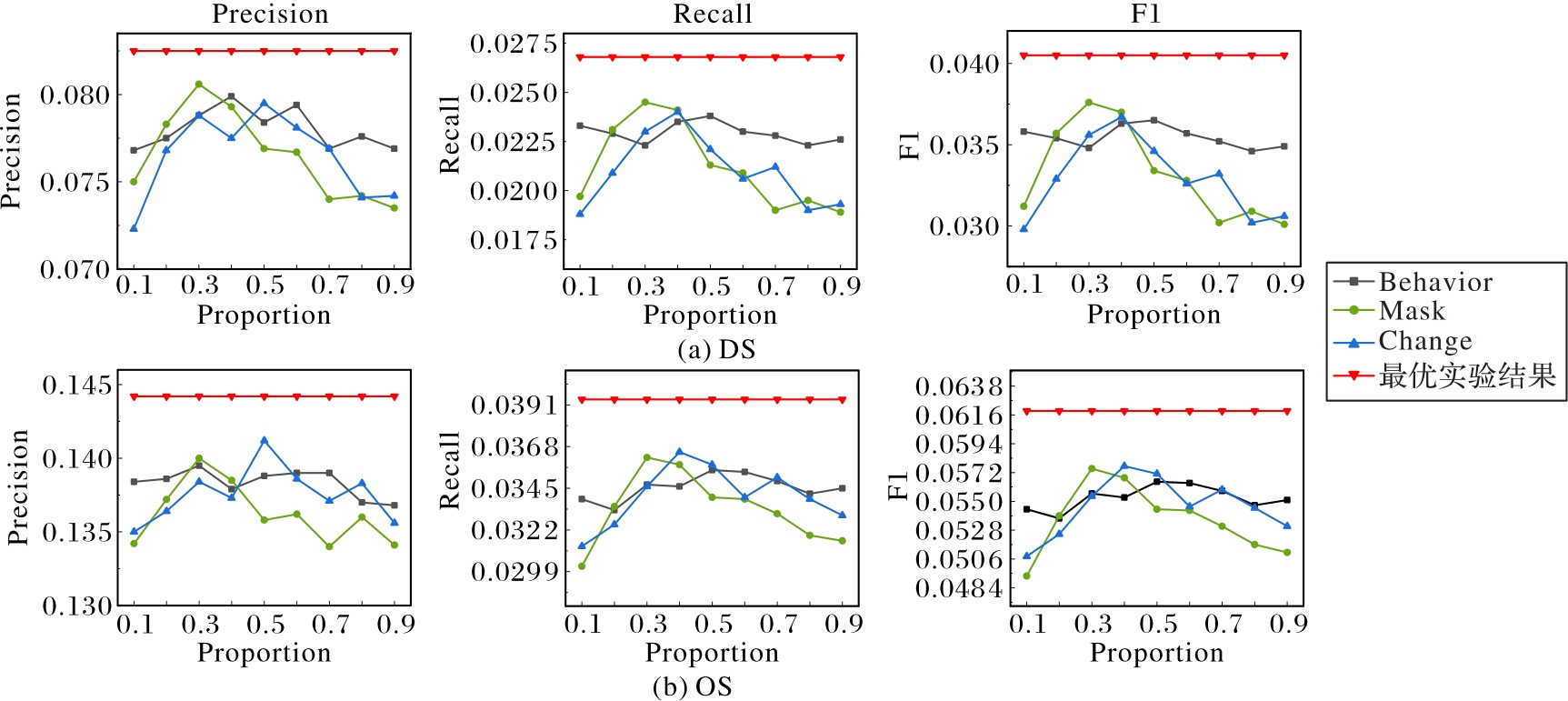
Fig. 6 Experimental results with various proportions on MOOCCubeX dataset
| L | JavaScript | Linux | DS | OS | ||||||||
|---|---|---|---|---|---|---|---|---|---|---|---|---|
| Precision | Recall | F1 | Precision | Recall | F1 | Precision | Recall | F1 | Precision | Recall | F1 | |
| 1 | 0.274 2 | 0.045 6 | 0.078 2 | 0.254 9 | 0.032 1 | 0.057 0 | 0.075 0 | 0.019 8 | 0.031 3 | 0.138 3 | 0.031 9 | 0.051 8 |
| 2 | ||||||||||||
| 3 | 0.307 6 | 0.049 7 | 0.085 6 | 0.276 3 | 0.036 8 | 0.064 9 | 0.082 5 | 0.026 8 | 0.040 5 | 0.144 2 | 0.039 4 | 0.061 9 |
| 4 | 0.284 9 | 0.046 0 | 0.079 2 | 0.260 1 | 0.032 3 | 0.057 5 | 0.077 4 | 0.022 8 | 0.035 2 | 0.140 8 | 0.035 1 | 0.056 2 |
| 5 | 0.260 1 | 0.043 3 | 0.074 2 | 0.253 0 | 0.028 4 | 0.051 1 | 0.074 3 | 0.021 0 | 0.032 7 | 0.139 2 | 0.032 3 | 0.052 4 |
Tab. 3 MOOPer and MOOCCubeX results with different layers
| L | JavaScript | Linux | DS | OS | ||||||||
|---|---|---|---|---|---|---|---|---|---|---|---|---|
| Precision | Recall | F1 | Precision | Recall | F1 | Precision | Recall | F1 | Precision | Recall | F1 | |
| 1 | 0.274 2 | 0.045 6 | 0.078 2 | 0.254 9 | 0.032 1 | 0.057 0 | 0.075 0 | 0.019 8 | 0.031 3 | 0.138 3 | 0.031 9 | 0.051 8 |
| 2 | ||||||||||||
| 3 | 0.307 6 | 0.049 7 | 0.085 6 | 0.276 3 | 0.036 8 | 0.064 9 | 0.082 5 | 0.026 8 | 0.040 5 | 0.144 2 | 0.039 4 | 0.061 9 |
| 4 | 0.284 9 | 0.046 0 | 0.079 2 | 0.260 1 | 0.032 3 | 0.057 5 | 0.077 4 | 0.022 8 | 0.035 2 | 0.140 8 | 0.035 1 | 0.056 2 |
| 5 | 0.260 1 | 0.043 3 | 0.074 2 | 0.253 0 | 0.028 4 | 0.051 1 | 0.074 3 | 0.021 0 | 0.032 7 | 0.139 2 | 0.032 3 | 0.052 4 |
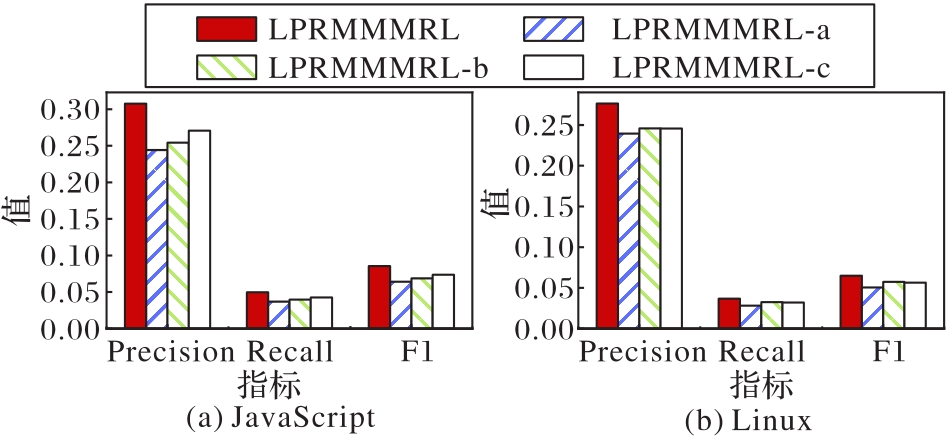
Fig. 7 Ablation study results on MOOPer dataset
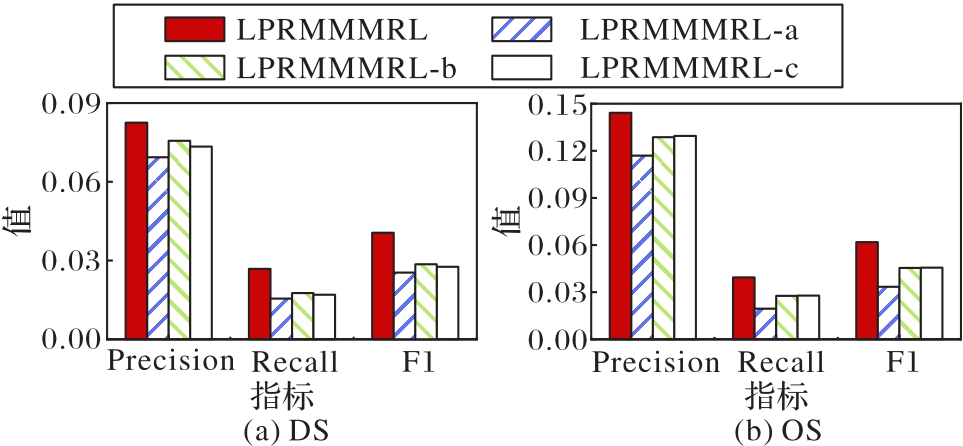
Fig. 8 Ablation study results on MOOCCubeX dataset
| [1] | Rahayu N W, Ferdiana R, Kusumawardani S S. A systematic review of learning path recommender systems[J]. Education and Information Technologies, 2023, 28(6): 7437-7460. |
| [2] | 云岳,代欢,张育培,等. 个性化学习路径推荐综述[J]. 软件学报, 2022, 33(12): 4590-4615. |
| Yun Yue, Dai Huan, Zhang Yupei, et al. State-of-the-art survey on personalized learning path recommendation[J]. Journal of Software, 2022, 33(12): 4590-4615. | |
| [3] | Wu S, Wang J, Zhang W. Contrastive personalized exercise recommendation with reinforcement learning[J]. IEEE Transactions on Learning Technologies, 2024, 17: 691-703. |
| [4] | Zheng Y, Wang D, Xu Y, et al. A multigranularity learning path recommendation framework based on knowledge graph and improved ant colony optimization algorithm for e-learning[J]. IEEE Transactions on Computational Social Systems, 2025, 12(2): 586-607. |
| [5] | Zhang F, Feng X, Wang Y. Personalized process-type learning path recommendation based on process mining and deep knowledge tracing[J]. Knowledge-Based Systems, 2024, 303: No.112431. |
| [6] | Ngo H, Vo K, Nguyen T. Personalized learning path recommendations: fusing knowledge graph embedding, sequence mining, and collaborative filtering[C]// BigData 2024. Piscataway: IEEE, 2024: 8145-8153. |
| [7] | Sageengrana S, Selvakumar S, Srinivasan S. Optimized RB-RNN: development of hybrid deep learning for analyzing student’s behaviours in online-learning using brain waves and chatbots[J]. Expert Systems with Applications, 2024, 248: No.123267. |
| [8] | Li X. Learning behavior analysis and learning effect evaluation in open online courses[J]. Creative Education, 2022, 13(4): 1337-1352. |
| [9] | Sofyan Z, Staubitz T, Meinel C. Expanding learning analytics in MOOCs to track learners’ engagement with interactive content[C]// LWMOOCS 2023. Piscataway: IEEE, 2023: 1-6. |
| [10] | Ma D, Zhu H, Liao S, et al. Learning path recommendation with multi-behavior user modeling and cascading deep Q networks[J]. Knowledge-Based Systems, 2024, 294: No.111743. |
| [11] | Wang S, Xu Y, Li Q, et al. Learning path planning algorithm based on learner behavior analysis[C]// ICBDE 2021. New York: ACM, 2021: 26-33. |
| [12] | Shou Z, Lu X, Wu Z, et al. On learning path planning algorithm based on collaborative analysis of learning behavior[J]. IEEE Access, 2020, 8: 119863-119879. |
| [13] | Afsar M M, Crump T, Far B. Reinforcement learning based recommender systems: a survey[J]. ACM Computing Surveys, 2023, 55(7): No.145. |
| [14] | Haldar S, Sengupta S, Das A K. Personalized learning path recommendation using graph reinforcement learning[J]. Procedia Computer Science, 2025, 258: 3480-3489. |
| [15] | Yun Y, Dai H, An R, et al. Doubly constrained offline reinforcement learning for learning path recommendation[J]. Knowledge-Based Systems, 2024, 284: No.111242. |
| [16] | Amin S, Uddin M I, Alarood A A, et al. Smart E-learning framework for personalized adaptive learning and sequential path recommendations using reinforcement learning[J]. IEEE Access, 2023, 11: 89769-89790. |
| [17] | Lin Y, Liu Z, Sun M, et al. Learning entity and relation embeddings for knowledge graph completion[J]. Proceedings of the AAAI Conference on Artificial Intelligence, 2015, 29(1): 2181-2187. |
| [18] | Devlin J, Chang M W, Lee K, et al. BERT: pre-training of deep bidirectional transformers for language understanding[C]// NAACL-HLT 2019, Volume 1 (Long and Short Papers). Stroudsburg: ACL, 2019: 4171-4186. |
| [19] | Wu Z. An efficient recommendation model based on Knowledge Graph ATtention-Assisted network (KGATAX)[PP/OL]. V1. arXiv (2024-09-05) [2025-05-20].. |
| [20] | Kipf T N, Welling M. Semi-supervised classification with graph convolutional networks[PP/OL]. V4. arXiv (2017-02-22) [2025-05-29].. |
| [21] | Li H, Gong R, Zhong Z, et al. Research on personalized learning path planning model based on knowledge network[J]. Neural Computing and Applications, 2023, 35(12): 8809-8821. |
| [22] | Liu K, Zhao X, Tang J, et al. MOOPer: a large-scale dataset of practice-oriented online learning[C]// CCKS 2021, CCIS 1466 . Singapore: Springer, 2021: 281-287. |
| [23] | Yu J, Wang Y, Zhong Q, et al. MOOCCubeX: a large knowledge-centered repository for adaptive learning in MOOCs[C]// CIKM 2021. New York: ACM, 2021: 4643-4652. |
| [24] | Gao J, Liu Q, Huang W B. Learning path generator based on knowledge graph[C]// IC4E 2021. New York: ACM, 2021: 27-33. |
| [25] | Cai D, Zhang Y, Dai B. Learning path recommendation based on knowledge tracing model and reinforcement learning[C]// ICCC 2019. Piscataway: IEEE, 2019: 1881-1885. |
| [26] | Chen Y-H, Huang N-F, Tzeng J-W, et al. A personalized learning path recommender system with LINE bot in MOOCs based on LSTM[C]// ICEIT 2022. Piscataway: IEEE, 2022: 40-45. |
| [27] | Zhang S, Hui N, Zhai P, et al. A fine-grained and multi-context-aware learning path recommendation model over knowledge graphs for online learning communities[J]. Information Processing and Management, 2023, 60(5): No.103464. |
| [1] | Musheng CHEN, Wenqing FU, Xiaohong QIU, Junhua WU, Qiang WEN. Aspect sentiment triplet extraction based on graph convolutional network and cross-domain data augmentation [J]. Journal of Computer Applications, 2026, 46(8): 2432-2439. |
| [2] | Huihui LYU, Zhaoman ZHONG, Yu ZHANG, Jidong FAN. Syntactically enhanced aspect-based sentiment analysis via mutual information maximization and contrastive learning [J]. Journal of Computer Applications, 2026, 46(8): 2440-2446. |
| [3] | Huijie GUO, Tianfeng DOU, Zhenlin ZHANG, Kaiyuan QI, Dong WU, Zhijian QU, Zhao LI, Chongguang REN. Time-interdependency-aware dynamic Bayesian network for traffic prediction [J]. Journal of Computer Applications, 2026, 46(5): 1507-1517. |
| [4] | Baoyuan ZHENG, Chaobo HE. Graph convolutional network enhanced by graph diffusion and dual-view feature learning [J]. Journal of Computer Applications, 2026, 46(5): 1370-1377. |
| [5] | Wenhao LI, Yinzhang GUO. Urban traffic flow prediction based on dual-layer multi-scale dynamic graph convolutional network model [J]. Journal of Computer Applications, 2026, 46(4): 1323-1333. |
| [6] | Chao SHI, Yuxin ZHOU, Qian FU, Wanyu TANG, Ling HE, Yuanyuan LI. Action recognition algorithm for ADHD patients using skeleton and 3D heatmap [J]. Journal of Computer Applications, 2025, 45(9): 3036-3044. |
| [7] | Ziliang LI, Guangli ZHU, Yulei ZHANG, Jiajia LIU, Yixuan JIAO, Shunxiang ZHANG. Aspect-based sentiment analysis model integrating syntax and sentiment knowledge [J]. Journal of Computer Applications, 2025, 45(6): 1724-1731. |
| [8] | Quan WANG, Qixiang LU, Pei SHI. Multi-graph diffusion attention network for traffic flow prediction [J]. Journal of Computer Applications, 2025, 45(5): 1472-1479. |
| [9] | Man CHEN, Xiaojun YANG, Huimin YANG. Pedestrian trajectory prediction based on graph convolutional network and endpoint induction [J]. Journal of Computer Applications, 2025, 45(5): 1480-1487. |
| [10] | Yufei LONG, Yuchen MOU, Ye LIU. Multi-source data representation learning model based on tensorized graph convolutional network and contrastive learning [J]. Journal of Computer Applications, 2025, 45(5): 1372-1378. |
| [11] | Weichao DANG, Chujun SONG, Gaimei GAO, Chunxia LIU. Multi-behavior recommendation based on cascading residual graph convolutional network [J]. Journal of Computer Applications, 2025, 45(4): 1223-1231. |
| [12] | Kun FU, Shicong YING, Tingting ZHENG, Jiajie QU, Jingyuan CUI, Jianwei LI. Graph data augmentation method for few-shot node classification [J]. Journal of Computer Applications, 2025, 45(2): 392-402. |
| [13] | Zhengyue ZHANG, Juhong PENG, Zixu DING, Xinyu FAN, Changyu HU. Aspect sentiment triplet extraction model with multi-view linguistic features and sentiment lexicon [J]. Journal of Computer Applications, 2025, 45(12): 3779-3785. |
| [14] | Yuqi ZHANG, Ying SHA. Chinese semantic error recognition model based on hierarchical information enhancement [J]. Journal of Computer Applications, 2025, 45(12): 3771-3778. |
| [15] | Mengnan XU, Hailiang YE, Feilong CAO. Neighborhood-attention and topology-aware graph convolution method for robust point cloud registration [J]. Journal of Computer Applications, 2025, 45(11): 3573-3582. |
| Viewed | ||||||
|
Full text |
|
|||||
|
Abstract |
|
|||||
