


Journal of Computer Applications ›› 2026, Vol. 46 ›› Issue (9): 2898-2909.DOI: 10.11772/j.issn.1001-9081.2025080956
• Advanced computing • Previous Articles
Guanliang CHEN1, Yi LIU1( ), Yi YU2
Received:2025-08-19
Revised:2025-11-30
Accepted:2025-12-05
Online:2026-02-12
Published:2026-09-10
Contact:
Yi LIU
About author:CHEN Guanliang, born in 1999, M. S. candidate. His research interests include edge computing.Supported by:
陈冠良1, 刘义1(), 余意2
通讯作者:
刘义
作者简介:陈冠良(1999—),男,广东广州人,硕士研究生,主要研究方向:边缘计算基金资助:CLC Number:
Guanliang CHEN, Yi LIU, Yi YU. Heterogeneous multi-agent reinforcement learning enabled co-optimization of UAV 3D obstacle avoidance and edge computing[J]. Journal of Computer Applications, 2026, 46(9): 2898-2909.
陈冠良, 刘义, 余意. 异构多智能体强化学习驱动的无人机三维避障与边缘计算协同优化[J]. 《计算机应用》唯一官方网站, 2026, 46(9): 2898-2909.
Add to citation manager EndNote|Ris|BibTeX
URL: https://www.joca.cn/EN/10.11772/j.issn.1001-9081.2025080956
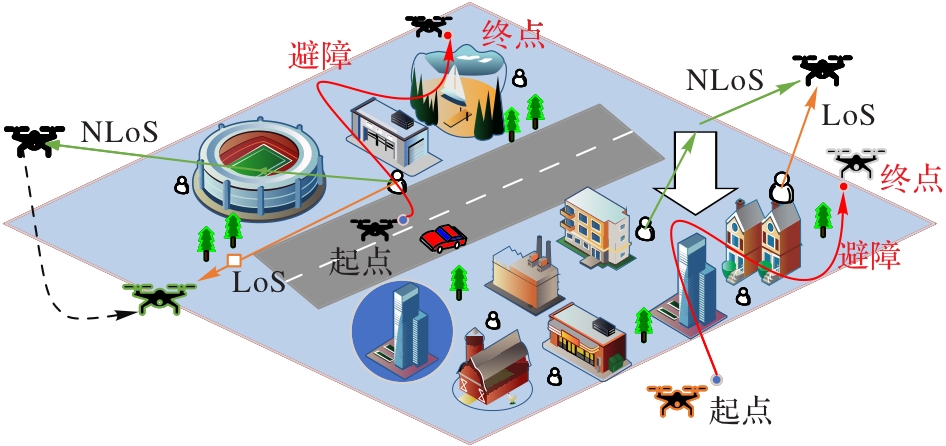
Fig. 1 Edge computing task offloading model based on multi-UAV collaborative obstacle avoidance
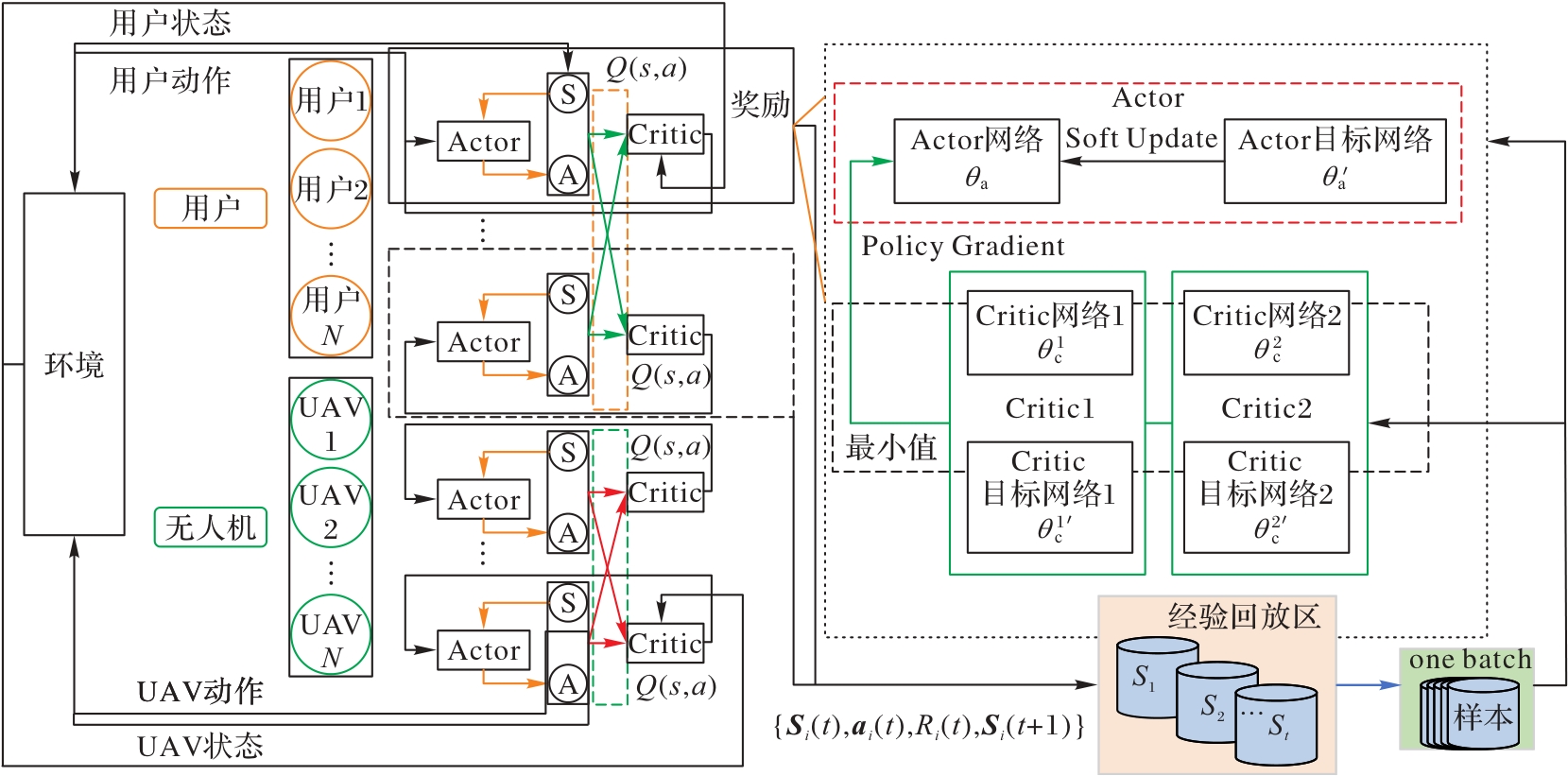
Fig. 2 Execution framework of UOUM algorithm
| 参数 | 数值 |
|---|---|
| 服务区域边界 | [-500,-500]m,[500,500]m |
| 无人机数 | 2,3,4 |
| 附加损耗 | 1.5 dB,10 dB |
| 噪声功率 | 10 dB |
| 光速c | |
| 发射功率 | |
| 带宽 | |
| 计算密度 | |
| 计算功率参数 | |
| 计算数据大小 | |
| 旋翼桨盘面积 | 0.503 |
| 空气密度 | 1.225 |
| 旋翼桨尖速度 | 62 |
| 静态不可跨越障碍安全距离阈值 | 40 m |
| 静态可跨越障碍水平安全距离阈值 | 10 m |
| UAV间安全距离阈值 | 30 m |
Tab. 1 Experimental parameters
| 参数 | 数值 |
|---|---|
| 服务区域边界 | [-500,-500]m,[500,500]m |
| 无人机数 | 2,3,4 |
| 附加损耗 | 1.5 dB,10 dB |
| 噪声功率 | 10 dB |
| 光速c | |
| 发射功率 | |
| 带宽 | |
| 计算密度 | |
| 计算功率参数 | |
| 计算数据大小 | |
| 旋翼桨盘面积 | 0.503 |
| 空气密度 | 1.225 |
| 旋翼桨尖速度 | 62 |
| 静态不可跨越障碍安全距离阈值 | 40 m |
| 静态可跨越障碍水平安全距离阈值 | 10 m |
| UAV间安全距离阈值 | 30 m |
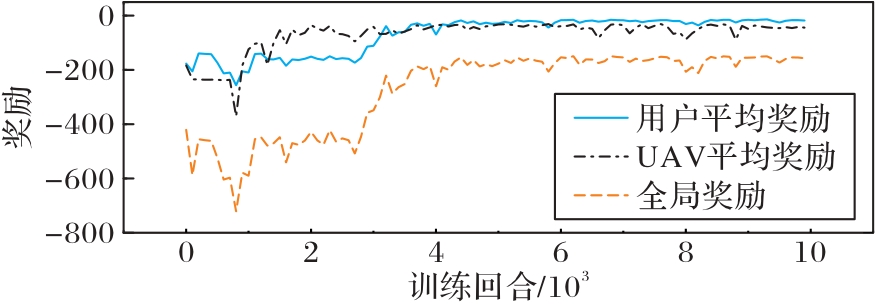
Fig. 3 Average reward of each agent
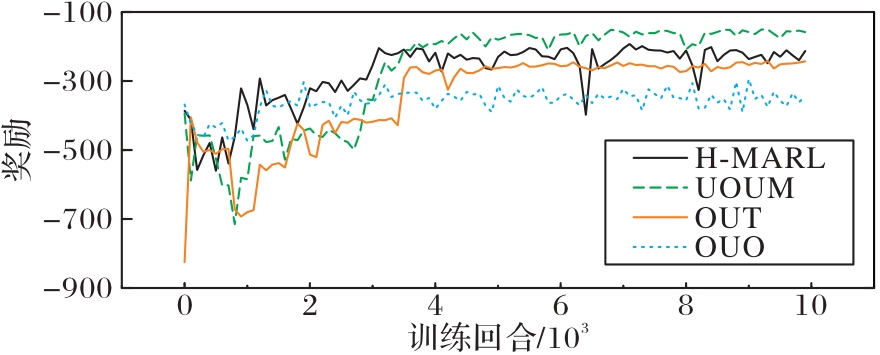
Fig. 4 Reward comparison among various algorithms
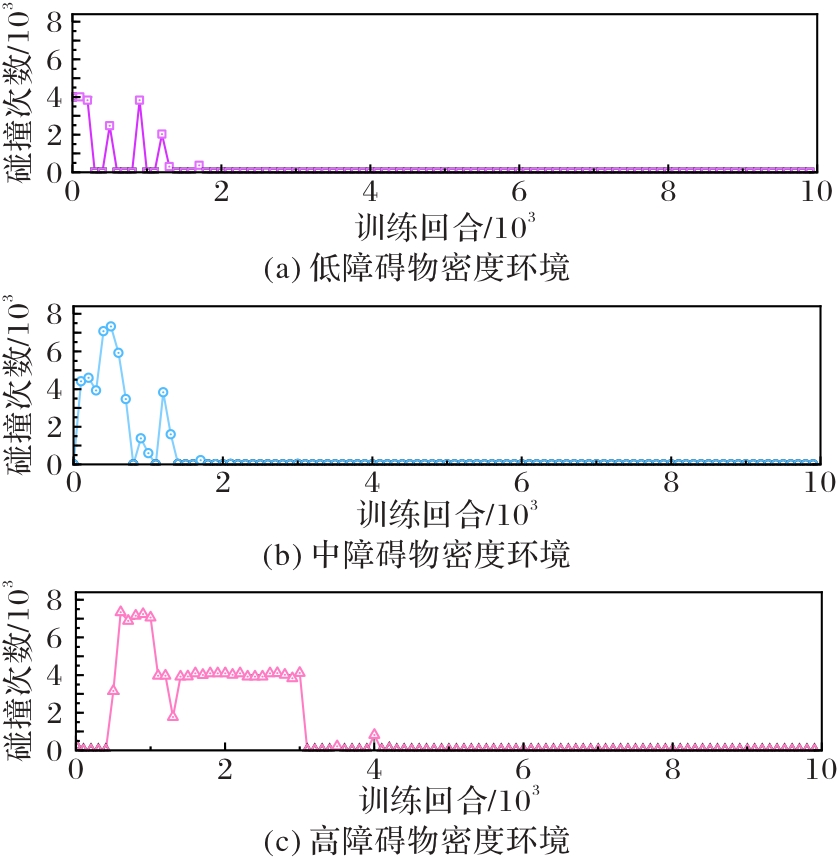
Fig. 5 UAV collision curves under different obstacle densities
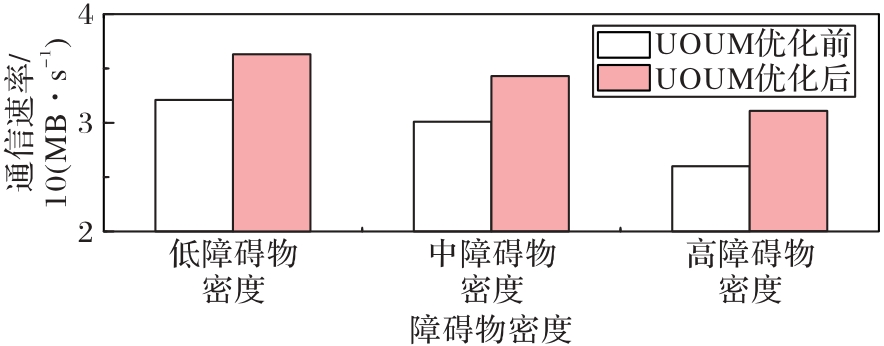
Fig. 6 Comparison of transmission rates under different obstacle densities
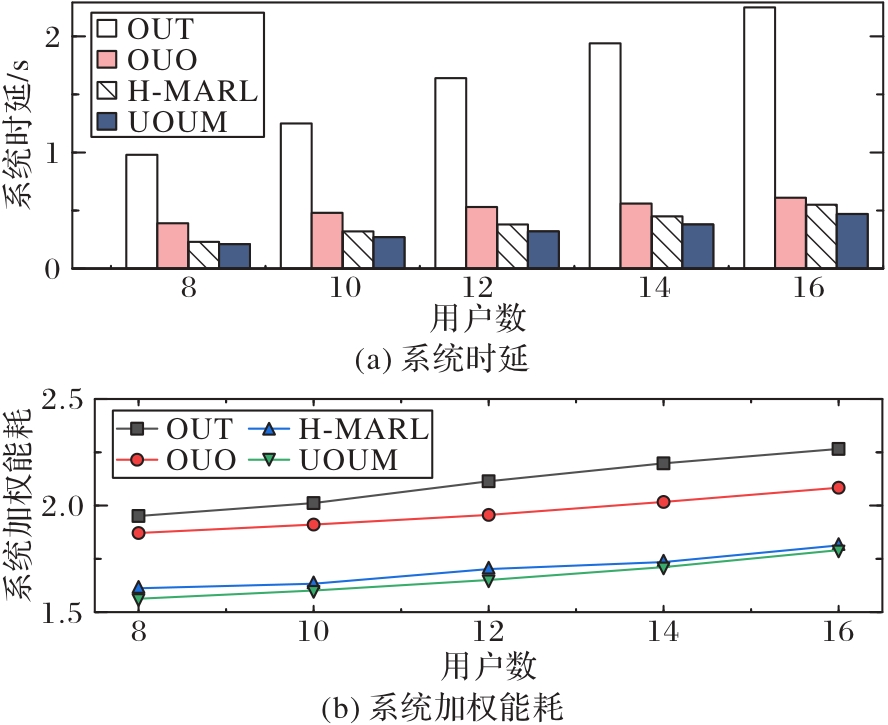
Fig. 7 Comparison of system latency and system weighted energy consumption under different user counts
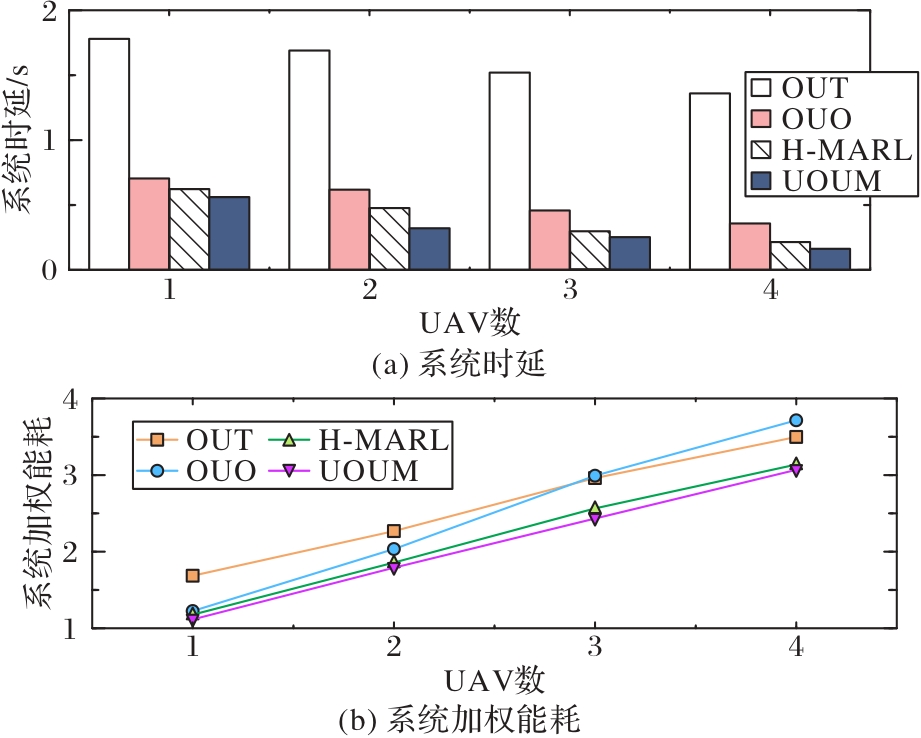
Fig. 8 Comparison of system latency and system weighted energy consumption under different UAV counts
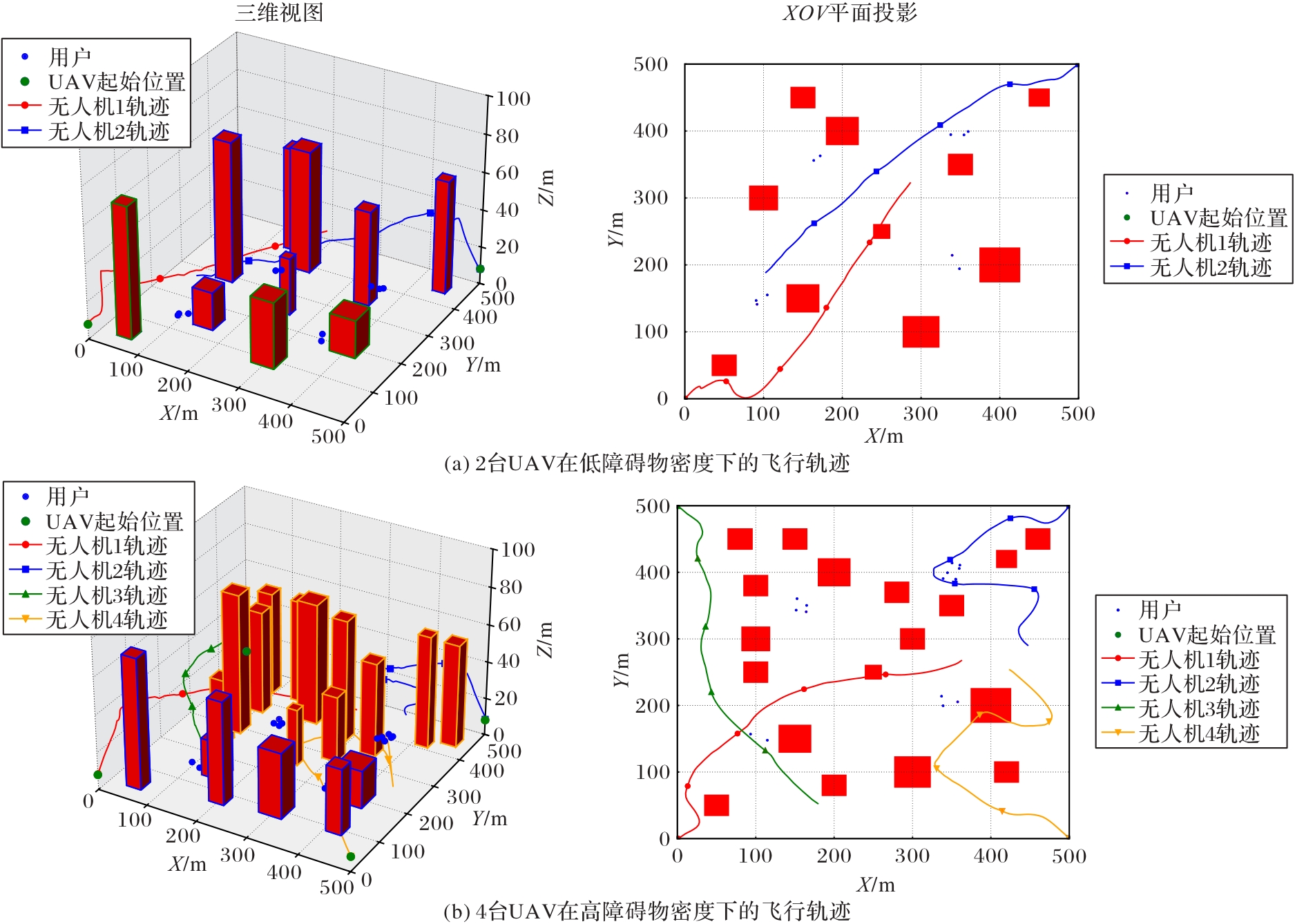
Fig. 9 Flight trajectories of different numbers of UAVs under varying obstacle densities
| [1] | Pan W, Liu Y, Yang C. Adaptive task offloading of rechargeable UAV edge computing network based on double decision value iteration [J]. Computer Communications, 2022, 193: 136-145. |
| [2] | Arthurs P, Gillam L, Krause P, et al. A taxonomy and survey of edge cloud computing for intelligent transportation systems and connected vehicles [J]. IEEE Transactions on Intelligent Transportation Systems, 2022, 23(7): 6206-6221. |
| [3] | Chen H, Wen Y, Huang Y, et al. Edge computing enabling internet of ships: a survey on architectures, emerging applications, and challenges [J]. IEEE Internet of Things Journal, 2025, 12(2): 1509-1528. |
| [4] | Duan S, Wang D, Ren J, et al. Distributed artificial intelligence empowered by end-edge-cloud computing: a survey [J]. IEEE Communications Surveys and Tutorials, 2023, 25(1): 591-624. |
| [5] | Baruffa G, Detti A, Rugini L, et al. AI-driven ground robots: mobile edge computing and mmWave communications at work [J]. IEEE Open Journal of the Communications Society, 2024, 5: 3104-3119. |
| [6] | Al-Doghman F, Moustafa N, Khalil I, et al. AI-enabled secure microservices in edge computing: opportunities and challenges [J]. IEEE Transactions on Services Computing, 2023, 16(2): 1485-1504. |
| [7] | 李校林,江雨桑. 无人机辅助移动边缘计算中的任务卸载算法[J]. 计算机应用, 2023, 43(6): 1893-1899. |
| Li Xiaolin, Jiang Yusang. Task offloading algorithm for UAV-assisted mobile edge computing [J]. Journal of Computer Applications, 2023, 43(6): 1893-1899. | |
| [8] | Zheng Y, Chen J. Geography-aware optimal UAV 3D placement for LOS relaying: a geometry approach [J]. IEEE Transactions on Wireless Communications, 2024, 23(8): 9301-9314. |
| [9] | Saoud B B, Nasraoui L. Coverage optimization for reliable UAV-assisted 5G/6G communication systems [J]. IEEE Systems Journal, 2025, 19(1): 65-74. |
| [10] | Zhao M, Zhang R, He Z, et al. Joint optimization of trajectory, offloading, caching, and migration for UAV-assisted MEC [J]. IEEE Transactions on Mobile Computing, 2025, 24(3): 1981-1998. |
| [11] | Liu D, Bao W, Zhu X, et al. Cooperative path optimization for multiple UAVs surveillance in uncertain environment [J]. IEEE Internet of Things Journal, 2022, 9(13): 10676-10692. |
| [12] | Chen J, Yang P, Ren S, et al. Enhancing AIoT device association with task offloading in aerial MEC networks [J]. IEEE Internet of Things Journal, 2024, 11(1): 174-187. |
| [13] | Wang L, Wang K, Pan C, et al. Multi-agent deep reinforcement learning-based trajectory planning for multi-UAV assisted mobile edge computing [J]. IEEE Transactions on Cognitive Communications and Networking, 2021, 7(1): 73-84. |
| [14] | 赵晓焱,韩威,张俊娜,等. 基于异步深度强化学习的车联网协作卸载策略[J]. 计算机应用, 2024, 44(5): 1501-1510. |
| Zhao Xiaoyan, Han Wei, Zhang Junna, et al. Collaborative offloading strategy in internet of vehicles based on asynchronous deep reinforcement learning [J]. Journal of Computer Applications, 2024, 44(5): 1501-1510. | |
| [15] | Chen Y, Ai B, Niu Y, et al. Energy-constrained computation offloading in space-air-ground integrated networks using distributionally robust optimization [J]. IEEE Transactions on Vehicular Technology, 2021, 70(11): 12113-12125. |
| [16] | Wang Y, Zhang C, Ge T, et al. Computation offloading via multi-agent deep reinforcement learning in aerial hierarchical edge computing systems [J]. IEEE Transactions on Network Science and Engineering, 2024, 11(6): 5253-5266. |
| [17] | Sun G, He L, Sun Z, et al. Joint task offloading and resource allocation in aerial-terrestrial UAV networks with edge and fog computing for post-disaster rescue [J]. IEEE Transactions on Mobile Computing, 2024, 23(9): 8582-8600. |
| [18] | Ye F, Hao W, Zhang J, et al. Energy-oriented offloading decision and multidimensional resource allocation for UAV-assisted edge computing systems [C]// VTC 2024 - Spring. Piscataway: IEEE, 2024: 1-6. |
| [19] | Guo H, Li J, Liu J, et al. A survey on space-air-ground-sea integrated network security in 6G [J]. IEEE Communications Surveys and Tutorials, 2022, 24(1): 53-87. |
| [20] | Ye W, Zhao L, Zhou J, et al. Energy-efficient flight scheduling and trajectory optimization in UAV-aided edge computing networks[J]. IEEE Transactions on Network Science and Engineering, 2024, 11(5): 4591-4602. |
| [21] | Han S, Liu X, Zhou M, et al. Joint association, deployment and flight trajectory optimization for multi-UAV-enabled large-scale mobile edge computing [J]. IEEE Transactions on Mobile Computing, 2024, 23(12): 13207-13221. |
| [22] | Ejaz M, Gui J, Asim M, et al. RL-planner: reinforcement learning-enabled efficient path planning in multi-UAV MEC systems [J]. IEEE Transactions on Network and Service Management, 2024, 21(3): 3317-3329. |
| [23] | Yan M, Chan C A, Gygax A F, et al. Efficient generation of optimal UAV trajectories with uncertain obstacle avoidance in MEC networks [J]. IEEE Internet of Things Journal, 2024, 11(23): 38380-38392. |
| [24] | Ouahouah S, Bagaa M, Prados-Garzon J, et al. Deep-reinforcement-learning-based collision avoidance in UAV environment [J]. IEEE Internet of Things Journal, 2022, 9(6): 4015-4030. |
| [25] | Wei Q, Zhou Z, Chen X. DRL-based energy-efficient trajectory planning, computation offloading, and charging scheduling in UAV-MEC network [C]// ICCC 2022. Piscataway: IEEE, 2022: 1056-1061. |
| [26] | Yan J, Zhao X, Li Z. Deep-reinforcement-learning-based computation offloading in UAV-assisted vehicular edge computing networks [J]. IEEE Internet of Things Journal, 2024, 11(11): 19882-19897. |
| [27] | Du J, Kong Z, Sun A, et al. MADDPG-based joint service placement and task offloading in MEC empowered air-ground integrated networks [J]. IEEE Internet of Things Journal, 2024, 11(6): 10600-10615. |
| [28] | Li X, Du X, Zhao N, et al. Computing over the sky: joint UAV trajectory and task offloading scheme based on optimization-embedding multi-agent deep reinforcement learning [J]. IEEE Transactions on Communications, 2024, 72(3): 1355-1369. |
| [29] | Qin P, Fu Y, Xie Y, et al. Multi-agent learning-based optimal task offloading and UAV trajectory planning for AGIN-power IoT[J]. IEEE Transactions on Communications, 2023, 71(7): 4005-4017. |
| [30] | Zeng Y, Xu J, Zhang R. Energy minimization for wireless communication with rotary-wing UAV [J]. IEEE Transactions on Wireless Communications, 2019, 18(4): 2329-2345. |
| [31] | 牟文心,时宏伟. 基于改进TD3算法的无人机轨迹规划[J]. 计算机系统应用, 2024, 33(12):197-209. |
| Mou Wenxin, Shi Hongwei. UAV trajectory planning based on improved TD3 algorithm [J]. Computer Systems and Applications, 2024, 33(12): 197-209. | |
| [32] | Mo W, Li J. Obstacle avoidance of multiple UAVs based on reinforcement learning [C]// ICARCV 2024. Piscataway: IEEE, 2024: 61-66. |
| [33] | Li H, Chen X, Mao K, et al. Air-to-ground path loss prediction using ray tracing and measurement data jointly driven DNN [J]. Computer Communications, 2022, 196: 268-276. |
| [34] | Wang S, Song X, Song T, et al. Fairness-aware computation offloading with trajectory optimization and phase-shift design in RIS-assisted multi-UAV MEC network [J]. IEEE Internet of Things Journal, 2024, 11(11): 20547-20561. |
| [35] | Gao A, Zhu Z, Zhang J, et al. Matching combined heterogeneous multi-agent reinforcement learning for resource allocation in NOMA-V2X networks [J]. IEEE Transactions on Vehicular Technology, 2024, 73(10): 15109-15124. |
| [1] | Juan CHEN, Yujie CHEN, Zongling WU, Di TIAN, Jie ZHONG. User-centric satellite edge computing architecture for task offloading optimization [J]. Journal of Computer Applications, 2026, 46(8): 2524-2532. |
| [2] | Tianyu XUE, Aiping LI, Liguo DUAN. Vehicular edge computing scheme with task offloading and resource optimization [J]. Journal of Computer Applications, 2025, 45(6): 1766-1775. |
| [3] | Yufei XIANG, Zhengwei NI. Edge federation dynamic analysis for hierarchical federated learning based on evolutionary game [J]. Journal of Computer Applications, 2025, 45(4): 1077-1085. |
| [4] | Lin WEI, Shihao ZHANG, Mengyang HE. Workflow task optimization and energy-efficient offloading method for computing power network [J]. Journal of Computer Applications, 2025, 45(12): 3916-3924. |
| [5] | Jian SUN, Wei ZHANG, Baoquan MA, Zhuiwei WU, Xiaohuan YANG, Tao WU. MATOS: UAV swarm assisted moving-aware adaptive-parallel computing task offloading system [J]. Journal of Computer Applications, 2025, 45(10): 3259-3269. |
| [6] | Junna ZHANG, Xinxin WANG, Tianze LI, Xiaoyan ZHAO, Peiyan YUAN. Task offloading method based on dynamic service cache assistance [J]. Journal of Computer Applications, 2024, 44(5): 1493-1500. |
| [7] | Xiaoyan ZHAO, Wei HAN, Junna ZHANG, Peiyan YUAN. Collaborative offloading strategy in internet of vehicles based on asynchronous deep reinforcement learning [J]. Journal of Computer Applications, 2024, 44(5): 1501-1510. |
| [8] | Xiaolin LI, Yusang JIANG. Task offloading algorithm for UAV-assisted mobile edge computing [J]. Journal of Computer Applications, 2023, 43(6): 1893-1899. |
| [9] | Xiaohui HUANG, Kaiming YANG, Jiahao LING. Order dispatching by multi-agent reinforcement learning based on shared attention [J]. Journal of Computer Applications, 2023, 43(5): 1620-1624. |
| [10] | Yanpei LIU, Ningning CHEN, Yunjing ZHU, Liping WANG. Review of mobile edge caching optimization technologies for 5G/Beyond 5G [J]. Journal of Computer Applications, 2022, 42(8): 2487-2500. |
| [11] | Jieqin WANG, Shihyang LIN, Shiming PENG, Shuo JIA, Miaohui YANG. Hierarchical resource allocation mechanism of cooperative mobile edge computing [J]. Journal of Computer Applications, 2022, 42(8): 2501-2510. |
| [12] | Shiquan DENG, Xuguo YE. Multi-objective task offloading algorithm based on deep Q-network [J]. Journal of Computer Applications, 2022, 42(6): 1668-1674. |
| [13] | Jingling YUAN, Huihua MAO, Nana WANG, Yao XIANG. Dynamic service deployment strategy in resource constrained mobile edge computing [J]. Journal of Computer Applications, 2022, 42(6): 1662-1667. |
| [14] | Yu LI, Xiping HE, Lianggui TANG. Multi-user computation offloading and resource optimization policy based on device-to-device communication [J]. Journal of Computer Applications, 2022, 42(5): 1538-1546. |
| [15] | Xuling ZENG, Taoshen LI, Jian GONG, Lijun DU. Secure offloading optimization of wireless powered mobile edge computing system [J]. Journal of Computer Applications, 2022, 42(4): 1216-1224. |
| Viewed | ||||||
|
Full text |
|
|||||
|
Abstract |
|
|||||
