


Journal of Computer Applications ›› 2026, Vol. 46 ›› Issue (1): 1-9.DOI: 10.11772/j.issn.1001-9081.2025010110
• Artificial intelligence • Next Articles
Wen LI, Kairong LI( ), Kai YANG
Received:2025-02-07
Revised:2025-04-01
Accepted:2025-04-02
Online:2026-01-10
Published:2026-01-10
Contact:
Kairong LI
About author:LI Wen, born in 1999, M. S. candidate. Her research interests include graph neural network, machine learning.Supported by:
李玟, 李开荣(), 杨凯
通讯作者:
李开荣
作者简介:李玟(1999—),女,福建福鼎人,硕士研究生,主要研究方向:图神经网络、机器学习基金资助:CLC Number:
Wen LI, Kairong LI, Kai YANG. Subgraph-aware contrastive learning with data augmentation[J]. Journal of Computer Applications, 2026, 46(1): 1-9.
李玟, 李开荣, 杨凯. 基于数据增强的子图感知对比学习[J]. 《计算机应用》唯一官方网站, 2026, 46(1): 1-9.
Add to citation manager EndNote|Ris|BibTeX
URL: https://www.joca.cn/EN/10.11772/j.issn.1001-9081.2025010110
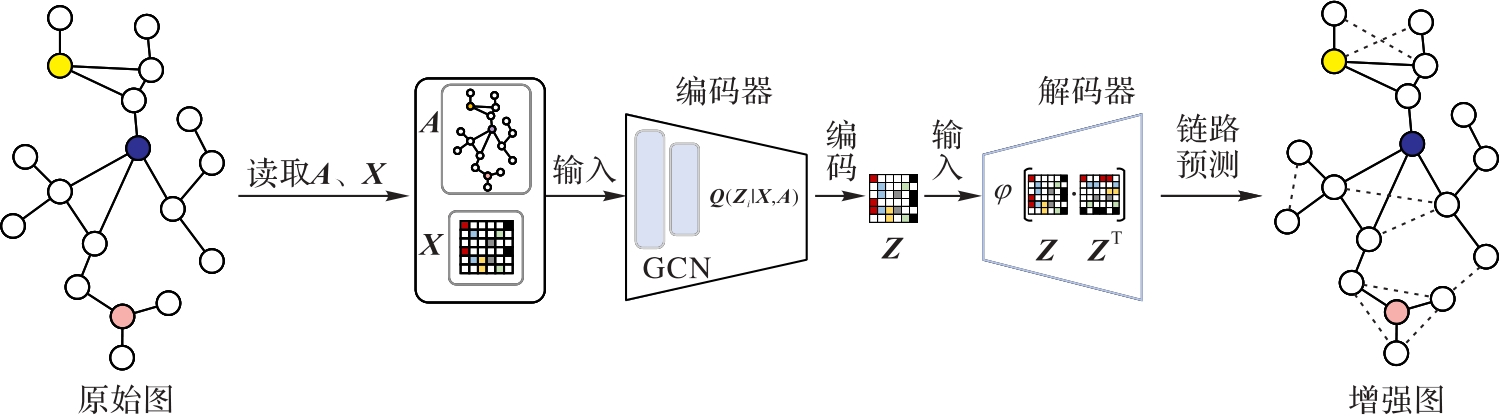
Fig. 1 Obtaining enhanced graphs using graph structure augmentation method

Fig. 2 Node-level subgraph contrastive learning framework
| 数据集 | 节点数 | 边数 | 特征数 | 标签数 |
|---|---|---|---|---|
| Cora | 2 708 | 5 429 | 1 433 | 7 |
| Citeseer | 3 327 | 4 732 | 3 703 | 6 |
| Pubmed | 19 717 | 44 338 | 500 | 3 |
| Cora_ML | 2 995 | 16 316 | 2 879 | 7 |
| DBLP | 17 716 | 105 734 | 1 639 | 4 |
| Photo | 19 717 | 44 338 | 500 | 3 |
Tab. 1 Statistical characteristics of six datasets
| 数据集 | 节点数 | 边数 | 特征数 | 标签数 |
|---|---|---|---|---|
| Cora | 2 708 | 5 429 | 1 433 | 7 |
| Citeseer | 3 327 | 4 732 | 3 703 | 6 |
| Pubmed | 19 717 | 44 338 | 500 | 3 |
| Cora_ML | 2 995 | 16 316 | 2 879 | 7 |
| DBLP | 17 716 | 105 734 | 1 639 | 4 |
| Photo | 19 717 | 44 338 | 500 | 3 |
| 算法 | 可用数据 | Cora | Citeseer | Pubmed | Cora_ML | DBLP | Photo |
|---|---|---|---|---|---|---|---|
| GCN[ | X, A, Y | 81.7 | 69.2 | 76.6 | 81.7 | 73.9 | 84.6 |
| GAT[ | X, A, Y | 82.6 | 69.6 | 77.6 | 82.1 | 74.2 | 85.8 |
| DGI[ | X, A | 83.0 | 72.0 | 77.5 | 82.5 | 78.1 | 77.8 |
| GMI[ | X, A | 80.9 | 68.1 | 77.2 | 82.1 | 76.8 | 76.7 |
| GGD[ | X, A | 83.4 | 70.4 | 79.3 | 81.8 | 80.2 | 75.6 |
| SUBG-CON[ | X, A | 82.8 | 72.7 | 79.8 | 83.5 | 80.8 | 89.7 |
| ASP[ | X, A | 81.8 | 71.4 | 79.8 | 82.7 | 81.2 | 91.1 |
| GRAPE[ | X, A | 84.9 | 73.1 | 79.9 | 86.8 | 82.6 | 92.1 |
| SCLDA | X, A | 85.3 | 73.6 | 80.1 | 87.5 | 83.7 | 92.5 |
Tab. 2 Comparison of node classification accuracy on six real world datasets
| 算法 | 可用数据 | Cora | Citeseer | Pubmed | Cora_ML | DBLP | Photo |
|---|---|---|---|---|---|---|---|
| GCN[ | X, A, Y | 81.7 | 69.2 | 76.6 | 81.7 | 73.9 | 84.6 |
| GAT[ | X, A, Y | 82.6 | 69.6 | 77.6 | 82.1 | 74.2 | 85.8 |
| DGI[ | X, A | 83.0 | 72.0 | 77.5 | 82.5 | 78.1 | 77.8 |
| GMI[ | X, A | 80.9 | 68.1 | 77.2 | 82.1 | 76.8 | 76.7 |
| GGD[ | X, A | 83.4 | 70.4 | 79.3 | 81.8 | 80.2 | 75.6 |
| SUBG-CON[ | X, A | 82.8 | 72.7 | 79.8 | 83.5 | 80.8 | 89.7 |
| ASP[ | X, A | 81.8 | 71.4 | 79.8 | 82.7 | 81.2 | 91.1 |
| GRAPE[ | X, A | 84.9 | 73.1 | 79.9 | 86.8 | 82.6 | 92.1 |
| SCLDA | X, A | 85.3 | 73.6 | 80.1 | 87.5 | 83.7 | 92.5 |
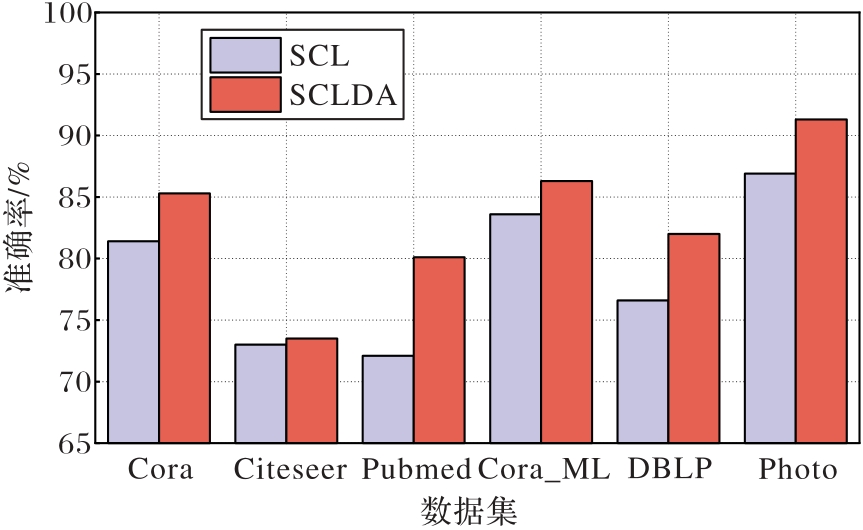
Fig. 3 Node classification accuracy after deleting enhanced graph component
| 编码器 | Cora | Citeseer | Pubmed | Cora_ML | DBLP | Photo |
|---|---|---|---|---|---|---|
| GAT[ | 81.0 | 72.8 | 73.9 | 82.2 | 81.2 | 92.2 |
| GraphSage[ | 81.4 | 71.7 | 80.3 | 85.1 | 81.5 | 85.0 |
| SGC[ | 82.2 | 73.4 | 72.1 | 85.6 | 82.8 | 93.1 |
| GIN[ | 80.8 | 70.3 | 68.1 | 84.3 | 81.7 | 90.2 |
| GCN[ | 85.3 | 73.6 | 80.1 | 87.5 | 83.7 | 92.5 |
Tab. 3 Comparison of node classification accuracy using different encoders
| 编码器 | Cora | Citeseer | Pubmed | Cora_ML | DBLP | Photo |
|---|---|---|---|---|---|---|
| GAT[ | 81.0 | 72.8 | 73.9 | 82.2 | 81.2 | 92.2 |
| GraphSage[ | 81.4 | 71.7 | 80.3 | 85.1 | 81.5 | 85.0 |
| SGC[ | 82.2 | 73.4 | 72.1 | 85.6 | 82.8 | 93.1 |
| GIN[ | 80.8 | 70.3 | 68.1 | 84.3 | 81.7 | 90.2 |
| GCN[ | 85.3 | 73.6 | 80.1 | 87.5 | 83.7 | 92.5 |
| 方法 | Cora | Citeseer | Pubmed | Cora_ML | DBLP | Photo |
|---|---|---|---|---|---|---|
| N-Hop | 80.7 | 71.3 | 78.8 | 83.2 | 78.7 | 89.0 |
| N-RW | 81.9 | 71.2 | 78.3 | 84.0 | 79.9 | 88.7 |
| N-PPR | 85.3 | 73.6 | 80.1 | 87.5 | 83.7 | 92.5 |
Tab. 4 Comparison of node classification accuracy using three subgraph extraction methods
| 方法 | Cora | Citeseer | Pubmed | Cora_ML | DBLP | Photo |
|---|---|---|---|---|---|---|
| N-Hop | 80.7 | 71.3 | 78.8 | 83.2 | 78.7 | 89.0 |
| N-RW | 81.9 | 71.2 | 78.3 | 84.0 | 79.9 | 88.7 |
| N-PPR | 85.3 | 73.6 | 80.1 | 87.5 | 83.7 | 92.5 |

Fig. 4 Node classification accuracies of different ratios of added edges

Fig. 5 Node classification accuracy of different subgraph sizes
| [1] | MIN S, GAO Z, PENG J, et al. STGSN — a spatial-temporal graph neural network framework for time-evolving social networks [J]. Knowledge-Based Systems, 2021, 214: No.106746. |
| [2] | DONG H, WANG P, XIAO M, et al. Temporal inductive path neural network for temporal knowledge graph reasoning [J]. Artificial Intelligence, 2024, 329: No.104085. |
| [3] | ZHANG C, SONG D, HUANG C, et al. Heterogeneous graph neural network [C]// Proceedings of the 25th ACM SIGKDD International Conference on Knowledge Discovery and Data Mining. New York: ACM, 2019: 793-803. |
| [4] | WU Z, PAN S, CHEN F, et al. A comprehensive survey on graph neural networks [J]. IEEE Transactions on Neural Networks and Learning Systems, 2021, 32(1): 4-24. |
| [5] | ASIF N A, SARKER Y, CHAKRABORTTY R K, et al. Graph neural network: a comprehensive review on non-Euclidean space [J]. IEEE Access, 2021, 9: 60588-60606. |
| [6] | FAN W, MA Y, LI Q, et al. Graph neural networks for social recommendation [C]// Proceedings of the 2019 World Wide Web Conference. New York: ACM, 2019: 417-426. |
| [7] | 刘渊,赵紫娟,杨凯.基于节点相似性的图注意力网络表示学习模型[J].计算机应用研究, 2023, 40(3): 822-827. |
| LIU Y, ZHAO Z J, YANG K. Graph attention network representation learning with node similarity [J]. Application Research of Computers, 2023, 40(3): 822-827. | |
| [8] | KIPF T N, WELLING M. Semi-supervised classification with graph convolutional networks [EB/OL]. [2024-12-20]. . |
| [9] | VELIČKOVIĆ P, CUCURULL G, CASANOVA A, et al. Graph attention networks [EB/OL]. [2024-12-20]. . |
| [10] | WANG R, MOU S, WANG X, et al. Graph structure estimation neural networks [C]// Proceedings of the Web Conference 2021. New York: ACM, 2021: 342-353. |
| [11] | ZHAO T, LIU Y, NEVES L, et al. Data augmentation for graph neural networks [C]// Proceedings of the 35th AAAI Conference on Artificial Intelligence. Palo Alto: AAAI Press, 2021: 11015-11023. |
| [12] | LI B, HOU Y, CHE W. Data augmentation approaches in natural language processing: a survey [J]. AI Open, 2022, 3: 71-90. |
| [13] | SHORTEN C, KHOSHGOFTAAR T M. A survey on image data augmentation for deep learning [J]. Journal of Big Data, 2019, 6: No.60. |
| [14] | YOU Y, CHEN T, SHEN Y, et al. Graph contrastive learning automated [C]// Proceedings of the 38th International Conference on Machine Learning. New York: JMLR.org, 2021: 12121-12132. |
| [15] | YOU Y, CHEN T, SUI Y, et al. Graph contrastive learning with augmentations [C]// Proceedings of the 34th International Conference on Neural Information Processing Systems. Red Hook: Curran Associates Inc., 2020: 5812-5823. |
| [16] | ZHU Y, XU Y, YU F, et al. Graph contrastive learning with adaptive augmentation [C]// Proceedings of the Web Conference 2021. New York: ACM, 2021: 2069-2080. |
| [17] | HUANG J, CAO Q, XIE R, et al. Adversarial learning data augmentation for graph contrastive learning in recommendation [C]// Proceedings of the 2023 International Conference on Database Systems for Advanced Applications, LNCS 13944. Cham: Springer, 2023: 373-388. |
| [18] | GILMER J, SCHOENHOLZ S S, RILEY P F, et al. Neural message passing for quantum chemistry [C]// Proceedings of the 34th International Conference on Machine Learning. New York: JMLR.org, 2017: 1263-1272. |
| [19] | DUAN H, XIE C, LI B, et al. Self-supervised contrastive graph representation with node and graph augmentation [J]. Neural Networks, 2023, 167: 223-232. |
| [20] | QIU J, CHEN Q, DONG Y, et al. GCC: graph contrastive coding for graph neural network pre-training [C]// Proceedings of the 26th ACM SIGKDD International Conference on Knowledge Discovery and Data Mining. New York: ACM, 2020: 1150-1160. |
| [21] | JIAO Y, XIONG Y, ZHANG J, et al. Sub-graph contrast for scalable self-supervised graph representation learning [C]// Proceedings of the 2020 IEEE International Conference on Data Mining. Piscataway: IEEE, 2020: 222-231. |
| [22] | ZHENG C, ZONG B, CHENG W, et al. Robust graph representation learning via neural sparsification [C]// Proceedings of the 37th International Conference on Machine Learning. New York: JMLR.org, 2020: 11458-11468. |
| [23] | DUAN J, WANG S, ZHANG P, et al. Graph anomaly detection via multi-scale contrastive learning networks with augmented view [C]// Proceedings of the 37th AAAI Conference on Artificial Intelligence. Palo Alto: AAAI Press, 2023: 7459-7467. |
| [24] | TAO C, WANG H, ZHU X, et al. Exploring the equivalence of Siamese self-supervised learning via a unified gradient framework [C]// Proceedings of the 2022 IEEE/CVF Conference on Computer Vision and Pattern Recognition. Piscataway: IEEE, 2022: 14411-14420. |
| [25] | YANG K, LIU Y, ZHAO Z, et al. Local structure-aware graph contrastive representation learning [J]. Neural Networks, 2024, 172: No.106083. |
| [26] | XIAO S, WANG S, DAI Y, et al. Graph neural networks in node classification: survey and evaluation [J]. Machine Vision and Applications, 2022, 33(1): No.4. |
| [27] | ROSSI A, BARBOSA D, FIRMANI D, et al. Knowledge graph embedding for link prediction: a comparative analysis [J]. ACM Transactions on Knowledge Discovery from Data, 2021, 15(2): No.14. |
| [28] | LUO L, HAFFARI G, PAN S. Graph Sequential Neural ODE Process for link prediction on dynamic and sparse graphs [C]// Proceedings of the 16th ACM International Conference on Web Search and Data Mining. New York: ACM, 2023: 778-786. |
| [29] | TAN Y, LIU Y, LONG G, et al. Federated learning on non-IID graphs via structural knowledge sharing [C]// Proceedings of the 37th AAAI Conference on Artificial Intelligence. Palo Alto: AAAI Press, 2023: 9953-9961. |
| [30] | CHEN J, XIONG H, ZHENG H, et al. EGC2: enhanced graph classification with easy graph compression [J]. Information Sciences, 2023, 629: 376-397. |
| [31] | JIN W, DERR T, LIU H, et al. Self-supervised learning on graphs: deep insights and new direction [EB/OL]. [2024-12-20]. . |
| [32] | XIAO T, ZHU H, CHEN Z, et al. Simple and asymmetric graph contrastive learning without augmentations [C]// Proceedings of the 37th International Conference on Neural Information Processing Systems. Red Hook: Curran Associates Inc., 2023: 16129-16152. |
| [33] | WAN G, TIAN Y, HUANG W, et al. S3GCL: spectral, swift, spatial graph contrastive learning [C]// Proceedings of the 41st International Conference on Machine Learning. New York: JMLR.org, 2024: 49973-49990. |
| [34] | KIPF T N, WELLING M. Variational graph auto-encoders [EB/OL]. [2024-12-20]. . |
| [35] | PARK H, LEE S, KIM S, et al. Metropolis-Hastings data augmentation for graph neural networks [C]// Proceedings of the 35th International Conference on Neural Information Processing Systems. Red Hook: Curran Associates Inc., 2021: 19010-19020. |
| [36] | SURESH S, LI P, HAO C, et al. Adversarial graph augmentation to improve graph contrastive learning [C]// Proceedings of the 35th International Conference on Neural Information Processing Systems. Red Hook: Curran Associates Inc., 2021: 15920-15933. |
| [37] | BERTON L, VALVERDE-REBAZA J, DE ANDRADE LOPES A. Link prediction in graph construction for supervised and semi-supervised learning [C]// Proceedings of the 2015 International Joint Conference on Neural Networks. Piscataway: IEEE, 2015: 1-8. |
| [38] | BO D, HU B, WANG X, et al. Regularizing graph neural networks via consistency-diversity graph augmentations [C]// Proceedings of the 36th AAAI Conference on Artificial Intelligence. Palo Alto: AAAI Press, 2022: 3913-3921. |
| [39] | FENG S, JING B, ZHU Y, et al. ArieL: adversarial graph contrastive learning [J]. ACM Transactions on Knowledge Discovery from Data, 2024, 18(4): No.82. |
| [40] | 刘渊,杨凯,苏嘉良,等.基于图注意力网络的在线社交网络链路预测[J].扬州大学学报(自然科学版), 2024, 27(2): 21-25. |
| LIU Y, YANG K, SU J L, et al. Link prediction for online social networks via graph attention network [J]. Journal of Yangzhou University (Natural Science Edition), 2024, 27(2): 21-25. | |
| [41] | WU S, SUN F, ZHANG W, et al. Graph neural networks in recommender systems: a survey [J]. ACM Computing Surveys, 2023, 55(5): No.97. |
| [42] | VELIČKOVIĆ P, FEDUS W, HAMILTON W L, et al. Deep Graph Infomax [EB/OL]. [2024-12-20]. . |
| [43] | PENG Z, HUANG W, LUO M, et al. Graph representation learning via graphical mutual information maximization [C]// Proceedings of the Web Conference 2020. New York: ACM, 2020: 259-270. |
| [44] | CHEN J, KOU G. Attribute and structure preserving graph contrastive learning [C]// Proceedings of the 37th AAAI Conference on Artificial Intelligence. Palo Alto: AAAI Press, 2023: 7024-7032. |
| [45] | JU W, GU Y, MAO Z, et al. GPS: graph contrastive learning via multi-scale augmented views from adversarial pooling [J]. SCIENCE CHINA Information Sciences, 2025, 68(1): No.112101. |
| [46] | GHAYEKHLOO M, NICKABADI A. Supervised contrastive learning for graph representation enhancement [J]. Neurocomputing, 2024, 588: No.127710. |
| [47] | SHAO P, TAO J. Multi-level graph contrastive learning [J]. Neurocomputing, 2024, 570: No.127101. |
| [48] | WANG H, WEI Z, GAN J, et al. Personalized PageRank to a target node, revisited [C]// Proceedings of the 26th ACM SIGKDD International Conference on Knowledge Discovery and Data Mining. New York: ACM, 2020: 657-667. |
| [49] | ZHENG Y, PAN S, LEE V C S, et al. Rethinking and scaling up graph contrastive learning: an extremely efficient approach with group discrimination [C]// Proceedings of the 36th International Conference on Neural Information Processing Systems. Red Hook: Curran Associates Inc., 2022: 10809-10820. |
| [50] | HAO Z, XIN H, WEI L, et al. Towards expansive and adaptive hard negative mining: graph contrastive learning via subspace preserving [C]// Proceedings of the ACM Web Conference 2024. New York: ACM, 2024: 322-333. |
| [51] | HAMILTON W L, YING Z, LESKOVEC J. Inductive representation learning on large graphs [C]// Proceedings of the 31st International Conference on Neural Information Processing Systems. Red Hook: Curran Associates Inc., 2017: 1025-1035. |
| [52] | WU F, ZHANG T, DE SOUZA A H, et al. Simplifying graph convolutional networks [C]// Proceedings of the 36th International Conference on Machine Learning. New York: JMLR.org, 2019: 6861-6871. |
| [53] | XU K, HU W, LESKOVEC J, et al. How powerful are graph neural networks? [EB/OL]. [2024-12-20]. . |
| [54] | 吴宗航,张东,李冠宇.基于联合自监督学习的多模态融合推荐算法[J].计算机应用, 2025, 45(6): 1858-1868. |
| WU Z H, ZHANG D, LI G Y. Multimodal fusion recommendation algorithm based on joint self-supervised learning [J]. Journal of Computer Applications, 2025, 45(6): 1858-1868. | |
| [55] | ZHAO W, YANG K, DING P, et al. Graph attention contrastive learning with missing modality for multimodal recommendation [J]. Knowledge-Based Systems, 2025, 311: No.113035. |
| [1] | Shiwei LI, Yufeng ZHOU, Pengfei SUN, Weisong LIU, Zhuxuan MENG, Haojie LIAN. Point cloud data augmentation method based on scattering and absorption effects of coal dust on LiDAR electromagnetic waves [J]. Journal of Computer Applications, 2026, 46(1): 331-340. |
| [2] | Fan HE, Li LI, Zhongxu YUAN, Xiu YANG, Dongxuan HAN. Knowledge tracking model based on concept association memory network with graph attention [J]. Journal of Computer Applications, 2026, 46(1): 43-51. |
| [3] | Zhihui ZAN, Yajing WANG, Ke LI, Zhixiang YANG, Guangyu YANG. Multi-feature fusion speech emotion recognition method based on SAA-CNN-BiLSTM network [J]. Journal of Computer Applications, 2026, 46(1): 69-76. |
| [4] | Yinlong JIAN, Xuebin CHEN, Zhongrui JING, Qi ZHONG, Zhenbo ZHANG. Data augmentation scheme based on conditional generative adversarial network in federated learning [J]. Journal of Computer Applications, 2026, 46(1): 21-32. |
| [5] | Chuang WANG, Lu YU, Jianwei CHEN, Cheng PAN, Wenbo DU. Review of open set domain adaptation [J]. Journal of Computer Applications, 2025, 45(9): 2727-2736. |
| [6] | Yiming LIANG, Jing FAN, Wenze CHAI. Multi-scale feature fusion sentiment classification based on bidirectional cross attention [J]. Journal of Computer Applications, 2025, 45(9): 2773-2782. |
| [7] | Chao LIU, Yanhua YU. Knowledge-aware recommendation model combining denoising strategy and multi-view contrastive learning [J]. Journal of Computer Applications, 2025, 45(9): 2827-2837. |
| [8] | Yi WANG, Yinglong MA. Multi-task social item recommendation method based on dynamic adaptive generation of item graph [J]. Journal of Computer Applications, 2025, 45(8): 2592-2599. |
| [9] | Yinchuan TU, Yong GUO, Heng MAO, Yi REN, Jianfeng ZHANG, Bao LI. Evaluation of training efficiency and training performance of graph neural network models based on distributed environment [J]. Journal of Computer Applications, 2025, 45(8): 2409-2420. |
| [10] | Danyang CHEN, Changlun ZHANG. Multi-scale decorrelation graph convolutional network model [J]. Journal of Computer Applications, 2025, 45(7): 2180-2187. |
| [11] | Yuelan ZHANG, Jing SU, Hangyu ZHAO, Baili YANG. Multi-view knowledge-aware and interactive distillation recommendation algorithm [J]. Journal of Computer Applications, 2025, 45(7): 2211-2220. |
| [12] | Chen LIANG, Yisen WANG, Qiang WEI, Jiang DU. Source code vulnerability detection method based on Transformer-GCN [J]. Journal of Computer Applications, 2025, 45(7): 2296-2303. |
| [13] | Zimo ZHANG, Xuezhuan ZHAO. Multi-scale sparse graph guided vision graph neural networks [J]. Journal of Computer Applications, 2025, 45(7): 2188-2194. |
| [14] | Chaoying JIANG, Qian LI, Ning LIU, Lei LIU, Lizhen CUI. Readmission prediction model based on graph contrastive learning [J]. Journal of Computer Applications, 2025, 45(6): 1784-1792. |
| [15] | Daoquan LI, Zheng XU, Sihui CHEN, Jiayu LIU. Network traffic classification model integrating variational autoencoder and AdaBoost-CNN [J]. Journal of Computer Applications, 2025, 45(6): 1841-1848. |
| Viewed | ||||||
|
Full text |
|
|||||
|
Abstract |
|
|||||
