


Journal of Computer Applications ›› 2026, Vol. 46 ›› Issue (7): 2229-2238.DOI: 10.11772/j.issn.1001-9081.2025060784
• Advanced computing • Previous Articles Next Articles
Tianle SUN1,2, Tengfei CAO1,2( )
)
Received:2025-07-16
Revised:2025-09-29
Accepted:2025-10-09
Online:2025-10-23
Published:2026-07-10
Contact:
Tengfei CAO
About author:SUN Tianle, born in 2000, M. S. candidate. His research interests include federated learning, game theory.
Supported by:
孙天乐1,2, 曹腾飞1,2()
通讯作者:
曹腾飞
作者简介:孙天乐(2000—),男,安徽阜阳人,硕士研究生,主要研究方向:联邦学习、博弈论
基金资助:CLC Number:
Tianle SUN, Tengfei CAO. Quality-aware incentive mechanism based on Stackelberg game for federated learning in internet of vehicles[J]. Journal of Computer Applications, 2026, 46(7): 2229-2238.
孙天乐, 曹腾飞. 车联网中基于Stackelberg博弈的联邦学习质量感知激励机制[J]. 《计算机应用》唯一官方网站, 2026, 46(7): 2229-2238.
Add to citation manager EndNote|Ris|BibTeX
URL: https://www.joca.cn/EN/10.11772/j.issn.1001-9081.2025060784
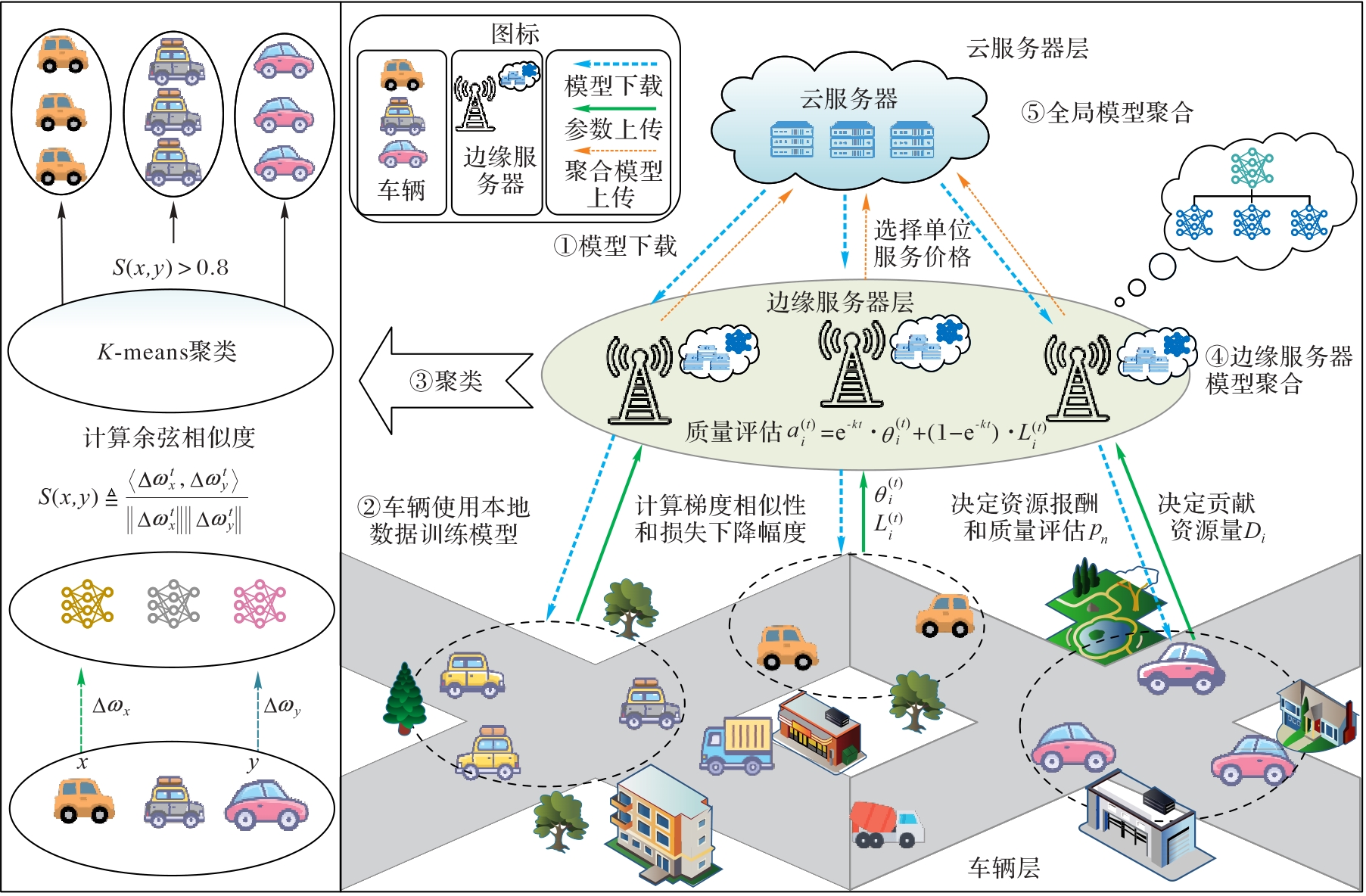
Fig. 1 Framework of hierarchical federated learning system for internet of vehicles
| 参数 | 值 | 说明 |
|---|---|---|
| 100 | 客户端总数 | |
| 5 | 边缘服务器数量 | |
| 6 | 本地训练轮数 | |
| 10 MHz | 通信带宽 | |
| 50 cycle/bit | 车辆 | |
| 10 GHz | 车辆 | |
| 0.5 W | 客户端发射功率 | |
| 25 | 云服务器效用系统参数 | |
| 1 | 边缘服务器奖励缩放系数 |
Tab. 1 Simulation parameters setting
| 参数 | 值 | 说明 |
|---|---|---|
| 100 | 客户端总数 | |
| 5 | 边缘服务器数量 | |
| 6 | 本地训练轮数 | |
| 10 MHz | 通信带宽 | |
| 50 cycle/bit | 车辆 | |
| 10 GHz | 车辆 | |
| 0.5 W | 客户端发射功率 | |
| 25 | 云服务器效用系统参数 | |
| 1 | 边缘服务器奖励缩放系数 |
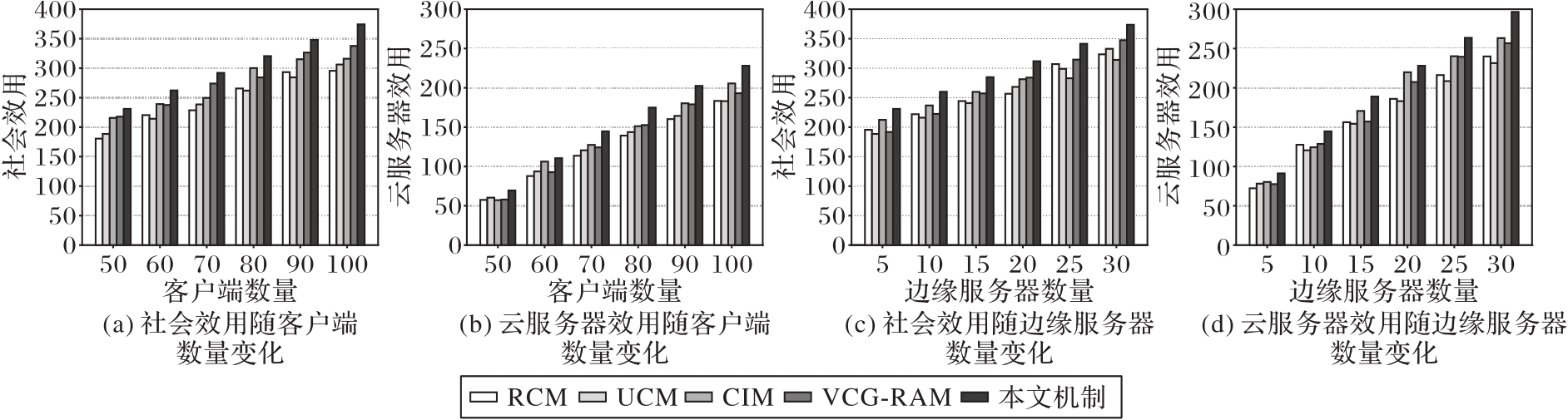
Fig. 2 Comparison of multiple mechanisms of social utility and cloud server utility under varying numbers of clients and edge servers without low-quality data
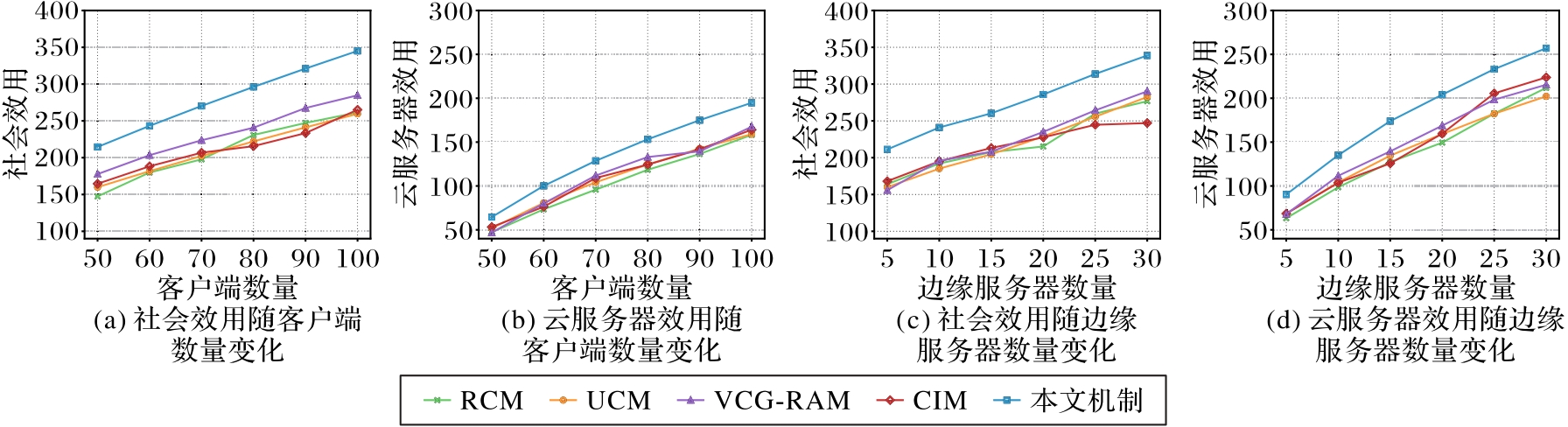
Fig. 3 Comparison of multiple mechanisms of social utility and cloud server utility under varying numbers of clients and edge servers with 30% low-quality data
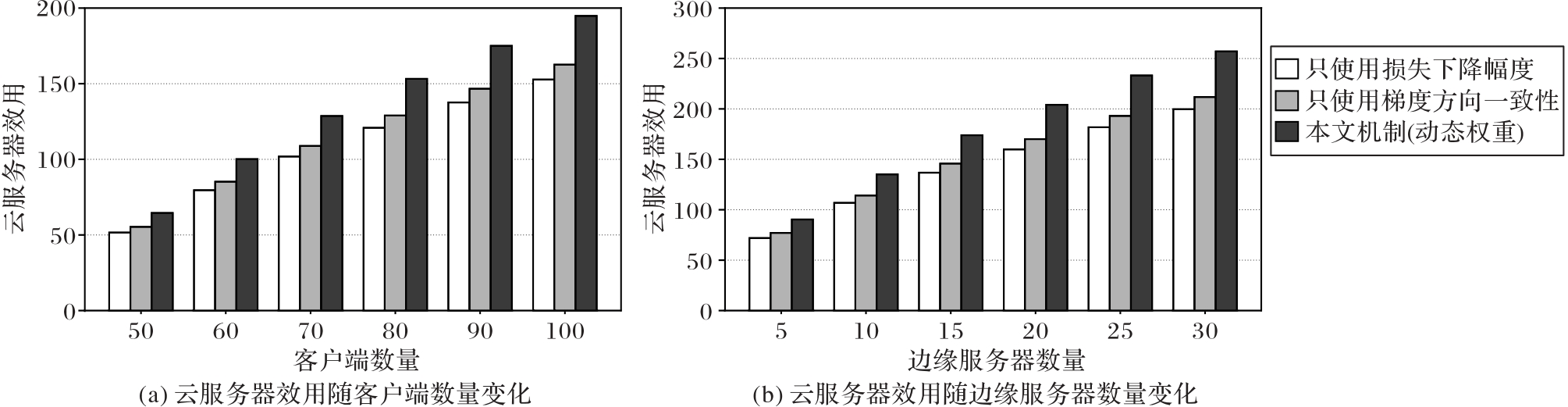
Fig. 4 Cloud server utility under different weight mechanisms
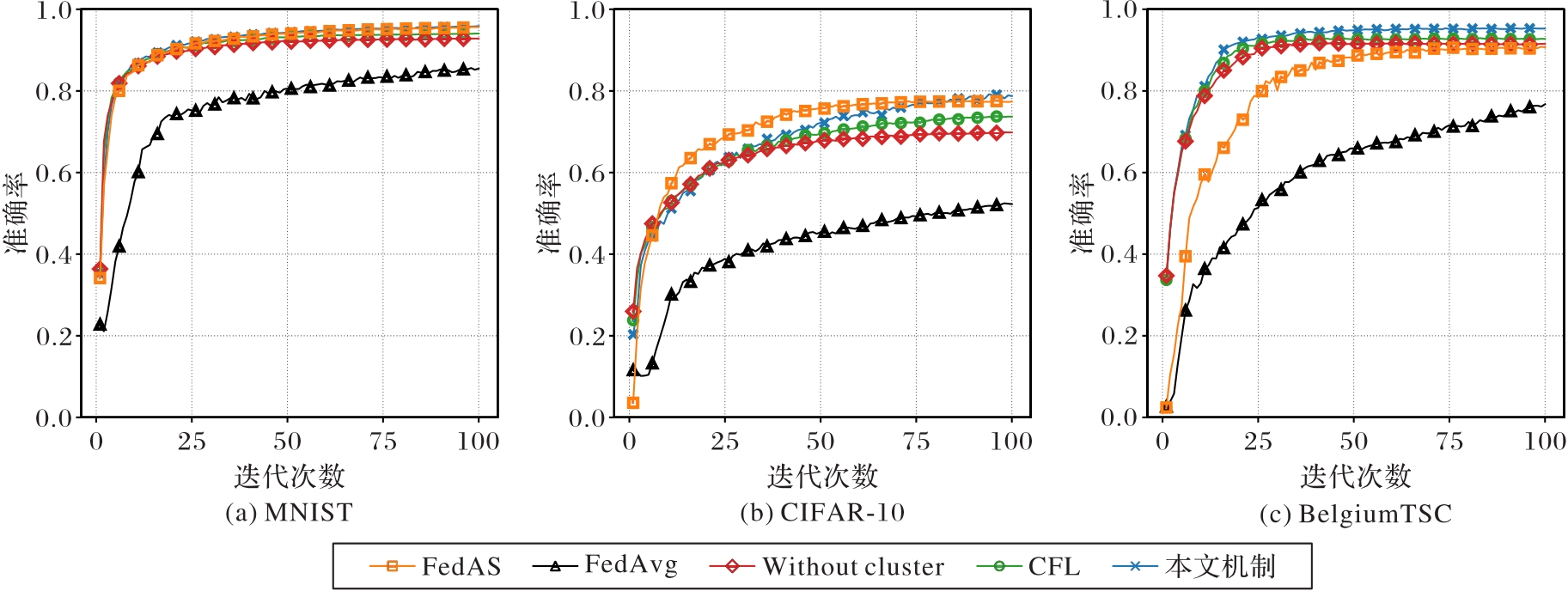
Fig. 5 Comparison of model test accuracy on different datasets
| [1] | 刘淼,林婉茹,王琴,等.车联网联邦学习的数据异质性问题及基于个性化的解决方法综述[J].通信学报, 2024, 45(10): 207-224. |
| Liu Miao, Lin Wanru, Wang Qin, et al. Survey on data heterogeneity problems and personalization based solutions of federated learning in Internet of vehicles [J]. Journal on Communications, 2024, 45(10): 207-224. | |
| [2] | Yin L, Luo J, Qiu C, et al. Joint task offloading and resources allocation for hybrid vehicle edge computing systems [J]. IEEE Transactions on Intelligent Transportation Systems, 2024, 25(8): 10355-10368. |
| [3] | Kumar A S, Zhao L, Fernando X. Asynchronous federated based vehicular edge computation offloading [J]. IEEE Transactions on Vehicular Technology, 2024, 73(12): 19350-19360. |
| [4] | 巫婕,钱雪忠,宋威.基于相似度聚类和正则化的个性化联邦学习[J].计算机应用, 2024, 44(11): 3345-3353. |
| Wu Jie, Qian Xuezhong, Song Wei. Personalized federated learning based on similarity clustering and regularization [J]. Journal of Computer Applications, 2024, 44(11): 3345-3353. | |
| [5] | 唐晓岚,梁煜婷,陈文龙.面向非独立同分布数据的车联网多阶段联邦学习机制[J].计算机研究与发展, 2024, 61(9): 2170-2184. |
| Tang Xiaolan, Liang Yuting, Chen Wenlong. Multi-stage federated learning mechanism with non-IID data in internet of vehicles [J]. Journal of Computer Research and Development, 2024, 61(9): 2170-2184. | |
| [6] | You C, Guo K, Yang H H, et al. Hierarchical personalized federated learning over massive mobile edge computing networks [J]. IEEE Transactions on Wireless Communications, 2023, 22(11): 8141-8157. |
| [7] | McMahan H B, Moore E, Ramage D, et al. Communication-efficient learning of deep networks from decentralized data [C]// AISTATS 2017. New York: JMLR.org, 2017: 1273-1282. |
| [8] | Liu L, Zhang J, Song S H, et al. Client-edge-cloud hierarchical federated learning [C]// ICC 2020. Piscataway: IEEE, 2020: 1-6. |
| [9] | Arisdakessian S, Wahab O A, Mourad A, et al. Coalitional federated learning: improving communication and training on non-IID data with selfish clients [J]. IEEE Transactions on Services Computing, 2023, 16(4): 2462-2476. |
| [10] | Liao G, Luo B, Feng Y, et al. Optimal mechanism design for heterogeneous client sampling in federated learning [J]. IEEE Transactions on Mobile Computing, 2024, 23(11): 10598-10609. |
| [11] | Pan Z, Li Y, Guan Z, et al. RFCSC: communication efficient reinforcement federated learning with dynamic client selection and adaptive gradient compression [J]. Neurocomputing, 2025, 612: No.128672. |
| [12] | Wang P, Song W, Qi H, et al. Server-initiated federated unlearning to eliminate impacts of low-quality data [J]. IEEE Transactions on Services Computing, 2024, 17(3): 1196-1211. |
| [13] | Wang D, Ren J, Wang Z, et al. PrivAim: a dual-privacy preserving and quality-aware incentive mechanism for federated learning [J]. IEEE Transactions on Computers, 2023, 72(7): 1913-1927. |
| [14] | Wu A, Yu J, Wang Y, et al. Prototype-decomposed knowledge distillation for learning generalized federated representation [J]. IEEE Transactions on Multimedia, 2024, 26: 10991-11002. |
| [15] | Zhao Z, Wang J, Hong W, et al. Ensemble federated learning with non-IID data in wireless networks [J]. IEEE Transactions on Wireless Communications, 2024, 23(4): 3557-3571. |
| [16] | Qi J, Lin F, Chen Z, et al. High-quality model aggregation for blockchain-based federated learning via reputation-motivated task participation [J]. IEEE Internet of Things Journal, 2022, 9(19): 18378-18391. |
| [17] | Wang S, Zhao H, Wen W, et al. Contract theory based incentive mechanism for clustered vehicular federated learning [J]. IEEE Transactions on Intelligent Transportation Systems, 2024, 25(7): 8134-8147. |
| [18] | Yao Y, Li G, Chen H, et al. Incentive mechanism design for semi-asynchronous federated learning based on contract theory: a learning approach [J]. IEEE Internet of Things Journal, 2025, 12(15): 30901-30920. |
| [19] | Li Y, Yang B, Wu H, et al. Joint offloading decision and resource allocation for vehicular fog-edge computing networks: a contract-Stackelberg approach [J]. IEEE Internet of Things Journal, 2022, 9(17): 15969-15982. |
| [20] | Kim T, Kim J, Lee H, et al. An efficient winner and payment determination algorithm in reverse auction for edge federation [J]. IEEE Transactions on Network and Service Management, 2025, 22(2): 1945-1954. |
| [21] | Li J, Chen Z, Zang T, et al. Reinforcement learning-based dual-identity double auction in personalized federated learning [J]. IEEE Transactions on Mobile Computing, 2025, 24(5): 4086-4103. |
| [22] | Li G, Cai J, Lu J, et al. Incentive mechanism design for cross-device federated learning: a reinforcement auction approach [J]. IEEE Transactions on Mobile Computing, 2025, 24(4): 3059-3075. |
| [23] | Cheng S, Ren T, Zhang H, et al. A Stackelberg game based framework for edge pricing and resource allocation in mobile edge computing [J]. IEEE Internet of Things Journal, 2024, 11(11): 20514-20530. |
| [24] | He W, Yao H, Mai T, et al. Three-stage Stackelberg game enabled clustered federated learning in heterogeneous UAV swarms [J]. IEEE Transactions on Vehicular Technology, 2023, 72(7): 9366-9380. |
| [25] | Xu Y, Xiao M, Wu J, et al. Incentive mechanism for spatial crowdsourcing with unknown social-aware workers: a three-stage Stackelberg game approach [J]. IEEE Transactions on Mobile Computing, 2023, 22(8): 4698-4713. |
| [26] | Hu C L, Lin K Y, Chang C K. Incentive mechanism for mobile crowdsensing with two-stage Stackelberg game [J]. IEEE Transactions on Services Computing, 2023, 16(3): 1904-1918. |
| [27] | Xu Q, Su Z, Li P, et al. Cooperative energy provisioning services with virtual power plants in smart grid internet of things: a coalition-Stackelberg game approach [J]. IEEE Internet of Things Journal, 2025, 12(16): 32980-32993. |
| [28] | Zeng B, Yang X, Chen Y, et al. Federated data quality assessment approach: robust learning with mixed label noise [J]. IEEE Transactions on Neural Networks and Learning Systems, 2024, 35(12): 17620-17634. |
| [29] | Yang Y, Wang W, Liu L, et al. AoI optimization in the UAV-aided traffic monitoring network under attack: a Stackelberg game viewpoint [J]. IEEE Transactions on Intelligent Transportation Systems, 2023, 24(1): 932-941. |
| [30] | Tian S, Xiang S, Zhou Z, et al. Task offloading and resource allocation based on reinforcement learning and load balancing in vehicular networking [J]. IEEE Transactions on Consumer Electronics, 2025, 71(1): 2217-2230. |
| [31] | Zhan Y, Li P, Qu Z, et al. A learning-based incentive mechanism for federated learning [J]. IEEE Internet of Things Journal, 2020, 7(7): 6360-6368. |
| [32] | Yang X, Huang W, Ye M. FedAS: bridging inconsistency in personalized federated learning [C]// ICCV 2024. Piscataway: IEEE, 2024: 11986-11995. |
| [1] | Zhiqiang REN, Xuebin CHEN, Changsheng QU. Active defense framework against Byzantine attacks in federated learning [J]. Journal of Computer Applications, 2026, 46(7): 2196-2207. |
| [2] | Hao YU, Jing FAN, Enkang XI, Yadong JIN, Hua DONG, Yihang SUN. HEFSL: high-efficient federated split learning framework for edge heterogeneity [J]. Journal of Computer Applications, 2026, 46(5): 1397-1407. |
| [3] | Lili HE, Xinru GUAN, Lei ZHANG, Sheng JIANG, Chengjie JIANG. Panorama and future of location privacy protection in internet of vehicles [J]. Journal of Computer Applications, 2026, 46(3): 809-820. |
| [4] | Lei WANG, Wenxuan ZHOU, Ninghui JIA, Zhihao QU. Federated learning with two-pass communication compression for privacy-sensitive IoT data [J]. Journal of Computer Applications, 2026, 46(3): 887-898. |
| [5] | Kejia ZHANG, Zhijun FANG, Nanrun ZHOU, Zhicai SHI. Personalized federated learning method based on model pre-assignment and self-distillation [J]. Journal of Computer Applications, 2026, 46(1): 10-20. |
| [6] | Hao YU, Jing FAN, Yihang SUN, Yadong JIN, Enkang XI, Hua DONG. Federated split learning optimization method under edge heterogeneity [J]. Journal of Computer Applications, 2026, 46(1): 33-42. |
| [7] | Jintao SU, Lina GE, Liguang XIAO, Jing ZOU, Zhe WANG. Detection and defense scheme for backdoor attacks in federated learning [J]. Journal of Computer Applications, 2025, 45(8): 2399-2408. |
| [8] | Yiming ZHANG, Tengfei CAO. Federated learning optimization algorithm based on local drift and diversity computing power [J]. Journal of Computer Applications, 2025, 45(5): 1447-1454. |
| [9] | Qingli CHEN, Yuanbo GUO, Chen FANG. Clustering federated learning algorithm for heterogeneous data [J]. Journal of Computer Applications, 2025, 45(4): 1086-1094. |
| [10] | Zhongrui JING, Xuebin CHEN, Yinlong JIAN, Qi ZHONG, Zhenbo ZHANG. Federated learning fairness algorithm based on personalized submodel and K-means clustering [J]. Journal of Computer Applications, 2025, 45(12): 3747-3756. |
| [11] | Ruilong CHEN, Peng YI, Tao HU, Youjun BU. Encrypted traffic classification method based on federated prototypical incremental learning [J]. Journal of Computer Applications, 2025, 45(12): 3888-3895. |
| [12] | Xinyang LUO, Wunan WAN, Shibin ZHANG, Jinquan ZHANG. Trust management scheme for internet of vehicles based on blockchain and multi-attribute decision making [J]. Journal of Computer Applications, 2025, 45(11): 3470-3476. |
| [13] | Tingda SHEN, Konglin ZHU, Lin ZHANG. Semi-centralized cross-chain bridge design based on hash time lock and incentive mechanism [J]. Journal of Computer Applications, 2025, 45(11): 3440-3445. |
| [14] | Shufen ZHANG, Hongyang ZHANG, Zhiqiang REN, Xuebin CHEN. Survey of fairness in federated learning [J]. Journal of Computer Applications, 2025, 45(1): 1-14. |
| [15] | Jiepo FANG, Chongben TAO. Hybrid internet of vehicles intrusion detection system for zero-day attacks [J]. Journal of Computer Applications, 2024, 44(9): 2763-2769. |
| Viewed | ||||||
|
Full text |
|
|||||
|
Abstract |
|
|||||
