


Journal of Computer Applications ›› 2026, Vol. 46 ›› Issue (11): 3720-3730.DOI: 10.11772/j.issn.1001-9081.2025111445
• Frontier and comprehensive applications • Previous Articles
Siya XIE, Qiang SUN( ), Xuehui ZHANG, Wangcheng CAO, Xiaodong WANG
Received:2025-12-08
Revised:2026-03-19
Accepted:2026-03-31
Online:2026-04-23
Published:2026-11-10
Contact:
Qiang SUN
About author:XIE Siya, born in 1996, Ph. D. candidate, assistant lecturer. Her research interests include bioinformatics, deep learning, machine learning.Supported by:
谢思雅, 孙强(), 张雪慧, 曹望成, 王晓东
通讯作者:
孙强
作者简介:谢思雅(1996—),女,山东单县人,助教,博士研究生,主要研究方向:生物信息学、深度学习、机器学习基金资助:CLC Number:
Siya XIE, Qiang SUN, Xuehui ZHANG, Wangcheng CAO, Xiaodong WANG. MiRNA-disease association prediction by integrating contrastive learning-enhanced deep matrix factorization and view-aware representation learning[J]. Journal of Computer Applications, 2026, 46(11): 3720-3730.
谢思雅, 孙强, 张雪慧, 曹望成, 王晓东. 整合对比学习增强的深度矩阵分解和视图感知表示学习预测miRNA与疾病关联[J]. 《计算机应用》唯一官方网站, 2026, 46(11): 3720-3730.
Add to citation manager EndNote|Ris|BibTeX
URL: https://www.joca.cn/EN/10.11772/j.issn.1001-9081.2025111445
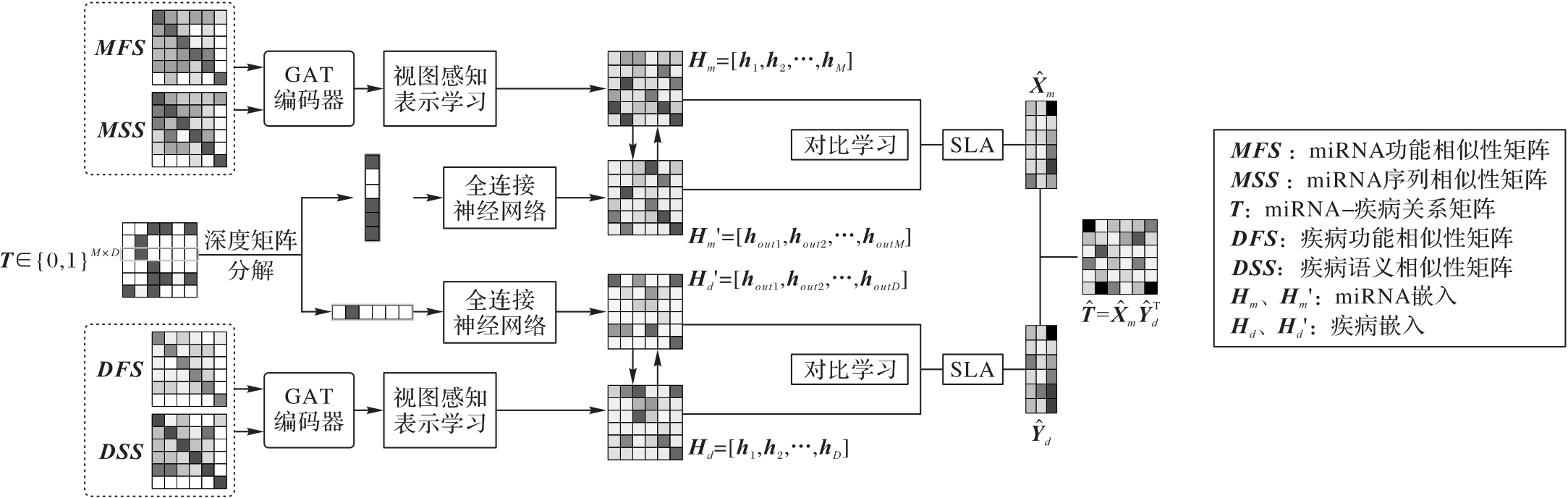
Fig. 1 Model structure of DMFVRLCL
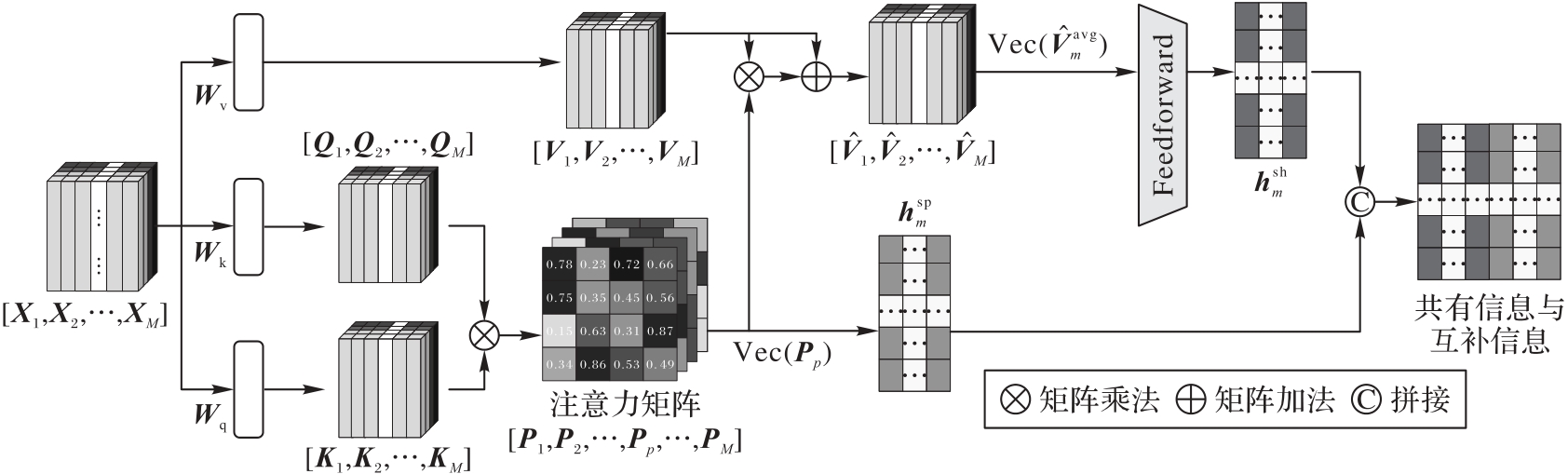
Fig. 2 Structure of view-aware representation learning module
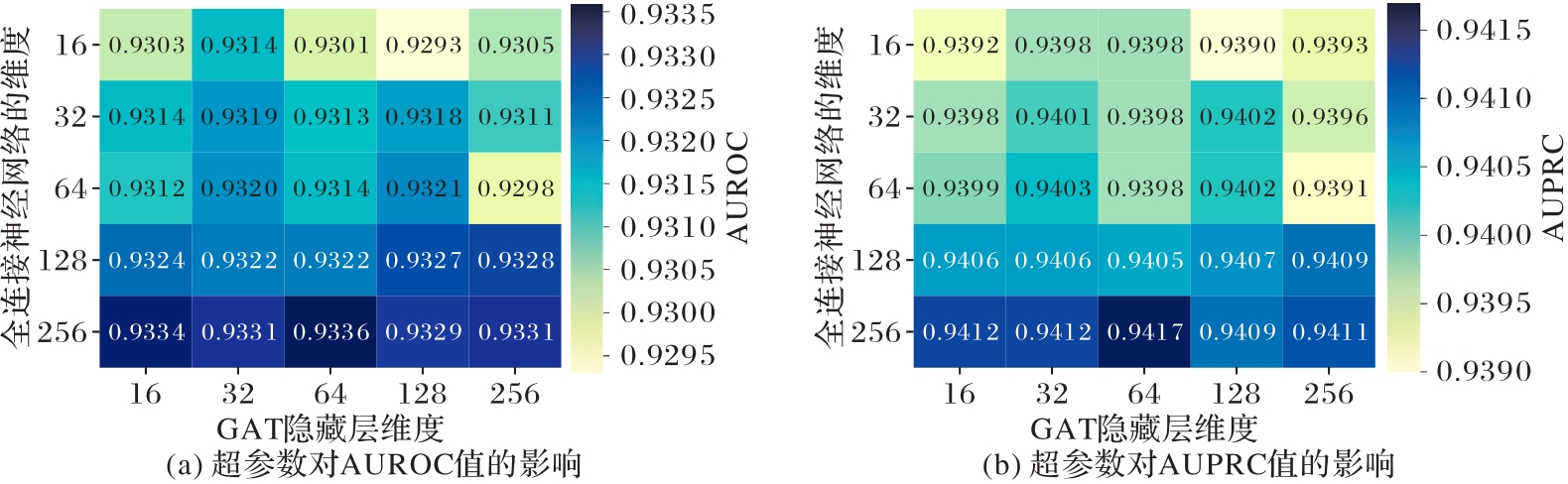
Fig. 3 Experimental results of different hyperparameter selections
| 参数 | 参数含义 | 默认值 |
|---|---|---|
| epoch | 训练轮数 | 600 |
| learning rate | 学习率 | 0.001 |
| L | GAT的层数 | 2 |
| Fm | miRNA特征嵌入维度 | 256 |
| Fd | 疾病特征嵌入维度 | 256 |
| seed | 随机数种子 | 1 234 |
Tab. 1 Key hyperparameter settings
| 参数 | 参数含义 | 默认值 |
|---|---|---|
| epoch | 训练轮数 | 600 |
| learning rate | 学习率 | 0.001 |
| L | GAT的层数 | 2 |
| Fm | miRNA特征嵌入维度 | 256 |
| Fd | 疾病特征嵌入维度 | 256 |
| seed | 随机数种子 | 1 234 |
| 模型 | AUROC | AUPRC | F1 |
|---|---|---|---|
| NIMCGCN | 0.840 943 | 0.836 942 | 0.774 569 |
| MMGCN | 0.921 022 | 0.923 151 | 0.853 934 |
| AMHMDA | 0.911 823 | 0.912 272 | 0.724 886 |
| MHCLMDA | 0.925 466 | 0.934 959 | 0.859 893 |
| MLRDFM | 0.940 545 | 0.940 389 | 0.868 758 |
| SLMRWMDA | 0.922 262 | 0.931 569 | 0.851 988 |
| IMCMDA | 0.819 581 | 0.817 555 | 0.759 879 |
| SPLHRNMTF | 0.930 061 | 0.935 561 | 0.861 719 |
| HGCLAMIR | 0.947 784 | 0.948 083 | 0.883 435 |
| DMFVRLCL | 0.949 495 | 0.956 336 | 0.897 268 |
Tab. 2 Performance comparison of five?fold cross?validation on MDAv3.2 dataset
| 模型 | AUROC | AUPRC | F1 |
|---|---|---|---|
| NIMCGCN | 0.840 943 | 0.836 942 | 0.774 569 |
| MMGCN | 0.921 022 | 0.923 151 | 0.853 934 |
| AMHMDA | 0.911 823 | 0.912 272 | 0.724 886 |
| MHCLMDA | 0.925 466 | 0.934 959 | 0.859 893 |
| MLRDFM | 0.940 545 | 0.940 389 | 0.868 758 |
| SLMRWMDA | 0.922 262 | 0.931 569 | 0.851 988 |
| IMCMDA | 0.819 581 | 0.817 555 | 0.759 879 |
| SPLHRNMTF | 0.930 061 | 0.935 561 | 0.861 719 |
| HGCLAMIR | 0.947 784 | 0.948 083 | 0.883 435 |
| DMFVRLCL | 0.949 495 | 0.956 336 | 0.897 268 |
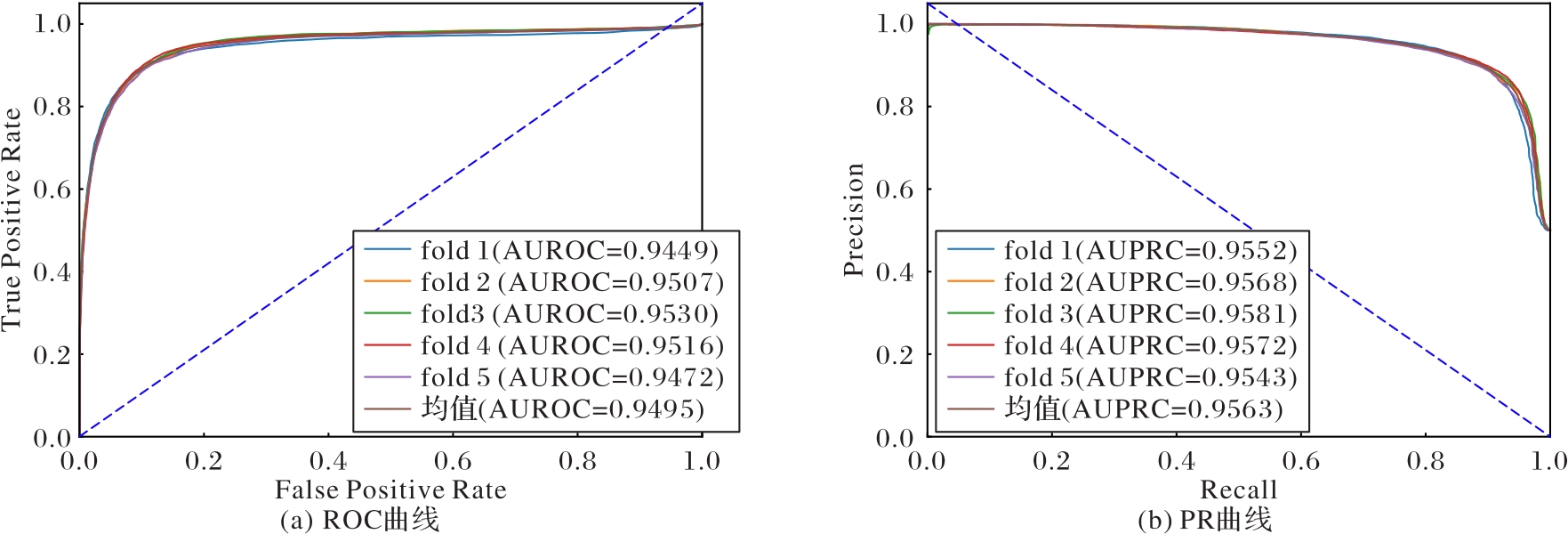
Fig. 4 ROC curve and PR curves of five-fold cross-validation
| 模型 | AUROC | AUPRC | F1 |
|---|---|---|---|
| NIMCGCN | 0.861 023 | 0.279 924 | 0.325 752 |
| MMGCN | 0.925 763 | 0.481 596 | 0.477 252 |
| AMHMDA | 0.910 774 | 0.349 109 | 0.393 176 |
| MHCLMDA | 0.923 474 | 0.444 657 | 0.462 675 |
| MLRDFM | 0.935 541 | 0.462 327 | 0.462 910 |
| SLMRWMDA | 0.919 564 | 0.239 222 | 0.306 860 |
| IMCMDA | 0.820 126 | 0.053 955 | 0.107 757 |
| SPLHRNMTF | 0.921 419 | 0.240 531 | 0.301 893 |
| HGCLAMIR | 0.945 803 | 0.479 549 | 0.509 251 |
| DMFVRLCL | 0.949 529 | 0.596 561 | 0.566 429 |
Tab. 3 Performance comparison of miRNA-disease association prediction models in real-world application scenarios
| 模型 | AUROC | AUPRC | F1 |
|---|---|---|---|
| NIMCGCN | 0.861 023 | 0.279 924 | 0.325 752 |
| MMGCN | 0.925 763 | 0.481 596 | 0.477 252 |
| AMHMDA | 0.910 774 | 0.349 109 | 0.393 176 |
| MHCLMDA | 0.923 474 | 0.444 657 | 0.462 675 |
| MLRDFM | 0.935 541 | 0.462 327 | 0.462 910 |
| SLMRWMDA | 0.919 564 | 0.239 222 | 0.306 860 |
| IMCMDA | 0.820 126 | 0.053 955 | 0.107 757 |
| SPLHRNMTF | 0.921 419 | 0.240 531 | 0.301 893 |
| HGCLAMIR | 0.945 803 | 0.479 549 | 0.509 251 |
| DMFVRLCL | 0.949 529 | 0.596 561 | 0.566 429 |
| DMFVRLCL变体 | AUROC | AUPRC | F1 |
|---|---|---|---|
| W/O CL | 0.941 913 | 0.946 468 | 0.880 982 |
| W/O SLA | 0.933 220 | 0.941 487 | 0.874 998 |
| W/O VRL‑average | 0.828 717 | 0.891 753 | 0.830 592 |
| W/O VRL‑concatenate | 0.808 421 | 0.878 274 | 0.815 326 |
| W/O DMF | 0.851 582 | 0.856 166 | 0.780 433 |
| W/O GAT | 0.819 597 | 0.887 809 | 0.828 283 |
| DMFVRLCL | 0.949 495 | 0.956 336 | 0.897 268 |
Tab. 4 Ablation experimental results
| DMFVRLCL变体 | AUROC | AUPRC | F1 |
|---|---|---|---|
| W/O CL | 0.941 913 | 0.946 468 | 0.880 982 |
| W/O SLA | 0.933 220 | 0.941 487 | 0.874 998 |
| W/O VRL‑average | 0.828 717 | 0.891 753 | 0.830 592 |
| W/O VRL‑concatenate | 0.808 421 | 0.878 274 | 0.815 326 |
| W/O DMF | 0.851 582 | 0.856 166 | 0.780 433 |
| W/O GAT | 0.819 597 | 0.887 809 | 0.828 283 |
| DMFVRLCL | 0.949 495 | 0.956 336 | 0.897 268 |
| 排序 | miRNA | 得分 | 证据(PMID) | 排序 | miRNA | 得分 | 证据(PMID) |
|---|---|---|---|---|---|---|---|
| 1 | hsa-let-7c | 1.367 212 | 35961236 | 11 | hsa-mir-148a | 1.291 590 6 | 35111850 |
| 2 | hsa-mir-23a | 1.348 679 | 34327529 | 12 | hsa-mir-30b | 1.285 369 8 | 16784538 |
| 3 | hsa-mir-195 | 1.338 751 | 34249465 | 13 | hsa-let-7a-2 | 1.276 144 3 | 31209222 |
| 4 | hsa-mir-146a | 1.335 394 | 32323801 | 14 | hsa-mir-210 | 1.271 569 1 | 34423038 |
| 5 | hsa-let-7b | 1.331 716 | 35812 757 | 15 | hsa-mir-221 | 1.269 419 8 | 33075494 |
| 6 | hsa-let-7a-1 | 1.310 271 | 未经证实 | 16 | hsa-mir-222 | 1.259 326 1 | 32304915 |
| 7 | hsa-mir-100 | 1.302 320 | 32919431 | 17 | hsa-mir-133b | 1.246 044 9 | 31545407 |
| 8 | hsa-mir-130a | 1.296 829 | 33727043 | 18 | hsa-mir-139 | 1.239 525 6 | 33317757 |
| 9 | hsa-let-7g | 1.295 501 | 16784538 | 19 | hsa-mir-125a | 1.232 164 0 | 31901156 |
| 10 | hsa-let-7i | 1.291 867 | 31878995 | 20 | hsa-mir-182 | 1.230 389 5 | 33884382 |
Tab. 5 Top-20 breast tumor-associated miRNAs predicted by DMFVRLCL model
| 排序 | miRNA | 得分 | 证据(PMID) | 排序 | miRNA | 得分 | 证据(PMID) |
|---|---|---|---|---|---|---|---|
| 1 | hsa-let-7c | 1.367 212 | 35961236 | 11 | hsa-mir-148a | 1.291 590 6 | 35111850 |
| 2 | hsa-mir-23a | 1.348 679 | 34327529 | 12 | hsa-mir-30b | 1.285 369 8 | 16784538 |
| 3 | hsa-mir-195 | 1.338 751 | 34249465 | 13 | hsa-let-7a-2 | 1.276 144 3 | 31209222 |
| 4 | hsa-mir-146a | 1.335 394 | 32323801 | 14 | hsa-mir-210 | 1.271 569 1 | 34423038 |
| 5 | hsa-let-7b | 1.331 716 | 35812 757 | 15 | hsa-mir-221 | 1.269 419 8 | 33075494 |
| 6 | hsa-let-7a-1 | 1.310 271 | 未经证实 | 16 | hsa-mir-222 | 1.259 326 1 | 32304915 |
| 7 | hsa-mir-100 | 1.302 320 | 32919431 | 17 | hsa-mir-133b | 1.246 044 9 | 31545407 |
| 8 | hsa-mir-130a | 1.296 829 | 33727043 | 18 | hsa-mir-139 | 1.239 525 6 | 33317757 |
| 9 | hsa-let-7g | 1.295 501 | 16784538 | 19 | hsa-mir-125a | 1.232 164 0 | 31901156 |
| 10 | hsa-let-7i | 1.291 867 | 31878995 | 20 | hsa-mir-182 | 1.230 389 5 | 33884382 |
| 排序 | miRNA | 得分 | 证据(PMID) | 排序 | miRNA | 得分 | 证据(PMID) |
|---|---|---|---|---|---|---|---|
| 1 | hsa-mir-34a | 1.515 261 | 32054948 | 11 | hsa-mir-182 | 1.172 915 | 30645846 |
| 2 | hsa-let-7b | 1.371 107 | 36643646 | 12 | hsa-mir-25 | 1.169 449 | 34440025 |
| 3 | hsa-mir-222 | 1.324 756 | 22331473 | 13 | hsa-mir-17 | 1.163 093 | 32798803 |
| 4 | hsa-mir-22 | 1.321 716 | 33841651 | 14 | hsa-mir-206 | 1.160 492 | 31507089 |
| 5 | hsa-mir-221 | 1.316 681 | 34107168 | 15 | hsa-mir-142 | 1.159 562 | 30970294 |
| 6 | hsa-mir-29a | 1.283 915 | 32102467 | 16 | hsa-mir-30a | 1.131 427 | 22331473 |
| 7 | hsa-mir-126 | 1.278 659 | 32223721 | 17 | hsa-mir-148a | 1.121 854 | 31106536 |
| 8 | hsa-let-7g | 1.247 923 | 35302725 | 18 | hsa-mir-15b | 1.121 040 | 19584273 |
| 9 | hsa-mir-195 | 1.205 083 | 31581360 | 19 | hsa-mir-106b | 1.111 281 | 34071592 |
| 10 | hsa-mir-21 | 1.178 946 | 36539984 | 20 | hsa-mir-204 | 1.099 823 | 15944708 |
Tab. 6 Top-20 lung tumor-associated miRNAs predicted by DMFVRLCL model
| 排序 | miRNA | 得分 | 证据(PMID) | 排序 | miRNA | 得分 | 证据(PMID) |
|---|---|---|---|---|---|---|---|
| 1 | hsa-mir-34a | 1.515 261 | 32054948 | 11 | hsa-mir-182 | 1.172 915 | 30645846 |
| 2 | hsa-let-7b | 1.371 107 | 36643646 | 12 | hsa-mir-25 | 1.169 449 | 34440025 |
| 3 | hsa-mir-222 | 1.324 756 | 22331473 | 13 | hsa-mir-17 | 1.163 093 | 32798803 |
| 4 | hsa-mir-22 | 1.321 716 | 33841651 | 14 | hsa-mir-206 | 1.160 492 | 31507089 |
| 5 | hsa-mir-221 | 1.316 681 | 34107168 | 15 | hsa-mir-142 | 1.159 562 | 30970294 |
| 6 | hsa-mir-29a | 1.283 915 | 32102467 | 16 | hsa-mir-30a | 1.131 427 | 22331473 |
| 7 | hsa-mir-126 | 1.278 659 | 32223721 | 17 | hsa-mir-148a | 1.121 854 | 31106536 |
| 8 | hsa-let-7g | 1.247 923 | 35302725 | 18 | hsa-mir-15b | 1.121 040 | 19584273 |
| 9 | hsa-mir-195 | 1.205 083 | 31581360 | 19 | hsa-mir-106b | 1.111 281 | 34071592 |
| 10 | hsa-mir-21 | 1.178 946 | 36539984 | 20 | hsa-mir-204 | 1.099 823 | 15944708 |
| [1] | Yin Y, Lv L, Wang W. Expression of miRNA-214 in the sera of elderly patients with acute myocardial infarction and its effect on cardiomyocyte apoptosis[J]. Experimental and Therapeutic Medicine, 2019, 17(6): 4657-4662. |
| [2] | Xu H, Wang F, Wang L. Suppression of miR-106a-5p expression inhibits tumorigenesis via increasing CELF-2 expression in spinal cord glioma[J]. Oncology Letters, 2021, 22(2): No.627. |
| [3] | 文瑾娟,蔡蘅,梁炎春,等.微小RNA在子宫内膜异位症发生发展中的作用[J]. 中国医学前沿杂志(电子版), 2025, 17(3): 102-107. |
| Wen Jinjuan, Cai Heng, Liang Yanchun, et al. The role of micro RNA in the development and progression of endometriosis[J]. Chinese Journal of the Frontiers of Medical Science (Electronic Version), 2025, 17(3): 102-107. | |
| [4] | Wang L, Wang H, Xu K, et al. Exploration of immune-related cells and ceRNA in squamous cell lung cancer[J]. Medicine, 2021, 100(35): No.e27058. |
| [5] | Chen X Z, He W X, Luo R G, et al. KLF14/miR‐1283/TFAP2C axis inhibits HER2‐positive breast cancer progression via declining tumor cell proliferation[J]. Molecular Carcinogenesis, 2023, 62(4): 532-545. |
| [6] | Han T Y, Hou L S, Li J X, et al. Bone targeted miRNA delivery system for miR-34a with enhanced anti-tumor efficacy to bone-associated metastatic breast cancer[J]. International Journal of Pharmaceutics, 2023, 635: No.122755. |
| [7] | Li J, Zhang S, Liu T, et al. Neural inductive matrix completion with graph convolutional networks for miRNA-disease association prediction[J]. Bioinformatics, 2020, 36(8): 2538-2546. |
| [8] | Tang X, Luo J, Shen C, et al. Multi-view multichannel attention graph convolutional network for miRNA-disease association prediction[J]. Briefings in Bioinformatics, 2021, 22(6): No.bbab174. |
| [9] | Ning Q, Zhao Y, Gao J, et al. AMHMDA: attention aware multi-view similarity networks and hypergraph learning for miRNA-disease associations identification[J]. Briefings in Bioinformatics, 2023, 24(2): No.bbad094. |
| [10] | Peng W, He Z, Dai W, et al. MHCLMDA: multihypergraph contrastive learning for miRNA-disease association prediction[J]. Briefings in Bioinformatics, 2024, 25(1): No.bbab524. |
| [11] | Ding Y, Lei X, Liao B, et al. MLRDFM: a multi-view Laplacian regularized DeepFM model for predicting miRNA-disease associations[J]. Briefings in Bioinformatics, 2022, 23(3): No.bbac079. |
| [12] | Chen X, Wang L, Qu J, et al. Predicting miRNA-disease association based on inductive matrix completion[J]. Bioinformatics, 2018, 34(24): 4256-4265. |
| [13] | Ouyang D, Miao R, Zeng J, et al. SPLHRNMTF: robust orthogonal non-negative matrix tri-factorization with self-paced learning and dual hypergraph regularization for predicting miRNA-disease associations[J]. BMC Genomics, 2024, 25: No.885. |
| [14] | Zeng X, Zhang X, Zou Q. Integrative approaches for predicting microRNA function and prioritizing disease-related microRNA using biological interaction networks[J]. Briefings in Bioinformatics, 2016, 17(2): 193-203. |
| [15] | Sheng N, Xie X, Wang Y, et al. A survey of deep learning for detecting miRNA-disease associations: databases, computational methods, challenges, and future directions[J]. IEEE/ACM Transactions on Computational Biology and Bioinformatics, 2024, 21(3): 328-347. |
| [16] | Jiang Q, Hao Y, Wang G, et al. Prioritization of disease microRNAs through a human phenome-microRNAome network[J]. BMC Systems Biology, 2010, 4(S1): No.S2. |
| [17] | Luo J, Xiao Q. A novel approach for predicting microRNA-disease associations by unbalanced bi-random walk on heterogeneous network[J]. Journal of Biomedical Informatics, 2017, 66: 194-203. |
| [18] | 阮璐,熊赟. 基于网络表示学习的miRNA功能相似性研究[J]. 计算机工程, 2019, 45(2): 154-159. |
| Ruan Lu, Xiong Yun. Research on functional similarity of miRNA based on network representation learning[J]. Computer Engineering, 2019, 45(2): 154-159. | |
| [19] | Jiang Q, Wang G, Jin S, et al. Predicting human microRNA-disease associations based on support vector machine[J]. International Journal of Data Mining and Bioinformatics, 2013, 8(3): 282-293. |
| [20] | Chen X, Gong Y, Zhang D H, et al. DRMDA: deep representations‑based miRNA-disease association prediction[J]. Journal of Cellular and Molecular Medicine, 2018, 22(1): 472-485. |
| [21] | Chen X, Wu Q F, Yan G Y. RKNNMDA: ranking-based KNN for miRNA-disease association prediction[J]. RNA Biology, 2017, 14(7): 952-962. |
| [22] | Wang X F, Yu C Q, You Z H, et al. KS-CMI: a circRNA-miRNA interaction prediction method based on the signed graph neural network and denoising autoencoder[J]. iScience, 2023, 26(8): No.107478. |
| [23] | Zhong X, Lei T, Rong R. Adopting a new sample strategy to predict miRNA-disease associations[J]. Journal of Physics: Conference Series. IOP Publishing, 2021, 1757: No.012110. |
| [24] | Liu D, Huang Y, Nie W, et al. SMALF: miRNA-disease associations prediction based on stacked autoencoder and XGBoost[J]. BMC Bioinformatics, 2021, 22: No.219. |
| [25] | Dai Q, Wang Z, Liu Z, et al. Predicting miRNA-disease associations using an ensemble learning framework with resampling method[J]. Briefings in Bioinformatics, 2022, 23(1): No.bbab543. |
| [26] | Tian Z, Han C, Xu L, et al. MGCNSS: miRNA-disease association prediction with multi-layer graph convolution and distance-based negative sample selection strategy[J]. Briefings in Bioinformatics, 2024, 25(3): No.bbae168. |
| [27] | Chu Y, Wang X, Dai Q, et al. MDA-GCNFTG: identifying miRNA-disease associations based on graph convolutional networks via graph sampling through the feature and topology graph[J]. Briefings in Bioinformatics, 2021, 22(6): No.bbab165. |
| [28] | Han H, Zhu R, Liu J X, et al. Predicting miRNA-disease associations via layer attention graph convolutional network model[J]. BMC Medical Informatics and Decision Making, 2022, 22: No.69. |
| [29] | Yan C, Duan G, Li N, et al. PDMDA: predicting deep-level miRNA-disease associations with graph neural networks and sequence features[J]. Bioinformatics, 2022, 38(8): 2226-2234. |
| [30] | Liu J, Kuang Z, Deng L. GCNPCA: miRNA-disease associations prediction algorithm based on graph convolutional neural networks[J]. IEEE/ACM Transactions on Computational Biology and Bioinformatics, 2023, 20(2): 1041-1052. |
| [31] | Huang Z, Shi J, Gao Y, et al. HMDD v3.0: a database for experimentally supported human microRNA-disease associations[J]. Nucleic Acids Research, 2019, 47(D1): D1013-D1017. |
| [32] | Xiao Q, Luo J, Liang C, et al. A graph regularized non-negative matrix factorization method for identifying microRNA-disease associations[J]. Bioinformatics, 2018, 34(2): 239-248. |
| [33] | Hwang S, Kim C Y, Yang S, et al. HumanNet v2: human gene networks for disease research[J]. Nucleic Acids Research, 2019, 47(D1): D573-D580. |
| [34] | Needleman S B, Wunsch C D. A general method applicable to the search for similarities in the amino acid sequence of two proteins[J]. Journal of Molecular Biology, 1970, 48(3): 443-453. |
| [35] | Wang D, Wang J, Lu M, et al. Inferring the human microRNA functional similarity and functional network based on microRNA-associated diseases[J]. Bioinformatics, 2010, 26(13): 1644-1650. |
| [36] | Ouyang D, Liang Y, Wang J, et al. HGCLAMIR: hypergraph contrastive learning with attention mechanism and integrated multi-view representation for predicting miRNA-disease associations[J]. PLoS Computational Biology, 2024, 20(4): No.e1011927. |
| [37] | Vaswani A, Shazeer N, Parmar N, et al. Attention is all you need[C]// NeurIPS 2017. Red Hook: Curran Associates Inc., 2017: 6000-6010. |
| [38] | Gao J, Lyu T, Xiong F, et al. MGNN: a multimodal graph neural network for predicting the survival of cancer patients[C]// SIGIR 2020. New York: ACM, 2020: 1697-1700. |
| [39] | Kazi A, Shekarforoush S, Kortuem K, et al. Self-attention equipped graph convolutions for disease prediction[C]// ISBI 2019. Piscataway: IEEE, 2019: 1896-1899. |
| [40] | Valenchon J, Coates M. Multiple-graph recurrent graph convolutional neural network architectures for predicting disease outcomes[C]// ICASSP 2019. Piscataway: IEEE, 2019: 3157-3161. |
| [41] | Chen T, Kornblith S, Norouzi M, et al. A simple framework for contrastive learning of visual representations[J]. Proceedings of Machine Learning Research, 2020, 119: 1597-1607. |
| [42] | Khosla P, Teterwak P, Wang C, et al. Supervised contrastive learning[C]// NeurIPS 2020. Red Hook: Curran Associates Inc., 2020: 18661-18673. |
| [43] | Zhu Y, Xu Y, Yu F, et al. Graph contrastive learning with adaptive augmentation[C]// WWW 2021. New York: ACM, 2021: 2069-2080. |
| [44] | Li Y, Qiao G, Gao X, et al. Supervised graph co-contrastive learning for drug-target interaction prediction[J]. Bioinformatics, 2022, 38(10): 2847-2854. |
| [45] | van den Oord A, Li Y, Vinyals O. Representation learning with contrastive predictive coding[PP/OL]. V2. arXiv (2019-01-22) [2025-10-15].. |
| [46] | Yao H B, Hou Z J, Zhang W G, et al. Prediction of microRNA-disease potential association based on sparse learning and multilayer random walks[J]. Journal of Computational Biology, 2024, 31(3): 241-256. |
| [47] | Cui C, Zhong B, Fan R, et al. HMDD v4.0: a database for experimentally supported human microRNA-disease associations[J]. Nucleic Acids Research, 2024, 52(D1): D1327-D1332. |
| [48] | Xu F, Wang Y, Ling Y, et al. dbDEMC 3.0: Functional exploration of differentially expressed miRNAs in cancers of human and model organisms[J]. Genomics, Proteomics and Bioinformatics, 2022, 20(3): 446-454. |
| [49] | Pan Y, Wang R, Zhang F, et al. MicroRNA-130a inhibits cell proliferation, invasion and migration in human breast cancer by targeting the RAB5A[J]. International Journal of Clinical and Experimental Pathology, 2015, 8(1): 384-393. |
| [50] | Yan M, Shield-Artin K, Byrne D, et al. Comparative microRNA profiling of sporadic and BRCA1 associated basal-like breast cancers[J]. BMC Cancer, 2015, 15: No.506. |
| [1] | Yan WANG, Xi CHEN, Zhongkai ZHAO, Huan ZHOU, Tao WU, Mengge AI, Xuesong XIAO. Similarity-aware link prediction model for ethnic culture knowledge graph [J]. Journal of Computer Applications, 2026, 46(8): 2447-2456. |
| [2] | Dong LI, Yiji ZHAO, Haiyan DING, Hao WU. Soft whitening inspired non-contrastive SSL framework for time-series forecasting [J]. Journal of Computer Applications, 2026, 46(8): 2457-2466. |
| [3] | Huihui LYU, Zhaoman ZHONG, Yu ZHANG, Jidong FAN. Syntactically enhanced aspect-based sentiment analysis via mutual information maximization and contrastive learning [J]. Journal of Computer Applications, 2026, 46(8): 2440-2446. |
| [4] | Jiaming LIU, Fangju AI. Text-ID sequential recommendation model based on multi-strategy contrastive learning and adaptive label smoothing [J]. Journal of Computer Applications, 2026, 46(8): 2477-2484. |
| [5] | Yuqi WANG, Yangsen ZHANG, Pu WANG. High school English reading comprehension model integrating knowledge augmentation and contrastive learning [J]. Journal of Computer Applications, 2026, 46(7): 2096-2103. |
| [6] | Haiwei FAN, Wenshuai DING, Hongzheng XING. Knowledge-aware recommendation performance enhancement method based on multi-heterogeneous topology collaboration and hierarchical contrastive learning [J]. Journal of Computer Applications, 2026, 46(7): 2085-2095. |
| [7] | Xiaoqin YU, Wuyang SHAN, Junying QIU, Yu LIN, Ronghao YANG, Mao TIAN. Image tampering localization and detection network under brightness-contrast disturbances [J]. Journal of Computer Applications, 2026, 46(6): 1893-1903. |
| [8] | Jinghong WANG, Xiao CHEN, Yingmei MA, Bi LI, Jusheng MI, Wei WANG. Multi-level neighborhood contrastive attribute graph clustering based on adaptive learning [J]. Journal of Computer Applications, 2026, 46(6): 1836-1843. |
| [9] | Hang QI, Tingting DONG, Yongqiang NAI, Xian MO. Contrastive collaborative filtering method based on graph diffusion generation and adaptive sampling [J]. Journal of Computer Applications, 2026, 46(6): 1818-1828. |
| [10] | Bingqing LI, Binhao HUANG, Yubei TANG, Baili ZHANG. Quality of service prediction model for data sparsity and cold start problems [J]. Journal of Computer Applications, 2026, 46(6): 1829-1835. |
| [11] | Kun FU, Haoyu WEI, Weijing LIU, Xing DANG, Zezheng LIU, Jianwei LI. Graph neural network framework for topology semantic dual-domain collaboration [J]. Journal of Computer Applications, 2026, 46(5): 1378-1387. |
| [12] | Dirui ZHANG, Jiayu LIN, Zuhong LIANG. Supervised contrastive generative sentiment analysis method with uncertainty-aware unlikelihood learning [J]. Journal of Computer Applications, 2026, 46(5): 1416-1423. |
| [13] | Haihua ZHAO, Yijun HU, Rui TANG, Xian MO. Multimodal recommendation method based on semantic fusion and contrast enhancement [J]. Journal of Computer Applications, 2026, 46(4): 1058-1068. |
| [14] | Xiaoxia LIU, Liqun KUANG, Song WANG, Shichao JIAO, Huiyan HAN, Fengguang XIONG. Multi-scale spatio-temporal decoupling for contrastive learning of skeleton action recognition [J]. Journal of Computer Applications, 2026, 46(3): 767-774. |
| [15] | Yuhang XIAO, Guanfeng LI, Yuyin CHEN, Jing QIN. Few-shot relation extraction model with graph-based multi-view contrastive learning [J]. Journal of Computer Applications, 2026, 46(3): 732-740. |
| Viewed | ||||||
|
Full text |
|
|||||
|
Abstract |
|
|||||
