Journal of Computer Applications ›› 2026, Vol. 46 ›› Issue (6): 1829-1835.DOI: 10.11772/j.issn.1001-9081.2025060675

• Data science and technology • Previous Articles    

Quality of service prediction model for data sparsity and cold start problems

Bingqing LI1, Binhao HUANG1, Yubei TANG1, Baili ZHANG1,2,3()   

  1. 1.School of Computer Science and Engineering,Southeast University,Nanjing Jiangsu 211189,China
    2.Key Laboratory of New Generation Artificial Intelligence Technology and Its Interdisciplinary Applications,Ministry of Education (Southeast University),Nanjing Jiangsu 211189,China
    3.Research Center for Judicial Big Data,Supreme Count of China,Nanjing Jiangsu 211189,China
  • Received:2025-06-19 Revised:2025-09-18 Accepted:2025-09-19 Online:2025-10-16 Published:2026-06-10
  • Contact: Baili ZHANG
  • About author:LI Bingqing, born in 2003, M. S. candidate. Her research interests include artificial intelligence.
    HUANG Binhao, born in 2000, M. S. His research interests include artificial intelligence, big data analysis.
    TANG Yubei, born in 2002, M. S. candidate. Her research interests include artificial intelligence.
    First author contact:ZHANG Baili, born in 1970, Ph. D., professor. His research interests include big data analysis, artificial intelligence, data warehouse.
  • Supported by:
    National Key Research and Development Program of China(2023YFC3806004);National Natural Science Foundation of China(62373104);Fundamental Research Funds for the Central Universities(2242024k30035)

面向数据稀疏性与冷启动问题的服务质量预测模型

李冰清1, 黄彬浩1, 唐语蓓1, 张柏礼1,2,3()   
  1. 1.东南大学 计算机科学与工程学院,南京 211189
    2.新一代人工智能技术与交叉应用教育部重点实验室(东南大学),南京 211189
    3.中国最高人民法院 司法大数据研究基地,南京 211189
  • 通讯作者: 张柏礼
  • 作者简介:李冰清(2003—),女,福建龙岩人,硕士研究生,CCF会员,主要研究方向:人工智能
    黄彬浩(2000—),男,江苏无锡人,硕士,主要研究方向:人工智能、大数据分析
    唐语蓓(2002—),女,云南昆明人,硕士研究生,主要研究方向:人工智能
    第一联系人:张柏礼(1970—),男,江苏盐城人,教授,博士,主要研究方向:大数据分析、人工智能、数据仓库。
  • 基金资助:
    国家重点研发计划项目(2023YFC3806004);国家自然科学基金资助项目(62373104);中央高校基本科研业务费专项(2242024k30035)

Abstract:

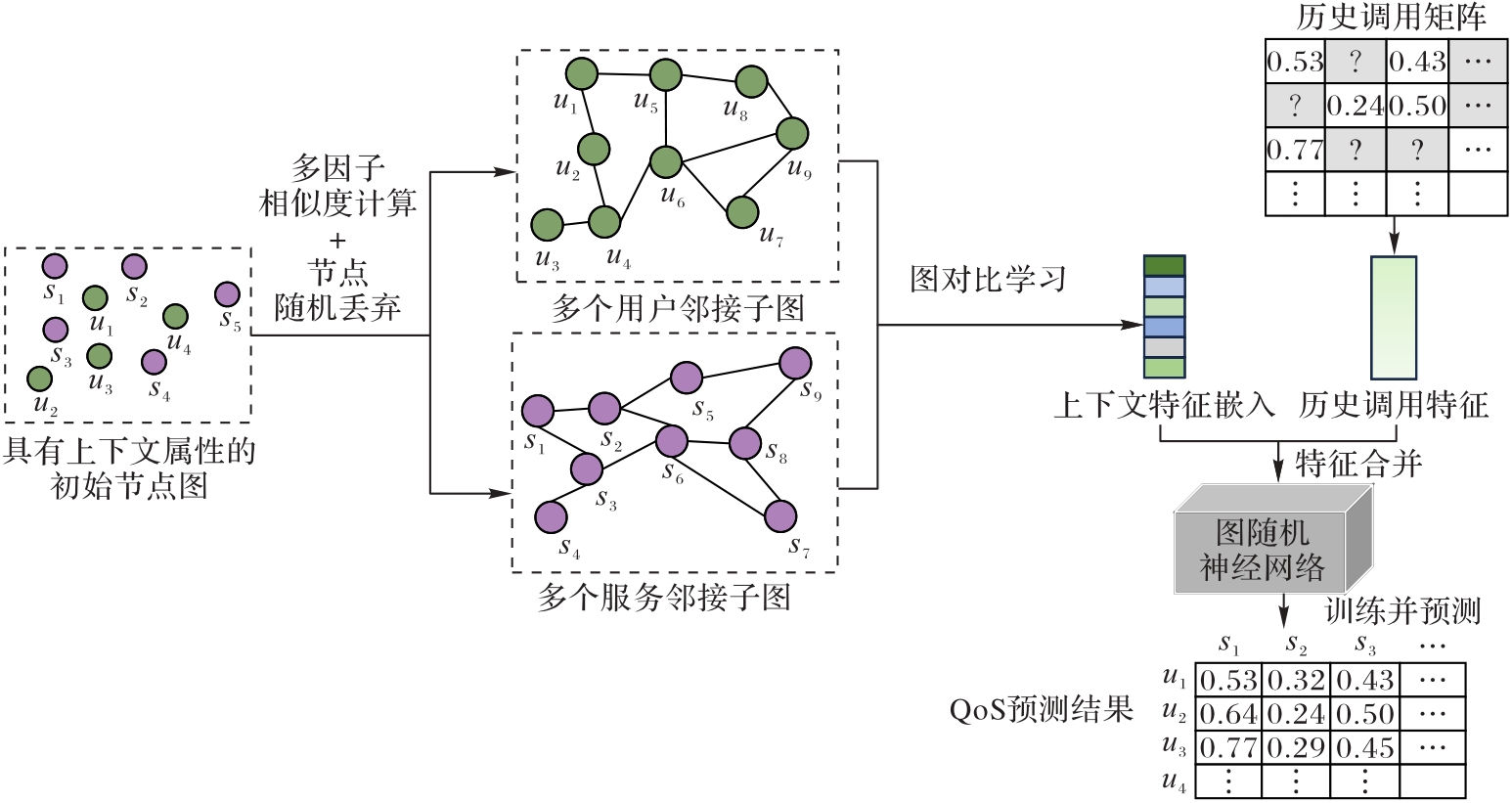
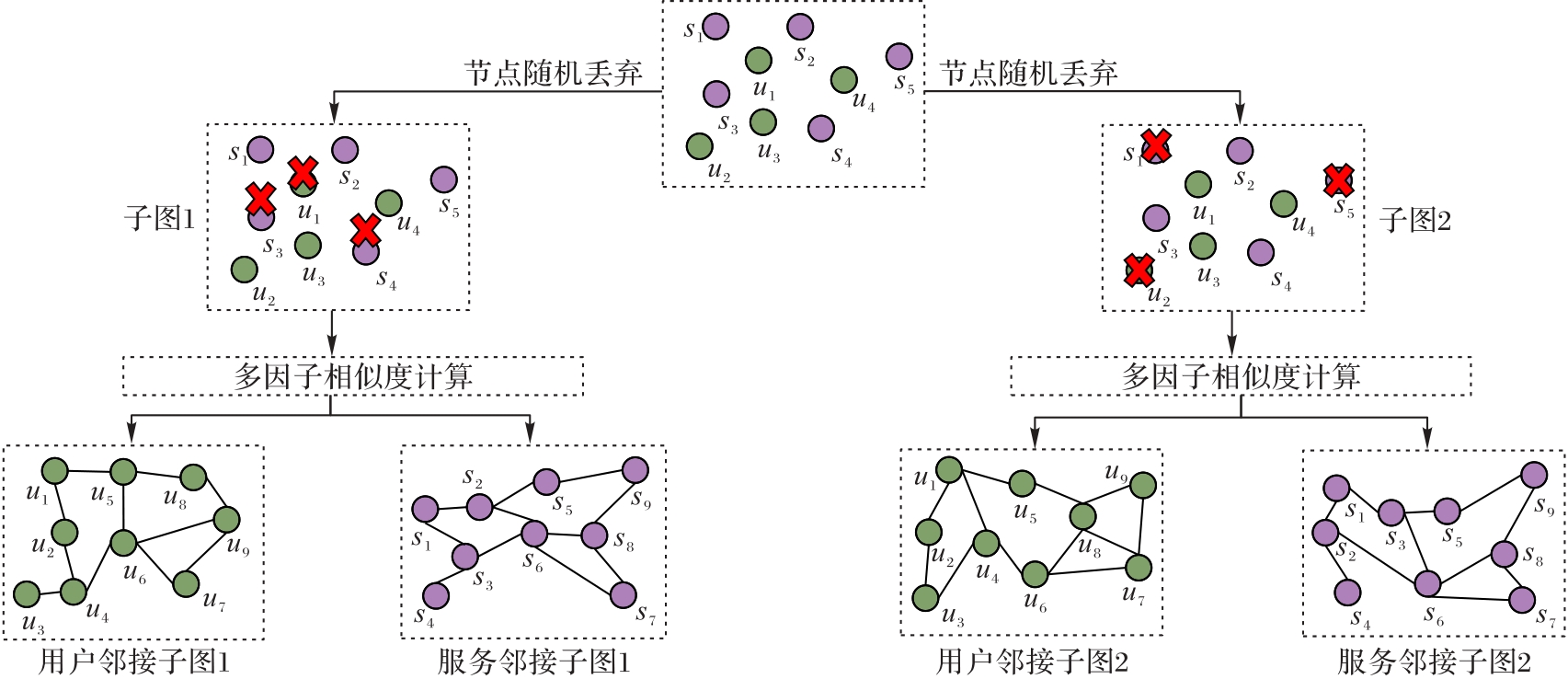
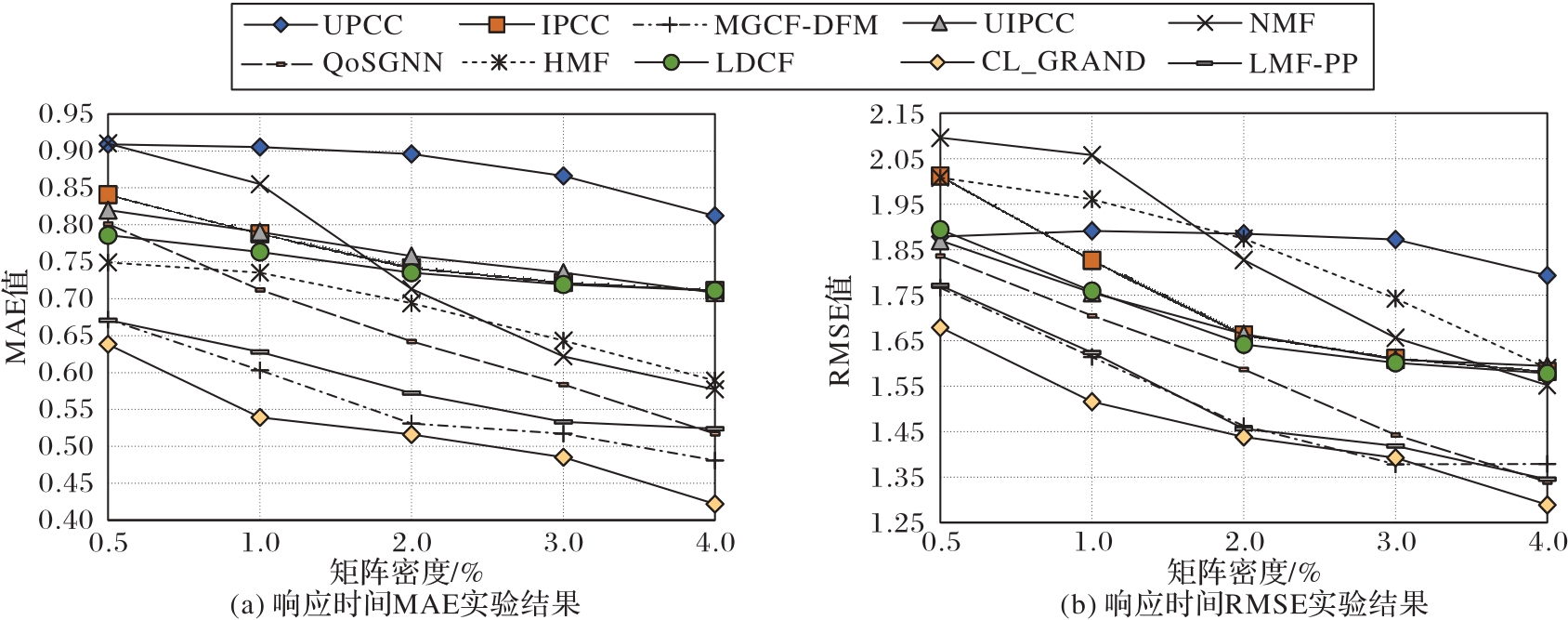
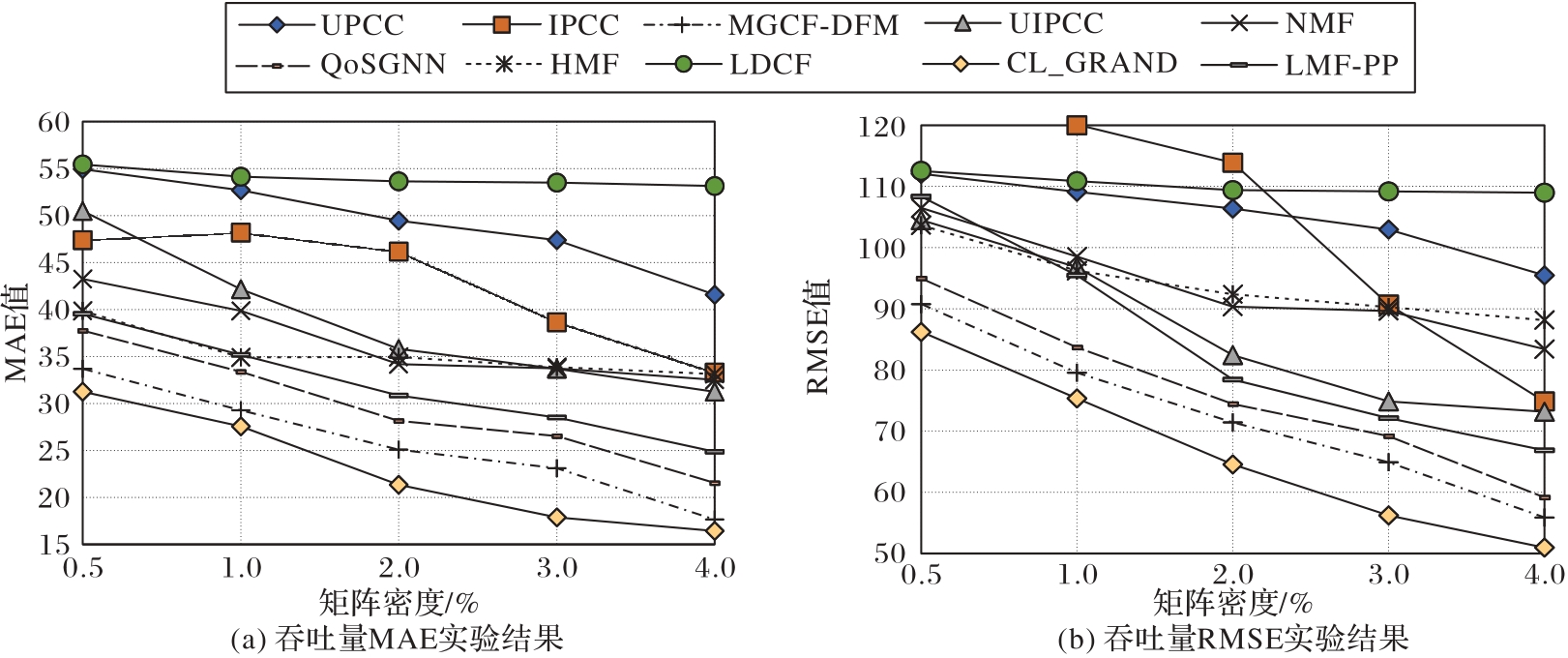
Aiming at the problem of data sparsity caused by few connections between users and service nodes in World Wide Web (Web) Quality of Service (QoS) prediction, as well as the cold start problem caused by the lack of historical call data, a QoS prediction model for data sparsity and cold start problems was proposed. Firstly, a random propagation strategy was adopted, where multiple augmented graphs were generated by dropping nodes randomly for propagation, so as to achieve data augmentation. At the same time a consistency regularization method was used to optimize the prediction consistency between multiple augmentations, thereby alleviating the data sparsity. Secondly, a multi-factor similarity calculation method was proposed, so that random node dropping was combined to construct user and service context subgraphs. Thirdly, graph contrastive learning was introduced to train each subgraph, making the context embedding representations of similar nodes closer, thereby alleviating the cold start. Experimental results show that compared with the existing QoS prediction models, this model maintains better performance in all scenarios with data density from 0.5% to 4.0%. It can be seen that this model provides a new paradigm for graph random neural network to process sparse data theoretically, and in application, it can improve the service recommendation accuracy of platforms such as community intelligent management and e-commerce, as well as reduce the trial-and-error cost of service calls.

Key words: World Wide Web (Web) service, Quality of Service (QoS) prediction, service recommendation, graph random neural network, graph contrastive learning

摘要:

针对万维网(Web)服务质量(QoS)预测中因用户与服务节点连接少而产生的数据稀疏性问题,以及历史调用数据空缺引发的冷启动问题,提出一种面向数据稀疏性与冷启动问题的QoS预测模型。首先,采用随机传播策略,通过随机丢弃节点生成多个增广图进行传播,实现数据增强;同时,采用一致性正则化方法优化多次增广间的预测一致性,缓解数据稀疏性现象;其次,提出多因子相似度计算方法,结合节点随机丢弃构建用户和服务上下文子图;最后,引入图对比学习对各子图进行训练,使相似节点的上下文嵌入表示距离更近,缓解冷启动现象。实验结果表明,与现有的QoS预测模型相比,该模型在0.5%~4.0%的各数据密度场景中均保持较优性能。可见,该模型在理论上为图随机神经网络处理稀疏数据提供了新范式,并且在应用中可提升社区智能管理和电子商务等平台的服务推荐精度,降低服务调用的试错成本。

关键词: 万维网服务, 服务质量预测, 服务推荐, 图随机神经网络, 图对比学习

CLC Number: