


《计算机应用》唯一官方网站 ›› 2026, Vol. 46 ›› Issue (10): 3191-3198.DOI: 10.11772/j.issn.1001-9081.2025080944
• 数据科学与技术 • 上一篇
滕雨轩1, 蒋从锋1( ), 刘俊明2, 徐传奇2
收稿日期:2025-08-19
修回日期:2025-09-10
接受日期:2025-09-24
发布日期:2026-10-21
出版日期:2026-10-10
通讯作者:
蒋从锋
作者简介:滕雨轩(1999—),男,福建福州人,工程师,硕士,主要研究方向:数据中心电源使用效率基金资助:
Yuxuan TENG1, Congfeng JIANG1(), Junming LIU2, Chuanqi XU2
Received:2025-08-19
Revised:2025-09-10
Accepted:2025-09-24
Online:2026-10-21
Published:2026-10-10
Contact:
Congfeng JIANG
About author:TENG Yuxuan, born in 1999, M. S., engineer. His research interests include data center power usage effectiveness.Supported by:摘要:
随着数据中心规模的不断扩大,电源使用效率(PUE)已成为衡量数据中心能效水平的重要指标。现有研究大多聚焦于超大规模数据中心,而小型风冷数据中心在扩展能力、负载波动性、网络基础设施以及管理方式等方面具有显著差异,因此相关预测研究相对不足。为此,本文提出一种基于LSTM-Transformer架构的小型风冷数据中心PUE预测模型。该模型结合长短期记忆(LSTM)网络对时间序列特征的提取能力与Transformer的全局依赖建模优势,有效整合多源异构能源数据,提升对PUE变化规律的刻画与预测能力。在真实数据中心数据集上的实验结果表明,该模型的预测均方误差(MSE)、平均绝对误差(MAE)和决定系数(R2)分别为0.000 7、0.021 4和0.958 3;与LSTM模型相比,MSE和MAE分别降低53.33%和28.43%,R2提高0.051 6;与Transformer模型相比,MSE和MAE分别降低78.79%和45.41%,R2提高0.136 3,验证了所提混合架构在PUE预测精度方面的有效性。研究结果表明,该模型能够为小型风冷数据中心的能效优化与运维管理提供可靠支持。
中图分类号:
滕雨轩, 蒋从锋, 刘俊明, 徐传奇. 基于LSTM-Transformer的小型风冷数据中心电源使用效率预测[J]. 计算机应用, 2026, 46(10): 3191-3198.
Yuxuan TENG, Congfeng JIANG, Junming LIU, Chuanqi XU. Power usage effectiveness prediction of small air-cooled data centers based on LSTM-Transformer[J]. Journal of Computer Applications, 2026, 46(10): 3191-3198.
| 设备 | 占比 | 设备 | 占比 |
|---|---|---|---|
| 制冷设备 | 40 | 配电单元 | 5 |
| IT设备 | 35 | 开关和发电机 | 2 |
| UPS | 18 |
表1 数据中心的能耗构成 (%)
Tab. 1 Composition of energy consumption in data center
| 设备 | 占比 | 设备 | 占比 |
|---|---|---|---|
| 制冷设备 | 40 | 配电单元 | 5 |
| IT设备 | 35 | 开关和发电机 | 2 |
| UPS | 18 |
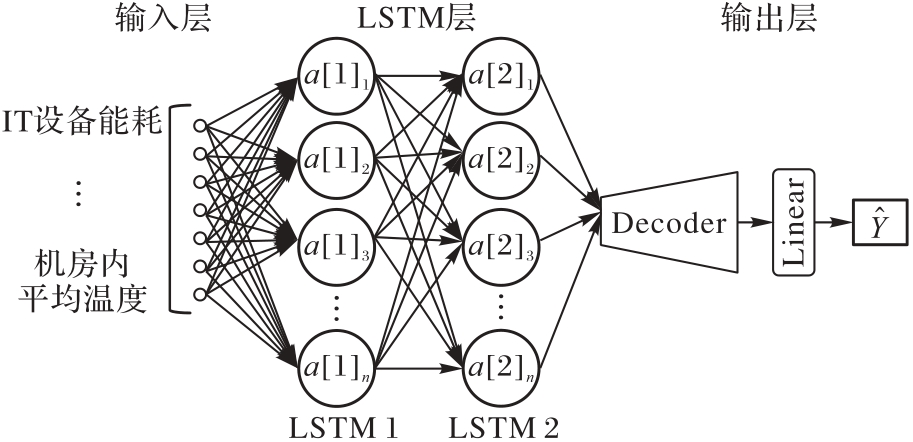
图1 LSTM-Transformer模型的结构
Fig. 1 Structure of LSTM-Transformer model
| 特征 | 维度 | 预处理 |
|---|---|---|
| 环境参数 | 6 | Z-score标准化 |
| 设备参数 | 2 | 归一化处理 |
| 历史前一时刻PUE | 1 | 直接拼接 |
表2 模型输入特征
Tab. 2 Model input features
| 特征 | 维度 | 预处理 |
|---|---|---|
| 环境参数 | 6 | Z-score标准化 |
| 设备参数 | 2 | 归一化处理 |
| 历史前一时刻PUE | 1 | 直接拼接 |
| 特征代码 | 物理意义 | 值域 |
|---|---|---|
| AC_dehumidify | 精密空调平均除湿状态 | 0~500 |
| AC_humidify | 精密空调平均加湿状态 | 0~1 000 |
| IT_power | IT设备能耗/kW | 38~46 |
| T_room | 机房平均温度/℃ | 24~28 |
| H_room | 机房平均湿度/% | 35~45 |
| T_power | 动力间温度/℃ | 23~27 |
| H_power | 动力间湿度/% | 40~50 |
| AC_air | 空调回风温度/℃ | 22~26 |
| 前一时刻PUE数值 | 1.5~2.0 |
表3 特征代码说明
Tab. 3 Feature code description
| 特征代码 | 物理意义 | 值域 |
|---|---|---|
| AC_dehumidify | 精密空调平均除湿状态 | 0~500 |
| AC_humidify | 精密空调平均加湿状态 | 0~1 000 |
| IT_power | IT设备能耗/kW | 38~46 |
| T_room | 机房平均温度/℃ | 24~28 |
| H_room | 机房平均湿度/% | 35~45 |
| T_power | 动力间温度/℃ | 23~27 |
| H_power | 动力间湿度/% | 40~50 |
| AC_air | 空调回风温度/℃ | 22~26 |
| 前一时刻PUE数值 | 1.5~2.0 |
| 超参数 | 参数候选值 |
|---|---|
| 学习率 | 0.001,0.01 |
| 批量大小 | 32,64 |
| Dropout率 | [0.2,0.4] |
| LSTM隐藏层维度 | 64,128 |
| LSTM隐藏层层数 | 1,2 |
| Transformer隐藏层维度 | 64,128 |
| Transformer层数 | 1,2 |
| 训练轮数 | [ |
表4 超参数范围
Tab. 4 Hyperparameter ranges
| 超参数 | 参数候选值 |
|---|---|
| 学习率 | 0.001,0.01 |
| 批量大小 | 32,64 |
| Dropout率 | [0.2,0.4] |
| LSTM隐藏层维度 | 64,128 |
| LSTM隐藏层层数 | 1,2 |
| Transformer隐藏层维度 | 64,128 |
| Transformer层数 | 1,2 |
| 训练轮数 | [ |
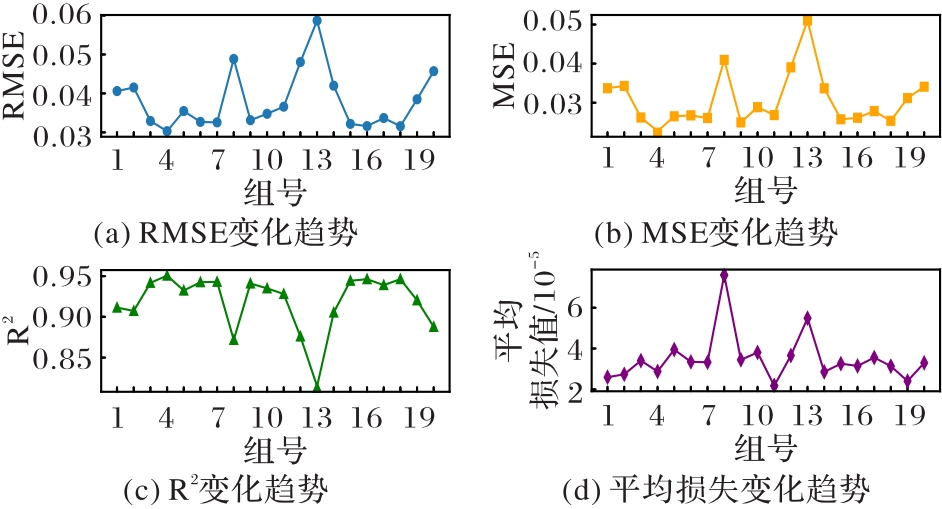
图2 超参数分析
Fig. 2 Hyperparameter analysis
| 序号 | 输入特征 | 序号 | 输入特征 | 序号 | 输入特征 |
|---|---|---|---|---|---|
| 1 | IT机房温度1(位置1) | 9 | IT机房温度5(位置5) | 17 | 精密空调1除湿状态 |
| 2 | IT机房湿度1(位置1) | 10 | IT机房湿度5(位置5) | 18 | 精密空调1加湿状态 |
| 3 | IT机房温度2(位置2) | 11 | IT机房温度6(位置6) | 19 | 精密空调2回风温度 |
| 4 | IT机房湿度2(位置2) | 12 | IT机房湿度6(位置6) | 20 | 精密空调2除湿状态 |
| 5 | IT机房温度3(位置3) | 13 | 动力间温度 | 21 | 精密空调2加湿状态 |
| 6 | IT机房湿度3(位置3) | 14 | 动力间湿度 | 22 | 精密空调3回风温度 |
| 7 | IT机房温度4(位置4) | 15 | IT负载 | 23 | 精密空调3除湿状态 |
| 8 | IT机房湿度4(位置4) | 16 | 精密空调1回风温度 | 24 | 精密空调3加湿状态 |
表5 原始采集特征
Tab. 5 Original acquisition features
| 序号 | 输入特征 | 序号 | 输入特征 | 序号 | 输入特征 |
|---|---|---|---|---|---|
| 1 | IT机房温度1(位置1) | 9 | IT机房温度5(位置5) | 17 | 精密空调1除湿状态 |
| 2 | IT机房湿度1(位置1) | 10 | IT机房湿度5(位置5) | 18 | 精密空调1加湿状态 |
| 3 | IT机房温度2(位置2) | 11 | IT机房温度6(位置6) | 19 | 精密空调2回风温度 |
| 4 | IT机房湿度2(位置2) | 12 | IT机房湿度6(位置6) | 20 | 精密空调2除湿状态 |
| 5 | IT机房温度3(位置3) | 13 | 动力间温度 | 21 | 精密空调2加湿状态 |
| 6 | IT机房湿度3(位置3) | 14 | 动力间湿度 | 22 | 精密空调3回风温度 |
| 7 | IT机房温度4(位置4) | 15 | IT负载 | 23 | 精密空调3除湿状态 |
| 8 | IT机房湿度4(位置4) | 16 | 精密空调1回风温度 | 24 | 精密空调3加湿状态 |
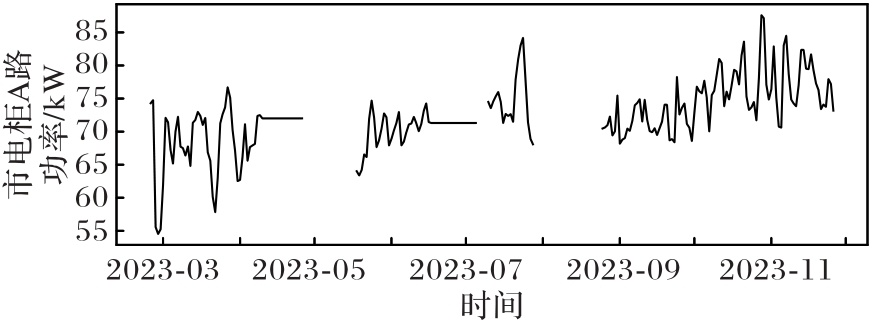
图3 动力间电柜的总功率
Fig. 3 Total power of electrical cabinet in power room
| 采集时间 | 温度1/℃ | 温度2/℃ | … | 湿度1/% | 湿度2/% | … | 动力间温度/℃ | 动力间湿度/% |
|---|---|---|---|---|---|---|---|---|
| 2023-03-13 T 00:00:08 | 25.2 | 22.3 | … | 40.7 | 46.8 | … | 23.2 | 42.5 |
| 2023-03-13 T 00:00:28 | 25.2 | 22.3 | … | 40.8 | 46.6 | … | 23.2 | 42.5 |
| 2023-03-13 T 00:00:48 | 25.2 | 22.3 | … | 40.7 | 46.6 | … | 23.1 | 42.5 |
| ︙ | ︙ | ︙ | ︙ | ︙ | ︙ | ︙ | ||
| 2023-03-13 T 23:59:06 | 24.6 | 22.5 | … | 40.4 | 44.9 | … | 23.1 | 41.7 |
| 2023-03-13 T 23:59:26 | 24.6 | 22.5 | … | 40.4 | 44.9 | … | 23.1 | 41.7 |
表6 典型风冷数据中心样例的数据集
Tab. 6 Dataset of typical air-cooled data center samples
| 采集时间 | 温度1/℃ | 温度2/℃ | … | 湿度1/% | 湿度2/% | … | 动力间温度/℃ | 动力间湿度/% |
|---|---|---|---|---|---|---|---|---|
| 2023-03-13 T 00:00:08 | 25.2 | 22.3 | … | 40.7 | 46.8 | … | 23.2 | 42.5 |
| 2023-03-13 T 00:00:28 | 25.2 | 22.3 | … | 40.8 | 46.6 | … | 23.2 | 42.5 |
| 2023-03-13 T 00:00:48 | 25.2 | 22.3 | … | 40.7 | 46.6 | … | 23.1 | 42.5 |
| ︙ | ︙ | ︙ | ︙ | ︙ | ︙ | ︙ | ||
| 2023-03-13 T 23:59:06 | 24.6 | 22.5 | … | 40.4 | 44.9 | … | 23.1 | 41.7 |
| 2023-03-13 T 23:59:26 | 24.6 | 22.5 | … | 40.4 | 44.9 | … | 23.1 | 41.7 |
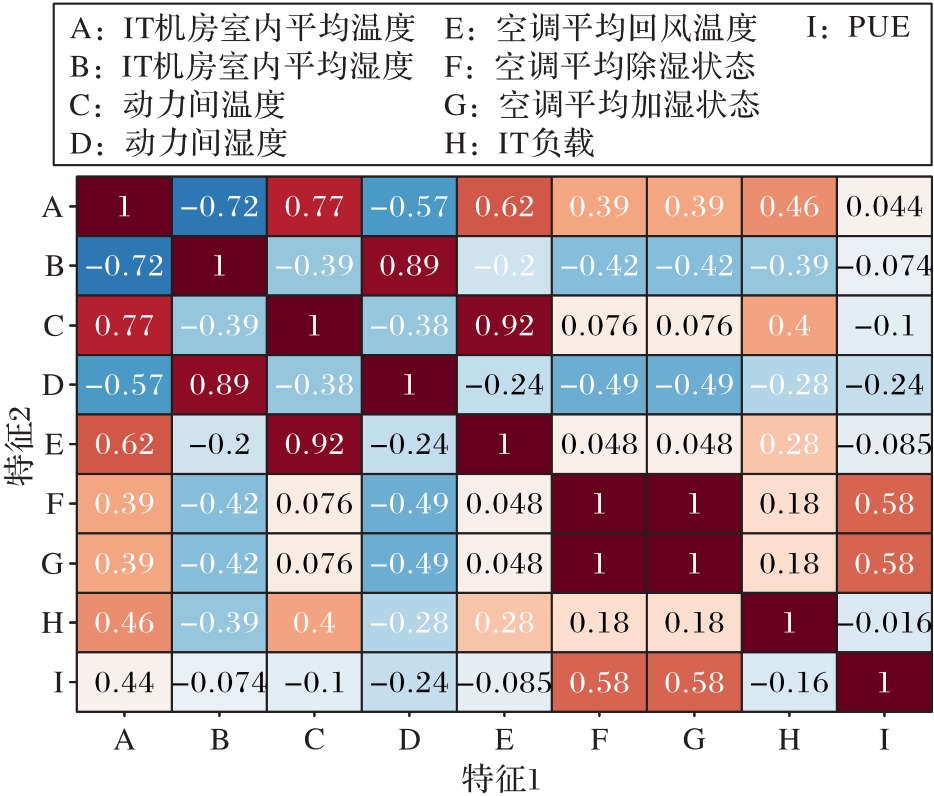
图4 特征间的Spearman相关系数的热力图
Fig. 4 Heatmap of Spearman correlation coefficients among different features
| 特征 | 重要性 |
|---|---|
| 精密空调平均除湿状态 | 0.361 364 |
| 精密空调平均加湿状态 | 0.323 583 |
| IT负载 | 0.114 897 |
| 动力间湿度 | 0.069 061 |
| IT机房室内平均温度 | 0.038 526 |
| IT机房室内平均湿度 | 0.033 612 |
| 空调平均回风温度 | 0.029 897 |
| 动力间温度 | 0.029 060 |
表7 前8位重要性的特征
Tab. 7 Features with rank-eight importance
| 特征 | 重要性 |
|---|---|
| 精密空调平均除湿状态 | 0.361 364 |
| 精密空调平均加湿状态 | 0.323 583 |
| IT负载 | 0.114 897 |
| 动力间湿度 | 0.069 061 |
| IT机房室内平均温度 | 0.038 526 |
| IT机房室内平均湿度 | 0.033 612 |
| 空调平均回风温度 | 0.029 897 |
| 动力间温度 | 0.029 060 |
| 模型 | MSE | MAE | |
|---|---|---|---|
| FNN[ | 0.002 3 | 0.034 8 | 0.881 3 |
| RF[ | 0.001 7 | 0.029 5 | 0.908 8 |
| GRU[ | 0.001 6 | 0.030 0 | 0.913 2 |
| LSTM[ | 0.001 5 | 0.029 9 | 0.906 7 |
| Transformer[ | 0.003 3 | 0.039 2 | 0.822 0 |
| LSTM-Transformer | 0.000 7 | 0.021 4 | 0.958 3 |
表8 模型预测效果
Tab. 8 Model prediction effects
| 模型 | MSE | MAE | |
|---|---|---|---|
| FNN[ | 0.002 3 | 0.034 8 | 0.881 3 |
| RF[ | 0.001 7 | 0.029 5 | 0.908 8 |
| GRU[ | 0.001 6 | 0.030 0 | 0.913 2 |
| LSTM[ | 0.001 5 | 0.029 9 | 0.906 7 |
| Transformer[ | 0.003 3 | 0.039 2 | 0.822 0 |
| LSTM-Transformer | 0.000 7 | 0.021 4 | 0.958 3 |

图5 4种模型的PUE预测结果
Fig. 5 PUE prediction results of four models
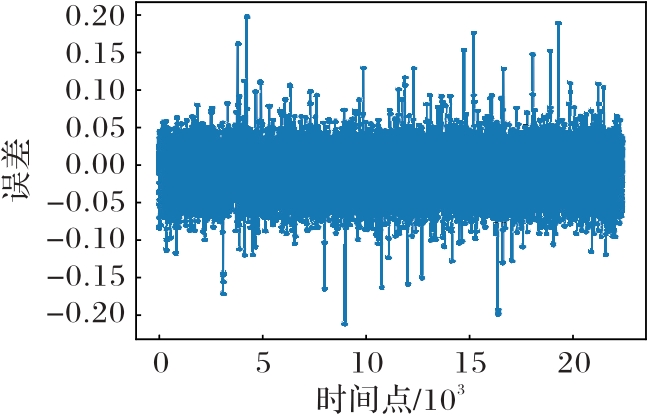
图6 LSTM-Transformer结果的误差
Fig. 6 Errors of LSTM-Transformer results
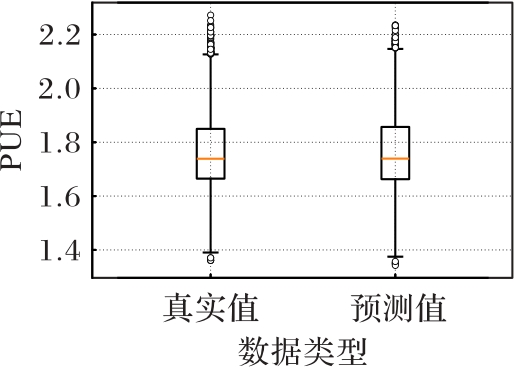
图7 LSTM-Transformer的箱线图
Fig. 7 Box plot of LSTM-Transformer
| [1] | Niewenhuis D, Talluri S, Iosup A, et al. FootPrinter: quantifying data center carbon footprint[C]// ICPE 2024. New York: ACM, 2024: 189-195. |
| [2] | 中国信息通信研究院,内蒙古和林格尔新区. 中国绿色算力发展研究报告(2024年)[R/OL]. (2024-06) [2025-07-10].. |
| China Academy of Information and Communications Technology, Horinger New Area. China green computing power development research report (2024)[R/OL]. (2024-06) [2025-07-10].. | |
| [3] | Chen L, Li X, Wang K, et al. Optimization of energy efficiency of data center cooling systems[C]// CCDC 2024. Piscataway: IEEE, 2024: 76-81. |
| [4] | 黄翔,郑竺凌,褚俊杰,等. 中小型数据中心冷却系统优化案例研究进展[J]. 制冷技术, 2024, 44(S1): 95-118. |
| Huang Xiang, Zheng Zhuling, Chu Junjie, et al. Research progress of optimization cases for cooling system in small and medium-sized data centers[J]. Chinese Journal of Refrigeration Technology, 2024, 44(S1): 95-118. | |
| [5] | 王继业,周碧玉,张法,等. 数据中心能耗模型及能效算法综述[J]. 计算机研究与发展, 2019, 56(8): 1587-1603. |
| Wang Jiye, Zhou Biyu, Zhang Fa, et al. Data center energy consumption models and efficient algorithms[J]. Journal of Computer Research and Development, 2019, 56(8): 1587-1603. | |
| [6] | 陈心拓,周黎旸,张程宾,等. 绿色高能效数据中心散热冷却技术研究现状及发展趋势[J]. 中国工程科学, 2022, 24(4): 94-104. |
| Chen Xintuo, Zhou Liyang, Zhang Chengbin, et al. Research status and future development of cooling technologies for green and energy-efficient data centers[J]. Strategic Study of CAE, 2022, 24(4): 94-104. | |
| [7] | 王博,郭焱华,邵双全,等. 数据中心冷却系统相关能效评价指标综述[J]. 制冷学报, 2023, 44(2): 18-27. |
| Wang Bo, Guo Yanhua, Shao Shuangquan, et al. Review of energy efficiency evaluation indexes related to data center cooling systems[J]. Journal of Refrigeration, 2023, 44(2): 18-27. | |
| [8] | Greenberg S, Herrlin M. Small data centers, big energy savings: an introduction for owners and operators[R/OL]. (2017-04) [2025-07-10].. |
| [9] | Ganeshalingam M, Shehabi A, Desroches L B. Shining a light on small data centers in the U.S.: LBNL-2001025[R/OL]. (2017-06) [2025-07-10].. |
| [10] | Vasques T L, Moura P, de Almeida A. A review on energy efficiency and demand response with focus on small and medium data centers[J]. Energy Efficiency, 2019, 12(5): 1399-1428. |
| [11] | Donnellan D, Davis J, Lawrence A, et al. Uptime Institute global data center survey 2024[R/OL]. (2024-07) [2025-07-10].. |
| [12] | Hochreiter S, Schmidhuber J. Long short-term memory[J]. Neural Computation, 1997, 9(8): 1735-1780. |
| [13] | Vaswani A, Shazeer N, Parmar N, et al. Attention is all you need[C]// NeurIPS 2017. Red Hook: Curran Associates Inc., 2017: 6000-6010. |
| [14] | Liu N, Lin X, Wang Y. Data center power management for regulation service using neural network-based power prediction[C]// ISQED 2017. Piscataway: IEEE, 2017: 367-372. |
| [15] | Gao J. Machine learning applications for data center optimization[EB/OL]. (2014-08) [2025-07-10].. |
| [16] | Kalle C, Chen C S, Li S Y, et al. Genetic algorithm-determined artificial neural network architecture for predicting Power Usage Effectiveness (PUE) in a data center[C]// ARIS 2022. Piscataway: IEEE, 2022: 1-5. |
| [17] | Ounifi H A, Gherbi A, Kara N. Deep machine learning-based power usage effectiveness prediction for sustainable cloud infrastructures[J]. Sustainable Energy Technologies and Assessments, 2022, 52(Pt A): No.101967. |
| [18] | Yang Z, Du J, Lin Y, et al. Increasing the energy efficiency of a data center based on machine learning[J]. Journal of Industrial Ecology, 2022, 26(1): 323-335. |
| [19] | 杨震,赵静洲,林依挺,等. 数据中心PUE能效优化的机器学习方法[J]. 系统工程理论与实践, 2022, 42(3): 801-810. |
| Yang Zhen, Zhao Jingzhou, Lin Yiting, et al. Data center PUE optimization based on machine learning[J]. Systems Engineering - Theory and Practice, 2022, 42(3): 801-810. | |
| [20] | Yu T, Zhu H. Hyper-parameter optimization: a review of algorithms and applications[PP/OL]. arXiv (2016-03-12) [2025-07-10].. |
| [21] | Zhang Y, Yang Y. Cross-validation for selecting a model selection procedure[J]. Journal of Econometrics, 2015, 187(1): 95-112. |
| [22] | Zou D, Xiang Y, Zhou T, et al. Outlier detection and data filling based on KNN and LOF for power Transformer operation data classification[J]. Energy Reports, 2023, 9(S7): 698-711. |
| [23] | Breiman L. Random forests[J]. Machine Learning, 2001, 45(1): 5-32. |
| [24] | Rumelhart D E, Hinton G E, Williams R J. Learning representations by back-propagating errors[J]. Nature, 1986, 323(6088): 533-536. |
| [25] | Cho K, van Merriënboer B, Gulcehre C, et al. Learning phrase representations using RNN encoder-decoder for statistical machine translation[C]// EMNLP 2014. Stroudsburg: ACL, 2014: 1724-1734. |
| [1] | 方和平, 刘曙光, 冉泳屹, 钟坤华. 基于深度强化学习的多数据中心一体化调度优化[J]. 《计算机应用》唯一官方网站, 2023, 43(6): 1884-1892. |
| [2] | 代荣荣, 李宏慧, 付学良. 基于差分进化融合蚁群算法的数据中心流量调度机制[J]. 《计算机应用》唯一官方网站, 2022, 42(12): 3863-3869. |
| [3] | 申明尧, 韩萌, 杜诗语, 孙蕊, 张春砚. 融合XGBoost和Multi-GRU的数据中心服务器能耗优化算法[J]. 《计算机应用》唯一官方网站, 2022, 42(1): 198-208. |
| [4] | 蔡豪, 袁正道. 云数据中心基于贪心模式的虚拟机选择算法[J]. 计算机应用, 2020, 40(6): 1707-1713. |
| [5] | 李启锐, 彭志平, 崔得龙, 何杰光. 容器云环境虚拟资源配置策略的优化[J]. 计算机应用, 2019, 39(3): 784-789. |
| [6] | 蔺凯青, 李志华, 郭曙杰, 李双俐. 云环境中多目标优化的虚拟机放置算法[J]. 计算机应用, 2019, 39(12): 3597-3603. |
| [7] | 刘开南. 云数据中心基于贪心算法的虚拟机迁移策略[J]. 计算机应用, 2019, 39(11): 3333-3338. |
| [8] | 李双俐, 李志华, 喻新荣, 闫成雨. 基于负载不确定性的虚拟机整合方法[J]. 计算机应用, 2018, 38(6): 1658-1664. |
| [9] | 赵春, 闫连山, 崔允贺, 邢焕来, 冯斌. 基于动态调整阈值的虚拟机迁移算法[J]. 计算机应用, 2017, 37(9): 2547-2550. |
| [10] | 夏羽, 廖苹秀, 崔雷. 数据中心中TCP连接建立过程的优化方法[J]. 计算机应用, 2017, 37(8): 2157-2162. |
| [11] | 蔡岳平, 张文鹏, 罗森. 基于最小接入保证带宽的数据中心网络带宽分配机制[J]. 计算机应用, 2017, 37(7): 1825-1829. |
| [12] | 薛弘晔, 朱天磊, 罗香玉, 冯健. 基于资源需求分布特征的异构云环境虚拟机放置算法[J]. 计算机应用, 2017, 37(12): 3386-3390. |
| [13] | 王仁群, 彭力. 数据中心网络拓扑感知型拥塞控制算法[J]. 计算机应用, 2016, 36(9): 2357-2361. |
| [14] | 孙三山, 汪帅, 樊自甫. 软件定义网络架构下基于流调度代价的数据中心网络拥塞控制路由算法[J]. 计算机应用, 2016, 36(7): 1784-1788. |
| [15] | 任红格, 李冬梅, 李福进. 基于半监督学习的动态神经网络结构设计[J]. 计算机应用, 2016, 36(3): 703-707. |
| 阅读次数 | ||||||
|
全文 |
|
|||||
|
摘要 |
|
|||||
