


《计算机应用》唯一官方网站 ›› 2026, Vol. 46 ›› Issue (10): 3280-3287.DOI: 10.11772/j.issn.1001-9081.2025091111
• 先进计算 • 上一篇
陶富悦1,2, 王磊1,2( ), 黎敏1,2
收稿日期:2025-09-23
修回日期:2025-12-26
接受日期:2025-12-30
发布日期:2026-03-18
出版日期:2026-10-10
通讯作者:
王磊
作者简介:陶富悦(2001—),女,安徽六安人,硕士研究生,主要研究方向:粒计算、粗糙集基金资助:
Fuyue TAO1,2, Lei WANG1,2(), Min LI1,2
Received:2025-09-23
Revised:2025-12-26
Accepted:2025-12-30
Online:2026-03-18
Published:2026-10-10
Contact:
Lei WANG
About author:TAO Fuyue, born in 2001, M. S. candidate. Her research interests include granular computing, rough set.Supported by:摘要:
传统的多属性决策(MADM)方法基于二支决策,即接受和拒绝,而三支决策(3WD)通过增加一个延迟决策降低决策风险。在当前复杂多变的决策环境下,利用3WD为MADM提供解决方案已经成为一个热门研究。本文提出一种基于毕达哥拉斯模糊数(PFN)相似度的效用三支多属性决策模型。首先,将相对效用函数拓展到毕达哥拉斯模糊环境下,结合PFN的相似度度量,建立一个基于相似度的相对效用函数;其次,利用记分函数得到理想优、劣母序列,结合PFN的距离度量计算灰色关联系数,进而提出一种基于灰色关联分析(GRA)的条件概率计算方法;在此基础上,利用期望效用引入排序策略得到基于PFN相似度的效用三支多属性决策模型。通过开发新的生活垃圾处理厂中的选址评估案例,验证该方法的可行性。实验结果表明,该方法可以精准划分方案分类,降低决策风险的可行性,相较于传统MADM方法,以客观权重结合3WD分类,突破了仅排序局限;相较于三支MADM方法,经灰色关联优化条件概率,更贴合3WD的分类逻辑。
中图分类号:
陶富悦, 王磊, 黎敏. 毕达哥拉斯模糊环境下基于效用三支决策的多属性决策方法[J]. 计算机应用, 2026, 46(10): 3280-3287.
Fuyue TAO, Lei WANG, Min LI. Multi-attribute decision-making method based on utility three-way decision in Pythagorean fuzzy environments[J]. Journal of Computer Applications, 2026, 46(10): 3280-3287.
| 行动 | ||
|---|---|---|
表2 单个属性下的相对效用函数
Tab. 2 Relative utility function under single attribute
| 行动 | ||
|---|---|---|
| 行动 | ||
|---|---|---|
表3 基于相似度的综合相对效用函数
Tab. 3 Comprehensive relative utility function based on similarity
| 行动 | ||
|---|---|---|
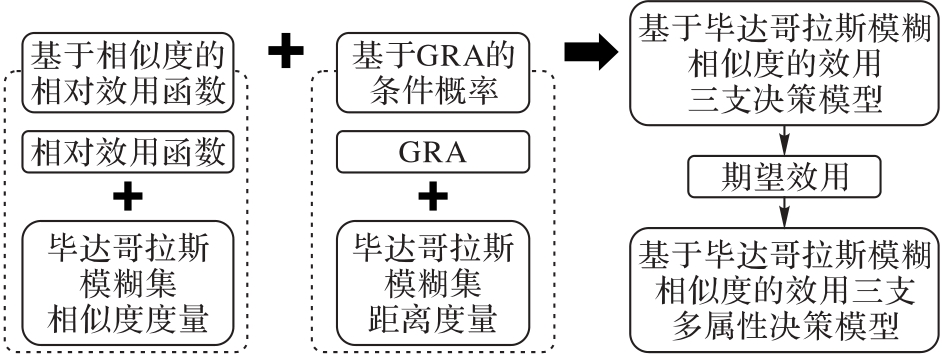
图1 模型框架
Fig. 1 Model framework
| 备选方案 | ||||||
|---|---|---|---|---|---|---|
| (0.38, 0.60) | (0.81, 0.38) | (0.75, 0.35) | (0.77, 0.19) | (0.72, 0.18) | (0.70, 0.43) | |
| (0.70, 0.22) | (0.34, 0.40) | (0.31, 0.74) | (0.48, 0.33) | (0.30, 0.68) | (0.24, 0.76) | |
| (0.64, 0.15) | (0.66, 0.37) | (0.83, 0.32) | (0.39, 0.63) | (0.82, 0.47) | (0.87, 0.20) | |
| (0.81, 0.33) | (0.45, 0.33) | (0.60, 0.26) | (0.78, 0.43) | (0.37, 0.53) | (0.21, 0.73) | |
| (0.14, 0.62) | (0.16, 0.61) | (0.21, 0.55) | (0.81, 0.35) | (0.15, 0.53) | (0.75, 0.13) |
表4 毕达哥拉斯模糊信息系统
Tab. 4 Pythagorean fuzzy information system
| 备选方案 | ||||||
|---|---|---|---|---|---|---|
| (0.38, 0.60) | (0.81, 0.38) | (0.75, 0.35) | (0.77, 0.19) | (0.72, 0.18) | (0.70, 0.43) | |
| (0.70, 0.22) | (0.34, 0.40) | (0.31, 0.74) | (0.48, 0.33) | (0.30, 0.68) | (0.24, 0.76) | |
| (0.64, 0.15) | (0.66, 0.37) | (0.83, 0.32) | (0.39, 0.63) | (0.82, 0.47) | (0.87, 0.20) | |
| (0.81, 0.33) | (0.45, 0.33) | (0.60, 0.26) | (0.78, 0.43) | (0.37, 0.53) | (0.21, 0.73) | |
| (0.14, 0.62) | (0.16, 0.61) | (0.21, 0.55) | (0.81, 0.35) | (0.15, 0.53) | (0.75, 0.13) |
| 效用函数 | |||||
|---|---|---|---|---|---|
| 0.876 0 | 0.584 7 | 0.813 3 | 0.687 0 | 0.593 4 | |
| 0.613 2 | 0.409 3 | 0.569 3 | 0.480 9 | 0.415 4 | |
| 0.420 2 | 0.597 7 | 0.402 6 | 0.499 1 | 0.535 9 | |
| 0.600 3 | 0.853 9 | 0.575 1 | 0.713 0 | 0.765 6 |
表5 针对算例的基于相似度的综合相对效用函数
Tab. 5 Comprehensive relative utility function based on similarity for instance
| 效用函数 | |||||
|---|---|---|---|---|---|
| 0.876 0 | 0.584 7 | 0.813 3 | 0.687 0 | 0.593 4 | |
| 0.613 2 | 0.409 3 | 0.569 3 | 0.480 9 | 0.415 4 | |
| 0.420 2 | 0.597 7 | 0.402 6 | 0.499 1 | 0.535 9 | |
| 0.600 3 | 0.853 9 | 0.575 1 | 0.713 0 | 0.765 6 |
| 备选方案 | |||
|---|---|---|---|
| 0.615 2 | 0.227 0 | 0.657 6 | |
| 0.773 1 | 0.384 9 | 0.350 7 | |
| 0.622 6 | 0.232 6 | 0.600 8 | |
| 0.707 7 | 0.307 9 | 0.498 4 | |
| 0.750 7 | 0.356 1 | 0.406 4 |
表6 决策阈值
Tab. 6 Decision thresholds
| 备选方案 | |||
|---|---|---|---|
| 0.615 2 | 0.227 0 | 0.657 6 | |
| 0.773 1 | 0.384 9 | 0.350 7 | |
| 0.622 6 | 0.232 6 | 0.600 8 | |
| 0.707 7 | 0.307 9 | 0.498 4 | |
| 0.750 7 | 0.356 1 | 0.406 4 |
| POS | BND | NEG | |
|---|---|---|---|
| 0.1 | |||
| 0.3 | |||
| 0.5 | |||
| 0.7 | |||
| 0.9 |
表7 参数ξ对分类结果的影响
Tab. 7 Impact of parameter ξ on classification results
| POS | BND | NEG | |
|---|---|---|---|
| 0.1 | |||
| 0.3 | |||
| 0.5 | |||
| 0.7 | |||
| 0.9 |
| 方法 | 排序结果 |
|---|---|
| 本文方法 | |
| 文献[ | |
| 文献[ | |
| 文献[ |
表8 不同MADM方法的排序结果
Tab. 8 Ranking results of different MADM methods
| 方法 | 排序结果 |
|---|---|
| 本文方法 | |
| 文献[ | |
| 文献[ | |
| 文献[ |
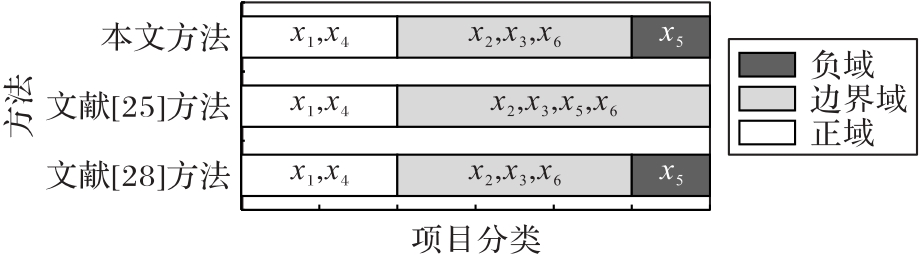
图2 不同三支MADM方法的分类结果
Fig. 2 Classification results of different three-way MADM methods
| 方法 | 排序结果 |
|---|---|
| 本文方法 | |
| 文献[ | |
| 文献[ |
表9 不同三支MADM方法的排序结果
Tab. 9 Ranking results of different three-way MADM methods
| 方法 | 排序结果 |
|---|---|
| 本文方法 | |
| 文献[ | |
| 文献[ |
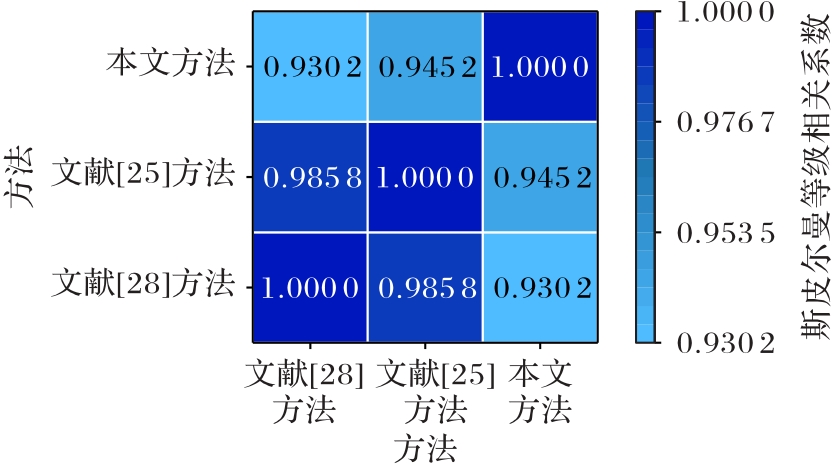
图3 3种方法排序结果的斯皮尔曼等级相关系数
Fig. 3 Spearman’s rank correlation coefficient of ranking results of three methods
| 方法 | 损失/效用 函数 | 条件概率 | 权重 |
|---|---|---|---|
| 本文方法 | 效用 | GRA | 最大偏差法 |
| 文献[ | 效用 | 毕达哥拉斯模糊相似度 | 无 |
| 文献[ | 损失 | TOPSIS | 最大偏差法 |
表10 3种方法的理论分析
Tab. 10 Theoretical analysis of three methods
| 方法 | 损失/效用 函数 | 条件概率 | 权重 |
|---|---|---|---|
| 本文方法 | 效用 | GRA | 最大偏差法 |
| 文献[ | 效用 | 毕达哥拉斯模糊相似度 | 无 |
| 文献[ | 损失 | TOPSIS | 最大偏差法 |
| 数据集 | 方案数 | 属性数 | 平均运行时间/ms |
|---|---|---|---|
| D1 | 5 | 6 | 12.3 |
| D2 | 10 | 6 | 38.7 |
| D3 | 30 | 10 | 425.1 |
| D4 | 100 | 15 | 8 324.9 |
表11 不同数据规模下的运行时间
Tab. 11 Running time under different data scales
| 数据集 | 方案数 | 属性数 | 平均运行时间/ms |
|---|---|---|---|
| D1 | 5 | 6 | 12.3 |
| D2 | 10 | 6 | 38.7 |
| D3 | 30 | 10 | 425.1 |
| D4 | 100 | 15 | 8 324.9 |
| [1] | Zarbakhshnia N, Wu Y, Govindan K, et al. A novel hybrid multiple attribute decision-making approach for outsourcing sustainable reverse logistics[J]. Journal of Cleaner Production, 2020, 242: No.118461. |
| [2] | Shen F, Huang Q, Su H, et al. An outranking approach for multi-attribute group decision-making with interval-valued hesitant fuzzy information[J]. Engineering Applications of Artificial Intelligence, 2024, 137(Pt A): No.109120. |
| [3] | Mendonça G H M, Ferreira F G D C, Cardoso R T N, et al. Multi-attribute decision making applied to financial portfolio optimization problem[J]. Expert Systems with Applications, 2020, 158: No.113527. |
| [4] | Konneh K V, Adewuyi O B, Gamil M M, et al. A scenario-based multi-attribute decision making approach for optimal design of a hybrid off-grid system[J]. Energy, 2023, 265: No.125663. |
| [5] | Yao Y. Three-way decisions with probabilistic rough sets[J]. Information Sciences, 2010, 180(3): 341-353. |
| [6] | Jia F, Liu P. A novel three-way decision model under multiple-criteria environment[J]. Information Sciences, 2019, 471: 29-51. |
| [7] | Zhang Q, Xie Q, Wang G. A novel three-way decision model with decision-theoretic rough sets using utility theory[J]. Knowledge-Based Systems, 2018, 159: 321-335. |
| [8] | Zhan J, Ye J, Ding W, et al. A novel three-way decision model based on utility theory in incomplete fuzzy decision systems[J]. IEEE Transactions on Fuzzy Systems, 2022, 30(7): 2210-2226. |
| [9] | Qi Z, Li H, Zhang K, et al. An attribute fuzzy concept-oriented three-way utility decision model in multi-attribute environments[J]. Applied Soft Computing, 2023, 143: No.110353. |
| [10] | Zhang K, Dai J, Xu Z. The criterion-oriented three-way ranking and clustering strategies in fuzzy decision environments[J]. IEEE Transactions on Fuzzy Systems, 2022, 30(9): 3841-3856. |
| [11] | Chen X Z, Zou L G. Three-way decision models based on ideal relations in multi-attribute decision-making[J]. Entropy, 2022, 24(7): No.986. |
| [12] | Zhan J, Jiang H, Yao Y. Three-way multiattribute decision-making based on outranking relations[J]. IEEE Transactions on Fuzzy Systems, 2021, 29(10): 2844-2858. |
| [13] | Ye J, Zhan J, Xu Z. A novel decision-making approach based on three-way decisions in fuzzy information systems[J]. Information Sciences, 2020, 541: 362-390. |
| [14] | Zadeh L. Fuzzy sets[J]. Information and Control, 1965, 8(3): 338-353. |
| [15] | Atanassov K T. Intuitionistic fuzzy sets[J]. Fuzzy Sets and Systems, 1986, 20(1): 87-96. |
| [16] | Yager R R. Pythagorean fuzzy subsets[C]// IFSA/NAFIPS 2013. Piscataway: IEEE, 2013: 57-61. |
| [17] | Ren P, Xu Z, Gou X. Pythagorean fuzzy TODIM approach to multi-criteria decision making[J]. Applied Soft Computing, 2016, 42: 246-259. |
| [18] | 李德清,曾文艺,尹乾. 勾股模糊集的距离测度及其在多属性决策中的应用[J]. 控制与决策, 2017, 32(10): 1817-1823. |
| Li Deqing, Zeng Wenyi, Yin Qian. Distance measures of Pythagorean fuzzy sets and their applications in multi-attribute decision making[J]. Control and Decision, 2017, 32(10): 1817-1823. | |
| [19] | 蔡香香,王磊,王冲,等. 一种结合勾股模糊相似度的多属性决策方法[J]. 南京大学学报(自然科学), 2023, 59(1): 35-42. |
| Cai Xiangxiang, Wang Lei, Wang Chong, et al. A multi-attribute decision-making approach with Pythagorean fuzzy similarity[J]. Journal of Nanjing University (Natural Sciences), 2023, 59(1): 35-42. | |
| [20] | Zhang X L, Xu Z S. Extension of TOPSIS to multiple criteria decision making with Pythagorean fuzzy sets[J]. International Journal of Intelligent Systems, 2014, 29(12): 1061-1078. |
| [21] | Wang H, He S, Li C, et al. Pythagorean uncertain linguistic variable Hamy mean operator and its application to multi-attribute group decision making[J]. IEEE/CAA Journal of Automatica Sinica, 2019, 6(2): 527-539. |
| [22] | 陈六新,罗南方. 基于前景理论的勾股模糊多属性决策[J]. 系统工程理论与实践, 2020, 40(3): 726-735. |
| Chen Liuxin, Luo Nanfang. Pythagorean fuzzy multi-criteria decision-making based on prospect theory[J]. Systems Engineering — Theory and Practice, 2020, 40(3): 726-735. | |
| [23] | Liu P, Wang Y, Jia F, et al. A multiple attribute decision making three-way model for intuitionistic fuzzy numbers[J]. International Journal of Approximate Reasoning, 2020, 119: 177-203. |
| [24] | Zhang H, Liu Y, Selang D, et al. A three-way decision with prospect-regret theory under Pythagorean fuzzy environments[J]. Applied Soft Computing, 2024, 167(Pt A): No.112286. |
| [25] | Liang D, Xu Z, Liu D, et al. Method for three-way decisions using ideal TOPSIS solutions at Pythagorean fuzzy information[J]. Information Sciences, 2018, 435: 282-295. |
| [26] | Wang Y. Using the method of maximizing deviation to make decision for multi-indices[J]. Journal of Systems Engineering and Electronics, 1997, 8(3): 21-26. |
| [27] | Zhang C, Hu Q, Zeng S, et al. IOWLAD-based MCDM model for the site assessment of a household waste processing plant under a Pythagorean fuzzy environment[J]. Environmental Impact Assessment Review, 2021, 89: No.106579. |
| [28] | Yi J H, Liu Y, Forrest J Y L, et al. A three-way decision approach with S-shaped utility function under Pythagorean fuzzy information[J]. Expert Systems with Applications, 2022, 210: No.118370. |
| [1] | 余鹰, 朱锋, 付红剑, 罗逸文, 钱进, 郑宇超. 联合三支决策与熵权TOPSIS的专家反评估模型[J]. 《计算机应用》唯一官方网站, 2025, 45(5): 1424-1431. |
| [2] | 罗欣洋, 万武南, 张仕斌, 张金全. 基于区块链和多属性决策的车联网信任管理方案[J]. 《计算机应用》唯一官方网站, 2025, 45(11): 3470-3476. |
| [3] | 姜春茂, 吴鹏, 李志聪. 基于Seeds集和成对约束的半监督三支聚类集成[J]. 《计算机应用》唯一官方网站, 2023, 43(5): 1481-1488. |
| [4] | 宁明超, 张俊勃, 陈戈. 基于面向服务架构的工业软件的任务调度算法[J]. 《计算机应用》唯一官方网站, 2023, 43(3): 885-893. |
| [5] | 郝志刚, 秦丽. 基于多属性综合评价的食品安全标准引用网络重要节点发现方法[J]. 《计算机应用》唯一官方网站, 2022, 42(4): 1178-1185. |
| [6] | 越凯强, 李波, 范盘龙. 基于三支决策的飞机空战机动决策方法[J]. 《计算机应用》唯一官方网站, 2022, 42(2): 616-621. |
| [7] | 张师鹏, 李永忠, 杜祥通. 基于半监督学习和三支决策的入侵检测模型[J]. 计算机应用, 2021, 41(9): 2602-2608. |
| [8] | 杨翎, 姜春茂. 基于三支决策的虚拟机节能迁移策略[J]. 计算机应用, 2021, 41(4): 990-998. |
| [9] | 任杰, 闵帆, 汪敏. 基于最远总距离采样的代价敏感主动学习[J]. 计算机应用, 2019, 39(9): 2499-2504. |
| [10] | 付立东, 郝伟, 李丹, 李凡. 基于共邻节点相似度的社区划分算法[J]. 计算机应用, 2019, 39(7): 2024-2029. |
| [11] | 彭定洪, 杨扬. 基于毕达哥拉斯模糊Frank算子的多属性决策方法[J]. 计算机应用, 2019, 39(2): 316-322. |
| [12] | 滕磊, 李苑, 李智星, 胡峰. 基于知识图嵌入的跨社交网络用户对齐算法[J]. 计算机应用, 2019, 39(11): 3198-3203. |
| [13] | 徐健锋, 邹伟康, 梁伟, 程高洁, 张远健. 面向聚类集成的基聚类三支筛选方法[J]. 计算机应用, 2019, 39(11): 3120-3126. |
| [14] | 万志超, 胡峰, 邓维斌. 面向不平衡文本情感分类的三支决策特征选择方法[J]. 计算机应用, 2019, 39(11): 3127-3133. |
| [15] | 李帅, 王国胤, 杨洁. 基于云综合方法的三支群决策模型[J]. 计算机应用, 2019, 39(11): 3163-3171. |
| 阅读次数 | ||||||
|
全文 |
|
|||||
|
摘要 |
|
|||||
