


《计算机应用》唯一官方网站 ›› 2026, Vol. 46 ›› Issue (10): 3065-3075.DOI: 10.11772/j.issn.1001-9081.2025091152
• 人工智能 •
王涵, 于瑞祺, 任爽( )
收稿日期:2025-09-29
修回日期:2025-12-09
接受日期:2025-12-12
发布日期:2025-12-26
出版日期:2026-10-10
通讯作者:
任爽
作者简介:王涵(2001—),男,山西大同人,硕士研究生,主要研究方向:人工智能、量子计算基金资助:
Han WANG, Ruiqi YU, Shuang REN()
Received:2025-09-29
Revised:2025-12-09
Accepted:2025-12-12
Online:2025-12-26
Published:2026-10-10
Contact:
Shuang REN
About author:WANG Han, born in 2001, M. S. candidate. His research interests include artificial intelligence, quantum computing.Supported by:摘要:
神经架构搜索(NAS)通过自动化设计神经网络结构,突破传统手动设计的试错局限,显著降低了深度学习模型开发对专业经验的依赖,且大幅提升了模型表现。在众多方法中,可微神经架构搜索(DNAS)借助one-shot框架与梯度下降优化大幅缩短了搜索时间,已成为当前研究的主流方向。然而,现有研究仍缺乏对可微方法及其发展脉络的系统化梳理。为了填补相关空白并为相关研究提供参考,对近年来出现的DNAS方法进行归纳分析。首先,介绍DNAS算法的基本理论和基准数据集,并梳理DNAS的现存挑战;其次,对现有的DNAS算法进行层次化分析;最后,展望DNAS未来的发展方向。
中图分类号:
王涵, 于瑞祺, 任爽. 可微神经架构搜索方法综述[J]. 计算机应用, 2026, 46(10): 3065-3075.
Han WANG, Ruiqi YU, Shuang REN. Survey on differentiable neural architecture search methods[J]. Journal of Computer Applications, 2026, 46(10): 3065-3075.
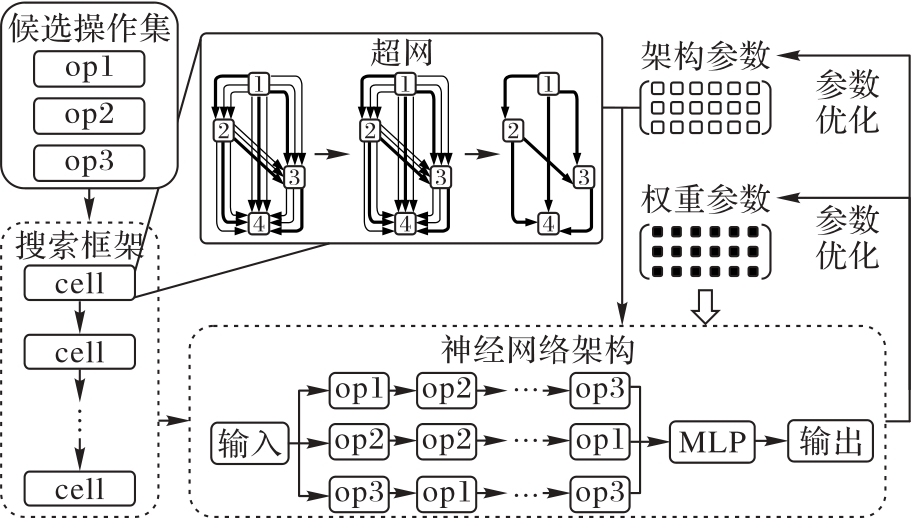
图1 DNAS基本范式
Fig. 1 Basic paradigm of DNAS
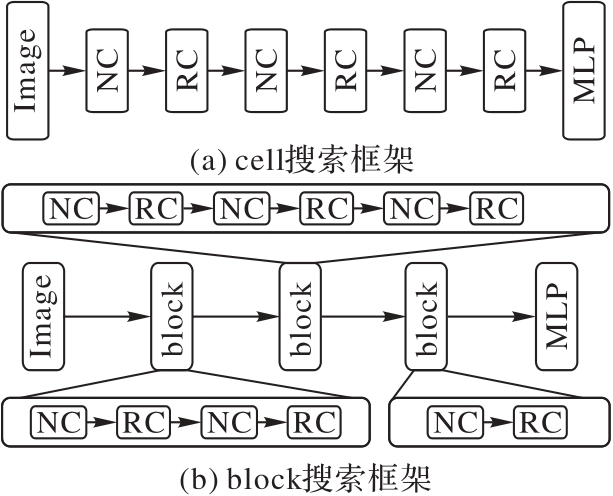
图2 DNAS基本框架
Fig. 2 Basic frameworks of DNAS
| 操作集 | 包含操作 |
|---|---|
| DARTS[ | 3×3和5×5深度可分离卷积,3×3和5×5 扩张深度可分离卷积,3×3最大池化, 3×3平均池化,跳跃连接,零映射 |
| MobileNetV2 | 3×3MBConv,5×5MBConv,7×7MBConv, 跳跃连接,零映射 |
| NAS-Bench-101[ | 1×1卷积,3×3卷积,3×3最大池化 |
| NAS-Bench-201[ | 1×1卷积,3×3卷积,3×3平均池化, 跳跃连接,零映射 |
表1 常见操作集
Tab. 1 Common operation sets
| 操作集 | 包含操作 |
|---|---|
| DARTS[ | 3×3和5×5深度可分离卷积,3×3和5×5 扩张深度可分离卷积,3×3最大池化, 3×3平均池化,跳跃连接,零映射 |
| MobileNetV2 | 3×3MBConv,5×5MBConv,7×7MBConv, 跳跃连接,零映射 |
| NAS-Bench-101[ | 1×1卷积,3×3卷积,3×3最大池化 |
| NAS-Bench-201[ | 1×1卷积,3×3卷积,3×3平均池化, 跳跃连接,零映射 |
| 基准 | 数据集 | 搜索空间 | 包含已测试架构数 | 测试算法 |
|---|---|---|---|---|
| NAS-Bench-101[ | CIFAR-10 | NAS-Bench-101 | 423 000 | 无 |
| NAS-Bench-1Shot1[ | CIFAR-10 | NAS-Bench-101 | 423 000 | iDARTS[ |
| NAS-Bench-201[ | CIFAR-10,CIFAR-100, ImageNet | NAS-Bench-201 | 16 000 | iDARTS[ Fa[ SP-DARTS[ |
| NATS-Bench[ | CIFAR-10,CIFAR-100, ImageNet | NAS-Bench-201 | 48 000 | CDARTS[ |
| NAS-Bench-301[ | 自定义数据集 | DARTS | 使用代理模型实时计算 | 无 |
| NAS-Bench-360[ | 10个数据集 | 允许自定义搜索空间 | 15 000 | 无 |
表2 DNAS算法的基准测试
Tab. 2 Benchmark tests for DNAS algorithms
| 基准 | 数据集 | 搜索空间 | 包含已测试架构数 | 测试算法 |
|---|---|---|---|---|
| NAS-Bench-101[ | CIFAR-10 | NAS-Bench-101 | 423 000 | 无 |
| NAS-Bench-1Shot1[ | CIFAR-10 | NAS-Bench-101 | 423 000 | iDARTS[ |
| NAS-Bench-201[ | CIFAR-10,CIFAR-100, ImageNet | NAS-Bench-201 | 16 000 | iDARTS[ Fa[ SP-DARTS[ |
| NATS-Bench[ | CIFAR-10,CIFAR-100, ImageNet | NAS-Bench-201 | 48 000 | CDARTS[ |
| NAS-Bench-301[ | 自定义数据集 | DARTS | 使用代理模型实时计算 | 无 |
| NAS-Bench-360[ | 10个数据集 | 允许自定义搜索空间 | 15 000 | 无 |

图3 DNAS挑战与研究方向之间的对应关系
Fig. 3 Correspondence between DNAS challenges and research directions
| 算法优化层级 | 算法研究点 |
|---|---|
| 搜索目标优化 | 搜索评价方法,硬件延迟约束 |
| 搜索步骤优化 | 采样方法,搜索框架优化,参数优化策略 |
| 搜索策略优化 | 剪枝方法,渐进式优化,联合优化与蒸馏方法, 变分算法,结合方法 |
表3 DNAS研究内容的层级
Tab. 3 Hierarchical structure of DNAS research content
| 算法优化层级 | 算法研究点 |
|---|---|
| 搜索目标优化 | 搜索评价方法,硬件延迟约束 |
| 搜索步骤优化 | 采样方法,搜索框架优化,参数优化策略 |
| 搜索策略优化 | 剪枝方法,渐进式优化,联合优化与蒸馏方法, 变分算法,结合方法 |
| 算法 | 类型 | 搜索 架构 | Top-1 准确率/% | 参数量/106 | 实验耗时 (GPU Days) | 候选操作集 | 解决问题 | 性能提升点 |
|---|---|---|---|---|---|---|---|---|
| DARTS[ | baseline | cell | 73.3 | 4.7 | 4.00 | DARTS | 无 | 通过连续松弛方法将离散架构映射为连续参数,通过梯度下降提升搜索效率 |
| DARTS+[ | 早停 | cell | 76.1 | 5.1 | 6.8 | MobileNet-like | 架构崩溃现象 | 通过早停增强模型稳定性,避免架构崩溃现象 |
| DARTS-EGS[ | 采样方法 | cell | 75.1 | 4.7 | 1.5 | DARTS | 计算资源瓶颈 | 通过Gumbel-Softmax进行离散化采样,降低内存占用 |
| GDAS[ | 采样方法 | block | 72.5 | 4.4 | 0.17 | DARTS | 计算资源瓶颈 | 通过Gumbel-Softmax进行离散化采样,降低内存占用 |
| Fair DARTS[ | 采样方法 | cell | 77.2 | 5.3 | 3 | MobileNet-like | 架构崩溃现象 | 通过sigmoid采样消除梯度不平衡,避免架构崩溃现象 |
| DARTS-PT[ | 采样方法 | cell | 74.5 | 4.6 | — | DARTS | 得分函数低效 | 通过扰动算法获取操作全局贡献,增强搜索算法稳定性 |
| DNAL[ | 采样方法 | block | 70.91 | 2.8 | — | MobileNet-like | 架构崩溃现象 | 通过sigmoid采样消除梯度不平衡,避免架构崩溃现象 |
| Shapley-NAS[ | 采样方法 | cell | 46.85 | 5.4 | 4.2 | NAS-Bench-201 | 得分函数低效 | 通过Shapley值获取操作全局贡献,增强模型稳定性 |
| NashNAS[ | 采样方法 | cell | — | 3.6* | — | NASNet | 得分函数低效 | 通过Nash平衡获取操作全局贡献,增强模型稳定性 |
| FBNet[ | 硬件延迟约束 | block | 74.9 | 5.5 | 9 | MobileNet-like | 硬件延迟评价 | 通过连续松弛方法衡量硬件延迟,提升硬件可部署性 |
| HardCoRe-NAS[ | 硬件延迟约束 | block | 77.9 | 7.7 | 16.7 | custom | 硬件延迟评价 | 通过连续松弛方法衡量硬件延迟,提升硬件可部署性 |
| ProxylessNAS[ | 硬件延迟约束, 参数优化方法 | block | 74.2 | 5.7 | 8.3 | MobileNet-like | 硬件延迟评价 | 通过连续松弛方法衡量硬件延迟,提升硬件可部署性 |
| PC-DARTS[ | 剪枝方法 | cell | 75.8 | 5.3 | 3.8 | DARTS | 计算资源瓶颈 | 通过剪枝加速搜索过程,提升搜索效率 |
| ADARTS[ | 剪枝方法 | cell | — | 2.9* | — | DARTS | 计算资源瓶颈 | 通过剪枝修剪通道,快速降低内存占用,提升搜索效率 |
| EPC-DARTS[ | 剪枝方法 | cell | 84.02 | 3.2 | 0.2 | DARTS | 计算资源瓶颈 | 通过剪枝修剪通道,快速降低内存占用,提升搜索效率 |
| FP-DARTS[ | 剪枝方法 | cell | 75.3 | 3.8 | 0.04 | DARTS | 计算资源瓶颈 | 通过剪枝加速搜索过程,提升搜索效率 |
| EnTranNAS[ | 剪枝方法, 联合优化 | cell | 76.2 | 5.2 | 2.1 | custom | 计算资源瓶颈 | 通过剪枝加速搜索过程,提升搜索效率;通过联合优化缓解搜索与评估阶段的优化误差问题 |
| AtomNAS[ | 剪枝方法, 搜索框架优化 | block | 75.9 | 4.7 | 25.5 | custom | 计算资源瓶颈 | 通过剪枝加速搜索过程,通过细化候选操作粒度提升搜索框架可表达性 |
| Single-Path NAS[ | 搜索框架优化 | block | 74.96 | 5.7 | 0.16 | MobileNet-like | 计算资源瓶颈 | 通过权重共享实现操作复用,降低内存消耗 |
| DMaskingNAS[ | 搜索框架优化 | block | 77.2 | 4 | 25 | custom | 计算资源瓶颈 | 通过权重共享实现操作复用,降低内存消耗 |
| DenseNAS[ | 搜索框架优化 | block | 75.3 | 24.7 | 2.67 | MobileNet-like | 计算资源瓶颈 | 通过设计搜索框架提升模型表现能力 |
| DARTS V2[ | 搜索框架优化 | cell | 74.3 | 5.3 | 0.3 | DARTS | 计算资源瓶颈 | 通过简化搜索框架降低优化误差,提升模型泛化能力 |
| Single-DARTS[ | 参数优化方法 | cell | 46.34 | 6.6 | — | DARTS | 得分函数低效 | 通过同步优化提升算法参数优化能力 |
| iDARTS[ | 参数优化方法 | cell | 75.7 | 3.8 | — | DARTS | 得分函数低效 | 通过隐函数定理实现双级参数同步优化,提升参数优化能力 |
| RF-DARTS[ | 参数优化方法 | block | 76 | 4.6 | — | DARTS | 得分函数低效 | 通过批归一化层训练提升模型性能 |
| P-DARTS[ | 渐进式优化 | cell | 75.3 | 5.1 | 0.3 | DARTS | 计算资源瓶颈 | 通过渐进式优化弥合优化误差,提升最终模型准确率 |
| OFA[ | 渐进式优化 | block | 80 | 7.7 | 1.7 | custom | 计算资源瓶颈 | 通过渐进式优化弥合优化误差,提升最终模型准确率 |
| SP-DARTS[ | 联合优化 | cell | 45.26 | 4.9 | 0.085 | NAS-Bench-201 | 优化差距现象 | 通过联合优化弥合连续参数与离散架构之间的误差,提升最终模型准确率 |
| BigNAS[ | 蒸馏算法 | block | 80.9 | 9.5 | — | MobileNet-like | 优化差距现象 | 通过自蒸馏算法提升模型泛化能力 |
| CDARTS[ | 蒸馏算法 | cell | 76.3 | 6.1 | 1.7 | DARTS | 优化差距现象 | 通过循环搜索策略和內省蒸馏提升模型泛化能力 |
| SD-DARTS[ | 蒸馏算法 | cell | 75 | 4.7 | 0.37 | DARTS | 优化差距现象 | 通过邻域蒸馏提升模型泛化能力 |
| VIM-NAS[ | 变分算法 | cell | 46.27 | 3.9 | 0.26 | DARTS | 计算资源瓶颈 | 挖掘架构参数与数据集的后验关系,提升准确率 |
| E2NAS[ | 变分算法 | cell | 45.07 | 1.7* | — | NAS-Bench-201 | 计算资源瓶颈 | 通过变分算法拟合神经网络输出,绕过神经网络搭建,降低内存消耗 |
| UNAS[ | 结合方法 | cell | 75.4 | 5.7 | 4.3 | MobileNet-like | 计算资源瓶颈 | 建立可微指标与不可微指标的联合评价体系,兼容强化学习和可微方法 |
| CARS[ | 结合方法 | cell | 75.2 | 5.1 | 0.4 | DARTS | 计算资源瓶颈 | 结合进化算法与可微方法,降低内存消耗的同时加速架构搜索 |
| RADARS[ | 结合方法 | block | 73.8 | — | 3.08 | MobileNet-like | 计算资源瓶颈 | 通过强化学习迭代剪枝加速架构搜索 |
表4 DNAS算法的对比
Tab. 4 Comparison of DNAS algorithms
| 算法 | 类型 | 搜索 架构 | Top-1 准确率/% | 参数量/106 | 实验耗时 (GPU Days) | 候选操作集 | 解决问题 | 性能提升点 |
|---|---|---|---|---|---|---|---|---|
| DARTS[ | baseline | cell | 73.3 | 4.7 | 4.00 | DARTS | 无 | 通过连续松弛方法将离散架构映射为连续参数,通过梯度下降提升搜索效率 |
| DARTS+[ | 早停 | cell | 76.1 | 5.1 | 6.8 | MobileNet-like | 架构崩溃现象 | 通过早停增强模型稳定性,避免架构崩溃现象 |
| DARTS-EGS[ | 采样方法 | cell | 75.1 | 4.7 | 1.5 | DARTS | 计算资源瓶颈 | 通过Gumbel-Softmax进行离散化采样,降低内存占用 |
| GDAS[ | 采样方法 | block | 72.5 | 4.4 | 0.17 | DARTS | 计算资源瓶颈 | 通过Gumbel-Softmax进行离散化采样,降低内存占用 |
| Fair DARTS[ | 采样方法 | cell | 77.2 | 5.3 | 3 | MobileNet-like | 架构崩溃现象 | 通过sigmoid采样消除梯度不平衡,避免架构崩溃现象 |
| DARTS-PT[ | 采样方法 | cell | 74.5 | 4.6 | — | DARTS | 得分函数低效 | 通过扰动算法获取操作全局贡献,增强搜索算法稳定性 |
| DNAL[ | 采样方法 | block | 70.91 | 2.8 | — | MobileNet-like | 架构崩溃现象 | 通过sigmoid采样消除梯度不平衡,避免架构崩溃现象 |
| Shapley-NAS[ | 采样方法 | cell | 46.85 | 5.4 | 4.2 | NAS-Bench-201 | 得分函数低效 | 通过Shapley值获取操作全局贡献,增强模型稳定性 |
| NashNAS[ | 采样方法 | cell | — | 3.6* | — | NASNet | 得分函数低效 | 通过Nash平衡获取操作全局贡献,增强模型稳定性 |
| FBNet[ | 硬件延迟约束 | block | 74.9 | 5.5 | 9 | MobileNet-like | 硬件延迟评价 | 通过连续松弛方法衡量硬件延迟,提升硬件可部署性 |
| HardCoRe-NAS[ | 硬件延迟约束 | block | 77.9 | 7.7 | 16.7 | custom | 硬件延迟评价 | 通过连续松弛方法衡量硬件延迟,提升硬件可部署性 |
| ProxylessNAS[ | 硬件延迟约束, 参数优化方法 | block | 74.2 | 5.7 | 8.3 | MobileNet-like | 硬件延迟评价 | 通过连续松弛方法衡量硬件延迟,提升硬件可部署性 |
| PC-DARTS[ | 剪枝方法 | cell | 75.8 | 5.3 | 3.8 | DARTS | 计算资源瓶颈 | 通过剪枝加速搜索过程,提升搜索效率 |
| ADARTS[ | 剪枝方法 | cell | — | 2.9* | — | DARTS | 计算资源瓶颈 | 通过剪枝修剪通道,快速降低内存占用,提升搜索效率 |
| EPC-DARTS[ | 剪枝方法 | cell | 84.02 | 3.2 | 0.2 | DARTS | 计算资源瓶颈 | 通过剪枝修剪通道,快速降低内存占用,提升搜索效率 |
| FP-DARTS[ | 剪枝方法 | cell | 75.3 | 3.8 | 0.04 | DARTS | 计算资源瓶颈 | 通过剪枝加速搜索过程,提升搜索效率 |
| EnTranNAS[ | 剪枝方法, 联合优化 | cell | 76.2 | 5.2 | 2.1 | custom | 计算资源瓶颈 | 通过剪枝加速搜索过程,提升搜索效率;通过联合优化缓解搜索与评估阶段的优化误差问题 |
| AtomNAS[ | 剪枝方法, 搜索框架优化 | block | 75.9 | 4.7 | 25.5 | custom | 计算资源瓶颈 | 通过剪枝加速搜索过程,通过细化候选操作粒度提升搜索框架可表达性 |
| Single-Path NAS[ | 搜索框架优化 | block | 74.96 | 5.7 | 0.16 | MobileNet-like | 计算资源瓶颈 | 通过权重共享实现操作复用,降低内存消耗 |
| DMaskingNAS[ | 搜索框架优化 | block | 77.2 | 4 | 25 | custom | 计算资源瓶颈 | 通过权重共享实现操作复用,降低内存消耗 |
| DenseNAS[ | 搜索框架优化 | block | 75.3 | 24.7 | 2.67 | MobileNet-like | 计算资源瓶颈 | 通过设计搜索框架提升模型表现能力 |
| DARTS V2[ | 搜索框架优化 | cell | 74.3 | 5.3 | 0.3 | DARTS | 计算资源瓶颈 | 通过简化搜索框架降低优化误差,提升模型泛化能力 |
| Single-DARTS[ | 参数优化方法 | cell | 46.34 | 6.6 | — | DARTS | 得分函数低效 | 通过同步优化提升算法参数优化能力 |
| iDARTS[ | 参数优化方法 | cell | 75.7 | 3.8 | — | DARTS | 得分函数低效 | 通过隐函数定理实现双级参数同步优化,提升参数优化能力 |
| RF-DARTS[ | 参数优化方法 | block | 76 | 4.6 | — | DARTS | 得分函数低效 | 通过批归一化层训练提升模型性能 |
| P-DARTS[ | 渐进式优化 | cell | 75.3 | 5.1 | 0.3 | DARTS | 计算资源瓶颈 | 通过渐进式优化弥合优化误差,提升最终模型准确率 |
| OFA[ | 渐进式优化 | block | 80 | 7.7 | 1.7 | custom | 计算资源瓶颈 | 通过渐进式优化弥合优化误差,提升最终模型准确率 |
| SP-DARTS[ | 联合优化 | cell | 45.26 | 4.9 | 0.085 | NAS-Bench-201 | 优化差距现象 | 通过联合优化弥合连续参数与离散架构之间的误差,提升最终模型准确率 |
| BigNAS[ | 蒸馏算法 | block | 80.9 | 9.5 | — | MobileNet-like | 优化差距现象 | 通过自蒸馏算法提升模型泛化能力 |
| CDARTS[ | 蒸馏算法 | cell | 76.3 | 6.1 | 1.7 | DARTS | 优化差距现象 | 通过循环搜索策略和內省蒸馏提升模型泛化能力 |
| SD-DARTS[ | 蒸馏算法 | cell | 75 | 4.7 | 0.37 | DARTS | 优化差距现象 | 通过邻域蒸馏提升模型泛化能力 |
| VIM-NAS[ | 变分算法 | cell | 46.27 | 3.9 | 0.26 | DARTS | 计算资源瓶颈 | 挖掘架构参数与数据集的后验关系,提升准确率 |
| E2NAS[ | 变分算法 | cell | 45.07 | 1.7* | — | NAS-Bench-201 | 计算资源瓶颈 | 通过变分算法拟合神经网络输出,绕过神经网络搭建,降低内存消耗 |
| UNAS[ | 结合方法 | cell | 75.4 | 5.7 | 4.3 | MobileNet-like | 计算资源瓶颈 | 建立可微指标与不可微指标的联合评价体系,兼容强化学习和可微方法 |
| CARS[ | 结合方法 | cell | 75.2 | 5.1 | 0.4 | DARTS | 计算资源瓶颈 | 结合进化算法与可微方法,降低内存消耗的同时加速架构搜索 |
| RADARS[ | 结合方法 | block | 73.8 | — | 3.08 | MobileNet-like | 计算资源瓶颈 | 通过强化学习迭代剪枝加速架构搜索 |
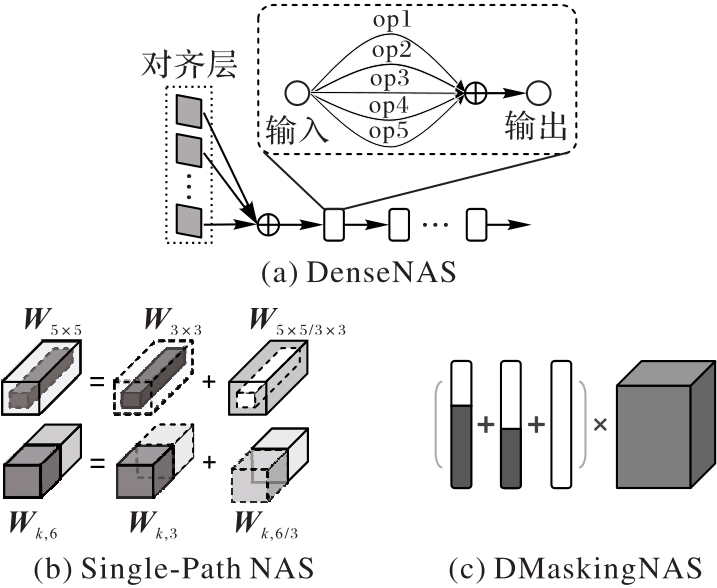
图4 部分DNAS算法框架的具体结构
Fig. 4 Structural details of selected DNAS algorithm frameworks
| [1] | Li S, Tan M, Pang R, et al. Searching for fast model families on datacenter accelerators[C]// CVPR 2021. Piscataway: IEEE, 2021: 8081-8091. |
| [2] | Real E, Aggarwal A, Huang Y, et al. Regularized evolution for image classifier architecture search[J]. Proceedings of the AAAI Conference on Artificial Intelligence, 2019, 33(1): 4780-4789. |
| [3] | Liu H, Simonyan K, Yang Y. DARTS: differentiable architecture search[PP/OL]. V2. arXiv (2019-04-23) [2025-07-11].. |
| [4] | Heuillet A, Nasser A, Arioui H, et al. Efficient automation of neural network design: a survey on differentiable neural architecture search[J]. ACM Computing Surveys, 2024, 56(11): No.270. |
| [5] | Zoph B, Vasudevan V, Shlens J, et al. Learning transferable architectures for scalable image recognition[C]// CVPR 2018. Piscataway: IEEE, 2018: 8697-8710. |
| [6] | Tan M, Chen B, Pang R, et al. MnasNet: platform-aware neural architecture search for mobile[C]// CVPR 2019. Piscataway: IEEE, 2019: 2815-2823. |
| [7] | Ying C, Klein A, Real E, et al. NAS-Bench-101: towards reproducible neural architecture search[J]. Proceedings of Machine Learning Research, 2019, 97: 7105-7114. |
| [8] | Dong X, Yang Y. NAS-Bench-201: extending the scope of reproducible neural architecture search[PP/OL]. V2. arXiv (2020-01-15) [2025-05-11].. |
| [9] | Zela A, Siems J, Hutter F. NAS-Bench-1Shot1: benchmarking and dissecting one-shot neural architecture search[PP/OL]. V2. arXiv (2020-04-12) [2025-07-11].. |
| [10] | Dong X, Liu L, Musial K, et al. NATS-Bench: benchmarking NAS algorithms for architecture topology and size[J]. IEEE Transactions on Pattern Analysis and Machine Intelligence, 2022, 44(7): 3634-3646. |
| [11] | Siems J, Zimmer L, Zela A, et al. NAS-Bench-301 and the case for surrogate benchmarks for neural architecture search[PP/OL]. V3. arXiv (2020-11-05) [2025-07-11].. |
| [12] | Tu R, Roberts N, Khodak M, et al. NAS-Bench-360: benchmarking neural architecture search on diverse tasks[C]// NeurIPS 2022. Red Hook: Curran Associates Inc., 2022: 12380-12394. |
| [13] | Zhang M, Su S, Pan S, et al. iDARTS: differentiable architecture search with stochastic implicit gradients[J]. Proceedings of Machine Learning Research, 2021, 139: 12557-12566. |
| [14] | Wang Y, Liu Y, Dai W, et al. Learning latent architectural distribution in differentiable neural architecture search via variational information maximization[C]// ICCV 2021. Piscataway: IEEE, 2021: 12292-12301. |
| [15] | Xiao H, Wang Z, Zhu Z, et al. Shapley-NAS: discovering operation contribution for neural architecture search[C]// CVPR 2022. Piscataway: IEEE, 2022: 11882-11891. |
| [16] | Li Q, Xue C, Li M, et al. Neural architecture selection as a Nash equilibrium with batch entanglement[J]. IEEE Transactions on Neural Networks and Learning Systems, 2024, 35(11): 15195-15209. |
| [17] | Ji J, Wang X. Fast progressive differentiable architecture search based on adaptive task granularity reorganization[J]. Information Sciences, 2023, 645: No.119326. |
| [18] | Hou P, Jin Y, Chen Y. Single-DARTS: towards stable architecture search[C]// ICCVW 2021. Piscataway: IEEE, 2021: 373-382. |
| [19] | Zhang X, Li Y, Zhang X, et al. Differentiable architecture search with random features[C]// CVPR 2023. Piscataway: IEEE, 2023: 16060-16069. |
| [20] | Zhang J, Ding Z. Robustifying DARTS by eliminating information bypass leakage via explicit sparse regularization[C]// ICDM 2021. Piscataway: IEEE, 2021: 877-885. |
| [21] | Zhu X, Li J, Liu Y, et al. Improving differentiable architecture search via self-distillation[J]. Neural Networks, 2023, 167: 656-667. |
| [22] | Zhang M, Li H, Pan S, et al. Differentiable neural architecture search in equivalent space with exploration enhancement[C]// NeurIPS 2020. Red Hook: Curran Associates Inc., 2020: 13341-13351. |
| [23] | Yu H, Peng H, Huang Y, et al. Cyclic differentiable architecture search[J]. IEEE Transactions on Pattern Analysis and Machine Intelligence, 2023, 45(1): 211-228. |
| [24] | Xiang L, Dudziak L, Abdelfattah M S, et al. Zero-cost operation scoring in differentiable architecture search[J]. Proceedings of the AAAI Conference on Artificial Intelligence, 2023, 37(9): 10453-10463. |
| [25] | Wang R, Cheng M, Chen X, et al. Rethinking architecture selection in differentiable NAS[PP/OL]. arXiv (2021-08-10) [2025-07-15].. |
| [26] | Cai H, Zhu L, Han S. ProxylessNAS: direct neural architecture search on target task and hardware[PP/OL]. V2. arXiv (2019-02-23) [2025-07-11].. |
| [27] | Liang H, Zhang S, Sun J, et al. DARTS+: improved differentiable architecture search with early stopping[PP/OL]. V2. arXiv (2020-10-20) [2025-07-11].. |
| [28] | Chu X, Zhou T, Zhang B, et al. Fair DARTS: eliminating unfair advantages in differentiable architecture search[C]// ECCV 2020, LNCS 12360. Cham: Springer, 2020: 465-480. |
| [29] | Chen X, Xie L, Wu J, et al. Progressive differentiable architecture search: bridging the depth gap between search and evaluation[C]// ICCV 2019. Piscataway: IEEE, 2019: 1294-1303. |
| [30] | Chang J, Zhang X, Guo Y, et al. Differentiable architecture search with ensemble Gumbel-Softmax[PP/OL]. arXiv (2019-05-06) [2025-07-11].. |
| [31] | Dong X, Yang Y. Searching for a robust neural architecture in four GPU hours[C]// CVPR 2019. Piscataway: IEEE, 2019: 1761-1770. |
| [32] | Wang X, Chu X, Fan Y, et al. ROME: robustifying memory-efficient NAS via topology disentanglement and gradient accumulation[C]// ICCV 2023. Piscataway: IEEE, 2023: 5916-5926. |
| [33] | Soro B, Song C. Enhancing differentiable architecture search: a study on small number of cell blocks in the search stage, and important branches-based cells selection[C]// ICCVW 2023. Piscataway: IEEE, 2023: 1245-1253. |
| [34] | Chen X, Hsieh C J. Stabilizing differentiable architecture search via perturbation-based regularization[J]. Proceedings of Machine Learning Research, 2020, 119: 1554-1565. |
| [35] | Yu J, Jin P, Liu H, et al. BigNAS: scaling up neural architecture search with big single-stage models[C]// ECCV 2020, LNCS 12352. Cham: Springer, 2020: 702-717. |
| [36] | Wu B, Dai X, Zhang P, et al. FBNet: hardware-aware efficient ConvNet design via differentiable neural architecture search[C]// CVPR 2019. Piscataway: IEEE, 2019: 10726-10734. |
| [37] | Nayman N, Aflalo Y, Noy A, et al. HardCoRe-NAS: hard constrained differentiable neural architecture search[J]. Proceedings of Machine Learning Research, 2021, 139: 7979-7990. |
| [38] | Guo Q, Wu X J, Kittler J, et al. Differentiable neural architecture learning for efficient neural networks[J]. Pattern Recognition, 2022, 126: No.108448. |
| [39] | Xu Y, Xie L, Zhang X, et al. PC-DARTS: partial channel connections for memory-efficient architecture search[PP/OL]. V4. arXiv (2020-04-07) [2025-07-11].. |
| [40] | Xue Y, Qin J. Partial connection based on channel attention for differentiable neural architecture search[J]. IEEE Transactions on Industrial Informatics, 2023, 19(5): 6804-6813. |
| [41] | Cai Z, Chen L, Liu H L. EPC-DARTS: efficient partial channel connection for differentiable architecture search[J]. Neural Networks, 2023, 166: 344-353. |
| [42] | Yang Y, You S, Li H, et al. Towards improving the consistency, efficiency, and flexibility of differentiable neural architecture search[C]// CVPR 2021. Piscataway: IEEE, 2021: 6663-6672. |
| [43] | Mei J, Li Y, Lian X, et al. AtomNAS: fine-grained end-to-end neural architecture search[PP/OL]. V2. arXiv (2020-02-23) [2025-08-04].. |
| [44] | Stamoulis D, Ding R, Wang D, et al. Single-Path NAS: designing hardware-efficient ConvNets in less than 4 hours[C]// ECML PKDD 2019, LNCS 11907. Cham: Springer, 2019: 481-497. |
| [45] | Wan A, Dai X, Zhang P, et al. FBNetV2: differentiable neural architecture search for spatial and channel dimensions[C]// CVPR 2020. Piscataway: IEEE, 2020: 12962-12971. |
| [46] | Fang J, Sun Y, Zhang Q, et al. Densely connected search space for more flexible neural architecture search[C]// CVPR 2020. Piscataway: IEEE, 2020: 10625-10634. |
| [47] | Cai H, Gan C, Wang T, et al. Once-for-all: train one network and specialize it for efficient deployment[PP/OL]. V5. arXiv (2020-04-29) [2025-07-11].. |
| [48] | Vahdat A, Mallya A, Liu M Y, et al. UNAS: differentiable architecture search meets reinforcement learning[C]// CVPR 2020. Piscataway: IEEE, 2020: 11263-11272. |
| [49] | Yang Z, Wang Y, Chen X, et al. CARS: continuous evolution for efficient neural architecture search[C]// CVPR 2020. Piscataway: IEEE, 2020: 1826-1835. |
| [50] | Yan Z, Jiang W, Hu X S, et al. RADARS: memory efficient reinforcement learning aided differentiable neural architecture search[C]// ASP-DAC 2022. Piscataway: IEEE, 2022: 128-133. |
| [51] | Fan Z, Hu G, Sun X, et al. Self-attention neural architecture search for semantic image segmentation[J]. Knowledge-Based Systems, 2022, 239: No.107968. |
| [52] | Wei L, Zhao H, He Z, et al. Neural architecture search for GNN-based graph classification[J]. ACM Transactions on Information Systems, 2024, 42(1): No.1. |
| [53] | Yan C, Chang X, Li Z, et al. ZeroNAS: differentiable generative adversarial networks search for zero-shot learning[J]. IEEE Transactions on Pattern Analysis and Machine Intelligence, 2022, 44(12): 9733-9740. |
| [54] | Zhao Y, Dong L, Shen Y, et al. Memory-efficient differentiable Transformer architecture search[C]// Findings of the Association for Computational Linguistics: ACL-IJCNLP 2021. Stroudsburg: ACL, 2021: 4254-4264. |
| [55] | Wu P, Neri F, Feng Z. DASViT: differentiable architecture search for vision Transformer[PP/OL]. arXiv (2025-07-17) [2025-07-21].. |
| [56] | Zhang S X, Hsieh C Y, Zhang S, et al. Differentiable quantum architecture search[J]. Quantum Science and Technology, 2022, 7(4): No.045023. |
| [57] | Wu W, Yan G, Lu X, et al. QuantumDARTS: differentiable quantum architecture search for variational quantum algorithms[J]. Proceedings of Machine Learning Research, 2023, 202: 37745-37764. |
| [1] | 金亚东, 范菁, 郗恩康, 董华, 俞浩, 孙伊航. 面向空天地一体化网络的个性化联邦学习智能边缘聚合方法[J]. 《计算机应用》唯一官方网站, 2026, 46(8): 2555-2566. |
| [2] | 刘占军, 宋云鹏, 王盛宝. 基于自适应梯度匹配追踪算法的超大规模多输入多输出混合场信道估计[J]. 《计算机应用》唯一官方网站, 2025, 45(12): 3931-3938. |
| [3] | 张淑芬, 汤本建, 田子坤, 秦肖阳. 基于差分隐私的联邦学习研究综述[J]. 《计算机应用》唯一官方网站, 2025, 45(10): 3221-3230. |
| [4] | 田野, 陈津津, 张兴义. 面向约束多目标优化的进化计算与梯度下降联合优化算法[J]. 《计算机应用》唯一官方网站, 2024, 44(5): 1386-1392. |
| [5] | 田阔, 吴英晗, 胡枫. 基于证据理论的多层超网络影响力节点识别方法[J]. 《计算机应用》唯一官方网站, 2024, 44(1): 182-189. |
| [6] | 王可可, 朱宇, 王晓英, 黄建强, 曹腾飞. 超边约束的异质超网络表示学习方法[J]. 《计算机应用》唯一官方网站, 2023, 43(12): 3654-3661. |
| [7] | 张宇, 蔡英, 崔剑阳, 张猛, 范艳芳. 卷积神经网络中基于差分隐私的动量梯度下降算法[J]. 《计算机应用》唯一官方网站, 2023, 43(12): 3647-3653. |
| [8] | 田蕾, 葛丽娜. 基于差分隐私的广告推荐算法[J]. 《计算机应用》唯一官方网站, 2023, 43(11): 3346-3350. |
| [9] | 王高杰, 冶忠林, 赵海兴, 朱宇, 孟磊. 唐诗宋词中的超网络特性分析[J]. 计算机应用, 2021, 41(8): 2432-2439. |
| [10] | 王锦凯, 贾旭. 基于迁移孪生非负矩阵分解的静脉识别算法[J]. 计算机应用, 2021, 41(3): 898-903. |
| [11] | 王锦凯, 贾旭. 基于加权正交约束非负矩阵分解的车脸识别算法[J]. 计算机应用, 2020, 40(4): 1050-1055. |
| [12] | 成其伟, 陈启买, 贺超波, 刘海. 基于改进对称二值非负矩阵分解的重叠社区发现方法[J]. 计算机应用, 2020, 40(11): 3203-3210. |
| [13] | 李瑶, 赵云芃, 李欣芸, 刘志芬, 陈俊杰, 郭浩. 基于sparse group Lasso方法的脑功能超网络构建与特征融合分析[J]. 计算机应用, 2020, 40(1): 62-70. |
| [14] | 樊玮, 谢聪, 肖春景, 曹淑燕. 基于组合类别空间的随机游走推荐算法[J]. 计算机应用, 2019, 39(4): 984-988. |
| [15] | 邱宁佳, 丛琳, 周思丞, 王鹏, 李岩芳. 结合改进主动学习的SVD-CNN弹幕文本分类算法[J]. 计算机应用, 2019, 39(3): 644-650. |
| 阅读次数 | ||||||
|
全文 |
|
|||||
|
摘要 |
|
|||||
