


Journal of Computer Applications ›› 2025, Vol. 45 ›› Issue (12): 3925-3930.DOI: 10.11772/j.issn.1001-9081.2024121756
• Advanced computing • Previous Articles Next Articles
Received:2024-12-13
Revised:2025-03-10
Accepted:2025-03-17
Online:2025-03-24
Published:2025-12-10
Contact:
Jun YAO
About author:LIU Ming, born in 1997, M. S. candidate. Her research interests include cloud computing, resource scheduling.
Supported by:
姚军( ), 刘明
), 刘明
通讯作者:
姚军
作者简介:刘明(1997—),女,内蒙古呼伦贝尔人,硕士研究生,主要研究方向:云计算、资源调度。基金资助:CLC Number:
Jun YAO, Ming LIU. Combined prediction model optimized by transit search algorithm[J]. Journal of Computer Applications, 2025, 45(12): 3925-3930.
姚军, 刘明. 基于凌日搜索算法优化的组合预测模型[J]. 《计算机应用》唯一官方网站, 2025, 45(12): 3925-3930.
Add to citation manager EndNote|Ris|BibTeX
URL: https://www.joca.cn/EN/10.11772/j.issn.1001-9081.2024121756
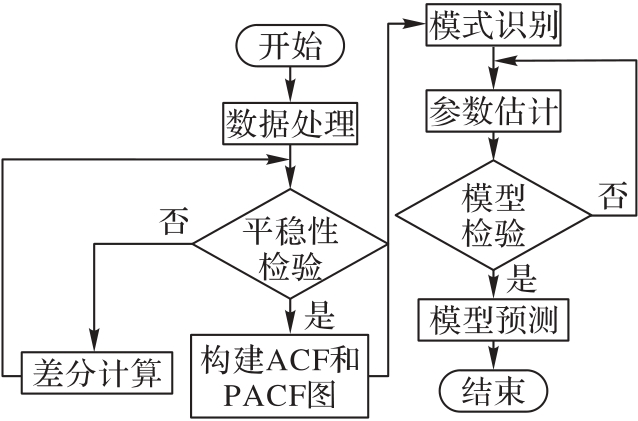
Fig. 1 Modeling flow of ARIMA
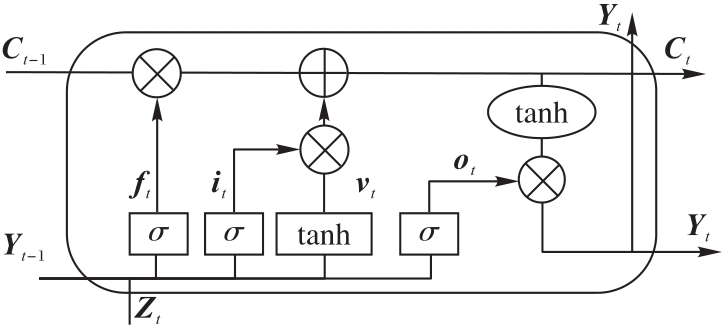
Fig.2 LSTM basic unit structure
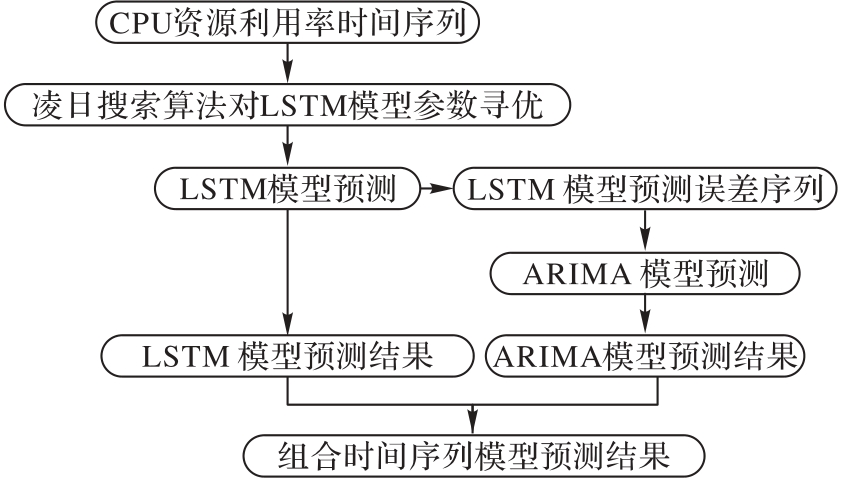
Fig.3 Combined prediction model
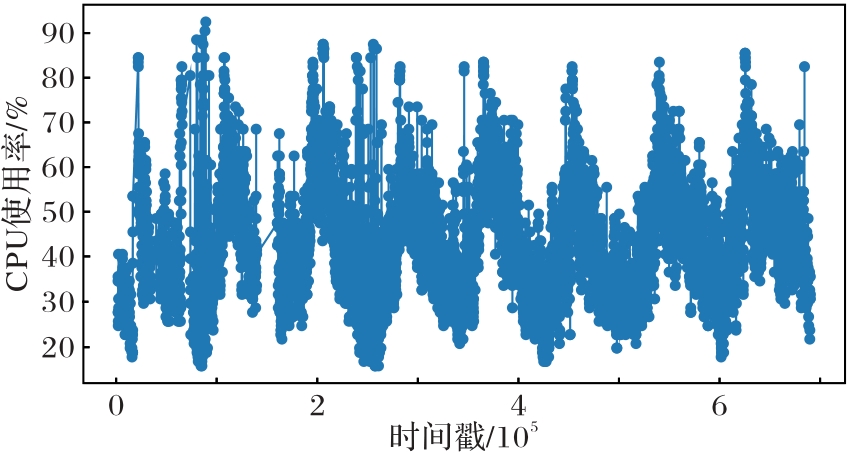
Fig.4 CPU resource usage data
| TS参数 | LSTM模型寻优结果 | MSE | RMSE | MAE | ||||
|---|---|---|---|---|---|---|---|---|
| SN | NUMBER_ NODES | DENSE_ UNITS_1 | DENSE_UNITS_2 | NN_ LAGS | ||||
| 20 | 5 | 58 | 30 | 35 | 19 | 35.26 | 5.94 | 4.71 |
| 15 | 10 | 60 | 38 | 42 | 16 | 31.41 | 5.60 | 4.61 |
| 10 | 15 | 32 | 28 | 40 | 10 | 21.88 | 4.67 | 3.29 |
| 5 | 20 | 83 | 45 | 58 | 7 | 26.92 | 5.19 | 3.65 |
Tab.1 Optimization results of LSTM model by transit optimization algorithm
| TS参数 | LSTM模型寻优结果 | MSE | RMSE | MAE | ||||
|---|---|---|---|---|---|---|---|---|
| SN | NUMBER_ NODES | DENSE_ UNITS_1 | DENSE_UNITS_2 | NN_ LAGS | ||||
| 20 | 5 | 58 | 30 | 35 | 19 | 35.26 | 5.94 | 4.71 |
| 15 | 10 | 60 | 38 | 42 | 16 | 31.41 | 5.60 | 4.61 |
| 10 | 15 | 32 | 28 | 40 | 10 | 21.88 | 4.67 | 3.29 |
| 5 | 20 | 83 | 45 | 58 | 7 | 26.92 | 5.19 | 3.65 |
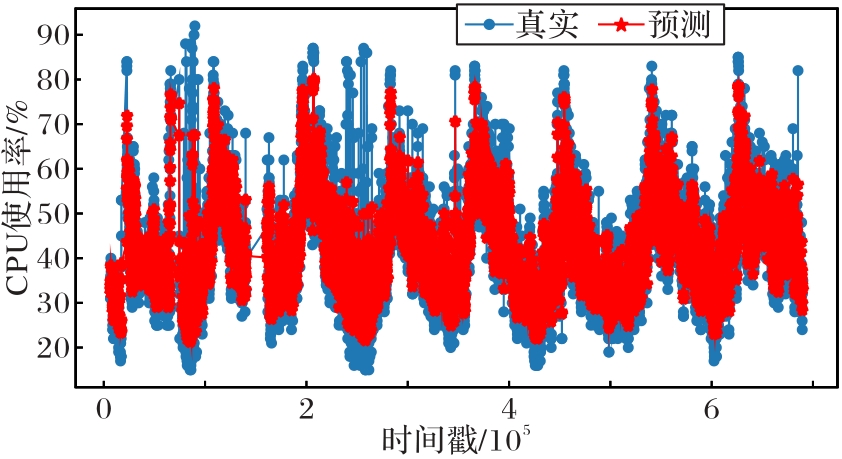
Fig.5 Prediction results of TS-ARMI-LSTM model
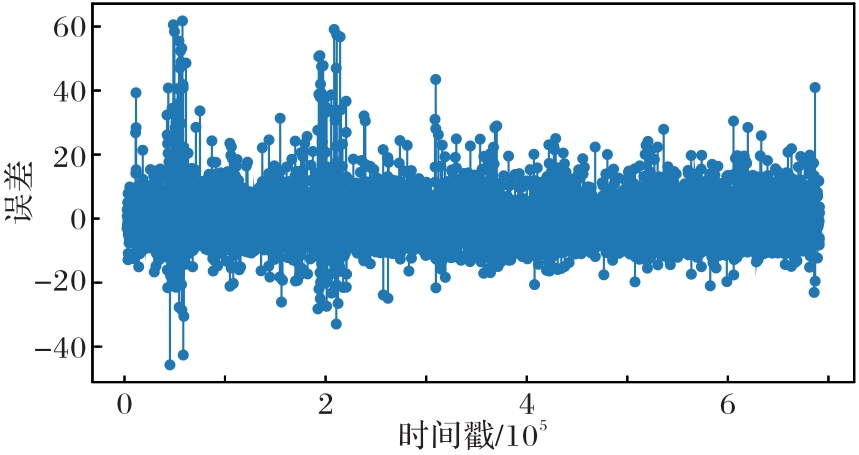
Fig.6 Prediction error results of TS-ARIMA-LSTM model
| 预测模型 | MSE | RMSE | MAE |
|---|---|---|---|
| ARIMA | 57.16 | 7.56 | 6.00 |
| LSTM | 86.38 | 9.29 | 7.90 |
| ARIMA-LSTM | |||
| TS-ARIMA-LSTM | 21.88 | 4.67 | 3.29 |
Tab.2 Evaluation indexes of each model
| 预测模型 | MSE | RMSE | MAE |
|---|---|---|---|
| ARIMA | 57.16 | 7.56 | 6.00 |
| LSTM | 86.38 | 9.29 | 7.90 |
| ARIMA-LSTM | |||
| TS-ARIMA-LSTM | 21.88 | 4.67 | 3.29 |
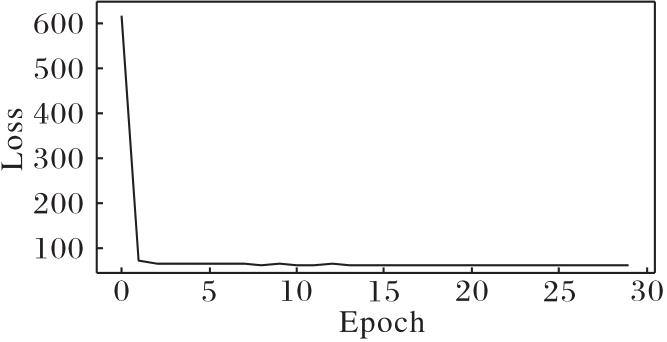
Fig.7 Loss function
| [1] | 刘邦邦,易国洪,黄祖源. 面向Docker容器的动态负载算法[J]. 计算机科学, 2021, 48(6): 276-281. |
| LIU B B, YI G H, HUANG Z Y. Dynamic loading algorithm for Docker container[J]. Computer Science, 2021, 48(6): 276-281. | |
| [2] | LI H, SHEN J, ZHENG L, et al. Cost-efficient scheduling algorithms based on beetle antennae search for containerized applications in Kubernetes clouds[J]. The Journal of Supercomputing, 2023, 79(9): 10300-10334. |
| [3] | PANDA S K, JANA P K. An energy-efficient task scheduling algorithm for heterogeneous cloud computing systems[J]. Cluster Computing, 2019, 22(2): 509-527. |
| [4] | MEDEL V, TOLOSANA-CALASANZ R, BAÑARES J Á, et al. Characterising resource management performance in Kubernetes[J]. Computers and Electrical Engineering, 2018, 68: 286-297. |
| [5] | YANG Z, WANG X, LI R, et al. HMM-CPM: a cloud instance resource prediction method tracing the workload trends via hidden Markov model[J]. Cluster Computing, 2024, 27(8): 11823-11838. |
| [6] | GUPTA S, DILEEP A D, GONSALVES T A. Online sparse BLSTM models for resource usage prediction in cloud datacentres [J]. IEEE Transactions on Network and Service Management, 2020, 17(4): 2335-2349. |
| [7] | 闫承鑫,陈宁江,刘文斌,等. 面向突变负载的容器资源弹性供给服务策略[J]. 小型微型计算机系统, 2019, 40(4): 787-792. |
| YAN C X, CHEN N J, LIU W B, et al. Elastic supply strategy of container resource for mutation load[J]. Journal of Chinese Computer Systems, 2019, 40(4): 787-792. | |
| [8] | TOFIGHY S, RAHMANIAN A A, GHOBAEI-ARANI M. An ensemble CPU load prediction algorithm using a Bayesian information criterion and smooth filters in a cloud computing environment[J]. Software: Practice and Experience, 2018, 48(12): 2257-2277. |
| [9] | NAWROCKI P, OSYPANKA P, POSLUSZNY B. Data-driven adaptive prediction of cloud resource usage[J]. Journal of Grid Computing, 2023, 21(1): No.6. |
| [10] | WEN Y, WANG Y, LIU J, et al. CPU usage prediction for cloud resource provisioning based on deep belief network and particle swarm optimization[J]. Concurrency and Computation: Practice and Experience, 2020, 32(14): No.e5730. |
| [11] | 赵兴朝. 基于Kubernetes的资源预测与调度优化方法研究[D]. 桂林:桂林电子科技大学, 2018: 10-13. |
| ZHAO X Z. Research on the methods of resource prediction and scheduling optimization based on Kubernetes[D]. Guilin: Guilin University of Electronic Technology, 2018: 10-13. | |
| [12] | HUANG Q, LI H, HE Y, et al. PiDicators: an efficient artifact to detect various VMs[C]// Proceedings of the 2020 International Conference on Information and Communications Security, LNCS 12282. Cham: Springer, 2020: 259-275. |
| [13] | HE Z. Novel container cloud elastic scaling strategy based on Kubernetes[C]// Proceedings of the IEEE 5th Information Technology and Mechatronics Engineering Conference. Piscataway: IEEE, 2020, 1400-1404. |
| [14] | TOKA L, DOBREFF G, FODOR B, et al. Machine learning-based scaling management for Kubernetes edge clusters[J]. IEEE Transactions on Network and Service Management, 2021, 18(1): 958-972. |
| [15] | 赵树君,黄倩.基于Kubernetes云原生的弹性伸缩研究[J]. 计算机与现代化, 2021(11): 28-38. |
| ZHAO S J, HUANG Q. Research and practice on elastic scaling of cloud-native 5G network [J]. Computer and Modernization, 2021(11): 28-38. | |
| [16] | VIDAL A, KRISTJANPOLLER W. Gold volatility prediction using a CNN-LSTM approach[J]. Expert Systems with Applications, 2020, 157: No.113481. |
| [17] | 王艺霏,于雷,滕飞,等. 基于长-短时序特征融合的资源负载预测模型[J]. 计算机应用, 2022, 42(5): 1508-1515. |
| WANG Y F, YU L, TENG F, et al. Resource load prediction model based on long-short time series feature fusion[J]. Journal of Computer Applications, 2022, 42(5): 1508-1515. | |
| [18] | XU M, SONG C, WU H, et al. esDNN: deep neural network based multivariate workload prediction in cloud computing environments[J]. ACM Transactions on Internet Technology, 2022, 22(3): No.75. |
| [19] | LI L, DONG J, ZUO D, et al. SLA-aware and energy-efficient VM consolidation in cloud data centers using host state 3rd-order Markov chain model[J]. Chinese Journal of Electronics, 2020, 29(6): 1207-1217. |
| [20] | 林涛,冯竞凯,郝章肖,等. 基于组合预测模型的云计算资源负载预测研究[J]. 计算机工程与科学, 2020, 42(7): 1168-1173. |
| LIN T, FENG J K, HAO Z X, et al. Cloud computing resource load prediction based on combined prediction model[J]. Computer Engineering and Science, 2020, 42(7): 1168-1173. | |
| [21] | BI J, YUAN H, ZHOU M. Temporal prediction of multiapplication consolidated workloads in distributed clouds[J]. IEEE Transactions on Automation Science and Engineering, 2019, 16(4): 1763-1773. |
| [22] | BI J, LI S, YUAN H, et al. Deep neural networks for predicting task time series in cloud computing systems [C]// Proceedings of the IEEE 16th International Conference on Networking, Sensing and Control. Piscataway: IEEE, 2019: 86-91. |
| [23] | 张妙妙,吕佳,吴剑,等. 基于正交参数优化LSTM神经网络的SOFC性能预测[J/OL]. 电源学报 [2024-12-29].. |
| ZHANG M M, LYU J, WU J, et al. Optimization of LSTM for SOFC performance prediction using orthogonal method[J/OL]. Journal of Power Supply [2024-12-29]. . | |
| [24] | 孙一夫,孙怀宇,陈众,等. 基于改进鲸鱼算法优化LSTM的化工过程故障诊断方法[J]. 现代电子技术, 2024, 47(24): 73-80. |
| SUN Y F, SUN H Y, CHEN Z, et al. Method of chemical process fault diagnosis based on MAWOA-LSTM[J]. Modern Electronics Technique, 2024, 47(24): 73-80. | |
| [25] | 洪吉超,裴佳琦,梁峰伟,等. 基于麻雀搜索优化LSTM的实车动力电池SOC估计研究[J]. 西南大学学报(自然科学版), 2024, 46(12): 41-50. |
| HONG J C, PEI J Q, LIANG F W, et al. Research on real vehicle power battery SOC estimation based on sparrow search optimized LSTM[J]. Journal of Southwest University (Natural Science Edition), 2024, 46(12): 41-50. | |
| [26] | BERHICH A, BELOUADHA F Z, KABBAJ M I. LSTM-based models for earthquake prediction[C]// Proceedings of the 3rd International Conference on Networking, Information Systems and Security. New York: ACM, 2020: No.46. |
| [27] | MIRRASHID M, NADERPOUR H. Transit search: an optimization algorithm based on exoplanet exploration[J]. Results in Control and Optimization, 2022, 7: No.100127. |
| [28] | CHENG Y, ANWAR A, DUAN X. Analyzing Alibaba’s co-located datacenter workloads[C]// Proceedings of the 2018 IEEE International Conference on Big Data. Piscataway: IEEE, 2018: 292-297. |
| [1] | Zhihui ZAN, Yajing WANG, Ke LI, Zhixiang YANG, Guangyu YANG. Multi-feature fusion speech emotion recognition method based on SAA-CNN-BiLSTM network [J]. Journal of Computer Applications, 2026, 46(1): 69-76. |
| [2] | Yilin DENG, Fajiang YU. Pseudo random number generator based on LSTM and separable self-attention mechanism [J]. Journal of Computer Applications, 2025, 45(9): 2893-2901. |
| [3] | Binhan LI, Lunzhi DENG, Huan LIU. Cloud-based conditional broadcast proxy re-encryption scheme [J]. Journal of Computer Applications, 2025, 45(7): 2278-2287. |
| [4] | Han ZHANG, Hang YU, Jiwei ZHOU, Yunkai BAI, Lutan ZHAO. Survey on trusted execution environment towards privacy computing [J]. Journal of Computer Applications, 2025, 45(2): 467-481. |
| [5] | Qinzhuang ZHAO, Hongye TAN. Time series causal inference method based on adaptive threshold learning [J]. Journal of Computer Applications, 2024, 44(9): 2660-2666. |
| [6] | Wei SHE, Yang LI, Lihong ZHONG, Defeng KONG, Zhao TIAN. Hyperparameter optimization for neural network based on improved real coding genetic algorithm [J]. Journal of Computer Applications, 2024, 44(3): 671-676. |
| [7] | Xiaoyu HUA, Dongfen LI, You FU, Kejun BI, Shi YING, Ruijin WANG. Industrial chain risk assessment and early warning model combining hierarchical graph neural network and long short-term memory [J]. Journal of Computer Applications, 2024, 44(10): 3223-3231. |
| [8] | Rui ZHANG, Junming PAN, Xiaolu BAI, Jing HU, Rongguo ZHANG, Pengyun ZHANG. Agent model for hyperparameter self-optimization of deep classification model [J]. Journal of Computer Applications, 2024, 44(10): 3021-3031. |
| [9] | Hanxiao SHI, Leichun WANG. Short-term power load forecasting by graph convolutional network combining LSTM and self-attention mechanism [J]. Journal of Computer Applications, 2024, 44(1): 311-317. |
| [10] | Li’an CHEN, Yi GUO. Text sentiment analysis model based on individual bias information [J]. Journal of Computer Applications, 2024, 44(1): 145-151. |
| [11] | Zhiping ZHU, Yan YANG, Jie WANG. Scene graph-aware cross-modal image captioning model [J]. Journal of Computer Applications, 2024, 44(1): 58-64. |
| [12] | Jiaxing LU, Hua DAI, Yuanlong LIU, Qian ZHOU, Geng YANG. Dictionary partition vector space model for ciphertext ranked search in cloud environment [J]. Journal of Computer Applications, 2023, 43(7): 1994-2000. |
| [13] | Jiagao WU, Shiwen ZHANG, Yudong JIANG, Linfeng LIU. Social-interaction GAN for pedestrian trajectory prediction based on state-refinement long short-term memory and attention mechanism [J]. Journal of Computer Applications, 2023, 43(5): 1565-1570. |
| [14] | Haiyu YANG, Wenpu GUO, Kai KANG. Signal modulation recognition method based on convolutional long short-term deep neural network [J]. Journal of Computer Applications, 2023, 43(4): 1318-1322. |
| [15] | Chunyong YIN, Liwen ZHOU. Unsupervised time series anomaly detection model based on re-encoding [J]. Journal of Computer Applications, 2023, 43(3): 804-811. |
| Viewed | ||||||
|
Full text |
|
|||||
|
Abstract |
|
|||||
