


Journal of Computer Applications ›› 2026, Vol. 46 ›› Issue (11): 3457-3467.DOI: 10.11772/j.issn.1001-9081.2025101215
• Artificial intelligence • Previous Articles
Guangdong SUN1, Fuhong WANG1, Ying SHEN1, Zhengming CHEN2, Zhifeng HAO2, Ruichu CAI1( )
Received:2025-10-20
Revised:2026-01-07
Accepted:2026-01-08
Online:2026-01-22
Published:2026-11-10
Contact:
Ruichu CAI
About author:SUN Guangdong, born in 2001, M. S. candidate. His research interests include causal discovery.Supported by:
孙光冬1, 王馥弘1, 沈颖1, 陈正鸣2, 郝志峰2, 蔡瑞初1()
通讯作者:
蔡瑞初
作者简介:孙光冬(2001—),男,河南濮阳人,硕士研究生,CCF会员,主要研究方向:因果发现基金资助:CLC Number:
Guangdong SUN, Fuhong WANG, Ying SHEN, Zhengming CHEN, Zhifeng HAO, Ruichu CAI. Latent polytree-based causal structure discovery method for multidimensional psychological assessment[J]. Journal of Computer Applications, 2026, 46(11): 3457-3467.
孙光冬, 王馥弘, 沈颖, 陈正鸣, 郝志峰, 蔡瑞初. 面向多维心理测评的隐周游树因果结构发现方法[J]. 《计算机应用》唯一官方网站, 2026, 46(11): 3457-3467.
Add to citation manager EndNote|Ris|BibTeX
URL: https://www.joca.cn/EN/10.11772/j.issn.1001-9081.2025101215
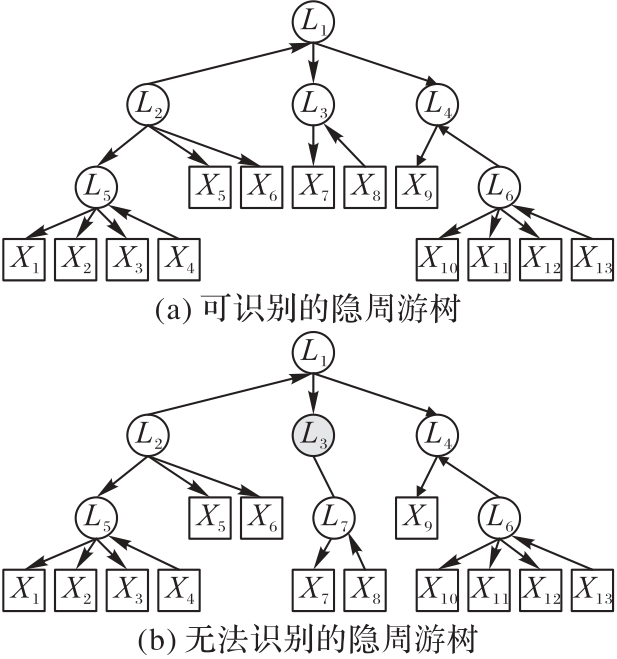
Fig. 1 Examples of LNG-LPT model
| 方法类别 | 非测量假设 | 单观测变量 | DAG |
|---|---|---|---|
| 基于距离[ | × | × | × |
| 基于矩阵分解[ | × | × | × |
| 基于评分[ | × | × | × |
| 基于独立约束[ | √ | × | √ |
| LNG-LPT | √ | √ | √ |
Tab. 1 Comparison of latent tree model methods
| 方法类别 | 非测量假设 | 单观测变量 | DAG |
|---|---|---|---|
| 基于距离[ | × | × | × |
| 基于矩阵分解[ | × | × | × |
| 基于评分[ | × | × | × |
| 基于独立约束[ | √ | × | √ |
| LNG-LPT | √ | √ | √ |
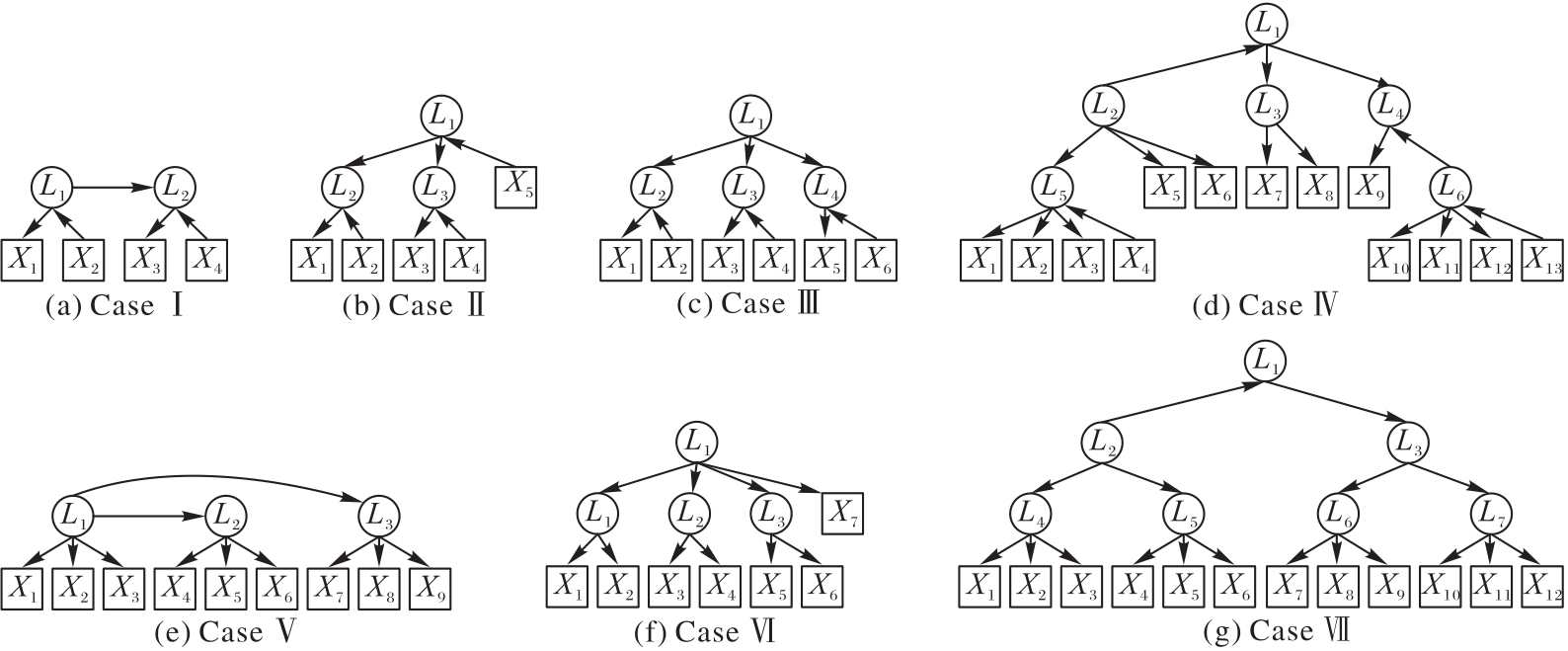
Fig. 2 Simulation graphs of seven latent-observed variable causal structures
| 算法 | CaseⅠ | CaseⅡ | CaseⅢ | CaseⅣ | ||||||||
|---|---|---|---|---|---|---|---|---|---|---|---|---|
| N=2 000 | N=5 000 | N=10 000 | N=2 000 | N=5 000 | N=10 000 | N=2 000 | N=5 000 | N=10 000 | N=2 000 | N=5 000 | N=10 000 | |
| 本文算法 | 0.93 | 0.93 | 0.97 | 0.91 | 0.94 | 0.97 | 0.92 | 0.96 | 0.96 | 0.72 | 0.75 | 0.84 |
| LHM | 0.08 | 0.12 | 0.14 | 0.24 | 0.28 | 0.31 | 0.33 | 0.34 | 0.34 | 0.33 | 0.34 | 0.34 |
| CLRG | 0.06 | 0.06 | 0.06 | 0.08 | 0.08 | 0.08 | 0.04 | 0.04 | 0.04 | 0.05 | 0.05 | 0.05 |
| LHD | 0.62 | 0.63 | 0.63 | 0.18 | 0.20 | 0.20 | 0.38 | 0.46 | 0.46 | 0.27 | 0.30 | 0.31 |
| TS-ICD | 0.29 | 0.31 | 0.31 | 0.20 | 0.22 | 0.22 | 0.43 | 0.43 | 0.43 | 0.57 | 0.57 | 0.59 |
| 算法 | CaseⅤ | CaseⅥ | CaseⅦ | |||||||||
| N=2 000 | N=5 000 | N=10 000 | N=2 000 | N=5 000 | N=10 000 | N=2 000 | N=5 000 | N=10 000 | ||||
| 本文算法 | 0.92 | 0.96 | 1.00 | 0.95 | 1.00 | 1.00 | 0.97 | 0.97 | 1.00 | |||
| LHM | 0.90 | 0.90 | 0.90 | 1.00 | 1.00 | 1.00 | 0.55 | 0.63 | 0.65 | |||
| CLRG | 0.06 | 0.06 | 0.06 | 0.08 | 0.08 | 0.08 | 0.04 | 0.06 | 0.08 | |||
| LHD | 0.65 | 0.68 | 0.69 | 0.81 | 0.84 | 0.85 | 0.77 | 0.78 | 0.78 | |||
| TS-ICD | 0.72 | 0.72 | 0.73 | 0.69 | 0.69 | 0.70 | 0.61 | 0.62 | 0.63 | |||
Tab. 2 Comparison of F1 performance in simulation experiments
| 算法 | CaseⅠ | CaseⅡ | CaseⅢ | CaseⅣ | ||||||||
|---|---|---|---|---|---|---|---|---|---|---|---|---|
| N=2 000 | N=5 000 | N=10 000 | N=2 000 | N=5 000 | N=10 000 | N=2 000 | N=5 000 | N=10 000 | N=2 000 | N=5 000 | N=10 000 | |
| 本文算法 | 0.93 | 0.93 | 0.97 | 0.91 | 0.94 | 0.97 | 0.92 | 0.96 | 0.96 | 0.72 | 0.75 | 0.84 |
| LHM | 0.08 | 0.12 | 0.14 | 0.24 | 0.28 | 0.31 | 0.33 | 0.34 | 0.34 | 0.33 | 0.34 | 0.34 |
| CLRG | 0.06 | 0.06 | 0.06 | 0.08 | 0.08 | 0.08 | 0.04 | 0.04 | 0.04 | 0.05 | 0.05 | 0.05 |
| LHD | 0.62 | 0.63 | 0.63 | 0.18 | 0.20 | 0.20 | 0.38 | 0.46 | 0.46 | 0.27 | 0.30 | 0.31 |
| TS-ICD | 0.29 | 0.31 | 0.31 | 0.20 | 0.22 | 0.22 | 0.43 | 0.43 | 0.43 | 0.57 | 0.57 | 0.59 |
| 算法 | CaseⅤ | CaseⅥ | CaseⅦ | |||||||||
| N=2 000 | N=5 000 | N=10 000 | N=2 000 | N=5 000 | N=10 000 | N=2 000 | N=5 000 | N=10 000 | ||||
| 本文算法 | 0.92 | 0.96 | 1.00 | 0.95 | 1.00 | 1.00 | 0.97 | 0.97 | 1.00 | |||
| LHM | 0.90 | 0.90 | 0.90 | 1.00 | 1.00 | 1.00 | 0.55 | 0.63 | 0.65 | |||
| CLRG | 0.06 | 0.06 | 0.06 | 0.08 | 0.08 | 0.08 | 0.04 | 0.06 | 0.08 | |||
| LHD | 0.65 | 0.68 | 0.69 | 0.81 | 0.84 | 0.85 | 0.77 | 0.78 | 0.78 | |||
| TS-ICD | 0.72 | 0.72 | 0.73 | 0.69 | 0.69 | 0.70 | 0.61 | 0.62 | 0.63 | |||
| 算法 | CaseⅠ | CaseⅡ | CaseⅢ | CaseⅣ | ||||||||
|---|---|---|---|---|---|---|---|---|---|---|---|---|
| N=2 000 | N=5 000 | N=10 000 | N=2 000 | N=5 000 | N=10 000 | N=2 000 | N=5 000 | N=10 000 | N=2 000 | N=5 000 | N=10 000 | |
| 本文算法 | 0.10 | 0.10 | 0.00 | 0.20 | 0.20 | 0.10 | 0.40 | 0.00 | 0.00 | 0.40 | 0.20 | 0.50 |
| LHM | 1.67 | 1.53 | 1.47 | 1.47 | 1.27 | 1.20 | 1.87 | 1.87 | 2.07 | 0.80 | 1.20 | 0.80 |
| CLRG | 1.34 | 1.33 | 1.33 | 2.47 | 2.47 | 2.47 | 3.33 | 3.33 | 3.20 | 3.40 | 3.00 | 2.20 |
| LHD | 0.00 | 0.00 | 0.00 | 1.20 | 1.00 | 1.00 | 0.56 | 0.32 | 0.32 | 0.95 | 0.78 | 0.77 |
| TS-ICD | 1.00 | 1.00 | 1.00 | 1.40 | 1.38 | 1.38 | 2.00 | 2.00 | 2.00 | 2.00 | 2.00 | 2.00 |
| 算法 | CaseⅤ | CaseⅥ | CaseⅦ | |||||||||
| N=2 000 | N=5 000 | N=10 000 | N=2 000 | N=5 000 | N=10 000 | N=2 000 | N=5 000 | N=10 000 | ||||
| 本文算法 | 0.40 | 0.20 | 0.00 | 0.20 | 0.00 | 0.00 | 0.32 | 0.30 | 0.30 | |||
| LHM | 1.00 | 1.10 | 1.00 | 0.00 | 0.00 | 0.00 | 1.32 | 1.30 | 1.25 | |||
| CLRG | 7.40 | 7.30 | 6.80 | 3.30 | 3.30 | 3.20 | 4.00 | 4.00 | 3.90 | |||
| LHD | 0.55 | 0.33 | 0.32 | 0.46 | 0.38 | 0.35 | 0.44 | 0.32 | 0.32 | |||
| TS-ICD | 0.30 | 0.28 | 0.20 | 1.00 | 1.00 | 1.00 | 1.20 | 1.10 | 1.00 | |||
Tab. 3 Simulation experimental results of latent variable count estimation error
| 算法 | CaseⅠ | CaseⅡ | CaseⅢ | CaseⅣ | ||||||||
|---|---|---|---|---|---|---|---|---|---|---|---|---|
| N=2 000 | N=5 000 | N=10 000 | N=2 000 | N=5 000 | N=10 000 | N=2 000 | N=5 000 | N=10 000 | N=2 000 | N=5 000 | N=10 000 | |
| 本文算法 | 0.10 | 0.10 | 0.00 | 0.20 | 0.20 | 0.10 | 0.40 | 0.00 | 0.00 | 0.40 | 0.20 | 0.50 |
| LHM | 1.67 | 1.53 | 1.47 | 1.47 | 1.27 | 1.20 | 1.87 | 1.87 | 2.07 | 0.80 | 1.20 | 0.80 |
| CLRG | 1.34 | 1.33 | 1.33 | 2.47 | 2.47 | 2.47 | 3.33 | 3.33 | 3.20 | 3.40 | 3.00 | 2.20 |
| LHD | 0.00 | 0.00 | 0.00 | 1.20 | 1.00 | 1.00 | 0.56 | 0.32 | 0.32 | 0.95 | 0.78 | 0.77 |
| TS-ICD | 1.00 | 1.00 | 1.00 | 1.40 | 1.38 | 1.38 | 2.00 | 2.00 | 2.00 | 2.00 | 2.00 | 2.00 |
| 算法 | CaseⅤ | CaseⅥ | CaseⅦ | |||||||||
| N=2 000 | N=5 000 | N=10 000 | N=2 000 | N=5 000 | N=10 000 | N=2 000 | N=5 000 | N=10 000 | ||||
| 本文算法 | 0.40 | 0.20 | 0.00 | 0.20 | 0.00 | 0.00 | 0.32 | 0.30 | 0.30 | |||
| LHM | 1.00 | 1.10 | 1.00 | 0.00 | 0.00 | 0.00 | 1.32 | 1.30 | 1.25 | |||
| CLRG | 7.40 | 7.30 | 6.80 | 3.30 | 3.30 | 3.20 | 4.00 | 4.00 | 3.90 | |||
| LHD | 0.55 | 0.33 | 0.32 | 0.46 | 0.38 | 0.35 | 0.44 | 0.32 | 0.32 | |||
| TS-ICD | 0.30 | 0.28 | 0.20 | 1.00 | 1.00 | 1.00 | 1.20 | 1.10 | 1.00 | |||
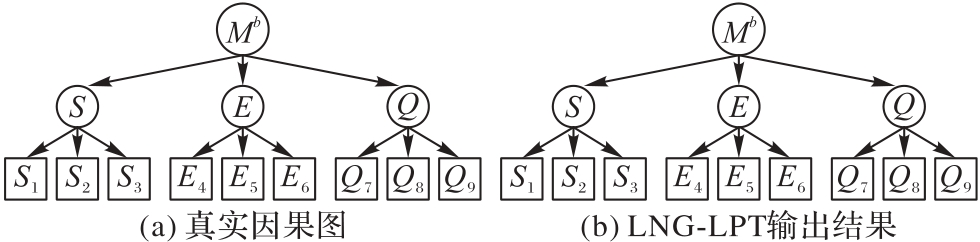
Fig. 3 Real data experimental results
| 阈值τ | F1分数(均值±标准差) | 平均运行时间/s |
|---|---|---|
| 0.01 | 0.76±0.03 | 39.7 |
| 0.05 | 0.75±0.04 | 18.3 |
| 0.10 | 0.71±0.03 | 9.8 |
Tab. 4 Performance of algorithm at different threshold τ
| 阈值τ | F1分数(均值±标准差) | 平均运行时间/s |
|---|---|---|
| 0.01 | 0.76±0.03 | 39.7 |
| 0.05 | 0.75±0.04 | 18.3 |
| 0.10 | 0.71±0.03 | 9.8 |

Fig. 4 Four types of structure when C=2
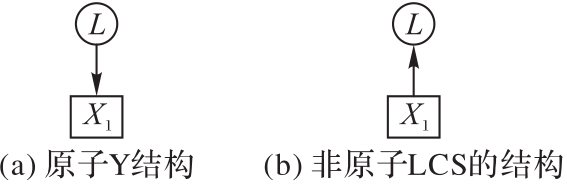
Fig. 5 Two types of structure when C=1
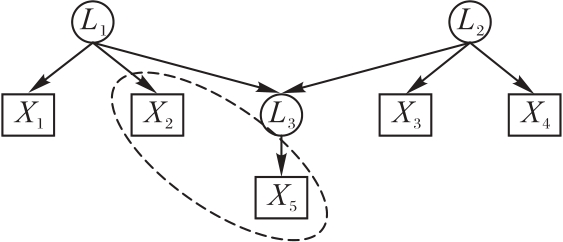
Fig. 6 Example in Prop 2 Case 2(a)
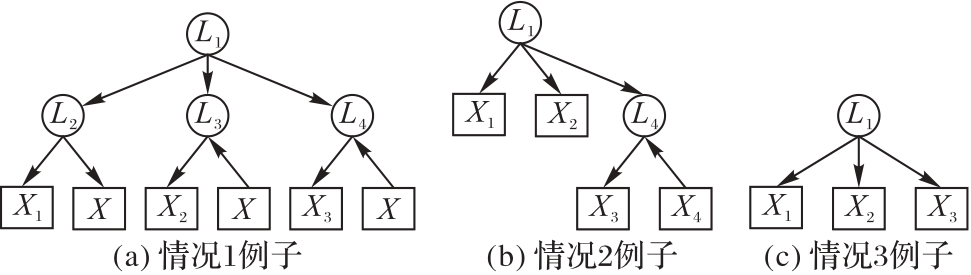
Fig. 7 Counterexample of Prop. 4
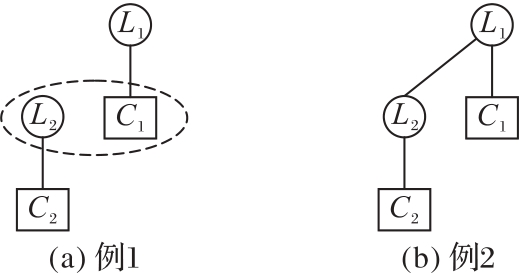
Fig. 8 Example of Prop. 6
| [1] | Zhou C, Wang X, Guo J. Learning mixed latent tree models[J]. Journal of Machine Learning Research, 2020, 21: 1-35. |
| [2] | Drton M, Lin S, Weihs L, et al. Marginal likelihood and model selection for Gaussian latent tree and forest models[J]. Bernoulli, 2017, 23(2): 1202-1232. |
| [3] | Choi M J, Tan V Y F, Anandkumar A, et al. Consistent and efficient reconstruction of latent tree models[C]// Allerton 2010. Piscataway: IEEE, 2010: 719-725. |
| [4] | Anandkumar A, Chaudhuri K, Hsu D, et al. Spectral methods for learning multivariate latent tree structure[C]// NeurIPS 2011. Red Hook: Curran Associates Inc., 2011: 225-2033. |
| [5] | Song L, Ishteva M, Parikh A, et al. Hierarchical tensor decomposition of latent tree graphical models[J]. Proceedings of Machine Learning Research, 2013, 28(3): 334-342. |
| [6] | Liu T F, Zhang N L, Chen P, et al. Greedy learning of latent tree models for multidimensional clustering[J]. Machine Learning, 2015, 98(1/2): 301-330. |
| [7] | Dagan Y, Kandiros V, Daskalakis C. EM’s convergence in Gaussian latent tree models[J]. Proceedings of Machine Learning Research, 2022, 178: 2597-2667. |
| [8] | Li G, Vandamme A M, Ramon J. Learning ancestral polytrees[EB/OL]. (2014) [2025-10-05].. |
| [9] | Sepehr F, Materassi D. An algorithm to learn polytree networks with hidden nodes[C]// NeurIPS 2019. Red Hook: Curran Associates Inc., 2019: 15110-15119. |
| [10] | Peters J, Janzing D, Schölkopf B. Elements of causal inference: foundations and learning algorithms[M]. Cambridge: MIT Press, 2017: 288-288. |
| [11] | Huang B, Low C, Xie F, et al. Latent hierarchical causal structure discovery with rank constraints[C]// NeurIPS 2022. Red Hook: Curran Associates Inc., 2022: 5549-5561. |
| [12] | Liu Y, Zhang Z, Gong D, et al. Identifiable latent neural causal models[PP/OL]. arXiv (2024-03-23) [2025-10-05].. |
| [13] | Tramontano D, Monod A, Drton M. Learning linear non-Gaussian polytree models[J]. Proceedings of Machine Learning Research, 2022, 180: 1960-1969. |
| [14] | Chow C, Liu C. Approximating discrete probability distributions with dependence trees[J]. IEEE Transactions on Information Theory, 1968, 14(3): 462-467. |
| [15] | Xie F, Huang B, Chen Z, et al. Identification of linear non-Gaussian latent hierarchical structure[J]. Proceedings of Machine Learning Research, 2022, 162: 24370-24387. |
| [16] | Xie F, Huang B, Chen Z, et al. Generalized independent noise condition for estimating causal structure with latent variables[J]. Journal of Machine Learning Research, 2024, 25: 1-61. |
| [17] | Xie F, Zeng Y, Chen Z, et al. Causal discovery of 1-factor measurement models in linear latent variable models with arbitrary noise distributions[J]. Neurocomputing, 2023, 526: 48-61. |
| [18] | Cai R, Shen Y, Chen Z, et al. Rank constraints of high-order cumulants for learning linear non-Gaussian latent polytree[C]// CSCWD 2025. Piscataway: IEEE, 2025: 1473-1479. |
| [19] | Silva R, Scheines R, Glymour C, et al. Learning the structure of linear latent variable models[J]. Journal of Machine Learning Research, 2006, 7: 191-246. |
| [20] | Erich K, Ramsey J, Yang R, et al. Causal clustering for 2-factor measurement models[C]// ECML PKDD 2014, LNCS 8725. Berlin: Springer, 2014: 34-49. |
| [21] | Shimizu S, Hoyer P O, Hyvärinen A. Estimation of linear non-Gaussian acyclic models for latent factors[J]. Neurocomputing, 2009, 72(7/8/9): 2024-2027. |
| [22] | Cai R, Xie F, Glymour C, et al. Triad constraints for learning causal structure of latent variables[C]// NeurIPS 2019. Red Hook: Curran Associates Inc., 2019: 12883-12892. |
| [23] | Xie F, Cai R, Huang B, et al. Generalized independent noise condition for estimating latent variable causal graphs[C]// NeurIPS 2020. Red Hook: Curran Associates Inc., 2020: 14891-14902. |
| [24] | Chen Z, Xie F, Qiao J, et al. Identification of linear latent variable model with arbitrary distribution[J]. Proceedings of the AAAI Conference on Artificial Intelligence, 2022, 36(6): 6350-6357. |
| [25] | Chandrasekaran V, Sanghavi S, Parrilo P A, et al. Rank-sparsity incoherence for matrix decomposition[J]. SIAM Journal on Optimization, 2011, 21(2): 572-596. |
| [26] | Chandrasekaran V, Parrilo P A, Willsky A S. Latent variable graphical model selection via convex optimization[J]. The Annals of Statistics, 2012, 40(4): 1935-1967. |
| [27] | Anandkumar A, Hsu D, Javanmard A, et al. Learning linear Bayesian networks with latent variables[J]. Proceedings of Machine Learning Research, 2013: 249-257. |
| [28] | Adams J, Hansen N R, Zhang K. Identification of partially observed linear causal models: graphical conditions for the non-Gaussian and heterogeneous cases[C]// NeurIPS 2021. Red Hook: Curran Associates Inc., 2021: 22822-22833. |
| [29] | Chen Z, Xie F, Qiao J, et al. Some general identification results for linear latent hierarchical causal structure[C]// IJCAI 2023. California: IJCAI, 2023: 3568-3576. |
| [30] | Chen Z, Cai R, Xie F, et al. Learning discrete latent variable structures with tensor rank conditions[C]// NeurIPS 2024. Red Hook: Curran Associates Inc., 2024: 17398-17427. |
| [31] | Spirtes P, Glymour C, Scheines R. Causation, prediction, and search[M]. 2nd ed. Cambridge, MA: MIT Press, 2001. |
| [32] | Sullivant S, Talaska K, Draisma J. Trek separation for Gaussian graphical models[PP/OL]. V3. arXiv (2010-08-04) [2025-10-05].. |
| [33] | Shimizu S, Hoyer P O, Hyvärinen A, et al. A linear non-Gaussian acyclic model for causal discovery[J]. Journal of Machine Learning Research, 2006, 7: 2003-2030. |
| [34] | Middleton D. Non-Gaussian noise models in signal processing for telecommunications: new methods an results for class A and class B noise models[J]. IEEE Transactions on Information Theory, 1999, 45(4): 1129-1149. |
| [35] | Gao J, Chen Q, Blasch E. Image denoising in the presence of non-Gaussian, power-law noise[C]// NAECON 2012. Piscataway: IEEE, 2012: 103-108. |
| [36] | 蔡瑞初,陈薇,张坤,等. 基于非时序观察数据的因果关系发现综述[J]. 计算机学报, 2017, 40(6): 1470-1490. |
| Cai Ruichu, Chen Wei, Zhang Kun, et al. A survey on non-temporal series observational data based causal discovery[J]. Chinese Journal of Computers, 2017, 40 (6): 1470-1490. | |
| [37] | 曾艳,郝志峰,蔡瑞初,等. 基于时序隐变量模型的因果关系发现算法[J]. 计算机工程与设计, 2022, 43(5): 1428-1434. |
| Zeng Yan, Hao Zhifeng, Cai Ruichu, et al. Causal discovery algorithm based on latent factor models for time series data[J]. Computer Engineering and Design, 2022, 43 (5): 1428-1434. | |
| [38] | Rohekar R Y, Nisimov S, Gurwicz Y, et al. From temporal to contemporaneous iterative causal discovery in the presence of latent confounders[J]. Proceedings of Machine Learning Research, 2023, 202: 39939-39950. |
| [39] | Himi S A, Bühner M, Schwaighofer M, et al. Multitasking behavior and its related constructs: executive functions, working memory capacity, relational integration, and divided attention[J]. Cognition, 2019, 189: 275-298. |
| [1] | Jinyu LIANG, Hongjuan GAO, Xiaofei DU. 3D face generation method based on latent feature enhancement for disentanglement [J]. Journal of Computer Applications, 2026, 46(1): 216-223. |
| [2] | Jun YANG, Mengxue PANG, Lishan QIAO. Estimation and classification of brain functional networks based on temporal correlation information fusion [J]. Journal of Computer Applications, 2025, 45(5): 1403-1409. |
| [3] | CAI Ruichu, BAI Yiming, QIAO Jie, HAO Zhifeng. Causal inference method based on confounder hidden compact representation model [J]. Journal of Computer Applications, 2021, 41(10): 2793-2798. |
| [4] | GAO Yan, YUE Kun, WU Hao, FU Xiaodong, LIU Weiyi. Construction and inference of latent variable model oriented to user preference discovery [J]. Journal of Computer Applications, 2017, 37(2): 360-366. |
| [5] | HAO Zhifeng, CHEN Wei, CAI Ruichu, HUANG Ruihui, WEN Wen, WANG Lijuan. Performance optimization of wireless network based on canonical causal inference algorithm [J]. Journal of Computer Applications, 2016, 36(8): 2114-2120. |
| [6] | ZHANG Wei HUANG Wei XIA Limin. Recommendation research based on general content probabilistic latent semantic analysis model [J]. Journal of Computer Applications, 2013, 33(05): 1330-1333. |
| Viewed | ||||||
|
Full text |
|
|||||
|
Abstract |
|
|||||
