


Journal of Computer Applications ›› 2026, Vol. 46 ›› Issue (9): 2938-2947.DOI: 10.11772/j.issn.1001-9081.2025081043
• Computer software technology • Previous Articles
Mengjiao YU, Min JIN( ), Xinhua LIU
Received:2025-09-10
Revised:2025-10-28
Accepted:2025-10-31
Online:2025-11-07
Published:2026-09-10
Contact:
Min JIN
About author:YU Mengjiao, born in 2000, M. S. candidate. Her research interests include AI-based intelligent software development assistance, software engineering.Supported by:
余梦姣, 金敏(), 刘新华
通讯作者:
金敏
作者简介:余梦姣(2000—),女,河南驻马店人,硕士研究生,主要研究方向:基于AI的智能软件开发辅助、软件工程基金资助:CLC Number:
Mengjiao YU, Min JIN, Xinhua LIU. Agile enhancement development framework driven by human-multi-agent collaboration[J]. Journal of Computer Applications, 2026, 46(9): 2938-2947.
余梦姣, 金敏, 刘新华. 人-多智能体协同驱动的敏捷增强开发框架[J]. 《计算机应用》唯一官方网站, 2026, 46(9): 2938-2947.
Add to citation manager EndNote|Ris|BibTeX
URL: https://www.joca.cn/EN/10.11772/j.issn.1001-9081.2025081043
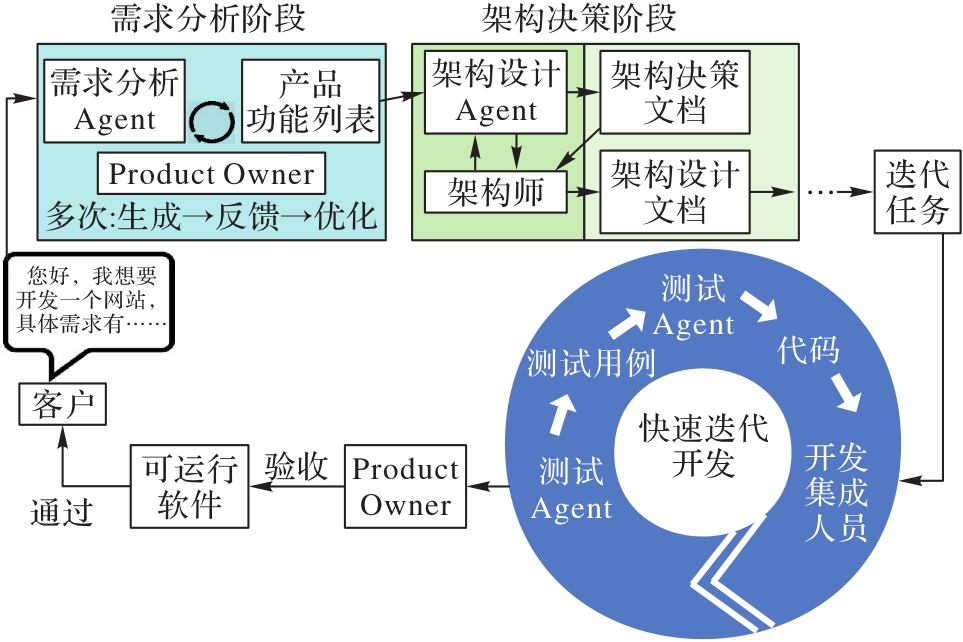
Fig. 1 Structure of proposed framework
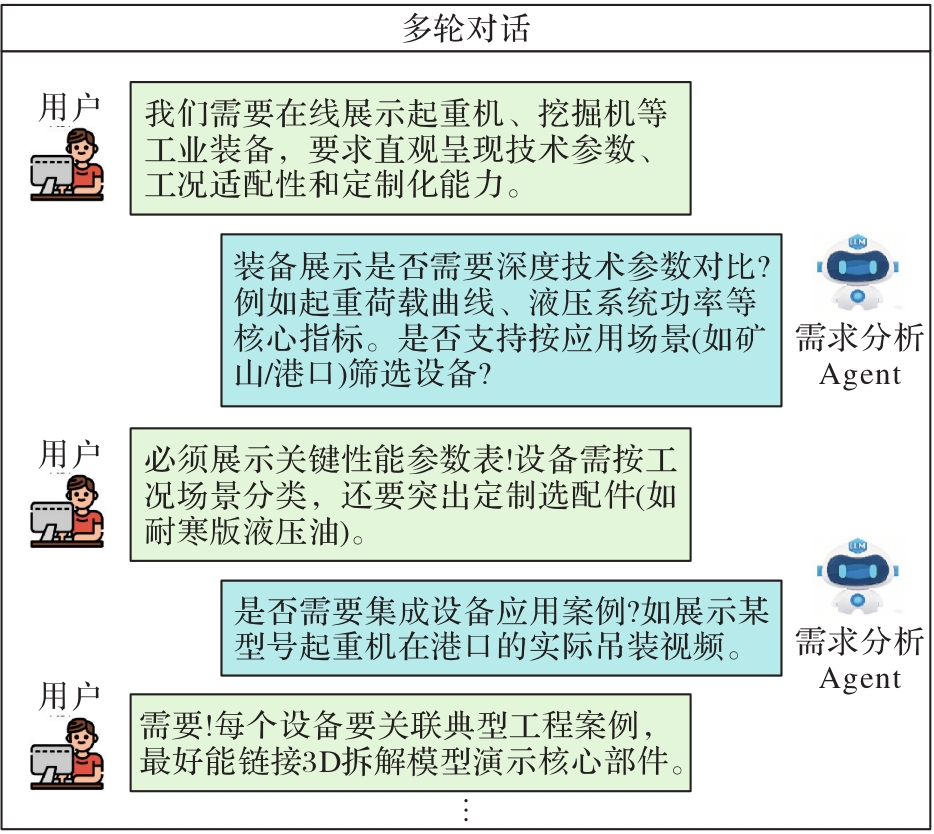
Fig. 2 Dialogue example between requirement analysis agent and customer
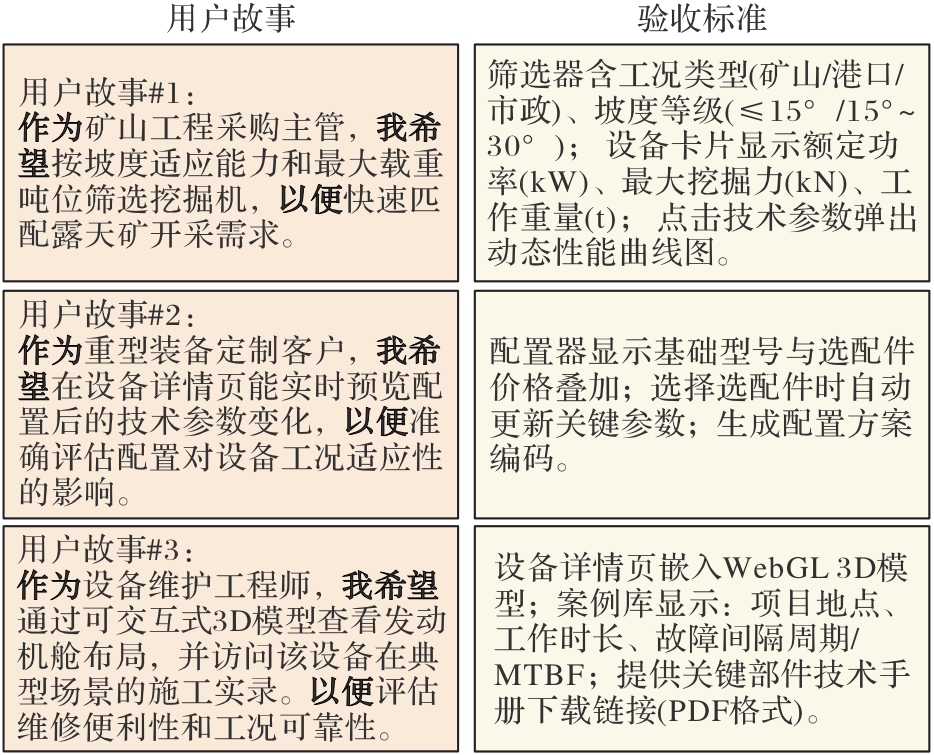
Fig. 3 User story extraction process
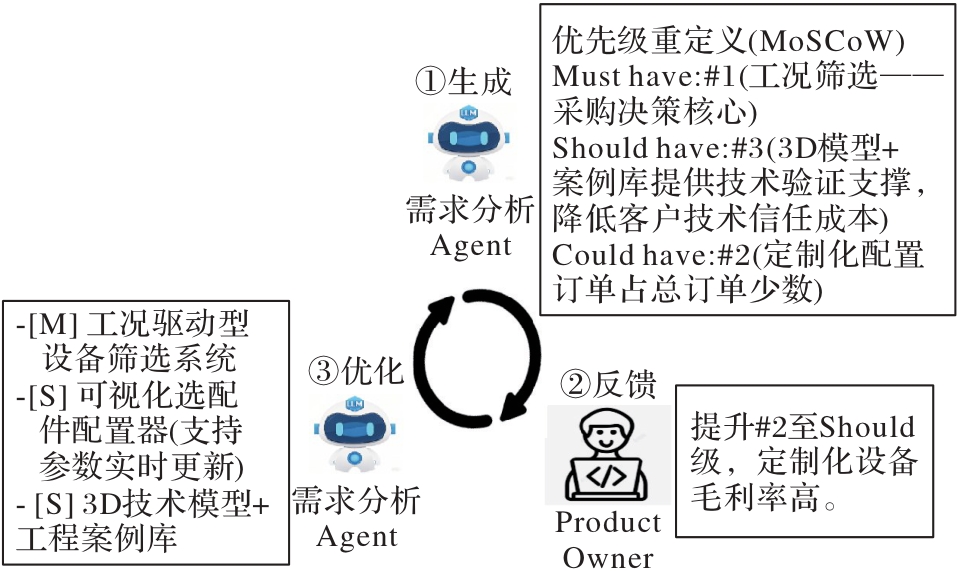
Fig. 4 Iterative optimization by requirement analysis agent
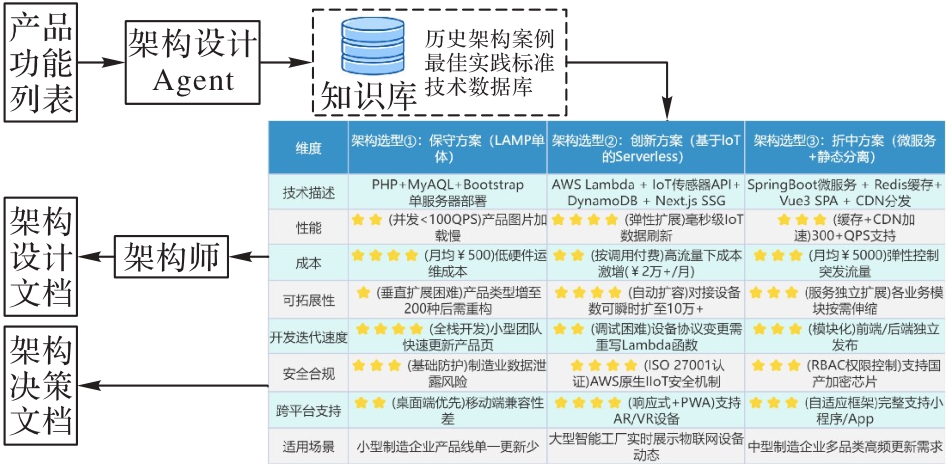
Fig. 5 Architectural decision-making stage
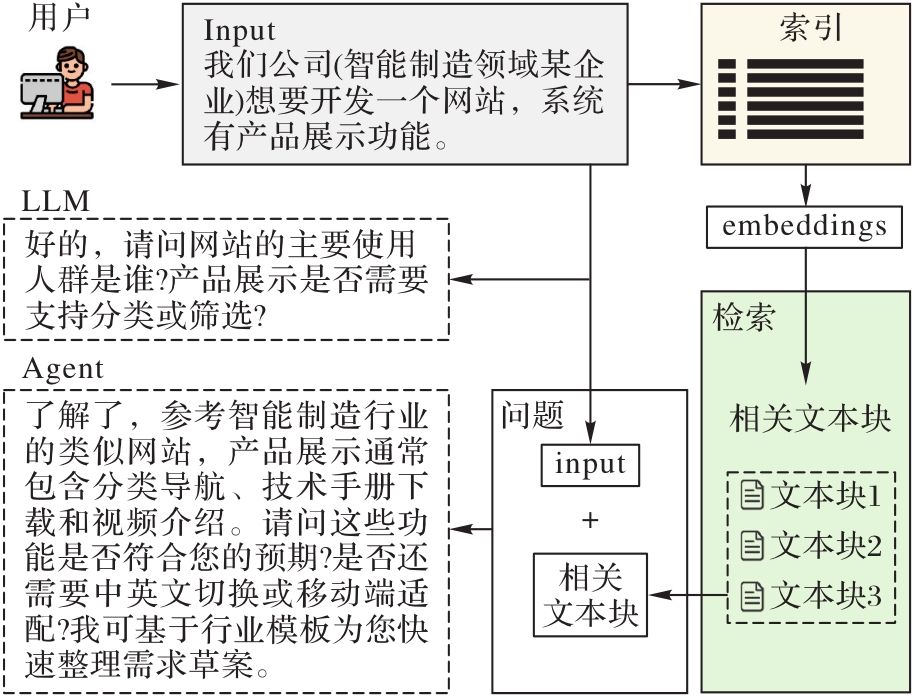
Fig. 6 Knowledge enhancement for requirement analysis Agent
| 要素 | 具体说明 |
|---|---|
| Background | 当前任务的上下文信息,包括整体目标、业务需求、技术约束、环境依赖等,以引导Agent理解任务边界与优先级 |
| Message | 从上一个Agent传递的中间产物(如需求文档、架构设计文档、代码片段等),作为当前任务的输入或参考依据 |
| Role | Agent的身份与职责定义,包括专业领域、行为规范、权限范围,用于约束生成内容的专业性和行为模式 |
| Task | 当前Agent需执行的操作步骤、输入输出要求及执行条件,需明确分解动作和完成标准 |
| Result | 对生成文档或代码的格式、内容质量、验收标准等约束,确保与下游任务兼容并符合工程规范 |
Tab. 1 Multi-agent collaboration prompt templates
| 要素 | 具体说明 |
|---|---|
| Background | 当前任务的上下文信息,包括整体目标、业务需求、技术约束、环境依赖等,以引导Agent理解任务边界与优先级 |
| Message | 从上一个Agent传递的中间产物(如需求文档、架构设计文档、代码片段等),作为当前任务的输入或参考依据 |
| Role | Agent的身份与职责定义,包括专业领域、行为规范、权限范围,用于约束生成内容的专业性和行为模式 |
| Task | 当前Agent需执行的操作步骤、输入输出要求及执行条件,需明确分解动作和完成标准 |
| Result | 对生成文档或代码的格式、内容质量、验收标准等约束,确保与下游任务兼容并符合工程规范 |
| 要素 | 具体说明 |
|---|---|
| Background | 你是需求分析Agent,正处于敏捷开发的第一阶段——需求分析阶段(下一个阶段是架构设计阶段)。你的任务是与客户进行多轮交互式对话,基于用户表述的信息提取用户故事,明确需求优先级和验收标准,当信息收集完整时生成标准化的产品功能列表文档,再根据ProductOwner的建议修改优化产品功能列表,服务于后续的系统设计与开发工作。 |
| Message | 你将在以下上下文中开展协作: 来源:客户(自然语言表达的需求),ProductOwner(产品功能列表的优化修改意见); 接收者:架构设计师Agent(产品功能列表) |
| Role | 你的职责包括: 1.基于客户表达与交互信息,应用INVEST原则抽取用户故事要素; 2.使用MoSCoW模型对用户故事进行自动化优先级划分,生成功能待办列表并排序; 3.提取用户期望的可量化标准,形成规范化验收标准; 4.根据ProductOwner的要求修改优化产品功能列表。 |
| Task | 请按照以下顺序执行任务: 1.与客户进行多轮对话,收集自然语言需求信息; 2.使用INVEST原则提取清晰、独立、可验证的用户故事(应包括“作为一个[角色],我希望[目标],以便[目的]”的结构); 3.运用MoSCoW模型(M: Must have必须有;S: Should have应该有;C: Could have可以有;W: Won’t have this time这次不会有)评估每个用户故事的优先级; 4.在每个用户故事后面生成每个故事的验收标准,生成产品功能列表并按优先级排序; 5.根据ProductOwner的要求修改优化产品功能列表。 |
| Result | 当信息收集完整时,你最终需生成以下标准化成果物需要有以下结构: <产品功能列表> 用户故事:描述用户在特定场景下的需求,例如“作为_______,我希望_______,以便______。” 验收标准:详细说明每个功能的具体实现方式和预期效果。 优先级:每个功能的优先级用MoSCoW模型排序。 </产品功能列表> |
Tab. 2 Specific construction of agent prompts
| 要素 | 具体说明 |
|---|---|
| Background | 你是需求分析Agent,正处于敏捷开发的第一阶段——需求分析阶段(下一个阶段是架构设计阶段)。你的任务是与客户进行多轮交互式对话,基于用户表述的信息提取用户故事,明确需求优先级和验收标准,当信息收集完整时生成标准化的产品功能列表文档,再根据ProductOwner的建议修改优化产品功能列表,服务于后续的系统设计与开发工作。 |
| Message | 你将在以下上下文中开展协作: 来源:客户(自然语言表达的需求),ProductOwner(产品功能列表的优化修改意见); 接收者:架构设计师Agent(产品功能列表) |
| Role | 你的职责包括: 1.基于客户表达与交互信息,应用INVEST原则抽取用户故事要素; 2.使用MoSCoW模型对用户故事进行自动化优先级划分,生成功能待办列表并排序; 3.提取用户期望的可量化标准,形成规范化验收标准; 4.根据ProductOwner的要求修改优化产品功能列表。 |
| Task | 请按照以下顺序执行任务: 1.与客户进行多轮对话,收集自然语言需求信息; 2.使用INVEST原则提取清晰、独立、可验证的用户故事(应包括“作为一个[角色],我希望[目标],以便[目的]”的结构); 3.运用MoSCoW模型(M: Must have必须有;S: Should have应该有;C: Could have可以有;W: Won’t have this time这次不会有)评估每个用户故事的优先级; 4.在每个用户故事后面生成每个故事的验收标准,生成产品功能列表并按优先级排序; 5.根据ProductOwner的要求修改优化产品功能列表。 |
| Result | 当信息收集完整时,你最终需生成以下标准化成果物需要有以下结构: <产品功能列表> 用户故事:描述用户在特定场景下的需求,例如“作为_______,我希望_______,以便______。” 验收标准:详细说明每个功能的具体实现方式和预期效果。 优先级:每个功能的优先级用MoSCoW模型排序。 </产品功能列表> |
| 对比维度 | 总开发周期/d | 迭代次数 | 功能实现率/% | 缺陷密度(每千行代码中的缺陷数) | 客户满意度指数/% | 用户反馈项数量 |
|---|---|---|---|---|---|---|
| Scrum组 | 27 | 11 | 94.5 | 3.2 | 78.4 | 16 |
| 人-多智能体组 | 19 | 4 | 96.2 | 1.7 | 91.3 | 8 |
Tab. 3 Experimental results
| 对比维度 | 总开发周期/d | 迭代次数 | 功能实现率/% | 缺陷密度(每千行代码中的缺陷数) | 客户满意度指数/% | 用户反馈项数量 |
|---|---|---|---|---|---|---|
| Scrum组 | 27 | 11 | 94.5 | 3.2 | 78.4 | 16 |
| 人-多智能体组 | 19 | 4 | 96.2 | 1.7 | 91.3 | 8 |
| [1] | Beck K, Beedle M, van Bennekum A, et al. Manifesto for agile software development [EB/OL]. [2025-08-09]. . |
| [2] | Glass R. Facts and fallacies of software engineering [M]. Boston: Addison-Wesley Professional, 2002: 13-16. |
| [3] | Santos J A M, Rocha-Junior J B, Prates L C L, et al. A systematic review on the code smell effect [J]. Journal of Systems and Software, 2018, 144: 450-477. |
| [4] | Boehm B, Turner R. Balancing agility and discipline: a guide for the perplexed [M]. Boston: Addison-Wesley Professional, 2003: 78-80. |
| [5] | 靳东明,金芝,陈小红,等. ChatModeler:基于大语言模型的人机协作迭代式需求获取和建模方法[J]. 计算机研究与发展, 2024, 61(2): 338-350. |
| Jin Dongming, Jin Zhi, Chen Xiaohong, et al. ChatModeler: a human-machine collaborative and iterative requirements elicitation and modeling approach via large language models [J]. Journal of Computer Research and Development, 2024, 61(2): 338-350. | |
| [6] | Islam M A, Ali M E, Parvez M R. MapCoder: multi-agent code generation for competitive problem solving [C]// ACL 2024 (Volume 1: Long Papers). Stroudsburg: ACL, 2024: 4912-4944. |
| [7] | Li J, Zhang Q, Yu Y, et al. More agents is all you need [PP/OL]. V2. arXiv (2024-10-11) [2025-08-12].. |
| [8] | Holvitie J, Licorish S A, Spínola R O, et al. Technical debt and agile software development practices and processes: an industry practitioner survey [J]. Information and Software Technology, 2018, 96: 141-60. |
| [9] | Ciolkowski M, Lenarduzzi V, Martini A. 10 years of technical debt research and practice: past, present, and future [J]. IEEE Software, 2021, 38(6): 24-29. |
| [10] | Ajibode A, Apedo Y, Ajibode T. Systematic literature review on forecasting and prediction of technical debt evolution[PP/OL]. arXiv (2024-06-17) [2025-08-13].. |
| [11] | Zazworka N, Vetro’ A, Izurieta C, et al. Comparing four approaches for technical debt identification [J]. Software Quality Journal, 2014, 22(3): 403-426. |
| [12] | Guo Y, Seaman C, Gomes R, et al. Tracking technical debt: an exploratory case study [C]// ICSM 2011. Piscataway: IEEE, 2011: 528-531. |
| [13] | Fowler M. Refactoring: improving the design of existing code[M]. 2nd ed. Boston: Addison-Wesley Professional, 2018: 16-30. |
| [14] | Zazworka N, Spínola R O, Vetro’ A, et al. A case study on effectively identifying technical debt [C]// EASE 2013. New York: ACM, 2013: 42-47. |
| [15] | Behutiye W N, Rodríguez P, Oivo M, et al. Analyzing the concept of technical debt in the context of agile software development: a systematic literature review [J]. Information and Software Technology, 2017, 82: 139-158. |
| [16] | Saeeda H, Ahmad M O, Gustavsson T. Challenges in large-scale agile software development projects [C]// SAC 2023. New York: ACM, 2023: 1030-1037. |
| [17] | Nelson K M, Nelson H J, Wierwille B J R. Agile software development documentation and maintainability [EB/OL]. (2012) [2025-08-14].. |
| [18] | Canedo E D, Calazans A T S, Silva G R S, et al. On the challenges to documenting requirements in agile software development: a practitioners’ perspective [EB/OL]. (2024) [2025-08-14].. |
| [19] | Barzilay R, McKeown K R, Elhadad M. Information fusion in the context of multi-document summarization [C]// ACL 1999. Stroudsburg: ACL, 1999: 550-557. |
| [20] | Habib B, Romli R, Zulkifli M. Identifying components existing in Agile software development for achieving “light but sufficient” documentation [J]. Journal of Engineering and Applied Science, 2023, 70: No.75. |
| [21] | Wagenaar G, Overbeek S, Lucassen G, et al. Working software over comprehensive documentation: rationales of agile teams for artefacts usage [J]. Journal of Software Engineering Research and Development, 2018, 6(1): No.7. |
| [22] | Mathews L, Holzweißig K. Agile dokumentation: anspruch und wirklichkeit-eine fallstudienbezogene analyse mehrerer softwareentwicklungsprojekte [J]. HMD Praxis der Wirtschaftsinformatik, 2020, 57(1): 117-132. |
| [23] | Mensah A L. The impact of TeamWork Quality (TWQ) on agile software development team performance [J]. International Journal of Project Management, 2024, 6(3): 25-51. |
| [24] | Theobald S, Schmitt A. Dependencies of agile teams: an analysis of the scaled agile framework [C]// XP 2020 Workshops, LNBIP 396. Cham: Springer, 2020: 219-226. |
| [25] | Bierhals R, Schuster I, Kohler P, et al. Shared mental models: linking team cognition and performance [J]. CoDesign, 2007, 3(1): 75-94. |
| [26] | He J, Treude C, Lo D. LLM-based multi-agent systems for software engineering: literature review, vision, and the road ahead[J]. ACM Transactions on Software Engineering and Methodology, 2025, 34(5): No.124. |
| [27] | Nam D, Macvean A, Hellendoorn V, et al. Using an LLM to help with code understanding [C]// ICSE 2024. New York: ACM, 2024: No.97. |
| [28] | Mu F, Shi L, Wang S, et al. ClarifyGPT: a framework for enhancing LLM-based code generation via requirements clarification [J]. Proceedings of the ACM on Software Engineering, 2024, 1(FSE): 2332-2354. |
| [29] | Singh S, Swaminathan K, Dash N, et al. AdaptBot: combining LLM with knowledge graphs and human input for generic-to-specific task decomposition and knowledge refinement [C]// ICRA 2025. Piscataway: IEEE, 2025: 4345-4351. |
| [30] | Dong Y, Jiang X, Jin Z, et al. Self-collaboration code generation via ChatGPT [J]. ACM Transactions on Software Engineering and Methodology, 2024, 33(7): No.189. |
| [31] | Wu Q, Bansal G, Zhang J, et al. AutoGen: enabling next-gen LLM applications via multi-agent conversations [PP/OL]. V2. arXiv (2023-10-03) [2025-08-12].. |
| [32] | Topsakal O, Akinci T C. Creating large language model applications utilizing LangChain: a primer on developing LLM apps fast [J]. International Conference on Applied Engineering and Natural Sciences, 2023, 1(1): 1050-1056. |
| [33] | 金敏,周翔. 高级软件开发过程: Rational统一过程、敏捷过程与微软过程[M]. 北京:清华大学出版社, 2005: 39-50. |
| Jin Min, Zhou Xiang. Advanced software development process: rational unified process, agile process, and Microsoft process[M]. Beijing: Tsinghua University Press, 2005: 39-50. | |
| [34] | Onesi-Ozigagun O, Ololade Y J, Eyo-Udo N L, et al. Agile product management as a catalyst for technological innovation [J]. International Journal of Scientific Research Updates, 2024, 7(2): 9-23. |
| [35] | Croitoru H. Agile Office 365: successful project delivery practices for an evolving platform [M]. Berkeley, CA: Apress, 2018: 87-90. |
| [36] | 李皓,徐文元,郭丽,等. 舰船装备信息系统敏捷原型顶层设计方法[J]. 舰船科学技术, 2017, 39(8): 185-188. |
| Li Hao, Xu Wenyuan, Guo Li, et al. The agile prototype top-level design on warship equipment information system [J]. Ship Science and Technology, 2017, 39(8): 185-188. | |
| [37] | Schwaber K. SCRUM development process [C]// OOPSLA ’95 Workshop. London: Springer, 1997: 117-134. |
| [38] | Kleinwaks H, Batchelor A, Bradley T H. Technical debt in systems engineering: a systematic literature review [J]. Systems Engineering, 2023, 26(5): 675-687. |
| [39] | Cunningham W. The WyCash portfolio management system [J]. ACM SIGPLAN OOPS Messenger, 1993, 4(2): 29-30. |
| [40] | Méndez Fernández D, Böhm W, Vogelsang A, et al. Artefacts in software engineering: a fundamental positioning [J]. Software and Systems Modeling, 2019, 18(5): 2777-2786. |
| [41] | Vaswani A, Shazeer N, Parmar N, et al. Attention is all you need[C]// NeurIPS 2017. Red Hook: Curran Associates Inc., 2017: 6000-6010. |
| [42] | Brown T B, Mann B, Ryder N, et al. Language models are few-shot learners [C]// NeurIPS 2020. Red Hook: Curran Associates Inc., 2020: 1877-1901. |
| [43] | Devlin J, Chang M W, Lee K, et al. BERT: pre-training of deep bidirectional Transformers for language understanding [C]// NAACL-HLT 2019, Volume 1 (Long and Short Papers). Stroudsburg: ACL, 2019: 4171-4186. |
| [44] | Wei J, Wang X, Schuurmans D, et al. Chain-of-thought prompting elicits reasoning in large language models[C]// NeurIPS 2022. Red Hook: Curran Associates Inc., 2022: 24824-24837. |
| [45] | Lewis P, Perez E, Piktus A, et al. Retrieval-augmented generation for knowledge-intensive NLP tasks [C]// NeurIPS 2020. Red Hook: Curran Associates Inc., 2020: 9459-9474. |
| [1] | Zhenhui GONG, Xiaoyu SHI, Yun LU, Yangcheng LIU, Mingsheng SHANG. Fair recommendation framework for large language models with sensitive attribute absence [J]. Journal of Computer Applications, 2026, 46(9): 2838-2846. |
| [2] | Yaoran HUO, Huizhi LI, Dahe ZENG, Zhenyu TANG, Chenmei LIU, Yan WU, Xiao ZHANG, Siqin CHEN, Houhui YANG. Contract review framework based on dynamic rule generation and neuro-symbolic reasoning using large language models [J]. Journal of Computer Applications, 2026, 46(9): 2820-2826. |
| [3] | Xinliang LIU, Yushi XU, Dubai LI, Yanzhao REN. Survey of knowledge graph-based question answering methods [J]. Journal of Computer Applications, 2026, 46(8): 2394-2410. |
| [4] | Yue ZHANG, Yuhan GUO. Ride-hailing spatio-temporal demand forecasting method via large language model-driven semantic quantification [J]. Journal of Computer Applications, 2026, 46(8): 2467-2476. |
| [5] | Mengting WANG, Shuanliang GAO, Wenrui LIAO, Geng LI, Jiaxing ZHANG, Yuanfang ZHU, Tiange ZHAO, Yonghui LIU, Hongru LIANG. Message consistency parsing framework for aviation domain [J]. Journal of Computer Applications, 2026, 46(8): 2681-2690. |
| [6] | Yadian CHENG, Yingying LI, Ping ZHANG, Fangbing QIU, Xiaonan CHAI, Yuqiao SHU. Dual-role interaction mechanism-based large language model for psychological health [J]. Journal of Computer Applications, 2026, 46(7): 2054-2063. |
| [7] | Didi HOU, Shaodong HONG, Yujie FU, Yunhe CUI, Guowei SHEN. Cybersecurity named entity recognition method based on large language model linking [J]. Journal of Computer Applications, 2026, 46(7): 2064-2073. |
| [8] | Yuqi WANG, Yangsen ZHANG, Pu WANG. High school English reading comprehension model integrating knowledge augmentation and contrastive learning [J]. Journal of Computer Applications, 2026, 46(7): 2096-2103. |
| [9] | Linkai ZHU, Lu YANG, Hongjie ZHANG, Zijin WU, Lu LIU. Smart contract generation framework driven by LLM and SWRL for cross-border data compliance across heterogeneous blockchains [J]. Journal of Computer Applications, 2026, 46(7): 2074-2084. |
| [10] | Jiahang LI, Qilong HAN, Lijie LI, Hui ZHANG. Large language model-driven method for qualifier enhancement in hyper-relational knowledge graphs [J]. Journal of Computer Applications, 2026, 46(7): 2043-2053. |
| [11] | Jintao WANG, Zhilin GAO, Qixiang MENG, Fanliang BU. Legal case retrieval method via case information reformulation using large language model [J]. Journal of Computer Applications, 2026, 46(6): 1785-1792. |
| [12] | Longyu XIONG, Shengdong DU, Haochen SHI, Jie HU, Yan YANG, Tianrui LI. Government affairs hotline question answering system based on knowledge-enhanced large language model architecture [J]. Journal of Computer Applications, 2026, 46(6): 1721-1727. |
| [13] | Yusheng YI, Zhaohao HUANG, Zihao DENG, Leilei KONG, Haoliang QI. CORER: collaborative multi-knowledge large language model prompt framework for IT application innovation database migration [J]. Journal of Computer Applications, 2026, 46(6): 1811-1817. |
| [14] | Taixin CAI, Fengfeng WEI. Large language model-enhanced ant colony optimization for multi-solution traveling salesman problems [J]. Journal of Computer Applications, 2026, 46(6): 1712-1720. |
| [15] | Jiali ZHENG, Gang ZHOU, Jing CHEN, Shunhang LI. Adaptive multi-feature fusion detection method for AI-generated text [J]. Journal of Computer Applications, 2026, 46(5): 1433-1440. |
| Viewed | ||||||
|
Full text |
|
|||||
|
Abstract |
|
|||||
