


Journal of Computer Applications ›› 2026, Vol. 46 ›› Issue (7): 2096-2103.DOI: 10.11772/j.issn.1001-9081.2025070871
• Artificial intelligence • Previous Articles Next Articles
Yuqi WANG, Yangsen ZHANG( ), Pu WANG
Received:2025-08-12
Revised:2025-09-09
Accepted:2025-09-19
Online:2025-11-05
Published:2026-07-10
Contact:
Yangsen ZHANG
About author:WANG Yuqi, born in 1999, Ph. D. candidate. Her research interests include machine reading comprehension, question and answer system.Supported by:
王昱麒, 张仰森(), 王璞
通讯作者:
张仰森
作者简介:王昱麒(1999—),女,山西运城人,博士研究生,CCF学生会员,主要研究方向:机器阅读理解、问答系统基金资助:CLC Number:
Yuqi WANG, Yangsen ZHANG, Pu WANG. High school English reading comprehension model integrating knowledge augmentation and contrastive learning[J]. Journal of Computer Applications, 2026, 46(7): 2096-2103.
王昱麒, 张仰森, 王璞. 融合知识增强和对比学习的高中英语阅读理解模型[J]. 《计算机应用》唯一官方网站, 2026, 46(7): 2096-2103.
Add to citation manager EndNote|Ris|BibTeX
URL: https://www.joca.cn/EN/10.11772/j.issn.1001-9081.2025070871
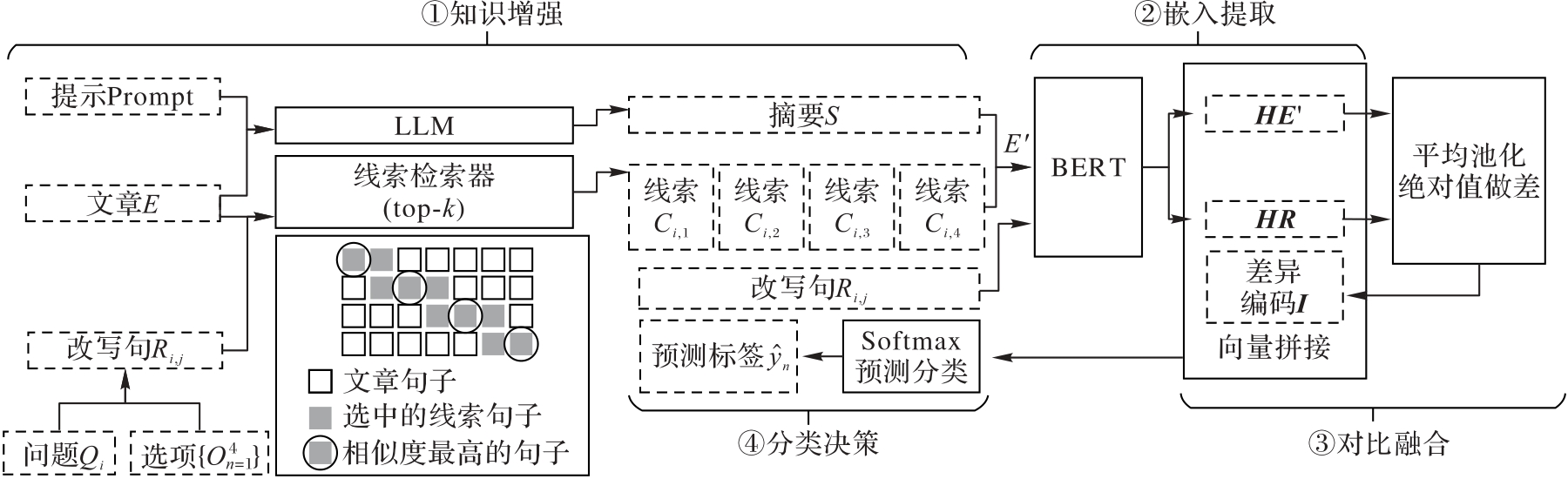
Fig. 1 Overall architecture of KCL-MCRC
| 数据划分 | 样本数 | ||||
|---|---|---|---|---|---|
| A | B | C | D | 合计 | |
| 合计 | 15 211 | 17 863 | 18 752 | 17 568 | 69 394 |
| 训练集 | 13 701 | 16 021 | 16 885 | 15 838 | 62 445 |
| 验证集 | 756 | 907 | 917 | 871 | 3 451 |
| 测试集 | 754 | 935 | 950 | 859 | 3 498 |
Tab. 1 Description of RACE-H dataset
| 数据划分 | 样本数 | ||||
|---|---|---|---|---|---|
| A | B | C | D | 合计 | |
| 合计 | 15 211 | 17 863 | 18 752 | 17 568 | 69 394 |
| 训练集 | 13 701 | 16 021 | 16 885 | 15 838 | 62 445 |
| 验证集 | 756 | 907 | 917 | 871 | 3 451 |
| 测试集 | 754 | 935 | 950 | 859 | 3 498 |
| 参数 | 值 | 参数 | 值 |
|---|---|---|---|
| batch_size | 8 | epochs | 20 |
| lr | 3×10⁻⁵ | weight_decay | 0.01 |
| warmup_proportion | 0.1 | optimizer | AdamW |
| max_length | 512 |
Tab. 2 Setting of experimental parameters
| 参数 | 值 | 参数 | 值 |
|---|---|---|---|
| batch_size | 8 | epochs | 20 |
| lr | 3×10⁻⁵ | weight_decay | 0.01 |
| warmup_proportion | 0.1 | optimizer | AdamW |
| max_length | 512 |
| 模型 | 准确率/% | |
|---|---|---|
| 验证集 | 测试集 | |
| BERT+MLP | 61.60 | 59.50 |
| STM | 64.70 | 62.60 |
| MMA | 65.40 | 63.20 |
| DCMN | 64.00 | 62.30 |
| GenMC | 52.33 | 50.91 |
| MDT | 64.73 | 63.24 |
| ChatGLM(Raw) | — | 68.13 |
| ChatGLM(K) | — | 72.07 |
| 本文模型 | 65.75 | 64.12 |
Tab. 3 Comparison of accuracy among different models on RACE-H dataset
| 模型 | 准确率/% | |
|---|---|---|
| 验证集 | 测试集 | |
| BERT+MLP | 61.60 | 59.50 |
| STM | 64.70 | 62.60 |
| MMA | 65.40 | 63.20 |
| DCMN | 64.00 | 62.30 |
| GenMC | 52.33 | 50.91 |
| MDT | 64.73 | 63.24 |
| ChatGLM(Raw) | — | 68.13 |
| ChatGLM(K) | — | 72.07 |
| 本文模型 | 65.75 | 64.12 |
| 模型 | 准确率/% | |
|---|---|---|
| 验证集 | 测试集 | |
| BERT | 62.13 | 61.34 |
| BERT+对比融合 | 62.94 | 61.75 |
| BERT+知识增强 | 64.73 | 63.69 |
| 本文模型 | 65.75 | 64.12 |
Tab. 4 Results of ablation experiments
| 模型 | 准确率/% | |
|---|---|---|
| 验证集 | 测试集 | |
| BERT | 62.13 | 61.34 |
| BERT+对比融合 | 62.94 | 61.75 |
| BERT+知识增强 | 64.73 | 63.69 |
| 本文模型 | 65.75 | 64.12 |
| 问题类型 | 定义 |
|---|---|
| 细节理解 | 理解具体信息的能力,要求回忆和识别文章中明确陈述的信息,包括事实、数据、定义、日期、事件和数字等 |
| 逻辑推理 | 根据信息推断结论,包括识别论点、理解论点结构、识别假设和前提并根据这些信息进行合理推断 |
| 主旨概括 | 理解文本的整体结构,识别关键段落,将复杂的信息简化为一个或几个核心思想,来识别和总结文本的主要观点或主题 |
| 作者态度 | 识别作者对某个主题或论点的情感倾向或观点。包括理解作者的语气、意图、偏见或看法 |
| 世界知识 | 对世界的事实性知识,包括计算、历史、地理、文化、科学和其他领域的信息 |
Tab. 5 Definition of question types
| 问题类型 | 定义 |
|---|---|
| 细节理解 | 理解具体信息的能力,要求回忆和识别文章中明确陈述的信息,包括事实、数据、定义、日期、事件和数字等 |
| 逻辑推理 | 根据信息推断结论,包括识别论点、理解论点结构、识别假设和前提并根据这些信息进行合理推断 |
| 主旨概括 | 理解文本的整体结构,识别关键段落,将复杂的信息简化为一个或几个核心思想,来识别和总结文本的主要观点或主题 |
| 作者态度 | 识别作者对某个主题或论点的情感倾向或观点。包括理解作者的语气、意图、偏见或看法 |
| 世界知识 | 对世界的事实性知识,包括计算、历史、地理、文化、科学和其他领域的信息 |
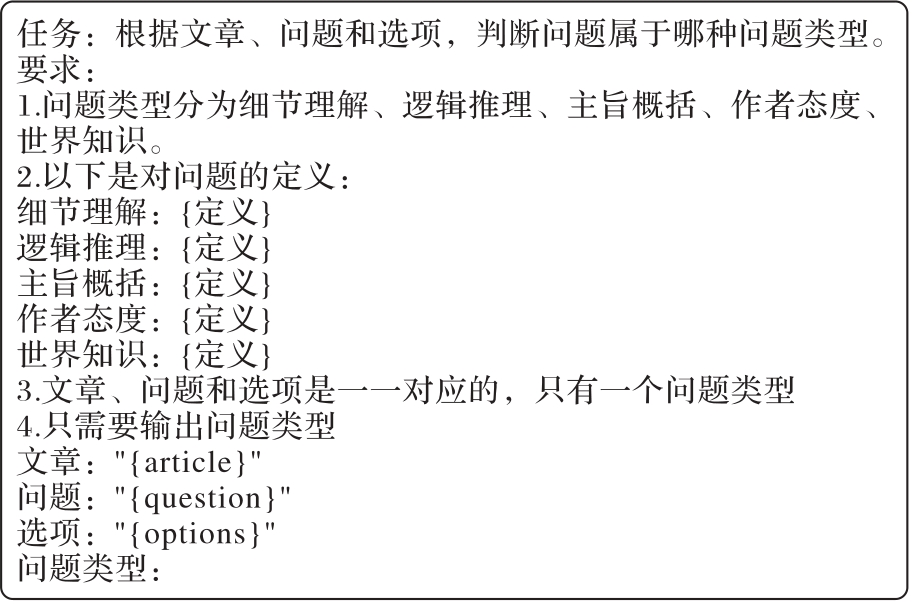
Fig. 2 Input prompt of Spark
| 数据划分 | 细节理解 | 逻辑推理 | 主旨概括 | 作者态度 | 世界知识 |
|---|---|---|---|---|---|
| 合计 | 24 149 | 25 123 | 16 778 | 2 901 | 443 |
| 训练集 | 21 691 | 22 618 | 15 118 | 2 614 | 404 |
| 验证集 | 1 223 | 1 227 | 827 | 159 | 15 |
| 测试集 | 1 235 | 1 278 | 833 | 128 | 24 |
Tab. 6 Quantity distribution of question types of RACE-H dataset labeled by Spark
| 数据划分 | 细节理解 | 逻辑推理 | 主旨概括 | 作者态度 | 世界知识 |
|---|---|---|---|---|---|
| 合计 | 24 149 | 25 123 | 16 778 | 2 901 | 443 |
| 训练集 | 21 691 | 22 618 | 15 118 | 2 614 | 404 |
| 验证集 | 1 223 | 1 227 | 827 | 159 | 15 |
| 测试集 | 1 235 | 1 278 | 833 | 128 | 24 |
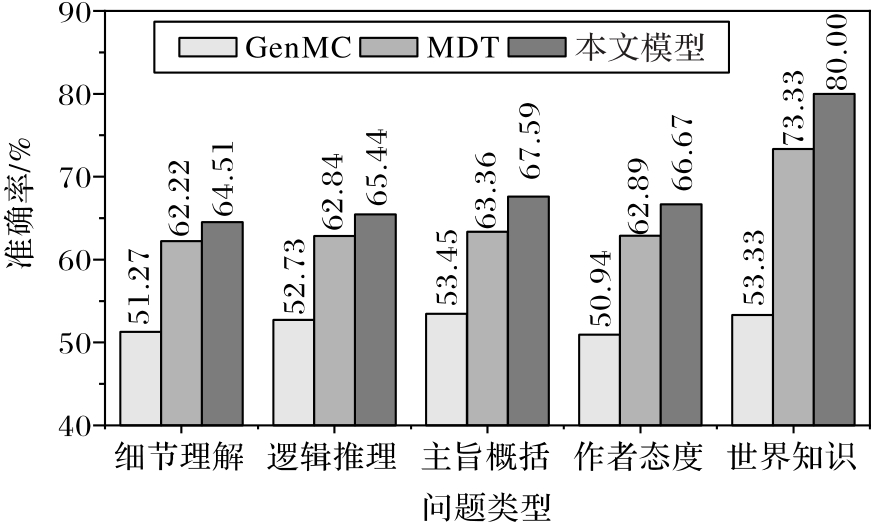
Fig. 3 Experimental results of GenMC, MDT, and KCL-MCRC for different question types on validation set
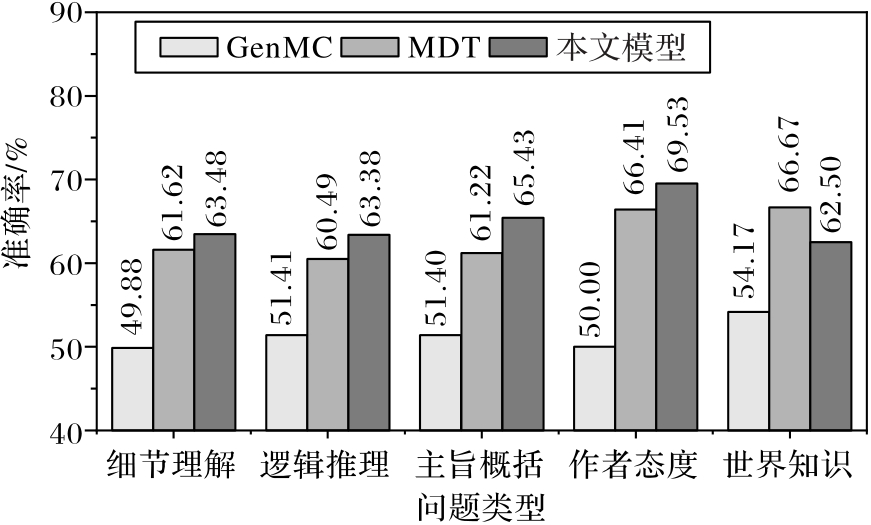
Fig. 4 Experimental results of GenMC, MDT, and KCL-MCRC for different question types on test set
| 模型 | 准确率/% | ||||
|---|---|---|---|---|---|
| 细节理解 | 逻辑推理 | 主旨概括 | 作者态度 | 世界知识 | |
| 本文模型 | 63.48 | 63.38 | 65.43 | 69.53 | 62.50 |
| -知识增强 | 62.02 | 60.88 | 61.70 | 67.19 | 66.67 |
| -对比学习 | 62.51 | 62.68 | 65.91 | 71.09 | 62.50 |
Tab. 7 Experimental results of knowledge augmentation and contrastive learning for different question types
| 模型 | 准确率/% | ||||
|---|---|---|---|---|---|
| 细节理解 | 逻辑推理 | 主旨概括 | 作者态度 | 世界知识 | |
| 本文模型 | 63.48 | 63.38 | 65.43 | 69.53 | 62.50 |
| -知识增强 | 62.02 | 60.88 | 61.70 | 67.19 | 66.67 |
| -对比学习 | 62.51 | 62.68 | 65.91 | 71.09 | 62.50 |
| [1] | Guan B, Zhu X, Yuan S. A T5-based interpretable reading comprehension model with more accurate evidence training [J]. Information Processing and Management, 2024, 61(2): No.103584. |
| [2] | 张学飞,张丽萍,闫盛,等.知识图谱与大语言模型协同的个性化学习推荐[J].计算机应用, 2025, 45(3): 773-784. |
| Zhang Xuefei, Zhang Liping, Yan Sheng, et al. Personalized learning recommendation in collaboration with knowledge graph and large language model [J]. Journal of Computer Applications, 2025, 45(3): 773-784. | |
| [3] | 张春云,赵洪焱,邓纪芹,等.基于类别对抗联合学习的跨提示自动作文评分方法[J].计算机研究与发展, 2025, 62(5): 1190-1204. |
| Zhang Chunyun, Zhang Hongyan, Deng Jiqin, et al. Category adversarial joint learning method for cross-prompt automated essay scoring [J]. Journal of Computer Research and Development, 2025, 62(5): 1190-1204. | |
| [4] | Pota M, Ventura M, Fujita H, et al. Multilingual evaluation of pre-processing for BERT-based sentiment analysis of tweets [J]. Expert Systems with Applications, 2021, 181(1): No.115119. |
| [5] | Li J, Li H, Pan Z, et al. Prompting ChatGPT in MNER: enhanced multimodal named entity recognition with auxiliary refined knowledge [C]// EMNLP 2023. Stroudsburg: ACL, 2023: 2787-2802. |
| [6] | Lester B, Al-Rfou R, Constant N. The power of scale for parameter-efficient prompt tuning [C]// EMNLP 2021. Stroudsburg: ACL, 2021: 3045-3059. |
| [7] | Zhao Y, Zhao H, Duan S. Multi-grained evidence inference for multi-choice reading comprehension [J]. IEEE/ACM Transactions on Audio, Speech, and Language Processing, 2023, 31: 3896-3907. |
| [8] | Jawahar G, Sagot B, Seddah D. What does BERT learn about the structure of language? [C]// ACL 2019. Stroudsburg: ACL, 2019: 3651-3657. |
| [9] | Hirschman L, Light M, Breck E, et al. Deep Read: a reading comprehension system [C]// ACL 1999. Stroudsburg: ACL, 1999: 325-332. |
| [10] | Poon H, Christensen J, Domingos P, et al. Machine reading at the University of Washington [C]// NAACL HLT 2010. Stroudsburg: ACL, 2010: 87-95. |
| [11] | Richardson M, Burges C J C, Renshaw E. MCTest: a challenge dataset for the open-domain machine comprehension of text [C]// EMNLP 2013. Stroudsburg: ACL, 2013: 193-203. |
| [12] | Rajpurkar P, Zhang J, Lopyrev K, et al. SQuAD: 100, 000+ questions for machine comprehension of text [C]// EMNLP 2016. Stroudsburg: ACL, 2016: 2383-2392. |
| [13] | Hermann K M, Kočiský T, Grefenstette E, et al. Teaching machines to read and comprehend [C]// NeurIPS 2015. Cambridge: MIT Press, 2015: 1693-1701. |
| [14] | Kadlec R, Schmid M, Bajgar O, et al. Text understanding with the attention sum reader network [C]// ACL 2016. Stroudsburg: ACL, 2016: 908-918. |
| [15] | Vaswani A, Shazeer N, Parmar N, et al. Attention is all you need [C]// NeurIPS 2017. Red Hook: Curran Associates Inc., 2017: 6000-6010. |
| [16] | Devlin J, Chang M W, Lee K, et al. BERT: pre-training of deep bidirectional transformers for language understanding [C]// NAACL-HLT 2019. Stroudsburg: ACL, 2019: 4171-4186. |
| [17] | Raffel C, Shazeer N, Roberts A, et al. Exploring the limits of transfer learning with a unified text-to-text Transformer [J]. Journal of Machine Learning Research, 2020, 21: 1-67. |
| [18] | Ni J, Zhu C, Chen W, et al. Learning to attend on essential terms: an enhanced retriever-reader model for open-domain question answering [C]// NAACL-HLT 2019. Stroudsburg: ACL, 2019: 335-344. |
| [19] | Khashabi D, Chaturvedi S, Roth M, et al. Looking beyond the surface: a challenge set for reading comprehension over multiple sentences [C]// NAACL-HLT 2018. Stroudsburg: ACL, 2018: 252-262. |
| [20] | Lai G, Xie Q, Liu H, et al. RACE: large-scale ReAding Comprehension Dataset from examinations [C]// EMNLP 2017. Stroudsburg: ACL, 2017: 785-794. |
| [21] | Khashabi D, Khot T, Sabharwal A, et al. Question answering via integer programming over semi-structured knowledge [C]// IJCAI 2016. Palo Alto: AAAI Press, 2016: 1145-1152. |
| [22] | Sun K, Yu D, Yu D, et al. Investigating prior knowledge for challenging Chinese machine reading comprehension [J]. Transactions of the Association for Computational Linguistics, 2020, 8: 141-155. |
| [23] | Bai Z, Liu J, Wang M, et al. Exploiting diverse information in pre-trained language model for multi-choice machine reading comprehension [J]. Applied Sciences, 2022, 12(6): No.3072. |
| [24] | Huang Z, Wu A, Zhou J, et al. Clues before answers: generation-enhanced multiple-choice QA [C]// NAACL-HLT 2022. Stroudsburg: ACL, 2022: 3272-3287. |
| [25] | 周昆,朱余韬,陈志朋,等. YuLan-Chat:基于多阶段课程学习的大语言模型[J].计算机学报, 2025, 48(1): 1-18. |
| Zhou Kun, Zhu Yutao, Chen Zhipeng, et al. YuLan-Chat: a large language model based on multi-stage curriculum learning [J]. Chinese Journal of Computers, 2025, 48(1): 1-18. | |
| [26] | Lin Z, Guan S, Zhang W, et al. Towards trustworthy LLMs: a review on debiasing and dehallucinating in large language models [J]. Artificial Intelligence Review, 2024, 57: No.243. |
| [27] | He X, Lin Z, Gong Y, et al. AnnoLLM: making large language models to be better crowdsourced annotators [C]// NAACL-HLT 2024. Stroudsburg: ACL, 2024: 165-190. |
| [28] | Ouyang L, Wu J, Jiang X, et al. Training language models to follow instructions with human feedback [C]// NeurIPS 2022. Red Hook: Curran Associates Inc., 2022: 27730-27744. |
| [29] | Cui C, Jiang Y, Wu S, et al. Transfer learning enhanced single-choice decision for multi-choice question answering [PP/OL]. arXiv (2024-04-27) [2024-11-12]. . |
| [30] | Zhang Q, Chen S, Fang M, et al. Joint reasoning with knowledge subgraphs for Multiple Choice Question Answering [J]. Information Processing and Management, 2023, 60(3): No.103297. |
| [31] | Niu Y, Jiao F, Zhou M, et al. A self-training method for machine reading comprehension with soft evidence extraction [C]// ACL 2020. Stroudsburg: ACL, 2020: 3916-3927. |
| [32] | Wu D, Li J, Wang B, et al. SparkRA: a retrieval-augmented knowledge service system based on Spark large language model [C]// EMNLP 2024. Stroudsburg: ACL, 2024: 382-389. |
| [33] | Chen J, Xiao S, Zhang P, et al. M3-Embedding: multi-linguality, multi-functionality, multi-granularity text embeddings through self-knowledge distillation [C]// ACL 2024. Stroudsburg: ACL, 2024: 2318-2335. |
| [34] | Zhang S, Zhao H, Wu Y, et al. DCMN+: dual co-matching network for multi-choice reading comprehension [C]// AAAI 2020. Palo Alto: AAAI Press, 2020: 9563-9570. |
| [35] | 张秀,纪科,马坤,等.基于多维度事件特征融合和语义特征交互的事件匹配算法[J].数据分析与知识发现, 2025, 9(4): 111-122. |
| Zhang Xiu, Ji Ke, Ma Kun, et al. Event matching algorithm based on multi-dimensional event feature fusion and semantic feature interaction [J]. Data Analysis and Knowledge Discovery, 2025, 9(4): 111-122. | |
| [36] | Reimers N, Gurevych I. Sentence-BERT: sentence embeddings using Siamese BERT-networks [C]// EMNLP 2019. Stroudsburg: ACL, 2019: 3982-3992. |
| [37] | Yan H, Liu L, Feng X, et al. Leveraging greater relations for improving multi-choice reading comprehension [J]. Neural Computing and Applications, 2022, 34(23): 20851-20864. |
| [38] | Team GLM. ChatGLM: a family of Large language models from GLM-130B to GLM-4 all tools [PP/OL]. V2. arXiv (2024-07-30) [2025-02-27]. . |
| [1] | Jiahang LI, Qilong HAN, Lijie LI, Hui ZHANG. Large language model-driven method for qualifier enhancement in hyper-relational knowledge graphs [J]. Journal of Computer Applications, 2026, 46(7): 2043-2053. |
| [2] | Haiwei FAN, Wenshuai DING, Hongzheng XING. Knowledge-aware recommendation performance enhancement method based on multi-heterogeneous topology collaboration and hierarchical contrastive learning [J]. Journal of Computer Applications, 2026, 46(7): 2085-2095. |
| [3] | Didi HOU, Shaodong HONG, Yujie FU, Yunhe CUI, Guowei SHEN. Cybersecurity named entity recognition method based on large language model linking [J]. Journal of Computer Applications, 2026, 46(7): 2064-2073. |
| [4] | Yadian CHENG, Yingying LI, Ping ZHANG, Fangbing QIU, Xiaonan CHAI, Yuqiao SHU. Dual-role interaction mechanism-based large language model for psychological health [J]. Journal of Computer Applications, 2026, 46(7): 2054-2063. |
| [5] | Linkai ZHU, Lu YANG, Hongjie ZHANG, Zijin WU, Lu LIU. Smart contract generation framework driven by LLM and SWRL for cross-border data compliance across heterogeneous blockchains [J]. Journal of Computer Applications, 2026, 46(7): 2074-2084. |
| [6] | Yusheng YI, Zhaohao HUANG, Zihao DENG, Leilei KONG, Haoliang QI. CORER: collaborative multi-knowledge large language model prompt framework for IT application innovation database migration [J]. Journal of Computer Applications, 2026, 46(6): 1811-1817. |
| [7] | Bingqing LI, Binhao HUANG, Yubei TANG, Baili ZHANG. Quality of service prediction model for data sparsity and cold start problems [J]. Journal of Computer Applications, 2026, 46(6): 1829-1835. |
| [8] | Taixin CAI, Fengfeng WEI. Large language model-enhanced ant colony optimization for multi-solution traveling salesman problems [J]. Journal of Computer Applications, 2026, 46(6): 1712-1720. |
| [9] | Hang QI, Tingting DONG, Yongqiang NAI, Xian MO. Contrastive collaborative filtering method based on graph diffusion generation and adaptive sampling [J]. Journal of Computer Applications, 2026, 46(6): 1818-1828. |
| [10] | Xiaoqin YU, Wuyang SHAN, Junying QIU, Yu LIN, Ronghao YANG, Mao TIAN. Image tampering localization and detection network under brightness-contrast disturbances [J]. Journal of Computer Applications, 2026, 46(6): 1893-1903. |
| [11] | Jintao WANG, Zhilin GAO, Qixiang MENG, Fanliang BU. Legal case retrieval method via case information reformulation using large language model [J]. Journal of Computer Applications, 2026, 46(6): 1785-1792. |
| [12] | Jinghong WANG, Xiao CHEN, Yingmei MA, Bi LI, Jusheng MI, Wei WANG. Multi-level neighborhood contrastive attribute graph clustering based on adaptive learning [J]. Journal of Computer Applications, 2026, 46(6): 1836-1843. |
| [13] | Longyu XIONG, Shengdong DU, Haochen SHI, Jie HU, Yan YANG, Tianrui LI. Government affairs hotline question answering system based on knowledge-enhanced large language model architecture [J]. Journal of Computer Applications, 2026, 46(6): 1721-1727. |
| [14] | Qianfei WANG, Yang LI, Deyu LI, Suge WANG. Dual-channel feature fusion representation method for short-text clustering based on large language model [J]. Journal of Computer Applications, 2026, 46(5): 1441-1449. |
| [15] | Jiali ZHENG, Gang ZHOU, Jing CHEN, Shunhang LI. Adaptive multi-feature fusion detection method for AI-generated text [J]. Journal of Computer Applications, 2026, 46(5): 1433-1440. |
| Viewed | ||||||
|
Full text |
|
|||||
|
Abstract |
|
|||||
