


《计算机应用》唯一官方网站 ›› 2026, Vol. 46 ›› Issue (8): 2594-2602.DOI: 10.11772/j.issn.1001-9081.2025070897
刘威1, 李维刚2( ), 田志强2
收稿日期:2025-08-07
修回日期:2025-10-15
接受日期:2025-10-15
发布日期:2025-11-05
出版日期:2026-08-10
通讯作者:
李维刚
作者简介:刘威(2001—),男,湖北孝感人,硕士研究生,主要研究方向:深度学习、点云数据处理基金资助:
Wei LIU1, Weigang LI2(), Zhiqiang TIAN2
Received:2025-08-07
Revised:2025-10-15
Accepted:2025-10-15
Online:2025-11-05
Published:2026-08-10
Contact:
Weigang LI
About author:LIU Wei, born in 2001, M. S. candidate. His research interests include deep learning, point cloud data processing.Supported by:摘要:
现有的点云深度学习方法能够有效处理固定视角下的点云数据;然而,在实际应用中,物体方向的变化会使点云描述受到旋转变换的影响,从而降低深度学习网络的识别精度。针对这一问题,提出一种面向点云分类与分割的层次化旋转不变几何结构的表征学习方法。首先,通过三角化的局部几何结构对点云样本进行建模,以在每个点的邻域内构建三角表面,提取描述欧氏空间与切平面几何关系的旋转不变特征;然后,将提取到的旋转不变特征通过卷积算子表达,并通过自注意力增强卷积聚合局部邻域结构,实现局部和全局信息的自适应融合,进一步提取精细的旋转不变特征并增强表达力和全局一致性;最后,引入层次化逆瓶颈残差模块(IRBlock),通过多级非线性映射和渐进式通道扩展,实现从浅层几何特征到深层语义特征的层次化特征融合,增强旋转不变特征的高阶表达能力和判断力,从而提升对复杂空间结构和多样旋转的表达和区分能力。实验结果表明,所提方法在ModelNet40数据集上实现了93.9%的整体准确率(OA),在ScanObjectNN数据集上实现了87.8%的OA,在ShapeNet数据集的分割任务中取得了82.3%的平均交并比(mIoU)。可见,所提方法具有良好的分类分割能力,同时兼具旋转不变性,表现出优异的鲁棒性和泛化能力。
中图分类号:
刘威, 李维刚, 田志强. 面向点云分类与分割的层次化旋转不变几何结构的表征学习方法[J]. 计算机应用, 2026, 46(8): 2594-2602.
Wei LIU, Weigang LI, Zhiqiang TIAN. Representation learning method of hierarchical rotation-invariant geometric structure for point cloud classification and segmentation[J]. Journal of Computer Applications, 2026, 46(8): 2594-2602.
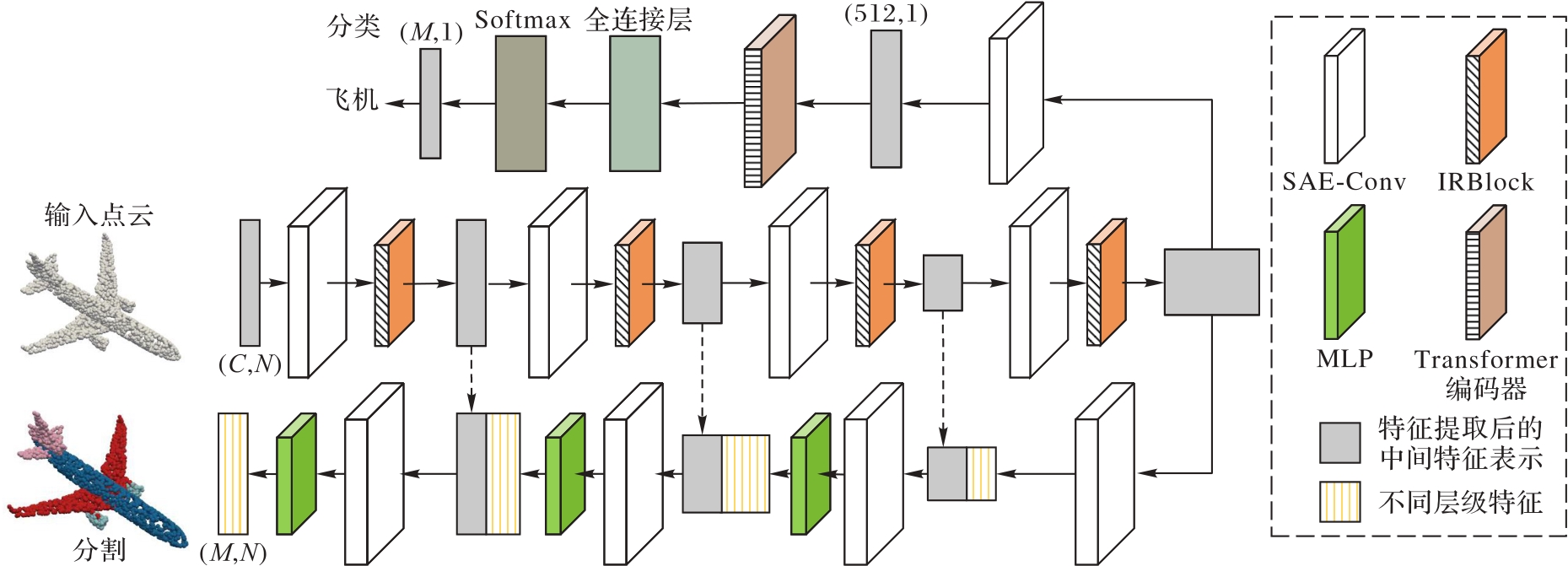
图1 本文方法框架
Fig. 1 Framework of proposed method
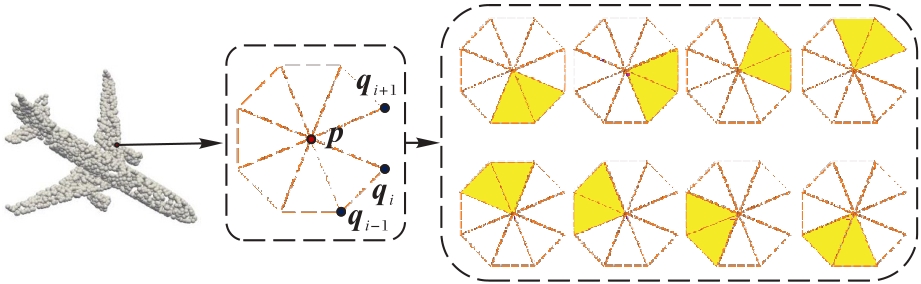
图2 LGF构建过程
Fig. 2 LGF construction process
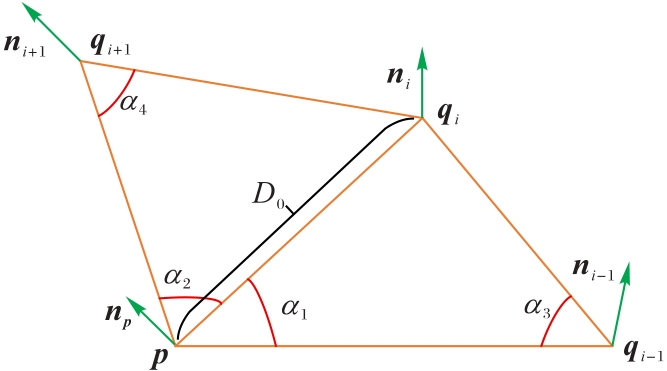
图3 局部三角表面的LGF
Fig. 3 LGF of local triangular surface
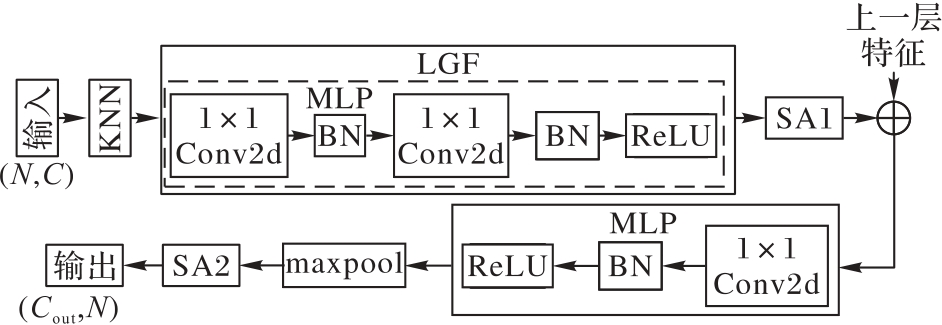
图4 自注意力增强卷积
Fig. 4 Self-attention-enhanced convolution
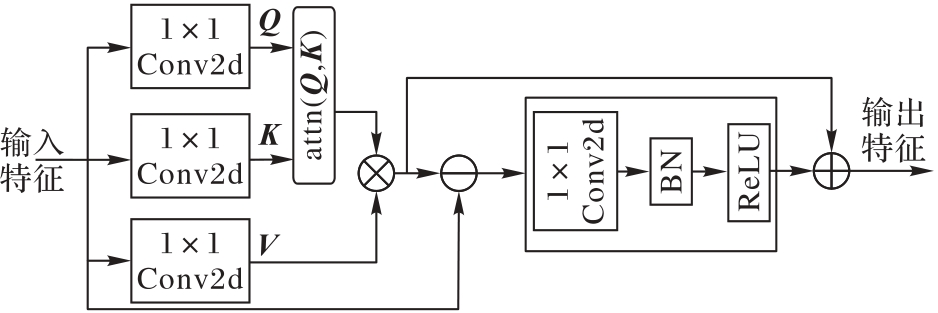
图5 自注意力机制的结构
Fig. 5 Structure of self-attention mechanism
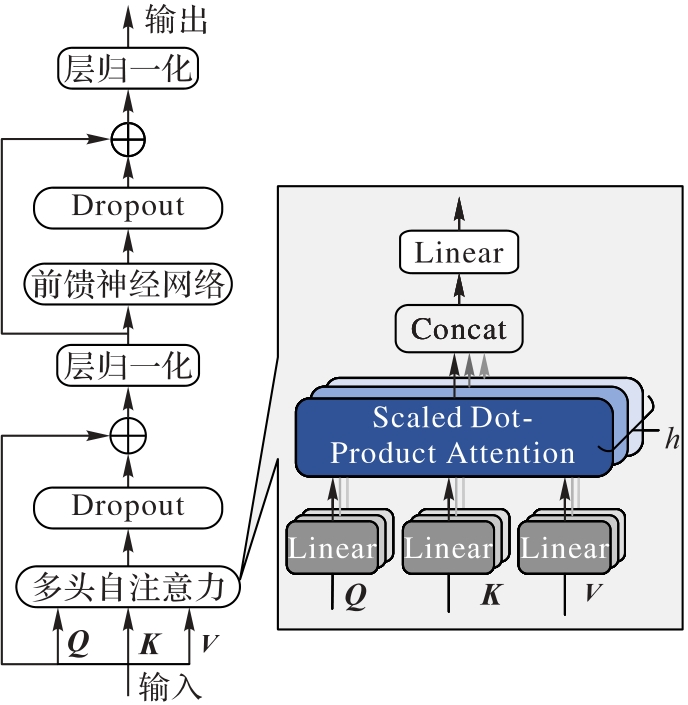
图6 Transformer编码器结构
Fig. 6 Transformer encoder structure
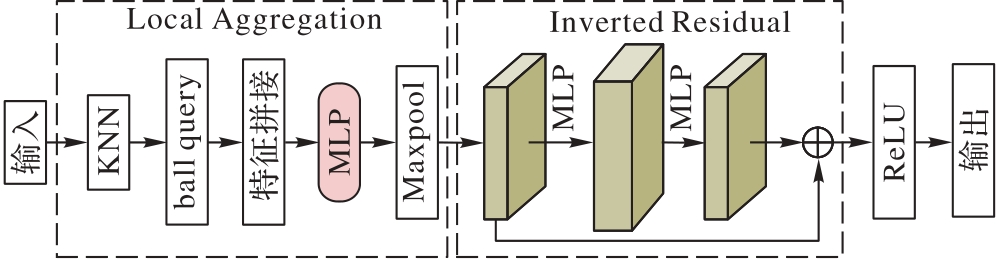
图7 IRBlock网络结构
Fig. 7 IRBlock network structure
| 方法 | 输入 | 不同场景下的OA/% | ||
|---|---|---|---|---|
| z/z | z/SO(3) | SO(3)/SO(3) | ||
| PointNet | xyz | 88.5 | 16.4 | 70.5 |
| PointNet++ | xyz+nor | 91.9 | 18.4 | 74.7 |
| PointCNN | xyz | 91.3 | 41.2 | 84.5 |
| DGCNN | xyz | 92.2 | 20.6 | 81.1 |
| Point Transformer | xyz | 93.7 | 85.9 | 50.1 |
| Spherical CNN | voxel | 88.9 | 76.9 | 86.9 |
| SFCNN | xyz | 91.4 | 84.8 | 90.1 |
| RI-GCN | xyz+nor | 91.0 | 91.0 | 91.0 |
| RI-Conv++ | xyz+nor | 91.3 | 91.3 | 91.3 |
| CRIN | xyz+nor | 91.8 | 91.8 | 91.8 |
| LocoTrans | xyz | 91.6 | 91.6 | 91.6 |
| RI-PCA | xyz+nor | 93.2 | 93.2 | 93.2 |
| RI-MAE | xyz | 93.7 | 93.7 | 93.7 |
| 本文方法(w/o normal) | xyz | 93.4 | 93.4 | 93.4 |
| 本文方法(w/ normal) | xyz+nor | 93.9 | 93.9 | 93.9 |
表1 不同方法在ModelNet40上的分类结果
Tab. 1 Classification results of different methods on ModelNet40
| 方法 | 输入 | 不同场景下的OA/% | ||
|---|---|---|---|---|
| z/z | z/SO(3) | SO(3)/SO(3) | ||
| PointNet | xyz | 88.5 | 16.4 | 70.5 |
| PointNet++ | xyz+nor | 91.9 | 18.4 | 74.7 |
| PointCNN | xyz | 91.3 | 41.2 | 84.5 |
| DGCNN | xyz | 92.2 | 20.6 | 81.1 |
| Point Transformer | xyz | 93.7 | 85.9 | 50.1 |
| Spherical CNN | voxel | 88.9 | 76.9 | 86.9 |
| SFCNN | xyz | 91.4 | 84.8 | 90.1 |
| RI-GCN | xyz+nor | 91.0 | 91.0 | 91.0 |
| RI-Conv++ | xyz+nor | 91.3 | 91.3 | 91.3 |
| CRIN | xyz+nor | 91.8 | 91.8 | 91.8 |
| LocoTrans | xyz | 91.6 | 91.6 | 91.6 |
| RI-PCA | xyz+nor | 93.2 | 93.2 | 93.2 |
| RI-MAE | xyz | 93.7 | 93.7 | 93.7 |
| 本文方法(w/o normal) | xyz | 93.4 | 93.4 | 93.4 |
| 本文方法(w/ normal) | xyz+nor | 93.9 | 93.9 | 93.9 |
| 方法 | 不同场景下的OA/% | ||
|---|---|---|---|
| z/z | z/SO(3) | SO(3)/SO(3) | |
| PointNet | 73.3 | 16.7 | 54.7 |
| PointNet++ | 82.3 | 15.0 | 47.4 |
| DGCNN | 82.8 | 17.7 | 71.8 |
| LGR-Net | 72.7 | 72.7 | 72.9 |
| RIConv++ | 80.3 | 80.3 | 80.3 |
| CRIN | 84.7 | 84.7 | 84.7 |
| IAS | — | 86.6 | 86.3 |
| LocoTrans | 85.0 | 85.0 | 84.5 |
| RI-PCA | 78.6 | 78.6 | 78.6 |
| RI-MAE | 87.3 | 87.3 | 87.3 |
| 本文方法 | 87.8 | 87.8 | 87.8 |
表2 在ScanObjectNN中PB_T50_RS上的分类结果
Tab. 2 Classification results on PB_T50_RS in ScanObjectNN
| 方法 | 不同场景下的OA/% | ||
|---|---|---|---|
| z/z | z/SO(3) | SO(3)/SO(3) | |
| PointNet | 73.3 | 16.7 | 54.7 |
| PointNet++ | 82.3 | 15.0 | 47.4 |
| DGCNN | 82.8 | 17.7 | 71.8 |
| LGR-Net | 72.7 | 72.7 | 72.9 |
| RIConv++ | 80.3 | 80.3 | 80.3 |
| CRIN | 84.7 | 84.7 | 84.7 |
| IAS | — | 86.6 | 86.3 |
| LocoTrans | 85.0 | 85.0 | 84.5 |
| RI-PCA | 78.6 | 78.6 | 78.6 |
| RI-MAE | 87.3 | 87.3 | 87.3 |
| 本文方法 | 87.8 | 87.8 | 87.8 |
| 方法 | 输入 | mIoU/% | |
|---|---|---|---|
| z/SO(3) | SO(3)/SO(3) | ||
| PointNet | xyz | 37.8 | 74.4 |
| PointNet++ | xyz+nor | 48.2 | 76.7 |
| PointCNN | xyz | 34.7 | 71.4 |
| DGCNN | xyz | 37.4 | 73.3 |
| SpiderCNN | xyz+nor | 42.9 | 72.3 |
| RI-GCN | xyz +nor | 77.2 | 77.3 |
| IAS | xyz | 80.3 | 80.4 |
| CRIN | xyz+nor | 80.5 | 80.5 |
| RIConv++ | xyz +nor | 81.5 | 81.5 |
| LocoTrans | xyz | 80.1 | 80.0 |
| RI-PCA | xyz+nor | 81.0 | 81.4 |
| RI-MAE | xyz | 82.1 | 82.1 |
| 本文方法 | xyz +nor | 82.0 | 82.3 |
表3 不同方法在ShapeNet上的部件分割结果
Tab. 3 Part segmentation results of different methods on ShapeNet
| 方法 | 输入 | mIoU/% | |
|---|---|---|---|
| z/SO(3) | SO(3)/SO(3) | ||
| PointNet | xyz | 37.8 | 74.4 |
| PointNet++ | xyz+nor | 48.2 | 76.7 |
| PointCNN | xyz | 34.7 | 71.4 |
| DGCNN | xyz | 37.4 | 73.3 |
| SpiderCNN | xyz+nor | 42.9 | 72.3 |
| RI-GCN | xyz +nor | 77.2 | 77.3 |
| IAS | xyz | 80.3 | 80.4 |
| CRIN | xyz+nor | 80.5 | 80.5 |
| RIConv++ | xyz +nor | 81.5 | 81.5 |
| LocoTrans | xyz | 80.1 | 80.0 |
| RI-PCA | xyz+nor | 81.0 | 81.4 |
| RI-MAE | xyz | 82.1 | 82.1 |
| 本文方法 | xyz +nor | 82.0 | 82.3 |
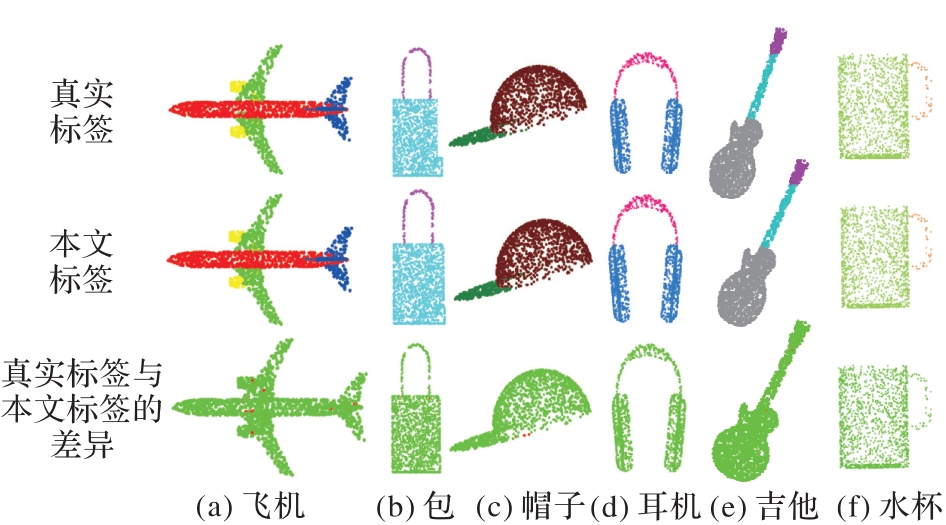
图8 ShapeNetPart数据集上部件分割的可视化
Fig. 8 Visualization of component segmentation on ShapeNetPart dataset
| 场景 | 方法 | 不同类别的mIoU/% | ||||||||||||||||
|---|---|---|---|---|---|---|---|---|---|---|---|---|---|---|---|---|---|---|
| mean | 飞机 | 包 | 帽子 | 汽车 | 椅子 | 耳机 | 吉他 | 刀 | 灯 | 电脑 | 摩托 | 水杯 | 手枪 | 火箭 | 滑板 | 桌子 | ||
| z/SO(3) | PointNet | 37.8 | 40.4 | 48.1 | 46.3 | 24.5 | 45.1 | 39.4 | 29.2 | 42.6 | 52.7 | 36.7 | 21.2 | 55.0 | 29.7 | 26.6 | 32.1 | 35.8 |
| PointNet++ | 48.3 | 51.3 | 66.0 | 50.8 | 25.2 | 66.7 | 27.7 | 29.7 | 65.6 | 59.7 | 70.1 | 17.2 | 67.3 | 49.9 | 23.4 | 43.8 | 57.6 | |
| PointCNN | 34.7 | 21.8 | 52.0 | 52.1 | 23.6 | 29.4 | 18.2 | 40.7 | 36.9 | 51.1 | 33.1 | 18.9 | 48.0 | 23.0 | 27.7 | 38.6 | 39.9 | |
| DGCNN | 37.4 | 37.0 | 50.2 | 38.5 | 24.1 | 43.9 | 32.3 | 23.7 | 48.6 | 54.8 | 28.7 | 17.8 | 74.4 | 25.2 | 24.1 | 43.1 | 32.3 | |
| RS-CNN | 36.5 | 26.9 | 49.7 | 44.7 | 25.3 | 36.5 | 30.0 | 33.3 | 39.4 | 54.9 | 36.1 | 20.6 | 53.3 | 29.0 | 29.4 | 32.3 | 42.6 | |
| GCA-Conv | 77.2 | 80.9 | 82.6 | 81.0 | 70.2 | 88.4 | 70.6 | 87.1 | 87.2 | 81.8 | 78.9 | 58.7 | 91.0 | 77.9 | 52.3 | 66.8 | 80.3 | |
| RIF | 79.2 | 81.4 | 82.3 | 86.3 | 75.3 | 88.5 | 72.8 | 90.3 | 82.1 | 81.3 | 81.9 | 67.5 | 92.6 | 75.5 | 54.8 | 75.1 | 78.9 | |
| LGR-Net | 80.0 | 81.5 | 80.5 | 81.4 | 75.5 | 87.4 | 72.6 | 88.7 | 83.4 | 83.1 | 86.8 | 66.2 | 92.9 | 76.8 | 62.9 | 80.0 | 80.0 | |
| 本文方法 | 82.0 | 83.8 | 82.0 | 86.4 | 78.5 | 91.2 | 66.7 | 91.2 | 88.2 | 83.4 | 96.5 | 60.8 | 95.4 | 82.3 | 63.3 | 77.4 | 83.4 | |
| SO(3)/SO(3) | PointNet | 74.4 | 81.6 | 68.7 | 74.0 | 70.3 | 87.6 | 68.5 | 88.9 | 80.0 | 74.9 | 83.6 | 56.5 | 77.6 | 75.2 | 53.9 | 69.4 | 79.9 |
| PointNet++ | 76.7 | 79.5 | 71.6 | 87.7 | 70.7 | 88.8 | 64.9 | 88.8 | 78.1 | 79.2 | 94.9 | 54.3 | 92.0 | 76.4 | 50.3 | 68.4 | 81.0 | |
| PointCNN | 71.4 | 78.0 | 80.1 | 78.2 | 68.2 | 81.2 | 70.2 | 82.0 | 70.6 | 68.9 | 80.8 | 48.6 | 77.3 | 63.2 | 50.6 | 63.2 | 82.0 | |
| DGCNN | 73.3 | 77.7 | 71.8 | 77.7 | 55.2 | 87.3 | 68.7 | 88.7 | 85.5 | 81.8 | 81.3 | 36.2 | 86.0 | 77.3 | 51.6 | 65.3 | 80.2 | |
| RS-CNN | 72.5 | 71.8 | 76.4 | 78.9 | 68.1 | 80.2 | 62.5 | 82.6 | 76.6 | 73.2 | 90.2 | 54.8 | 89.8 | 72.8 | 43.6 | 65.3 | 72.6 | |
| GCA-Conv | 77.3 | 81.2 | 82.6 | 81.6 | 70.2 | 88.6 | 70.6 | 86.2 | 86.6 | 81.6 | 79.6 | 58.9 | 90.8 | 76.8 | 53.2 | 67.2 | 81.6 | |
| RIF | 79.4 | 81.4 | 84.5 | 85.1 | 75.0 | 88.2 | 72.4 | 90.7 | 84.4 | 80.3 | 84.0 | 68.8 | 92.6 | 76.1 | 52.1 | 74.1 | 80.0 | |
| LGR-Net | 80.1 | 81.7 | 78.1 | 82.5 | 75.1 | 87.6 | 74.5 | 89.4 | 86.1 | 83.0 | 86.4 | 65.3 | 92.6 | 75.2 | 64.1 | 79.8 | 80.5 | |
| 本文方法 | 82.3 | 83.9 | 82.5 | 87.3 | 78.6 | 91.2 | 72.3 | 91.2 | 87.8 | 84.4 | 96.1 | 62.8 | 95.9 | 80.6 | 62.7 | 76.9 | 82.6 | |
表4 ShapeNet数据集上不同方法的部件分割性能对比
Tab. 4 Comparison of component segmentation performance of different methods on ShapeNet dataset
| 场景 | 方法 | 不同类别的mIoU/% | ||||||||||||||||
|---|---|---|---|---|---|---|---|---|---|---|---|---|---|---|---|---|---|---|
| mean | 飞机 | 包 | 帽子 | 汽车 | 椅子 | 耳机 | 吉他 | 刀 | 灯 | 电脑 | 摩托 | 水杯 | 手枪 | 火箭 | 滑板 | 桌子 | ||
| z/SO(3) | PointNet | 37.8 | 40.4 | 48.1 | 46.3 | 24.5 | 45.1 | 39.4 | 29.2 | 42.6 | 52.7 | 36.7 | 21.2 | 55.0 | 29.7 | 26.6 | 32.1 | 35.8 |
| PointNet++ | 48.3 | 51.3 | 66.0 | 50.8 | 25.2 | 66.7 | 27.7 | 29.7 | 65.6 | 59.7 | 70.1 | 17.2 | 67.3 | 49.9 | 23.4 | 43.8 | 57.6 | |
| PointCNN | 34.7 | 21.8 | 52.0 | 52.1 | 23.6 | 29.4 | 18.2 | 40.7 | 36.9 | 51.1 | 33.1 | 18.9 | 48.0 | 23.0 | 27.7 | 38.6 | 39.9 | |
| DGCNN | 37.4 | 37.0 | 50.2 | 38.5 | 24.1 | 43.9 | 32.3 | 23.7 | 48.6 | 54.8 | 28.7 | 17.8 | 74.4 | 25.2 | 24.1 | 43.1 | 32.3 | |
| RS-CNN | 36.5 | 26.9 | 49.7 | 44.7 | 25.3 | 36.5 | 30.0 | 33.3 | 39.4 | 54.9 | 36.1 | 20.6 | 53.3 | 29.0 | 29.4 | 32.3 | 42.6 | |
| GCA-Conv | 77.2 | 80.9 | 82.6 | 81.0 | 70.2 | 88.4 | 70.6 | 87.1 | 87.2 | 81.8 | 78.9 | 58.7 | 91.0 | 77.9 | 52.3 | 66.8 | 80.3 | |
| RIF | 79.2 | 81.4 | 82.3 | 86.3 | 75.3 | 88.5 | 72.8 | 90.3 | 82.1 | 81.3 | 81.9 | 67.5 | 92.6 | 75.5 | 54.8 | 75.1 | 78.9 | |
| LGR-Net | 80.0 | 81.5 | 80.5 | 81.4 | 75.5 | 87.4 | 72.6 | 88.7 | 83.4 | 83.1 | 86.8 | 66.2 | 92.9 | 76.8 | 62.9 | 80.0 | 80.0 | |
| 本文方法 | 82.0 | 83.8 | 82.0 | 86.4 | 78.5 | 91.2 | 66.7 | 91.2 | 88.2 | 83.4 | 96.5 | 60.8 | 95.4 | 82.3 | 63.3 | 77.4 | 83.4 | |
| SO(3)/SO(3) | PointNet | 74.4 | 81.6 | 68.7 | 74.0 | 70.3 | 87.6 | 68.5 | 88.9 | 80.0 | 74.9 | 83.6 | 56.5 | 77.6 | 75.2 | 53.9 | 69.4 | 79.9 |
| PointNet++ | 76.7 | 79.5 | 71.6 | 87.7 | 70.7 | 88.8 | 64.9 | 88.8 | 78.1 | 79.2 | 94.9 | 54.3 | 92.0 | 76.4 | 50.3 | 68.4 | 81.0 | |
| PointCNN | 71.4 | 78.0 | 80.1 | 78.2 | 68.2 | 81.2 | 70.2 | 82.0 | 70.6 | 68.9 | 80.8 | 48.6 | 77.3 | 63.2 | 50.6 | 63.2 | 82.0 | |
| DGCNN | 73.3 | 77.7 | 71.8 | 77.7 | 55.2 | 87.3 | 68.7 | 88.7 | 85.5 | 81.8 | 81.3 | 36.2 | 86.0 | 77.3 | 51.6 | 65.3 | 80.2 | |
| RS-CNN | 72.5 | 71.8 | 76.4 | 78.9 | 68.1 | 80.2 | 62.5 | 82.6 | 76.6 | 73.2 | 90.2 | 54.8 | 89.8 | 72.8 | 43.6 | 65.3 | 72.6 | |
| GCA-Conv | 77.3 | 81.2 | 82.6 | 81.6 | 70.2 | 88.6 | 70.6 | 86.2 | 86.6 | 81.6 | 79.6 | 58.9 | 90.8 | 76.8 | 53.2 | 67.2 | 81.6 | |
| RIF | 79.4 | 81.4 | 84.5 | 85.1 | 75.0 | 88.2 | 72.4 | 90.7 | 84.4 | 80.3 | 84.0 | 68.8 | 92.6 | 76.1 | 52.1 | 74.1 | 80.0 | |
| LGR-Net | 80.1 | 81.7 | 78.1 | 82.5 | 75.1 | 87.6 | 74.5 | 89.4 | 86.1 | 83.0 | 86.4 | 65.3 | 92.6 | 75.2 | 64.1 | 79.8 | 80.5 | |
| 本文方法 | 82.3 | 83.9 | 82.5 | 87.3 | 78.6 | 91.2 | 72.3 | 91.2 | 87.8 | 84.4 | 96.1 | 62.8 | 95.9 | 80.6 | 62.7 | 76.9 | 82.6 | |
| 局部表面数 | OA/% | 局部表面数 | OA/% |
|---|---|---|---|
| 1 | 92.6 | 3 | 89.8 |
| 2 | 93.9 | 4 | 87.8 |
表5 不同局部表面数的OA
Tab. 5 OA with different numbers of local surfaces
| 局部表面数 | OA/% | 局部表面数 | OA/% |
|---|---|---|---|
| 1 | 92.6 | 3 | 89.8 |
| 2 | 93.9 | 4 | 87.8 |
| O值 | OA/% | O值 | OA/% |
|---|---|---|---|
| 6 | 92.0 | 12 | 93.0 |
| 8 | 93.9 | 14 | 92.1 |
| 10 | 93.4 |
表6 不同O值时的OA
Tab. 6 OA at different O values
| O值 | OA/% | O值 | OA/% |
|---|---|---|---|
| 6 | 92.0 | 12 | 93.0 |
| 8 | 93.9 | 14 | 92.1 |
| 10 | 93.4 |
| 模型 | OA/% | ||||
|---|---|---|---|---|---|
| A | √ | √ | √ | × | 93.9 |
| B | √ | √ | × | × | 86.2 |
| C | × | √ | √ | × | 93.4 |
| D | × | × | √ | × | 88.8 |
| E | √ | √ | √ | √ | 93.6 |
表7 旋转不变特征数量对精度的影响
Tab. 7 Impact of number of rotation-invariant features on accuracy
| 模型 | OA/% | ||||
|---|---|---|---|---|---|
| A | √ | √ | √ | × | 93.9 |
| B | √ | √ | × | × | 86.2 |
| C | × | √ | √ | × | 93.4 |
| D | × | × | √ | × | 88.8 |
| E | √ | √ | √ | √ | 93.6 |
| 注意力机制 | 参数量/106 | FLOPs/109 | OA/% |
|---|---|---|---|
| CAM | 17.23 | 6.31 | 93.5±0.15 |
| SAM | 17.65 | 6.75 | 93.6±0.12 |
| Sparse Attention | 16.87 | 5.20 | 93.4±0.20 |
| 本文机制 | 17.12 | 6.30 | 93.9±0.10 |
表8 不同注意力机制的性能与复杂度对比
Tab. 8 Comparison of performance and complexity amongdifferent attention mechanisms
| 注意力机制 | 参数量/106 | FLOPs/109 | OA/% |
|---|---|---|---|
| CAM | 17.23 | 6.31 | 93.5±0.15 |
| SAM | 17.65 | 6.75 | 93.6±0.12 |
| Sparse Attention | 16.87 | 5.20 | 93.4±0.20 |
| 本文机制 | 17.12 | 6.30 | 93.9±0.10 |
| 模型 | SA1 | SA2 | Transformer编码器 | IRBlock | OA/% |
|---|---|---|---|---|---|
| A | × | × | × | × | 89.8 |
| B | √ | × | × | × | 90.7 |
| C | √ | √ | × | × | 91.5 |
| D | √ | √ | √ | × | 93.0 |
| E | √ | √ | √ | √ | 93.9 |
表9 不同模块的消融实验结果
Tab. 9 Ablation experiment results of different modules
| 模型 | SA1 | SA2 | Transformer编码器 | IRBlock | OA/% |
|---|---|---|---|---|---|
| A | × | × | × | × | 89.8 |
| B | √ | × | × | × | 90.7 |
| C | √ | √ | × | × | 91.5 |
| D | √ | √ | √ | × | 93.0 |
| E | √ | √ | √ | √ | 93.9 |
| 方法 | 参数量/106 | FLOPs/109 |
|---|---|---|
| PointNet++ | 1.41 | 0.86 |
| RI-Conv++ | 0.42 | 0.72 |
| LocoTrans | 6.27 | 7.81 |
| RI-PCA | 1.88 | 6.36 |
| RI-MAE | 22.10 | 13.20 |
| 本文方法 | 17.12 | 6.30 |
表10 各方法复杂度对比
Tab. 10 Comparison of complexity among different methods
| 方法 | 参数量/106 | FLOPs/109 |
|---|---|---|
| PointNet++ | 1.41 | 0.86 |
| RI-Conv++ | 0.42 | 0.72 |
| LocoTrans | 6.27 | 7.81 |
| RI-PCA | 1.88 | 6.36 |
| RI-MAE | 22.10 | 13.20 |
| 本文方法 | 17.12 | 6.30 |
| 方法 | Clean_OA | m_OA | 方法 | Clean_OA | m_OA |
|---|---|---|---|---|---|
| PointNet++ | 89.2 | 76.4 | CSI | 92.5 | 81.6 |
| DGCNN | 91.0 | 74.1 | PointFCLC | 93.1 | 82.1 |
| PointNetMeta-S | 92.8 | 78.8 | 本文方法 | 93.9 | 81.7 |
| APES_global | 93.5 | 81.1 |
表11 各方法ModelNet40-C上的分类结果 (%)
Tab. 11 Classification results on ModelNet40-C bydifferent methods
| 方法 | Clean_OA | m_OA | 方法 | Clean_OA | m_OA |
|---|---|---|---|---|---|
| PointNet++ | 89.2 | 76.4 | CSI | 92.5 | 81.6 |
| DGCNN | 91.0 | 74.1 | PointFCLC | 93.1 | 82.1 |
| PointNetMeta-S | 92.8 | 78.8 | 本文方法 | 93.9 | 81.7 |
| APES_global | 93.5 | 81.1 |
| [1] | Grilli E, Menna F, Remondino F. A review of point clouds segmentation and classification algorithms[J]. The International Archives of the Photogrammetry, Remote Sensing and Spatial Information Sciences, 2017, XLII-2/W3: 339-344. |
| [2] | Rusu R B, Marton Z C, Blodow N, et al. Towards 3D point cloud based object maps for household environments[J]. Robotics and Autonomous Systems, 2008, 56(11): 927-941. |
| [3] | Pomerleau F, Colas F, Siegwart R. A review of point cloud registration algorithms for mobile robotics[J]. Foundations and Trends in Robotics, 2015, 4(1): 1-104. |
| [4] | Li Y, Ma L, Zhong Z, et al. Deep learning for LiDAR point clouds in autonomous driving: a review[J]. IEEE Transactions on Neural Networks and Learning Systems, 2021, 32(8): 3412-3432. |
| [5] | Wang R, Peethambaran J, Chen D. LiDAR point clouds to 3-D urban models: a review[J]. IEEE Journal of Selected Topics in Applied Earth Observations and Remote Sensing, 2018, 11(2): 606-627. |
| [6] | Persad R A, Armenakis C. Automatic co-registration of 3D multi-sensor point clouds[J]. ISPRS Journal of Photogrammetry and Remote Sensing, 2017, 130: 162-186. |
| [7] | Guo Y, Wang H, Hu Q, et al. Deep learning for 3D point clouds: a survey[J]. IEEE Transactions on Pattern Analysis and Machine Intelligence, 2021, 43(12): 4338-4364. |
| [8] | Li Y, Bu R, Sun M, et al. PointCNN: convolution on X-transformed points[C]// NeurIPS 2018. Red Hook: Curran Associates Inc., 2018: 828-838. |
| [9] | Qi C R, Su H, Mo K, et al. PointNet: deep learning on point sets for 3D classification and segmentation[C]// CVPR 2017. Piscataway: IEEE, 2017: 77-85. |
| [10] | Qi C R, Yi L, Su H, et al. PointNet++: deep hierarchical feature learning on point sets in a metric space[C]// NeurIPS 2017. Red Hook: Curran Associates Inc., 2017: 5105-5114. |
| [11] | Wang Y, Sun Y, Liu Z, et al. Dynamic graph CNN for learning on point clouds[J]. ACM Transactions on Graphics, 2019, 38(5): No.146. |
| [12] | 李维刚,李歆怡,王永强,等. 基于自适应动态图卷积和无参注意力的点云分类分割方法[J]. 计算机应用, 2025, 45(6): 1980-1986. |
| Li Weigang, Li Xinyi, Wang Yongqiang, et al. Point cloud classification and segmentation method based on adaptive dynamic graph convolution and parameter-free attention[J]. Journal of Computer Applications, 2025, 45(6): 1980-1986. | |
| [13] | Zhao H, Jiang L, Jia J, et al. Point Transformer[C]// ICCV 2021. Piscataway: IEEE, 2021: 16239-16248. |
| [14] | 陈家辉,张旭东,范之国,等. 基于交换注意力特征融合的点云旋转不变网络[J]. 激光与光电子学进展, 2025, 62(20): No.2015003. |
| Chen Jiahui, Zhang Xudong, Fan Zhiguo, et al. Point cloud rotation-invariant network based on exchange attention feature fusion[J]. Laser and Optoelectronics Progress, 2025, 62(20): No.2015003. | |
| [15] | Esteves C, Allen-Blanchette C, Makadia A, et al. Learning SO(3) equivariant representations with spherical CNNs[C]// ECCV 2018, LNCS 11217. Cham: Springer, 2018: 54-70. |
| [16] | Rao Y, Lu J, Zhou J. Spherical fractal convolutional neural networks for point cloud recognition[C]// CVPR 2019. Piscataway: IEEE, 2019: 452-460. |
| [17] | Zhang Z, Hua B S, Rosen D W, et al. Rotation invariant convolutions for 3D point clouds deep learning[C]// 3DV 2019. Piscataway: IEEE, 2019: 204-213. |
| [18] | Li X, Li R, Chen G, et al. A rotation-invariant framework for deep point cloud analysis[J]. IEEE Transactions on Visualization and Computer Graphics, 2022, 28(12): 4503-4514. |
| [19] | Kim S, Park J, Han B. Rotation-invariant local-to-global representation learning for 3D point cloud[C]// NeurIPS 2020. Red Hook: Curran Associates Inc., 2020: 8174-8185. |
| [20] | Lou Y, Ye Z, You Y, et al. CRIN: rotation-invariant point cloud analysis and rotation estimation via centrifugal reference frame[J]. Proceedings of the AAAI Conference on Artificial Intelligence, 2023, 37(2): 1817-1825. |
| [21] | Chen Y, Duan L, Zhao S, et al. Local-consistent transformation learning for rotation-invariant point cloud analysis[C]// CVPR 2024. Piscataway: IEEE, 2024: 5418-5427. |
| [22] | Wang Z, Yu Y, Li X. Rethinking local-to-global representation learning for rotation-invariant point cloud analysis[J]. Pattern Recognition, 2024, 154: No.110624. |
| [23] | Su K, Wu Q, Cai P, et al. RI-MAE: rotation-invariant masked autoencoders for self-supervised point cloud representation learning[J]. Proceedings of the AAAI Conference on Artificial Intelligence, 2025, 39(7): 7015-7023. |
| [24] | Ronneberger O, Fischer P, Brox T. U-Net: convolutional networks for biomedical image segmentation[C]// MICCAI 2015, LNCS 9351. Cham: Springer, 2015: 234-241. |
| [25] | Vaswani A, Shazeer N, Parmar N, et al. Attention is all you need[C]// NeurIPS 2017. Red Hook: Curran Associates Inc., 2017: 6000-6010. |
| [26] | Sandler M, Howard A, Zhu M, et al. MobileNetV2: inverted residuals and linear bottlenecks[C]// CVPR 2018. Piscataway: IEEE, 2018: 4510-4520. |
| [27] | Armeni I, Sener O, Zamir A R, et al. 3D semantic parsing of large-scale indoor spaces[C]// CVPR 2016. Piscataway: IEEE, 2016: 1534-1543. |
| [28] | Uy M A, Pham Q H, Hua B S, et al. Revisiting point cloud classification: a new benchmark dataset and classification model on real-world data[C]// ICCV 2019. Piscataway: IEEE, 2019: 1588-1597. |
| [29] | Esteves C, Xu Y, Allen-Blanchette C, et al. Equivariant multi-view networks[C]// ICCV 2019. Piscataway: IEEE, 2019: 1568-1577. |
| [30] | Zhang Z, Hua B S, Yeung S K. RIConv++: effective rotation invariant convolutions for 3D point clouds deep learning[J]. International Journal of Computer Vision, 2022, 130(5): 1228-1243. |
| [31] | Yan X, Zheng C, Li Z, et al. PointASNL: robust point clouds processing using nonlocal neural networks with adaptive sampling[C]// CVPR 2020. Piscataway: IEEE, 2020: 5588-5597. |
| [32] | 李维刚,邵佳乐,田志强. 基于双注意力机制和多尺度融合的点云分类与分割网络[J]. 计算机应用, 2025, 45(9): 3003-3010. |
| Li Weigang, Shao Jiale, Tian Zhiqiang. Point cloud classification and segmentation network based on dual attention mechanism and multi-scale fusion[J]. Journal of Computer Applications, 2025, 45(9): 3003-3010. |
| [1] | 李光辉, 屈立成. 基于改进Lite-Mono架构的动态空洞卷积和分层注意力模型[J]. 《计算机应用》唯一官方网站, 2026, 46(8): 2567-2576. |
| [2] | 郭晓金, 隋旭洋, 周柯男. 基于深度学习的STAR⁃RIS辅助混合场通信系统信道估计[J]. 《计算机应用》唯一官方网站, 2026, 46(8): 2548-2554. |
| [3] | 刘明, 沈东奇, 孟子洋. 双分支结构下多层次特征融合的点云配准网络[J]. 《计算机应用》唯一官方网站, 2026, 46(8): 2584-2593. |
| [4] | 刘晶, 赵邵泽, 刘鑫刚, 牛浩哲, 季海鹏. 跨工况下基于改进CGAN的钛合金显微组织数据生成方法[J]. 《计算机应用》唯一官方网站, 2026, 46(7): 2373-2382. |
| [5] | 凌妙根, 井瑞, 方巍. 可解释性深度学习在热带气旋预报中的应用研究综述[J]. 《计算机应用》唯一官方网站, 2026, 46(7): 2318-2326. |
| [6] | 颜建强, 董贝贝, 曲博婷, 彭晨. 融合多源信息与图级注意力的双向扩散动态图卷积交通流预测网络[J]. 《计算机应用》唯一官方网站, 2026, 46(7): 2327-2333. |
| [7] | 刘雯玲, 李勇, 李佳慧, 张厚康. 面向不均匀雾霾遥感图像的无监督去雾方法[J]. 《计算机应用》唯一官方网站, 2026, 46(7): 2297-2306. |
| [8] | 杜秀丽, 高星, 张校毓, 潘成胜, 邹启杰. 基于密集时空可变形注意力的视频快照压缩成像重建方法[J]. 《计算机应用》唯一官方网站, 2026, 46(7): 2288-2296. |
| [9] | 张国有, 聂宏宇, 潘理虎, 雷润东. 基于多层感知机级联宽度学习系统的点云语义分割网络Point-MLPBLS[J]. 《计算机应用》唯一官方网站, 2026, 46(7): 2259-2266. |
| [10] | 武湘怡, 叶海良, 曹飞龙. 基于平滑-锐化图卷积的点云补全方法[J]. 《计算机应用》唯一官方网站, 2026, 46(7): 2267-2276. |
| [11] | 秦隽, 焦新涛, 曾碧卿. 融合BiLSTM-Transformer与Kolmogorov-Arnold网络的非侵入式负荷监测方法[J]. 《计算机应用》唯一官方网站, 2026, 46(6): 2026-2033. |
| [12] | 张金萧, 李成龙, 高新燕, 张铭. 基于时空特征金字塔网络与多假设交互机制的三维人体姿态估计模型[J]. 《计算机应用》唯一官方网站, 2026, 46(6): 1965-1972. |
| [13] | 何运平, 王雷春, 宋芮芮, 卢祥凤, 魏金香, 刘小萌. 基于对比不变性和强化特定性的双通道多模态情感分析模型[J]. 《计算机应用》唯一官方网站, 2026, 46(6): 1767-1775. |
| [14] | 姚力挽, 刘海龙, 曾张帆. 基于频域驱动及扩散融合的声纳图像增强算法[J]. 《计算机应用》唯一官方网站, 2026, 46(6): 1947-1955. |
| [15] | 何丽丽, 曹勐, 张磊, 潘洪军, 刘义, 孙成心. 基于Kolmogorov-Arnold网络与扩散Transformer的手语生成模型[J]. 《计算机应用》唯一官方网站, 2026, 46(6): 1801-1810. |
| 阅读次数 | ||||||
|
全文 |
|
|||||
|
摘要 |
|
|||||
