


《计算机应用》唯一官方网站 ›› 2026, Vol. 46 ›› Issue (4): 1292-1299.DOI: 10.11772/j.issn.1001-9081.2025040461
• 多媒体计算与计算机仿真 • 上一篇
许盛伟, 王健波( ), 韩季杰, 白怡婕
收稿日期:2025-04-27
修回日期:2025-07-30
接受日期:2025-08-04
发布日期:2025-08-15
出版日期:2026-04-10
通讯作者:
王健波
作者简介:许盛伟(1976—),男,江西吉安人,教授,博士,主要研究方向:大数据安全、人工智能与密码应用基金资助:
Shengwei XU, Jianbo WANG(), Jijie HAN, Yijie BAI
Received:2025-04-27
Revised:2025-07-30
Accepted:2025-08-04
Online:2025-08-15
Published:2026-04-10
Contact:
Jianbo WANG
About author:XU Shengwei, born in 1976, Ph. D., professor. His research interests include big data security, AI-driven cryptographic applications.Supported by:摘要:
针对现有检测方法在应对多样化伪造方式和低质量图像时存在的特征表达不足、鲁棒性差和跨域泛化能力弱等问题,提出一种基于三分支特征提取的人脸伪造检测方法Tri-BranchNet(Tri-Branch feature extraction Network),以实现多类型特征的互补与融合,并提升伪造痕迹的表征能力和模型的检测性能。具体架构为:1)利用ViT(Vision Transformer)捕获全局语义表征;2)引入可逆神经网络(INN)增强局部纹理特征的建模能力;3)设计边缘特征提取分支解决传统模型对边界伪造区域特征提取不足的问题。在多个公开数据集上的实验结果表明,所提方法在FaceForensics++(C23)数据集上的准确率达98.75%,相较于F3-Net(Frequency in Face Forgery Network)和CORE(COnsistent REpresentation learning)分别提升了1.26%和1.17%;在跨压缩率与跨数据集测试中,所提方法的曲线下面积(AUC)值分别达到85.26%(C40)和81.09%(Celeb-DF),显示出良好的鲁棒性与泛化性能。可见,所提三分支融合机制在复杂伪造场景下能显著提升检测准确率,为伪造图像的多维度特征建模提供了一种新思路。
中图分类号:
许盛伟, 王健波, 韩季杰, 白怡婕. 基于三分支特征提取的人脸伪造检测方法[J]. 计算机应用, 2026, 46(4): 1292-1299.
Shengwei XU, Jianbo WANG, Jijie HAN, Yijie BAI. Face forgery detection method based on tri-branch feature extraction[J]. Journal of Computer Applications, 2026, 46(4): 1292-1299.
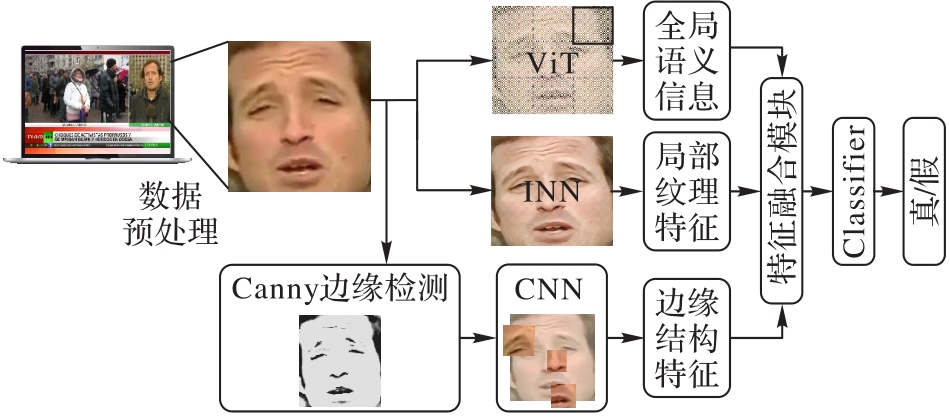
图1 Tri-BranchNet的整体框架
Fig. 1 Overall framework of Tri-BranchNet
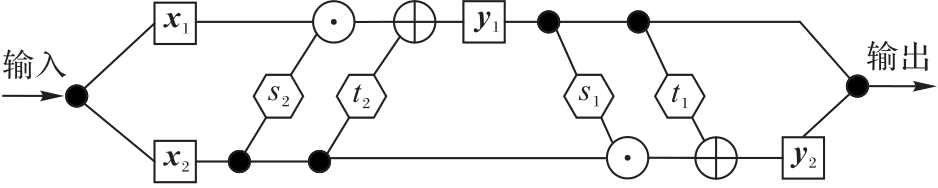
图2 INN分支结构
Fig. 2 INN branch structure
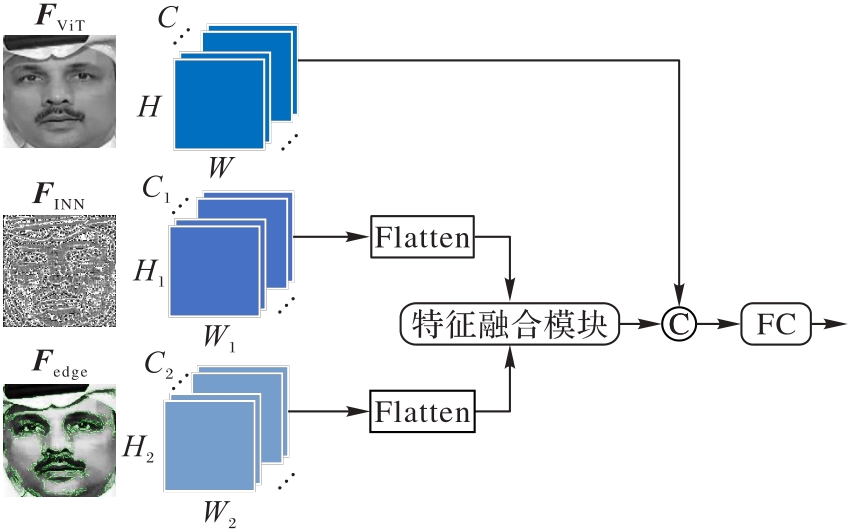
图3 特征融合的过程
Fig. 3 Process of feature fusion
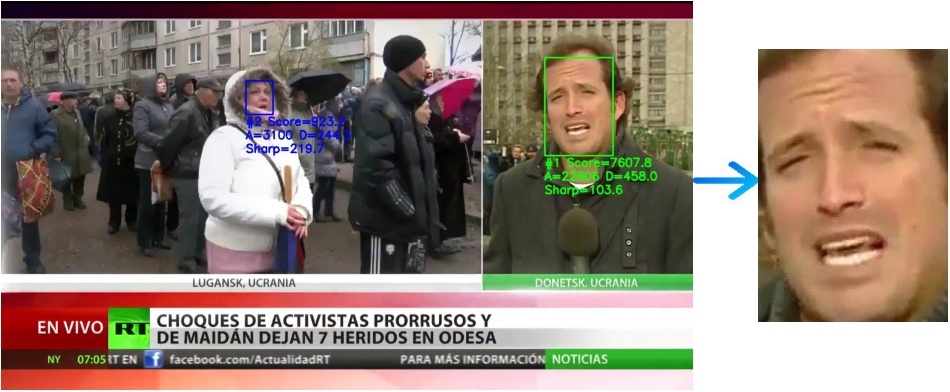
图4 视频帧中人脸的质量评估与目标提取
Fig. 4 Face quality assessment and target extraction in video frames
| 方法 | 主干网络 | C23(HQ) | C40(LQ) | ||
|---|---|---|---|---|---|
| Acc | AUC | Acc | AUC | ||
| Xception[ | Xception | 95.73 | — | 86.86 | — |
| MesoNet[ | MesoNet | 83.10 | — | 70.47 | — |
| Two-branchRN[ | Two-branchRN | 96.43 | 88.70 | 86.34 | 86.59 |
| F3-Net[ | Xception | 97.52 | 98.10 | 90.43 | 93.30 |
| Multi-attentional[ | EfficientNet-b4 | 97.60 | 99.29 | 88.69 | 90.40 |
| CORE[ | Xception | 97.61 | 99.66 | 87.99 | 90.61 |
| MH-FFNet[ | multi-frequency CNN | 97.37 | 99.44 | 85.90 | 87.44 |
| 本文方法 | Tri-BranchNet | 98.75 | 99.98 | 90.56 | 92.21 |
表1 FF++数据集上不同方法的评估结果 (%)
Tab. 1 Evaluation results of different methods on FF++ dataset
| 方法 | 主干网络 | C23(HQ) | C40(LQ) | ||
|---|---|---|---|---|---|
| Acc | AUC | Acc | AUC | ||
| Xception[ | Xception | 95.73 | — | 86.86 | — |
| MesoNet[ | MesoNet | 83.10 | — | 70.47 | — |
| Two-branchRN[ | Two-branchRN | 96.43 | 88.70 | 86.34 | 86.59 |
| F3-Net[ | Xception | 97.52 | 98.10 | 90.43 | 93.30 |
| Multi-attentional[ | EfficientNet-b4 | 97.60 | 99.29 | 88.69 | 90.40 |
| CORE[ | Xception | 97.61 | 99.66 | 87.99 | 90.61 |
| MH-FFNet[ | multi-frequency CNN | 97.37 | 99.44 | 85.90 | 87.44 |
| 本文方法 | Tri-BranchNet | 98.75 | 99.98 | 90.56 | 92.21 |
| 方法 | 主干网络 | 参数量/106 | GFLOPs |
|---|---|---|---|
| Xception[ | Xception | 22.97 | 18.62 |
| MesoNet[ | MesoNet | 33.21 | 19.06 |
| Two-branch RN[ | Two-branchRN | — | — |
| F3-Net[ | Xception | 27.56 | 20.33 |
| Multi-attentional[ | EfficientNet-b4 | 31.26 | 19.85 |
| CORE[ | Xception | 29.05 | 23.46 |
| MH-FFNet[ | multi-frequency CNN | — | — |
| 本文方法 | Tri-BranchNet | 161.57 | 21.12 |
表2 参数量和FLOPs对比
Tab. 2 Comparison of parameter count and FLOPs
| 方法 | 主干网络 | 参数量/106 | GFLOPs |
|---|---|---|---|
| Xception[ | Xception | 22.97 | 18.62 |
| MesoNet[ | MesoNet | 33.21 | 19.06 |
| Two-branch RN[ | Two-branchRN | — | — |
| F3-Net[ | Xception | 27.56 | 20.33 |
| Multi-attentional[ | EfficientNet-b4 | 31.26 | 19.85 |
| CORE[ | Xception | 29.05 | 23.46 |
| MH-FFNet[ | multi-frequency CNN | — | — |
| 本文方法 | Tri-BranchNet | 161.57 | 21.12 |
| 方法 | Acc | AUC | 方法 | Acc | AUC |
|---|---|---|---|---|---|
| Xception[ | — | 70.87 | FADE[ | — | 83.33 |
| FWA[ | — | 62.00 | 本文方法 | 83.72 | 85.26 |
| face X-ray[ | — | 72.80 |
表3 跨压缩率评估结果 (%)
Tab. 3 Cross-compression rate evaluation results
| 方法 | Acc | AUC | 方法 | Acc | AUC |
|---|---|---|---|---|---|
| Xception[ | — | 70.87 | FADE[ | — | 83.33 |
| FWA[ | — | 62.00 | 本文方法 | 83.72 | 85.26 |
| face X-ray[ | — | 72.80 |
| 方法 | 不同测试集上的AUC | |
|---|---|---|
| Celeb-DF | DFDC | |
| Xception[ | 65.23 | 72.20 |
| F3-Net[ | 68.69 | 67.45 |
| face X-ray[ | 74.46 | 71.15 |
| Two-branchRN[ | 73.41 | 71.06 |
| CORE[ | 79.40 | 75.46 |
| 本文方法 | 81.09 | 73.28 |
表4 跨数据集评估结果 (%)
Tab. 4 Cross-dataset evaluation results
| 方法 | 不同测试集上的AUC | |
|---|---|---|
| Celeb-DF | DFDC | |
| Xception[ | 65.23 | 72.20 |
| F3-Net[ | 68.69 | 67.45 |
| face X-ray[ | 74.46 | 71.15 |
| Two-branchRN[ | 73.41 | 71.06 |
| CORE[ | 79.40 | 75.46 |
| 本文方法 | 81.09 | 73.28 |
| ViT | INN | 边缘 | Acc | AUC |
|---|---|---|---|---|
| √ | 77.94 | 86.13 | ||
| √ | 64.27 | 55.38 | ||
| √ | 45.11 | 49.59 | ||
| √ | √ | 96.35 | 97.64 | |
| √ | √ | 94.26 | 96.51 | |
| √ | √ | 81.44 | 89.83 | |
| √ | √ | √ | 98.75 | 99.98 |
表5 消融实验结果 (%)
Tab. 5 Ablation experimental results
| ViT | INN | 边缘 | Acc | AUC |
|---|---|---|---|---|
| √ | 77.94 | 86.13 | ||
| √ | 64.27 | 55.38 | ||
| √ | 45.11 | 49.59 | ||
| √ | √ | 96.35 | 97.64 | |
| √ | √ | 94.26 | 96.51 | |
| √ | √ | 81.44 | 89.83 | |
| √ | √ | √ | 98.75 | 99.98 |
| 策略 | Acc | AUC |
|---|---|---|
| ViT+INN+边缘 | 97.21 | 98.96 |
| SE[ | 98.55 | 99.96 |
| (INN+边缘)+ViT | 98.75 | 99.98 |
表6 FF++(C23)上不同融合策略的性能对比 (%)
Tab. 6 Performance comparison of different fusion strategies on FF++ (C23)
| 策略 | Acc | AUC |
|---|---|---|
| ViT+INN+边缘 | 97.21 | 98.96 |
| SE[ | 98.55 | 99.96 |
| (INN+边缘)+ViT | 98.75 | 99.98 |
| [1] | GOODFELLOW I J, POUGET-ABADIE J, MIRZA M, et al. Generative adversarial nets[C]// Proceedings of the 28th International Conference on Neural Information Processing Systems — Volume 2. Cambridge: MIT Press, 2014: 2672-2680. |
| [2] | YU P, FEI J, XIA Z, et al. Improving generalization by commonality learning in face forgery detection[J]. IEEE Transactions on Information Forensics and Security, 2022, 17: 547-558. |
| [3] | AMERINI I, GALTERI L, CALDELLI R, et al. Deepfake video detection through optical flow based CNN[C]// Proceedings of the 2019 IEEE/CVF International Conference on Computer Vision Workshops. Piscataway: IEEE, 2019: 1205-1207. |
| [4] | SANDOTRA N, ARORA B. A comprehensive evaluation of feature-based AI techniques for deepfake detection[J]. Neural Computing and Applications, 2024, 36(8): 3859-3887. |
| [5] | PEI G, ZHANG J, HU M, et al. Deepfake generation and detection: a benchmark and survey[EB/OL]. [2025-07-30].. |
| [6] | 董佳乐,邓正杰,张宝,等. 基于人脸关键区域的深度伪造视频检测方法[J]. 计算机技术与发展, 2025, 35(1): 73-80. |
| DONG J L, DENG Z J, ZHANG B, et al. A deepfake video detection method based on facial key regions[J]. Computer Technology and Development, 2025, 35(1): 73-80. | |
| [7] | MASI I, KILLEKAR A, MASCARENHAS R M, et al. Two-branch recurrent network for isolating deepfakes in videos[C]// Proceedings of the 2020 European Conference on Computer Vision, LNCS 12352. Cham: Springer, 2020: 667-684. |
| [8] | ZHANG W, ZHAO C, LI Y. A novel counterfeit feature extraction technique for exposing face-swap images based on deep learning and error level analysis[J]. Entropy, 2020, 22(2): No.249. |
| [9] | ZHAO Z, BAI H, ZHANG J, et al. CDDFUSE: correlation-driven dual-branch feature decomposition for multi‑modality image fusion[C]// Proceedings of the 2023 IEEE/CVF Conference on Computer Vision and Pattern Recognition. Piscataway: IEEE, 2023: 5906-5916. |
| [10] | GUARNERA L, GIUDICE O, BATTIATO S. DeepFake detection by analyzing convolutional traces[C]// Proceedings of the 2020 IEEE/CVF Conference on Computer Vision and Pattern Recognition Workshops. Piscataway: IEEE, 2020: 2841-2850. |
| [11] | TOLOSANA R, VERA-RODRIGUEZ R, FIERREZ J, et al. Deepfakes and beyond: a survey of face manipulation and fake detection[J]. Information Fusion, 2020, 64: 131-148. |
| [12] | ARDIZZONE L, KRUSE J, WIRKERT S, et al. Analyzing inverse problems with invertible neural networks[EB/OL]. [2025‑07‑30].. |
| [13] | CHOLLET F. Xception: deep learning with depthwise separable convolutions[C]// Proceedings of the 2017 IEEE Conference on Computer Vision and Pattern Recognition. Piscataway: IEEE, 2017: 1800-1807. |
| [14] | LI Y, CHANG M C, LYU S. In Ictu Oculi: exposing AI created fake videos by detecting eye blinking[C]// Proceedings of the 2018 IEEE International Workshop on Information Forensics and Security. Piscataway: IEEE, 2018: 1-7. |
| [15] | CIFTCI U A, DEMIR I, YIN L. FakeCatcher: detection of synthetic portrait videos using biological signals[J]. IEEE Transactions on Pattern Analysis and Machine Intelligence, 2020(Early Access): 1-1. |
| [16] | YANG X, LI Y, LYU S. Exposing deep fakes using inconsistent head poses[C]// Proceedings of the 2019 IEEE International Conference on Acoustics, Speech and Signal Processing. Piscataway: IEEE, 2019: 8261-8265. |
| [17] | NGUYEN H H, YAMAGISHI J, ECHIZEN I. Capsule-Forensics: using capsule networks to detect forged images and videos[C]// Proceedings of the 2019 IEEE International Conference on Acoustics, Speech and Signal Processing. Piscataway: IEEE, 2019: 2307-2311. |
| [18] | KOHLI A, GUPTA A. Detecting DeepFake, FaceSwap and Face2Face facial forgeries using frequency CNN[J]. Multimedia Tools and Applications, 2021, 80(12): 18461-18478. |
| [19] | 许楷文,周翊超,谷文权,等. 基于多尺度特征融合重建学习的深度伪造人脸检测算法[J]. 信息网络安全, 2024, 24(8): 1173-1183. |
| XU K W, ZHOU Y C, GU W Q, et al. Multi-scale feature fusion deepfake detection algorithm based on reconstruction learning[J]. Netinfo Security, 2024, 24(8): 1173-1183. | |
| [20] | 李颖,边山,王春桃,等. CNN结合Transformer的深度伪造高效检测[J]. 中国图象图形学报, 2023, 28(3): 804-819. |
| LI Y, BIAN S, WANG C T, et al. CNN and Transformer-coordinated deepfake detection[J]. Journal of Image and Graphics, 2023, 28(3): 804-819. | |
| [21] | WANG F, CHEN Q, JING B, et al. Deepfake detection based on the adaptive fusion of spatial‑frequency features[J]. International Journal of Intelligent Systems, 2024, 2024: No.7578036. |
| [22] | ZHANG D, CHEN J, LIAO X, et al. Face forgery detection via multi-feature fusion and local enhancement[J]. IEEE Transactions on Circuits and Systems for Video Technology, 2024, 34(9): 8972-8977. |
| [23] | THAKUR R, ROHILLA R. Recent advances in digital image manipulation detection techniques: a brief review[J]. Forensic Science International, 2020, 312: No.110311. |
| [24] | 杨睿,胡心如,黄卓超,等. 深度网络生成式伪造人脸检测方法研究综述[J]. 计算机辅助设计与图形学学报, 2024, 36(10): 1491-1510. |
| YANG R, HU X R, HUANG Z C, et al. Review of deep network generative fake face detection methods[J]. Journal of Computer-Aided Design and Computer Graphics, 2024, 36(10): 1491-1510. | |
| [25] | RÖSSLER A, COZZOLINO D, VERDOLIVA L, et al. FaceForensics++: learning to detect manipulated facial images[C]// Proceedings of the 2019 IEEE/CVF International Conference on Computer Vision. Piscataway: IEEE, 2019: 1-11. |
| [26] | LI Y, YANG X, SUN P, et al. Celeb‑DF: a large‑scale challenging dataset for deepfake forensics[C]// Proceedings of the 2020 IEEE/CVF Conference on Computer Vision. Piscataway: IEEE, 2020: 3204-3213. |
| [27] | DOLHANSKY B, BITTON J, PFLAUM B, et al. The DeepFake Detection Challenge (DFDC) dataset[EB/OL]. [2025‑07‑30].. |
| [28] | DENG J, GUO J, VERVERAS E, et al. RetinaFace: single‑shot multi‑level face localisation in the wild[C]// Proceedings of the 2020 IEEE/CVF Conference on Computer Vision and Pattern Recognition. Piscataway: IEEE, 2020: 5202-5211. |
| [29] | AFCHAR D, NOZICK V, YAMAGISHI J, et al. MesoNet: a compact facial video forgery detection network[C]// Proceedings of the 2018 IEEE International Workshop on Information Forensics and Security. Piscataway: IEEE, 2018: 1-7. |
| [30] | QIAN Y, YIN G, SHENG L, et al. Thinking in frequency: face forgery detection by mining frequency-aware clues[C]// Proceedings of the 2020 European Conference on Computer Vision, LNCS 12357. Cham: Springer, 2020: 86-103. |
| [31] | ZHAO H, WEI T, ZHOU W, et al. Multi-attentional deepfake detection[C]// Proceedings of the 2021 IEEE/CVF Conference on Computer Vision and Pattern Recognition. Piscataway: IEEE, 2021: 2185-2194. |
| [32] | NI Y, MENG D, YU C, et al. CORE: consistent representation learning for face forgery detection[C]// Proceedings of the 2022 IEEE/CVF Conference on Computer Vision and Pattern Recognition Workshops. Piscataway: IEEE, 2022: 12-21. |
| [33] | ZHOU K, SUN G, WANG J, et al. MH-FFNet: leveraging mid-high frequency information for robust fine-grained face forgery detection[J]. Expert Systems with Applications, 2025, 276: No.127108. |
| [34] | LI Y, LYU S. Exposing deepfake videos by detecting face warping artifacts[EB/OL]. [2025‑07‑30].. |
| [35] | LI L, BAO J, ZHANG T, et al. Face‑X‑ray for more general face forgery detection[C]// Proceedings of the 2020 IEEE/CVF Conference on Computer Vision. Piscataway: IEEE, 2020: 5000-5009. |
| [36] | TAN L, WANG Y, WANG J, et al. Deepfake video detection via facial action dependencies estimation[C]// Proceedings of the 37th AAAI Conference on Artificial Intelligence. Palo Alto: AAAI Press, 2023: 5276-5284. |
| [37] | DASGUPTA S, MASON J, YUAN X, et al. Enhancing deepfake detection using SE block attention with CNN[C]// Proceedings of the 7th International Conference on Artificial Intelligence, Big Data, Computing and Data Communication Systems. Piscataway: IEEE, 2024: 1-6. |
| [1] | 姜勇维, 陈晓清, 付麟杰. 基于频谱分解的高频保持医学图像弹性配准模型[J]. 《计算机应用》唯一官方网站, 2026, 46(3): 924-932. |
| [2] | 徐千惠, 钮可, 朱顺哲, 石林, 李军. 增强型可逆神经网络视频隐写网络GAB3D-SEVSN[J]. 《计算机应用》唯一官方网站, 2026, 46(2): 467-474. |
| [3] | 姜坤元, 李小霞, 王利, 曹耀丹, 张晓强, 丁楠, 周颖玥. 引入解耦残差自注意力的边界交叉监督语义分割网络[J]. 《计算机应用》唯一官方网站, 2025, 45(4): 1120-1129. |
| [4] | 周雯, 谌雨章, 温志远, 王诗琦. 基于位置编码重叠切块嵌入和多尺度通道交互注意力的鱼类图像分类[J]. 《计算机应用》唯一官方网站, 2024, 44(10): 3209-3216. |
| [5] | 许喆, 王志宏, 单存宇, 孙亚茹, 杨莹. 基于重构误差的无监督人脸伪造视频检测[J]. 《计算机应用》唯一官方网站, 2023, 43(5): 1571-1577. |
| [6] | 秦强强, 廖俊国, 周弋荀. 基于多分支混合注意力的小目标检测算法[J]. 《计算机应用》唯一官方网站, 2023, 43(11): 3579-3586. |
| [7] | 韩艳茹, 尹梦晓, 覃子轩, 苏鹏, 杨锋. 图像和视频的低多边形渲染[J]. 计算机应用, 2021, 41(2): 504-510. |
| [8] | 张一飞, 李新福, 田学东. 基于图像分割的立体匹配算法[J]. 计算机应用, 2020, 40(5): 1415-1420. |
| [9] | 杨健 李若楠 黄晨阳 王刚 丁闯. 基于局部显著边缘特征的快速图像配准算法[J]. 计算机应用, 2014, 34(1): 149-153. |
| [10] | 刘付民 张治斌. 基于色彩和边缘特征的图像检索方法[J]. 计算机应用, 2012, 32(05): 1280-1282. |
| [11] | 曾宇燕 何建农. 基于小波包和边缘特征的遥感图像融合算法[J]. 计算机应用, 2011, 31(10): 2742-2744. |
| [12] | 陈永萍 朱庆生 葛垚. 结合变步长的两阶段视频镜头边界检测方法[J]. 计算机应用, 2008, 28(6): 1501-1503. |
| 阅读次数 | ||||||
|
全文 |
|
|||||
|
摘要 |
|
|||||
