


《计算机应用》唯一官方网站 ›› 2026, Vol. 46 ›› Issue (3): 924-932.DOI: 10.11772/j.issn.1001-9081.2025030322
姜勇维1,2, 陈晓清1,2( ), 付麟杰1,2
收稿日期:2025-03-28
修回日期:2025-05-12
接受日期:2025-05-13
发布日期:2025-05-27
出版日期:2026-03-10
通讯作者:
陈晓清
作者简介:姜勇维(2000—),男,黑龙江哈尔滨人,硕士研究生,主要研究方向:深度学习、医学图像处理基金资助:
Yongwei JIANG1,2, Xiaoqing CHEN1,2(), Linjie FU1,2
Received:2025-03-28
Revised:2025-05-12
Accepted:2025-05-13
Online:2025-05-27
Published:2026-03-10
Contact:
Xiaoqing CHEN
About author:JIANG Yongwei, born in 2000, M. S. candidate. His research interests include deep learning, medical image processing.Supported by:摘要:
弹性配准是医学图像处理中的关键任务之一,它的效果会直接影响到后续的分割、分类和预测等任务的准确性;然而,由于神经网络的高频不敏感特性,现有的方法难以捕捉图像的高频信息,这影响了配准场的拟合精度。为了解决这个问题,提出一种基于频谱分解的高频保持医学图像配准模型——DFRes (Decomposition in Frequency domain model for Registration)。该模型引入频谱分解策略,并采用双支结构处理原始图像中的高频信息和低频信息;同时,设计具有高频保持特性的可逆神经网络(INN)结构和具有高频低频融合能力的桥式特征融合模块,并通过交替的空间-频谱信息提取模块进一步加强模型对频域和空域信息的提取和融合能力。在IXI、OSSAI和华西直肠癌数据集上,DFRes与现有的先进模型对比的实验结果表明,DFRes在多个指标上取得了显著的提升。在IXI数据集上,相较于TransMorph模型,Dice相似系数(DSC)提高了2.5个百分点,平均表面距离(ASD)降低了0.012,而结构化相似性(SSIM)提高了1.6个百分点。同时,通过消融实验验证了模块设计的有效性。
中图分类号:
姜勇维, 陈晓清, 付麟杰. 基于频谱分解的高频保持医学图像弹性配准模型[J]. 计算机应用, 2026, 46(3): 924-932.
Yongwei JIANG, Xiaoqing CHEN, Linjie FU. Elastic medical image registration model with high-frequency preservation based on spectrum decomposition[J]. Journal of Computer Applications, 2026, 46(3): 924-932.
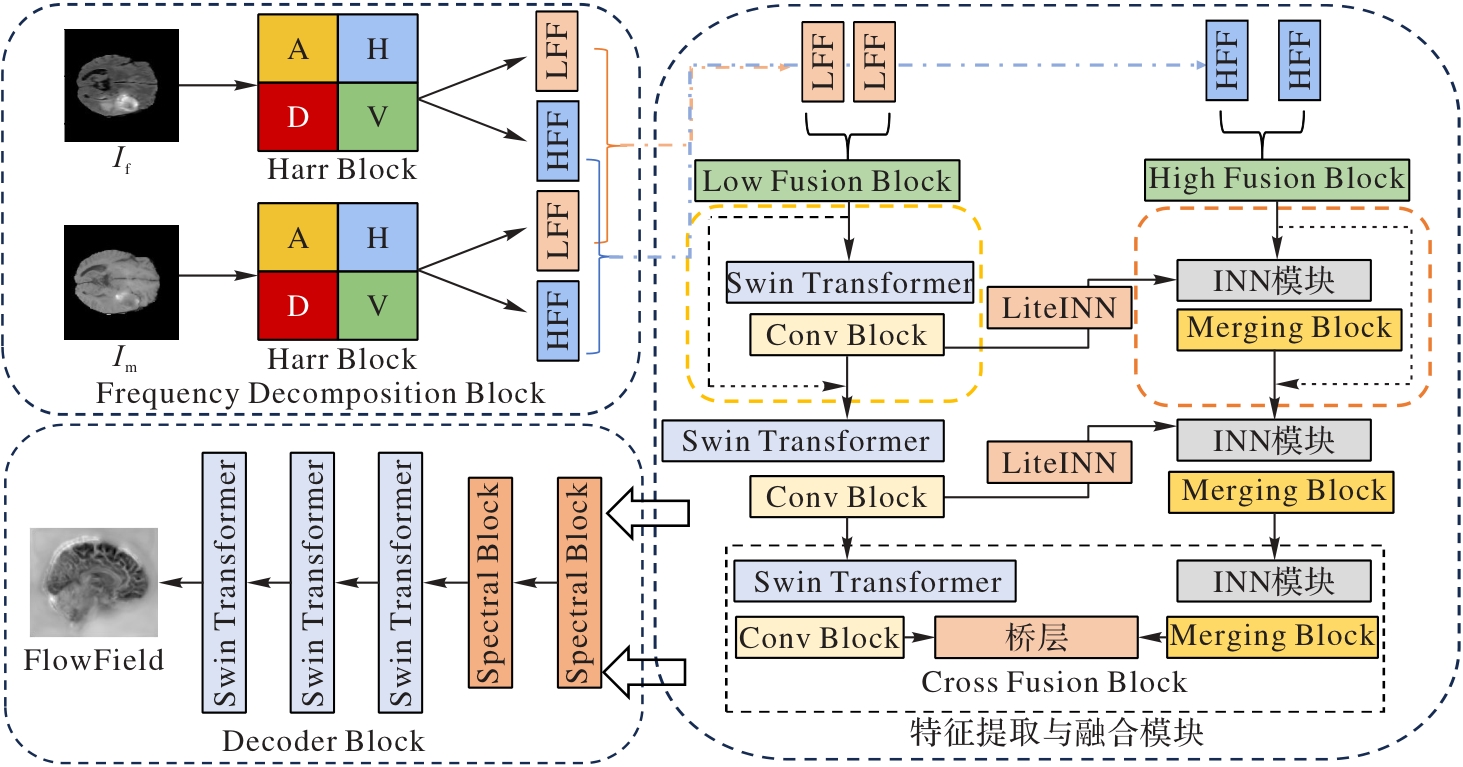
图1 DFRes的结构
Fig. 1 Structure of DFRes
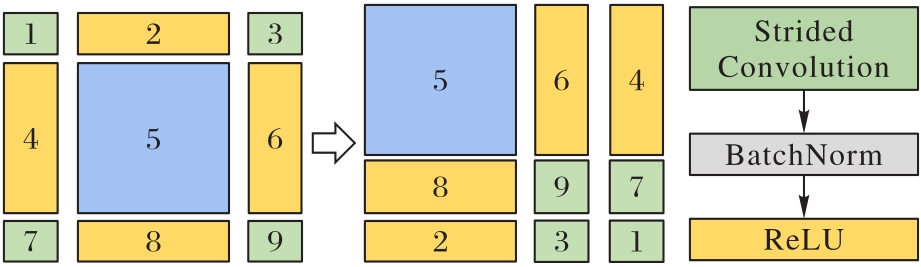
图2 注意力窗口和带步长的卷积
Fig. 2 Attention windows and strided convolution
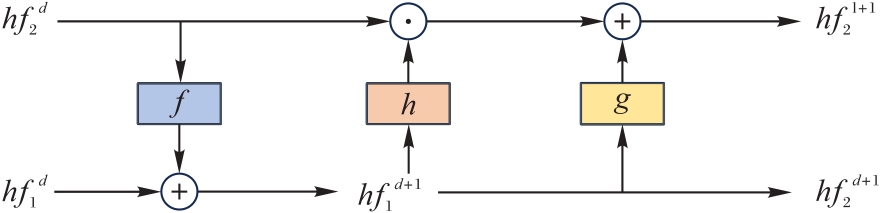
图3 三段式INN的整体构造
Fig. 3 Overall structure of three-stage INN
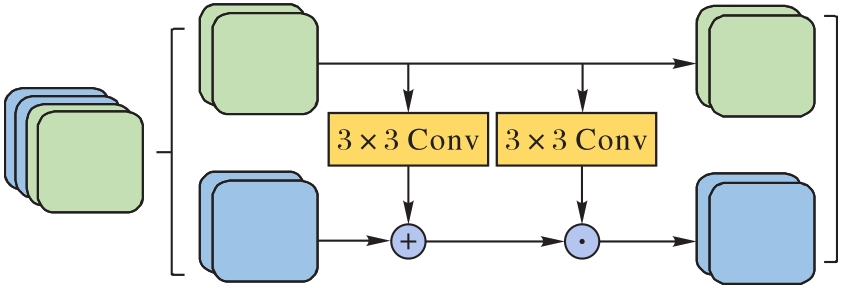
图4 两段式轻量级INN模块的结构
Fig. 4 Structure of two-stage LiteINN module

图5 桥式高-低频特征融合模块的结构
Fig. 5 Structure of bridge-style fusion module for low-high frequency features

图6 自适应谱模块的结构
Fig. 6 Structure of adaptive spectrum block

图7 两阶段训练的示意图
Fig. 7 Schematic diagram of two-stage training
| 模型 | IXI | OASIS | Huaxi Rect | |||||||||
|---|---|---|---|---|---|---|---|---|---|---|---|---|
| DSC | ASD | SSIM | Jac | DSC | ASD | SSIM | Jac | DSC | ASD | SSIM | Jac | |
| VoxelMorph | 0.679 | 1.135 | 0.865 | 2.152 | 0.715 | 0.782 | 0.813 | 1.864 | 0.710 | 1.279 | 0.716 | 2.152 |
| CycleMorph | 0.695 | 1.068 | 0.875 | 1.784 | 0.741 | 0.735 | 0.825 | 1.784 | 0.717 | 1.126 | 0.711 | 2.006 |
| ViT-V-Net | 0.741 | 0.942 | 0.912 | 0.410 | 0.781 | 0.636 | 0.917 | 0.372 | 0.792 | 0.548 | 0.863 | 0.410 |
| PVT | 0.736 | 0.976 | 0.905 | 0.767 | 0.776 | 0.689 | 0.648 | 0.865 | 0.748 | 0.863 | 0.789 | 0.865 |
| TransMorph | 0.744 | 0.917 | 0.902 | 0.967 | 0.782 | 0.581 | 0.912 | 0.926 | 0.795 | 0.586 | 0.902 | 0.764 |
| Dsc | 0.765 | 0.911 | 0.926 | 0.577 | 0.788 | 0.512 | 0.941 | 0.553 | 0.807 | 0.492 | 0.894 | 0.142 |
| LKA | 0.737 | 0.971 | 0.911 | 0.745 | 0.622 | 0.622 | 0.932 | 0.849 | 0.784 | 0.577 | 0.883 | 0.872 |
| DFRes | 0.769 | 0.905 | 0.918 | 0.397 | 0.791 | 0.497 | 0.943 | 0.302 | 0.802 | 0.484 | 0.897 | 0.012 |
表1 不同模型在3个数据集上的性能对比
Tab. 1 Performance comparison of different models on three datasets
| 模型 | IXI | OASIS | Huaxi Rect | |||||||||
|---|---|---|---|---|---|---|---|---|---|---|---|---|
| DSC | ASD | SSIM | Jac | DSC | ASD | SSIM | Jac | DSC | ASD | SSIM | Jac | |
| VoxelMorph | 0.679 | 1.135 | 0.865 | 2.152 | 0.715 | 0.782 | 0.813 | 1.864 | 0.710 | 1.279 | 0.716 | 2.152 |
| CycleMorph | 0.695 | 1.068 | 0.875 | 1.784 | 0.741 | 0.735 | 0.825 | 1.784 | 0.717 | 1.126 | 0.711 | 2.006 |
| ViT-V-Net | 0.741 | 0.942 | 0.912 | 0.410 | 0.781 | 0.636 | 0.917 | 0.372 | 0.792 | 0.548 | 0.863 | 0.410 |
| PVT | 0.736 | 0.976 | 0.905 | 0.767 | 0.776 | 0.689 | 0.648 | 0.865 | 0.748 | 0.863 | 0.789 | 0.865 |
| TransMorph | 0.744 | 0.917 | 0.902 | 0.967 | 0.782 | 0.581 | 0.912 | 0.926 | 0.795 | 0.586 | 0.902 | 0.764 |
| Dsc | 0.765 | 0.911 | 0.926 | 0.577 | 0.788 | 0.512 | 0.941 | 0.553 | 0.807 | 0.492 | 0.894 | 0.142 |
| LKA | 0.737 | 0.971 | 0.911 | 0.745 | 0.622 | 0.622 | 0.932 | 0.849 | 0.784 | 0.577 | 0.883 | 0.872 |
| DFRes | 0.769 | 0.905 | 0.918 | 0.397 | 0.791 | 0.497 | 0.943 | 0.302 | 0.802 | 0.484 | 0.897 | 0.012 |

图8 配准结果
Fig. 8 Results of registration

图9 不同模型的前向推理时间和模型大小
Fig. 9 Forward inference time and model sizes of different models
| 实验序号 | Harr | INN | Sp | Fusion | DSC | ASD | SSIM |
|---|---|---|---|---|---|---|---|
| 1 | √ | √ | √ | 0.705 | 3.731 | 0.785 | |
| 2 | √ | √ | √ | 0.677 | 2.374 | 0.709 | |
| 3 | √ | √ | √ | 0.762 | 1.158 | 0.892 | |
| 4 | √ | √ | √ | 0.723 | 1.875 | 0.815 | |
| 5 | √ | √ | √ | √ | 0.769 | 0.905 | 0.918 |
表2 模块消融实验结果
Tab. 2 Experiment results of module ablation
| 实验序号 | Harr | INN | Sp | Fusion | DSC | ASD | SSIM |
|---|---|---|---|---|---|---|---|
| 1 | √ | √ | √ | 0.705 | 3.731 | 0.785 | |
| 2 | √ | √ | √ | 0.677 | 2.374 | 0.709 | |
| 3 | √ | √ | √ | 0.762 | 1.158 | 0.892 | |
| 4 | √ | √ | √ | 0.723 | 1.875 | 0.815 | |
| 5 | √ | √ | √ | √ | 0.769 | 0.905 | 0.918 |
| Two-Stage | DSC | Bending | DSC | ASD | SSIM |
|---|---|---|---|---|---|
| √ | √ | 0.766 | 0.891 | 0.917 | |
| √ | √ | 0.757 | 0.885 | 0.908 | |
| √ | √ | 0.768 | 0.901 | 0.918 | |
| √ | √ | √ | 0.769 | 0.905 | 0.918 |
表3 训练消融实验
Tab. 3 Experiments of training ablation
| Two-Stage | DSC | Bending | DSC | ASD | SSIM |
|---|---|---|---|---|---|
| √ | √ | 0.766 | 0.891 | 0.917 | |
| √ | √ | 0.757 | 0.885 | 0.908 | |
| √ | √ | 0.768 | 0.901 | 0.918 | |
| √ | √ | √ | 0.769 | 0.905 | 0.918 |
| [1] | HASKINS G, KRUGER U, YAN P. Deep learning in medical image registration: a survey [J]. Machine Vision and Applications, 2020, 31(1): No.8. |
| [2] | 黄一超,傅锐芝,王昕辰,等. 医学影像图像与组织学图像配准的研究进展[J]. 中国医学计算机成像杂志, 2024, 30(5): 646-652. |
| HUANG Y C, FU R Z, WANG X C, et al. Research progress on registration of medical image and histological image [J]. Chinese Computed Medical Imaging, 2024, 30(5): 646-652. | |
| [3] | NEYSHABUR B, TOMIOKA R, SREBRO N. In search of the real inductive bias: on the role of implicit regularization in deep learning[EB/OL]. [2024-10-02].. |
| [4] | RAHAMAN N, BARATIN A, ARPIT D, et al. On the spectral bias of neural networks[C]// Proceedings of the 36th International Conference on Machine Learning. New York: JMLR.org, 2019: 5301-5310. |
| [5] | JIANG L, DAI B, WU W, et al. Focal frequency loss for image reconstruction and synthesis[C]// Proceedings of the 2021 IEEE/CVF International Conference on Computer Vision. Piscataway: IEEE, 2021: 13899-13909. |
| [6] | AZAD R, BOZORGPOUR I A, ASADI-AGHBOLAGHI M, et al. Deep frequency re-calibration U-Net for medical image segmentation[C]// Proceedings of the 2021 IEEE/CVF International Conference on Computer Vision Workshops. Piscataway: IEEE, 2021: 3267-3276. |
| [7] | WANG H, WU X, HUANG Z, et al. High-frequency component helps explain the generalization of convolutional neural networks[C]// Proceedings of the 2020 IEEE/CVF Conference on Computer Vision and Pattern Recognition. Piscataway: IEEE, 2020: 8681-8691. |
| [8] | MUSTAJAB A H, LYU H, RIZVI Z, et al. Physics-informed neural networks for high-frequency and multi-scale problems using transfer learning [J]. Applied Sciences, 2024, 14(8): No.3204. |
| [9] | MILDENHALL B, SRINIVASAN P P, TANCIK M, et al. NeRF: representing scenes as neural radiance fields for view synthesis [J]. Communications of the ACM, 2022, 65(1): 99-106. |
| [10] | DINH L, KRUEGER D, BENGIO Y. NICE: non-linear independent components estimation[EB/OL]. [2024-10-02].. |
| [11] | KINGMA D P, DHARIWAL P. Glow: generative flow with invertible 1×1 convolutions[C]// Proceedings of the 32nd International Conference on Neural Information Processing Systems. Red Hook: Curran Associates Inc., 2018: 10236-10245. |
| [12] | XU X, WU C, ROSENMAN S, et al. BridgeTower: building bridges between encoders in vision-language representation learning[C]// Proceedings of the 37th AAAI Conference on Artificial Intelligence. Palo Alto: AAAI Press, 2023: 10637-10647. |
| [13] | ONOFREY J A, STAIB L H, PAPADEMETRIS X. Semi-supervised learning of nonrigid deformations for image registration[C]// Proceedings of the 2013 International MICCAI Workshop on Medical Computer Vision, LNCS 8331. Cham: Springer, 2014: 13-23. |
| [14] | BALAKRISHNAN G, ZHAO A, SABUNCU M R, et al. VoxelMorph: a learning framework for deformable medical image registration [J]. IEEE Transactions on Medical Imaging, 2019, 38(8): 1788-1800. |
| [15] | KIM B, KIM D H, PARK S H, et al. CycleMorph: cycle consistent unsupervised deformable image registration[J]. Medical Image Analysis, 2021, 71: No.102036. |
| [16] | CHEN J, FREY E C, HE Y, et al. TransMorph: Transformer for unsupervised medical image registration[J]. Medical Image Analysis, 2022, 82: No.102615. |
| [17] | CHEN J, HE Y, FREY E C, et al. ViT-V-Net: Vision Transformer for unsupervised volumetric medical image registration[EB/OL]. [2024-10-02].. |
| [18] | WANG W, XIE E, LI X, et al. Pyramid Vision Transformer: a versatile backbone for dense prediction without convolutions[C]// Proceedings of the 2021 IEEE/CVF International Conference on Computer Vision. Piscataway: IEEE, 2021: 548-558. |
| [19] | XU Z, LUO J, LU D, et al. Double-uncertainty guided spatial and temporal consistency regularization weighting for learning-based abdominal registration [C]// Proceedings of the 2022 International Conference on Medical Image Computing and Computer-Assisted Intervention, LNCS 13436. Cham: Springer, 2022: 14-24. |
| [20] | RAO Y, ZHOU Y, WANG Y. Salient deformable network for abdominal multiorgan registration [J]. Medical Physics, 2022, 49(9): 5953-5963. |
| [21] | CHEN J, FREY E C, DU Y. Unsupervised learning of diffeomorphic image registration via TransMorph [C]// Proceedings of the 2022 International Workshop on Biomedical Image Registration, LNCS 13386. Cham: Springer, 2022: 96-102. |
| [22] | 王一铭,李世源,廖南清,等. 基于证据深度学习的不确定性感知无监督医学图像配准模型[J]. 计算机应用,2025, 45(10): 3371-3380. |
| WANG Y M, LI S Y, LIAO N Q, et al. Uncertainty-aware unsupervised medical image registration model based on evidential deep learning[J]. Journal of Computer Applications, 2025, 45(10): 3371-3380. | |
| [23] | CHEN Y, HU X, LU T, et al. A multi-scale large kernel attention with U-Net for medical image registration[J]. The Journal of Supercomputing, 2025, 81: No.70. |
| [24] | MENG M, FENG D, BI L, et al. Correlation-aware coarse-to-fine MLPs for deformable medical image registration[C]// Proceedings of the 2024 IEEE/CVF Conference on Computer Vision and Pattern Recognition. Piscataway: IEEE, 2024: 9645-9654. |
| [25] | HAN Y, WANG L, HUANG Z, et al. A novel 3D magnetic resonance imaging registration framework based on the Swin-Transformer UNet+ model with 3D dynamic snake convolution scheme [J]. Journal of Imaging, 2025, 11(2): No.54. |
| [26] | QI Y, HE Y, QI X, et al. Dynamic snake convolution based on topological geometric constraints for tubular structure segmentation[C]// Proceedings of the 2023 IEEE/CVF International Conference on Computer Vision. Piscataway: IEEE, 2023: 6047-6056. |
| [27] | MENG M, FULHAM M, FENG D, et al. AutoFuse: automatic fusion networks for deformable medical image registration[J]. Pattern Recognition, 2025, 161: No.111338. |
| [28] | SHAN L, LI X, WANG W. Decouple the high-frequency and low-frequency information of images for semantic segmentation[C]// Proceedings of the 2021 IEEE International Conference on Acoustics, Speech and Signal Processing. Piscataway: IEEE, 2021: 1805-1809. |
| [29] | LI J, ZHANG S, SUN Y, et al. Frequency-driven edge guidance network for semantic segmentation of remote sensing images[J]. IEEE Journal of Selected Topics in Applied Earth Observations and Remote Sensing, 2024, 17: 9677-9693. |
| [30] | PATRO B N, NAMBOODIRI V P, AGNEESWARAN V S. SpectFormer: frequency and attention is what you need in a vision Transformer [C]// Proceedings of the 2025 IEEE/CVF Winter Conference on Applications of Computer Vision. Piscataway: IEEE, 2025: 9543-9554. |
| [31] | WANG J, CHEN H, XU H, et al. SFANet: spatial-frequency attention network for weather forecasting[EB/OL]. [2024-12-02].. |
| [32] | QIN Z, ZHANG P, WU F, et al. FcaNet: frequency channel attention networks[C]// Proceedings of the 2021 IEEE/CVF International Conference on Computer Vision. Piscataway: IEEE, 2021: 763-772. |
| [33] | ZHENG H, GONG M, LIU T, et al. HFA-Net: high frequency attention Siamese network for building change detection in VHR remote sensing images[J]. Pattern Recognition, 2022, 129: No.108717. |
| [34] | PHAM C, NGUYEN V A, LE T, et al. Frequency attention for knowledge distillation[C]// Proceedings of the 2024 IEEE/CVF Winter Conference on Applications of Computer Vision. Piscataway: IEEE, 2024: 2266-2275. |
| [35] | ZHAO Z, BAI H, ZHANG J, et al. CDDFuse: correlation-driven dual-branch feature decomposition for multi-modality image fusion[C]// Proceedings of the 2023 IEEE/CVF Conference on Computer Vision and Pattern Recognition. Piscataway: IEEE, 2023: 5906-5916. |
| [36] | XIAO M, ZHENG S, LIU C, et al. Invertible image rescaling[C]// Proceedings of the 2020 European Conference on Computer Vision, LNCS 12346. Cham: Springer, 2020: 126-144. |
| [1] | 余松森, 何皇, 薛国鹏, 崔恒拓. 基于改进FENet的瓷砖色差量化分级方法[J]. 《计算机应用》唯一官方网站, 2026, 46(3): 959-968. |
| [2] | 陈敏, 秦小林, 李绍涵, 杨昊, 李韬弘. 深度学习应用于强对流天气预测的综述[J]. 《计算机应用》唯一官方网站, 2026, 46(3): 980-992. |
| [3] | 张健, 于剑波, 汤健. 基于多层预处理的城市固废焚烧状态识别方法[J]. 《计算机应用》唯一官方网站, 2026, 46(3): 940-949. |
| [4] | 李名, 王孟齐, 张爱丽, 任花, 窦育强. 基于条件生成对抗网络和混合注意力机制的图像隐写方法[J]. 《计算机应用》唯一官方网站, 2026, 46(2): 475-484. |
| [5] | 曹杰, 谢凌锋, 王丙金, 张昌河, 余紫东, 邓超. 考虑类不平衡和背景多样性问题的青少年脊柱侧弯筛查方法[J]. 《计算机应用》唯一官方网站, 2026, 46(2): 630-639. |
| [6] | 郭泽一, 李凤莲, 徐利春. 基于双重决策机制的深度符号回归算法[J]. 《计算机应用》唯一官方网站, 2026, 46(2): 406-415. |
| [7] | 崔克俭, 王志明, 邱兆文. 基于光学相干断层扫描血管成像的视网膜血管分割与冠心病预测方法[J]. 《计算机应用》唯一官方网站, 2026, 46(2): 640-651. |
| [8] | 徐千惠, 钮可, 朱顺哲, 石林, 李军. 增强型可逆神经网络视频隐写网络GAB3D-SEVSN[J]. 《计算机应用》唯一官方网站, 2026, 46(2): 467-474. |
| [9] | 付锦程, 杨仕友. 基于贝叶斯优化和特征融合混合模型的短期风电功率预测[J]. 《计算机应用》唯一官方网站, 2026, 46(2): 652-658. |
| [10] | 姜皓骞, 张东, 李冠宇, 陈恒. 基于结构增强的层次化任务导向提示策略的对话推荐系统SetaCRS[J]. 《计算机应用》唯一官方网站, 2026, 46(2): 368-377. |
| [11] | 陈晓雷, 郑芷薇, 黄雪, 曲振彬. 结合球面对齐与自适应几何校正的全景视频超分辨率网络[J]. 《计算机应用》唯一官方网站, 2026, 46(2): 528-535. |
| [12] | 刘权捷, 顾兆一, 王春源. 复杂光照条件下的不安全驾驶行为检测[J]. 《计算机应用》唯一官方网站, 2026, 46(2): 613-619. |
| [13] | 林金娇, 张灿舜, 陈淑娅, 王天鑫, 连剑, 徐庸辉. 基于改进图注意力网络的车险欺诈检测方法[J]. 《计算机应用》唯一官方网站, 2026, 46(2): 437-444. |
| [14] | 韩锋, 卜永丰, 梁浩翔, 黄舒雯, 张朝阳, 孙士杰. 基于多层次时空交互依赖的车辆轨迹异常检测[J]. 《计算机应用》唯一官方网站, 2026, 46(2): 604-612. |
| [15] | 边小勇, 袁培洋, 胡其仁. 双编码空频混合的红外小目标检测方法[J]. 《计算机应用》唯一官方网站, 2026, 46(1): 252-259. |
| 阅读次数 | ||||||
|
全文 |
|
|||||
|
摘要 |
|
|||||
