


《计算机应用》唯一官方网站 ›› 2026, Vol. 46 ›› Issue (7): 2064-2073.DOI: 10.11772/j.issn.1001-9081.2025070867
侯迪迪1,2, 洪少东1,2, 付玉杰1,2, 崔允贺1,2, 申国伟1,2( )
)
收稿日期:2025-08-01
修回日期:2025-08-19
接受日期:2025-08-29
发布日期:2025-11-05
出版日期:2026-07-10
通讯作者:
申国伟
作者简介:侯迪迪(2000—),女,贵州毕节人,硕士研究生,CCF会员,主要研究方向:威胁情报分析、知识图谱基金资助:
Didi HOU1,2, Shaodong HONG1,2, Yujie FU1,2, Yunhe CUI1,2, Guowei SHEN1,2()
Received:2025-08-01
Revised:2025-08-19
Accepted:2025-08-29
Online:2025-11-05
Published:2026-07-10
Contact:
Guowei SHEN
About author:HOU Didi, born in 2000, M. S. candidate. Her research interests include threat intelligence analysis, knowledge graph.Supported by:摘要:
网络安全知识图谱是对非结构化的网络威胁情报(CTI)数据进行深度关联分析的重要手段,使用大语言模型(LLM)能够克服传统的网络安全命名实体识别方法存在的缺乏对文本上下文的理解、难以捕捉长距离依赖以及面对噪声和冗余时缺乏鲁棒性的局限。然而,单一LLM在网络安全命名实体抽取中存在模型能力在边界外领域适应性差、分布外(OOD)数据上泛化能力不足以及单一模型认知局限的情况。为了解决以上问题,提出一种融合微调的LLM协同链接方法。该方法使用CTI语料对基础LLM进行低秩适应(LoRA)参数微调,通过参数优化增强模型对网络安全领域的理解。同时, LLM协同采用静态投票与动态元学习器的链接方式,其中,通过投票让静态机制综合多个模型的预测结果,而在动态机制中设计特征空间适配函数来量化模型的能力边界,并通过随机森林等元学习器实现输入数据特征与模型性能的动态映射。实验结果表明,所提方法的F1分数达到了91.1%,与基于多特征的语义增强网络方法相比提升了6.8%,为网络安全命名实体识别提供了高效可扩展的解决方案。
中图分类号:
侯迪迪, 洪少东, 付玉杰, 崔允贺, 申国伟. 基于大语言模型链接的网络安全实体识别方法[J]. 计算机应用, 2026, 46(7): 2064-2073.
Didi HOU, Shaodong HONG, Yujie FU, Yunhe CUI, Guowei SHEN. Cybersecurity named entity recognition method based on large language model linking[J]. Journal of Computer Applications, 2026, 46(7): 2064-2073.
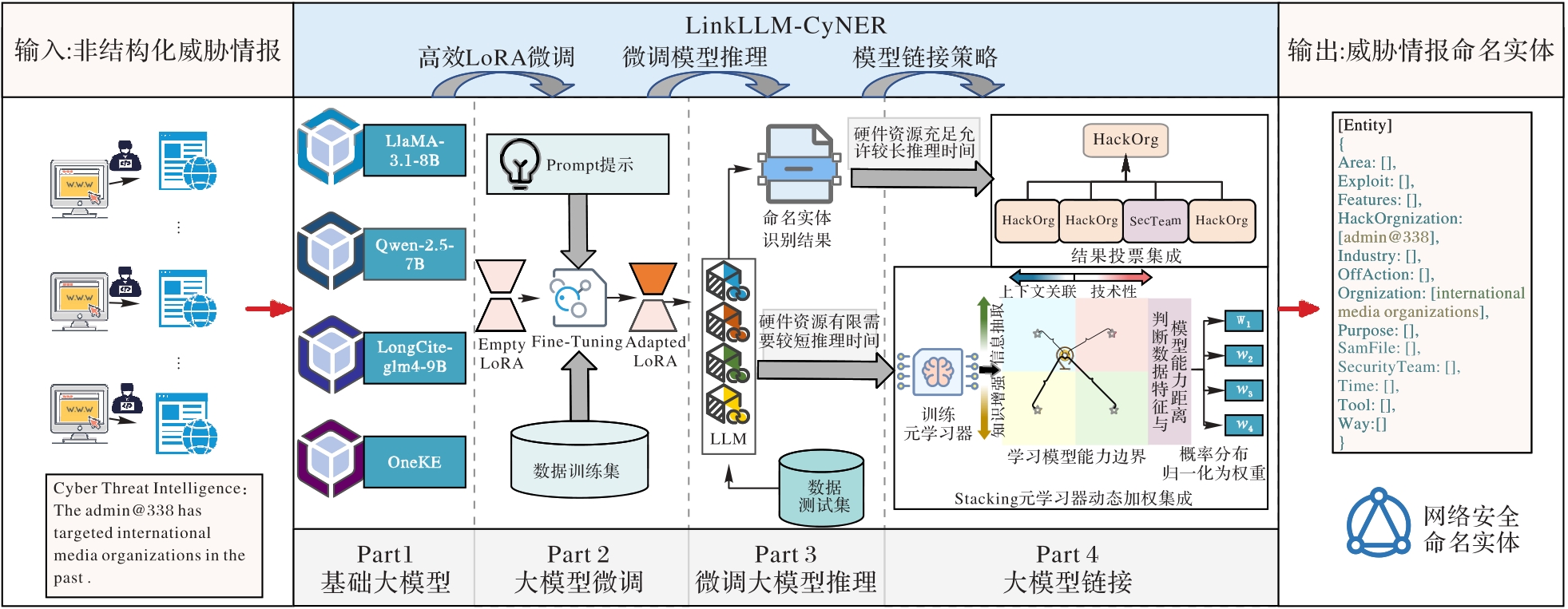
图1 融合微调的LLM链接方法的框架
Fig. 1 Framework of LLM linking method integrating fine-tuning
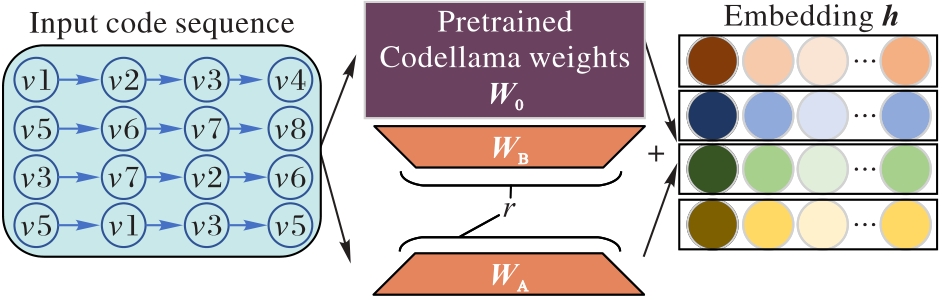
图2 LoRA微调技术原理
Fig. 2 LoRA fine-tuning technology principle
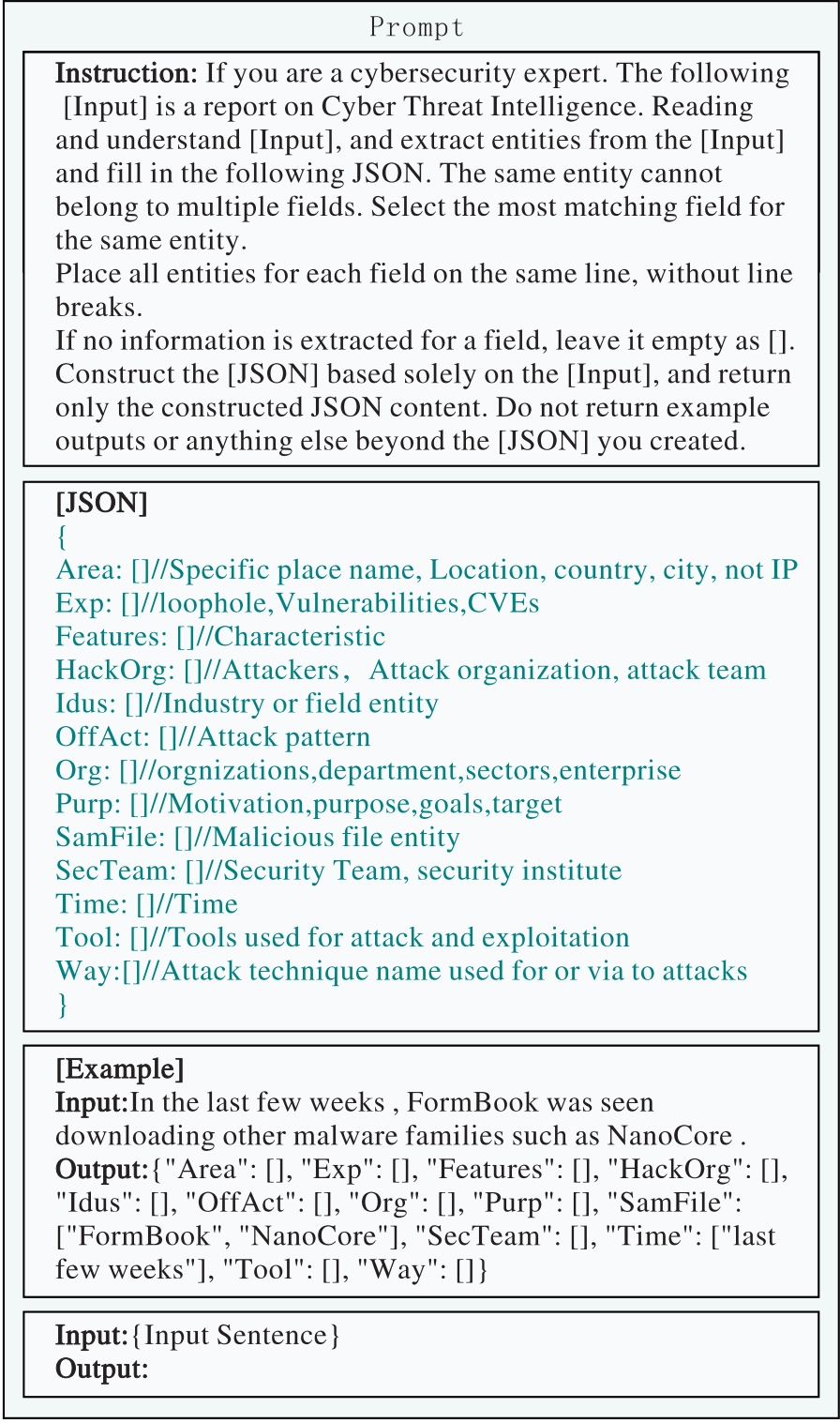
图3 LLM推理提示
Fig. 3 LLM inference prompt
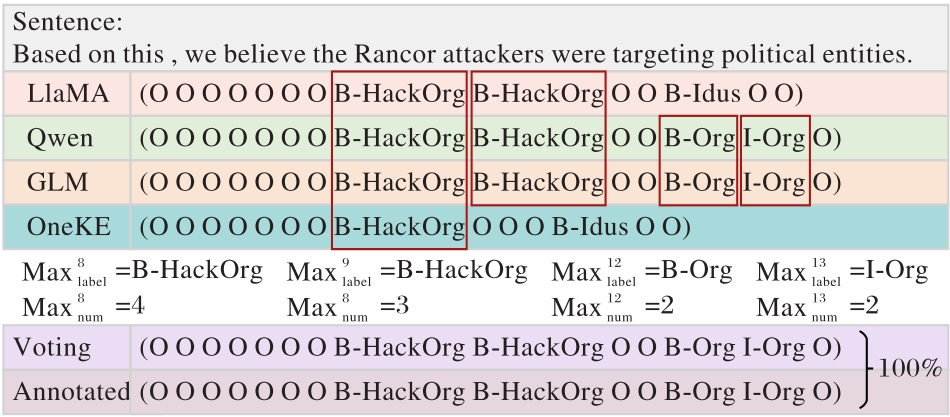
图4 静态链接过程
Fig. 4 Static linking process
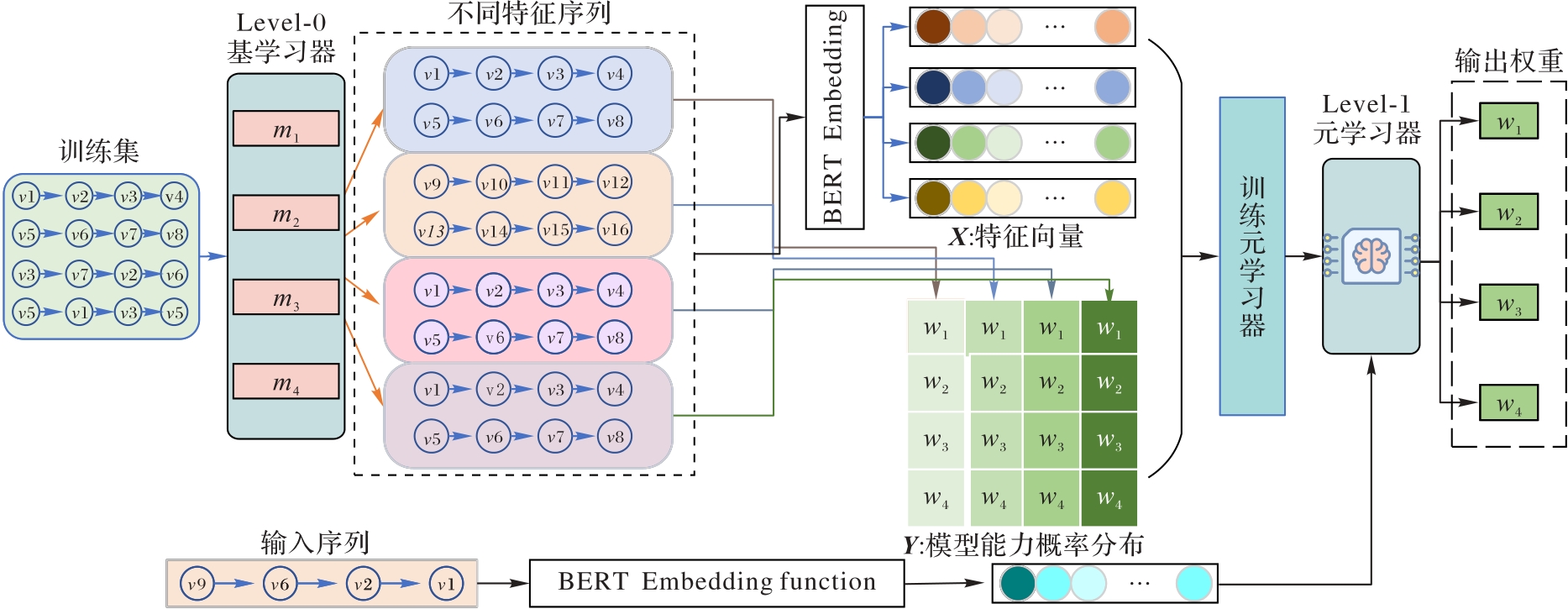
图5 元学习器的动态链接框架
Fig. 5 Dynamic linking framework of meta-learners
| 实体类型 | 含义 | 示例 | 数量 |
|---|---|---|---|
| Area | Location | China | 3 447 |
| Exp | Exploit | EternalBlue | 1 559 |
| Feature | Characteristics | Uploading files | 2 441 |
| HackOrg | Hacker Org | China Chopper | 5 465 |
| Idus | Industry | social media | 2 136 |
| OffAct | Attack Pattern | supply-chain | 2 669 |
| Org | Organization | 2 489 | |
| Purp | Motivation | steal credentials | 2 424 |
| SamFile | File | KHNP.doc | 2 400 |
| SecTeam | Security team | FireEye | 1 921 |
| Time | Time | 2008 | 2 659 |
| Tool | Tool | LATENTBOT | 4 784 |
| Way | Technique | spear phishing | 2 018 |
表1 DNRTI实体信息
Tab. 1 DNRTI entity information
| 实体类型 | 含义 | 示例 | 数量 |
|---|---|---|---|
| Area | Location | China | 3 447 |
| Exp | Exploit | EternalBlue | 1 559 |
| Feature | Characteristics | Uploading files | 2 441 |
| HackOrg | Hacker Org | China Chopper | 5 465 |
| Idus | Industry | social media | 2 136 |
| OffAct | Attack Pattern | supply-chain | 2 669 |
| Org | Organization | 2 489 | |
| Purp | Motivation | steal credentials | 2 424 |
| SamFile | File | KHNP.doc | 2 400 |
| SecTeam | Security team | FireEye | 1 921 |
| Time | Time | 2008 | 2 659 |
| Tool | Tool | LATENTBOT | 4 784 |
| Way | Technique | spear phishing | 2 018 |
| 模型 | 目标模块 | LoRA | LoRA | LoRA dropout | Batch_size | Epochs | Learning_rate |
|---|---|---|---|---|---|---|---|
| LlaMA-3.1-8B | q,k,v_proj | 8 | 32 | 0.1 | 4 | 8 | 1.00×10⁻⁴ |
| Qwen2.5-7B | q,k,v_proj | 8 | 32 | 0.1 | 4 | 10 | 1.00×10⁻⁴ |
| GLM4-9B | q,k,v_proj | 8 | 32 | 0.1 | 4 | 7 | 1.00×10⁻⁴ |
| OneKE | q,k,v_proj | 8 | 32 | 0.1 | 4 | 7 | 1.00×10⁻⁴ |
表2 LoRA微调的参数配置
Tab. 2 Parameter configuration of LoRA fine-tuning
| 模型 | 目标模块 | LoRA | LoRA | LoRA dropout | Batch_size | Epochs | Learning_rate |
|---|---|---|---|---|---|---|---|
| LlaMA-3.1-8B | q,k,v_proj | 8 | 32 | 0.1 | 4 | 8 | 1.00×10⁻⁴ |
| Qwen2.5-7B | q,k,v_proj | 8 | 32 | 0.1 | 4 | 10 | 1.00×10⁻⁴ |
| GLM4-9B | q,k,v_proj | 8 | 32 | 0.1 | 4 | 7 | 1.00×10⁻⁴ |
| OneKE | q,k,v_proj | 8 | 32 | 0.1 | 4 | 7 | 1.00×10⁻⁴ |
| 参数 | MLP | CNN | 随机森林 |
|---|---|---|---|
| Batch_size | 16 | 16 | — |
| Epochs | 270 | 370 | — |
| Learning_rate | 1×10⁻⁴ | 1×10⁻³ | — |
| Dropout | 0.5 | 0.5 | — |
| 优化器 | AdamW | Adam | — |
| 学习率调度器 | StepLR | — | — |
| n_estimators | — | — | 300 |
| random_state | — | — | 42 |
表3 集成学习的具体参数配置
Tab. 3 Specific parameter configuration of ensemble learning
| 参数 | MLP | CNN | 随机森林 |
|---|---|---|---|
| Batch_size | 16 | 16 | — |
| Epochs | 270 | 370 | — |
| Learning_rate | 1×10⁻⁴ | 1×10⁻³ | — |
| Dropout | 0.5 | 0.5 | — |
| 优化器 | AdamW | Adam | — |
| 学习率调度器 | StepLR | — | — |
| n_estimators | — | — | 300 |
| random_state | — | — | 42 |
| 模型 | 准确率 | 精确率 | 召回率 | F1分数 |
|---|---|---|---|---|
| DeepSeek | 75.5 | 41.8 | 48.2 | 44.9 |
| GPT-4o | 77.3 | 41.5 | 51.1 | 45.8 |
| GPT-4 | 71.3 | 34.7 | 46.7 | 39.8 |
| LlaMA-3.1-8B | 82.6 | 47.8 | 41.6 | 44.5 |
| Qwen2.5-7B | 77.5 | 39.3 | 40.0 | 39.6 |
| GLM4-9B | 81.9 | 46.3 | 44.6 | 45.5 |
| OneKE | 83.1 | 48.2 | 39.5 | 43.6 |
表4 预训练LLM的网络安全命名实体识别性能 (%)
Tab. 4 Cybersecurity named entity recognition performance of pre-trained LLMs
| 模型 | 准确率 | 精确率 | 召回率 | F1分数 |
|---|---|---|---|---|
| DeepSeek | 75.5 | 41.8 | 48.2 | 44.9 |
| GPT-4o | 77.3 | 41.5 | 51.1 | 45.8 |
| GPT-4 | 71.3 | 34.7 | 46.7 | 39.8 |
| LlaMA-3.1-8B | 82.6 | 47.8 | 41.6 | 44.5 |
| Qwen2.5-7B | 77.5 | 39.3 | 40.0 | 39.6 |
| GLM4-9B | 81.9 | 46.3 | 44.6 | 45.5 |
| OneKE | 83.1 | 48.2 | 39.5 | 43.6 |
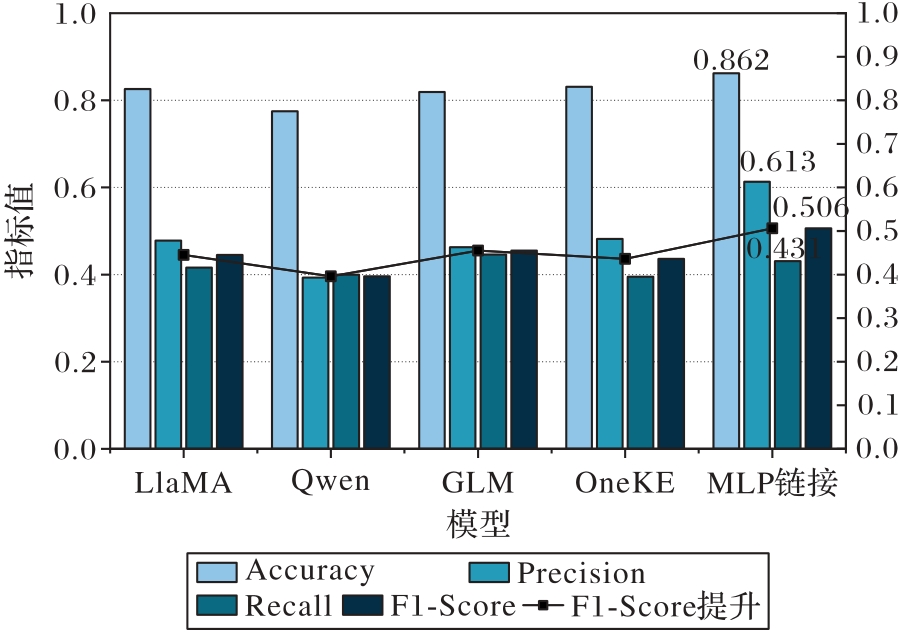
图6 单一预训练LLM与MLP的链接性能对比
Fig. 6 Comparison of linking performance of single pre-trained LLMs and MLP
| 模型 | 准确率 | 精确率 | 召回率 | F1分数 | ||||||||
|---|---|---|---|---|---|---|---|---|---|---|---|---|
| 微调前 | 微调后 | 提升 | 微调前 | 微调后 | 提升 | 微调前 | 微调后 | 提升/% | 微调前 | 微调后 | 提升 | |
| LlaMA-3.1-8B | 82.6 | 96.0 | 16.2 | 47.8 | 88.1 | 84.3 | 41.6 | 87.9 | 111.3 | 44.5 | 88.0 | 97.8 |
| Qwen2.5-7B | 77.5 | 96.3 | 39.3 | 87.8 | 40.0 | 89.4 | 39.6 | 88.7 | ||||
| GLM4-9B | 81.9 | 95.7 | 16.9 | 46.3 | 87.0 | 87.9 | 44.6 | 86.6 | 94.2 | 45.5 | 86.8 | 90.8 |
| OneKE | 83.1 | 95.9 | 15.4 | 48.2 | 88.0 | 82.6 | 39.5 | 87.2 | 120.8 | 43.6 | 87.6 | 100.9 |
表5 LoRA微调带来的性能增长 (%)
Tab. 5 Performance improvement brought by LoRA fine-tuning
| 模型 | 准确率 | 精确率 | 召回率 | F1分数 | ||||||||
|---|---|---|---|---|---|---|---|---|---|---|---|---|
| 微调前 | 微调后 | 提升 | 微调前 | 微调后 | 提升 | 微调前 | 微调后 | 提升/% | 微调前 | 微调后 | 提升 | |
| LlaMA-3.1-8B | 82.6 | 96.0 | 16.2 | 47.8 | 88.1 | 84.3 | 41.6 | 87.9 | 111.3 | 44.5 | 88.0 | 97.8 |
| Qwen2.5-7B | 77.5 | 96.3 | 39.3 | 87.8 | 40.0 | 89.4 | 39.6 | 88.7 | ||||
| GLM4-9B | 81.9 | 95.7 | 16.9 | 46.3 | 87.0 | 87.9 | 44.6 | 86.6 | 94.2 | 45.5 | 86.8 | 90.8 |
| OneKE | 83.1 | 95.9 | 15.4 | 48.2 | 88.0 | 82.6 | 39.5 | 87.2 | 120.8 | 43.6 | 87.6 | 100.9 |
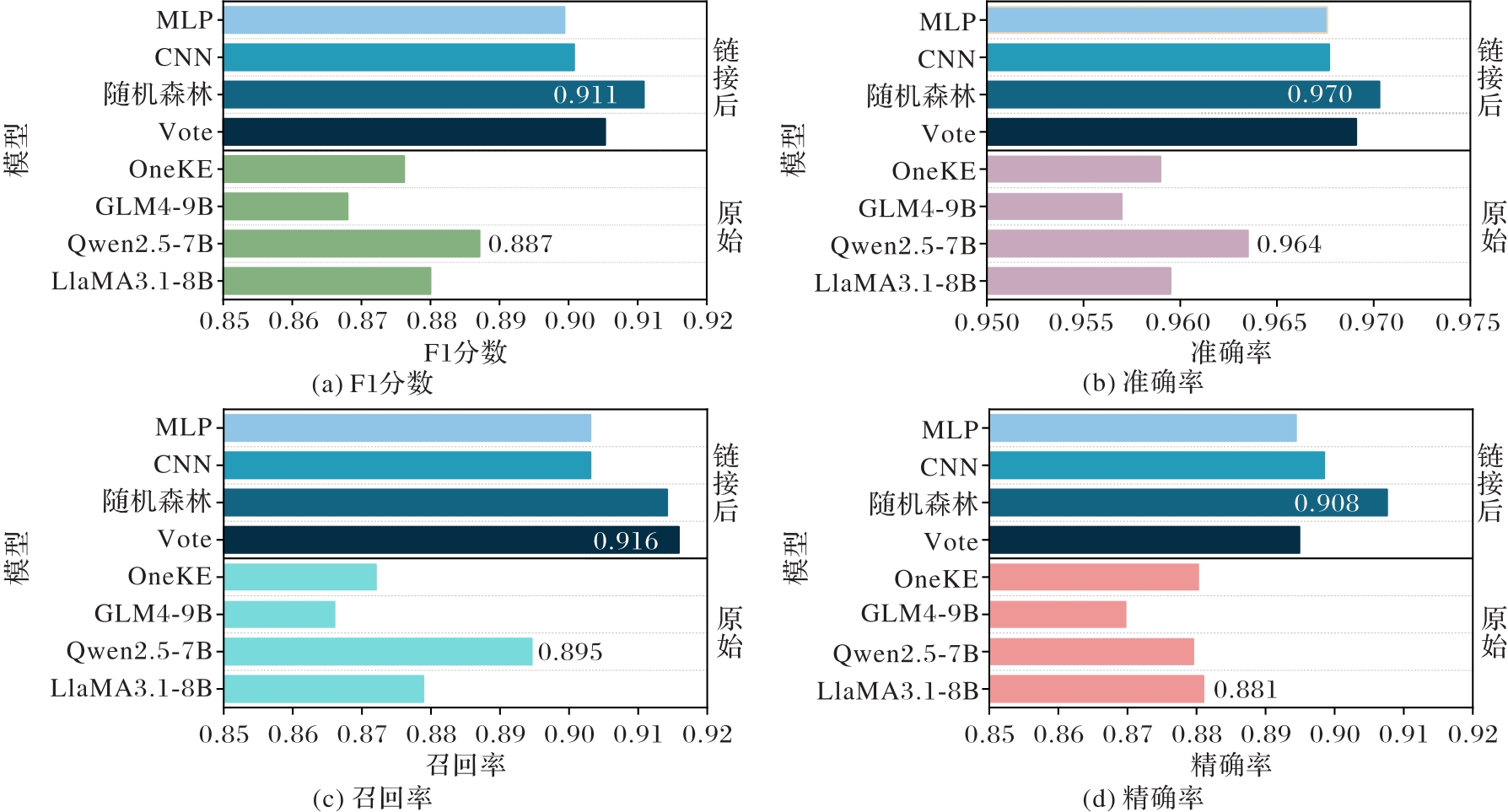
图7 微调模型链接前后的性能对比
Fig. 7 Performance comparison before and after fine-tuning model linking
| 方法 | 精确率 | 召回率 | F1分数 |
|---|---|---|---|
| BERT | 77.2 | 82.2 | 79.6 |
| CRF | 82.1 | 78.0 | 80.0 |
| TiKG | 74.1 | 76.0 | 75.0 |
| BERT-BiLSTM-CRF | 85.2 | 85.0 | 84.6 |
| CNN-BiLSTM-CRF | 76.2 | 76.2 | 76.1 |
| 基于多特征的语义增强网络[ | 86.2 | 84.5 | 85.3 |
| 大语言模型链接(Vote) | 89.5 | 91.6 | 90.5 |
| 大语言模型链接(随机森林) | 90.8 | 91.4 | 91.1 |
表6 LLM链接方法与现有方法的性能对比 (%)
Tab. 6 Performance comparison of LLM linking methods and existing models
| 方法 | 精确率 | 召回率 | F1分数 |
|---|---|---|---|
| BERT | 77.2 | 82.2 | 79.6 |
| CRF | 82.1 | 78.0 | 80.0 |
| TiKG | 74.1 | 76.0 | 75.0 |
| BERT-BiLSTM-CRF | 85.2 | 85.0 | 84.6 |
| CNN-BiLSTM-CRF | 76.2 | 76.2 | 76.1 |
| 基于多特征的语义增强网络[ | 86.2 | 84.5 | 85.3 |
| 大语言模型链接(Vote) | 89.5 | 91.6 | 90.5 |
| 大语言模型链接(随机森林) | 90.8 | 91.4 | 91.1 |
| [1] | Zhou Y, Tang Y, Yi M, et al. CTI View: APT threat intelligence analysis system [J]. Security and Communication Networks, 2022, 2022: No.9875199. |
| [2] | Qin Y, Shen G W, Zhao W B, et al. A network security entity recognition method based on feature template and CNN-BiLSTM-CRF [J]. Frontiers of Information Technology and Electronic Engineering, 2019, 20(6): 872-884. |
| [3] | Sarhan I, Spruit M. Open-CyKG: an open cyber threat intelligence knowledge graph [J]. Knowledge-Based Systems, 2021, 233: No.107524. |
| [4] | Wang G, Liu P, Huang J, et al. KnowCTI: knowledge-based cyber threat intelligence entity and relation extraction [J]. Computers and Security, 2024, 141: No.103824. |
| [5] | Dasgupta S, Piplai A, Kotal A, et al. A comparative study of deep learning based named entity recognition algorithms for cybersecurity [C]// IEEE BigData 2020. Piscataway: IEEE, 2020: 2596-2604. |
| [6] | 秦娅,申国伟,赵文波,等.基于深度神经网络的网络安全实体识别方法[J].南京大学学报(自然科学), 2019, 55(1): 29-40. |
| Qin Ya, Shen Guowei, Zhao Wenbo, et al. Research on the method of network security entity recognition based on deep neural network [J]. Journal of Nanjing University (Natural Science), 2019, 55(1): 29-40. | |
| [7] | Zhao W X, Zhou K, Li J, et al. A survey of large language models [J]. Frontiers of Computer Science, 2026, 20(12): No.2012627. |
| [8] | 秦小林,古徐,李弟诚,等.大语言模型综述与展望[J].计算机应用, 2025, 45(3): 685-696. |
| Qin Xiaolin, Gu Xu, Li Dicheng, et al. Survey and prospect of large language models [J]. Journal of Computer Applications, 2025, 45(3): 685-696. | |
| [9] | Hu E J, Shen Y, Wallis P, et al. LoRA: low-rank adaptation of large language models [PP/OL]. V2. arXiv (2021-10-16) [2025-06-20]. . |
| [10] | Mirzadeh I, Alizadeh K, Shahrokhi H, et al. GSM-Symbolic: understanding the limitations of mathematical reasoning in large language models [PP/OL]. arXiv (2024-10-07) [2025-08-17]. . |
| [11] | Zhang Z, Zhao Y, Gao H, et al. LinkNER: linking local named entity recognition models to large language models using uncertainty [C]// TheWebConf 2024. New York: ACM, 2024: 4047-4058. |
| [12] | Jia Y, Qi Y, Shang H, et al. A practical approach to constructing a knowledge graph for cybersecurity [J]. Engineering, 2018, 4(1): 53-60. |
| [13] | Fang Y, Zhang Y, Huang C. CyberEyes: cybersecurity entity recognition model based on graph convolutional network [J]. The Computer Journal, 2020, 64(8): 1215-1225. |
| [14] | Mouiche I, Saad S. Entity and relation extractions for threat intelligence knowledge graphs [J]. Computers and Security, 2025, 148: No.104120. |
| [15] | OpenAI. GPT-4 technical report [PP/OL]. V6. arXiv (2024-03-04) [2025-05-17]. . |
| [16] | Liu J, Zhan J. Constructing knowledge graph from cyber threat intelligence using large language model [C]// IEEE BigData 2023. Piscataway: IEEE, 2023: 516-521. |
| [17] | Hu Y, Zou F, Han J, et al. LLM-TIKG: threat intelligence knowledge graph construction utilizing large language model [J]. Computers and Security, 2024, 145: No.103999. |
| [18] | Dietterich T G. Ensemble methods in machine learning [C]// MCS 2000. Berlin: Springer, 2000: 1-15. |
| [19] | Chen T, Guestrin C. XGBoost: a scalable tree boosting system [C]// KDD 2016. New York: ACM, 2016: 785-794. |
| [20] | Wolpert D H. Stacked generalization [J]. Neural Networks, 1992, 5(2): 241-259. |
| [21] | Ho T K. The random subspace method for constructing decision forests [J]. IEEE Transactions on Pattern Analysis and Machine Intelligence, 1998, 20(8): 832-844. |
| [22] | da Silva R A, de Paula Canuto A M, da Silveira Barreto C A, et al. Automatic recommendation method for classifier ensemble structure using meta-learning [J]. IEEE Access, 2021, 9: 106254-106268. |
| [23] | Yoon T, Kang D. Multi-modal stacking ensemble for the diagnosis of cardiovascular diseases [J]. Journal of Personalized Medicine, 2023, 13(2): No.373. |
| [24] | Akyol K. Stacking ensemble based deep neural networks modeling for effective epileptic seizure detection [J]. Expert Systems with Applications, 2020, 148: No.113239. |
| [25] | Kumar M, Singhal S, Shekhar S, et al. Optimized stacking ensemble learning model for breast cancer detection and classification using machine learning [J]. Sustainability, 2022, 14(21): No.13998. |
| [26] | Team Llama. The Llama 3 herd of models [PP/OL]. V3. arXiv (2024-11-23) [2025-06-10]. . |
| [27] | Team Qwen. Qwen2.5 technical report [PP/OL]. V2. arXiv (2025-01-03) [2025-05-15]. . |
| [28] | Zhang J, Bai Y, Lv X, et al. LongCite: enabling LLMs to generate fine-grained citations in long-context QA [C]// ACL 2025. Stroudsburg: ACL, 2025: 5098-5122. |
| [29] | Luo Y, Ru X, Liu K, et al. OneKE: a dockerized schema-guided LLM agent-based knowledge extraction system [C]// TheWebConf 2025. New York: ACM, 2025: 2871-2874. |
| [30] | 张岐龙,单甘霖,段修生,等.基于特征空间中类别可分性判据的特征选择[J].火力与指挥控制, 2010, 35(6): 118-120. |
| Zhang Qilong, Shan Ganlin, Duan Xiusheng, et al. Feature selection based on separability in feature space [J]. Fire Control and Command Control, 2010, 35(6): 118-120. | |
| [31] | Breiman L. Random forests [J]. Machine Learning, 2001, 45(1): 5-32. |
| [32] | Taud H, Mas J F. MultiLayer Perceptron (MLP) [M]// Camacho Olmedo M T, Paegelow M, Mas J F, et al. Geomatic approaches for modeling land change scenarios, LNGC. Cham: Springer, 2018: 451-455. |
| [33] | LeCun Y, Bottou L, Bengio Y, et al. Gradient-based learning applied to document recognition [J]. Proceedings of the IEEE, 1998, 86(11): 2278-2324. |
| [34] | Wang X, Liu X, Ao S, et al. DNRTI: a large-scale dataset for named entity recognition in threat intelligence [C]// TrustCom 2020. Piscataway: IEEE, 2020: 1842-1848. |
| [35] | Devlin J, Chang M W, Lee K, et al. BERT: pre-training of deep bidirectional Transformers for language understanding [C]// NAACL-HLT 2019. Stroudsburg: ACL, 2019: 4171-4186. |
| [36] | Lafferty J D, McCallum A, Pereira F C N. Conditional random fields: probabilistic models for segmenting and labeling sequence data [C]// ICML 2001. San Francisco: Morgan Kaufmann Publishers Inc., 2001: 282-289. |
| [37] | Ma X, Hovy E. End-to-end sequence labeling via bi-directional LSTM-CNNs-CRF [C]// ACL 2016. Stroudsburg: ACL, 2016: 1064-1074. |
| [38] | 谢腾,杨俊安,刘辉.基于BERT-BiLSTM-CRF模型的中文实体识别[J].计算机系统应用, 2020, 29(7): 48-55. |
| Xie Teng, Yang Jun'an, Liu Hui. Chinese entity recognition based on BERT-BiLSTM-CRF model [J]. Computer Systems and Applications, 2020, 29(7): 48-55. | |
| [39] | Liu P, Li H, Wang Z, et al. Multi-features based semantic augmentation networks for named entity recognition in threat intelligence [C]// ICPR 2022. Piscataway: IEEE, 2022: 1557-1563. |
| [1] | 李佳航, 韩启龙, 李丽洁, 张慧. 基于大语言模型的超关系知识图谱限定符增强方法[J]. 《计算机应用》唯一官方网站, 2026, 46(7): 2043-2053. |
| [2] | 王昱麒, 张仰森, 王璞. 融合知识增强和对比学习的高中英语阅读理解模型[J]. 《计算机应用》唯一官方网站, 2026, 46(7): 2096-2103. |
| [3] | 程雅典, 李颖颖, 张平, 邱芳冰, 柴晓楠, 舒玉巧. 基于双角色交互机制的心理健康大语言模型[J]. 《计算机应用》唯一官方网站, 2026, 46(7): 2054-2063. |
| [4] | 朱林凯, 杨璐, 张弘杰, 吴子衿, 刘璐. LLM与SWRL驱动的跨境数据合规异构跨链智能合约生成框架[J]. 《计算机应用》唯一官方网站, 2026, 46(7): 2074-2084. |
| [5] | 王劲滔, 高志霖, 孟琪翔, 卜凡亮. 基于大语言模型重构案件信息的类案检索方法[J]. 《计算机应用》唯一官方网站, 2026, 46(6): 1785-1792. |
| [6] | 易宇声, 黄兆豪, 邓梓昊, 孔蕾蕾, 齐浩亮. 面向信创数据库迁移的多知识库协同大语言模型提示框架CORER[J]. 《计算机应用》唯一官方网站, 2026, 46(6): 1811-1817. |
| [7] | 蔡泰鑫, 魏凤凤. 面向多解旅行商问题的大语言模型增强蚁群优化算法[J]. 《计算机应用》唯一官方网站, 2026, 46(6): 1712-1720. |
| [8] | 熊龙雨, 杜圣东, 史浩琛, 胡节, 杨燕, 李天瑞. 基于知识增强大语言模型架构的政务热线问答系统[J]. 《计算机应用》唯一官方网站, 2026, 46(6): 1721-1727. |
| [9] | 郑嘉丽, 周刚, 陈静, 李顺航. 基于多特征自适应融合的智能生成文本检测方法[J]. 《计算机应用》唯一官方网站, 2026, 46(5): 1433-1440. |
| [10] | 王倩飞, 李旸, 李德玉, 王素格. 基于大语言模型的双通道特征融合表示的短文本聚类方法[J]. 《计算机应用》唯一官方网站, 2026, 46(5): 1441-1449. |
| [11] | 盛兴, 翁孙贤, 陈扩松, 王忠平, 任芮锋, 刘勇. 基于深度学习的电网企业专利价值评估[J]. 《计算机应用》唯一官方网站, 2026, 46(5): 1468-1474. |
| [12] | 王晓宇, 李欣, 薛迪, 蒋章涛, 王威, 肖岩军. 基于大语言模型的视频监控网络安全漏洞分类框架[J]. 《计算机应用》唯一官方网站, 2026, 46(4): 1158-1170. |
| [13] | 师凯洲, 何旋, 候国义, 李根, 李泷杲, 黄翔. 基于大语言模型的机载产品计量溯源知识图谱构建方法[J]. 《计算机应用》唯一官方网站, 2026, 46(4): 1086-1095. |
| [14] | 陈浩轩, 叶培昌, 刘磊, 刘承明, 胡文华. 自动代码编辑推荐综述[J]. 《计算机应用》唯一官方网站, 2026, 46(4): 1227-1237. |
| [15] | 王日龙, 李振平, 李晓松, 高强, 何亚, 钟勇, 赵英潇. 多Agent协作的知识推理框架[J]. 《计算机应用》唯一官方网站, 2026, 46(3): 708-714. |
| 阅读次数 | ||||||
|
全文 |
|
|||||
|
摘要 |
|
|||||
