


《计算机应用》唯一官方网站 ›› 2026, Vol. 46 ›› Issue (10): 3124-3132.DOI: 10.11772/j.issn.1001-9081.2025080935
• 人工智能 • 上一篇
王政, 倪佳慧, 张凡龙( )
收稿日期:2025-08-15
修回日期:2025-09-18
接受日期:2025-09-24
发布日期:2026-10-21
出版日期:2026-10-10
通讯作者:
张凡龙
作者简介:王政(2000—),男,江苏连云港人,硕士研究生,主要研究方向:情感计算、信号处理基金资助:
Zheng WANG, Jiahui NI, Fanlong ZHANG()
Received:2025-08-15
Revised:2025-09-18
Accepted:2025-09-24
Online:2026-10-21
Published:2026-10-10
Contact:
Fanlong ZHANG
About author:WANG Zheng, born in 2000, M. S. candidate. His research interests include affective computing, signal processing.Supported by:摘要:
针对传统卷积神经网络(CNN)在语音情感识别(SER)中因感受野受限而难以捕获全局情感信息,以及全局自注意力机制在移动端等资源受限设备上计算开销过大的问题,提出一种适用于边缘部署的轻量级、高精度的SER模型——基于二值多尺度特征表示的全局感知融合网络(GAF-BMFR)。该网络以二值神经网络(BNN)为骨架以降低模型复杂度,核心部分包括:设计二值多尺度模块(BMSB),通过并行的3×3与5×5二值卷积同步提取时频域的细粒度与宽视野特征;引入轻量级的全局感知模块(GAB),利用全连接层与1×1卷积替代高成本的自注意力机制,实现跨尺度特征的全局关联建模与自适应选择。此外,设计类均衡焦点?对数边距?多尺度二值正则化(CB-FLM-MSR)联合损失函数,缓解类别不平衡与情感边界模糊等问题。在公开数据集上的实验结果表明,GAF-BMFR的性能优越且资源消耗低。以IEMOCAP数据集的剧本部分为例,与典型的注意力池化卷积神经网络(APCNN)模型相比,GAF-BMFR的加权准确率(WA)提升了25.23个百分点,未加权准确率(UA)提升了24.18个百分点;同时,GAF-BMFR的参数量相较于它的全精度版本显著降低了约24.04%。可见,GAF-BMFR在显著降低参数量与计算开销的同时,有效提升了SER的准确率与鲁棒性,为在资源受限场景下部署高效的情感计算应用提供了一个可行的轻量级解决方案。
中图分类号:
王政, 倪佳慧, 张凡龙. 全局感知融合二值多尺度特征的语音情感识别[J]. 计算机应用, 2026, 46(10): 3124-3132.
Zheng WANG, Jiahui NI, Fanlong ZHANG. Speech emotion recognition with global-aware fusing binary multi-scale features[J]. Journal of Computer Applications, 2026, 46(10): 3124-3132.

图1 MFCC参数提取流程
Fig. 1 MFCC parameter extraction flow
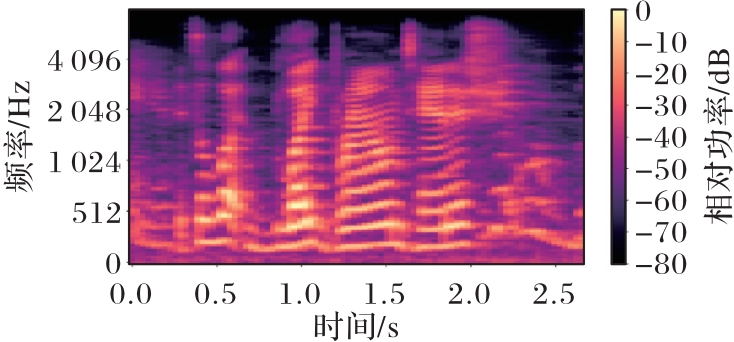
图2 MFCC频谱图
Fig. 2 MFCC spectrogram
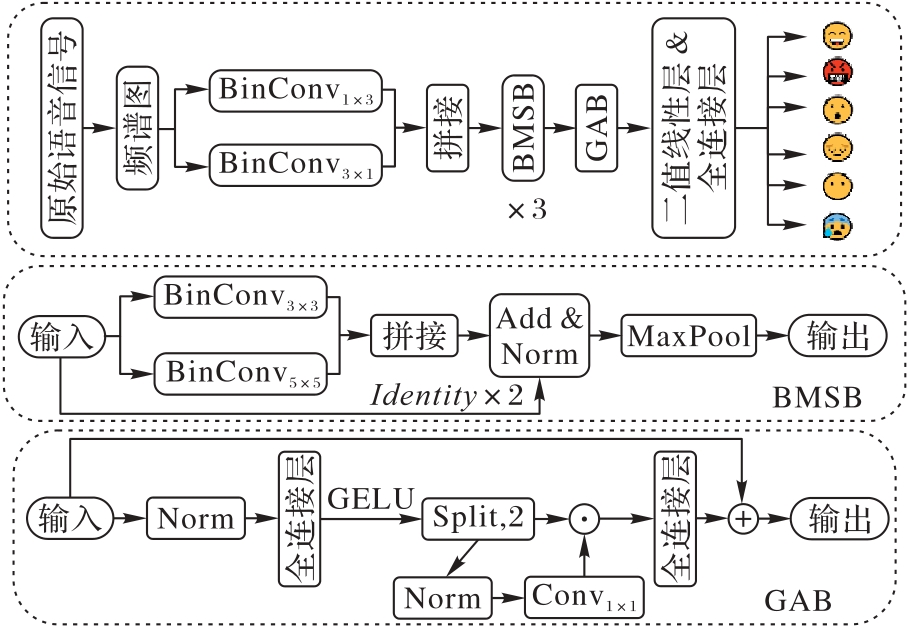
图3 GAF-BMFR模型的架构
Fig. 3 GAF-BMFR model architecture
| 模型 | Param | Te.Time/s |
|---|---|---|
| APCNN | 930 573 | 6.24 |
| MHCNN | 855 636 | 6.06 |
| AACNN | 823 908 | |
| GAPCNN | 808 372 | 6.00 |
| GAPMHCNN | 5.59 | |
| MHAACNN | 892 996 | 5.53 |
| 全精度模型 | 904 078 | 6.80 |
| GAF-BMFR | 686 756 | 3.76 |
表1 不同模型在即兴部分上的性能对比
Tab. 1 Performance comparison of different models in improvisational part
| 模型 | Param | Te.Time/s |
|---|---|---|
| APCNN | 930 573 | 6.24 |
| MHCNN | 855 636 | 6.06 |
| AACNN | 823 908 | |
| GAPCNN | 808 372 | 6.00 |
| GAPMHCNN | 5.59 | |
| MHAACNN | 892 996 | 5.53 |
| 全精度模型 | 904 078 | 6.80 |
| GAF-BMFR | 686 756 | 3.76 |
| 模型 | 即兴部分 | 剧本部分 | 完整部分 | |||||||||
|---|---|---|---|---|---|---|---|---|---|---|---|---|
| WA | UA | Macro-F1 | Weighted-F1 | WA | UA | Macro-F1 | Weighted-F1 | WA | UA | Macro-F1 | Weighted-F1 | |
| APCNN | 77.75 | 73.89 | 74.61 | 76.12 | 55.67 | 54.76 | 51.89 | 51.21 | 62.31 | 62.87 | 61.89 | 62.12 |
| MHCNN | 77.55 | 73.01 | 72.80 | 72.45 | 64.82 | 63.64 | 62.46 | 62.96 | 68.98 | 70.11 | 69.65 | 69.56 |
| AACNN | 76.95 | 75.32 | 72.79 | 75.20 | 67.38 | 65.98 | 65.32 | 68.72 | 71.23 | 73.58 | 72.56 | 70.71 |
| GAPCNN | 76.12 | 75.03 | 75.87 | 76.70 | 66.82 | 65.04 | 64.85 | 67.73 | 69.75 | 68.39 | 68.65 | 69.91 |
| GAPMHCNN | 77.15 | 76.88 | 77.23 | 68.05 | 66.32 | 66.08 | 69.48 | 70.16 | 69.81 | 68.74 | 70.68 | |
| MHAACNN | 76.48 | 75.03 | 75.29 | 76.01 | 67.46 | 65.61 | 65.41 | 68.71 | 68.71 | 67.94 | 68.09 | 70.43 |
| 全精度模型 | 79.21 | 78.65 | 80.37 | 74.17 | ||||||||
| GAF-BMFR | 80.19 | 80.90 | 78.94 | 79.43 | 80.68 | 76.42 | 77.35 | 75.14 | ||||
表2 不同模型在IEMOCAP数据集上的性能比较 (%)
Tab. 2 Performance comparison of different models on IEMOCAP dataset
| 模型 | 即兴部分 | 剧本部分 | 完整部分 | |||||||||
|---|---|---|---|---|---|---|---|---|---|---|---|---|
| WA | UA | Macro-F1 | Weighted-F1 | WA | UA | Macro-F1 | Weighted-F1 | WA | UA | Macro-F1 | Weighted-F1 | |
| APCNN | 77.75 | 73.89 | 74.61 | 76.12 | 55.67 | 54.76 | 51.89 | 51.21 | 62.31 | 62.87 | 61.89 | 62.12 |
| MHCNN | 77.55 | 73.01 | 72.80 | 72.45 | 64.82 | 63.64 | 62.46 | 62.96 | 68.98 | 70.11 | 69.65 | 69.56 |
| AACNN | 76.95 | 75.32 | 72.79 | 75.20 | 67.38 | 65.98 | 65.32 | 68.72 | 71.23 | 73.58 | 72.56 | 70.71 |
| GAPCNN | 76.12 | 75.03 | 75.87 | 76.70 | 66.82 | 65.04 | 64.85 | 67.73 | 69.75 | 68.39 | 68.65 | 69.91 |
| GAPMHCNN | 77.15 | 76.88 | 77.23 | 68.05 | 66.32 | 66.08 | 69.48 | 70.16 | 69.81 | 68.74 | 70.68 | |
| MHAACNN | 76.48 | 75.03 | 75.29 | 76.01 | 67.46 | 65.61 | 65.41 | 68.71 | 68.71 | 67.94 | 68.09 | 70.43 |
| 全精度模型 | 79.21 | 78.65 | 80.37 | 74.17 | ||||||||
| GAF-BMFR | 80.19 | 80.90 | 78.94 | 79.43 | 80.68 | 76.42 | 77.35 | 75.14 | ||||
| 模型 | WA | UA | Macro-F1 | Weighted-F1 |
|---|---|---|---|---|
| APCNN | 71.36 | 69.21 | 70.51 | 71.17 |
| MHCNN | 70.13 | 62.82 | 60.88 | 67.06 |
| AACNN | 72.65 | 69.50 | 68.17 | 69.58 |
| GAPCNN | 67.83 | 61.35 | 61.19 | 65.45 |
| GAPMHCNN | 73.61 | 67.87 | 68.03 | 72.31 |
| MHAACNN | 71.57 | 69.37 | 69.94 | 71.25 |
| 全精度模型 | 76.28 | 73.82 | ||
| GAF-BMFR | 77.19 | 76.41 |
表3 不同模型在RAVDESS数据集上的性能比较 (%)
Tab. 3 Performance comparison of different models on RAVDESS dataset
| 模型 | WA | UA | Macro-F1 | Weighted-F1 |
|---|---|---|---|---|
| APCNN | 71.36 | 69.21 | 70.51 | 71.17 |
| MHCNN | 70.13 | 62.82 | 60.88 | 67.06 |
| AACNN | 72.65 | 69.50 | 68.17 | 69.58 |
| GAPCNN | 67.83 | 61.35 | 61.19 | 65.45 |
| GAPMHCNN | 73.61 | 67.87 | 68.03 | 72.31 |
| MHAACNN | 71.57 | 69.37 | 69.94 | 71.25 |
| 全精度模型 | 76.28 | 73.82 | ||
| GAF-BMFR | 77.19 | 76.41 |
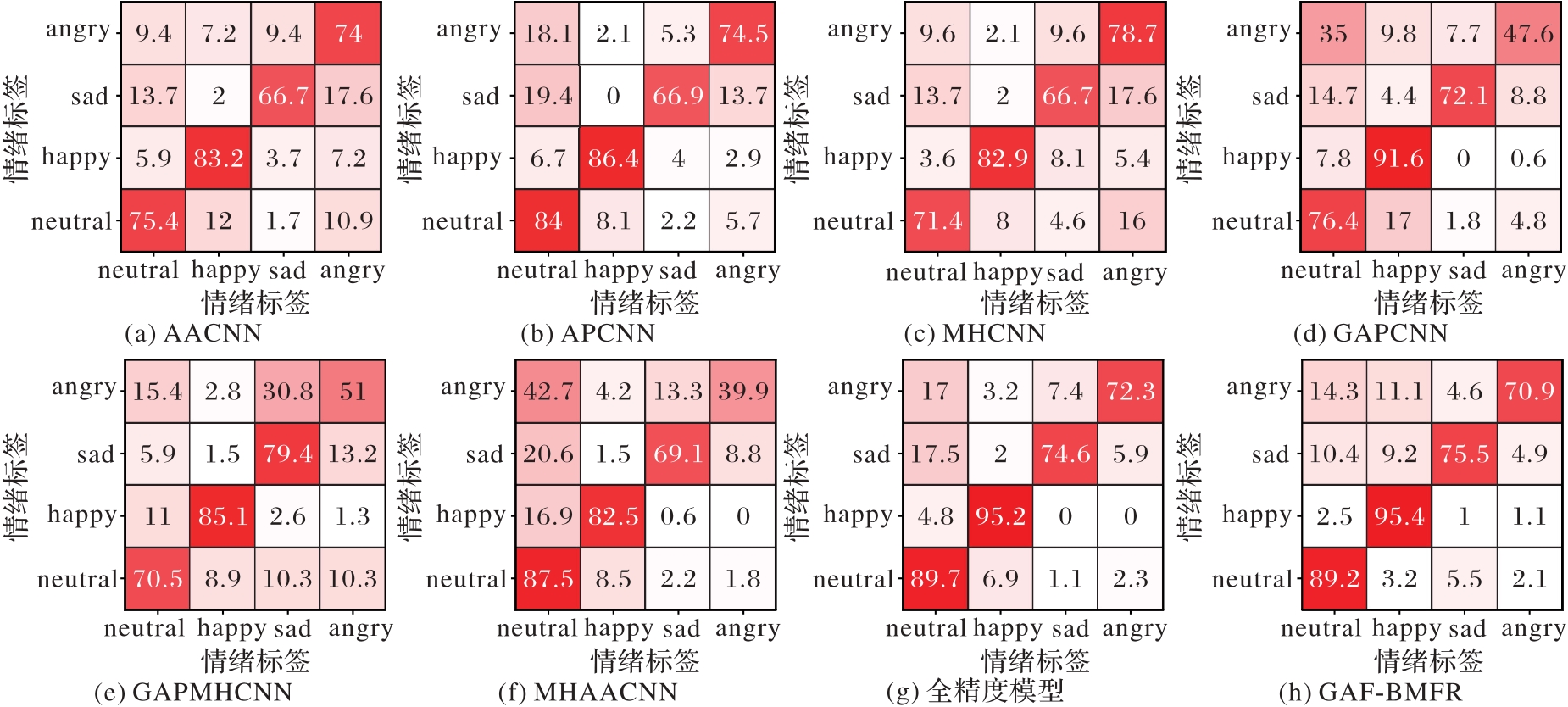
图4 混淆矩阵
Fig. 4 Confusion matrices
| 模型 | WA | UA | Macro-F1 | Weighted-F1 |
|---|---|---|---|---|
| 完整模型 | 80.90 | 78.94 | 79.43 | 80.68 |
| 去除GAB | 77.08 | 75.08 | 75.54 | 76.77 |
| 去除1层BMSB | 78.63 | 76.53 | 77.01 | 77.46 |
| 去除2层BMSB | 75.43 | 72.93 | 73.46 | 75.33 |
| 完全去除BMSB | 73.98 | 70.43 | 71.43 | 72.93 |
表4 消融实验结果 (%)
Tab. 4 Ablation experimental results
| 模型 | WA | UA | Macro-F1 | Weighted-F1 |
|---|---|---|---|---|
| 完整模型 | 80.90 | 78.94 | 79.43 | 80.68 |
| 去除GAB | 77.08 | 75.08 | 75.54 | 76.77 |
| 去除1层BMSB | 78.63 | 76.53 | 77.01 | 77.46 |
| 去除2层BMSB | 75.43 | 72.93 | 73.46 | 75.33 |
| 完全去除BMSB | 73.98 | 70.43 | 71.43 | 72.93 |
| 模型 | 单样本端到端延迟/ms | RTF | 内存使用/MB | 参数量/106 | GFLOPs | BOPs/ | WA/% | UA/% |
|---|---|---|---|---|---|---|---|---|
| GAF-BMFR | 74.11 | 0.047 | 656.10 | 0.686 | 0.328 | 80.1 | 80.5 | |
| 全精度模型 | 130.21 | 0.205 | 813.12 | 0.904 | 0.563 | 0.000 | ||
| APCNN | 127.74 | 0.931 | 0.000 | 63.8 | 65.0 | |||
| MHCNN | 0.160 | 750.08 | 0.856 | 0.682 | 0.000 | 64.8 | 62.0 | |
| AACNN | 129.46 | 0.195 | 760.32 | 0.572 | 0.000 | 72.5 | 73.2 |
表5 仿真实验结果
Tab.5 Simulation experimental results
| 模型 | 单样本端到端延迟/ms | RTF | 内存使用/MB | 参数量/106 | GFLOPs | BOPs/ | WA/% | UA/% |
|---|---|---|---|---|---|---|---|---|
| GAF-BMFR | 74.11 | 0.047 | 656.10 | 0.686 | 0.328 | 80.1 | 80.5 | |
| 全精度模型 | 130.21 | 0.205 | 813.12 | 0.904 | 0.563 | 0.000 | ||
| APCNN | 127.74 | 0.931 | 0.000 | 63.8 | 65.0 | |||
| MHCNN | 0.160 | 750.08 | 0.856 | 0.682 | 0.000 | 64.8 | 62.0 | |
| AACNN | 129.46 | 0.195 | 760.32 | 0.572 | 0.000 | 72.5 | 73.2 |
| [1] | 张艳倪,汤敏,王坤赤. 基于深度学习的情感识别研究综述[J]. 计算机时代, 2025(3): 1-5. |
| Zhang Yanni, Tang Min, Wang Kunchi. Review of emotion recognition based on deep learning[J]. Computer Era, 2025(3): 1-5. | |
| [2] | 王琛. 语音中身份与情感信息提取及其在普适计算中的应用[D]. 北京:北京交通大学, 2007. |
| Wang Chen. Speech based identification and emotion information extraction and its application in pervasive computing[D]. Beijing: Beijing Jiaotong University, 2007. | |
| [3] | 罗德虎,冉启武,杨超,等. 语音情感识别研究综述[J]. 计算机工程与应用, 2022, 58(21): 40-52. |
| Luo Dehu, Ran Qiwu, Yang Chao, et al. Review on speech emotion recognition research[J]. Computer Engineering and Applications, 2022, 58(21): 40-52. | |
| [4] | Han K, Yu D, Tashev I. Speech emotion recognition using deep neural network and extreme learning machine[C]// INTERSPEECH 2014. [S.l.]: International Speech Communication Association, 2014: 223-227. |
| [5] | Hu D, Hu X, Xu X. Multiple enhancements to LSTM for learning emotion-salient features in speech emotion recognition[C]// INTERSPEECH 2022. [S.l.]: International Speech Communication Association, 2022: 4720-4724. |
| [6] | Trigeorgis G, Ringeval F, Brueckner R, et al. Adieu features? end-to-end speech emotion recognition using a deep convolutional recurrent network[C]// ICASSP 2016. Piscataway: IEEE, 2016: 5200-5204. |
| [7] | Akkad G, Mansour A, Inaty E. Embedded deep learning accelerators: a survey on recent advances[J]. IEEE Transactions on Artificial Intelligence, 2024, 5(5): 1954-1972. |
| [8] | Lv C, Niu C, Gu R, et al. Walle: an end-to-end, general-purpose, and large-scale production system for device-cloud collaborative machine learning[C]// OSDI 2022. Berkeley: USENIX Association, 2022: 249-265. |
| [9] | 沈学民,承楠,周海波,等. 空天地一体化网络技术:探索与展望[J]. 物联网学报, 2020, 4(3): 3-19. |
| Shen Xueming, Cheng Nan, Zhou Haibo, et al. Air-ground-space integrated network technology: exploration and prospect[J]. Journal of Internet of Things, 2020, 4(3): 3-19. | |
| [10] | Wen L, Li X, Gao L. A transfer convolutional neural network for fault diagnosis based on ResNet-50[J]. Neural Computing and Applications, 2020, 32(10): 6111-6124. |
| [11] | Xia X, Xu C, Nan B. Inception-v3 for flower classification[C]// ICIVC 2017. Piscataway: IEEE, 2017: 783-787. |
| [12] | 张忠民,姜嵛涵. 基于轻量级卷积神经网络的雷达辐射源识别方法[J]. 应用科技, 2025, 52(1): 166-172. |
| Zhang Zhongmin, Jiang Yuhan. Radar radiation source recognition method based on lightweight convolutional neural networks[J]. Applied Science and Technology, 2025, 52(1): 166-172. | |
| [13] | 卢毓东,陈益. “双碳”目标下绿色人工智能技术研究综述[J]. 浙江电力, 2023, 42(10): 45-56. |
| Lu Yudong, Chen Yi. A review of green AI research under carbon peaking and neutrality goals[J]. Zhejiang Electric Power, 2023, 42(10): 45-56. | |
| [14] | 田永林,王雨桐,王建功,等. 视觉Transformer研究的关键问题:现状及展望[J]. 自动化学报, 2022, 48(4): 957-979. |
| Tian Yonglin, Wang Yutong, Wang Jiangong, et al. Key problems and progress of vision Transformers: the state of the art and prospects[J]. Acta Automatica Sinica, 2022, 48(4): 957-979. | |
| [15] | 李翔,张涛,张哲,等. Transformer在计算机视觉领域的研究综述[J]. 计算机工程与应用, 2023, 59(1): 1-14. |
| Li Xiang, Zhang Tao, Zhang Zhe, et al. Survey of Transformer research in computer vision[J]. Computer Engineering and Applications, 2023, 59(1): 1-14. | |
| [16] | 姚庆安,孙旭,冯云丛,等. 融合注意力机制和轻量化的目标检测方法研究[J]. 计算机仿真, 2025, 42(2): 252-258. |
| Yao Qing’an, Sun Xu, Feng Yuncong, et al. Research on fusion of attention mechanism and lightweight object detection method[J]. Computer Simulation, 2025, 42(2): 252-258. | |
| [17] | Xu M, Zhang F, Khan S U. Improve accuracy of speech emotion recognition with attention head fusion[C]// CCWC 2020. Piscataway: IEEE, 2020: 1058-1064. |
| [18] | 韩文静,李海峰,阮华斌,等. 语音情感识别研究进展综述[J]. 软件学报, 2014, 25(1): 37-50. |
| Han Wenjing, Li Haifeng, Ruan Huabin, et al. Review on speech emotion recognition[J]. Journal of Software, 2014, 25(1): 37-50. | |
| [19] | Zhu W, Li X. Speech emotion recognition with global-aware fusion on multi-scale feature representation[C]// ICASSP 2022. Piscataway: IEEE, 2022: 6437-6441. |
| [20] | 肖宇锋. 基于深度学习的语音情感分类器研究[D]. 长沙:湖南大学, 2020. |
| Xiao Yufeng. Research on speech emotion classifier based on deep learning[D]. Changsha: Hunan University, 2020. | |
| [21] | 郑婉璐. 基于领域对抗训练的跨数据库语音情感识别[D]. 南京:东南大学, 2021. |
| Zheng Wanlu. Research on cross corpus speech emotion recognition based on domain adversarial training[D]. Nanjing: Southeast University, 2021. | |
| [22] | 郭佳淇,张继通. 基于MFCC和HMM的语音识别优化方法研究[J]. 电声技术, 2024, 48(10): 83-85. |
| Guo Jiaqi, Zhang Jitong. Research on speech recognition optimization method based on MFCC and HMM[J]. Audio Engineering, 2024, 48(10): 83-85. | |
| [23] | 王原林,孙静,杨宏波,等. 基于改进梅尔频谱倒谱系数和集成决策网络的心音分类算法[J]. 生物医学工程学杂志, 2022, 39(6): 1140-1148. |
| Wang Yuanlin, Sun Jing, Yang Hongbo, et al. Heart sound classification based on improved Mel frequency cepstrum coefficient and integrated decision network method[J]. Journal of Biomedical Engineering, 2022, 39(6): 1140-1148. | |
| [24] | Dutta A, Ashishkumar G, Rama Rao C V. Auditory inspired acoustic model for hybrid ASR system using Gammatone based Gabor filters[C]// ISSPIT 2019. Piscataway: IEEE, 2019: 1-6. |
| [25] | Trirat P, Shin Y, Kang J, et al. Universal time-series representation learning: a survey[PP/OL]. V3. arXiv (2024-08-27) [2025-05-25].. |
| [26] | Wu Q, Lu X, Xue S, et al. SBNN: slimming binarized neural network[J]. Neurocomputing, 2020, 401: 113-122. |
| [27] | Qin H, Zhang M, Ding Y, et al. BiBench: benchmarking and analyzing network binarization[J]. Proceedings of Machine Learning Research, 2023, 202: 28351-28388. |
| [28] | Conti F, Schiavone P D, Benini L. XNOR neural engine: a hardware accelerator IP for 21.6-fJ/op binary neural network inference[J]. IEEE Transactions on Computer-Aided Design of Integrated Circuits and Systems, 2018, 37(11): 2940-2951. |
| [29] | Kim M, Smaragdis P. Bitwise neural networks for efficient single-channel source separation[C]// ICASSP 2018. Piscataway: IEEE, 2018: 701-705. |
| [30] | Busso C, Bulut M, Lee C C, et al. IEMOCAP: interactive emotional dyadic motion capture database[J]. Language Resources and Evaluation, 2008, 42(4): 335-359. |
| [31] | Antoniou N, Katsamanis A, Giannakopoulos T, et al. Designing and evaluating speech emotion recognition systems: a reality check case study with IEMOCAP[C]// ICASSP 2023. Piscataway: IEEE, 2023: 1-5. |
| [32] | Livingstone S R, Russo F A. The Ryerson Audio-Visual Database of Emotional Speech and Song (RAVDESS): a dynamic, multimodal set of facial and vocal expressions in North American English[J]. PLoS ONE, 2018, 13(5): No.e0196391. |
| [33] | Li P, Song Y, McLoughlin I, et al. An attention pooling based representation learning method for speech emotion recognition[C]// INTERSPEECH 2018. [S.l.]: International Speech Communication Association, 2018: 3087-3091. |
| [34] | Xu M, Zhang F, Cui X, et al. Speech emotion recognition with multiscale area attention and data augmentation[C]// ICASSP 2021. Piscataway: IEEE, 2021: 6319-6323. |
| [35] | Tang C, Yu W, Sun G, et al. SALMONN: towards generic hearing abilities for large language models[PP/OL]. V2. arXiv (2024-08-08) [2025-05-25].. |
| [1] | 欧宇枫, 王嘉宏. 基于双分支特征提取的印刷电路板小目标缺陷检测方法[J]. 《计算机应用》唯一官方网站, 2026, 46(9): 2977-2986. |
| [2] | 张一心, 蒋林, 李远成, 纪辰. 面向可重构结构的CNN剪枝与量化压缩方法[J]. 《计算机应用》唯一官方网站, 2026, 46(9): 2732-2740. |
| [3] | 陈江彦, 王彦丹, 刘翼虎, 马应龙. 基于协同查询优化的长尾目标检测框架[J]. 《计算机应用》唯一官方网站, 2026, 46(9): 2769-2775. |
| [4] | 李光辉, 屈立成. 基于改进Lite-Mono架构的动态空洞卷积和分层注意力模型[J]. 《计算机应用》唯一官方网站, 2026, 46(8): 2567-2576. |
| [5] | 黄麟, 李英顺, 佟维妍, 张树园, 王子涵. 基于改进实时检测Transformer的遥感图像目标检测算法[J]. 《计算机应用》唯一官方网站, 2026, 46(8): 2652-2659. |
| [6] | 刘凤春, 邵馨莹, 张春英, 王立亚, 任静. 多尺度特征优化的单目深度估计框架FCMdepth[J]. 《计算机应用》唯一官方网站, 2026, 46(8): 2603-2611. |
| [7] | 朱莉, 米路革麻, 朱春强, 徐婉茹, 高靖凯, 屈锦琪. 基于动态卷积分解和多尺度图的短期电力负荷预测模型[J]. 《计算机应用》唯一官方网站, 2026, 46(7): 2334-2346. |
| [8] | 吕超, 马歌谣. 基于冗余特征抑制的轻量级人体姿态估计网络[J]. 《计算机应用》唯一官方网站, 2026, 46(6): 1973-1980. |
| [9] | 吴闵奇, 杨元华, 李航, 胡雅琴, 汤智豪, 梅腾. 基于图Transformer和RT-DETR的轻量化水下小目标检测[J]. 《计算机应用》唯一官方网站, 2026, 46(5): 1586-1595. |
| [10] | 张红瑞, 冯威铭, 杨潞霞, 马永杰. 基于YOLO11改进的水下小目标检测算法CSAF-YOLO[J]. 《计算机应用》唯一官方网站, 2026, 46(5): 1578-1585. |
| [11] | 严心怡, 朱灵龙, 张永宏. 面向复杂交通场景的多尺度实时人车检测方法CDC-DETR[J]. 《计算机应用》唯一官方网站, 2026, 46(4): 1283-1291. |
| [12] | 尹春勇, 张不凡. 基于多尺度的多变量时间序列异常检测模型[J]. 《计算机应用》唯一官方网站, 2026, 46(3): 790-797. |
| [13] | 刘汉卿, 桑国明, 张益嘉. 结合密集多尺度特征融合和特征知识增强Transformer的遥感图像描述模型[J]. 《计算机应用》唯一官方网站, 2026, 46(3): 741-749. |
| [14] | 麦超云, 张洪燚, 秦传波, 曾军英, 王栋. 基于多尺度与空间频率特征的嗜铬细胞瘤图像分割网络[J]. 《计算机应用》唯一官方网站, 2026, 46(1): 280-288. |
| [15] | 郭伟, 王曼婷, 曲海成. 基于多尺度感知的多维空间融合水下图像增强算法[J]. 《计算机应用》唯一官方网站, 2026, 46(1): 224-232. |
| 阅读次数 | ||||||
|
全文 |
|
|||||
|
摘要 |
|
|||||
