


Journal of Computer Applications ›› 2026, Vol. 46 ›› Issue (1): 161-168.DOI: 10.11772/j.issn.1001-9081.2025010006
• Cyber security • Previous Articles Next Articles
Yuan JIA1, Deyu YUAN1,2( ), Yuquan PAN1, Anran WANG1
Received:2025-01-06
Revised:2025-04-07
Accepted:2025-04-08
Online:2026-01-10
Published:2026-01-10
Contact:
Deyu YUAN
About author:JIA Yuan, born in 2001, M. S. candidate. His research interests include model watermarking, network security.Supported by:
贾源1, 袁得嵛1,2(), 潘语泉1, 王安然1
通讯作者:
袁得嵛
作者简介:贾源(2001—),男,山东潍坊人,硕士研究生,主要研究方向:模型水印、网络安全基金资助:CLC Number:
Yuan JIA, Deyu YUAN, Yuquan PAN, Anran WANG. Watermarking method for diffusion model output[J]. Journal of Computer Applications, 2026, 46(1): 161-168.
贾源, 袁得嵛, 潘语泉, 王安然. 面向扩散模型输出的水印方法[J]. 《计算机应用》唯一官方网站, 2026, 46(1): 161-168.
Add to citation manager EndNote|Ris|BibTeX
URL: https://www.joca.cn/EN/10.11772/j.issn.1001-9081.2025010006
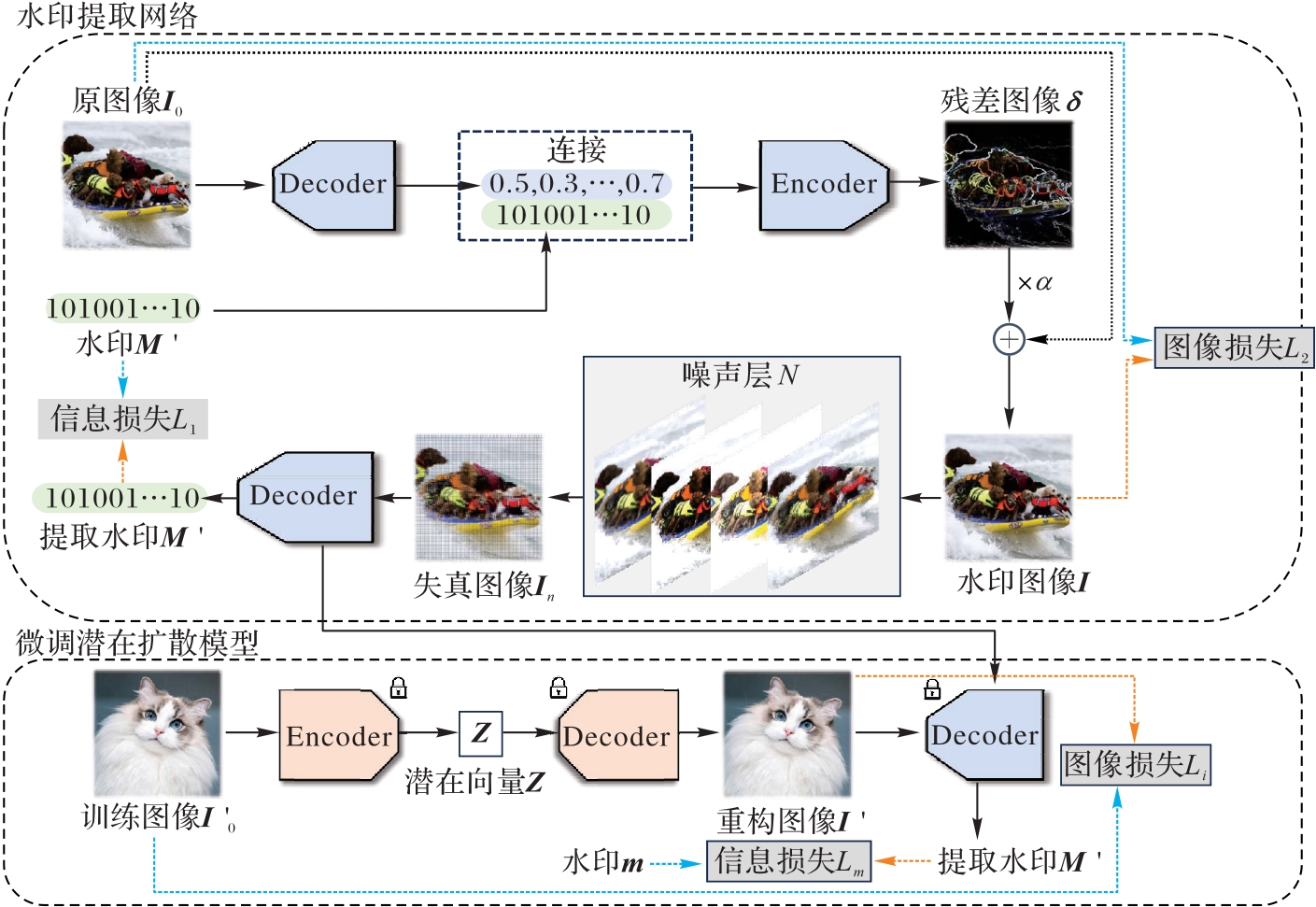
Fig. 1 Framework of DeWM watermarking method for diffusion model output
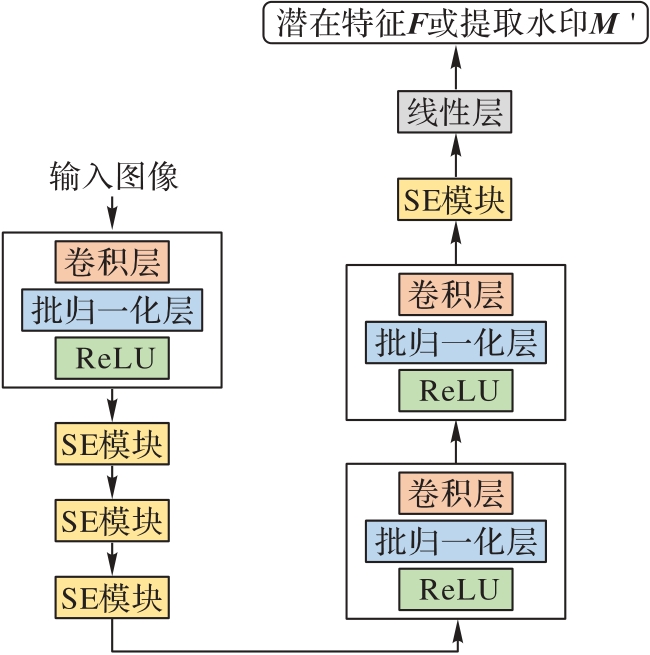
Fig. 2 Structure of decoder
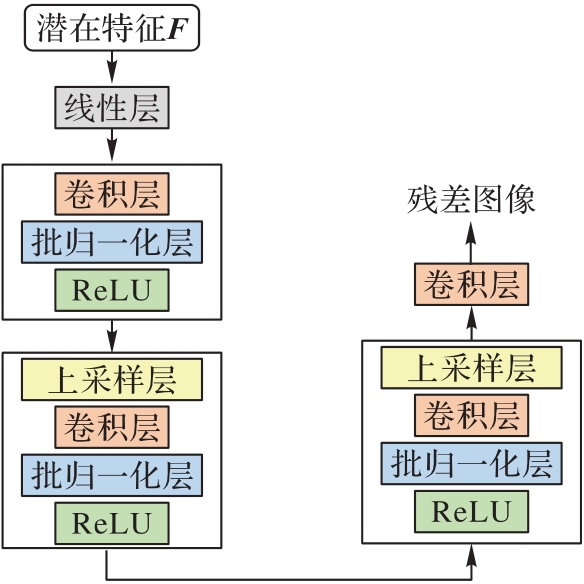
Fig. 3 Structure of encoder
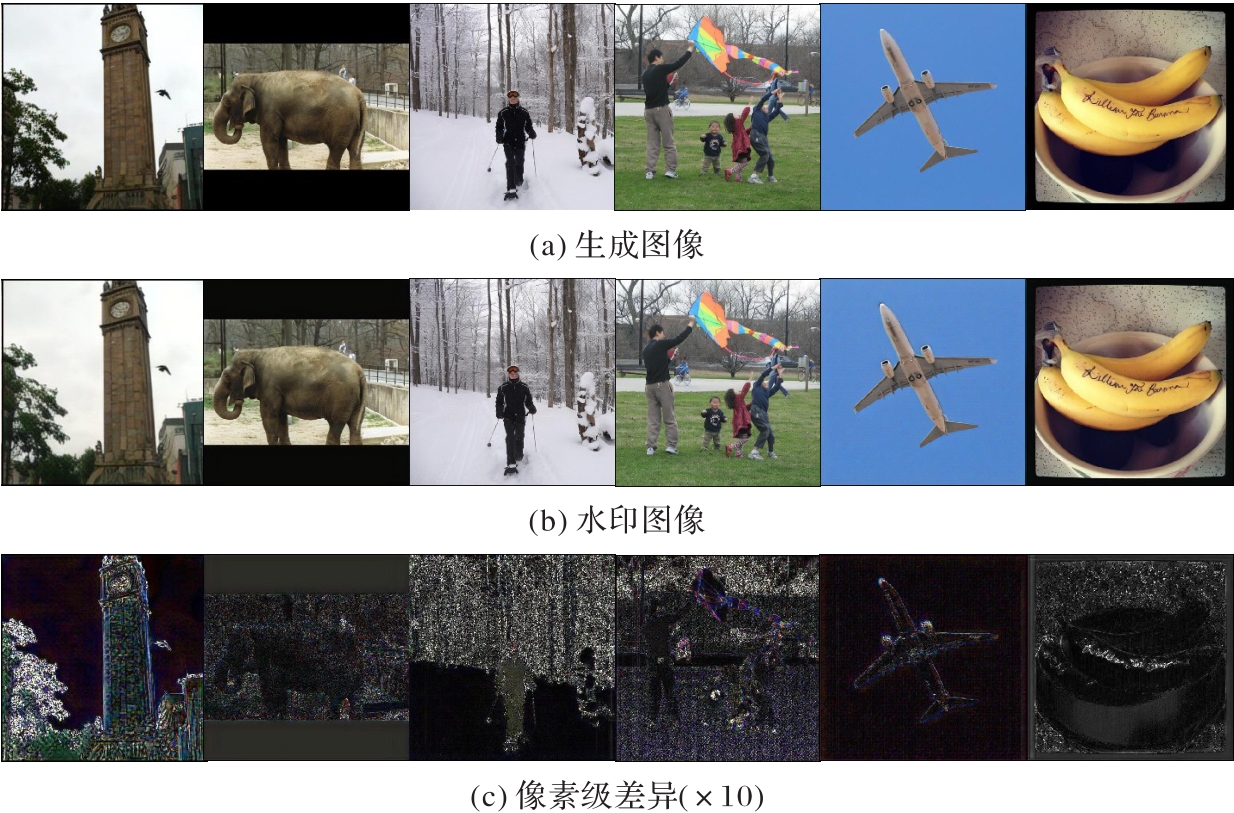
Fig. 4 Comparison of original and watermarked images
| 主动检测方法 | 方法(水印位数) | 图像质量 | 位精度(↑) | |||||||
|---|---|---|---|---|---|---|---|---|---|---|
| PSNR/dB(↑) | SSIM(↑) | FID(↓) | 无变换 | 裁剪 | JPEG压缩 | 亮度调整 | 图像重建 | 组合变换 | ||
| 水印后置嵌入方法 | Dct-Dwt (48)[ | 39.3 | 0.97 | 18.82 | 0.81 | 0.51 | 0.50 | 0.52 | 0.51 | 0.51 |
| SSL (48)[ | 31.5 | 0.86 | 19.68 | 1.00 | 0.85 | 0.96 | 0.93 | 0.63 | 0.86 | |
| FNNS (48)[ | 32.2 | 0.92 | 19.07 | 0.94 | 0.93 | 0.87 | 0.93 | 0.68 | 0.89 | |
| HiDDeN (48)[ | 31.9 | 0.90 | 19.51 | 0.98 | 0.97 | 0.85 | 0.98 | 0.55 | 0.91 | |
| 联合生成方法 | Stable Signature (48)[ | 28.9 | 0.85 | 19.40 | 0.93 | 0.79 | ||||
| LaWa (48)[ | 32.7 | 0.86 | 19.24 | 1.00 | 0.96 | 0.98 | 0.74 | 0.94 | ||
| AquaLoRA (48)[ | 29.6 | 0.92 | 19.77 | 0.95 | 0.91 | 0.93 | 0.86 | 0.90 | ||
| DeWM (64) | 1.00 | 0.97 | 0.93 | 0.98 | 0.94 | |||||
Tab. 1 Comparison of DeWM and baseline methods on image generation quality and watermark robustness
| 主动检测方法 | 方法(水印位数) | 图像质量 | 位精度(↑) | |||||||
|---|---|---|---|---|---|---|---|---|---|---|
| PSNR/dB(↑) | SSIM(↑) | FID(↓) | 无变换 | 裁剪 | JPEG压缩 | 亮度调整 | 图像重建 | 组合变换 | ||
| 水印后置嵌入方法 | Dct-Dwt (48)[ | 39.3 | 0.97 | 18.82 | 0.81 | 0.51 | 0.50 | 0.52 | 0.51 | 0.51 |
| SSL (48)[ | 31.5 | 0.86 | 19.68 | 1.00 | 0.85 | 0.96 | 0.93 | 0.63 | 0.86 | |
| FNNS (48)[ | 32.2 | 0.92 | 19.07 | 0.94 | 0.93 | 0.87 | 0.93 | 0.68 | 0.89 | |
| HiDDeN (48)[ | 31.9 | 0.90 | 19.51 | 0.98 | 0.97 | 0.85 | 0.98 | 0.55 | 0.91 | |
| 联合生成方法 | Stable Signature (48)[ | 28.9 | 0.85 | 19.40 | 0.93 | 0.79 | ||||
| LaWa (48)[ | 32.7 | 0.86 | 19.24 | 1.00 | 0.96 | 0.98 | 0.74 | 0.94 | ||
| AquaLoRA (48)[ | 29.6 | 0.92 | 19.77 | 0.95 | 0.91 | 0.93 | 0.86 | 0.90 | ||
| DeWM (64) | 1.00 | 0.97 | 0.93 | 0.98 | 0.94 | |||||

Fig. 5 Image transformation demonstration

Fig. 6 Robustness of watermark under different image transformations

Fig. 7 Impact of watermark bit length on image quality and robustness
| PSNR/dB | 位精度(组合变换) | |
|---|---|---|
| 1.0 | 34.6 | 0.66 |
| 0.8 | 33.5 | 0.78 |
| 0.6 | 33.2 | 0.94 |
| 0.4 | 31.8 | 0.96 |
| 0.2 | 30.5 | 0.97 |
Tab. 2 Relationship between image quality and robustness under different weights
| PSNR/dB | 位精度(组合变换) | |
|---|---|---|
| 1.0 | 34.6 | 0.66 |
| 0.8 | 33.5 | 0.78 |
| 0.6 | 33.2 | 0.94 |
| 0.4 | 31.8 | 0.96 |
| 0.2 | 30.5 | 0.97 |
| 方法 | PSNR/dB | SSIM | 位精度 | 位精度(组合变换) |
|---|---|---|---|---|
| DeWM | 33.2 | 0.93 | 1.00 | 0.94 |
| w/o de | 30.3 | 0.88 | 0.99 | 0.92 |
| w/o no | 33.6 | 0.94 | 0.98 | 0.59 |
Tab. 3 Results of ablation experiments
| 方法 | PSNR/dB | SSIM | 位精度 | 位精度(组合变换) |
|---|---|---|---|---|
| DeWM | 33.2 | 0.93 | 1.00 | 0.94 |
| w/o de | 30.3 | 0.88 | 0.99 | 0.92 |
| w/o no | 33.6 | 0.94 | 0.98 | 0.59 |
| [1] | BETKER J, GOH G, JING L, et al. Improving image generation with better captions [EB/OL]. [2025-03-26]. . |
| [2] | SAHARIA C, CHAN W, SAXENA S, et al. Photorealistic text-to-image diffusion models with deep language understanding [C]// Proceedings of the 36th International Conference on Neural Information Processing Systems. Red Hook: Curran Associates Inc., 2022: 36479-36494. |
| [3] | ROMBACH R, BLATTMANN A, LORENZ D, et al. High-resolution image synthesis with latent diffusion models [C]// Proceedings of the 2022 IEEE/CVF Conference on Computer Vision and Pattern Recognition. Piscataway: IEEE, 2022: 10674-10685. |
| [4] | BRUNDAGE M, AVIN S, CLARK J, et al. The malicious use of artificial intelligence: forecasting, prevention, and mitigation [EB/OL]. [2025-03-26]. . |
| [5] | NIRKIN Y, WOLF L, KELLER Y, et al. Deepfake detection based on discrepancies between faces and their context [J]. IEEE Transactions on Pattern Analysis and Machine Intelligence, 2022, 44(10): 6111-6121. |
| [6] | GUARNERA L, GIUDICE O, BATTIATO S. DeepFake detection by analyzing convolutional traces [C]// Proceedings of the 2020 IEEE/CVF Conference on Computer Vision and Pattern Recognition Workshops. Piscataway: IEEE, 2020: 2841-2850. |
| [7] | MARRA F, GRAGNANIELLO D, VERDOLIVA L, et al. Do GANs leave artificial fingerprints? [C]// Proceedings of the 2019 IEEE Conference on Multimedia Information Processing and Retrieval. Piscataway: IEEE, 2019: 506-511. |
| [8] | YU N, DAVIS L S, FRITZ M. Attributing fake images to GANs: learning and analyzing GAN fingerprints [C]// Proceedings of the 2019 IEEE/CVF International Conference on Computer Vision. Piscataway: IEEE, 2019: 7555-7565. |
| [9] | FRANK J, EISENHOFER T, SCHÖNHERR L, et al. Leveraging frequency analysis for deep fake image recognition [C]// Proceedings of the 37th International Conference on Machine Learning. New York: JMLR.org, 2020: 3247-3258. |
| [10] | ZHANG X, KARAMAN S, CHANG S F. Detecting and simulating artifacts in GAN fake images [C]// Proceedings of the 2019 IEEE International Workshop on Information Forensics and Security. Piscataway: IEEE, 2019: 1-6. |
| [11] | SEOW J W, LIM M K, PHAN R C W, et al. A comprehensive overview of Deepfake: generation, detection, datasets, and opportunities [J]. Neurocomputing, 2022, 513: 351-371. |
| [12] | ZHAO Y, PANG T, DU C, et al. A recipe for watermarking diffusion models [EB/OL]. [2025-03-26]. . |
| [13] | YU N, SKRIPNIUK V, ABDELNABI S, et al. Artificial fingerprinting for generative models: rooting deepfake attribution in training data [C]// Proceedings of the 2021 IEEE/CVF International Conference on Computer Vision. Piscataway: IEEE, 2021: 14428-14437. |
| [14] | COX I J, MILLER M W, BLOOM J A, et al. Digital watermarking and steganography [M]. 2nd ed. San Francisco: Morgan Kaufmann, 2008. |
| [15] | ZHU J, KAPLAN R, JOHNSON J, et al. HiDDeN: hiding data with deep networks [C]// Proceedings of the 2018 European Conference on Computer Vision, LNCS 11219. Cham: Springer, 2018: 682-697. |
| [16] | KISHORE V, CHEN X, WANG Y, et al. Fixed neural network steganography: train the images, not the network [EB/OL]. [2025-03-26]. . |
| [17] | FERNANDEZ P, SABLAYROLLES A, FURON T, et al. Watermarking images in self-supervised latent spaces [C]// Proceedings of the 2022 IEEE International Conference on Acoustics, Speech and Signal Processing. Piscataway: IEEE, 2022: 3054-3058. |
| [18] | FERNANDEZ P, COUAIRON G, JÉGOU H, et al. The Stable Signature: rooting watermarks in latent diffusion models [C]// Proceedings of the 2023 IEEE/CVF International Conference on Computer Vision. Piscataway: IEEE, 2023: 22409-22420. |
| [19] | WEN Y, KIRCHENBAUER J, GEIPING J, et al. Tree-ring watermarks: fingerprints for diffusion images that are invisible and robust [C]// Proceedings of the 36th International Conference on Neural Information Processing Systems. Red Hook: Curran Associates Inc., 2023: 58047-58063. |
| [20] | REZAEI A, AKBARI M, ALVAR S R, et al. LaWa: using latent space for in-generation image watermarking [C]// Proceedings of the 2024 European Conference on Computer Vision, LNCS 15147. Cham: Springer, 2025: 118-136. |
| [21] | XIONG C, QIN C, FENG G, et al. Flexible and secure watermarking for latent diffusion model [C]// Proceedings of the 31st ACM International Conference on Multimedia. New York: ACM, 2023: 1668-1676. |
| [22] | FENG W, ZHOU W, HE J, et al. AquaLoRA: toward white-box protection for customized stable diffusion models via watermark LoRA [C]// Proceedings of the 41st International Conference on Machine Learning. New York: JMLR.org, 2024: 13423-13444. |
| [23] | HU J, SHEN L, SUN G. Squeeze-and-excitation networks [C]// Proceedings of the 2018 IEEE/CVF Conference on Computer Vision and Pattern Recognition. Piscataway: IEEE, 2018: 7132-7141. |
| [24] | CZOLBE S, KRAUSE O, COX I, et al. A loss function for generative neural networks based on Watson's perceptual model [C]// Proceedings of the 34th International Conference on Neural Information Processing Systems. Red Hook: Curran Associates Inc., 2020: 2051-2061. |
| [25] | LIN T Y, MAIRE M, BELONGIE S, et al. Microsoft COCO: common objects in context [C]// Proceedings of the 2014 European Conference on Computer Vision, LNCS 8693. Cham: Springer, 2014: 740-755. |
| [26] | LOSHCHILOV I, HUTTER F. Decoupled weight decay regularization [EB/OL]. [2025-03-26]. . |
| [27] | WANG Z, BOVIK A C, SHEIKH H R, et al. Image quality assessment: from error visibility to structural similarity [J]. IEEE Transactions on Image Processing, 2004, 13(4): 600-612. |
| [28] | HEUSEL M, RAMSAUER H, UNTERTHINER T, et al. GANs trained by a two time-scale update rule converge to a local Nash equilibrium [C]// Proceedings of the 31st International Conference on Neural Information Processing Systems. Red Hook: Curran Associates Inc., 2017: 6629-6640. |
| [29] | LI X. DiffWA: diffusion models for watermark attack [C]// Proceedings of the 2023 International Conference on Integrated Intelligence and Communication Systems. Piscataway: IEEE, 2023: 1-8. |
| [30] | MARCEL S, RODRIGUEZ Y. Torchvision the machine-vision package of Torch [C]// Proceedings of the 18th ACM International Conference on Multimedia. New York: ACM, 2010: 1485-1488. |
| [1] | Xingjie FENG, Xingpeng BIAN, Xiaorong FENG, Xinglong WANG. Incremental missing value imputation algorithm for time series based on diffusion model [J]. Journal of Computer Applications, 2025, 45(8): 2582-2591. |
| [2] | Hailin XIAO, Xiangting KONG, Yu WANG, Di ZHOU, Xiaoming DAI. Image watermarking algorithm based on improved singular value decomposition and Haar wavelet transform [J]. Journal of Computer Applications, 2025, 45(3): 896-903. |
| [3] | Qiang LI, Shaoxiong BAI, Yuan XIONG, Wei YUAN. Privacy preserving localization of surveillance images based on large vision models [J]. Journal of Computer Applications, 2025, 45(3): 832-839. |
| [4] | Tianqi ZHANG, Shuang TAN, Xiwen SHEN, Juan TANG. Image watermarking method combining attention mechanism and multi-scale feature [J]. Journal of Computer Applications, 2025, 45(2): 616-623. |
| [5] | Chenyang LI, Long ZHANG, Qiusheng ZHENG, Shaohua QIAN. Multivariate controllable text generation based on diffusion sequences [J]. Journal of Computer Applications, 2024, 44(8): 2414-2420. |
| [6] | Jinsong XU, Ming ZHU, Zhiqiang LI, Shijie GUO. Location control method for generated objects by diffusion model with exciting and pooling attention [J]. Journal of Computer Applications, 2024, 44(4): 1093-1098. |
| [7] | Yusheng LIU, Xuezhong XIAO. High-fidelity image editing based on fine-tuning of diffusion model [J]. Journal of Computer Applications, 2024, 44(11): 3574-3580. |
| [8] | YANG Shuxin, LIANG Wen, ZHU Kaili. Reverse influence maximization algorithm in social networks [J]. Journal of Computer Applications, 2020, 40(7): 1944-1949. |
| [9] | ZHANG Yan-fang XIONG Hai-ling. Product diffusion study of fast moving consumer goods based on hybrid model of Bass and cellular automata models [J]. Journal of Computer Applications, 2011, 31(12): 3305-3308. |
| [10] | . Fake verification analysis of SVD-based image watermarking [J]. Journal of Computer Applications, 2010, 30(2): 517-520. |
| [11] | . Performance estimation scheme for histogram shifting based on reversible watermarking [J]. Journal of Computer Applications, 2010, 30(12): 3246-3251. |
| [12] | Jie ZHAO . Zero digital image watermarking method against rotation attack based on Contourlet transform [J]. Journal of Computer Applications, 2009, 29(3): 801-804. |
| Viewed | ||||||
|
Full text |
|
|||||
|
Abstract |
|
|||||
