


Journal of Computer Applications ›› 2026, Vol. 46 ›› Issue (10): 3354-3364.DOI: 10.11772/j.issn.1001-9081.2025091135
• Frontier and comprehensive applications • Previous Articles
Haiyan LYU( ), Lijun ZHOU, Jie ZHANG, Yuan ZHAO, Lina WANG
Received:2025-09-26
Revised:2025-11-20
Accepted:2025-11-21
Online:2025-12-04
Published:2026-10-10
Contact:
Haiyan LYU
About author:ZHOU Lijun, born in 1982, M. S., professor. His research interests include computational intelligence, aviation meteorological data assimilation.Supported by:
吕海燕(), 周立军, 张杰, 赵媛, 王丽娜
通讯作者:
吕海燕
作者简介:周立军(1982—),男,湖南岳阳人,教授,硕士,CCF会员,主要研究方向:计算智能、航空气象数据同化基金资助:CLC Number:
Haiyan LYU, Lijun ZHOU, Jie ZHANG, Yuan ZHAO, Lina WANG. Evolution and prospect of deep learning in meteorological data assimilation[J]. Journal of Computer Applications, 2026, 46(10): 3354-3364.
吕海燕, 周立军, 张杰, 赵媛, 王丽娜. 深度学习在气象数据同化中的应用演进与展望[J]. 《计算机应用》唯一官方网站, 2026, 46(10): 3354-3364.
Add to citation manager EndNote|Ris|BibTeX
URL: https://www.joca.cn/EN/10.11772/j.issn.1001-9081.2025091135
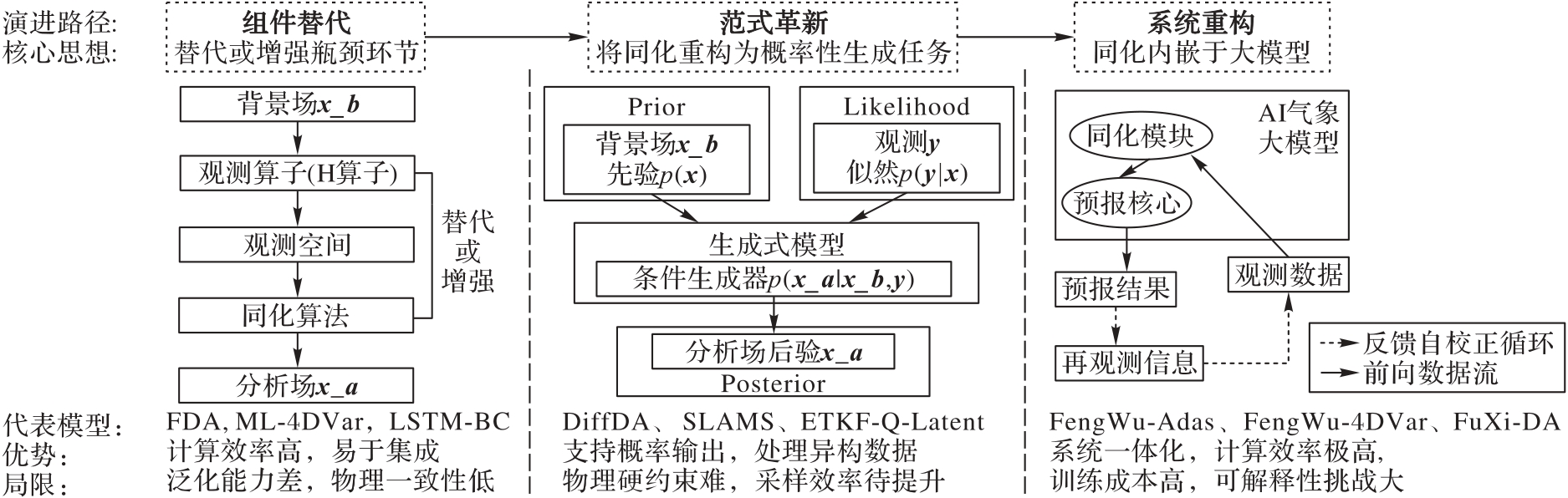
Fig. 1 Evolutionary path of research on application of deep learning in meteorological data assimilation
| 处理方法 | 应用场景 | 误差评价指标 | 偏差校正后性能 | 无偏差校正性能 | 计算时间/s |
|---|---|---|---|---|---|
| LSTM+分区IDW | 青藏高原积雪 | NSE | 0.79 | 0.19 | 2.8 |
| LSTM | 沙尘暴PM10校正 | RMSE | 58.6 μg/m³ | 89.4 μg/m³ | 3.2 |
| 变分偏差校正 | 传统气象同化 | RMSE相对降低值 | 19.7% | — | 900~1 500 |
Tab. 1 Performance comparison of time-series processing methods
| 处理方法 | 应用场景 | 误差评价指标 | 偏差校正后性能 | 无偏差校正性能 | 计算时间/s |
|---|---|---|---|---|---|
| LSTM+分区IDW | 青藏高原积雪 | NSE | 0.79 | 0.19 | 2.8 |
| LSTM | 沙尘暴PM10校正 | RMSE | 58.6 μg/m³ | 89.4 μg/m³ | 3.2 |
| 变分偏差校正 | 传统气象同化 | RMSE相对降低值 | 19.7% | — | 900~1 500 |
| 方法类别 | 代表性工作 | 核心思想 | 主要优势 | 关键挑战 | 物理一致性 |
|---|---|---|---|---|---|
| 观测算子代理 | 文献[ | 用NN学习H算子的 输入‒输出映射 | 推理快,计算成本降低 | 依赖训练数据,外推风险高, 缺乏可解释性 | 低(黑箱代理,不保证 辐射传输物理过程) |
误差/偏差 混合订正 | 文献[ | 在传统同化器上叠加 AI订正模块 | 捕捉复杂非线性误差, 提升自适应性 | 训练数据需求大,可能引入 伪相关 | 中(依赖基础同化器的 物理框架) |
| 同化算法替代 | 文献[ | 用NN端到端学习同化 算法的输入‒输出映射 | 计算效率指数级提升, 简化流程 | 泛化性差,难以保证物理守恒性 | 低(纯数据驱动,易 产生物理不协调场) |
| 时序处理 | 文献[ | 用LSTM等模型处理 观测序列的时变特性 | 有效建模动态偏差和 长期依赖 | 存在模型漂移,需与BC结合 | 中(依赖具体实现, 本身不施加物理约束) |
Tab. 2 Comparison of component replacement methods using deep learning in traditional data assimilation steps
| 方法类别 | 代表性工作 | 核心思想 | 主要优势 | 关键挑战 | 物理一致性 |
|---|---|---|---|---|---|
| 观测算子代理 | 文献[ | 用NN学习H算子的 输入‒输出映射 | 推理快,计算成本降低 | 依赖训练数据,外推风险高, 缺乏可解释性 | 低(黑箱代理,不保证 辐射传输物理过程) |
误差/偏差 混合订正 | 文献[ | 在传统同化器上叠加 AI订正模块 | 捕捉复杂非线性误差, 提升自适应性 | 训练数据需求大,可能引入 伪相关 | 中(依赖基础同化器的 物理框架) |
| 同化算法替代 | 文献[ | 用NN端到端学习同化 算法的输入‒输出映射 | 计算效率指数级提升, 简化流程 | 泛化性差,难以保证物理守恒性 | 低(纯数据驱动,易 产生物理不协调场) |
| 时序处理 | 文献[ | 用LSTM等模型处理 观测序列的时变特性 | 有效建模动态偏差和 长期依赖 | 存在模型漂移,需与BC结合 | 中(依赖具体实现, 本身不施加物理约束) |
| 方法类别 | 技术路径 | 代表性工作 | 核心机制 | 主要优势 | 关键挑战 |
|---|---|---|---|---|---|
| 基于VAE | 数据重建 | DDA[ | 利用CVAE从稀疏观测中重建出完整的 伪观测场,再输入传统同化系统 (如EnSRF) | 兼容现有业务系统,有效解决 观测稀疏区域的同化难题 | 本质仍为混合方法, 未完全脱离传统同化 框架的束缚 |
完全潜在 空间同化 | ETKF-Q-Latent[ | 将编码、同化分析、动力学传播和解码 全流程置于VAE构建的低维潜在空间 中执行 | 极大降低计算复杂度,缓解 维度灾难;低维空间中线性 假设更合理 | 性能高度依赖潜在空间 能否准确捕捉关键的 大气动力学特征 | |
基于扩散 模型 | 全球 高分辨率 同化 | DiffDA[ | 通过软掩码和克里金插值将稀疏观测 融入去噪过程,直接生成全球高分辨率 后验样本 | 首个全球高分辨率机器学习 同化方案,分析场质量高, 速度快(15~30 min) | 训练计算成本高昂,对 极度稀疏观测(<1%)的 处理效果需进一步验证 |
多模态 数据融合 | SLAMS[ Appa[ | 将背景场与多源异构观测(如地面、 卫星)统一映射至潜在空间,利用 扩散模型进行条件生成 | 首个多模态生成式同化框架, 对低质量输入鲁棒性强;可 验证物理一致性 | 异构数据映射与融合的 复杂性;如何有效施加 多变量间的物理约束 | |
零样本 适应性 | SDA[ | 将观测作为推理阶段的引导,模型 无需重新训练新的观测类型或网络 | 强大的通用性和灵活性;可自然生成集合,为概率性预报和 不确定性量化奠定基础 | 如何在不重新训练的 情况下,保证对新观测 类型实现最优融合 |
Tab. 3 Comparison of probabilistic assimilation methods driven by generative models
| 方法类别 | 技术路径 | 代表性工作 | 核心机制 | 主要优势 | 关键挑战 |
|---|---|---|---|---|---|
| 基于VAE | 数据重建 | DDA[ | 利用CVAE从稀疏观测中重建出完整的 伪观测场,再输入传统同化系统 (如EnSRF) | 兼容现有业务系统,有效解决 观测稀疏区域的同化难题 | 本质仍为混合方法, 未完全脱离传统同化 框架的束缚 |
完全潜在 空间同化 | ETKF-Q-Latent[ | 将编码、同化分析、动力学传播和解码 全流程置于VAE构建的低维潜在空间 中执行 | 极大降低计算复杂度,缓解 维度灾难;低维空间中线性 假设更合理 | 性能高度依赖潜在空间 能否准确捕捉关键的 大气动力学特征 | |
基于扩散 模型 | 全球 高分辨率 同化 | DiffDA[ | 通过软掩码和克里金插值将稀疏观测 融入去噪过程,直接生成全球高分辨率 后验样本 | 首个全球高分辨率机器学习 同化方案,分析场质量高, 速度快(15~30 min) | 训练计算成本高昂,对 极度稀疏观测(<1%)的 处理效果需进一步验证 |
多模态 数据融合 | SLAMS[ Appa[ | 将背景场与多源异构观测(如地面、 卫星)统一映射至潜在空间,利用 扩散模型进行条件生成 | 首个多模态生成式同化框架, 对低质量输入鲁棒性强;可 验证物理一致性 | 异构数据映射与融合的 复杂性;如何有效施加 多变量间的物理约束 | |
零样本 适应性 | SDA[ | 将观测作为推理阶段的引导,模型 无需重新训练新的观测类型或网络 | 强大的通用性和灵活性;可自然生成集合,为概率性预报和 不确定性量化奠定基础 | 如何在不重新训练的 情况下,保证对新观测 类型实现最优融合 |
| 评估维度 | 方法 | 典型指标 | 性能表现 | 数据来源 |
|---|---|---|---|---|
| 真实性 | DiffDA[ | 500 hPa位势高度RMSE | 93.158(0.25°) | ERA5 |
| SDA[ | 10 m风U分量RMSE | 10%低于HRRR(3 km) | 美国中部气象站 | |
| SLAMS[ | Wasserstein距离 | 比单模态降低35%(多模态) | 多源观测 | |
| 鲁棒性 | SLAMS[ | 20×粗化数据Wasserstein距离 | <0.2(所有变量) | 合成观测 |
| SDA[ | 极度稀疏观测(1/18)RMSE | 保持合理结构 | Kolmogorov流 | |
| Appa[ | 零样本适应RMSE | 与重训练相当(<5%差异) | 多类型观测 | |
| 物理一致性 | Appa[ | 500 hPa风‒压梯度角度 | 85°~95°(符合地转平衡) | 数值验证 |
| SDA[ | 冷池发散风场‒降水相关性 | >0.8(物理合理) | 观测验证 | |
| SLAMS[ | 热力学变量能量谱 | 与ERA5谱差异<15% | 能量谱分析 | |
| 计算效率 | DiffDA[ | 全球0.25°同化时间 | 15~30 min(单GPU) | NVIDIA A100 |
| Appa[ | 25 h轨迹生成 | 20 s(单GPU) | RTX 6000 Ada | |
| SDA[ | 单次3 km同化 | 10 s(单GPU) | RTX 6000 Ada |
Tab. 4 Experimental performance comparison of generative assimilation methods
| 评估维度 | 方法 | 典型指标 | 性能表现 | 数据来源 |
|---|---|---|---|---|
| 真实性 | DiffDA[ | 500 hPa位势高度RMSE | 93.158(0.25°) | ERA5 |
| SDA[ | 10 m风U分量RMSE | 10%低于HRRR(3 km) | 美国中部气象站 | |
| SLAMS[ | Wasserstein距离 | 比单模态降低35%(多模态) | 多源观测 | |
| 鲁棒性 | SLAMS[ | 20×粗化数据Wasserstein距离 | <0.2(所有变量) | 合成观测 |
| SDA[ | 极度稀疏观测(1/18)RMSE | 保持合理结构 | Kolmogorov流 | |
| Appa[ | 零样本适应RMSE | 与重训练相当(<5%差异) | 多类型观测 | |
| 物理一致性 | Appa[ | 500 hPa风‒压梯度角度 | 85°~95°(符合地转平衡) | 数值验证 |
| SDA[ | 冷池发散风场‒降水相关性 | >0.8(物理合理) | 观测验证 | |
| SLAMS[ | 热力学变量能量谱 | 与ERA5谱差异<15% | 能量谱分析 | |
| 计算效率 | DiffDA[ | 全球0.25°同化时间 | 15~30 min(单GPU) | NVIDIA A100 |
| Appa[ | 25 h轨迹生成 | 20 s(单GPU) | RTX 6000 Ada | |
| SDA[ | 单次3 km同化 | 10 s(单GPU) | RTX 6000 Ada |
| 架构范式 | 代表工作 | 核心机制 | 主要优势 | 关键挑战 |
|---|---|---|---|---|
| 显式:专用网络 | FengWu-Adas[ | 专用网络,自我纠正循环 | 动态适应,持续学习,闭环优化 | 需独立设计同化网络,融合机制的 物理可解释性 |
| 显式:可微分内化 | FengWu-4DVar[ | 自动微分内化4DVar | 计算效率极高,理论基础强 (源于4DVar) | 依赖模型完全可微分,AD内存开销大 |
| 显式:通用融合网络 | FuXi-DA[ | 通用融合网络替代B/H矩阵 | 完全摒弃传统算子,高度通用 | 训练数据需求极大,对复杂观测的 泛化能力弱 |
| 隐式:端到端训练 | GraphCast[ | 端到端训练学习映射 | 架构简洁,预报性能卓越 | 依赖高质量再分析数据,灵活性差 |
Tab. 5 Comparison of representative architectures for end-to-end AI large models applied in meteorological data assimilation
| 架构范式 | 代表工作 | 核心机制 | 主要优势 | 关键挑战 |
|---|---|---|---|---|
| 显式:专用网络 | FengWu-Adas[ | 专用网络,自我纠正循环 | 动态适应,持续学习,闭环优化 | 需独立设计同化网络,融合机制的 物理可解释性 |
| 显式:可微分内化 | FengWu-4DVar[ | 自动微分内化4DVar | 计算效率极高,理论基础强 (源于4DVar) | 依赖模型完全可微分,AD内存开销大 |
| 显式:通用融合网络 | FuXi-DA[ | 通用融合网络替代B/H矩阵 | 完全摒弃传统算子,高度通用 | 训练数据需求极大,对复杂观测的 泛化能力弱 |
| 隐式:端到端训练 | GraphCast[ | 端到端训练学习映射 | 架构简洁,预报性能卓越 | 依赖高质量再分析数据,灵活性差 |
| 方法 | 分辨率 | 硬件配置 | 单次同化时间 | 相较于传统方法的加速比 |
|---|---|---|---|---|
| 4DVar(传统) | 0.25°(全球) | 256 CPU核心集群 | 4~6 h | 1×(基准) |
| DiffDA | 0.25°(全球) | 单A100 GPU | 15~30 min | 8~24× |
| FengWu-4DVar | 1.4°(全球) | 单A100 GPU | (30.4±0.5) s | >500× |
| Appa | 0.25°(全球) | 单RTX 6000 Ada | (75±3) s(25 h轨迹) | >150× |
| SDA | 3 km(区域) | 单RTX 6000 Ada | (10±0.8) s(24 h轨迹) | >180× |
| FuXi-DA | 0.25°(全球) | 单A100 GPU | <10 s | >1 440× |
| ETKF-Q-Latent | 400维(增强Lorenz) | 单Tesla P100 GPU | (6.52±0.12) s | 2.5× |
Tab. 6 Measured computational efficiency comparison of different data assimilation methods
| 方法 | 分辨率 | 硬件配置 | 单次同化时间 | 相较于传统方法的加速比 |
|---|---|---|---|---|
| 4DVar(传统) | 0.25°(全球) | 256 CPU核心集群 | 4~6 h | 1×(基准) |
| DiffDA | 0.25°(全球) | 单A100 GPU | 15~30 min | 8~24× |
| FengWu-4DVar | 1.4°(全球) | 单A100 GPU | (30.4±0.5) s | >500× |
| Appa | 0.25°(全球) | 单RTX 6000 Ada | (75±3) s(25 h轨迹) | >150× |
| SDA | 3 km(区域) | 单RTX 6000 Ada | (10±0.8) s(24 h轨迹) | >180× |
| FuXi-DA | 0.25°(全球) | 单A100 GPU | <10 s | >1 440× |
| ETKF-Q-Latent | 400维(增强Lorenz) | 单Tesla P100 GPU | (6.52±0.12) s | 2.5× |
| [1] | Kalnay E. Atmospheric modeling, data assimilation and predictability[M]. Cambridge: Cambridge University Press, 2003. |
| [2] | Asch M, Bocquet M, Nodet M. Data assimilation: methods, algorithms, and applications[M]. Philadelphia, PA: SIAM, 2016. |
| [3] | Bouttier F, Courtier P. Data assimilation concepts and methods[M]. Reading: ECMWF, 2002. |
| [4] | Daley R. Atmospheric data analysis[M]. Cambridge: Cambridge University Press, 1993. |
| [5] | Lorenc A C. Analysis method for numerical weather prediction[J]. Quarterly Journal of the Royal Meteorological Society, 1986, 112(474): 1177-1194. |
| [6] | Bauer P, Thorpe A, Brunet G. The quiet revolution of numerical weather prediction[J]. Nature, 2015, 525(7567): 47-55. |
| [7] | Hersbach H, Bell B, Berrisford P, et al. The ERA5 global reanalysis[J]. Quarterly Journal of the Royal Meteorological Society, 2020, 146(730): 1999-2049. |
| [8] | Zhao D, Zhang L, Zhou T, et al. Contributions of local and remote atmospheric moisture fluxes to East China precipitation estimated from CRA-40 reanalysis[J]. Journal of Meteorological Research, 2021, 35(1): 32-45. |
| [9] | Kalman R E. A new approach to linear filtering and prediction problems[J]. Journal of Basic Engineering, 1960, 82(1): 35-45. |
| [10] | Welch G, Bishop G. An introduction to the Kalman filter[EB/OL]. (2021) [2025-07-28].. |
| [11] | Kovvali N, Banavar M, Spanias A. An introduction to Kalman filtering with MATLAB examples, SLSP[M]. Cham: Springer, 2022. |
| [12] | le Dimet F X, Talagrand O. Variational algorithms for analysis and assimilation of meteorological observations: theoretical aspects[J]. Tellus A: Dynamic Meteorology and Oceanography, 1986, 38A(2): 97-110. |
| [13] | Courtier P, Thépaut J N, Hollingsworth A. A strategy for operational implementation of 4D-Var, using an incremental approach[J]. Quarterly Journal of the Royal Meteorological Society, 1994, 120(519): 1367-1387. |
| [14] | Rabier F, Järvinen H, Klinker E, et al. The ECMWF operational implementation of four-dimensional variational assimilation. Ⅰ: experimental results with simplified physics[J]. Quarterly Journal of the Royal Meteorological Society, 2000, 126(564): 1143-1170. |
| [15] | Evensen G. The ensemble Kalman filter: theoretical formulation and practical implementation[J]. Ocean Dynamics, 2003, 53(4): 343-367. |
| [16] | Houtekamer P L, Mitchell H L. A sequential ensemble Kalman filter for atmospheric data assimilation[J]. Monthly Weather Review, 2001, 129(1): 123-137. |
| [17] | Carrassi A, Bocquet M, Bertino L, et al. Data assimilation in the geosciences: an overview of methods, issues, and perspectives[J]. WIREs Climate Change, 2018, 9(5): No.e535. |
| [18] | Ide K, Courtier P, Ghil M, et al. Unified notation for data assimilation: operational, sequential and variational[J]. Journal of the Meteorological Society of Japan, 1997, 75(1B): 181-189. |
| [19] | van Leeuwen P J. Nonlinear data assimilation in geosciences: an extremely efficient particle filter[J]. Quarterly Journal of the Royal Meteorological Society, 2010, 136(653): 1991-1999. |
| [20] | Han X, Li X. An evaluation of the nonlinear/non-Gaussian filters for the sequential data assimilation[J]. Remote Sensing of Environment, 2008, 112(4): 1434-1449. |
| [21] | Majumdar S J. A review of targeted observations[J]. Bulletin of the American Meteorological Society, 2016, 97(12): 2287-2303. |
| [22] | Saito K. The JMA nonhydrostatic model and its applications to operation and research[M]// Yucel I. Atmospheric model applications. London: InTechOpen Limited, 2012: 85-110. |
| [23] | Snyder C, Bengtsson T, Bickel P, et al. Obstacles to high-dimensional particle filtering[J]. Monthly Weather Review, 2008, 136(12): 4629-4640. |
| [24] | Bonavita M, Hólm E, Isaksen L, et al. The evolution of the ECMWF hybrid data assimilation system[J]. Quarterly Journal of the Royal Meteorological Society, 2016, 142(694): 287-303. |
| [25] | Bousserez N, Guerrette J J, Henze D K. Enhanced parallelization of the incremental 4D-Var data assimilation algorithm using the Randomized Incremental Optimal Technique[J]. Quarterly Journal of the Royal Meteorological Society, 2020, 146(728): 1351-1371. |
| [26] | Bannister R N. A review of forecast error covariance statistics in atmospheric variational data assimilation. Ⅰ: characteristics and measurements of forecast error covariances[J]. Quarterly Journal of the Royal Meteorological Society, 2008, 134(637): 1951-1970. |
| [27] | Hamill T M, Snyder C. A hybrid ensemble Kalman filter-3D variational analysis scheme[J]. Monthly Weather Review, 2000, 128(8): 2905-2919. |
| [28] | LeCun Y, Bengio Y, Hinton G. Deep learning[J]. Nature, 2015, 521(7553): 436-444. |
| [29] | Tian X, Holdaway D, Kleist D. Exploring the use of machine learning weather models in data assimilation[PP/OL]. arXiv (2024-11-22) [2025-07-28].. |
| [30] | Geer A J. Learning earth system models from observations: machine learning or data assimilation?[J]. Philosophical Transactions of the Royal Society A, 2021, 379(2194): No.20200089. |
| [31] | Karniadakis G E, Kevrekidis I G, Lu L, et al. Physics-informed machine learning[J]. Nature Reviews Physics, 2021, 3(6): 422-440. |
| [32] | Buizza C, Casas C Q, Nadler P, et al. Data learning: integrating data assimilation and machine learning[J]. Journal of Computational Science, 2022, 58: No.101525. |
| [33] | Scarlett J, Heckel R, Rodrigues M R D, et al. Theoretical perspectives on deep learning methods in inverse problems[J]. IEEE Journal on Selected Areas in Information Theory, 2022, 3(3): 433-453. |
| [34] | Papamakarios G, Nalisnick E, Rezende D J, et al. Normalizing flows for probabilistic modeling and inference[J]. Journal of Machine Learning Research, 2021, 22: 1-64. |
| [35] | Biswas A, Al Nasim M A, Imran A, et al. Generative adversarial networks for data augmentation[M]// Zheng B, Andrei S, Sarker M K, et al. Data driven approaches on medical imaging. Cham: Springer, 2023: 159-177. |
| [36] | Schultz M G, Betancourt C, Gong B, et al. Can deep learning beat numerical weather prediction?[J]. Philosophical Transactions of the Royal Society A, 2021, 379(2194): No.20200097. |
| [37] | Huang L, Gianinazzi L, Yu Y, et al. DiffDA: a diffusion model for weather-scale data assimilation[J]. Proceedings of Machine Learning Research, 2024, 235: 19798-19815. |
| [38] | Chen K, Bai L, Ling F, et al. Towards an end-to-end artificial intelligence driven global weather forecasting system[PP/OL]. V4. arXiv (2024-12-04) [2025-12-28].. |
| [39] | Xiao Y, Bai L, Xue W, et al. FengWu-4DVar: coupling the data-driven weather forecasting model with 4D variational assimilation[PP/OL]. V2. arXiv (2024-05-19) [2025-07-28].. |
| [40] | Blackwell W J. A neural-network technique for the retrieval of atmospheric temperature and moisture profiles from high spectral resolution sounding data[J]. IEEE Transactions on Geoscience and Remote Sensing, 2005, 43(11): 2535-2546. |
| [41] | 蒋鸿儒,方巍. 深度学习在气象数据订正中的应用综述[J]. 计算机应用, 2024, 44(12): 3930-3940. |
| Jiang Hongru, Fang Wei. Survey of application of deep learning in meteorological data correction[J]. Journal of Computer Applications, 2024, 44(12): 3930-3940. | |
| [42] | Bonavita M, Laloyaux P. Machine learning for model error inference and correction[J]. Journal of Advances in Modeling Earth Systems, 2020, 12(12): No.e2020MS002232. |
| [43] | Saunders R, Hocking J, Rayer P, et al. RTTOV-10 science and validation report[R/OL]. (2012-01-23) [2025-08-10].. |
| [44] | Eyre J. A fast radiative transfer model for satellite sounding systems[EB/OL]. (1991-03) [2025-08-10].. |
| [45] | Yang J, Ding S, Dong P, et al. Advanced radiative transfer modeling system developed for satellite data assimilation and remote sensing applications[J]. Journal of Quantitative Spectroscopy and Radiative Transfer, 2020, 251: No.107043. |
| [46] | Bonavita M, Arcucci R, Carrassi A, et al. Machine learning for earth system observation and prediction[J]. Bulletin of the American Meteorological Society, 2021, 102(4): E710-E716. |
| [47] | Jing S. Data assimilation with a machine-learned observation operator and application to the assimilation of satellite data for sea ice models[D]. Reading: University of Reading, 2019. |
| [48] | Liang X, Garrett K, Liu Q, et al. A deep-learning-based microwave radiative transfer emulator for data assimilation and remote sensing[J]. IEEE Journal of Selected Topics in Applied Earth Observations and Remote Sensing, 2022, 15: 8819-8833. |
| [49] | Reichstein M, Camps-Valls G, Stevens B, et al. Deep learning and process understanding for data-driven Earth system science[J]. Nature, 2019, 566(7743): 195-204. |
| [50] | Gneiting T. Correlation functions for atmospheric data analysis[J]. Quarterly Journal of the Royal Meteorological Society, 1999, 125(559): 2449-2464. |
| [51] | Wang Y, Shi L, Lin L, et al. A robust data-worth analysis framework for soil moisture flow by hybridizing sequential data assimilation and machine learning[J]. Vadose Zone Journal, 2020, 19(1): No.e20026. |
| [52] | Brajard J, Carrassi A, Bocquet M, et al. Combining data assimilation and machine learning to emulate a dynamical model from sparse and noisy observations: a case study with the Lorenz 96 model[J]. Journal of Computational Science, 2020, 44: No.101171. |
| [53] | Peng Z, Lei L, Tan Z M. A hybrid deep learning and data assimilation method for model error estimation[J]. SCIENCE CHINA Earth Sciences, 2024, 67(12): 3655-3670. |
| [54] | Cintra R S, de Campos Velho H F. Data assimilation by artificial neural networks for an atmospheric general circulation model[M]// El-Shahat A. Advanced applications for artificial neural networks. London: InTechOpen Limited, 2018: 265. |
| [55] | Wu P, Chang X, Yuan W, et al. Fast Data Assimilation (FDA): data assimilation by machine learning for faster optimize model state[J]. Journal of Computational Science, 2021, 51: No.101323. |
| [56] | Dong R, Leng H, Zhao J, et al. A framework for four-dimensional variational data assimilation based on machine learning[J]. Entropy, 2022, 24(2): No.264. |
| [57] | Cai S, Fang F, Wang Y. Advancing neural network-based data assimilation for large-scale spatiotemporal systems with sparse observations[J]. Physics of Fluids, 2024, 36(9): No.096616. |
| [58] | Jin J, Lin X H, Segers A, et al. Machine learning for observation bias correction with application to dust storm data assimilation[J]. Atmospheric Chemistry and Physics, 2019, 19(15): 10009-10026. |
| [59] | Cui G, Anderson M, Bales R. Mapping of snow water equivalent by a deep-learning model assimilating snow observations[J]. Journal of Hydrology, 2023, 616: No.128835. |
| [60] | Kumar P. Diffusion models and generative artificial intelligence: frameworks, applications and challenges[J]. Archives of Computational Methods in Engineering, 2025, 32(7): 4049-4092. |
| [61] | Kingma D P, Welling M. Auto-encoding variational Bayes[PP/OL]. V11. arXiv (2022-12-10) [2025-07-28].. |
| [62] | Aggarwal A, Mittal M, Battineni G. Generative adversarial network: an overview of theory and applications[J]. International Journal of Information Management Data Insights, 2021, 1(1): No.100004. |
| [63] | Huang Y, Huang J, Liu Y, et al. Diffusion model-based image editing: a survey[J]. IEEE Transactions on Pattern Analysis and Machine Intelligence, 2025, 47(6): 4409-4437. |
| [64] | Komanduri A, Wu X, Wu Y, et al. From identifiable causal representations to controllable counterfactual generation: a survey on causal generative modeling[PP/OL]. V2. arXiv (2024-03-23) [2025-07-28].. |
| [65] | Arcucci R, Zhu J, Hu S, et al. Deep data assimilation: integrating deep learning with data assimilation[J]. Applied Sciences, 2021, 11(3): No.1114. |
| [66] | Wang Y, Shi X, Lei L, et al. Deep learning augmented data assimilation: reconstructing missing information with convolutional autoencoders[J]. Monthly Weather Review, 2022, 150(8): 1977-1991. |
| [67] | Peyron M, Fillion A, Gürol S, et al. Latent space data assimilation by using deep learning[J]. Quarterly Journal of the Royal Meteorological Society, 2021, 147(740): 3759-3777. |
| [68] | Lim J H, Kovachki N B, Baptista R, et al. Score-based diffusion models in function space[J]. Journal of Machine Learning Research, 2025, 26: 1-62. |
| [69] | Qu Y, Nathaniel J, Li S, et al. Deep generative data assimilation in multimodal setting[C]// CVPRW 2024. Piscataway: IEEE, 2024: 449-459. |
| [70] | Andry G, Lewin S, Rozet F, et al. Appa: bending weather dynamics with latent diffusion models for global data assimilation[PP/OL]. V3. arXiv (2022-11-18) [2025-11-28]. . |
| [71] | Rozet F, Louppe G. Score-based data assimilation[C]// NeurIPS 2023. Red Hook: Curran Associates Inc., 2023: 40521-40541. |
| [72] | Manshausen P, Cohen Y, Harrington P, et al. Generative data assimilation of sparse weather station observations at kilometer scales[J]. Journal of Advances in Modeling Earth Systems, 2025, 17(10): No.e2024MS004505. |
| [73] | He Y H, Chan P W. A study of the extended-range weather forecasts by artificial intelligence models Pangu-Weather and FengWu [J]. Weather, 2025, 80(4): 134-138. |
| [74] | Xu X, Sun X, Han W, et al. FuXi-DA: a generalized deep learning data assimilation framework for assimilating satellite observations[J]. npj Climate and Atmospheric Science, 2025, 8: No.156. |
| [75] | Lam R, Sanchez-Gonzalez A, Willson M, et al. Learning skillful medium-range global weather forecasting[J]. Science, 2023, 382(6677): 1416-1421. |
| [76] | Yang X, Dong Z. Kalman filter-based differential privacy federated learning method[J]. Applied Sciences, 2022, 12(15): No.7787. |
| [77] | Chen Y, Chen W. Kalman filter aided federated Koopman learning[J]. IEEE Transactions on Signal Processing, 2025, 73: 2879-2895. |
| [78] | Polato M. Federated variational autoencoder for collaborative filtering[C]// IJCNN 2021. Piscataway: IEEE, 2021: 1-8. |
| [79] | Raissi M, Perdikaris P, Karniadakis G E. Physics-informed neural networks: a deep learning framework for solving forward and inverse problems involving nonlinear partial differential equations[J]. Journal of Computational Physics, 2019, 378: 686-707. |
| [80] | Krasnopolsky V. Applying machine learning in numerical weather and climate modeling systems[J]. Climate, 2024, 12(6): No.78. |
| [81] | Ham Y G, Kim J H, Luo J J. Deep learning for multi-year ENSO forecasts[J]. Nature, 2019, 573(7775): 568-572. |
| [82] | Wang X, Liu Z, Huang B. Robust and privacy-preserving federated learning scheme based on cipher-text-selected users[J]. Computer Networks, 2025, 259: No.111072. |
| [83] | Ge Y, Liu S, Fu Z, et al. A survey on trustworthy recommender systems[J]. ACM Transactions on Recommender Systems, 2025, 3(2): No.13. |
| [84] | Bauer P, Dueben P D, Hoefler T, et al. The digital revolution of Earth-system science[J]. Nature Computational Science, 2021, 1(2): 104-113. |
| [85] | Rasp S, Dueben P D, Scher S, et al. WeatherBench: a benchmark data set for data-driven weather forecasting[J]. Journal of Advances in Modeling Earth Systems, 2020, 12(11): No.e2020MS002203. |
| [86] | Seo J, Yoo S, Chang J, et al. SE(3)-equivariant robot learning and control: a tutorial survey[J]. International Journal of Control, Automation and Systems, 2025, 23(5): 1271-1306. |
| [87] | Rolnick D, Donti P L, Kaack L H, et al. Tackling climate change with machine learning[J]. ACM Computing Surveys, 2023, 55(2): No.42. |
| [1] | Yingchun TANG, Rong HUANG, Shubo ZHOU, Xueqin JIANG. Clean-label multi-backdoor attack method based on feature regulation and color separation [J]. Journal of Computer Applications, 2026, 46(1): 124-134. |
| [2] | Ying TAN, Xinyu REN, Chaoli SUN, Sisi WANG. Two-stage infill sampling-based semi-supervised expensive multi-objective optimization algorithm [J]. Journal of Computer Applications, 2025, 45(5): 1605-1612. |
| [3] | Jie HUANG, Ruizi WU, Junli LI. Efficient adaptive robustness optimization algorithm for complex networks [J]. Journal of Computer Applications, 2024, 44(11): 3530-3539. |
| [4] | Runting DONG, Li WU, Xiaoying WANG, Tengfei CAO, Jianqiang HUANG, Qin GUAN, Jiexia WU. Review of application analysis and research progress of deep learning in weather forecasting [J]. Journal of Computer Applications, 2023, 43(6): 1958-1968. |
| [5] | Zhe XU, Zhihong WANG, Cunyu SHAN, Yaru SUN, Ying YANG. Unsupervised face forgery video detection based on reconstruction error [J]. Journal of Computer Applications, 2023, 43(5): 1571-1577. |
| [6] | Junyan LIU, Feibo JIANG, Yubo PENG, Li DONG. Multi-objective optimization model for unmanned aerial vehicles trajectory based on decomposition and trajectory search [J]. Journal of Computer Applications, 2023, 43(12): 3806-3815. |
| [7] | ZHENG Sai, LI Tianrui, HUANG Wei. Federated learning algorithm for communication cost optimization [J]. Journal of Computer Applications, 2023, 43(1): 1-7. |
| [8] | LI Xujuan, PI Jianyong, HUANG Feixiang, JIA Haipeng. Self-generated deep neural network based 4D trajectory prediction [J]. Journal of Computer Applications, 2021, 41(5): 1492-1499. |
| [9] | XUE Feng, SHI Xuhua, SHI Feifan. Surrogate-based differential evolution constrained optimization [J]. Journal of Computer Applications, 2020, 40(4): 1091-1096. |
| [10] | CAO Yudong, CAI Xibiao. No-reference image quality assessment algorithm with enhanced adversarial learning [J]. Journal of Computer Applications, 2020, 40(11): 3166-3171. |
| [11] | XIANG Jinyong, YANG Wenzhong, SILAMU·Wushouer. Text sentiment classification algorithm based on feature selection and deep belief network [J]. Journal of Computer Applications, 2019, 39(7): 1942-1947. |
| [12] | WANG Yining, QIN Pinle, LI Chuanpeng, CUI Yuhao. Improved algorithm of image super resolution based on residual neural network [J]. Journal of Computer Applications, 2018, 38(1): 246-254. |
| [13] | ZHU Linqi, ZHANG Chong, ZHOU Xueqing, WEI Yang, HUANG Yuyang, GAO Qiming. Nuclear magnetic resonance logging reservoir permeability prediction method based on deep belief network and kernel extreme learning machine algorithm [J]. Journal of Computer Applications, 2017, 37(10): 3034-3038. |
| Viewed | ||||||
|
Full text |
|
|||||
|
Abstract |
|
|||||
