


Journal of Computer Applications ›› 2026, Vol. 46 ›› Issue (11): 3516-3522.DOI: 10.11772/j.issn.1001-9081.2025101318
• Data science and technology • Previous Articles
Mingyan LIAO, Faquan ZHANG( ), Yiyang WU, Mande SHEN, Hao CHEN
Received:2025-11-13
Revised:2026-02-03
Accepted:2026-02-06
Online:2026-02-13
Published:2026-11-10
Contact:
Faquan ZHANG
About author:LIAO Mingyan, born in 1999, M. S. candidate. Her research interests include incremental learning, image processing.Supported by:
廖名燕, 张法全(), 吴逸阳, 沈满德, 陈昊
通讯作者:
张法全
作者简介:廖名燕(1999—),女,湖北潜江人,硕士研究生,主要研究方向:增量学习、图像处理基金资助:CLC Number:
Mingyan LIAO, Faquan ZHANG, Yiyang WU, Mande SHEN, Hao CHEN. Orthogonal constraint and attention-guided augmentation for class-incremental learning[J]. Journal of Computer Applications, 2026, 46(11): 3516-3522.
廖名燕, 张法全, 吴逸阳, 沈满德, 陈昊. 基于类增量学习的正交约束与注意力引导增强[J]. 《计算机应用》唯一官方网站, 2026, 46(11): 3516-3522.
Add to citation manager EndNote|Ris|BibTeX
URL: https://www.joca.cn/EN/10.11772/j.issn.1001-9081.2025101318
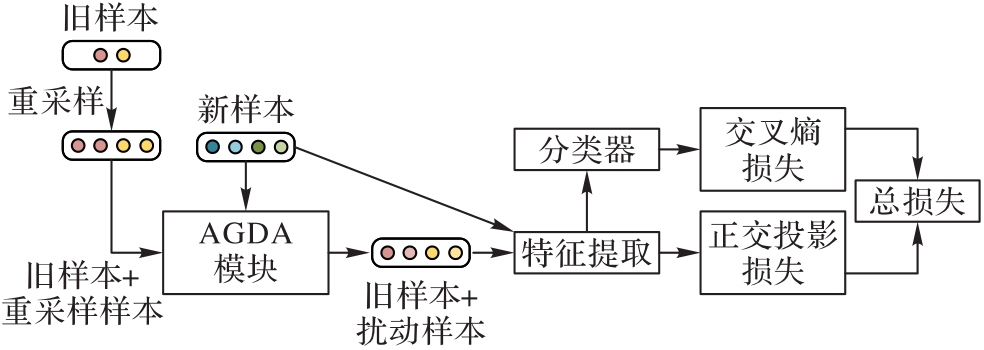
Fig. 1 Flow of OCAGA method
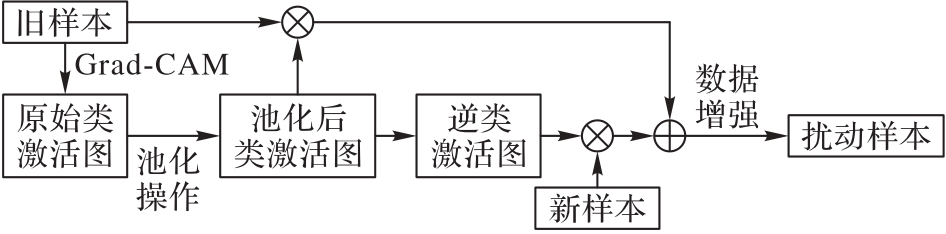
Fig. 2 Flow of AGDA method
| 方法 | 平均准确率 | 最终准确率 | 平均遗忘率 |
|---|---|---|---|
| Finetune | 17.59 | 4.83 | 91.14 |
| EWC | 18.42 | 5.58 | 74.83 |
| LwF | 30.93 | 12.60 | 69.98 |
| GEM | 31.73 | 19.48 | 48.92 |
| PODNet | 47.88 | 27.99 | 42.71 |
| COIL | 57.68 | 34.33 | 54.82 |
| MTD | 50.80 | 35.90 | 30.00 |
| iCaRL | 59.06 | 38.99 | 26.28 |
| OCAGA | 61.51 | 41.54 | 21.69 |
Tab. 1 Performance comparison of different methods on CIFAR-100 dataset
| 方法 | 平均准确率 | 最终准确率 | 平均遗忘率 |
|---|---|---|---|
| Finetune | 17.59 | 4.83 | 91.14 |
| EWC | 18.42 | 5.58 | 74.83 |
| LwF | 30.93 | 12.60 | 69.98 |
| GEM | 31.73 | 19.48 | 48.92 |
| PODNet | 47.88 | 27.99 | 42.71 |
| COIL | 57.68 | 34.33 | 54.82 |
| MTD | 50.80 | 35.90 | 30.00 |
| iCaRL | 59.06 | 38.99 | 26.28 |
| OCAGA | 61.51 | 41.54 | 21.69 |
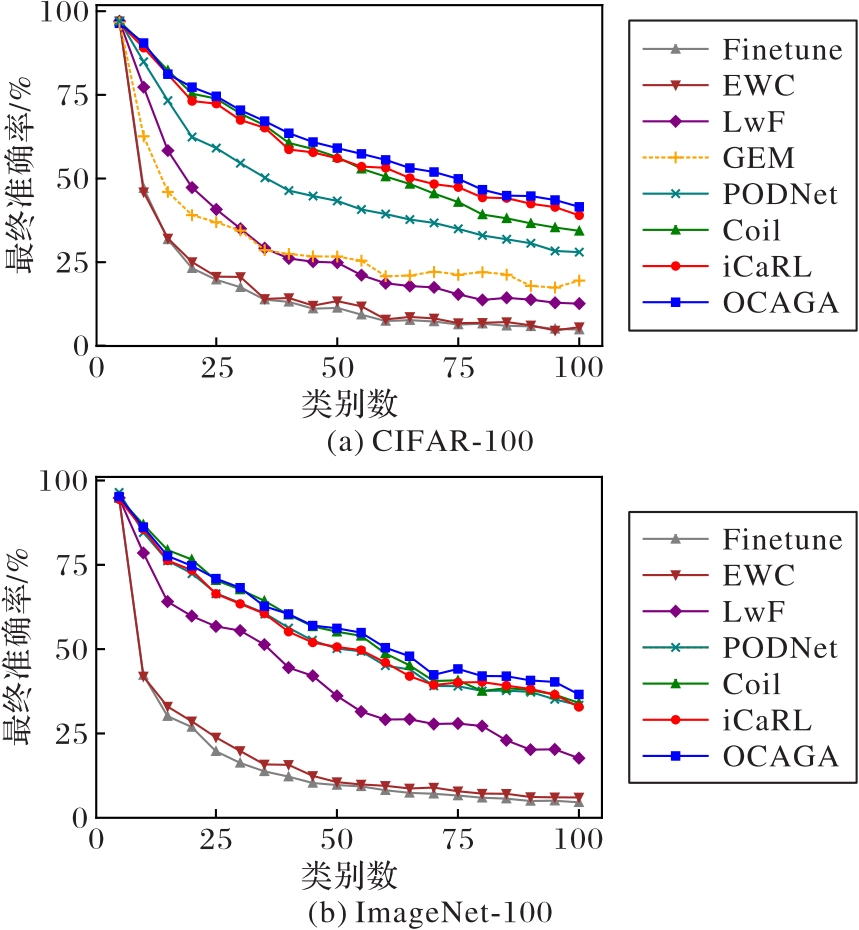
Fig. 3 Final accuracies on different datasets
| 方法 | GFLOPs | 单任务运行时间/min | |
|---|---|---|---|
| LwF | 0.46 | 0.07 | 11 |
| PODNet | 0.46 | 0.07 | 11 |
| COIL | 0.46 | 0.07 | 60 |
| iCaRL | 0.46 | 0.07 | 11 |
| OCAGA | 0.46 | 0.07 | 18 |
Tab. 2 Comparison of parameters, computational complexity and training efficiency among different methods
| 方法 | GFLOPs | 单任务运行时间/min | |
|---|---|---|---|
| LwF | 0.46 | 0.07 | 11 |
| PODNet | 0.46 | 0.07 | 11 |
| COIL | 0.46 | 0.07 | 60 |
| iCaRL | 0.46 | 0.07 | 11 |
| OCAGA | 0.46 | 0.07 | 18 |
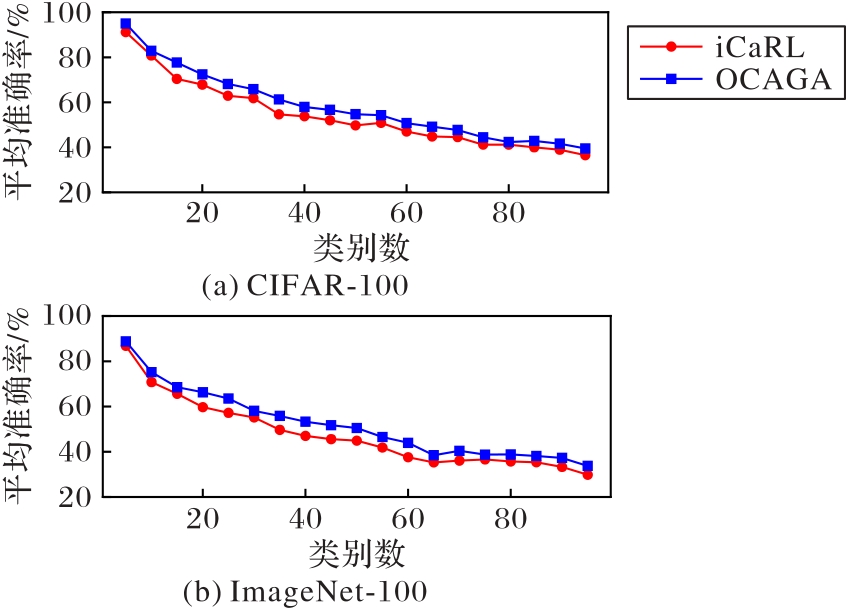
Fig. 4 Stage-wise forgetting analysis curves of old classes on different datasets
| 方法 | 平均准确率 | 最终准确率 | 平均遗忘率 |
|---|---|---|---|
| Finetune | 17.06 | 4.70 | 94.04 |
| EWC | 18.78 | 6.14 | 89.71 |
| LwF | 41.76 | 17.70 | 65.24 |
| PODNet | 53.70 | 33.34 | 51.31 |
| COIL | 56.21 | 34.00 | 59.56 |
| iCaRL | 53.93 | 32.82 | 31.61 |
| OCAGA | 57.33 | 36.94 | 28.61 |
Tab. 3 Performance comparison of different methods on ImageNet-100 dataset
| 方法 | 平均准确率 | 最终准确率 | 平均遗忘率 |
|---|---|---|---|
| Finetune | 17.06 | 4.70 | 94.04 |
| EWC | 18.78 | 6.14 | 89.71 |
| LwF | 41.76 | 17.70 | 65.24 |
| PODNet | 53.70 | 33.34 | 51.31 |
| COIL | 56.21 | 34.00 | 59.56 |
| iCaRL | 53.93 | 32.82 | 31.61 |
| OCAGA | 57.33 | 36.94 | 28.61 |
| 方法名称 | 平均准确率 | 最终准确率 | 平均遗忘率 |
|---|---|---|---|
| Base | 59.06 | 38.99 | 26.28 |
| Base+AGDA | 60.13 | 40.73 | 43.06 |
| Base+OPL | 59.98 | 39.25 | 25.99 |
| Base+CAM+OPL | 61.51 | 41.54 | 21.69 |
Tab. 4 Results of ablation experiments
| 方法名称 | 平均准确率 | 最终准确率 | 平均遗忘率 |
|---|---|---|---|
| Base | 59.06 | 38.99 | 26.28 |
| Base+AGDA | 60.13 | 40.73 | 43.06 |
| Base+OPL | 59.98 | 39.25 | 25.99 |
| Base+CAM+OPL | 61.51 | 41.54 | 21.69 |
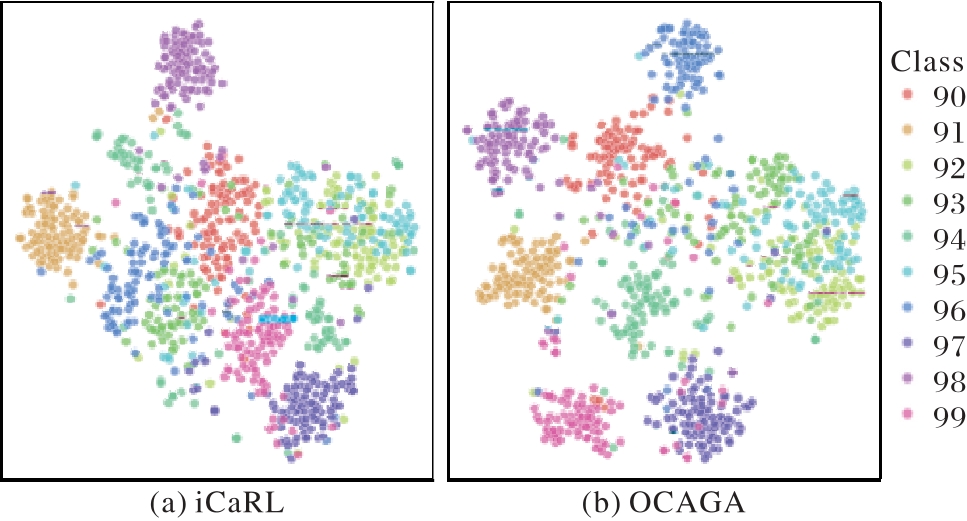
Fig. 5 t-SNE visualization of feature embeddings on CIFAR-100 dataset
| [1] | Shafiq M, Gu Z. Deep residual learning for image recognition: a survey[J]. Applied Sciences, 2022, 12(18): No.8972. |
| [2] | Zheng Z, Ma M, Wang K, et al. Preventing zero-shot transfer degradation in continual learning of vision-language models[C]// ICCV 2023. Piscataway: IEEE, 2023: 19068-19079. |
| [3] | Evron I, Moroshko E, Ward R, et al. How catastrophic can catastrophic forgetting be in linear regression?[J]. Proceedings of Machine Learning Research, 2022, 178: 4028-4079. |
| [4] | van de Ven G M, Tuytelaars T, Tolias A S. Three types of incremental learning[J]. Nature Machine Intelligence, 2022, 4(12): 1185-1197. |
| [5] | 李雪,姚光乐,王洪辉,等.基于样本增量学习的遥感影像分类[J].计算机应用,2024,44(3):732-736. |
| Li Xue, Yao Guangle, Wang Honghui, et al. Remote sensing image classification based on sample-incremental learning[J]. Journal of Computer Applications, 2024, 44(3): 732-736. | |
| [6] | Rebuffi S A, Kolesnikov A, Sperl G, et al. iCaRL: Incremental classifier and representation learning[C]// CVPR 2017. Piscataway: IEEE, 2017: 5533-5542. |
| [7] | Ranasinghe K, Naseer M, Hayat M, et al. Orthogonal projection loss[C]// ICCV 2021. Piscataway: IEEE, 2021: 12313-12323. |
| [8] | Krizhevsky A. Learning multiple layers of features from tiny images[R/OL]. (2009-04-08) [2024-12-18]. . |
| [9] | Russakovsky O, Deng J, Su H, et al. ImageNet large scale visual recognition challenge[J]. International Journal of Computer Vision, 2015, 115(3): 211-252. |
| [10] | Kirkpatrick J, Pascanu R, Rabinowitz N, et al. Overcoming catastrophic forgetting in neural networks[J]. Proceedings of the National Academy of Sciences of the United States of America, 2017, 114(13): 3521-3526. |
| [11] | Li Z, Hoiem D. Learning without forgetting[J]. IEEE Transactions on Pattern Analysis and Machine Intelligence, 2018, 40(12): 2935-2947. |
| [12] | Yan S, Xie J, He X. DER: dynamically expandable representation for class incremental learning[C]// CVPR 2021. Piscataway: IEEE, 2021: 3013-3022. |
| [13] | Douillard A, Ramé A, Couairon G, et al. DyTox: Transformers for continual learning with dynamic token expansion[C]// CVPR 2022. Piscataway: IEEE, 2022: 9275-9285. |
| [14] | Wang F Y, Zhou D W, Ye H J, et al. FOSTER: feature boosting and compression for class-incremental learning[C]// ECCV 2022, LNCS 13685. Cham: Springer, 2022: 398-414. |
| [15] | Wen H, Pan L, Dai Y, et al. Class incremental learning with multi-teacher distillation[C]// CVPR 2024. Piscataway: IEEE, 2024: 28443-28452. |
| [16] | Selvaraju R R, Cogswell M, Das A, et al. Grad-CAM: visual explanations from deep networks via gradient-based localization[C]// ICCV 2017. Piscataway: IEEE, 2017: 618-626. |
| [17] | Zhou D W, Wang Q W, Qi Z H, et al. Class-incremental learning: a survey[J]. IEEE Transactions on Pattern Analysis and Machine Intelligence, 2024, 46(12): 9851-9873. |
| [18] | He K, Zhang X, Ren S, et al. Deep residual learning for image recognition[C]// CVPR 2016. Piscataway: IEEE, 2016: 770-778. |
| [19] | Lopez-Paz D, Ranzato M A. Gradient episodic memory for continual learning[C]// NeurIPS 2017. Red Hook: Curran Associates Inc., 2017: 6470-6479. |
| [20] | Douillard A, Cord M, Ollion C, et al. PODNet: pooled outputs distillation for small-tasks incremental learning[C]// ECCV 2020, LNCS 12365. Cham: Springe, 2020: 86-102. |
| [21] | Zhou D W, Ye H J, Zhan D C. Co-transport for class-incremental learning[C]// MM 2021. New York: ACM, 2021: 1645-1654. |
| [1] | Shang LIU, Zhaosen TANG, Hongyue LIU, Linfang DONG, Jin ZHOU. Multimodal sentiment analysis model for missing modalities under shared semantic conditions [J]. Journal of Computer Applications, 2026, 46(9): 2761-2768. |
| [2] | Wei CUI, Ping ZHANG, Zhuoling XIAO, Zhuohang CHEN. Incremental semantic mapping system based on visual SLAM [J]. Journal of Computer Applications, 2026, 46(9): 2800-2808. |
| [3] | Yimin ZHOU, Wenhui FU, Jie LUO, Juan WANG. End‑to‑end robust video watermarking against screen‑recapturing attacks based on spatio-temporal feature enhancement network [J]. Journal of Computer Applications, 2026, 46(9): 2889-2897. |
| [4] | Xinliang LIU, Yushi XU, Dubai LI, Yanzhao REN. Survey of knowledge graph-based question answering methods [J]. Journal of Computer Applications, 2026, 46(8): 2394-2410. |
| [5] | Musheng CHEN, Wenqing FU, Xiaohong QIU, Junhua WU, Qiang WEN. Aspect sentiment triplet extraction based on graph convolutional network and cross-domain data augmentation [J]. Journal of Computer Applications, 2026, 46(8): 2432-2439. |
| [6] | Xiaojin GUO, Xuyang SUI, Kenan ZHOU. Channel estimation of STAR-RIS-assisted hybrid-field communication system based on deep learning [J]. Journal of Computer Applications, 2026, 46(8): 2548-2554. |
| [7] | Yue ZHANG, Yuhan GUO. Ride-hailing spatio-temporal demand forecasting method via large language model-driven semantic quantification [J]. Journal of Computer Applications, 2026, 46(8): 2467-2476. |
| [8] | Ming LIU, Dongqi SHEN, Ziyang MENG. Point cloud registration network with dual-branch multi-level feature fusion [J]. Journal of Computer Applications, 2026, 46(8): 2584-2593. |
| [9] | Fengchun LIU, Xinying SHAO, Chunying ZHANG, Liya WANG, Jing REN. FCMdepth: monocular depth estimation framework with multi-scale feature optimization [J]. Journal of Computer Applications, 2026, 46(8): 2603-2611. |
| [10] | Wei LIU, Weigang LI, Zhiqiang TIAN. Representation learning method of hierarchical rotation-invariant geometric structure for point cloud classification and segmentation [J]. Journal of Computer Applications, 2026, 46(8): 2594-2602. |
| [11] | Jiangyu YAN, Shiqian WANG, Hong WANG. Electricity theft detection method based on improved Wasserstein generative adversarial network with gradient penalty and time-frequency feature fusion [J]. Journal of Computer Applications, 2026, 46(8): 2691-2698. |
| [12] | Miaogen LING, Rui JING, Wei FANG. Survey of research on applications of explainable deep learning in tropical cyclone forecasting [J]. Journal of Computer Applications, 2026, 46(7): 2318-2326. |
| [13] | Xiangyi WU, Hailiang YE, Feilong CAO. Point cloud completion method based on smooth-sharpen graph convolution [J]. Journal of Computer Applications, 2026, 46(7): 2267-2276. |
| [14] | Xiuli DU, Xing GAO, Xiaoyu ZHANG, Chengsheng PAN, Qijie ZOU. Video snapshot compressive imaging reconstruction method based on dense spatio-temporal deformable attention [J]. Journal of Computer Applications, 2026, 46(7): 2288-2296. |
| [15] | Jing LIU, Shaoze ZHAO, Xingang LIU, Haozhe NIU, Haipeng JI. Cross-condition microstructure data generation method for titanium alloys based on improved CGAN [J]. Journal of Computer Applications, 2026, 46(7): 2373-2382. |
| Viewed | ||||||
|
Full text |
|
|||||
|
Abstract |
|
|||||
