


Journal of Computer Applications ›› 2026, Vol. 46 ›› Issue (7): 2104-2110.DOI: 10.11772/j.issn.1001-9081.2025070907
• Artificial intelligence • Previous Articles Next Articles
Received:2025-08-11
Revised:2025-09-27
Accepted:2025-09-28
Online:2025-11-05
Published:2026-07-10
Contact:
Ying WANG
About author:ZHANG Yue, born in 2001, M. S. candidate. Her research interests include graph data mining, dynamic graph representation learning, social computing.
Supported by:
张玥1,2, 王英1,2( )
)
通讯作者:
王英
作者简介:张玥(2001—),女,吉林四平人,硕士研究生,CCF学生会员,主要研究方向:图数据挖掘、动态图表示学习、社会计算
基金资助:CLC Number:
Yue ZHANG, Ying WANG. Scalable dynamic graph representation learning with neighborhood memory[J]. Journal of Computer Applications, 2026, 46(7): 2104-2110.
张玥, 王英. 基于邻域记忆的可扩展动态图表示学习[J]. 《计算机应用》唯一官方网站, 2026, 46(7): 2104-2110.
Add to citation manager EndNote|Ris|BibTeX
URL: https://www.joca.cn/EN/10.11772/j.issn.1001-9081.2025070907
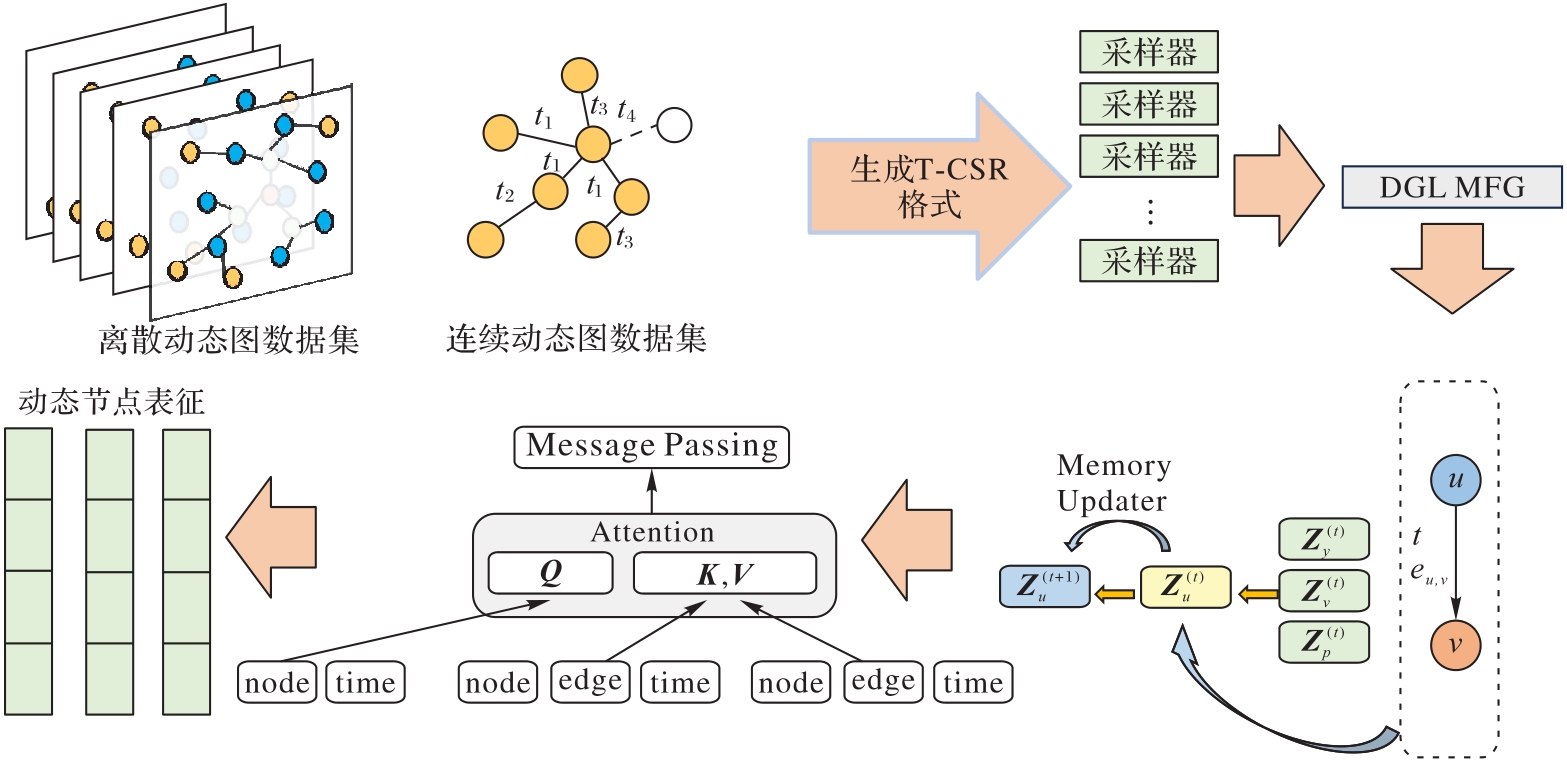
Fig. 1 Framework of scalable dynamic graph representation learning model with neighborhood memory
| 数据集 | 节点数/103 | 边数/103 | 标签数 | 类别数 | 边特征维度 | 时间跨度 |
|---|---|---|---|---|---|---|
| Wikipedia | 9 | 157 | 217 | 2 | 172 | 30 d |
| 11 | 672 | 366 | 2 | 172 | 30 d | |
| MOOC | 7 | 412 | — | — | 128* | 30 d |
| LastFM | 2 | 1 300 | — | — | 128* | 4 a |
Tab. 1 Dataset statistics
| 数据集 | 节点数/103 | 边数/103 | 标签数 | 类别数 | 边特征维度 | 时间跨度 |
|---|---|---|---|---|---|---|
| Wikipedia | 9 | 157 | 217 | 2 | 172 | 30 d |
| 11 | 672 | 366 | 2 | 172 | 30 d | |
| MOOC | 7 | 412 | — | — | 128* | 30 d |
| LastFM | 2 | 1 300 | — | — | 128* | 4 a |
| 方法 | Wikipedia | |
|---|---|---|
| TGAT | 95.09 | 97.82 |
| JODIE | 94.35 | 96.56 |
| APAN | 98.12 | 99.22 |
| TGN | 98.34 | 98.47 |
| D-DGNN | 98.54 | 98.81 |
| MTGN-TGAT | 98.16 | 99.54 |
| MTGN- DySAT | 96.77 | 98.53 |
| MTGN-JODIE | 98.91 | 99.49 |
| MTGN-APAN | 98.78 | 99.68 |
| MTGN-TGN | 99.14 | 99.79 |
Tab. 2 Comparison of dynamic link prediction accuracy under transductive setting
| 方法 | Wikipedia | |
|---|---|---|
| TGAT | 95.09 | 97.82 |
| JODIE | 94.35 | 96.56 |
| APAN | 98.12 | 99.22 |
| TGN | 98.34 | 98.47 |
| D-DGNN | 98.54 | 98.81 |
| MTGN-TGAT | 98.16 | 99.54 |
| MTGN- DySAT | 96.77 | 98.53 |
| MTGN-JODIE | 98.91 | 99.49 |
| MTGN-APAN | 98.78 | 99.68 |
| MTGN-TGN | 99.14 | 99.79 |
| 方法 | LASTFM | MOOC |
|---|---|---|
| MTGN-TGAT | 73.74 | 98.63 |
| MTGN-JODIE | 74.46 | 99.20 |
| MTGN-APAN | 68.29 | 99.35 |
| MTGN-TGN | 62.56 | 99.38 |
Tab. 3 Comparison of link prediction accuracy of discrete-time dynamic graphs under transductive setting
| 方法 | LASTFM | MOOC |
|---|---|---|
| MTGN-TGAT | 73.74 | 98.63 |
| MTGN-JODIE | 74.46 | 99.20 |
| MTGN-APAN | 68.29 | 99.35 |
| MTGN-TGN | 62.56 | 99.38 |
| 方法 | Wikipedia | |
|---|---|---|
| TGAT | 83.69 | 65.56 |
| JODIE | 84.84 | 61.83 |
| TGN | 87.81 | 67.06 |
| D-DGNN | 89.81 | 67.53 |
| MTGN-TGAT | 90.50 | 79.08 |
| MTGN-JODIE | 89.78 | 70.79 |
| MTGN-TGN | 83.86 | 59.54 |
Tab. 4 Comparison of dynamic node classification accuracy
| 方法 | Wikipedia | |
|---|---|---|
| TGAT | 83.69 | 65.56 |
| JODIE | 84.84 | 61.83 |
| TGN | 87.81 | 67.06 |
| D-DGNN | 89.81 | 67.53 |
| MTGN-TGAT | 90.50 | 79.08 |
| MTGN-JODIE | 89.78 | 70.79 |
| MTGN-TGN | 83.86 | 59.54 |
| 数据集 | JODIE | TGAT | TGN | ||||||
|---|---|---|---|---|---|---|---|---|---|
原始训练 时间/s | 基于MTGN 训练时间/s | 减少 占比/% | 原始 训练时间/s | 基于MTGN 训练时间/s | 减少 占比/% | 原始训练 时间/s | 基于MTGN 训练时间/s | 减少 占比/% | |
| Wikipedia | 45.3 | 2.0 | 95.6 | 166.8 | 6.8 | 95.9 | 32.1 | 4.2 | 86.9 |
| 305.6 | 7.7 | 97.5 | 692.1 | 37.9 | 94.5 | 262.3 | 16.9 | 93.6 | |
Tab. 5 Comparison of training time for different methods on Wikipedia and Reddit datasets
| 数据集 | JODIE | TGAT | TGN | ||||||
|---|---|---|---|---|---|---|---|---|---|
原始训练 时间/s | 基于MTGN 训练时间/s | 减少 占比/% | 原始 训练时间/s | 基于MTGN 训练时间/s | 减少 占比/% | 原始训练 时间/s | 基于MTGN 训练时间/s | 减少 占比/% | |
| Wikipedia | 45.3 | 2.0 | 95.6 | 166.8 | 6.8 | 95.9 | 32.1 | 4.2 | 86.9 |
| 305.6 | 7.7 | 97.5 | 692.1 | 37.9 | 94.5 | 262.3 | 16.9 | 93.6 | |
| [1] | Wang J, Huang P, Zhao H, et al. Billion-scale commodity embedding for e-commerce recommendation in Alibaba [C]// KDD 2018. New York: ACM, 2018: 839-848. |
| [2] | Liben-Nowell D, Kleinberg J. The link prediction problem for social networks [C]// CIKM 2003. New York: ACM, 2003: 556-559. |
| [3] | Li H, Yang S, Song Y, et al. Spatial dynamic graph convolutional network for traffic flow forecasting [J]. Applied Intelligence, 2023, 53(12): 14986-14998. |
| [4] | Wu Z, Pan S, Chen F, et al. A comprehensive survey on graph neural networks [J]. IEEE Transactions on Neural Networks and Learning Systems, 2021, 32(1): 4-24. |
| [5] | Barros C D T, Mendonça M R F, Vieira A B, et al. A survey on embedding dynamic graphs [J]. ACM Computing Surveys, 2023, 55(1): No.10. |
| [6] | Abadal S, Jain A, Guirado R, et al. Computing graph neural networks: a survey from algorithms to accelerators [J]. ACM Computing Surveys, 2022, 54(9): No.191. |
| [7] | Jiang W, Luo J. Graph neural network for traffic forecasting: a survey [J]. Expert Systems with Applications, 2022, 207: No.117921. |
| [8] | Batarfi O, El Shawi R, Fayoumi A G, et al. Large scale graph processing systems: survey and an experimental evaluation [J]. Cluster Computing, 2015, 18: 1189-1213. |
| [9] | Trivedi R, Farajtabar M, Biswal P, et al. DyRep: learning representations over dynamic graphs [EB/OL]. (2024-04-03) [2025-05-20]. . |
| [10] | Kumar S, Zhang X, Leskovec J. Predicting dynamic embedding trajectory in temporal interaction networks [C]// KDD 2019. New York: ACM, 2019: 1269-1278. |
| [11] | Rossi E, Chamberlain B, Frasca F, et al. Temporal graph networks for deep learning on dynamic graphs [PP/OL]. V3. arXiv (2020-10-09) [2025-02-10]. . |
| [12] | Sankar A, Wu Y, Gou L, et al. DySAT: deep neural representation learning on dynamic graphs via self-attention networks [C]// WSDM 2020. New York: ACM, 2020: 519-527. |
| [13] | Xu D, Ruan C, Korpeoglu E, et al. Inductive representation learning on temporal graphs [PP/OL]. arXiv (2020-02-19) [2025-04-05]. . |
| [14] | Wang X, Lyu D, Li M, et al. APAN: asynchronous propagation attention network for real-time temporal graph embedding [C]// SIGMOD 2021. New York: ACM, 2021: 2628-2638. |
| [15] | Zheng Y, Wei Z, Liu J. Decoupled graph neural networks for large dynamic graphs [J]. Proceedings of the VLDB Endowment, 2023, 16(9): 2239-2247. |
| [16] | Liu B, Huang X. Link-aware link prediction over temporal graph by pattern recognition [C]// IEA/AIE 2023. Cham: Springer, 2023: 325-337. |
| [17] | Huang S, Poursafaei F, Rabbany R, et al. UTG: towards a unified view of snapshot and event based models for temporal graphs [C]// LoG 2025. New York: JMLR.org, 2025: No.28. |
| [18] | Wu F, Zhang T, de Souza A H, et al. Simplifying graph convolutional networks [C]// ICML 2019. New York: JMLR.org, 2019: 6861-6871. |
| [19] | Frasca F, Rossi E, Eynard D, et al. SIGN: scalable inception graph neural networks [PP/OL]. V3. arXiv (2020-11-03) [2025-04-20]. . |
| [20] | Zheng D, Ma C, Wang M, et al. DistDGL: distributed graph neural network training for billion-scale graphs [C]// IA3 2020. Piscataway: IEEE, 2020: 36-44. |
| [21] | Wang M, Zheng D, Ye Z, et al. Deep graph library: a graph-centric, highly-performant package for graph neural networks [PP/OL]. V2. arXiv (2020-08-25) [2025-03-02]. . |
| [22] | Yan M, Deng L, Hu X, et al. HyGCN: a GCN accelerator with hybrid architecture [C]// HPCA 2020. Piscataway: IEEE, 2020: 15-29. |
| [23] | Zhou J, Cui G, Hu S, et al. Graph neural networks: a review of methods and applications [J]. AI Open, 2020, 1: 57-81. |
| [24] | Hamilton W L, Ying R, Leskovec J. Inductive representation learning on large graphs [C]// NeurIPS 2017. Red Hook: Curran Associates Inc., 2017: 1025-1035. |
| [25] | Chiang W L, Liu X, Si S, et al. Cluster-GCN: an efficient algorithm for training deep and large graph convolutional networks [C]// KDD 2019. New York: ACM, 2019: 257-266. |
| [26] | Zeng H, Zhou H, Srivastava A, et al. GraphSAINT: graph sampling based inductive learning method [PP/OL]. V4. arXiv (2020-02-16) [2025-05-20]. . |
| [27] | Li M, Chen S, Chen X, et al. Actional-structural graph convolutional networks for skeleton-based action recognition [C]// CVPR 2019. Piscataway: IEEE, 2019: 3590-3598. |
| [28] | Wei Z, He X, Xiao X, et al. TopPPR: top-k personalized PageRank queries with precision guarantees on large graphs [C]// SIGMOD 2018. New York: ACM, 2018: 441-456. |
| [29] | Chen J, Ma T, Xiao C. FastGCN: fast learning with graph convolutional networks via importance sampling [PP/OL]. arXiv (2018-01-30) [2025-02-25]. . |
| [30] | Zeng H, Zhang M, Xia Y, et al. Decoupling the depth and scope of graph neural networks [C]// NeurIPS 2021. Red Hook: Curran Associates Inc., 2021: 19665-19679. |
| [31] | Pareja A, Domeniconi G, Chen J, et al. EvolveGCN: evolving graph convolutional networks for dynamic graphs [C]// AAAI 2020. Palo Alto: AAAI Press, 2020: 5363-5370. |
| [32] | Nguyen G H, Lee J B, Rossi R A, et al. Continuous-time dynamic network embeddings [C]// TheWebConf 2018. Republic and Canton of Geneva: International World Wide Web Conferences Steering Committee, 2018: 969-976. |
| [33] | Wang Y, Chang Y Y, Liu Y, et al. Inductive representation learning in temporal networks via causal anonymous walks [PP/OL]. V5. arXiv (2022-10-31) [2025-02-12]. . |
| [34] | Gilmer J, Schoenholz S S, Riley P F, et al. Neural message passing for quantum chemistry [C]// ICML 2017. New York: JMLR.org, 2017: 1263-1272. |
| [35] | Zhang J, Xue R, Fan W, et al. Linear-time graph neural networks for scalable recommendations [C]// TheWebConf 2024. New York: ACM, 2024: 3533-3544. |
| [36] | Luo Y, Li P. Neighborhood-aware scalable temporal network representation learning [C]// LoG 2022. New York: JMLR.org, 2022: No.1. |
| [37] | Guan M, Iyer A P, Kim T. DynaGraph: dynamic graph neural networks at scale [C]// GRADES-NDA 2022. New York: ACM, 2022: No.6. |
| [38] | Wang Y, Mendis C. TGLite: a lightweight programming framework for continuous-time temporal graph neural networks [C]// ASPLOS 2024. New York: ACM, 2024: 1183-1199. |
| [1] | Xiangyi WU, Hailiang YE, Feilong CAO. Point cloud completion method based on smooth-sharpen graph convolution [J]. Journal of Computer Applications, 2026, 46(7): 2267-2276. |
| [2] | Li ZHU, Lugema MI, Chunqiang ZHU, Wanru XU, Jingkai GAO, Jinqi QU. Short-term power load forecasting model based on dynamic convolution decomposition and multi-scale graph [J]. Journal of Computer Applications, 2026, 46(7): 2334-2346. |
| [3] | Yasong ZHANG, Bihui CONG, Shuang XU. Graph neural network node classification model incorporating clustering coefficients [J]. Journal of Computer Applications, 2026, 46(6): 1855-1862. |
| [4] | Hang QI, Tingting DONG, Yongqiang NAI, Xian MO. Contrastive collaborative filtering method based on graph diffusion generation and adaptive sampling [J]. Journal of Computer Applications, 2026, 46(6): 1818-1828. |
| [5] | Min LU, Hui ZHOU. Airport gate assignment algorithm based on node prediction in conflict graph of assigned activities [J]. Journal of Computer Applications, 2026, 46(6): 1913-1921. |
| [6] | Haoran YUAN, Huan LIU, Pengfei JIAO, Zhidong ZHAO, Xianfei ZHANG, Zunliang LIU. Masked autoencoder enhanced dynamic heterogeneous graph representation learning model [J]. Journal of Computer Applications, 2026, 46(6): 1728-1737. |
| [7] | Baoyuan ZHENG, Chaobo HE. Graph convolutional network enhanced by graph diffusion and dual-view feature learning [J]. Journal of Computer Applications, 2026, 46(5): 1370-1377. |
| [8] | Fengwei CHENG, Bingqi ZHANG, Guohua XU, Wenjian WANG. Competitive loss-driven generative imbalanced node classification [J]. Journal of Computer Applications, 2026, 46(5): 1475-1481. |
| [9] | Kun FU, Haoyu WEI, Weijing LIU, Xing DANG, Zezheng LIU, Jianwei LI. Graph neural network framework for topology semantic dual-domain collaboration [J]. Journal of Computer Applications, 2026, 46(5): 1378-1387. |
| [10] | Xumeng DOU, Bin XIE, Zhaohui ZHANG, Zhengang ZHAO, Hanyu DUAN, Aolei GUO. Drug-target interaction prediction based on structure-network collaborative features and grid-attention enhanced Kolmogorov-Arnold network [J]. Journal of Computer Applications, 2026, 46(4): 1344-1353. |
| [11] | Haoyang ZHANG, Liping ZHANG, Sheng YAN, Na LI, Xuefei ZHANG. Review of large language model methods for knowledge graph completion [J]. Journal of Computer Applications, 2026, 46(3): 683-695. |
| [12] | Rilong WANG, Zhenping LI, Xiaosong LI, Qiang GAO, Ya HE, Yong ZHONG, Yingxiao ZHAO. Multi-Agent collaborative knowledge reasoning framework [J]. Journal of Computer Applications, 2026, 46(3): 708-714. |
| [13] | Jinjiao LIN, Canshun ZHANG, Shuya CHEN, Tianxin WANG, Jian LIAN, Yonghui XU. Vehicle insurance fraud detection method based on improved graph attention network [J]. Journal of Computer Applications, 2026, 46(2): 437-444. |
| [14] | Junrui WU, Jiangchuan YANG, Haisheng YU, Sai ZOU, Wenyong WANG. Performance evaluation method for deterministic networks based on complex-enhanced attention graph neural network [J]. Journal of Computer Applications, 2026, 46(2): 505-517. |
| [15] | Wen LI, Kairong LI, Kai YANG. Subgraph-aware contrastive learning with data augmentation [J]. Journal of Computer Applications, 2026, 46(1): 1-9. |
| Viewed | ||||||
|
Full text |
|
|||||
|
Abstract |
|
|||||
