


Journal of Computer Applications ›› 2026, Vol. 46 ›› Issue (9): 3035-3042.DOI: 10.11772/j.issn.1001-9081.2025081016
• Frontier and comprehensive applications • Previous Articles
Xiaocui XU, Bo LI( ), Yutong ZOU
Received:2025-09-04
Revised:2025-11-13
Accepted:2025-11-17
Online:2025-11-21
Published:2026-09-10
Contact:
Bo LI
About author:XU Xiaocui, born in 2000, M. S. candidate. Her research interests include natural language processing, electroencephalography signal decoding.
徐晓翠, 李波(), 邹宇童
通讯作者:
李波
作者简介:徐晓翠(2000—),女,浙江金华人,硕士研究生,主要研究方向:自然语言处理、脑电图信号解码CLC Number:
Xiaocui XU, Bo LI, Yutong ZOU. EEG decoding model based on dual-branch representation fusion and cross-modal alignment[J]. Journal of Computer Applications, 2026, 46(9): 3035-3042.
徐晓翠, 李波, 邹宇童. 基于双分支表征融合与跨模态对齐的脑电信号解码模型[J]. 《计算机应用》唯一官方网站, 2026, 46(9): 3035-3042.
Add to citation manager EndNote|Ris|BibTeX
URL: https://www.joca.cn/EN/10.11772/j.issn.1001-9081.2025081016
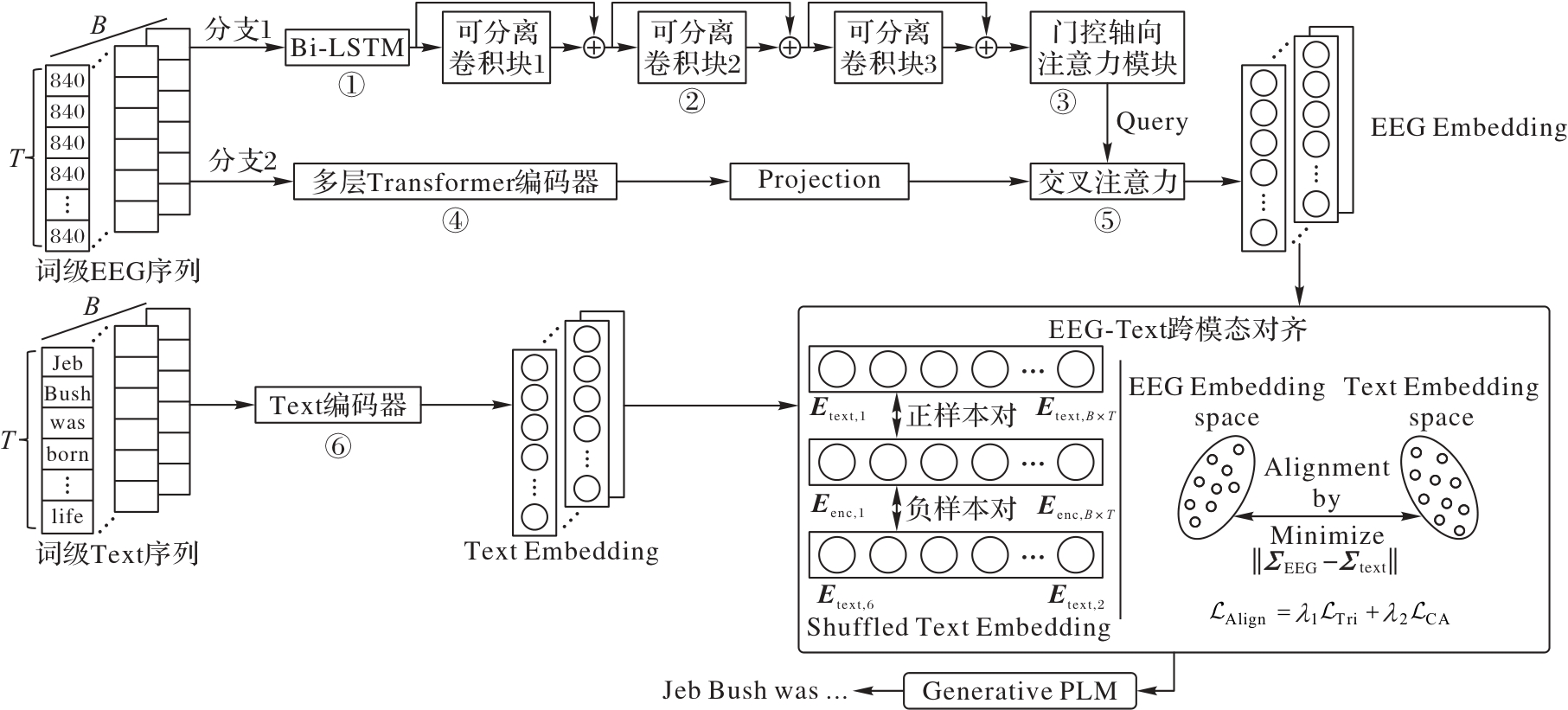
Fig. 1 Architecture of proposed model
| 数据集 | 受试者数 | 唯一句子数 | 训练样本数 | 测试样本数 |
|---|---|---|---|---|
| SR v1.0 | 12 | 400 | 3 391 | 418 |
| NR v1.0 | 12 | 300 | 2 406 | 321 |
| NR v2.0 | 18 | 349 | 4 456 | 601 |
Tab. 1 Detailed information of ZuCo datasets
| 数据集 | 受试者数 | 唯一句子数 | 训练样本数 | 测试样本数 |
|---|---|---|---|---|
| SR v1.0 | 12 | 400 | 3 391 | 418 |
| NR v1.0 | 12 | 300 | 2 406 | 321 |
| NR v2.0 | 18 | 349 | 4 456 | 601 |
| 序号 | 模块 | 参数设置 |
|---|---|---|
| 1 | Bi-LSTM | Insize=840, bidirectional, layers=1, hiddensize=420, outsize=1 024, 激活=GELU |
| 2 | 深度可分离 卷积块 | Insize=840, layers=3, outsize=840; depthwise: kernel=3,stride=1,pad=1; Pointwise: kernel_size=1;outsize=840;激活=ReLU |
| 3 | 门控轴向 自注意力 | Insize=840, layers=6, len=56, heads=8, ffn_dim=2 048;时间轴MHSA dim=840; 通道轴MHSA dim=56;门控激活=Sigmoid |
| 4 | Transformer 编码器 | Insize=840, layers=6, d_model=840, heads=8, ffndim=2 048,outsize=840; projection: insize=840, outsize=1 024 |
| 5 | 交叉 注意力层 | Insize=1 024, embed_dim=1 024, num_heads=8, outsize=1 024 |
| 6 | TextEncoder | Model=BART-Large, outsize=1 024 |
Tab. 2 Model network setting
| 序号 | 模块 | 参数设置 |
|---|---|---|
| 1 | Bi-LSTM | Insize=840, bidirectional, layers=1, hiddensize=420, outsize=1 024, 激活=GELU |
| 2 | 深度可分离 卷积块 | Insize=840, layers=3, outsize=840; depthwise: kernel=3,stride=1,pad=1; Pointwise: kernel_size=1;outsize=840;激活=ReLU |
| 3 | 门控轴向 自注意力 | Insize=840, layers=6, len=56, heads=8, ffn_dim=2 048;时间轴MHSA dim=840; 通道轴MHSA dim=56;门控激活=Sigmoid |
| 4 | Transformer 编码器 | Insize=840, layers=6, d_model=840, heads=8, ffndim=2 048,outsize=840; projection: insize=840, outsize=1 024 |
| 5 | 交叉 注意力层 | Insize=1 024, embed_dim=1 024, num_heads=8, outsize=1 024 |
| 6 | TextEncoder | Model=BART-Large, outsize=1 024 |
| 基线ID | EEG编码器 | 预训练语言模型 |
|---|---|---|
| EEG2Text[ | MTE | BART-Large[ |
| EEG2Text-B1 | MTE | BART-Base |
| EEG2Text-B2 | MTE | T5-base[ |
| EEG2Text-B3 | MTE | Pegasus-Large[ |
| EEG2Text-B4 | MTE | Pegasus-Sum |
Tab. 3 Information of baseline model
| 基线ID | EEG编码器 | 预训练语言模型 |
|---|---|---|
| EEG2Text[ | MTE | BART-Large[ |
| EEG2Text-B1 | MTE | BART-Base |
| EEG2Text-B2 | MTE | T5-base[ |
| EEG2Text-B3 | MTE | Pegasus-Large[ |
| EEG2Text-B4 | MTE | Pegasus-Sum |
| 模型 | BLEU-1 | BLEU-2 | BLEU-3 | BLEU-4 | ROUGE-p | ROUGE-r | ROUGE-f |
|---|---|---|---|---|---|---|---|
| EEG2Text | 40.12 | 23.18 | 12.61 | 6.80 | 28.84 | 31.69 | 30.10 |
| EEG2Text-B1 | 39.97 | 22.04 | 11.51 | 6.43 | 30.30 | 29.31 | 29.73 |
| EEG2Text-B2 | 30.42 | 16.38 | 8.75 | 4.56 | 13.80 | 20.99 | 15.30 |
| EEG2Text-B3 | 39.74 | 22.43 | 12.66 | 6.75 | 30.30 | 30.12 | 30.09 |
| EEG2Text-B4 | 38.98 | 21.36 | 11.81 | 6.38 | 29.69 | 29.02 | 29.24 |
| 本文模型 | 41.28 | 24.14 | 13.88 | 8.01 | 32.31 | 29.90 | 31.01 |
Tab. 4 Experiment results of different models
| 模型 | BLEU-1 | BLEU-2 | BLEU-3 | BLEU-4 | ROUGE-p | ROUGE-r | ROUGE-f |
|---|---|---|---|---|---|---|---|
| EEG2Text | 40.12 | 23.18 | 12.61 | 6.80 | 28.84 | 31.69 | 30.10 |
| EEG2Text-B1 | 39.97 | 22.04 | 11.51 | 6.43 | 30.30 | 29.31 | 29.73 |
| EEG2Text-B2 | 30.42 | 16.38 | 8.75 | 4.56 | 13.80 | 20.99 | 15.30 |
| EEG2Text-B3 | 39.74 | 22.43 | 12.66 | 6.75 | 30.30 | 30.12 | 30.09 |
| EEG2Text-B4 | 38.98 | 21.36 | 11.81 | 6.38 | 29.69 | 29.02 | 29.24 |
| 本文模型 | 41.28 | 24.14 | 13.88 | 8.01 | 32.31 | 29.90 | 31.01 |
| 模型 | BLEU-1 | BLEU-2 | BLEU-3 | BLEU-4 | ROUGE-p | ROUGE-r | ROUGE-f |
|---|---|---|---|---|---|---|---|
| 本文模型 | 41.28 | 24.14 | 13.88 | 8.01 | 32.31 | 29.90 | 31.01 |
| 消融1 | 40.35 | 23.14 | 12.94 | 7.28 | 31.95 | 29.19 | 30.47 |
| 消融2 | 40.00 | 22.60 | 12.11 | 6.37 | 31.77 | 29.19 | 30.38 |
| 消融3 | 40.38 | 23.21 | 12.74 | 6.92 | 32.54 | 29.44 | 30.87 |
Tab. 5 Ablation experiment results
| 模型 | BLEU-1 | BLEU-2 | BLEU-3 | BLEU-4 | ROUGE-p | ROUGE-r | ROUGE-f |
|---|---|---|---|---|---|---|---|
| 本文模型 | 41.28 | 24.14 | 13.88 | 8.01 | 32.31 | 29.90 | 31.01 |
| 消融1 | 40.35 | 23.14 | 12.94 | 7.28 | 31.95 | 29.19 | 30.47 |
| 消融2 | 40.00 | 22.60 | 12.11 | 6.37 | 31.77 | 29.19 | 30.38 |
| 消融3 | 40.38 | 23.21 | 12.74 | 6.92 | 32.54 | 29.44 | 30.87 |
| BLEU-1/% | ROUGE-f/% | ||
|---|---|---|---|
| 1.0 | 1.0 | 41.28 | 31.01 |
| 1.0 | 0.0 | 40.52 | 30.80 |
| 0.0 | 1.0 | 39.73 | 30.52 |
| 2.0 | 1.0 | 40.43 | 30.40 |
| 1.5 | 1.0 | 40.91 | 30.93 |
| 1.2 | 0.8 | 41.13 | 31.04 |
Tab. 6 Impact of weights of joint loss on model performance
| BLEU-1/% | ROUGE-f/% | ||
|---|---|---|---|
| 1.0 | 1.0 | 41.28 | 31.01 |
| 1.0 | 0.0 | 40.52 | 30.80 |
| 0.0 | 1.0 | 39.73 | 30.52 |
| 2.0 | 1.0 | 40.43 | 30.40 |
| 1.5 | 1.0 | 40.91 | 30.93 |
| 1.2 | 0.8 | 41.13 | 31.04 |
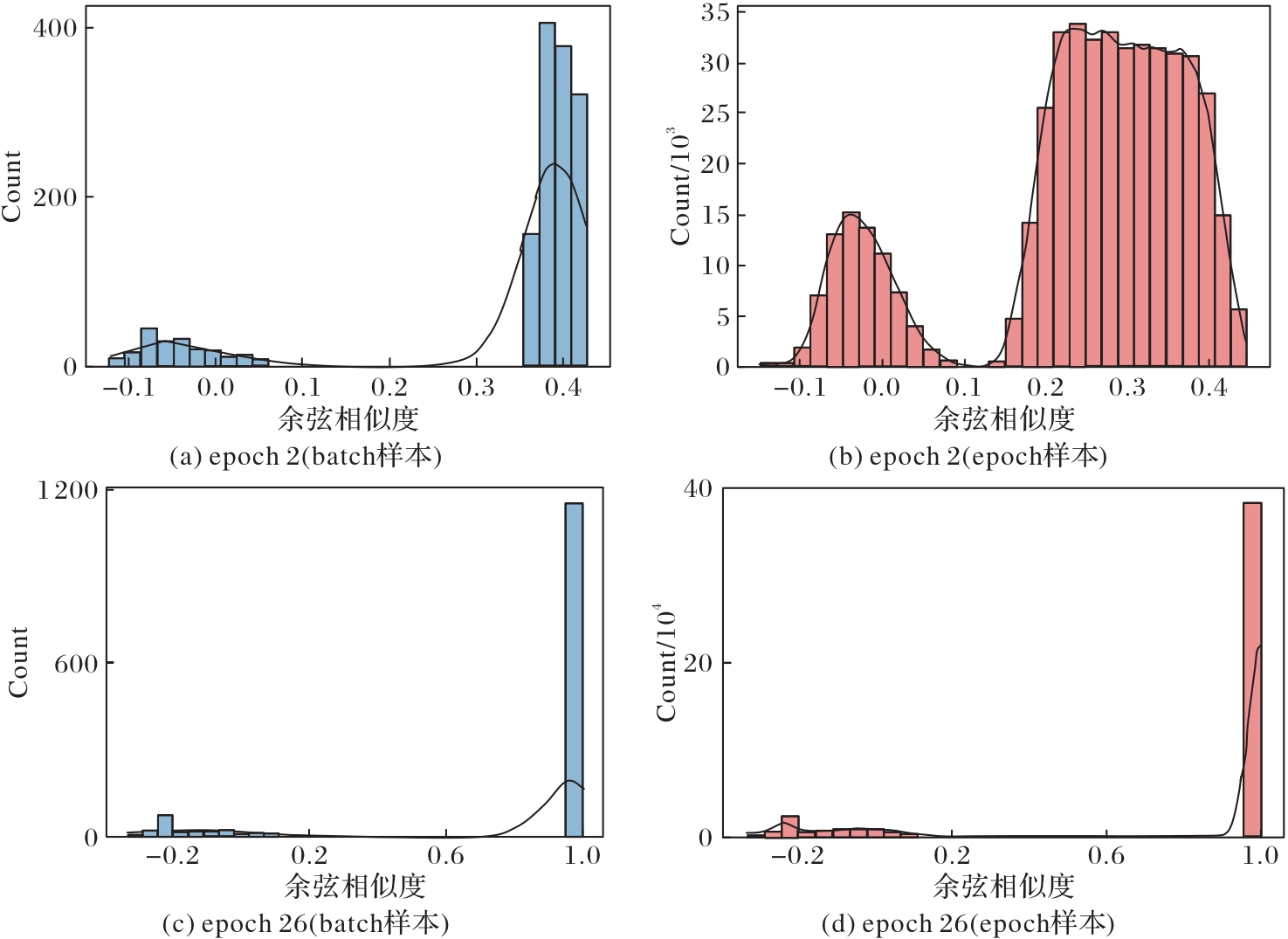
Fig. 2 EEG-Text representation similarity histograms
| 示例 | 类型 | 内容 |
|---|---|---|
| 1 | 目标句 | While attending |
| 生成句 | in | |
| 2 | 目标句 | Jeb |
| 生成句 | ||
| 3 | 目标句 | Their three children, now grown, are |
| 生成句 | first children, all grown, are all,. | |
| 4 | 目标句 | Bush attended the Studies in |
| 生成句 | was the | |
| 5 | 目标句 | Jeb |
| 生成句 |
Tab. 7 Case study
| 示例 | 类型 | 内容 |
|---|---|---|
| 1 | 目标句 | While attending |
| 生成句 | in | |
| 2 | 目标句 | Jeb |
| 生成句 | ||
| 3 | 目标句 | Their three children, now grown, are |
| 生成句 | first children, all grown, are all,. | |
| 4 | 目标句 | Bush attended the Studies in |
| 生成句 | was the | |
| 5 | 目标句 | Jeb |
| 生成句 |
| [1] | Gibson M, Newman-Norlund R, Bonilha L, et al. The Aphasia Recovery Cohort, an open-source chronic stroke repository [J]. Scientific Data, 2024, 11: No.981. |
| [2] | Peitz D, Schumann-Werner B, Hussmann K, et al. Success rates of intensive aphasia therapy: real-world data from 448 patients between 2003 and 2020 [J]. Journal of Neurology, 2024, 271(11): 7169-7183. |
| [3] | Le H, Lui F, Lui M Y. Aphasia[EB/OL]. (2024-10-29) [2025-09-02].. |
| [4] | Birbaumer N, Cohen L G. Brain-computer interfaces: communication and restoration of movement in paralysis [J]. The Journal of Physiology, 2007, 579(3): 621-636. |
| [5] | Metzger S L, Littlejohn K T, Silva A B, et al. A high-performance speech neuroprosthesis for speech decoding and avatar control [J]. Nature, 2023, 620(7976): 1031-1036. |
| [6] | Akbari H, Khalighinejad B, Herrero J L, et al. Towards reconstructing intelligible speech from the human auditory cortex[J]. Scientific Reports, 2019, 9: No.874. |
| [7] | Panachakel J T, Ramakrishnan A G. Decoding covert speech from EEG: a comprehensive review [J]. Frontiers in Neuroscience, 2021, 15: No.642251. |
| [8] | Willett F R, Avansino D T, Hochberg L R, et al. High-performance brain-to-text communication via handwriting [J]. Nature, 2021, 593(7858): 249-254. |
| [9] | Moses D A, Metzger S L, Liu J R, et al. Neuroprosthesis for decoding speech in a paralyzed person with anarthria [J]. The New England Journal of Medicine, 2021, 385(3): 217-227. |
| [10] | 陈景霞,郝为,张鹏伟,等. 基于混合神经网络的脑电时空特征情感分类[J]. 软件学报, 2021, 32(12): 3869-3883. |
| Chen Jingxia, Hao Wei, Zhang Pengwei, et al. Emotion classification of spatiotemporal EEG features using hybrid neural networks [J]. Journal of Software, 2021, 32(12): 3869-3883. | |
| [11] | 李锦瑶,杜肖兵,朱志亮,等. 脑电情绪识别的深度学习研究综述[J]. 软件学报, 2023, 34(1): 255-276. |
| Li Jingyao, Du Xiaobing, Zhu Zhiliang, et al. Deep learning for EEG-based emotion recognition: a survey [J]. Journal of Software, 2023, 34(1): 255-276. | |
| [12] | Nicolas-Alonso L F, Gomez-Gil J. Brain-computer interfaces, a review [J]. Sensors, 2012, 12(2): 1211-1279. |
| [13] | Mahajan G, Divija L, Jeevan R, et al. A survey on deciphering of EEG waves [C]// ISI 2023, SIST 389. Singapore: Springer, 2025: 391-404. |
| [14] | Srivastava A, Shinde T, Ansari R A, et al. Think2Type: thoughts to text using EEG waves [J]. International Journal of Engineering Research, 2020, 9(6): 659-664. |
| [15] | Wang Z, Ji H. Open vocabulary electroencephalography-to-text decoding and zero-shot sentiment classification [J]. Proceedings of the AAAI Conference on Artificial Intelligence, 2022, 36(5): 5350-5358. |
| [16] | Lewis M, Liu Y, Goyal N, et al. BART: denoising sequence-to-sequence pre-training for natural language generation, translation, and comprehension [C]// ACL 2020. Stroudsburg: ACL, 2020: 7871-7880. |
| [17] | Brigham K, Kumar B V K V. Imagined speech classification with EEG signals for silent communication: a preliminary investigation into synthetic telepathy [C]// 2010 4th International Conference on Bioinformatics and Biomedical Engineering. Piscataway: IEEE, 2010: 1-4. |
| [18] | Wehbe L, Vaswani A, Knight K, Mitchell T. Aligning context-based statistical models of language with brain activity during reading [C]// EMNLP 2014. Stroudsburg: ACL, 2014: 233-243. |
| [19] | 代成龙,李光辉,李栋,等. 多项正则化约束的伪标签传播优化脑电信号聚类[J]. 计算机研究与发展, 2024, 61(1): 156-171. |
| Dai Chenglong, Li Guanghui, Li Dong, et al. Electroencephalogram clustering with multiple regularization constrained pseudo label propagation optimization [J]. Journal of Computer Research and Development, 2024, 61(1): 156-171. | |
| [20] | Makin J G, Moses D A, Chang E F. Machine translation of cortical activity to text with an encoder-decoder framework [J]. Nature Neuroscience, 2020, 23(4): 575-582. |
| [21] | Hollenstein N, Rengli C, Glaus B, et al. Decoding EEG brain activity for multimodal natural language processing [J]. Frontiers in Human Neuroscience, 2021, 15: No.659410. |
| [22] | Qiu J, Han W, Zhu J, et al. Can brain signals reveal inner alignment with human languages? [C]// Findings of the Association for Computational Linguistics: EMNLP 2023. Stroudsburg: ACL, 2023: 1789-1804. |
| [23] | Défossez A, Caucheteux C, Rapin J, et al. Decoding speech perception from non-invasive brain recordings [J]. Nature Machine Intelligence, 2023, 5(10): 1097-1107. |
| [24] | Amrani H, Micucci D, Napoletano P. Deep representation learning for open vocabulary electroencephalography-to-text decoding [J]. IEEE Journal of Biomedical and Health Informatics, 2026, 30(4): 3593-3600. |
| [25] | Duan Y, Zhou J, Wang Z, et al. DeWave: discrete encoding of EEG waves for EEG-to-text translation [C]// NeurIPS 2023. Red Hook: Curran Associates Inc., 2023: 9907-9918. |
| [26] | Schroff F, Kalenichenko D, Philbin J. FaceNet: a unified embedding for face recognition and clustering [C]// CVPR 2015. Piscataway: IEEE, 2015: 815-823. |
| [27] | Sun B, Saenko K. Deep CORAL: correlation alignment for deep domain adaptation[C]// ECCV 2016. Cham: Springer, 2016: 443-450. |
| [28] | Hollenstein N, Rotsztejn J, Troendle M, et al. ZuCo, a simultaneous EEG and eye-tracking resource for natural sentence reading [J]. Scientific Data, 2018, 5: No.180291. |
| [29] | Hollenstein N, Troendle M, Zhang C, et al. ZuCo 2.0: a dataset of physiological recordings during natural reading and annotation[C]// LREC 2020. Stroudsburg: ACL, 2020: 138-146. |
| [30] | Paszke A, Gross S, Massa F, et al. PyTorch: an imperative style, high-performance deep learning library [C]// NeurIPS 2019. Red Hook: Curran Associates Inc., 2019: 8026-8037. |
| [31] | Wolf T, Debut L, Sanh V, et al. Transformers: state-of-the-art natural language processing [C]// EMNLP 2020: System Demonstrations. Stroudsburg: ACL, 2020: 38-45. |
| [32] | Raffel C, Shazeer N, Roberts A, et al. Exploring the limits of transfer learning with a unified text-to-text Transformer [J]. Journal of Machine Learning Research, 2020, 21: 1-67. |
| [33] | Zhang J, Zhao Y, Saleh M, et al. PEGASUS: pre-training with extracted gap-sentences for abstractive summarization [J]. Proceedings of Machine Learning Research, 2020, 119: 11328-11339. |
| [34] | Papineni K, Roukos S, Ward T, Zhu W J. BLEU: a method for automatic evaluation of machine translation [C]// ACL 2002. Stroudsburg: ACL, 2002: 311-318. |
| [35] | Lin C Y. ROUGE: a package for automatic evaluation of summaries [C]// ACL-04 Workshop: Text Summarization Branches Out. Stroudsburg: ACL, 2004: 74-81. |
| [1] | Siyu DONG, Xin JIA, Mi ZHANG, Xinwen CHEN, Xinying SUN, Fangxiao CHENG. CNN-Transformer encoder-based model for depressive state recognition with multidimensional EEG feature fusion [J]. Journal of Computer Applications, 2026, 46(9): 3025-3034. |
| [2] | Kan HE, Hongfeng MA, Xuejun ZONG, Hongyan SHI, Lian LIAN, Bowei NING. DCSFFuzzer: dual-channel semantic feature fusion-based fuzz testing method for industrial control protocols [J]. Journal of Computer Applications, 2026, 46(9): 2877-2888. |
| [3] | Jiangyan CHEN, Yandan WANG, Yihu LIU, Yinglong MA. Collaborative query optimization-based framework for long-tailed object detection [J]. Journal of Computer Applications, 2026, 46(9): 2769-2775. |
| [4] | Dingli YANG, Yuanfang WEI, Wenrui HU, Liyang KONG, Yinshan YU. Spatio-temporal modeling and hierarchical feature enhancement for person re-identification [J]. Journal of Computer Applications, 2026, 46(9): 2776-2786. |
| [5] | Jiangyu YAN, Shiqian WANG, Hong WANG. Electricity theft detection method based on improved Wasserstein generative adversarial network with gradient penalty and time-frequency feature fusion [J]. Journal of Computer Applications, 2026, 46(8): 2691-2698. |
| [6] | Lin HUANG, Yingshun LI, Weiyan TONG, Shuyuan ZHANG, Zihan WANG. Remote sensing image object detection algorithm based on improved real-time detection Transformer [J]. Journal of Computer Applications, 2026, 46(8): 2652-2659. |
| [7] | Ming LIU, Dongqi SHEN, Ziyang MENG. Point cloud registration network with dual-branch multi-level feature fusion [J]. Journal of Computer Applications, 2026, 46(8): 2584-2593. |
| [8] | Guoyou ZHANG, Hongyu NIE, Lihu PAN, Rundong LEI. Point-MLPBLS: point cloud semantic segmentation network based on MLP cascaded broad learning system [J]. Journal of Computer Applications, 2026, 46(7): 2259-2266. |
| [9] | Hailin XIAO, Qingyang CAO, Hailong JIANG, Zhongshan ZHANG, Zhiqun HU. Channel estimation algorithm for orthogonal frequency division multiplexing system based on deep neural network [J]. Journal of Computer Applications, 2026, 46(7): 2250-2258. |
| [10] | Songhao ZHU, Zhiyun ZHAO, Mengling WANG. Low-light image enhancement network based on lightweight residual and brightness-aware dynamic feature fusion [J]. Journal of Computer Applications, 2026, 46(6): 1936-1946. |
| [11] | Chao LYU, Geyao MA. Lightweight human pose estimation network based on redundant feature suppression [J]. Journal of Computer Applications, 2026, 46(6): 1973-1980. |
| [12] | Minqi WU, Yuanhua YANG, Hang LI, Yaqin HU, Zhihao TANG, Teng MEI. Lightweight underwater small object detection based on graph Transformer and RT-DETR [J]. Journal of Computer Applications, 2026, 46(5): 1586-1595. |
| [13] | Hongrui ZHANG, Weiming FENG, Luxia YANG, Yongjie MA. CSAF-YOLO: improved YOLO11 algorithm for underwater small object detection [J]. Journal of Computer Applications, 2026, 46(5): 1578-1585. |
| [14] | Xuechao LIAO, Rui CHEN. Prediction-evaluation framework for anomaly detection in electric vehicle lithium-ion battery [J]. Journal of Computer Applications, 2026, 46(5): 1614-1623. |
| [15] | Yuqian HUANG, Hui HUANG, Yongbin QIN, Ruizhang HUANG, Yanping CHEN, Yulin ZHOU, Qian SUN. Judicial element extraction method by integrating global and local semantics [J]. Journal of Computer Applications, 2026, 46(5): 1460-1467. |
| Viewed | ||||||
|
Full text |
|
|||||
|
Abstract |
|
|||||
