


Journal of Computer Applications ›› 2026, Vol. 46 ›› Issue (9): 2776-2786.DOI: 10.11772/j.issn.1001-9081.2025081053
• Artificial intelligence • Previous Articles
Dingli YANG( ), Yuanfang WEI, Wenrui HU, Liyang KONG, Yinshan YU
Received:2025-09-11
Revised:2025-12-18
Accepted:2026-01-04
Online:2026-02-12
Published:2026-09-10
Contact:
Dingli YANG
About author:YANG Dingli, born in 1973, M. S., associate professor. His research interests include deep learning, image signal processing.Supported by:
杨定礼(), 卫元芳, 胡文瑞, 孔力杨, 于银山
通讯作者:
杨定礼
作者简介:杨定礼(1973—),男,淮安金湖人,副教授,硕士,CCF会员,主要研究方向:深度学习、图像信号处理基金资助:CLC Number:
Dingli YANG, Yuanfang WEI, Wenrui HU, Liyang KONG, Yinshan YU. Spatio-temporal modeling and hierarchical feature enhancement for person re-identification[J]. Journal of Computer Applications, 2026, 46(9): 2776-2786.
杨定礼, 卫元芳, 胡文瑞, 孔力杨, 于银山. 时空建模与层次化特征增强的行人重识别算法[J]. 《计算机应用》唯一官方网站, 2026, 46(9): 2776-2786.
Add to citation manager EndNote|Ris|BibTeX
URL: https://www.joca.cn/EN/10.11772/j.issn.1001-9081.2025081053
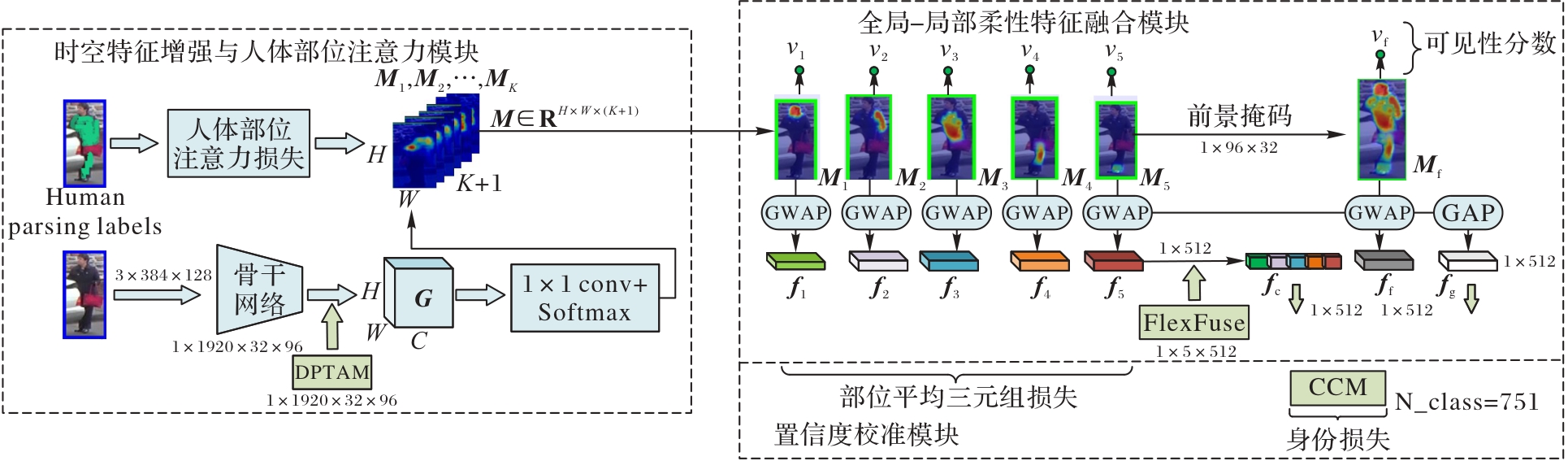
Fig. 1 Network structure of proposed algorithm
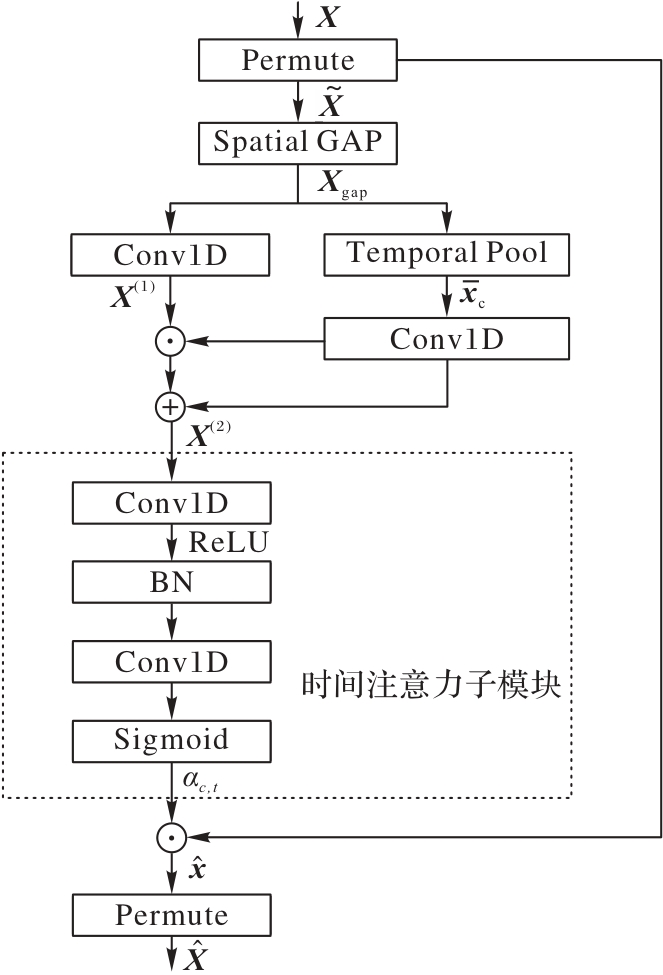
Fig. 2 Network structure of DPTAM
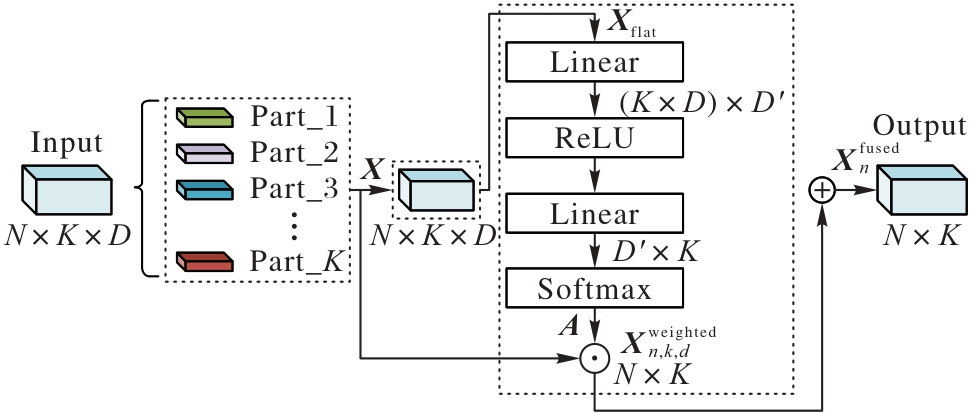
Fig. 3 Network structure of FlexFuse
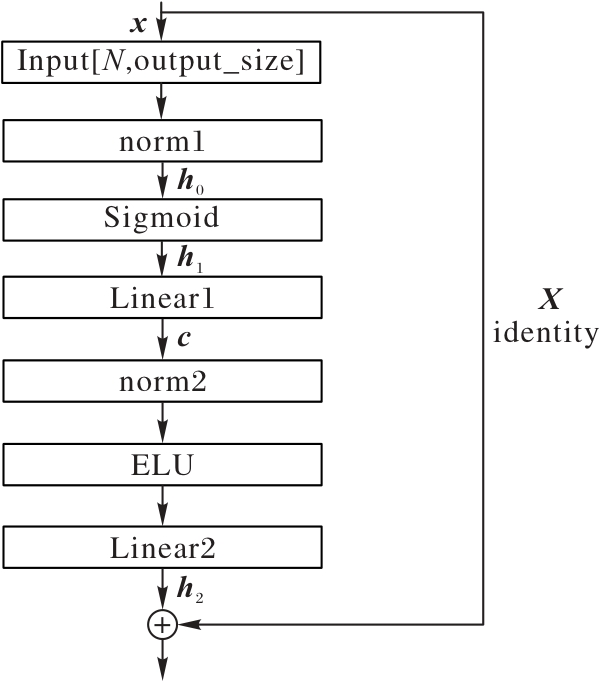
Fig. 4 Network structure of CCM Block
| Rank-1/% | mAP/% | Rank-1/% | mAP/% | ||
|---|---|---|---|---|---|
| 0.10 | 94.2 | 83.7 | 0.35 | 97.3 | 93.2 |
| 0.20 | 94.5 | 84.0 | 0.50 | 96.7 | 92.5 |
Tab. 1 Impact of structure loss weight λpa on model performance
| Rank-1/% | mAP/% | Rank-1/% | mAP/% | ||
|---|---|---|---|---|---|
| 0.10 | 94.2 | 83.7 | 0.35 | 97.3 | 93.2 |
| 0.20 | 94.5 | 84.0 | 0.50 | 96.7 | 92.5 |
| 数据集 | 摄像机数 | 身份数 | 图像数 |
|---|---|---|---|
| Market-1501[ | 6 | 1 501 | 32 668 |
| Occluded-Duke[ | 8 | 1 404 | 46 261 |
| Occluded-ReID[ | 1 | 200 | 2 000 |
| P-DukeMTMC | 8 | 1 812 | 85 324 |
Tab. 2 Dataset information
| 数据集 | 摄像机数 | 身份数 | 图像数 |
|---|---|---|---|
| Market-1501[ | 6 | 1 501 | 32 668 |
| Occluded-Duke[ | 8 | 1 404 | 46 261 |
| Occluded-ReID[ | 1 | 200 | 2 000 |
| P-DukeMTMC | 8 | 1 812 | 85 324 |
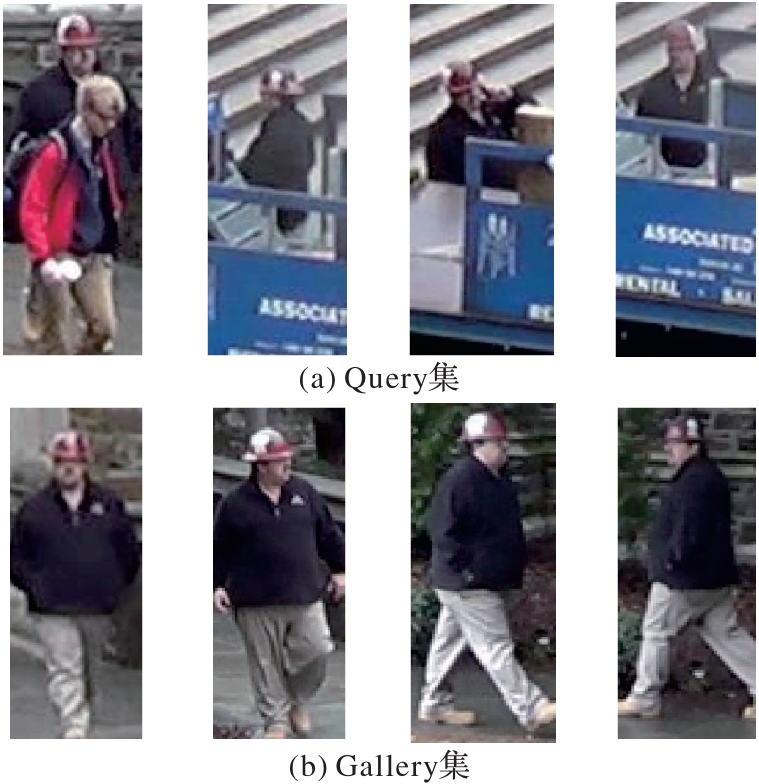
Fig. 5 Sample images of pedestrian from P-DukeMTMC dataset
| 方法 | Market-1501 | Occluded-Duke | Occluded-ReID | P-DukeMTMC | ||||
|---|---|---|---|---|---|---|---|---|
| Rank-1 | mAP | Rank-1 | mAP | Rank-1 | mAP | Rank-1 | mAP | |
| BoT[ | 94.5 | 85.9 | 51.4 | 44.7 | 58.4 | 52.3 | 87.0 | 74.9 |
| SGAM[ | 91.4 | 67.3 | 55.1 | 35.3 | — | — | — | — |
| PGFA[ | 91.2 | 76.8 | 51.4 | 37.3 | — | — | 44.2 | 23.1 |
| MHSA[ | 94.6 | 84.0 | 59.7 | 44.8 | — | — | 70.7 | 41.1 |
| VGTri[ | — | — | 62.2 | 46.3 | 81.0 | 71.0 | — | — |
| OAMN[ | 93.2 | 79.8 | 62.6 | 46.1 | — | — | — | — |
| HG[ | 95.6 | 86.1 | 61.4 | 50.5 | — | — | — | — |
| SSGR[ | 96.1 | 89.3 | 69.0 | 57.2 | 78.5 | 72.9 | — | — |
| PVPM[ | — | — | — | — | 66.8 | 59.5 | 85.1 | 69.9 |
| HOReID[ | 94.2 | 84.9 | 55.1 | 43.8 | 80.3 | 70.2 | — | — |
| TransReIDDeiT[ | 95.2 | 89.5 | — | — | — | — | — | — |
| TransReIDViT[ | 95.1 | 88.5 | — | — | — | — | — | — |
| PFD[ | 95.5 | 89.7 | 69.5 | 61.8 | 81.5 | 83.0 | — | — |
| LDS[ | 95.8 | 90.3 | 64.3 | 55.7 | — | — | 91.9 | 82.9 |
| FED[ | 95.0 | 86.3 | 68.1 | 56.4 | 86.3 | 79.3 | — | — |
| PGFL[ | 95.3 | 87.2 | 63.0 | 54.1 | 80.7 | 70.3 | 81.1 | 64.2 |
| PAT[ | 95.4 | 88.0 | 64.5 | 53.6 | 81.6 | 72.1 | — | — |
| BPBReIDRI | 95.7 | 88.4 | 71.3 | 57.5 | 77.0 | 70.9 | 91.3 | 79.2 |
| BPBReIDHR | 95.7 | 89.4 | 75.1 | 62.5 | 82.9 | 75.2 | 93.0 | 83.2 |
| 本文方法 | 97.4 | 93.2 | 77.7 | 66.4 | 84.6 | 78.9 | 95.2 | 86.8 |
Tab. 3 Experimental results of different methods on occlusion pedestrian dataset
| 方法 | Market-1501 | Occluded-Duke | Occluded-ReID | P-DukeMTMC | ||||
|---|---|---|---|---|---|---|---|---|
| Rank-1 | mAP | Rank-1 | mAP | Rank-1 | mAP | Rank-1 | mAP | |
| BoT[ | 94.5 | 85.9 | 51.4 | 44.7 | 58.4 | 52.3 | 87.0 | 74.9 |
| SGAM[ | 91.4 | 67.3 | 55.1 | 35.3 | — | — | — | — |
| PGFA[ | 91.2 | 76.8 | 51.4 | 37.3 | — | — | 44.2 | 23.1 |
| MHSA[ | 94.6 | 84.0 | 59.7 | 44.8 | — | — | 70.7 | 41.1 |
| VGTri[ | — | — | 62.2 | 46.3 | 81.0 | 71.0 | — | — |
| OAMN[ | 93.2 | 79.8 | 62.6 | 46.1 | — | — | — | — |
| HG[ | 95.6 | 86.1 | 61.4 | 50.5 | — | — | — | — |
| SSGR[ | 96.1 | 89.3 | 69.0 | 57.2 | 78.5 | 72.9 | — | — |
| PVPM[ | — | — | — | — | 66.8 | 59.5 | 85.1 | 69.9 |
| HOReID[ | 94.2 | 84.9 | 55.1 | 43.8 | 80.3 | 70.2 | — | — |
| TransReIDDeiT[ | 95.2 | 89.5 | — | — | — | — | — | — |
| TransReIDViT[ | 95.1 | 88.5 | — | — | — | — | — | — |
| PFD[ | 95.5 | 89.7 | 69.5 | 61.8 | 81.5 | 83.0 | — | — |
| LDS[ | 95.8 | 90.3 | 64.3 | 55.7 | — | — | 91.9 | 82.9 |
| FED[ | 95.0 | 86.3 | 68.1 | 56.4 | 86.3 | 79.3 | — | — |
| PGFL[ | 95.3 | 87.2 | 63.0 | 54.1 | 80.7 | 70.3 | 81.1 | 64.2 |
| PAT[ | 95.4 | 88.0 | 64.5 | 53.6 | 81.6 | 72.1 | — | — |
| BPBReIDRI | 95.7 | 88.4 | 71.3 | 57.5 | 77.0 | 70.9 | 91.3 | 79.2 |
| BPBReIDHR | 95.7 | 89.4 | 75.1 | 62.5 | 82.9 | 75.2 | 93.0 | 83.2 |
| 本文方法 | 97.4 | 93.2 | 77.7 | 66.4 | 84.6 | 78.9 | 95.2 | 86.8 |
| 人体部位特征 | mAP | Rank-1 | Rank-5 | Rank-10 |
|---|---|---|---|---|
| P0 | 93.7 | 97.6 | 99.4 | 99.6 |
| P1 | 16.3 | 42.4 | 61.1 | 68.0 |
| P2 | 57.9 | 80.0 | 91.1 | 94.2 |
| P3 | 54.4 | 79.0 | 90.2 | 93.2 |
| P4 | 51.3 | 73.7 | 87.7 | 91.3 |
| P5 | 25.2 | 48.5 | 67.6 | 73.0 |
Tab. 4 Independent retrieval performance of different body part feature embeddings
| 人体部位特征 | mAP | Rank-1 | Rank-5 | Rank-10 |
|---|---|---|---|---|
| P0 | 93.7 | 97.6 | 99.4 | 99.6 |
| P1 | 16.3 | 42.4 | 61.1 | 68.0 |
| P2 | 57.9 | 80.0 | 91.1 | 94.2 |
| P3 | 54.4 | 79.0 | 90.2 | 93.2 |
| P4 | 51.3 | 73.7 | 87.7 | 91.3 |
| P5 | 25.2 | 48.5 | 67.6 | 73.0 |
| 方法 | DPTAM | FlexFuse | CCM | mAP/% | Rank-1/% | FLOPs/109 | 参数量/106 | 帧率/(frame·s-1) |
|---|---|---|---|---|---|---|---|---|
| Baseline | 89.4 | 95.7 | 8.07 | 39.85 | 34.05 | |||
| +DPTAM | | 92.9 | 96.0 | 8.02 | 50.91 | 32.84 | ||
| +FlexFuse | | 89.5 | 95.8 | 8.00 | 39.62 | 34.09 | ||
| +DPTAM+FlexFuse | | | 93.1 | 97.3 | 8.02 | 50.68 | 32.02 | |
| +DPTAM+CCM | | | 93.0 | 97.4 | 8.02 | 51.51 | 33.13 | |
| 本文方法 | | | | 93.2 | 97.4 | 8.02 | 51.28 | 33.88 |
Tab. 5 Ablation experiment results of various modules
| 方法 | DPTAM | FlexFuse | CCM | mAP/% | Rank-1/% | FLOPs/109 | 参数量/106 | 帧率/(frame·s-1) |
|---|---|---|---|---|---|---|---|---|
| Baseline | 89.4 | 95.7 | 8.07 | 39.85 | 34.05 | |||
| +DPTAM | | 92.9 | 96.0 | 8.02 | 50.91 | 32.84 | ||
| +FlexFuse | | 89.5 | 95.8 | 8.00 | 39.62 | 34.09 | ||
| +DPTAM+FlexFuse | | | 93.1 | 97.3 | 8.02 | 50.68 | 32.02 | |
| +DPTAM+CCM | | | 93.0 | 97.4 | 8.02 | 51.51 | 33.13 | |
| 本文方法 | | | | 93.2 | 97.4 | 8.02 | 51.28 | 33.88 |
人体 部位特征 | 部位 | Query 可见性 | Gallery 可见性 | 配对 可见性 |
|---|---|---|---|---|
| P0 | 头部 | 100.0 | 99.8 | 100 |
| P1 | 躯干 | 99.5 | 83.0 | 79 |
| P2 | 上肢 | 99.7 | 99.2 | 98 |
| P3 | 手臂 | 99.6 | 98.5 | 96 |
| P4 | 手部 | 99.8 | 99.0 | 97 |
| P5 | 双脚/腿部 | 99.4 | 90.0 | 88 |
Tab. 6 Visibility analysis of various body parts in Query and Gallery samples
人体 部位特征 | 部位 | Query 可见性 | Gallery 可见性 | 配对 可见性 |
|---|---|---|---|---|
| P0 | 头部 | 100.0 | 99.8 | 100 |
| P1 | 躯干 | 99.5 | 83.0 | 79 |
| P2 | 上肢 | 99.7 | 99.2 | 98 |
| P3 | 手臂 | 99.6 | 98.5 | 96 |
| P4 | 手部 | 99.8 | 99.0 | 97 |
| P5 | 双脚/腿部 | 99.4 | 90.0 | 88 |
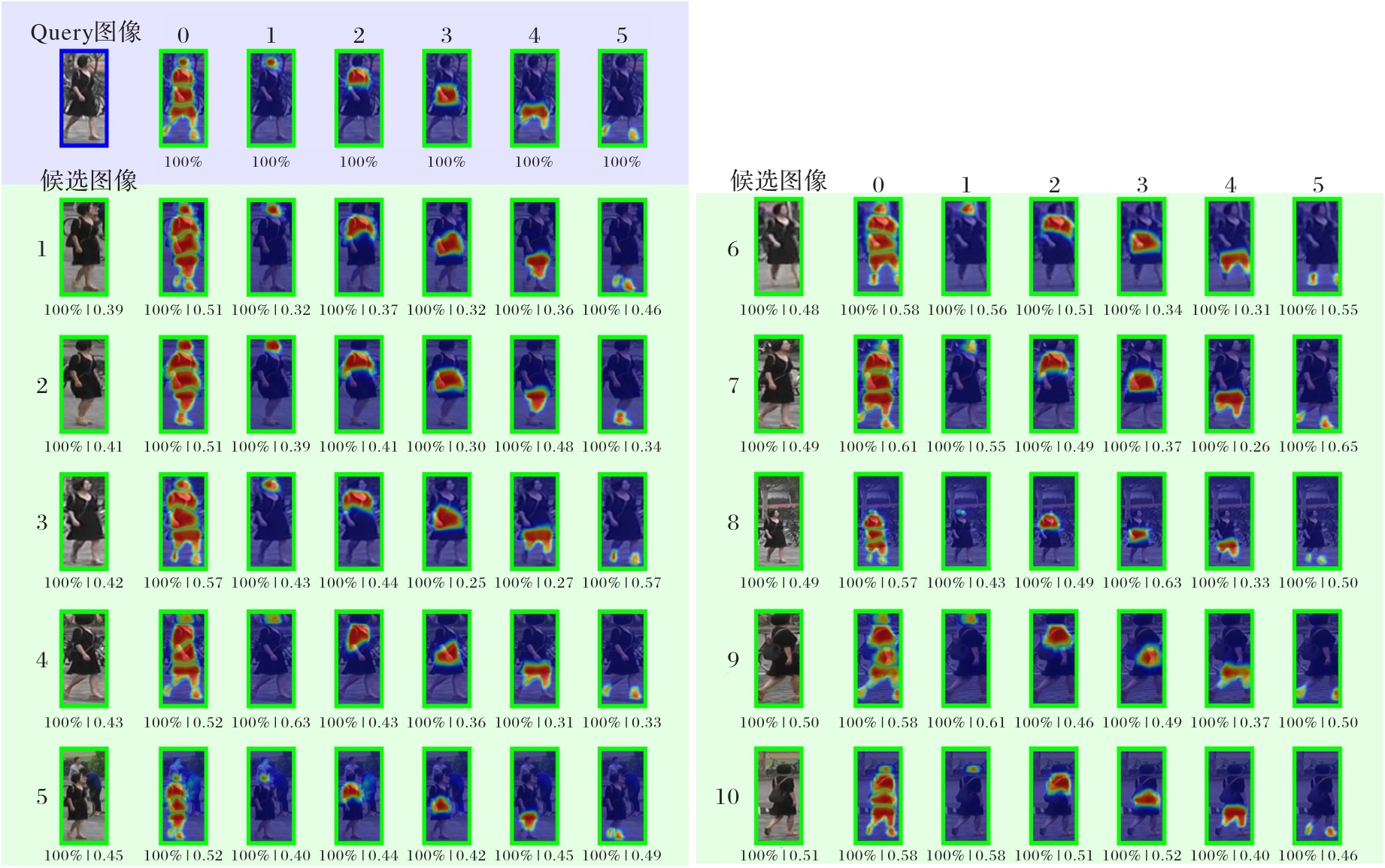
Fig. 6 Heatmap visualization results under non-occluded scenarios

Fig. 7 Heatmap visualization results under partially occluded scenarios
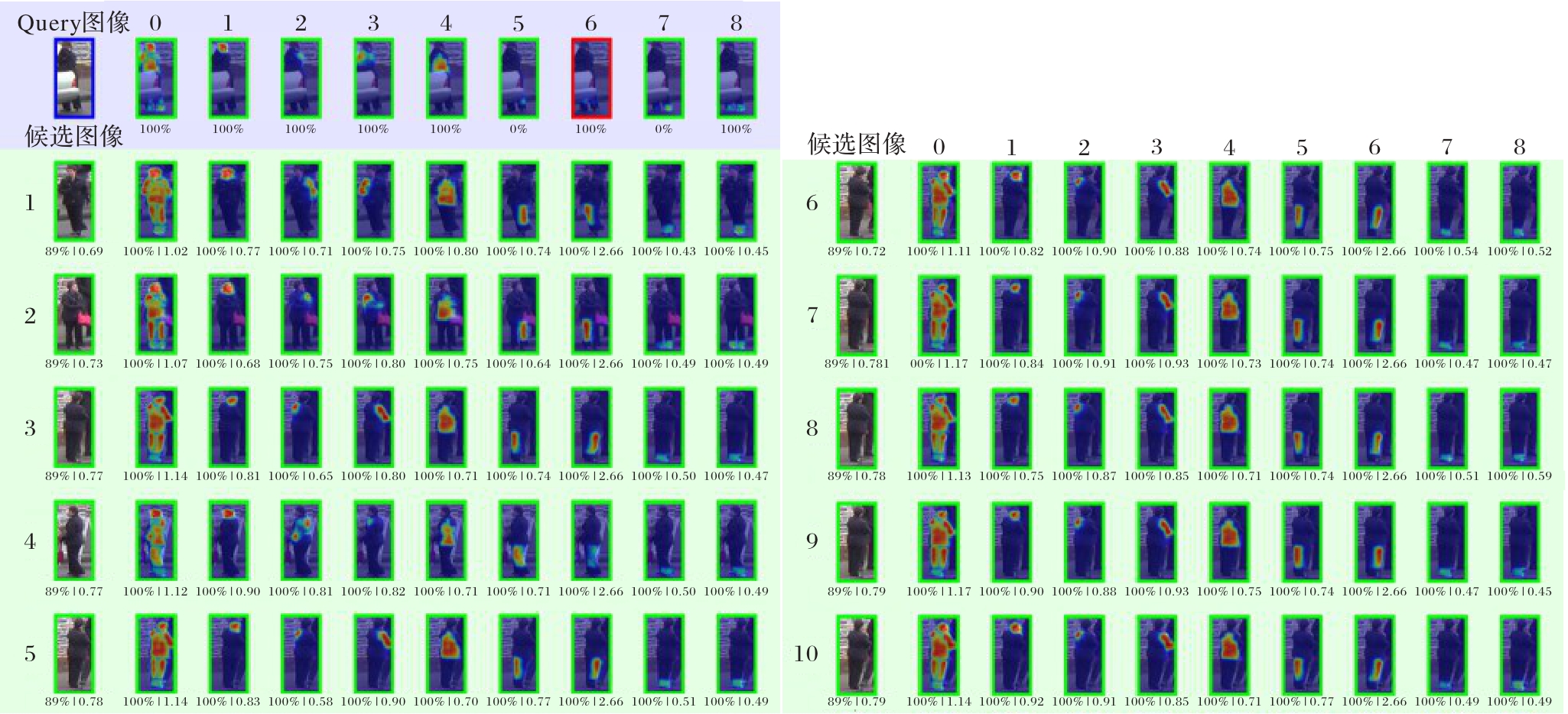
Fig. 8 Heatmap visualization results under heavily occluded scenarios
| [1] | Ye M, Shen J, Lin G, et al. Deep learning for person re-identification: a survey and outlook [J]. IEEE Transactions on Pattern Analysis and Machine Intelligence, 2022, 44(6): 2872-2893. |
| [2] | 石瑞鑫,智敏,殷雁君. 多模态行人重识别研究综述[J]. 计算机应用研究, 2025, 42(7): 1921-1929. |
| Shi Ruixin, Zhi Min, Yin Yanjun. Review of multi-modal person re-identification [J]. Application Research of Computers, 2025, 42(7): 1921-1929. | |
| [3] | 罗浩,姜伟,范星,等. 基于深度学习的行人重识别研究进展[J]. 自动化学报, 2019, 45(11): 2032-2049. |
| Luo Hao, Jiang Wei, Fan Xing, et al. A survey on deep learning based person re-identification [J]. Acta Automatica Sinica, 2019, 45(11): 2032-2049. | |
| [4] | Sun Y, Zheng L, Yang Y, et al. Beyond part models: person retrieval with refined part pooling (and a strong convolutional baseline) [C]// ECCV 2018, LNCS 11208. Cham: Springer, 2018: 501-518. |
| [5] | Qian X, Fu Y, Xiang T, et al. Pose-normalized image generation for person re-identification [C]// ECCV 2018, LNCS 11213. Cham: Springer, 2018: 661-678. |
| [6] | Che J, Zhang Y, Yang Q, et al. Research on person re-identification based on posture guidance and feature alignment [J]. Multimedia Systems, 2023, 29(2): 763-770. |
| [7] | Yan G, Wang Z, Geng S, et al. Part-based representation enhancement for occluded person re-identification [J]. IEEE Transactions on Circuits and Systems for Video Technology, 2023, 33(8): 4217-4231. |
| [8] | Liu C, Ma H. DADnet: a network pays attention to details and improve distinguishability for person re-identification [J]. Digital Signal Processing, 2025, 159: No.105027. |
| [9] | Tang Q, Ren Y, Shan Z, et al. Dual-branch aggregation and edge refinement network for few shot semantic segmentation [J]. Multimedia Systems, 2025, 31(2): No.142. |
| [10] | Li Y, Ma M, Wu J, et al. MIE-Net: motion information enhancement network for fine-grained action recognition using RGB sensors [J]. IEEE Sensors Journal, 2024, 24(7): 11770-11782. |
| [11] | Mansourian A M, Somers V, de Vleeschouwer C, et al. Multi-task learning for joint re-identification, team affiliation, and role classification for sports visual tracking [C]// MMSports 2023. New York: ACM, 2023: 103-112. |
| [12] | Adaimi G, Kreiss S, Alahi A. Rethinking person re-identification with confidence [PP/OL]. arXiv (2019-06-11) [2025-04-21].. |
| [13] | Alnissany A, Dayoub Y. Modified centroid triplet loss for person re-identification [J]. Journal of Big Data, 2023, 10(1): No.74. |
| [14] | Alzubaidi L, Zhang J, Humaidi A J, et al. Review of deep learning: concepts, CNN architectures, challenges, applications, future directions [J]. Journal of Big Data, 2021, 8(1): No.53. |
| [15] | Touvron H, Cord M, Douze M, et al. Training data-efficient image Transformers & distillation through attention [J]. Proceedings of Machine Learning Research, 2021, 139: 10347-10357. |
| [16] | Coquenet D, Chatelain C, Paquet T. End-to-end handwritten paragraph text recognition using a vertical attention network [J]. IEEE Transactions on Pattern Analysis and Machine Intelligence, 2023, 45(1): 508-524. |
| [17] | Jiang D, Li G, Tan C, et al. Semantic segmentation for multiscale target based on object recognition using the improved Faster-RCNN model [J]. Future Generation Computer Systems, 2021, 123: 94-104. |
| [18] | Kreiss S, Bertoni L, Alahi A. PifPaf: composite fields for human pose estimation [C]// CVPR 2019. Piscataway: IEEE, 2019: 11969-11978. |
| [19] | 丁美荣,卓金鑫,陆玉武,等. 融合环境标签平滑与核范数差异的领域自适应[J]. 计算机应用, 2025, 45(4): 1130-1138. |
| Ding Meirong, Zhuo Jinxin, Lu Yuwu, et al. Domain adaptation integrating environmental label smoothing and nuclear norm disparity [J]. Journal of Computer Applications, 2025, 45(4): 1130-1138. | |
| [20] | Somers V, de Vleeschouwer C, Alahi A. Body part-based representation learning for occluded person re-identification [C]// WACV 2023. Piscataway: IEEE, 2023: 1613-1623. |
| [21] | Guo C, Pleiss G, Sun Y, et al. On calibration of modern neural networks [J]. Proceedings of Machine Learning Research, 2017, 70: 1321-1330. |
| [22] | Platt J C. Probabilistic outputs for support vector machines and comparisons to regularized likelihood methods [EB/OL]. (1999-03-26) [2025-04-24].. |
| [23] | He F, Liu T, Tao D. Why ResNet works? residuals generalize[J]. IEEE Transactions on Neural Networks and Learning Systems, 2020, 31(12): 5349-5362. |
| [24] | Luo H, Gu Y, Liao X, et al. Bag of tricks and a strong baseline for deep person re-identification [C]// CVPRW 2019. Piscataway: IEEE, 2019: 1487-1495. |
| [25] | Szegedy C, Vanhoucke V, Ioffe S, et al. Rethinking the inception architecture for computer vision [C]// CVPR 2016. Piscataway: IEEE, 2016: 2818-2826. |
| [26] | Zheng L, Shen L, Tian L, et al. Scalable person re-identification: a benchmark [C]// ICCV 2015. Piscataway: IEEE, 2015: 1116-1124. |
| [27] | Miao J, Wu Y, Liu P, et al. Pose-guided feature alignment for occluded person re-identification [C]// ICCV 2019. Piscataway: IEEE, 2019: 542-551. |
| [28] | Zhuo J, Chen Z, Lai J, et al. Occluded person re-identification[C]// ICME 2018. Piscataway: IEEE, 2018: 1-6. |
| [29] | Zhu K, Guo H, Liu Z, et al. Identity-guided human semantic parsing for person re-identification [C]// ECCV 2020, LNCS 12348. Cham: Springer, 2020: 346-363. |
| [30] | Yang Q, Wang P, Fang Z, et al. Focus on the visible regions: semantic-guided alignment model for occluded person re-identification [J]. Sensors, 2020, 20(16): No.4431. |
| [31] | Zhang Z, Bai Z, Zhou M. Pose-guided human feature aggregation for occluded person re-identification [J]. Journal of Big Data and Computing, 2023, 1(4): 31-38. |
| [32] | Tan H, Liu X, Yin B, et al. MHSA-Net: multihead self-attention network for occluded person re-identification [J]. IEEE Transactions on Neural Networks and Learning Systems, 2023, 34(11):8210-8224. |
| [33] | Chen P, Liu W, Dai P, et al. Occlude them all: occlusion-aware attention network for occluded person Re-ID [C]// ICCV 2021. Piscataway: IEEE, 2021: 11833-11842. |
| [34] | Kiran M, Praveen R G, Nguyen-Meidine L T, et al. Holistic guidance for occluded person re-identification [C]// BMVC 2021. London: BMVA Press, 2021: 115-123. |
| [35] | Yan C, Pang G, Jiao J, et al. Occluded person re-identification with single-scale global representations [C]// ICCV 2021. Piscataway: IEEE, 2021: 11855-11864. |
| [36] | Gao S, Wang J, Lu H, et al. Pose-guided visible part matching for occluded person ReID [C]// CVPR 2020. Piscataway: IEEE, 2020: 11744-11752. |
| [37] | Wang G, Yang S, Liu H, et al. High-order information matters: learning relation and topology for occluded person re-identification [C]// CVPR 2020. Piscataway: IEEE, 2020: 6448-6457. |
| [38] | He S, Luo H, Wang P, et al. TransReID: Transformer-based object re-identification [C]// ICCV 2021. Piscataway: IEEE, 2021: 14993-15002. |
| [39] | Wang T, Liu H, Song P, et al. Pose-guided feature disentangling for occluded person re-identification based on Transformer [J]. Proceedings of the AAAI conference on artificial intelligence. 2022, 36(3): 2540-2549. |
| [40] | Zang X, Li G, Gao W, et al. Learning to disentangle scenes for person re-identification [J]. Image and Vision Computing, 2021, 116: No.104330. |
| [41] | Wang Z, Zhu F, Tang S, et al. Feature erasing and diffusion network for occluded person re-identification [C]// CVPR 2022. Piscataway: IEEE, 2022: 4754-4763. |
| [42] | Zheng K, Lan C, Zeng W, et al. Pose-guided feature learning with knowledge distillation for occluded person re-identification[C]// MM 2021. New York: ACM, 2021: 4537-4545. |
| [43] | Ni H, Li Y, Gao L, et al. Part-aware transformer for generalizable person re-identification [C]// ICCV 2023. Piscataway: IEEE, 2023: 11246-11255. |
| [1] | Li TANG, Jianyu ZHANG, Rui YAO. Object detection algorithm based on improved YOLOv11 in foggy weather [J]. Journal of Computer Applications, 2026, 46(8): 2630-2639. |
| [2] | Wenling LIU, Yong LI, Jiahui LI, Houkang ZHANG. Unsupervised dehazing method for remote sensing images with non-uniform haze [J]. Journal of Computer Applications, 2026, 46(7): 2297-2306. |
| [3] | Xiaoqin YU, Wuyang SHAN, Junying QIU, Yu LIN, Ronghao YANG, Mao TIAN. Image tampering localization and detection network under brightness-contrast disturbances [J]. Journal of Computer Applications, 2026, 46(6): 1893-1903. |
| [4] | Wen PENG, Bokai ZHANG, Jinwei LIN. Chromosome cascaded classification framework integrating image texture enhancement and super-resolution [J]. Journal of Computer Applications, 2026, 46(5): 1647-1657. |
| [5] | Jiaxiang ZHANG, Xiaoming LI, Jiahui ZHANG. Few-shot object detection algorithm based on new category feature enhancement and metric mechanism [J]. Journal of Computer Applications, 2025, 45(9): 2984-2992. |
| [6] | Wei ZHANG, Jiaxiang NIU, Jichao MA, Qiongxia SHEN. Chinese spelling correction model ReLM enhanced with deep semantic features [J]. Journal of Computer Applications, 2025, 45(8): 2484-2490. |
| [7] | Haoyu LIU, Pengwei KONG, Yaoli WANG, Qing CHANG. Pedestrian detection algorithm based on multi-view information [J]. Journal of Computer Applications, 2025, 45(7): 2325-2332. |
| [8] | Weichao DANG, Yinghao FAN, Gaimei GAO, Chunxia LIU. Weakly supervised action localization based on temporal and global contextual feature enhancement [J]. Journal of Computer Applications, 2025, 45(3): 963-971. |
| [9] | Binhong XIE, Wanyin GAO, Wangdong LU, Yingjun ZHANG, Rui ZHANG. Dense object counting network with few-shot similarity matching feature enhancement [J]. Journal of Computer Applications, 2025, 45(2): 403-410. |
| [10] | Benchen YANG, Haoran LI, Haibo JIN. Multi-focus image fusion network with cascade fusion and enhanced reconstruction [J]. Journal of Computer Applications, 2025, 45(2): 594-600. |
| [11] | Jing ZHOU, Zhenyang TANG, Hui DONG, Xin LIU. Multi-label text classification method of power customer service work orders integrating feature enhancement and contrastive learning [J]. Journal of Computer Applications, 2025, 45(12): 3847-3854. |
| [12] | Jie WANG, Hua MENG. Image classification algorithm based on overall topological structure of point cloud [J]. Journal of Computer Applications, 2024, 44(4): 1107-1113. |
| [13] | Xinye LI, Yening HOU, Yinghui KONG, Zhiqi YAN. Few-shot object detection combining feature fusion and enhanced attention [J]. Journal of Computer Applications, 2024, 44(3): 745-751. |
| [14] | Jia CHEN, Hong ZHANG. Image text retrieval method based on feature enhancement and semantic correlation matching [J]. Journal of Computer Applications, 2024, 44(1): 16-23. |
| [15] | Bin LU, Jielin LIU. Semantic segmentation for 3D point clouds based on feature enhancement [J]. Journal of Computer Applications, 2023, 43(6): 1818-1825. |
| Viewed | ||||||
|
Full text |
|
|||||
|
Abstract |
|
|||||
