


Journal of Computer Applications ›› 2026, Vol. 46 ›› Issue (5): 1378-1387.DOI: 10.11772/j.issn.1001-9081.2025050566
• Artificial intelligence • Previous Articles
Kun FU1( ), Haoyu WEI1, Weijing LIU2,3, Xing DANG2,3, Zezheng LIU1, Jianwei LI1
Received:2025-05-26
Revised:2025-08-30
Accepted:2025-09-01
Online:2025-09-15
Published:2026-05-10
Contact:
Kun FU
About author:WEI Haoyu, born in 2000, M. S. candidate. His research interests include network representation learning.Supported by:
富坤1(), 魏昊宇1, 刘伟静2,3, 党兴2,3, 刘泽政1, 李建伟1
通讯作者:
富坤
作者简介:魏昊宇(2000—),男,河北保定人,硕士研究生,主要研究方向:网络表示学习基金资助:CLC Number:
Kun FU, Haoyu WEI, Weijing LIU, Xing DANG, Zezheng LIU, Jianwei LI. Graph neural network framework for topology semantic dual-domain collaboration[J]. Journal of Computer Applications, 2026, 46(5): 1378-1387.
富坤, 魏昊宇, 刘伟静, 党兴, 刘泽政, 李建伟. 拓扑语义双域协同的图神经网络框架[J]. 《计算机应用》唯一官方网站, 2026, 46(5): 1378-1387.
Add to citation manager EndNote|Ris|BibTeX
URL: https://www.joca.cn/EN/10.11772/j.issn.1001-9081.2025050566
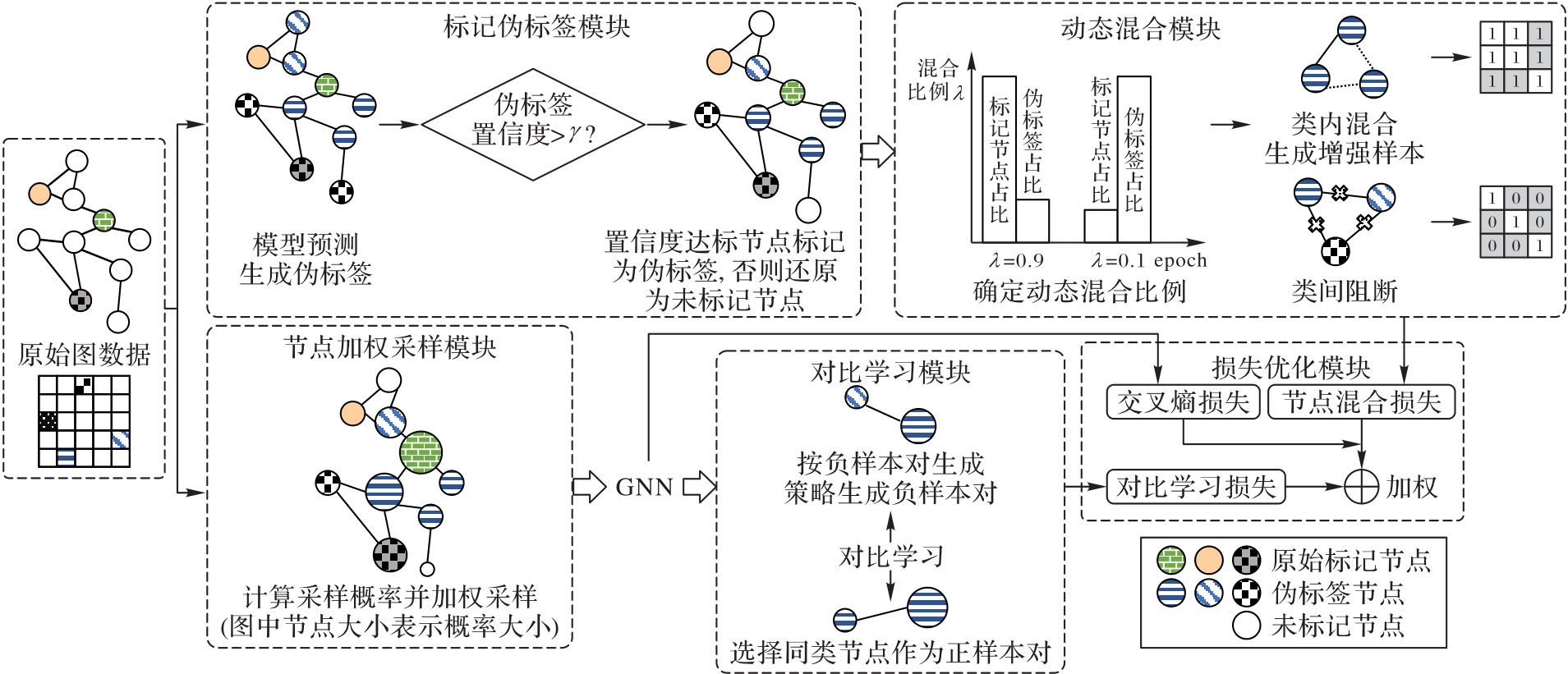
Fig.1 Overall framework of TriMix
| 符号 | 说明 |
|---|---|
| G | 输入的图数据 |
| 邻接矩阵 | |
| 特征矩阵 | |
| n | 图中节点数 |
| f | 每个节点的特征维度 |
| A 中的第i与第j个节点间是否存在边,存在边取值为1,否则为0 | |
| 类别分布矩阵 | |
| C | 节点类别数 |
| V | 图数据中节点的集合 |
Tab. 1 Main symbols and related descriptions
| 符号 | 说明 |
|---|---|
| G | 输入的图数据 |
| 邻接矩阵 | |
| 特征矩阵 | |
| n | 图中节点数 |
| f | 每个节点的特征维度 |
| A 中的第i与第j个节点间是否存在边,存在边取值为1,否则为0 | |
| 类别分布矩阵 | |
| C | 节点类别数 |
| V | 图数据中节点的集合 |
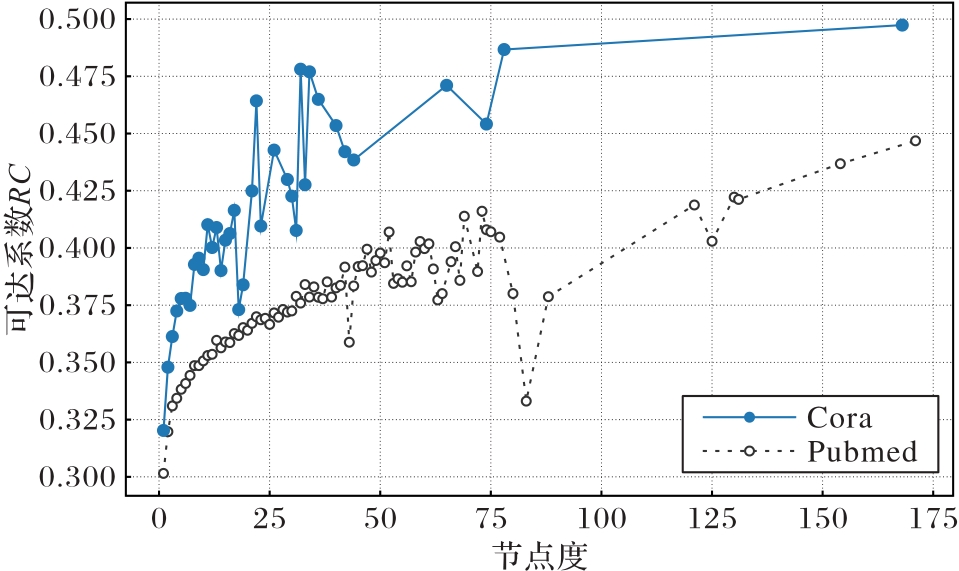
Fig. 2 Relationship between node reachability coefficient and node degree on Cora and PubMeddatasets
| 数据集 | 领域 | 节点数 | 边数 | 特征维度 | 类别数 |
|---|---|---|---|---|---|
| Cora[ | 机器学习 | 2 708 | 5 429 | 1 433 | 7 |
| PubMed[ | 医学 | 19 717 | 44 338 | 500 | 3 |
| CiteSeer[ | 计算机科学 | 3 312 | 4 732 | 3 703 | 6 |
| CS[ | 计算机科学 | 18 333 | 81 894 | 6 805 | 15 |
| Physics[ | 物理 | 34 493 | 247 962 | 8 415 | 5 |
| ogbn-arxiv[ | 计算机科学 | 169 343 | 1 166 243 | 128 | 40 |
| Reddit[ | 社交网络 | 232 965 | 114 645 892 | 602 | 41 |
Tab. 2 Dataset information
| 数据集 | 领域 | 节点数 | 边数 | 特征维度 | 类别数 |
|---|---|---|---|---|---|
| Cora[ | 机器学习 | 2 708 | 5 429 | 1 433 | 7 |
| PubMed[ | 医学 | 19 717 | 44 338 | 500 | 3 |
| CiteSeer[ | 计算机科学 | 3 312 | 4 732 | 3 703 | 6 |
| CS[ | 计算机科学 | 18 333 | 81 894 | 6 805 | 15 |
| Physics[ | 物理 | 34 493 | 247 962 | 8 415 | 5 |
| ogbn-arxiv[ | 计算机科学 | 169 343 | 1 166 243 | 128 | 40 |
| Reddit[ | 社交网络 | 232 965 | 114 645 892 | 602 | 41 |
| 主干模型 | 增强方法 | 准确率(均值±标准差) | ||||
|---|---|---|---|---|---|---|
| Cora | PubMed | CiteSeer | CS | Physics | ||
| GCN | original | 81.57±0.40 | 77.91±0.30 | 70.50±0.67 | 91.24±0.40 | 92.56±1.30 |
| UPS | 82.35±0.40 | 78.45±0.40 | 72.82±0.60 | 91.62±0.30 | 93.01±0.30 | |
| PASTEL | 81.97±0.60 | 78.92±0.29 | 71.32±0.40 | 91.76±0.60 | >3days | |
| ReNode | 81.97±0.60 | 78.13±0.70 | 69.48±0.40 | 91.32±0.10 | OOM | |
| GraphMix | 82.29±3.70 | 82.82±0.50 | 74.55±0.50 | 91.90±0.20 | 90.43±1.70 | |
| NodeMixup | 83.47±0.30 | 81.16±0.20 | 74.12±0.30 | 92.69±0.40 | 93.97±0.40 | |
| HDS-GNN | 84.60±0.10 | 79.90±0.20 | 73.00±0.20 | 93.80±0.20 | — | |
| TriMix | 83.58±0.17 | 81.80±0.36 | 74.89±0.40 | 92.55±0.47 | 94.64±0.10 | |
| GAT | original | 82.04±0.60 | 78.00±0.70 | 71.82±0.80 | 90.52±0.40 | 91.97±0.60 |
| UPS | 82.17±0.50 | 78.56±0.90 | 72.97±0.70 | 91.26±0.40 | 92.45±1.10 | |
| PASTEL | 82.21±0.30 | 78.74±0.90 | 72.35±0.80 | 90.31±0.20 | >3days | |
| ReNode | 81.88±0.70 | 79.68±0.50 | 71.73±1.20 | 88.36±0.50 | OOM | |
| GraphMix | 82.76±0.60 | 78.82±0.40 | 73.04±0.50 | 90.57±1.00 | 92.90±0.40 | |
| NodeMixup | 83.52±0.30 | 81.26±0.30 | 74.30±0.10 | 92.69±0.20 | 93.87±0.30 | |
| HDS | 84.30±0.10 | 80.60±0.30 | 72.10±0.20 | 93.50±0.10 | — | |
| TriMix | 82.78± 0.75 | 81.84± 0.85 | 73.15±0.96 | 92.77±0.30 | 93.91±0.20 | |
| APPNP | original | 80.03±0.50 | 78.67±0.20 | 70.30±0.60 | 91.79±0.50 | 92.36±0.80 |
| UPS | 81.24±0.60 | 78.69±0.70 | 71.02±0.70 | 91.77±0.30 | 92.31±0.50 | |
| PASTEL | 81.56±0.30 | 78.39±0.20 | 70.68±0.80 | 91.98±0.40 | >3days | |
| ReNode | 81.12±0.20 | 78.58±0.30 | 70.04±0.80 | 91.99±0.20 | OOM | |
| GraphMix | 82.98±0.40 | 78.73±0.40 | 70.26±0.40 | 91.53±0.60 | 94.12±0.10 | |
| NodeMixup | 83.54±0.40 | 79.93±0.10 | 75.12±0.30 | 92.82±0.20 | 94.34±0.20 | |
| EE-APPNP | 81.48±0.47 | 78.90±0.52 | 71.45±0.54 | — | — | |
| TriMix | 83.60±0.65 | 78.24±0.59 | 71.55±0.40 | 92.88±0.70 | 94.63±0.30 | |
| GraphSAGE | original | 78.12±0.30 | 77.30±0.70 | 68.09±0.80 | 91.01±0.90 | 93.09±0.40 |
| UPS | 81.83±0.30 | 77.82±0.60 | 70.29±0.60 | 91.35±0.40 | 93.20±0.40 | |
| PASTEL | 78.58±0.60 | 78.26±0.70 | 70.31±0.30 | 91.77±0.60 | >3 days | |
| ReNode | 76.48±1.00 | 78.67±1.20 | 70.79±0.90 | 89.61±0.70 | OOM | |
| GraphMix | 80.09±0.80 | 79.85±0.40 | 70.97±1.20 | 91.55±0.30 | 93.25±0.30 | |
| GraphSANN | 77.73±0.75 | 66.39±0.15 | 75.54±1.12 | 89.12±0.28 | 92.73±1.02 | |
| NodeMixup | 81.93±0.20 | 79.97±0.50 | 74.12±0.40 | 91.97±0.20 | 94.76±0.20 | |
| TriMix | 82.56±0.28 | 79.25±0.05 | 72.14±0.06 | 92.34±0.40 | 95.12±0.20 | |
Tab. 3 Comparison of node classification accuracy (mean±standard deviation)
| 主干模型 | 增强方法 | 准确率(均值±标准差) | ||||
|---|---|---|---|---|---|---|
| Cora | PubMed | CiteSeer | CS | Physics | ||
| GCN | original | 81.57±0.40 | 77.91±0.30 | 70.50±0.67 | 91.24±0.40 | 92.56±1.30 |
| UPS | 82.35±0.40 | 78.45±0.40 | 72.82±0.60 | 91.62±0.30 | 93.01±0.30 | |
| PASTEL | 81.97±0.60 | 78.92±0.29 | 71.32±0.40 | 91.76±0.60 | >3days | |
| ReNode | 81.97±0.60 | 78.13±0.70 | 69.48±0.40 | 91.32±0.10 | OOM | |
| GraphMix | 82.29±3.70 | 82.82±0.50 | 74.55±0.50 | 91.90±0.20 | 90.43±1.70 | |
| NodeMixup | 83.47±0.30 | 81.16±0.20 | 74.12±0.30 | 92.69±0.40 | 93.97±0.40 | |
| HDS-GNN | 84.60±0.10 | 79.90±0.20 | 73.00±0.20 | 93.80±0.20 | — | |
| TriMix | 83.58±0.17 | 81.80±0.36 | 74.89±0.40 | 92.55±0.47 | 94.64±0.10 | |
| GAT | original | 82.04±0.60 | 78.00±0.70 | 71.82±0.80 | 90.52±0.40 | 91.97±0.60 |
| UPS | 82.17±0.50 | 78.56±0.90 | 72.97±0.70 | 91.26±0.40 | 92.45±1.10 | |
| PASTEL | 82.21±0.30 | 78.74±0.90 | 72.35±0.80 | 90.31±0.20 | >3days | |
| ReNode | 81.88±0.70 | 79.68±0.50 | 71.73±1.20 | 88.36±0.50 | OOM | |
| GraphMix | 82.76±0.60 | 78.82±0.40 | 73.04±0.50 | 90.57±1.00 | 92.90±0.40 | |
| NodeMixup | 83.52±0.30 | 81.26±0.30 | 74.30±0.10 | 92.69±0.20 | 93.87±0.30 | |
| HDS | 84.30±0.10 | 80.60±0.30 | 72.10±0.20 | 93.50±0.10 | — | |
| TriMix | 82.78± 0.75 | 81.84± 0.85 | 73.15±0.96 | 92.77±0.30 | 93.91±0.20 | |
| APPNP | original | 80.03±0.50 | 78.67±0.20 | 70.30±0.60 | 91.79±0.50 | 92.36±0.80 |
| UPS | 81.24±0.60 | 78.69±0.70 | 71.02±0.70 | 91.77±0.30 | 92.31±0.50 | |
| PASTEL | 81.56±0.30 | 78.39±0.20 | 70.68±0.80 | 91.98±0.40 | >3days | |
| ReNode | 81.12±0.20 | 78.58±0.30 | 70.04±0.80 | 91.99±0.20 | OOM | |
| GraphMix | 82.98±0.40 | 78.73±0.40 | 70.26±0.40 | 91.53±0.60 | 94.12±0.10 | |
| NodeMixup | 83.54±0.40 | 79.93±0.10 | 75.12±0.30 | 92.82±0.20 | 94.34±0.20 | |
| EE-APPNP | 81.48±0.47 | 78.90±0.52 | 71.45±0.54 | — | — | |
| TriMix | 83.60±0.65 | 78.24±0.59 | 71.55±0.40 | 92.88±0.70 | 94.63±0.30 | |
| GraphSAGE | original | 78.12±0.30 | 77.30±0.70 | 68.09±0.80 | 91.01±0.90 | 93.09±0.40 |
| UPS | 81.83±0.30 | 77.82±0.60 | 70.29±0.60 | 91.35±0.40 | 93.20±0.40 | |
| PASTEL | 78.58±0.60 | 78.26±0.70 | 70.31±0.30 | 91.77±0.60 | >3 days | |
| ReNode | 76.48±1.00 | 78.67±1.20 | 70.79±0.90 | 89.61±0.70 | OOM | |
| GraphMix | 80.09±0.80 | 79.85±0.40 | 70.97±1.20 | 91.55±0.30 | 93.25±0.30 | |
| GraphSANN | 77.73±0.75 | 66.39±0.15 | 75.54±1.12 | 89.12±0.28 | 92.73±1.02 | |
| NodeMixup | 81.93±0.20 | 79.97±0.50 | 74.12±0.40 | 91.97±0.20 | 94.76±0.20 | |
| TriMix | 82.56±0.28 | 79.25±0.05 | 72.14±0.06 | 92.34±0.40 | 95.12±0.20 | |
| 模型 | ogbn-arxiv | |
|---|---|---|
| GCN | 59.30±1.20 | 89.70±1.00 |
| TDGIA | 57.00±0.10 | 86.11±0.10 |
| GCond | 59.20±0.10 | 88.00±1.80 |
| GCond-X | 61.30±0.50 | 88.40±0.40 |
| DC-GCN | 64.07±0.12 | 90.37±0.27 |
| BS-KAGCN | 53.76±0.31 | 87.23±0.26 |
| TriMix-GCN | 64.71±0.46 | 89.25±0.60 |
Tab. 4 Comparison of node classification accuracy on large datasets
| 模型 | ogbn-arxiv | |
|---|---|---|
| GCN | 59.30±1.20 | 89.70±1.00 |
| TDGIA | 57.00±0.10 | 86.11±0.10 |
| GCond | 59.20±0.10 | 88.00±1.80 |
| GCond-X | 61.30±0.50 | 88.40±0.40 |
| DC-GCN | 64.07±0.12 | 90.37±0.27 |
| BS-KAGCN | 53.76±0.31 | 87.23±0.26 |
| TriMix-GCN | 64.71±0.46 | 89.25±0.60 |
| 模型 | 策略 | Cora | CiteSeer | PubMed |
|---|---|---|---|---|
| GCN | original | 81.6±0.7 | 71.6±0.4 | 70.3±0.2 |
| BGCN | 81.2±0.8 | 72.4±0.5 | 71.6±0.3 | |
| AdaEdge | 81.9±0.7 | 72.8±0.7 | 72.1±0.6 | |
| DropEdge | 82.0±0.8 | 71.8±0.2 | 74.3±0.5 | |
| TriMix | 82.6±0.2 | 73.0±0.3 | 77.4±0.4 | |
| GAT | original | 81.3±1.1 | 70.5±0.7 | 69.4±0.7 |
| BGCN | 80.8±0.8 | 70.8±0.6 | 71.1±0.2 | |
| AdaEdge | 82.0±0.6 | 71.1±0.8 | 73.5±0.4 | |
| DropEdge | 81.9±0.6 | 71.0±0.5 | 73.2±0.3 | |
| TriMix | 82.2±0.7 | 71.6±0.4 | 76.3±0.4 |
Tab. 5 Comparison of model F1-score
| 模型 | 策略 | Cora | CiteSeer | PubMed |
|---|---|---|---|---|
| GCN | original | 81.6±0.7 | 71.6±0.4 | 70.3±0.2 |
| BGCN | 81.2±0.8 | 72.4±0.5 | 71.6±0.3 | |
| AdaEdge | 81.9±0.7 | 72.8±0.7 | 72.1±0.6 | |
| DropEdge | 82.0±0.8 | 71.8±0.2 | 74.3±0.5 | |
| TriMix | 82.6±0.2 | 73.0±0.3 | 77.4±0.4 | |
| GAT | original | 81.3±1.1 | 70.5±0.7 | 69.4±0.7 |
| BGCN | 80.8±0.8 | 70.8±0.6 | 71.1±0.2 | |
| AdaEdge | 82.0±0.6 | 71.1±0.8 | 73.5±0.4 | |
| DropEdge | 81.9±0.6 | 71.0±0.5 | 73.2±0.3 | |
| TriMix | 82.2±0.7 | 71.6±0.4 | 76.3±0.4 |
| 模型 | 链路预测准确率 | 模型 | 链路预测准确率 |
|---|---|---|---|
| GAT | 81.7±0.2 | CorGCN | 87.1±0.2 |
| GCN | 82.9±0.1 | TriMix-GCN | 87.9±0.3 |
| NodeMixup | 85.6±0.6 |
Tab. 6 Comparison of link prediction accuracy
| 模型 | 链路预测准确率 | 模型 | 链路预测准确率 |
|---|---|---|---|
| GAT | 81.7±0.2 | CorGCN | 87.1±0.2 |
| GCN | 82.9±0.1 | TriMix-GCN | 87.9±0.3 |
| NodeMixup | 85.6±0.6 |
| 模型与变体 | Cora | PubMed | CiteSeer |
|---|---|---|---|
| TriMix | 83.58 | 81.80 | 74.89 |
| TriMix-A | 81.77 | 77.63 | 70.33 |
| TriMix-B | 81.66 | 77.55 | 69.62 |
| TriMix-C | 82.05 | 78.63 | 69.49 |
Tab. 7 Accuracy of node classification in ablation experiments
| 模型与变体 | Cora | PubMed | CiteSeer |
|---|---|---|---|
| TriMix | 83.58 | 81.80 | 74.89 |
| TriMix-A | 81.77 | 77.63 | 70.33 |
| TriMix-B | 81.66 | 77.55 | 69.62 |
| TriMix-C | 82.05 | 78.63 | 69.49 |
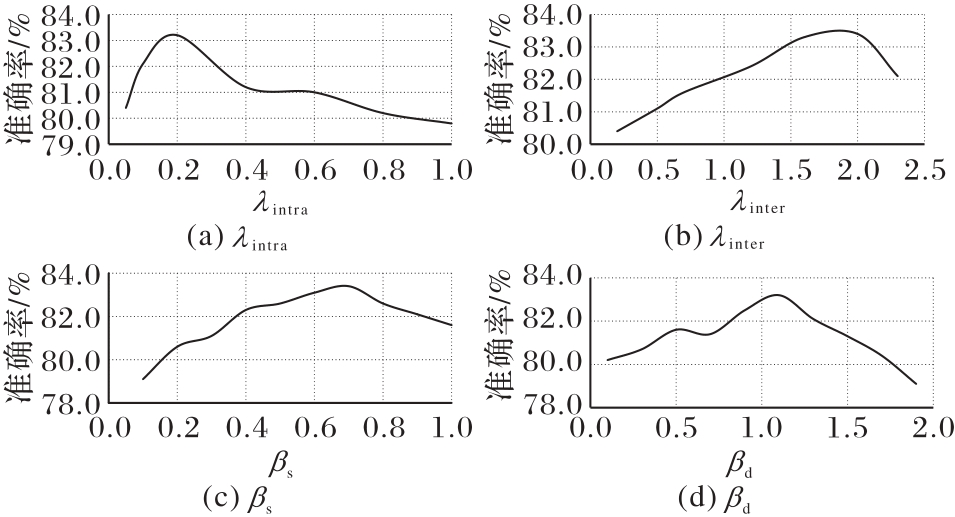
Fig. 3 Accuracy variation under impact of single parameter
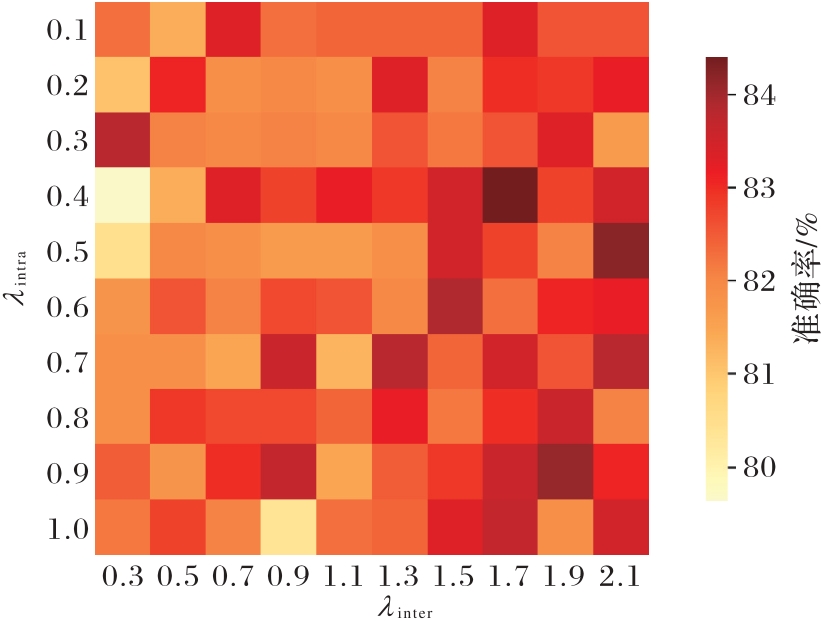
Fig. 4 Classification accuracy of two-parameter combinations
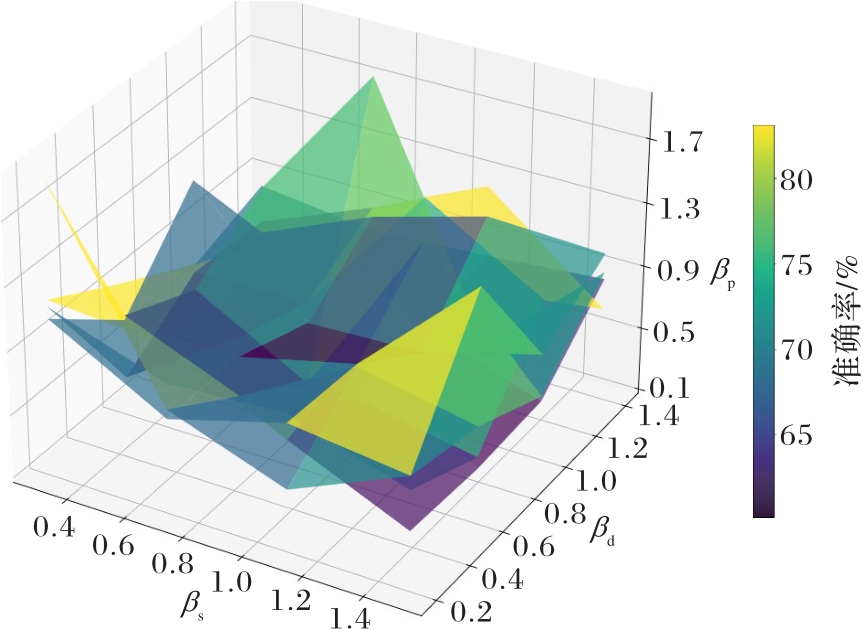
Fig. 5 Classification accuracy of three-parameter combinations
| 模型 | 参数量/106 | 峰值内存占用/GB | 每epoch训练时间/ms |
|---|---|---|---|
| GCN | 0.89 | 0.65 | 323 |
| GAT | 1.37 | 1.08 | 668 |
| NodeMixup | 0.91 | 0.87 | 449 |
| GPM | 0.81 | 1.60 | 196 |
| TriMix-GCN | 1.16 | 1.03 | 463 |
| TriMix-GAT | 1.41 | 1.37 | 695 |
Tab.8 Comparison of model training efficiency
| 模型 | 参数量/106 | 峰值内存占用/GB | 每epoch训练时间/ms |
|---|---|---|---|
| GCN | 0.89 | 0.65 | 323 |
| GAT | 1.37 | 1.08 | 668 |
| NodeMixup | 0.91 | 0.87 | 449 |
| GPM | 0.81 | 1.60 | 196 |
| TriMix-GCN | 1.16 | 1.03 | 463 |
| TriMix-GAT | 1.41 | 1.37 | 695 |
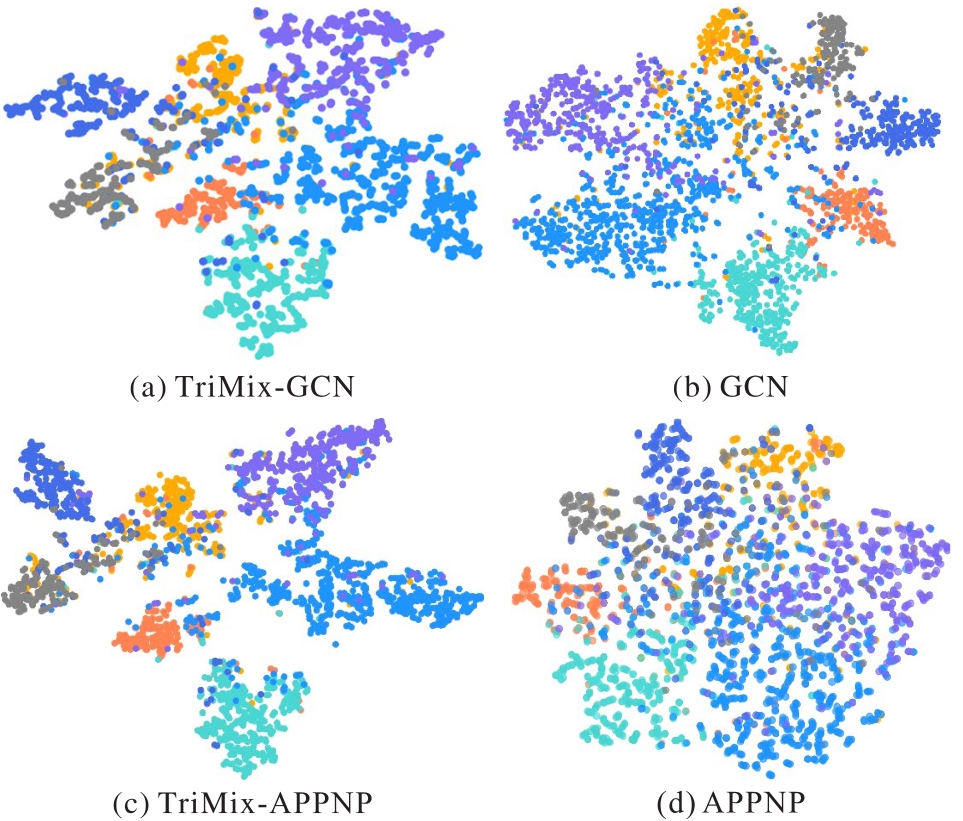
Fig. 6 Visualization results for node classification
| [1] | KIPF T N, WELLING M. Semi-supervised classification with graph convolutional networks[C/OL]// Proceedings of the 5th International Conference on Learning Representations. [S.l.]: ICLR, 2017 [2025-05-10].. |
| [2] | HAN X, JIANG Z, LIU N, et al. G-Mixup: graph data augmentation for graph classification[C]// Proceedings of the 39th International Conference on Machine Learning. New York: JMLR.org, 2022: 8230-8248. |
| [3] | SU C, TONG J, ZHU Y, et al. Network embedding in biomedical data science[J]. Briefings in Bioinformatics, 2020, 21(1): 182-197. |
| [4] | LU W, GUAN Z, ZHAO W, et al. NodeMixup: tackling under-reaching for graph neural networks[C]// Proceedings of the 38th AAAI Conference on Artificial Intelligence. Palo Alto: AAAI Press, 2024: 14175-14183. |
| [5] | CHEN Z, GUO X, ZHOU B, et al. Accelerating personalized PageRank vector computation[C]// Proceedings of the 29th ACM SIGKDD Conference on Knowledge Discovery and Data Mining. New York: ACM, 2023: 262-273. |
| [6] | VELIČKOVIĆ P, CUCURULL G, CASANOVA A, et al. Graph attention networks[EB/OL]. [2025-03-10].. |
| [7] | GILMER J, SCHOENHOLZ S S, RILEY P F, et al. Neural message passing for quantum chemistry[C]// Proceedings of the 34th International Conference on Machine Learning. New York: JMLR.org, 2017: 1263-1272. |
| [8] | RONG Y, HUANG W, XU T, et al. DropEdge: towards deep graph convolutional networks on node classification[EB/OL]. [2025-05-10].. |
| [9] | NAGARAJAN A, RAGHUNATHAN A. FASTRAIN-GNN: fast and accurate self-training for graph neural networks[EB/OL]. [2025-05-10].. |
| [10] | YOU Y, CHEN T, SUI Y, et al. Graph contrastive learning with augmentations[C]// Proceedings of the 34th International Conference on Neural Information Processing Systems. Red Hook: Curran Associates Inc., 2020: 5812-5823. |
| [11] | DAZA D, CHU C X, TRAN T K, et al. Explaining graph neural networks for node similarity on graphs[EB/OL]. [2025-05-10].. |
| [12] | ALON U, YAHAV E. On the bottleneck of graph neural networks and its practical implications[EB/OL]. [2025-02-01].. |
| [13] | SEN P, NAMATA G, BILGIC M, et al. Collective classification in network data[J]. AI Magazine, 2008, 29(3): 93-106. |
| [14] | NAMATA G, LONDON B, GETOOR L, et al. Query-driven active surveying for collective classification[EB/OL]. [2025-02-23].. |
| [15] | ZHANG Z, JIANG B, TANG J, et al. Unifying graph contrastive learning via graph message augmentation[J]. IEEE Transactions on Pattern Analysis and Machine Intelligence, 2025, 47(11): 9563-9579. |
| [16] | LI W Z, WANG C D, XIONG H, et al. GraphSHA: synthesizing harder samples for class-imbalanced node classification[C]// Proceedings of the 29th ACM SIGKDD Conference on Knowledge Discovery and Data Mining. New York: ACM, 2023: 1328-1340. |
| [17] | 李玟,李开荣,杨凯. 基于数据增强的子图感知对比学习[J]. 计算机应用, 2026, 46(1): 1-9. |
| LI W, LI K R, YANG K. Subgraph-aware contrastive learning with data augmentation[J]. Journal of Computer Applications, 2026, 46(1): 1-9. | |
| [18] | MADUSHANKA T, ICHISE R. Negative sampling in knowledge graph representation learning: a review[EB/OL]. [2025-07-11].. |
| [19] | SU Z, WANG D, MIAO C. Context pooling: query-specific graph pooling for generic inductive link prediction in knowledge graphs[C]// Proceedings of the 31st ACM SIGKDD Conference on Knowledge Discovery and Data Mining V.2. New York: ACM, 2025: 2680-2689. |
| [20] | GILES C L, BOLLACKER K D, LAWRENCE S. CiteSeer: an automatic citation indexing system[C]// Proceedings of the 3rd ACM Conference on Digital Libraries. New York: ACM, 1998: 89-98. |
| [21] | CHEN X, CHEN J, QIU S, et al. GS-Net: point cloud sampling with graph neural networks[J]. Pattern Recognition, 2026, 170: No.112054. |
| [22] | SHI D, HAN A, LIN L, et al. Design your own universe: a physics-informed agnostic method for enhancing graph neural networks[J]. International Journal of Machine Learning and Cybernetics, 2025, 16(2): 1129-1144. |
| [23] | HU W, FEY M, ZITNIK M, et al. Open graph benchmark: datasets for machine learning on graphs[C]// Proceedings of the 34th International Conference on Neural Information Processing Systems. Red Hook: Curran Associates Inc., 2020: 22118-22133. |
| [24] | BAUMGARTNER J, ZANNETTOU S, KEEGAN B, et al. The Pushshift Reddit dataset[C]// Proceedings of the 14th International AAAI Conference on Web and Social Media. Palo Alto: AAAI Press, 2020: 830-839. |
| [25] | GASTEIGER J, BOJCHEVSKI A, GÜNNEMANN S. Predict then propagate: graph neural networks meet personalized PageRank[EB/OL]. [2025-07-11].. |
| [26] | HAMILTON W L, YING Z, LESKOVEC J. Inductive representation learning on large graphs[C]// Proceedings of the 31st International Conference on Neural Information Processing Systems. Red Hook: Curran Associates Inc., 2017: 1025-1035. |
| [27] | RIZVE M N, DUARTE K, RAWAT Y S, et al. In defense of pseudo-labeling: an uncertainty-aware pseudo-label selection framework for semi-supervised learning[C/OL]// Proceedings of the 9th International Conference on Learning Representations. San Diego, CA: ICLR, 2021 [2025-07-23].. |
| [28] | SUN Q, LI J, YUAN H, et al. Position-aware structure learning for graph topology-imbalance by relieving under-reaching and over-squashing[C]// Proceedings of the 31st ACM International Conference on Information & Knowledge Management. New York: ACM, 2022: 1848-1857. |
| [29] | CHEN D, LIN Y, ZHAO G, et al. Topology-imbalance learning for semi-supervised node classification[C]// NeurIPS 2021: Proceedings of the 35th Conference on Neural Information Processing Systems. Red Hook, NY: Curran Associates Inc., 2021, 34: 29885-29897. |
| [30] | VERMA V, QU M, KAWAGUCHI K, et al. GraphMix: improved training of GNNs for semi-supervised learning[C]// Proceedings of the 35th AAAI Conference on Artificial Intelligence. Palo Alto: AAAI Press, 2021: 10024-10032. |
| [31] | ZHANG K, PU X, LI J, et al. Hierarchical diffusion scattering graph neural network[C]// Proceedings of the 31st International Joint Conference on Artificial Intelligence. [S.l.]: IJCAI, 2022: 519-525. |
| [32] | LIU Y, QIAO X, WANG L, et al. EEGNN: edge enhanced graph neural network with a Bayesian nonparametric graph model[C]// Proceedings of the 26th International Conference on Artificial Intelligence and Statistics. New York: JMLR.org, 2023: 2132-2146. |
| [33] | LIU J, HE M, WANG G, et al. Imbalanced node classification beyond homophilic assumption[C]// Proceedings of the 32nd International Joint Conference on Artificial Intelligence. [S.l.]: IJCAI, 2023: 7206-7214. |
| [34] | ZOU X, ZHENG Q, DONG Y, et al. TDGIA: effective injection attacks on graph neural networks[C]// Proceedings of the 27th ACM SIGKDD Conference on Knowledge Discovery and Data Mining. New York: ACM, 2021: 2461-2471. |
| [35] | JIN W, ZHAO L, ZHANG S, et al. Graph condensation for graph neural networks[C/OL]// Proceedings of the 10th International Conference on Learning Representations. San Diego, CA: ICLR, 2022 [2025-03-11].. |
| [36] | ZHANG Y, PAL S, COATES M, et al. Bayesian graph convolutional neural networks for semi-supervised classification[C]// Proceedings of the 33rd AAAI Conference on Artificial Intelligence. Menlo Park: AAAI Press, 2019: 5829-5836. |
| [37] | CHEN D, LIN Y, LI W, et al. Measuring and relieving the over-smoothing problem for graph neural networks from the topological view[C]// Proceedings of the 34th AAAI Conference on Artificial Intelligence. New York: AAAI Press, 2020: 3438-3445. |
| [38] | JAYADEVAN D, HARIHARAN R, MANIKANDAN L, et al. A novel DC-GCN with attention mechanism for accurate near-duplicate video data cleaning[J]. Journal of Machine and Computing, 2024, 4(4): 1001-1008. |
| [39] | BRESSON R, NIKOLENTZOS G, PANAGOPOULOS G, et al. KAGNNs: Kolmogorov-Arnold networks meet graph learning[EB/OL]. [2025-03-06]. . |
| [40] | BEI Y, CHEN W, CHEN H, et al. Correlation-aware graph convolutional networks for multi-label node classification[EB/OL]. [2025-06-17]. . |
| [41] | WANG Z, ZHANG Z, MA T, et al. Beyond message passing: neural graph pattern machine[C/OL]// Proceedings of the 42nd International Conference on Machine Learning. [S.l.]: ICLR, 2025 [2025-06-19]. |
| [1] | Haihua ZHAO, Yijun HU, Rui TANG, Xian MO. Multimodal recommendation method based on semantic fusion and contrast enhancement [J]. Journal of Computer Applications, 2026, 46(4): 1058-1068. |
| [2] | Xumeng DOU, Bin XIE, Zhaohui ZHANG, Zhengang ZHAO, Hanyu DUAN, Aolei GUO. Drug-target interaction prediction based on structure-network collaborative features and grid-attention enhanced Kolmogorov-Arnold network [J]. Journal of Computer Applications, 2026, 46(4): 1344-1353. |
| [3] | Xiaoxia LIU, Liqun KUANG, Song WANG, Shichao JIAO, Huiyan HAN, Fengguang XIONG. Multi-scale spatio-temporal decoupling for contrastive learning of skeleton action recognition [J]. Journal of Computer Applications, 2026, 46(3): 767-774. |
| [4] | Rilong WANG, Zhenping LI, Xiaosong LI, Qiang GAO, Ya HE, Yong ZHONG, Yingxiao ZHAO. Multi-Agent collaborative knowledge reasoning framework [J]. Journal of Computer Applications, 2026, 46(3): 708-714. |
| [5] | Yuhang XIAO, Guanfeng LI, Yuyin CHEN, Jing QIN. Few-shot relation extraction model with graph-based multi-view contrastive learning [J]. Journal of Computer Applications, 2026, 46(3): 732-740. |
| [6] | Junrui WU, Jiangchuan YANG, Haisheng YU, Sai ZOU, Wenyong WANG. Performance evaluation method for deterministic networks based on complex-enhanced attention graph neural network [J]. Journal of Computer Applications, 2026, 46(2): 505-517. |
| [7] | Hu LUO, Mingshu ZHANG. Rumor detection method based on cross-modal attention mechanism and contrastive learning [J]. Journal of Computer Applications, 2026, 46(2): 361-367. |
| [8] | Limei DONG, Yanzi LI, Jiayin LI, Li XU. Neighborhood-enhanced unsupervised graph anomaly detection [J]. Journal of Computer Applications, 2026, 46(2): 458-466. |
| [9] | Jinjiao LIN, Canshun ZHANG, Shuya CHEN, Tianxin WANG, Jian LIAN, Yonghui XU. Vehicle insurance fraud detection method based on improved graph attention network [J]. Journal of Computer Applications, 2026, 46(2): 437-444. |
| [10] | Fan HE, Li LI, Zhongxu YUAN, Xiu YANG, Dongxuan HAN. Knowledge tracking model based on concept association memory network with graph attention [J]. Journal of Computer Applications, 2026, 46(1): 43-51. |
| [11] | Ziyang CHENG, Ruizhang HUANG, Jingjing XUE. Deep evolutionary topic clustering model [J]. Journal of Computer Applications, 2026, 46(1): 85-94. |
| [12] | Wen LI, Kairong LI, Kai YANG. Subgraph-aware contrastive learning with data augmentation [J]. Journal of Computer Applications, 2026, 46(1): 1-9. |
| [13] | Xingyao YANG, Zheng QI, Jiong YU, Zulian ZHANG, Shuai MA, Hongtao SHEN. Session-based recommendation model based on time-aware and space-enhanced dual channel graph neural network [J]. Journal of Computer Applications, 2026, 46(1): 104-112. |
| [14] | Chao LIU, Yanhua YU. Knowledge-aware recommendation model combining denoising strategy and multi-view contrastive learning [J]. Journal of Computer Applications, 2025, 45(9): 2827-2837. |
| [15] | Zhixiong XU, Bo LI, Xiaoyong BIAN, Qiren HU. Adversarial sample embedded attention U-Net for 3D medical image segmentation [J]. Journal of Computer Applications, 2025, 45(9): 3011-3016. |
| Viewed | ||||||
|
Full text |
|
|||||
|
Abstract |
|
|||||
