


Journal of Computer Applications ›› 2026, Vol. 46 ›› Issue (10): 3272-3279.DOI: 10.11772/j.issn.1001-9081.2025091145
• Advanced computing • Previous Articles
Xiaoqing ZENG1, Juan TANG1,2( ), Huafeng XIAO3, Manqi XIE1, Kai LUO1
Received:2025-09-28
Revised:2025-12-18
Accepted:2025-12-19
Online:2026-03-13
Published:2026-10-10
Contact:
Juan TANG
About author:ZENG Xiaoqing, born in 2001, M. S. candidate. Her research interests include physics-informed neural networks, machine learning.Supported by:
曾晓青1, 唐卷1,2(), 肖华峰3, 谢漫淇1, 罗凯1
通讯作者:
唐卷
作者简介:曾晓青(2001—),女,江西赣州人,硕士研究生,主要研究方向:物理信息神经网络、机器学习基金资助:CLC Number:
Xiaoqing ZENG, Juan TANG, Huafeng XIAO, Manqi XIE, Kai LUO. APINN-based method for solving integro-differential-algebraic equations[J]. Journal of Computer Applications, 2026, 46(10): 3272-3279.
曾晓青, 唐卷, 肖华峰, 谢漫淇, 罗凯. 基于辅助物理信息神经网络的积分微分代数方程求解方法[J]. 《计算机应用》唯一官方网站, 2026, 46(10): 3272-3279.
Add to citation manager EndNote|Ris|BibTeX
URL: https://www.joca.cn/EN/10.11772/j.issn.1001-9081.2025091145
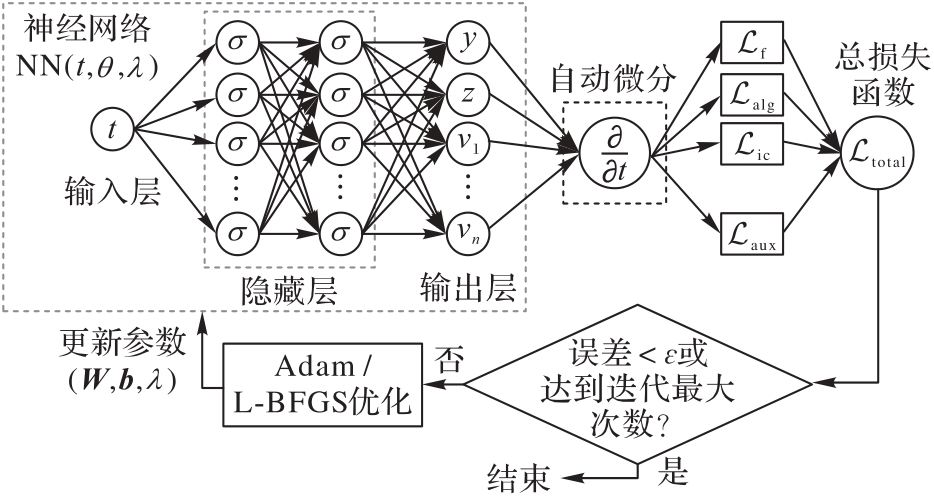
Fig. 1 Network framework of APINN-IDAE
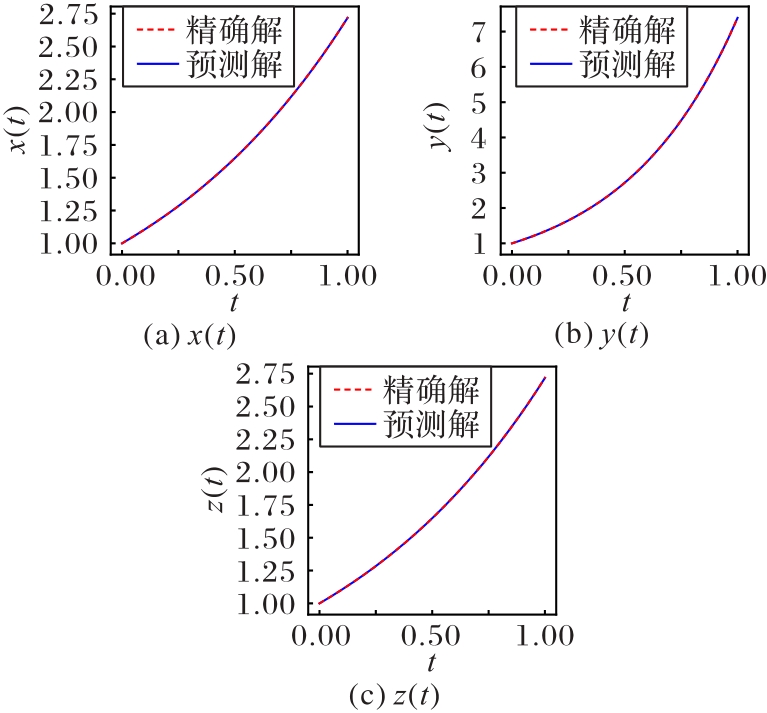
Fig. 2 Comparison between predicted and exact solutions for example 1
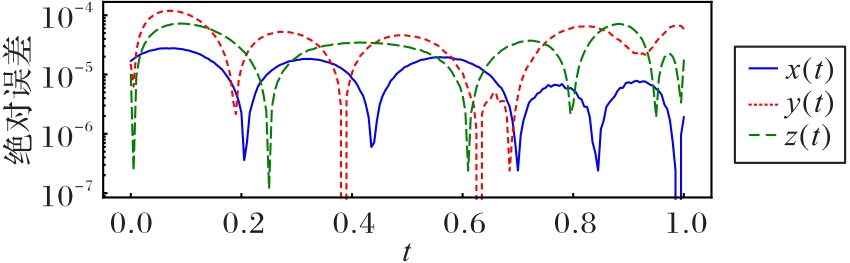
Fig. 3 Absolute errors of solution functions x, y and z for example 1
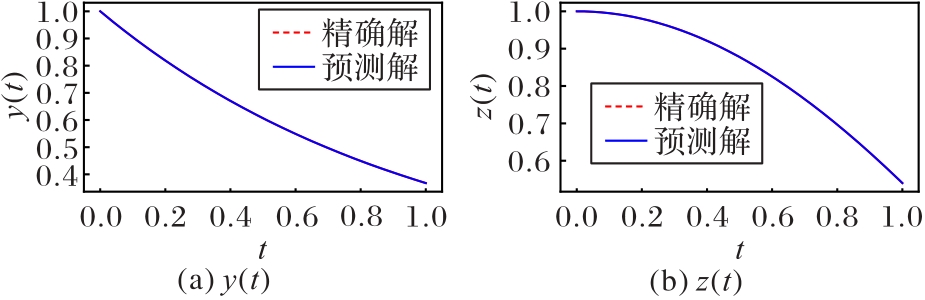
Fig. 4 Comparison between predicted and exact solutions for example 2
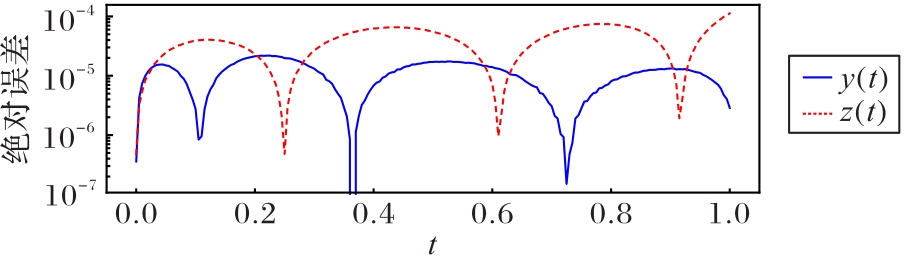
Fig. 5 Absolute errors of solution functions y and z for example 2
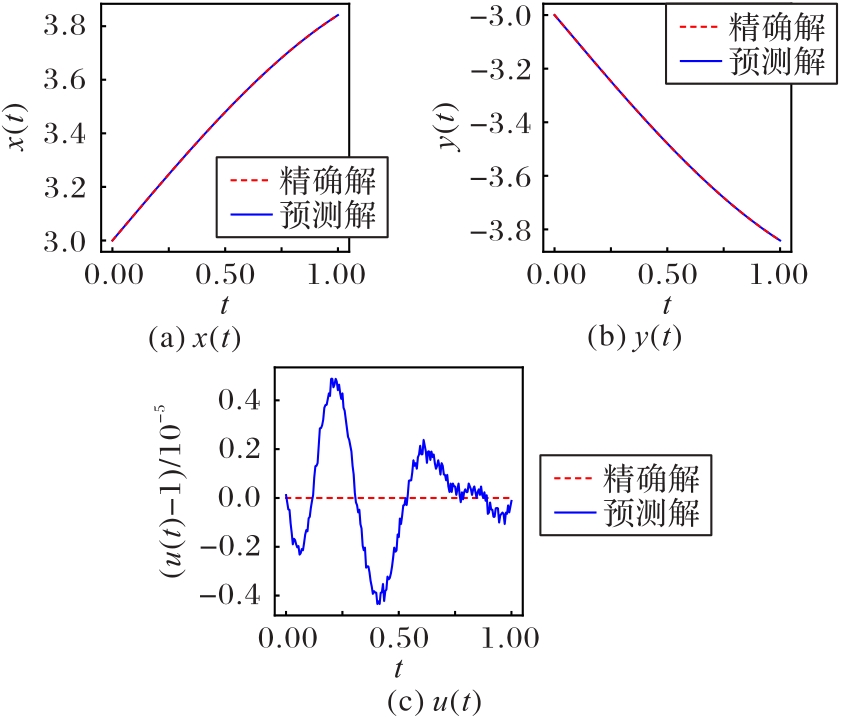
Fig. 6 Comparison between predicted and exact solutions for example 3
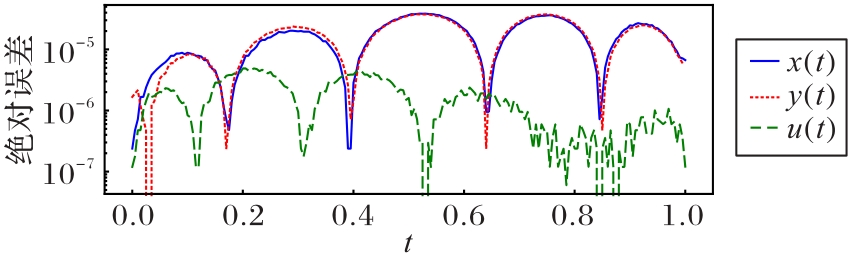
Fig. 7 Absolute errors of solution functions x, y, and u for example 3
| 网络层数 | 神经元数 | 相对L2误差 | 网络层数 | 神经元数 | 相对L2误差 |
|---|---|---|---|---|---|
| 4 | 80 | 8.31E-06 | 8 | 80 | 4.50E-06 |
| 100 | 6.64E-06 | 100 | 4.46E-06 | ||
| 120 | 8.01E-06 | 120 | 2.37E-06 | ||
| 140 | 6.32E-06 | 140 | 2.47E-06 | ||
| 6 | 80 | 3.16E-06 | 10 | 80 | 7.13E-06 |
| 100 | 3.90E-06 | 100 | 5.03E-06 | ||
| 120 | 8.24E-06 | 120 | 3.16E-06 | ||
| 140 | 1.24E-06 | 140 | 5.88E-06 |
Tab. 1 Comparison of relative L2 error for example 3
| 网络层数 | 神经元数 | 相对L2误差 | 网络层数 | 神经元数 | 相对L2误差 |
|---|---|---|---|---|---|
| 4 | 80 | 8.31E-06 | 8 | 80 | 4.50E-06 |
| 100 | 6.64E-06 | 100 | 4.46E-06 | ||
| 120 | 8.01E-06 | 120 | 2.37E-06 | ||
| 140 | 6.32E-06 | 140 | 2.47E-06 | ||
| 6 | 80 | 3.16E-06 | 10 | 80 | 7.13E-06 |
| 100 | 3.90E-06 | 100 | 5.03E-06 | ||
| 120 | 8.24E-06 | 120 | 3.16E-06 | ||
| 140 | 1.24E-06 | 140 | 5.88E-06 |
| [1] | Bandurin N G, Gureeva N A. A method and a software package for numerical solution of the systems of nonlinear ordinary integro-differential-algebraic equations[J]. Mathematical Models and Computer Simulations, 2012, 4(5): 455-463. |
| [2] | Milano F, Dassios I. Small-signal stability analysis for non-index 1 Hessenberg form systems of delay differential-algebraic equations[J]. IEEE Transactions on Circuits and Systems Ⅰ: Regular Papers, 2016, 63(9): 1521-1530. |
| [3] | Schiessel H, Metzler R, Blumen A, et al. Generalized viscoelastic models: their fractional equations with solutions[J]. Journal of Physics A: Mathematical and General, 1995, 28(23): No.6567. |
| [4] | Zhang X, Wu J. A coupled algebraic-delay differential system modeling tick-host interactive behavioural dynamics and multi-stability[J]. Journal of Mathematical Biology, 2023, 86(3): No.42. |
| [5] | Chistyakov V F, Chistyakova E V. Linear differential-algebraic equations perturbed by Volterra integral operators[J]. Differential Equations, 2017, 53(10): 1274-1287. |
| [6] | Zolfaghari R, Taylor J, Spiteri R J. Structural analysis of integro-differential-algebraic equations[J]. Journal of Computational and Applied Mathematics, 2021, 394: No.113568. |
| [7] | Petzold L R. A description of DASSL: a differential/algebraic system solver[R/OL]. [2025-08-10].. |
| [8] | Brunner H, Hairer E, Nørsett S P. Runge-Kutta theory for Volterra integral equations of the second kind[J]. Mathematics of Computation, 1982, 39(159): 147-163. |
| [9] | Lotfi M, Alipanah A. Legendre spectral element method for solving Volterra-integro differential equations[J]. Results in Applied Mathematics, 2020, 7: No.100116. |
| [10] | Chen C, Shih T. Finite element methods for integrodifferential equations[M]. Singapore: World Scientific Publishing Co Pte Ltd., 1998. |
| [11] | Biazar J, Babolian E, Islam R. Solution of a system of Volterra integral equations of the first kind by Adomian method[J]. Applied Mathematics and Computation, 2003, 139(2/3): 249-258. |
| [12] | Hussain A K, Fadhel F S, Yahya Z R, et al. Variational Iteration Method (VIM) for solving partial integro-differential equations[J]. Journal of Theoretical and Applied Information Technology, 2016, 88(2): 367-374. |
| [13] | Brunner H. Volterra integral equations: an introduction to theory and applications[M]. Cambridge: Cambridge University Press, 2017. |
| [14] | Bulatov M V, Chistyakova E V. Numerical solution of integro-differential systems with a degenerate matrix multiplying the derivative by multistep methods[J]. Differential Equations, 2006, 42(9): 1317-1325. |
| [15] | Kauthen J P. Continuous time collocation methods for Volterra-Fredholm integral equations[J]. Numerische Mathematik, 1989, 56(5): 409-424. |
| [16] | Chen R T Q, Rubanova Y, Bettencourt J, et al. Neural ordinary differential equations[C]// NeurIPS 2018. Red Hook: Curran Associates Inc., 2018: 6572-6583. |
| [17] | Raissi M, Perdikaris P, Karniadakis G E. Physics-informed neural networks: a deep learning framework for solving forward and inverse problems involving nonlinear partial differential equations[J]. Journal of Computational Physics, 2019, 378: 686-707. |
| [18] | Mao Z, Jagtap A D, Karniadakis G E. Physics-informed neural networks for high-speed flows[J]. Computer Methods in Applied Mechanics and Engineering, 2020, 360: No.112789. |
| [19] | Zhang R, Liu Y, Sun H. Physics-informed multi-LSTM networks for metamodeling of nonlinear structures[J]. Computer Methods in Applied Mechanics and Engineering, 2020, 369: No.113226. |
| [20] | Zhu Q, Liu Z, Yan J. Machine learning for metal additive manufacturing: predicting temperature and melt pool fluid dynamics using physics-informed neural networks[J]. Computational Mechanics, 2021, 67(2): 619-635. |
| [21] | Lu L, Meng X, Mao Z, et al. DeepXDE: a deep learning library for solving differential equations[J]. SIAM Review, 2021, 63(1): 208-228. |
| [22] | Jagtap A D, Kawaguchi K, Karniadakis G E. Adaptive activation functions accelerate convergence in deep and physics-informed neural networks[J]. Journal of Computational Physics, 2020, 404: No.109136. |
| [23] | Yu J, Lu L, Meng X, et al. Gradient-enhanced physics-informed neural networks for forward and inverse PDE problems[J]. Computer Methods in Applied Mechanics and Engineering, 2022, 393: No.114823. |
| [24] | Cuomo S, di Cola V S, Giampaolo F, et al. Scientific machine learning through physics-informed neural networks: where we are and what’s next[J]. Journal of Scientific Computing, 2022, 92(3): No.88. |
| [25] | Pang G, Lu L, Karniadakis G E. fPINNs: fractional physics-informed neural networks[J]. SIAM Journal on Scientific Computing, 2019, 41(4): A2603-A2626. |
| [26] | Jang Y. Physics-informed neural networks for solving integro-differential equations with applications to viscoelasticity[EB/OL]. [2025-08-10].. |
| [27] | Moya C, Lin G. DAE-PINN: a physics-informed neural network model for simulating differential algebraic equations with application to power networks[J]. Neural Computing and Applications, 2023, 35(5): 3789-3804. |
| [28] | Chen J, Tang J, Yan M, et al. Physics-informed neural networks for solving high-index differential-algebraic equation systems based on Radau methods[J]. International Journal of Intelligent Systems, 2024, 2024: No.6641674. |
| [29] | 赖帅,唐卷,梁锟,等. 基于Lobatto方法和Legendre多项式的PINN求解微分代数方程[J]. 计算机应用, 2025, 45(3): 911-919. |
| Lai Shuai, Tang Juan, Liang Kun, et al. Physics-informed neural network based on Lobatto method and Legendre polynomials for solving differential-algebraic equations[J]. Journal of Computer Applications, 2025, 45(3): 911-919. | |
| [30] | Luo K, Tang J, Cai M, et al. DAE-KAN: a Kolmogorov-Arnold network model for high-index differential-algebraic equations[PP/OL]. arXiv (2025-04-12) [2025-08-16].. |
| [31] | Son H, Cho S W, Hwang H J. Enhanced physics-informed neural networks with Augmented Lagrangian relaxation method (AL-PINNs)[J]. Neurocomputing, 2023, 548: No.126424. |
| [32] | Basir S, Senocak I. Physics and equality constrained artificial neural networks: application to forward and inverse problems with multi-fidelity data fusion[J]. Journal of Computational Physics, 2022, 463: No.111301. |
| [33] | Yuan L, Ni Y Q, Deng X Y, et al. A-PINN: auxiliary physics informed neural networks for forward and inverse problems of nonlinear integro-differential equations[J]. Journal of Computational Physics, 2022, 462: No.111260. |
| [34] | Karniadakis G E, Kevrekidis I G, Lu L, et al. Physics-informed machine learning[J]. Nature Reviews Physics, 2021, 3(6): 422-440. |
| [35] | Wang S, Teng Y, Perdikaris P. Understanding and mitigating gradient flow pathologies in physics-informed neural networks[J]. SIAM Journal on Scientific Computing, 2021, 43(5): A3055-A3081. |
| [1] | Yimin ZHOU, Wenhui FU, Jie LUO, Juan WANG. End‑to‑end robust video watermarking against screen‑recapturing attacks based on spatio-temporal feature enhancement network [J]. Journal of Computer Applications, 2026, 46(9): 2889-2897. |
| [2] | Wei CUI, Ping ZHANG, Zhuoling XIAO, Zhuohang CHEN. Incremental semantic mapping system based on visual SLAM [J]. Journal of Computer Applications, 2026, 46(9): 2800-2808. |
| [3] | Shang LIU, Zhaosen TANG, Hongyue LIU, Linfang DONG, Jin ZHOU. Multimodal sentiment analysis model for missing modalities under shared semantic conditions [J]. Journal of Computer Applications, 2026, 46(9): 2761-2768. |
| [4] | Ming LIU, Dongqi SHEN, Ziyang MENG. Point cloud registration network with dual-branch multi-level feature fusion [J]. Journal of Computer Applications, 2026, 46(8): 2584-2593. |
| [5] | Fengchun LIU, Xinying SHAO, Chunying ZHANG, Liya WANG, Jing REN. FCMdepth: monocular depth estimation framework with multi-scale feature optimization [J]. Journal of Computer Applications, 2026, 46(8): 2603-2611. |
| [6] | Wei LIU, Weigang LI, Zhiqiang TIAN. Representation learning method of hierarchical rotation-invariant geometric structure for point cloud classification and segmentation [J]. Journal of Computer Applications, 2026, 46(8): 2594-2602. |
| [7] | Xinliang LIU, Yushi XU, Dubai LI, Yanzhao REN. Survey of knowledge graph-based question answering methods [J]. Journal of Computer Applications, 2026, 46(8): 2394-2410. |
| [8] | Xiaojin GUO, Xuyang SUI, Kenan ZHOU. Channel estimation of STAR-RIS-assisted hybrid-field communication system based on deep learning [J]. Journal of Computer Applications, 2026, 46(8): 2548-2554. |
| [9] | Jing LIU, Shaoze ZHAO, Xingang LIU, Haozhe NIU, Haipeng JI. Cross-condition microstructure data generation method for titanium alloys based on improved CGAN [J]. Journal of Computer Applications, 2026, 46(7): 2373-2382. |
| [10] | Xiuli DU, Xing GAO, Xiaoyu ZHANG, Chengsheng PAN, Qijie ZOU. Video snapshot compressive imaging reconstruction method based on dense spatio-temporal deformable attention [J]. Journal of Computer Applications, 2026, 46(7): 2288-2296. |
| [11] | Xiangyi WU, Hailiang YE, Feilong CAO. Point cloud completion method based on smooth-sharpen graph convolution [J]. Journal of Computer Applications, 2026, 46(7): 2267-2276. |
| [12] | Miaogen LING, Rui JING, Wei FANG. Survey of research on applications of explainable deep learning in tropical cyclone forecasting [J]. Journal of Computer Applications, 2026, 46(7): 2318-2326. |
| [13] | Lili HE, Meng CAO, Lei ZHANG, Hongjun PAN, Yi LIU, Chengxin SUN. Sign language generation model based on Kolmogorov-Arnold network and diffusion Transformer [J]. Journal of Computer Applications, 2026, 46(6): 1801-1810. |
| [14] | Yi DU, Mingjin XU, Jiayi KONG, Liyao WANG, Chen ZHAO. Low-rank adaptive parameter-efficient fine-tuning algorithm based on YOLOv11 [J]. Journal of Computer Applications, 2026, 46(6): 1738-1745. |
| [15] | Zhenkai XIONG, Mengjun XU, Yinyin SUN, Xin WANG. Maritime ship detection algorithm under complex weather environments based on enhanced YOLOv8 [J]. Journal of Computer Applications, 2026, 46(6): 1998-2006. |
| Viewed | ||||||
|
Full text |
|
|||||
|
Abstract |
|
|||||
