


《计算机应用》唯一官方网站 ›› 2026, Vol. 46 ›› Issue (4): 1309-1322.DOI: 10.11772/j.issn.1001-9081.2025040491
• 前沿与综合应用 • 上一篇
吴夏煜, 张洪( )
)
收稿日期:2025-05-02
修回日期:2026-01-20
接受日期:2026-01-22
发布日期:2026-01-26
出版日期:2026-04-10
通讯作者:
张洪
作者简介:吴夏煜(2000—),女,四川成都人,硕士研究生,主要研究方向:人群流动算法
基金资助:Received:2025-05-02
Revised:2026-01-20
Accepted:2026-01-22
Online:2026-01-26
Published:2026-04-10
Contact:
Hong ZHANG
About author:WU Xiayu, born in 2000, M. S. candidate. Her research interests include crowd flow algorithms.
Supported by:摘要:
人群疏散建模正从经典物理模拟向数据与行为双驱动智能系统演进,引发经典模型持续改良与新兴智能技术不断涌现的双重趋势。然而,现有研究未能系统性地整合这两个趋势并揭示它们内在演进逻辑的分析框架,导致研究者难以全面评估和恰当选择现有方法。为了应对此挑战,提出一种三阶段递进式分析框架。第一阶段,梳理物理环境、突发事件及主观心理等多重因素驱动模型向更高真实性演进的方式;第二阶段,系统性地评估以社会力模型(SFM)和元胞自动机(CA)为代表的经典物理模型,以及它们在融合多因素情况下的性能改进;第三阶段,聚焦前沿智能方法,并按照“态势感知?行为预测?决策优化”的闭环逻辑对人工智能(AI)技术在疏散领域的应用进行功能性解构与归纳。该框架清晰地揭示了该领域的核心技术矛盾,即在效率与真实性之间的权衡,并阐明下一代智能疏散模型不断演进的根本动力。所提框架为理解人群疏散建模的复杂技术全景提供了一个结构化、高层次的逻辑视图,同时也为该领域的研究人员在评估、选择和创新疏散模型时提供一套系统性的参照基准。
中图分类号:
吴夏煜, 张洪. 人群疏散计算方法的演进与变迁综述[J]. 计算机应用, 2026, 46(4): 1309-1322.
Xiayu WU, Hong ZHANG. Review of evolution and changes in crowd evacuation calculation methods[J]. Journal of Computer Applications, 2026, 46(4): 1309-1322.
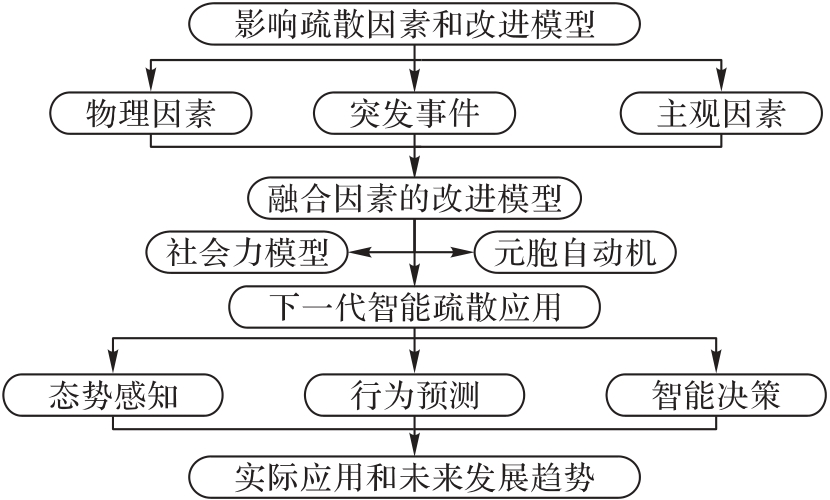
图1 整体框架
Fig. 1 Overall framework
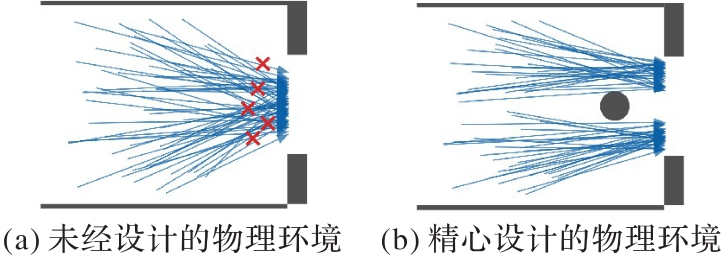
图2 物理环境的主动调控作用示意图
Fig. 2 Schematic diagram of active regulation effect of physical environment

图3 应对复杂环境的疏散模型的演进框架
Fig. 3 Evolutionary framework of evacuation models for complex environments
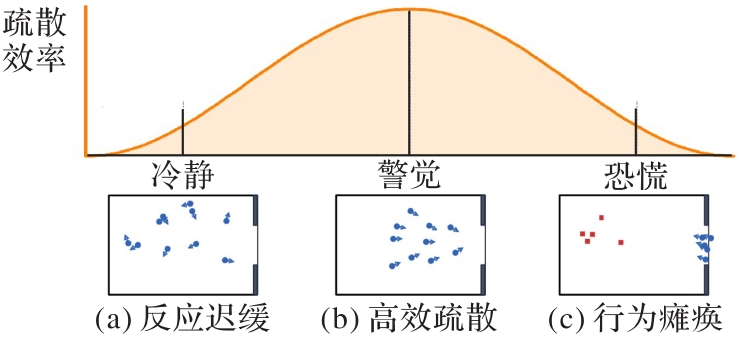
图4 不同情绪阈值下的疏散效果
Fig. 4 Evacuation effects under different emotional thresholds

图5 从众行为对群体自组织模式的非线性影响与调控
Fig. 5 Nonlinear influence and regulation of herd behavior on group self-organization patterns

图6 社会力模型的演进脉络
Fig. 6 Evolutionary trajectory of social force model
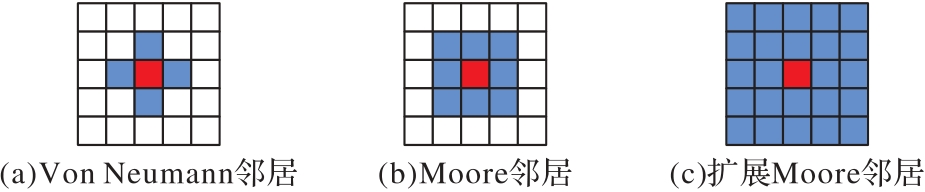
图7 元胞自动机模型
Fig. 7 Cellular automata models
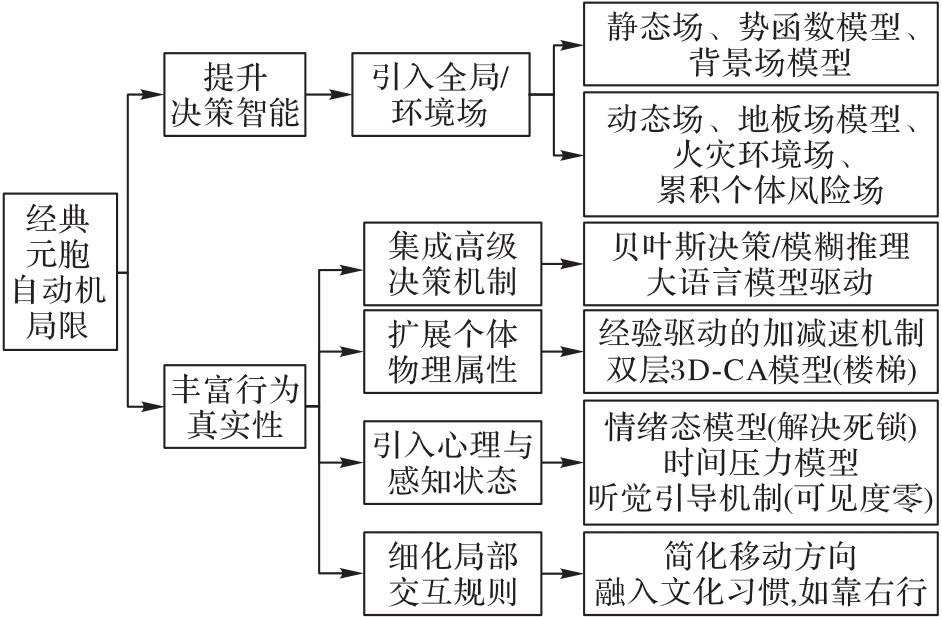
图8 元胞自动机模型的演进脉络
Fig. 8 Evolutionary trajectory of cellular automata models
| 模型 | 文献序号 | 基础复杂度 | 额外计算开销 | 总复杂度 | 评估维度 | 应用价值 |
|---|---|---|---|---|---|---|
社会力 改进 模型 | O(M),求解偏微分方程 | 疏散效率提升25% | 灾前设计优化与策略验证 | |||
| O(N),垂直平面计算 | 模拟30°横摇下疏散时间 | 特定动态环境下风险评估 | ||||
| O(N),视觉认知计算 | 高行为真实性 | 微观行为机理研究 | ||||
| O(N),心理状态计算 | 高行为真实性 | 准实时风险预警 | ||||
| O(N),更新传染状态 | 高群体动力学真实性 | 恐慌干预策略研究 | ||||
| O(N),计算邻居平均速度 | 强现象复现能力 | 大型场馆安全容量评估 | ||||
| O(N),局部行人SFM计算 | 高自组织行为真实性 | 双向流通道设计优化 | ||||
元胞 改进 模型 | O(N) | O(M),需外部物理场仿真 | O(N+M) | 高环境真实性 | 多灾种场景下风险评估 | |
| O(N) | O(N⋅C) | 极高决策智能 | 微观行为机理研究 | |||
| O(N) | 高心理真实性 | 高压应急情景心理因素分析 | ||||
| O(N) | O(N),智能体常数级计算 | O(N) | 高物理运动真实性 | 修正不现实瞬时速度变化 | ||
| O(N) | O(N),三维空间生物力学计算 | O(N) | 高空间与物理真实性 | 复杂三维结构精细疏散模拟 | ||
| O(N) | O(N),增状态判断与转移计算 | O(N) | 高特定情景真实性 | 模拟零可见度下的听觉寻路 |
表 1 改进模型的多维度对比
Tab. 1 Multi-dimensional comparison of improved models
| 模型 | 文献序号 | 基础复杂度 | 额外计算开销 | 总复杂度 | 评估维度 | 应用价值 |
|---|---|---|---|---|---|---|
社会力 改进 模型 | O(M),求解偏微分方程 | 疏散效率提升25% | 灾前设计优化与策略验证 | |||
| O(N),垂直平面计算 | 模拟30°横摇下疏散时间 | 特定动态环境下风险评估 | ||||
| O(N),视觉认知计算 | 高行为真实性 | 微观行为机理研究 | ||||
| O(N),心理状态计算 | 高行为真实性 | 准实时风险预警 | ||||
| O(N),更新传染状态 | 高群体动力学真实性 | 恐慌干预策略研究 | ||||
| O(N),计算邻居平均速度 | 强现象复现能力 | 大型场馆安全容量评估 | ||||
| O(N),局部行人SFM计算 | 高自组织行为真实性 | 双向流通道设计优化 | ||||
元胞 改进 模型 | O(N) | O(M),需外部物理场仿真 | O(N+M) | 高环境真实性 | 多灾种场景下风险评估 | |
| O(N) | O(N⋅C) | 极高决策智能 | 微观行为机理研究 | |||
| O(N) | 高心理真实性 | 高压应急情景心理因素分析 | ||||
| O(N) | O(N),智能体常数级计算 | O(N) | 高物理运动真实性 | 修正不现实瞬时速度变化 | ||
| O(N) | O(N),三维空间生物力学计算 | O(N) | 高空间与物理真实性 | 复杂三维结构精细疏散模拟 | ||
| O(N) | O(N),增状态判断与转移计算 | O(N) | 高特定情景真实性 | 模拟零可见度下的听觉寻路 |
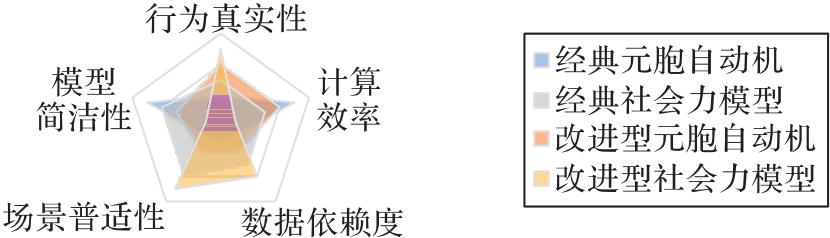
图9 经典疏散模型演进的多维性能评估
Fig. 9 Multi-dimensional performance evaluation of evolution of classic evacuation models
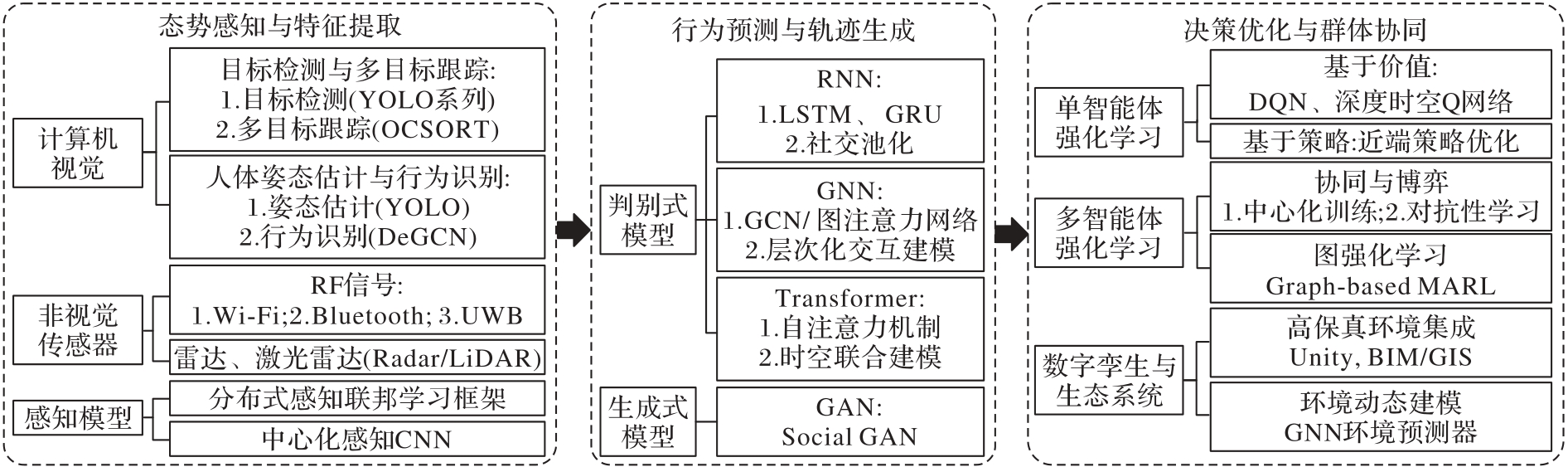
图10 下一代智能疏散技术的关联图谱
Fig. 10 Relation graph of next-generation intelligent evacuation technologies
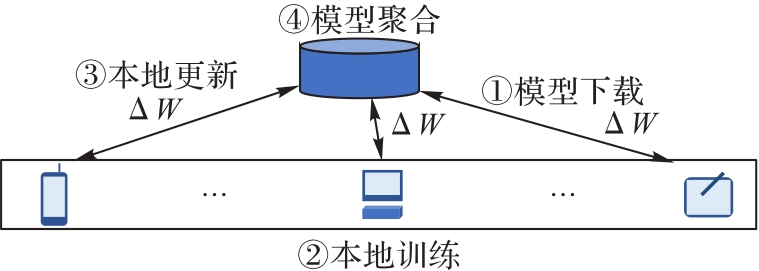
图11 联邦学习的过程
Fig. 11 Process of federated learning
| 主流模型 | 优点 | 缺点 | 实用价值 | |
|---|---|---|---|---|
| 目标检测、MOT | 1)技术成熟;2)提供丰富外观与运动信息; 3)多目标跟踪准确率 > 75% | 1)对人群严重遮挡、光照变化、相似外观敏感; 2)易发生ID切换 | 提供基础个体空间轨迹数据 | |
人体姿态估计、 行为识别 | 1)提取行走、奔跑等深层语义信息; 2)判断异常行为 | 1)计算开销大,对小目标和遮挡敏感; 2)难以大规模实时部署 | 风险预警 | |
| RF信号 | Wi-Fi | 1)利用现有设施,成本极低; 2)保护隐私 | 1)精度受多径效应影响大; 2)仅适用于追踪少量移动目标 | 特定区域定位感知 |
| UWB | 1)定位误差 < 0.3 m,不受环境影响; 2)可提供姿态信息 | 1)依赖个体主动佩戴特定设备; 2)部署成本高,维护复杂 | 高精度标定 | |
| 蓝牙 | 1)部署简单、成本低、功耗低; 2)易于集成到现有设施 | 1)精度较低,稳定性较差; 2)易受信号波动和多径效应干扰 | 粗粒度区域定位 | |
| 雷达、激光雷达 | 1)不受光照、烟雾影响;2)天然保护隐私; 3)抗遮挡能力强 | 1)无法获取颜色、纹理等外观特征; 2)难以应对密集人群的分割与关联 | 极端环境定位 | |
| FL | 1)保护隐私,极大降低网络带宽需求; 2)支持边缘实时计算 | 1)模型收敛较慢 | 部署可行性保障 | |
| CNN | 1)快速获取场景宏观人群分布热力图; 2)计算整体拥堵水平 | 1)无法区分个体,不提供轨迹信息; 2)易受透视畸变影响 | 宏观风险评估 | |
表2 态势感知与特征提取模型的多维度对比
Tab. 2 Multi-dimensional comparison of situation awareness and feature extraction models
| 主流模型 | 优点 | 缺点 | 实用价值 | |
|---|---|---|---|---|
| 目标检测、MOT | 1)技术成熟;2)提供丰富外观与运动信息; 3)多目标跟踪准确率 > 75% | 1)对人群严重遮挡、光照变化、相似外观敏感; 2)易发生ID切换 | 提供基础个体空间轨迹数据 | |
人体姿态估计、 行为识别 | 1)提取行走、奔跑等深层语义信息; 2)判断异常行为 | 1)计算开销大,对小目标和遮挡敏感; 2)难以大规模实时部署 | 风险预警 | |
| RF信号 | Wi-Fi | 1)利用现有设施,成本极低; 2)保护隐私 | 1)精度受多径效应影响大; 2)仅适用于追踪少量移动目标 | 特定区域定位感知 |
| UWB | 1)定位误差 < 0.3 m,不受环境影响; 2)可提供姿态信息 | 1)依赖个体主动佩戴特定设备; 2)部署成本高,维护复杂 | 高精度标定 | |
| 蓝牙 | 1)部署简单、成本低、功耗低; 2)易于集成到现有设施 | 1)精度较低,稳定性较差; 2)易受信号波动和多径效应干扰 | 粗粒度区域定位 | |
| 雷达、激光雷达 | 1)不受光照、烟雾影响;2)天然保护隐私; 3)抗遮挡能力强 | 1)无法获取颜色、纹理等外观特征; 2)难以应对密集人群的分割与关联 | 极端环境定位 | |
| FL | 1)保护隐私,极大降低网络带宽需求; 2)支持边缘实时计算 | 1)模型收敛较慢 | 部署可行性保障 | |
| CNN | 1)快速获取场景宏观人群分布热力图; 2)计算整体拥堵水平 | 1)无法区分个体,不提供轨迹信息; 2)易受透视畸变影响 | 宏观风险评估 | |
| 模型 | 优点 | 缺点 | 实用价值 |
|---|---|---|---|
| RNN | 1)能有效捕捉单个轨迹的时间依赖性,平均位移误差≈0.45 m/终点位移误差≈0.90 m;2)易于理解和实现 | 1)交互建模粗糙;2)难以并行化,处理长序列时效率低且易梯度消失、爆炸 | 常用于新模型的 性能比较基准 |
| GNN | 1)图结构显式灵活捕捉个体间复杂社交关系,平均位移 误差≈0.25 m/终点位移误差≈0.50 m; 2)易于融合地图、群体归属等信息,可解释性强 | 1)高效准确地构建随时间变化的交互图仍是挑战; 2)判别式模型,无法直接处理预测的多模态性 | 社交行为分析与 预测 |
| Transformer | 1)能一次性处理整个序列,有效捕捉长时序动态; 2)能同时感知场景中所有个体间的相互影响,具备全局视野 | 1)几何结构信息编码不如GNN直观,需要大量 数据和精巧的位置编码;2)计算开销大 | 长时序预测与 时空联合建模 |
| 生成式AI | 1)能生成多样化、合理的未来轨迹,非单一预测,分布一致性Kullback⁃Leibler散度 < 0.1;2)可用于生成大量逼真的虚拟轨迹数据,缓解真实数据稀缺问题 | 1)训练不稳定;2)生成结果可能不完全符合物理或 社交规范 | 风险评估与 多样性场景生成 |
表3 行为预测与轨迹生成模型的多维度对比
Tab. 3 Multi-dimensional comparison of behavior prediction and trajectory generation models
| 模型 | 优点 | 缺点 | 实用价值 |
|---|---|---|---|
| RNN | 1)能有效捕捉单个轨迹的时间依赖性,平均位移误差≈0.45 m/终点位移误差≈0.90 m;2)易于理解和实现 | 1)交互建模粗糙;2)难以并行化,处理长序列时效率低且易梯度消失、爆炸 | 常用于新模型的 性能比较基准 |
| GNN | 1)图结构显式灵活捕捉个体间复杂社交关系,平均位移 误差≈0.25 m/终点位移误差≈0.50 m; 2)易于融合地图、群体归属等信息,可解释性强 | 1)高效准确地构建随时间变化的交互图仍是挑战; 2)判别式模型,无法直接处理预测的多模态性 | 社交行为分析与 预测 |
| Transformer | 1)能一次性处理整个序列,有效捕捉长时序动态; 2)能同时感知场景中所有个体间的相互影响,具备全局视野 | 1)几何结构信息编码不如GNN直观,需要大量 数据和精巧的位置编码;2)计算开销大 | 长时序预测与 时空联合建模 |
| 生成式AI | 1)能生成多样化、合理的未来轨迹,非单一预测,分布一致性Kullback⁃Leibler散度 < 0.1;2)可用于生成大量逼真的虚拟轨迹数据,缓解真实数据稀缺问题 | 1)训练不稳定;2)生成结果可能不完全符合物理或 社交规范 | 风险评估与 多样性场景生成 |
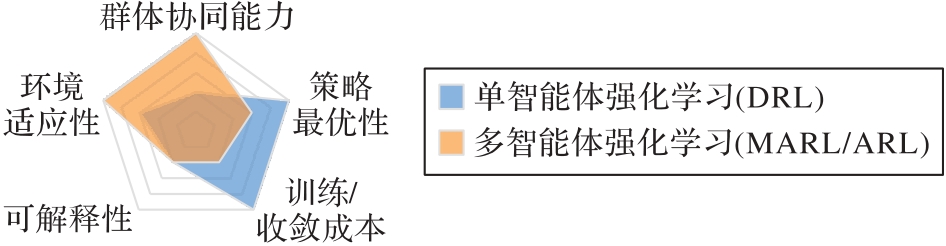
图12 决策优化模型的性能对比
Fig. 12 Performance comparison of decision optimization models
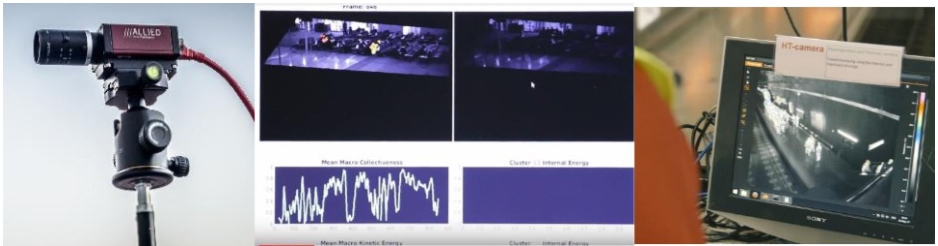
图13 人群计数、行为检测与识别系统
Fig. 13 Crowd counting, behavior detection, and recognition system
| 模型 | 优点 | 缺点 | 实用价值 |
|---|---|---|---|
单智能体 强化学习 | 1)实现从计算智能到自主学习决策智能; 2)为单个决策主体在复杂动态环境中找到最优行动策略,导航成功率 > 95% | 1)忽略群体效应; 2)缺乏环境演化预测能力 | 优化个体决策 |
多智能体 强化学习 | 1)实现从个体最优到群体协同的提升,生存率提升17.7%; 2)学习应对最坏情况和复杂对手策略 | 1)训练复杂度高; 2)重博弈,轻环境 | 协同群体行为 |
数字孪生与 生态系统 | 1)将智能体置于数字孪生环境中,提升决策有效性和可信度; 2)通过环境建模器,智能体不仅适应环境,还能预测并主动影响环境,实现人、 机、环境协同进化,疏散效率提升20%~50% | 1)系统构建极度复杂; 2)实时性挑战 | 调控生态系统 |
表4 决策优化与群体协同模型的多维度对比
Tab. 4 Multi-dimensional comparison of decision optimization and group collaboration models
| 模型 | 优点 | 缺点 | 实用价值 |
|---|---|---|---|
单智能体 强化学习 | 1)实现从计算智能到自主学习决策智能; 2)为单个决策主体在复杂动态环境中找到最优行动策略,导航成功率 > 95% | 1)忽略群体效应; 2)缺乏环境演化预测能力 | 优化个体决策 |
多智能体 强化学习 | 1)实现从个体最优到群体协同的提升,生存率提升17.7%; 2)学习应对最坏情况和复杂对手策略 | 1)训练复杂度高; 2)重博弈,轻环境 | 协同群体行为 |
数字孪生与 生态系统 | 1)将智能体置于数字孪生环境中,提升决策有效性和可信度; 2)通过环境建模器,智能体不仅适应环境,还能预测并主动影响环境,实现人、 机、环境协同进化,疏散效率提升20%~50% | 1)系统构建极度复杂; 2)实时性挑战 | 调控生态系统 |
| [1] | LIANG B, VAN DER WAL C N, XIE K, et al. Mapping the knowledge domain of soft computing applications for emergency evacuation studies: a scientometric analysis and critical review[J]. Safety Science, 2023, 158: No.105955. |
| [2] | SHAFIZADEGAN F, NAGHSH-NILCHI A R, SHABANINIA E. Multimodal vision-based human action recognition using deep learning: a review[J]. Artificial Intelligence Review, 2024, 57(7): No.178. |
| [3] | GWYNNE S, GALEA E R, OWEN M, et al. A review of the methodologies used in evacuation modelling[J]. Fire and Materials, 1999, 23(6): 383-388. |
| [4] | LU P. Multi-agent modeling for indoor fire risk prediction during evacuation based on cellular automata and artificial neural network[J]. Applied Soft Computing, 2025, 174: No.113013. |
| [5] | LI X, YU H, XU H, et al. A comparative study on pedestrian flow through bottlenecks between flood evacuation and land evacuation[J]. International Journal of Disaster Risk Reduction, 2023, 95: No.103822. |
| [6] | CHEN M, GUO M, HAN D, et al. A pedestrian evacuation model for a ship’s flat multi-exit large space under fire environment[J]. Ocean Engineering, 2024, 309(Pt 2): No.118570. |
| [7] | OH R S, LEE J Y, BAE Y H, et al. Analysis of luminance reduction based on the operating durations of emergency exit lights[J]. Journal of Building Engineering, 2024, 98: No.111145. |
| [8] | KINKEL E, VAN DER WAL C N, HOOGENDOORN S P. The effects of three environmental factors on problem-solving abilities during evacuation[J]. Journal of Building Engineering, 2025, 99: No.111546. |
| [9] | FU M, LIU R, LIU Q. Why individuals do not use emergency exit doors during evacuations: a virtual reality and eye-tracking experimental study[J]. Advanced Engineering Informatics, 2024, 60: No.102396. |
| [10] | MAO Y, WANG X, HE W, et al. An investigation into the influence of gender on crowd exit selection in indoor evacuation[J]. International Journal of Disaster Risk Reduction, 2024, 108: No.104563. |
| [11] | TONG Y, BODE N W F, HAGHANI M, et al. Exploring occupant exit choices during fire drills and false alarm evacuations in a library[J]. Safety Science, 2025, 182: No.106708. |
| [12] | DONG S, HUANG P, ZHANG J, et al. An optimization method for evacuation guidance in multi-room scenarios[J]. IEEE Transactions on Intelligent Transportation Systems, 2024, 25(11): 17940-17951. |
| [13] | LUO L, LIU H, QIN T, et al. Enhancing pedestrian navigation safety under strong wind environments: experimental insights on assistive handrails and obstacle impacts[J]. Safety Science, 2026, 193: No.107015. |
| [14] | YU Y, WANG Q, JIN L, et al. Optimizing evacuation path planning in high-rise building fires using an improved ant colony algorithm and dynamic window approach under smoke control scenarios[J]. Applied Soft Computing, 2025, 184(Pt B): No.113796. |
| [15] | NONG T, ZHANG Z, WANG T, et al. Dynamics analysis of pedestrian movement on slopes: modelling, simulations and experiments[J]. Physica A: Statistical Mechanics and its Applications, 2025, 668: No.130589. |
| [16] | RASA A R, XIA L, SONG X, et al. Understanding human-obstacle interacting dynamics on stairs: implications for emergency evacuation and fire safety in high-rise building[J]. Journal of Building Engineering, 2024, 98: No.111082. |
| [17] | LIU X, HUANG J, ZHAO J, et al. Predicting temporal evacuation travel time in staircases between adjacent floors of super high-rise buildings by artificial neural networks[J]. Journal of Building Engineering, 2024, 98: No.111133. |
| [18] | WANG F, ZHANG Y, DING S, et al. Optimizing phased-evacuation strategy for high-rise buildings in fire[J]. Journal of Building Engineering, 2024, 95: No.110084. |
| [19] | MINEGISHI Y. Crowd management employing nudge theory for safe elevator use by masses of occupants during a high-rise building evacuation[J]. Journal of Building Engineering, 2025, 111: No.113529. |
| [20] | SPEARPOINT M, ARNOTT M, XIE H, et al. Comparative analysis of two evacuation simulation tools when applied to high-rise residential buildings[J]. Safety Science, 2024, 175: No.106515. |
| [21] | ZHANG L, WEN T, KONG D, et al. Modeling the evacuation behavior of subway pedestrians with the consideration of luggage abandonment under emergency scenarios[J]. Transportation Research Part E: Logistics and Transportation Review, 2024, 189: No.103672. |
| [22] | JIANG J, TU W, KONG H, et al. Large-scale urban multiple-modal transport evacuation model for mass gathering events considering pedestrian and public transit system[J]. IEEE Transactions on Intelligent Transportation Systems, 2022, 23(12): 23059-23069. |
| [23] | ALAM M J, HABIB M A. A mass evacuation modeling framework to account for vulnerabilities in staged evacuation[J]. Transportation Research Part A: Policy and Practice, 2024, 190: No.104245. |
| [24] | CHEN J, LO S, ZHOU Y, et al. Subway station facility layout optimization for efficient evacuation: a hybrid method of adaptable queueing network and heuristic retrieval[J]. Tunnelling and Underground Space Technology, 2026, 168(Pt 2): No.107173. |
| [25] | ZENG X, LIU K, MA Y, et al. DC-HEN: a deadline-aware and congestion-relieved hierarchical emergency navigation algorithm for ship indoor environments[C]// Proceedings of the 2023 IEEE International Conference on Mobility, Operations, Services and Technologies. Piscataway: IEEE, 2023: 44-54. |
| [26] | 赵利强,刘进益,唐水雄,等. 基于社会力模型和改进K短路径规划的地铁站客流疏散方法研究[J]. 北京化工大学学报(自然科学版), 2025, 52(2): 54-64. |
| ZHAO L Q, LIU J Y, TANG S X, et al. Simulation of subway passenger flow during station evacuation based on K-shortest path planning and an improved social force model[J]. Journal of Beijing University of Chemical Technology (Natural Science Edition), 2025, 52(2): 54-64. | |
| [27] | ZHENG W H, ZHOU X Y, ZHANG T J, et al. How to predict the evacuation capacity of hub stations: a dynamic network loading model based on BIM and MDPM[J]. Transportation Research Part C: Emerging Technologies, 2024, 164: No.104682. |
| [28] | PADOVANO A, LONGO F, MANCA L, et al. Improving safety management in railway stations through a simulation-based digital twin approach[J]. Computers and Industrial Engineering, 2024, 187: No.109839. |
| [29] | LU T, ZHANG Y, XIE W, et al. Human-AI interactive framework for smart evacuation safety analysis in large infrastructures[J]. Reliability Engineering and System Safety, 2025, 266(Pt B): No.111695. |
| [30] | 朱前坤,李继武,杜永峰. 老旧教学楼火灾场景人员疏散仿真研究[J]. 系统仿真学报, 2024, 36(9): 2043. |
| ZHU Q K, LI J W, DU Y F. Simulation research on personnel evacuation in old teaching building fire scenarios[J]. Journal of System Simulation, 2024, 36(9): 2043. | |
| [31] | MA Y, ZHANG Z, ZHANG W, et al. Development of a time pressure-based model for the simulation of an evacuation in a fire emergency[J]. Journal of Building Engineering, 2024, 87: No.109069. |
| [32] | XIA X, CHEN J, ZHANG J, et al. How the strength of social relationship affects pedestrian evacuation behavior: a multi-participant fire evacuation experiment in a virtual metro station[J]. Transportation Research Part C: Emerging Technologies, 2024, 167: No.104805. |
| [33] | 张俊,罗梦好,宋卫国,等. 不同姿态人群的火场疏散模型研究[J]. 安全与环境学报, 2024, 24(9): 3556-3564. |
| ZHANG J, LUO M H, SONG W G, et al. An evacuation model that integrates considerations for fire effects and motion posture[J]. Journal of Safety and Environment, 2024, 24(9): 3556-3564. | |
| [34] | WANG J, LIU Y, LI Q, et al. Optimization of emergency shelter layout with consideration of toxic gas leakage based on a cell transmission model[J]. Safety Science, 2025, 185: No.106810. |
| [35] | BHARDWAJ R, BHARGAVA A, KUMAR V. INFED: enhancing fire evacuation dynamics through 3D congestion-aware indoor navigation framework[J]. Simulation Modelling Practice and Theory, 2024, 136: No.103010. |
| [36] | ZHANG Y, DING Y, CHRAIBI M, et al. Multi-scale analysis of fire and evacuation drill in a multi-functional university high-rise building[J]. Developments in the Built Environment, 2025, 21: No.100626. |
| [37] | LU T, ZENG Y, ZHENG Z, et al. AI-powered safe egress time assessment for complex building fire evacuation[J]. Journal of Building Engineering, 2025, 110: No.113013. |
| [38] | HASSANPOUR S, GONZÁLEZ V A, ZOU Y, et al. Agent-based post-earthquake evacuation simulation to enhance early-stage architectural layout and non-structural design[J]. Automation in Construction, 2024, 165: No.105541. |
| [39] | SHI Z L, DONG Z Q, LI G, et al. Quantitative evaluation method for post-earthquake functionality loss of pedestrian flow pathways within a complex building using evacuation and rescue simulation[J]. Engineering Structures, 2024, 317: No.118604. |
| [40] | NADIMI N, LOO B P Y, MANSOURIFAR F, et al. Earthquake-related evacuation transportation: insights from Kerman, Iran[J]. Cities, 2025, 158: No.105713. |
| [41] | 曹淑超,王苗苗,倪捷,等. 洪涝灾害下地铁站人群运动特性及疏散建模研究[J]. 铁道科学与工程学报, 2023, 20(12): 4802-4810. |
| CAO S C, WANG M M, NI J, et al. Research on crowd movement characteristics and evacuation modeling in subway stations under flood disaster[J]. Journal of Railway Science and Engineering, 2023, 20(12): 4802-4810. | |
| [42] | CAO S, WANG M, ZENG G, et al. Simulation of crowd evacuation in subway stations under flood disasters[J]. IEEE Transactions on Intelligent Transportation Systems, 2024, 25(9): 11858-11867. |
| [43] | LI Y, XU D, WANG J, et al. Simulation of subway flood evacuation based on modified social force model[J]. Tunnelling and Underground Space Technology, 2025, 156: No.106244. |
| [44] | GUO C, HUO F, LI Y, et al. An evacuation model considering pedestrian crowding and stampede under terrorist attacks[J]. Reliability Engineering and System Safety, 2024, 249: No.110230. |
| [45] | LIU J, ZHANG H, DING N, et al. A modified social force model for sudden attack evacuation based on Yerkes-Dodson law and the tendency toward low risk areas[J]. Physica A: Statistical Mechanics and its Applications, 2024, 633: No.129403. |
| [46] | SHIPMAN A, MAJUMDAR A, BOYCE N, et al. Movement behaviour of pedestrians in knife-based terrorist attacks: an experimental approach[J]. Transportation Research Part C: Emerging Technologies, 2024, 166: No.104790. |
| [47] | LU P, LI Y. An agent-based model for simulating cooperative behavior in crowd evacuation during toxic gas terrorist attacks[J]. Chaos, Solitons and Fractals, 2025, 196: No.116397. |
| [48] | 王立晓,郝闵熙,孙小慧. 考虑行人心理潜变量的地铁应急疏散仿真研究[J]. 中国安全科学学报, 2022, 32(8): 67-75. |
| WANG L X, HAO M X, SUN X H. Simulation study on subway emergency evacuation considering psychological latent variables of pedestrians[J]. China Safety Science Journal, 2022, 32(8): 67-75. | |
| [49] | 刘晓然,丰慧,曾德民,等. 考虑弱势群体疏散行为特征的高层住院楼疏散仿真及优化[J]. 科学技术与工程, 2024, 24(2): 715-722. |
| LIU X R, FENG H, ZENG D M, et al. Simulation and optimization of considering evacuation behavior characteristics of vulnerable groups within high-rise hospital buildings[J]. Science Technology and Engineering, 2024, 24(2): 715-722. | |
| [50] | 王冠宁,陈涛,郑晖杰,等. 考虑恐慌情绪和沿墙引导的行人疏散模型[J]. 中国安全科学学报, 2022, 32(9): 111-117. |
| WANG G N, CHEN T, ZHENG H J, et al. Pedestrian evacuation model considering panic and wall-following guidance[J]. China Safety Science Journal, 2022, 32(9): 111-117. | |
| [51] | HAN M, KUANG Y, ZHAO Y, et al. Psychological stress on human mobility and emergency evacuation in disaster response[J]. Transportation Research Part D: Transport and Environment, 2025, 148: No.105022. |
| [52] | 谢秉磊,周立,赵金秋. 恐慌情绪和疏散行为交互影响的地铁站火灾疏散仿真方法[J]. 中国安全生产科学技术, 2024, 20(3): 20-25. |
| XIE B L, ZHOU L, ZHAO J Q. Simulation method evacuation in subway station fire under interaction of panic emotion and evacuation behavior[J]. Journal of Safety Science and Technology, 2024, 20(3): 20-25. | |
| [53] | 薛铸鑫,范湘涛. 基于五因素人格模型的人群仿真研究[J]. 计算机应用与软件, 2015, 32(12): 46-50, 174. |
| XUE Z X, FAN X T. Research on crowd simulation based on five-factor personality model[J]. Computer Applications and Software, 2015, 32(12): 46-50, 174. | |
| [54] | 田玉敏. 人群疏散心理及行为个体差异的探讨[J]. 人类工效学, 2010, 16(3): 53-55, 82. |
| TIAN Y M. Discussion on individual differences in crowd evacuation psychology and behavior[J]. Chinese Journal of Ergonomics, 2010, 16(3): 53-55, 82. | |
| [55] | REN X, FANG Z, YE R, et al. Qualitative and quantitative hybrid analysis of heterogeneous crowds involving individuals with diverse types of disabilities passing through bottleneck[J]. Accident Analysis and Prevention, 2025, 221: No.108204. |
| [56] | 李昆,段新龙,郑强. 信息受限情况下多出口应急疏散仿真分析[J].中国安全生产科学技术, 2024, 20(6): 212-218. |
| LI K, DUAN X L, ZHENG Q. Simulation analysis of multi-exit emergency evacuation under limited information[J]. Journal of Safety Science and Technology, 2024, 20(6): 212-218. | |
| [57] | HAGHANI M, YAZDANI M. How behavioural changes in social groups affect evacuation efficiency of crowds[J]. Safety Science, 2025, 181: No.106679. |
| [58] | LI K, CHEN Z. Emergency evacuation dynamics based on evolutionary game theory[J]. Physics Letters A, 2024, 528: No.130059. |
| [59] | 陈晓薇,王坚. 考虑个体恐慌与人群混乱的社会小群体疏散模型[J]. 同济大学学报(自然科学版), 2023, 51(2): 280-287. |
| CHEN X W, WANG J. A social group evacuation model considering individual panic and crowd chaos[J]. Journal of Tongji University (Natural Science), 2023, 51(2): 280-287. | |
| [60] | ZHANG X, DUNN S, LUO Y, et al. Integrating human behaviors in an agent-based model for multi-floor building emergency evacuation[J]. Journal of Building Engineering, 2025, 112: No.113716. |
| [61] | WU W, YI W. Modeling the dynamical process of behavioral contagion in human crowds during evacuation[J]. Reliability Engineering and System Safety, 2025, 266(Pt A): No.111649. |
| [62] | OUYANG K, FU S, CHEN Y, et al. Escape: an optimization method based on crowd evacuation behaviors[J]. Artificial Intelligence Review, 2024, 58(1): No.19. |
| [63] | 陈亮,郭志良,李永行,等. 零视野条件下考虑结伴行为的行人疏散研究[J]. 物理学报, 2024, 73(21): No.210502. |
| CHEN L, GUO Z L, LI Y X, et al. Research on pedestrian evacuation considering group behavior under zero-visibility condition[J]. Acta Physica Sinica, 2024, 73(21): No.210502. | |
| [64] | WU W, YI W, WANG X, et al. A vision-driven model based on cognitive heuristics for simulating subgroup behaviors during evacuation[J]. IEEE Transactions on Intelligent Transportation Systems, 2024, 25(11): 16048-16058. |
| [65] | FENG X, JIANG Y, GAI W. Rural community response to accidental toxic gas release: an individual emergency response model during self-organized evacuations[J]. Reliability Engineering and System Safety, 2024, 248: No.110178. |
| [66] | FANG S, LIU Z, WANG X, et al. Dynamic analysis of emergency evacuation in a rolling passenger ship using a two-layer social force model[J]. Expert Systems with Applications, 2024, 247: No.123310. |
| [67] | ZHAO Q, TANG G, YANG Y, et al. Fusion-based extended social force model for reciprocal transformation tasks in bidirectional pedestrian movement[J]. Information Fusion, 2025, 117: No.102835. |
| [68] | DANG P, ZHU J, LI W, et al. Large-language-model-driven agents for fire evacuation simulation in a cellular automata environment[J]. Safety Science, 2025, 191: No.106935. |
| [69] | XIONG X, LUO L, FENG Y, et al. Development of floor field cellular automaton model for pedestrian dynamics: incorporating empirical acceleration mechanisms[J]. Simulation Modelling Practice and Theory, 2025, 144: No.103197. |
| [70] | 陈群,喻亚文. 基于双层运动模型的楼梯行人群体仿真[J]. 物理学报, 2025, 74(14): No.140202. |
| CHEN Q, YU Y W. Simulation of pedestrian groups on stairs based on dual-layer motion model[J]. Acta Physica Sinica, 2025, 74(14): No.140202. | |
| [71] | DONG C, DU G. An enhanced real-time human pose estimation method based on modified YOLOv8 framework[J]. Scientific Reports, 2024, 14: No.8012. |
| [72] | MYUNG W, SU N, XUE J H, et al. DeGCN: deformable graph convolutional networks for skeleton-based action recognition[J]. IEEE Transactions on Image Processing, 2024, 33: 2477-2490. |
| [73] | QIU H, HOU B. Multi-grained clip focus for skeleton-based action recognition[J]. Pattern Recognition, 2024, 148: No.110188. |
| [74] | SHI F, LI W, TANG C, et al. ML-Track: passive human tracking using WiFi multi-link round-trip CSI and particle filter[J]. IEEE Transactions on Mobile Computing, 2025, 24(6): 5155-5172. |
| [75] | ZHANG S, TANG H, CHEN L, et al. A seamless pedestrian localization system based on GNSS/IMU/UWB/MAP integration[J]. IEEE Internet of Things Journal, 2025, 12(11): 16653-16667. |
| [76] | UKYO R, AMANO T, RIZK H, et al. Robust pedestrian tracking with severe occlusions in public spaces using 3D point clouds[J]. IEEE Transactions on Intelligent Transportation Systems, 2025, 26(6): 8411-8423. |
| [77] | 王宗尧,吕子龙,徐欣然,等. 基于深度卷积神经网络的人群疏散运动仿真模型[J]. 大连海事大学学报, 2024, 50(2): 101-108. |
| WANG Z Y, LYU Z L, XU X R, et al. Simulation model of crowd evacuation movement based on deep convolutional neural network[J]. Journal of Dalian Maritime University, 2024, 50(2): 101-108. | |
| [78] | PANG Y, NI Z, ZHONG X. Federated learning for crowd counting in smart surveillance systems[J]. IEEE Internet of Things Journal, 2024, 11(3): 5200-5209. |
| [79] | AKRAM J, AKRAM A, INGLE P, et al. Privacy-preserving spatial crowdsourcing drone services for postdisaster infrastructure monitoring: a conditional federated learning approach[J]. IEEE Journal of Selected Topics in Applied Earth Observations and Remote Sensing, 2025, 18: 16272-16291. |
| [80] | SIDDIQA A, KHAN W Z, ALKINANI M H, et al. Edge-assisted federated learning framework for smart crowd management[J]. Internet of Things, 2024, 27: No.101253. |
| [81] | LIN X, LIANG Y, ZHANG Y, et al. IE-GAN: a data-driven crowd simulation method via generative adversarial networks[J]. Multimedia Tools and Applications, 2024, 83(15): 45207-45240. |
| [82] | XIE C Z T, XU J, ZHU B, et al. Advancing crowd forecasting with graphs across microscopic trajectory to macroscopic dynamics[J]. Information Fusion, 2024, 106: No.102275. |
| [83] | WANG B, SUN C, LENG J, et al. HSIGCN: hierarchical spatial interaction graph convolutional network considering group behavior for pedestrian trajectory prediction[J]. IEEE Internet of Things Journal, 2025, 12(24): 53274-53287. |
| [84] | WANG Z, CHEN Y, ZHU F, et al. GENII: a graph neural network-based model for citywide litter prediction leveraging crowdsensing data[J]. Expert Systems with Applications, 2024, 237(Pt B): No.121565. |
| [85] | PETERS H, BAYER J B, MATZ S C, et al. Social media use is predictable from app sequences: using LSTM and Transformer neural networks to model habitual behavior[J]. Computers in Human Behavior, 2024, 161: No.108381. |
| [86] | ALAFIF T, ALZAHRANI B, CAO Y, et al. Generative adversarial network based abnormal behavior detection in massive crowd videos: a Hajj case study[J]. Journal of Ambient Intelligence and Humanized Computing, 2022, 13(8): 4077-4088. |
| [87] | KOTHARI P, ALAHI A. Safety-compliant generative adversarial networks for human trajectory forecasting[J]. IEEE Transactions on Intelligent Transportation Systems, 2023, 24(4): 4251-4261. |
| [88] | LIU H, XU B, LU D, et al. A path planning approach for crowd evacuation in buildings based on improved artificial bee colony algorithm[J]. Applied Soft Computing, 2018, 68: 360-376. |
| [89] | CHARALAMBOUS P, PETTRE J, VASSILIADES V, et al. GREIL-Crowds: crowd simulation with deep reinforcement learning and examples[J]. ACM Transactions on Graphics, 2023, 42(4): No.137. |
| [90] | 张晨,蒋文英,陈思源,等. 基于双层DQN的多智能体路径规划[J]. 中国图象图形学报, 2023, 28(7): 2167-2181. |
| ZHANG C, JIANG W Y, CHEN S Y, et al. Multi-agent path planning based on improved double DQN[J]. Journal of Image and Graphics, 2023, 28(7): 2167-2181. | |
| [91] | ZHOU W, JIANG W, JIE B, et al. Multiagent evacuation framework for a virtual fire emergency scenario based on generative adversarial imitation learning[J]. Computer Animation and Virtual Worlds, 2022, 33(1): No.e2035. |
| [92] | XIE C Z T, CHEN Q, ZHU B, et al. Coordinating dynamic signage for evacuation guidance: a multi-agent reinforcement learning approach integrating mesoscopic crowd modeling and fire propagation[J]. Chaos, Solitons and Fractals, 2025, 194: No.116246. |
| [93] | OMIDBEYK S, GHAVAMI S M. Multi-agent simulation of population evacuation during dynamic fire using reinforcement learning based on integration of geographic information systems and building information modeling[J]. Journal of Building Engineering, 2025, 111: No.113035. |
| [94] | WU T, YU J, JIANG Q, et al. An unmanned system-guided crowd evacuation method in complex and large-scale evacuation environments[J]. IEEE Transactions on Automation Science and Engineering, 2025, 22: 1864-1877. |
| [95] | ZHAO H, LIANG Z, MA T, et al. Adversarial reinforcement learning for enhanced decision-making of evacuation guidance robots in intelligent fire scenarios[J]. IEEE Transactions on Computational Social Systems, 2025, 12(5): 2030-2046. |
| [96] | ZHANG Z, TAN L, TIONG R L K. Evacuation path optimization algorithm for grassland fires based on SAR imagery and intelligent optimization[J]. Frontiers in Environmental Science, 2025, 13: No.1522933. |
| [97] | CHAUDHARY S, SINPAN N, SASITHONG P, et al. Proximal policy optimization for crowd evacuation in complex environments — a metaverse approach at Krung Thep Aphiwat Central Terminal, Thailand[J]. IEEE Access, 2024, 12: 196969-196983. |
| [98] | The European Union’s Seventh Framework Program. eVACUATE[EB/OL]. [2024-06-01].. |
| [99] | PARK S, LEE S, JANG H, et al. Smart Fire Safety Management System (SFSMS) connected with energy management for sustainable service in smart building infrastructures[J]. Buildings, 2023, 13(12): No.3018. |
| [100] | ZHANG Z, LIU H, JIAO Z, et al. Congestion-aware evacuation routing using augmented reality devices[C]// Proceedings of the 2020 IEEE International Conference on Robotics and Automation. Piscataway: IEEE, 2020: 2798-2804. |
| [1] | 薛天宇, 李爱萍, 段利国. 联合任务卸载和资源优化的车辆边缘计算方案[J]. 《计算机应用》唯一官方网站, 2025, 45(6): 1766-1775. |
| [2] | 许鹏程, 何磊, 李川, 钱炜祺, 赵暾. 基于Transformer的深度符号回归方法[J]. 《计算机应用》唯一官方网站, 2025, 45(5): 1455-1463. |
| [3] | 王华华, 黄梁, 陈甲杰, 方杰宁. 基于深度强化学习的低轨卫星多波束子载波动态分配算法[J]. 《计算机应用》唯一官方网站, 2025, 45(2): 571-577. |
| [4] | 王靖, 方旭明. Wi-Fi7多链路通感一体化的功率和信道联合智能分配算法[J]. 《计算机应用》唯一官方网站, 2025, 45(2): 563-570. |
| [5] | 卫琳, 张世豪, 和孟佯. 面向算力网络的工作流任务优化与节能卸载方法[J]. 《计算机应用》唯一官方网站, 2025, 45(12): 3916-3924. |
| [6] | 曾君, 童英华, 王得芳. 基于累积概率波动和自动化聚类的异常检测方法[J]. 《计算机应用》唯一官方网站, 2025, 45(12): 3864-3871. |
| [7] | 卫琳, 李金阳, 王亚杰, 和孟佯. 算力网络中基于多维资源度量和重调度的高可靠匹配方法[J]. 《计算机应用》唯一官方网站, 2025, 45(11): 3632-3641. |
| [8] | 张焱鹏, 赵于前, 张帆, 丘腾海, 桂瑰, 余伶俐. 基于改进MAML与GVAE的容量约束车辆路径问题求解方法[J]. 《计算机应用》唯一官方网站, 2025, 45(11): 3642-3648. |
| [9] | 周帅, 符浩, 刘伟. 基于时空Transformer的混合回报隐式Q学习人群导航[J]. 《计算机应用》唯一官方网站, 2025, 45(11): 3666-3673. |
| [10] | 缪孜珺, 罗飞, 丁炜超, 董文波. 基于全局状态预测与公平经验重放的交通信号控制算法[J]. 《计算机应用》唯一官方网站, 2025, 45(1): 337-344. |
| [11] | 周毅, 高华, 田永谌. 基于裁剪优化和策略指导的近端策略优化算法[J]. 《计算机应用》唯一官方网站, 2024, 44(8): 2334-2341. |
| [12] | 马天, 席润韬, 吕佳豪, 曾奕杰, 杨嘉怡, 张杰慧. 基于深度强化学习的移动机器人三维路径规划方法[J]. 《计算机应用》唯一官方网站, 2024, 44(7): 2055-2064. |
| [13] | 赵晓焱, 韩威, 张俊娜, 袁培燕. 基于异步深度强化学习的车联网协作卸载策略[J]. 《计算机应用》唯一官方网站, 2024, 44(5): 1501-1510. |
| [14] | 唐睿, 庞川林, 张睿智, 刘川, 岳士博. D2D通信增强的蜂窝网络中基于DDPG的资源分配[J]. 《计算机应用》唯一官方网站, 2024, 44(5): 1562-1569. |
| [15] | 秦鑫彤, 宋政育, 侯天为, 王飞越, 孙昕, 黎伟. 基于自适应p持续的移动自组网信道接入和资源分配算法[J]. 《计算机应用》唯一官方网站, 2024, 44(3): 863-868. |
| 阅读次数 | ||||||
|
全文 |
|
|||||
|
摘要 |
|
|||||
