


《计算机应用》唯一官方网站 ›› 2026, Vol. 46 ›› Issue (3): 907-914.DOI: 10.11772/j.issn.1001-9081.2025030333
薛苏玲, 何金旭, 魏文洁, 何荧荧, 娄路( )
)
收稿日期:2025-03-31
修回日期:2025-05-13
接受日期:2025-05-15
发布日期:2025-05-28
出版日期:2026-03-10
通讯作者:
娄路
作者简介:薛苏玲(2001—),女,重庆人,硕士研究生,CCF会员,主要研究方向:多视图三维重建
Suling XUE, Jinxu HE, Wenjie WEI, Yingying HE, Lu LOU()
Received:2025-03-31
Revised:2025-05-13
Accepted:2025-05-15
Online:2025-05-28
Published:2026-03-10
Contact:
Lu LOU
About author:XUE Suling, born in 2001, M. S. candidate. Her research interests include multi-view 3D reconstruction.Supported by:摘要:
针对隐式神经表面(NeuS)重建中密集采样及体积渲染导致的效率与精度失衡问题,提出一种快速高效的重建方法。首先,采用动态占用网格结合密度阈值的方法来优化筛选有效采样点,从而降低冗余计算和内存占用;其次,融合多分辨率哈希编码和截断符号距离场(TSDF),以通过截断距离约束和哈希特征插值来增强梯度稳定性与抗噪能力;最后,引入光度一致性约束来利用归一化交叉相关(NCC)优化跨视角几何一致性,从而提高表面重建的质量。实验结果表明:在仿真数据集Nerf-Synthetic上,所提方法的训练时间相较于神经辐射场(NeRF)缩短了98.8%;虽比采用CUDA (Compute Unified Device Architecture)加速的Instant-NGP (Instant Neural Graphics Primitives)长,但表面重建质量得到明显提升。在真实数据集DTU上,该方法的表面重建误差倒角距离(CD)和新视角合成指标峰值信噪比(PSNR)优于大多数现有方法,较Instant-NGP分别降低了1.21 mm和提高2.93 dB;虽略逊于Neuralangelo (CD提升0.02 mm、PSNR降低2.05 dB),但是训练耗时相较于Neuralangelo缩短了97.5%。可见,该方法能够有效提升训练效率且保证重建精度,实用性好,适用于复杂结构场景的高效三维重建。
中图分类号:
薛苏玲, 何金旭, 魏文洁, 何荧荧, 娄路. 基于动态占用网格的快速隐式神经表面重建[J]. 计算机应用, 2026, 46(3): 907-914.
Suling XUE, Jinxu HE, Wenjie WEI, Yingying HE, Lu LOU. Fast neural implicit surface reconstruction based on dynamic occupancy grid[J]. Journal of Computer Applications, 2026, 46(3): 907-914.
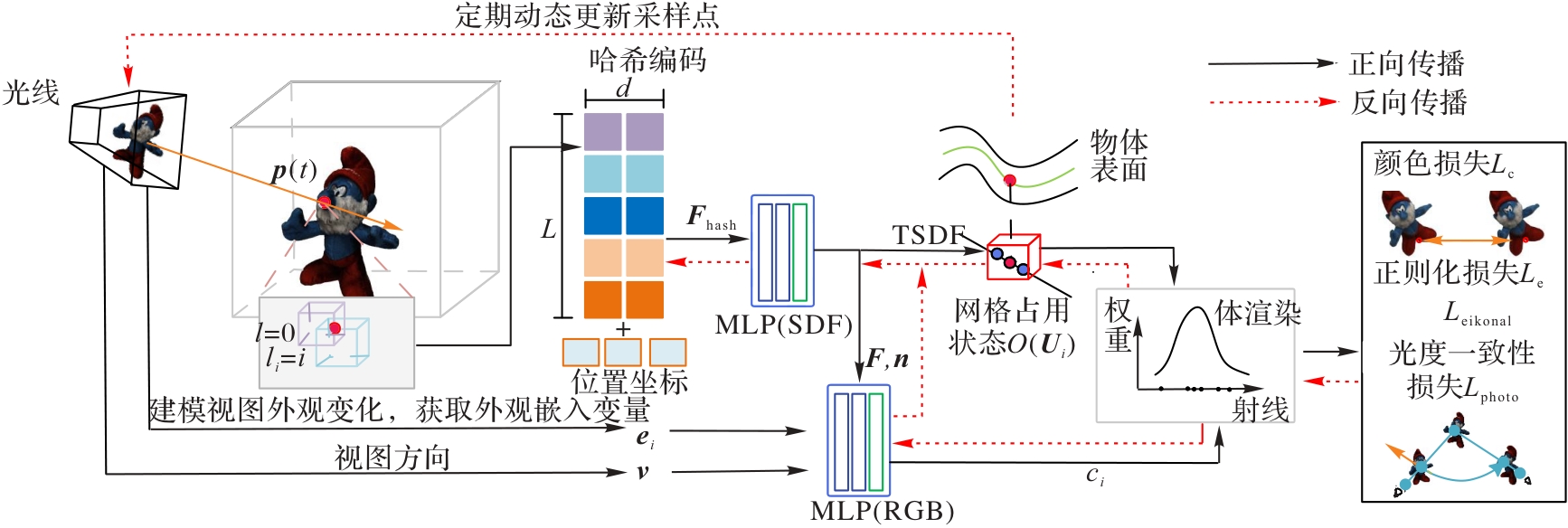
图1 整体框架
Fig. 1 Overall framework
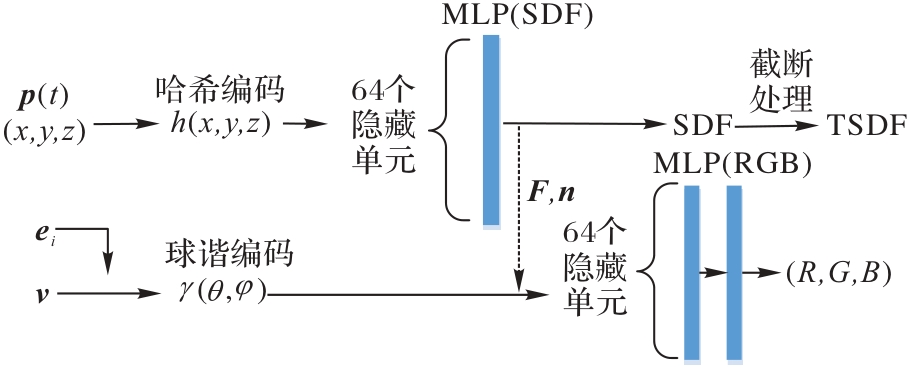
图2 MLP网络结构
Fig. 2 Structure of MLP network
| 方法 | 不同场景下的CD/mm | 平均CD/mm | 训练 时间/min | ||||||||||||||
|---|---|---|---|---|---|---|---|---|---|---|---|---|---|---|---|---|---|
| 24 | 37 | 40 | 55 | 63 | 65 | 69 | 83 | 97 | 105 | 106 | 110 | 114 | 118 | 122 | |||
| NeuS | 1.00 | 1.37 | 0.93 | 0.43 | 1.10 | 1.48 | 1.09 | 0.83 | 0.52 | 1.20 | 0.35 | 0.49 | 0.54 | 0.84 | 480.0 | ||
| Neuralangelo | 0.37 | 0.35 | 0.54 | 0.53 | 1.29 | 0.97 | 0.73 | 0.74 | 0.41 | 0.61 | 1 170.0 | ||||||
| Instant-NGP | 1.68 | 1.93 | 1.57 | 1.16 | 2.00 | 1.56 | 1.81 | 2.33 | 2.16 | 1.88 | 1.76 | 2.32 | 1.86 | 1.80 | 1.72 | 1.84 | 5.0 |
| Instant-NSR | 2.86 | 2.81 | 2.09 | 0.81 | 1.65 | 1.39 | 1.47 | 1.67 | 2.47 | 1.12 | 1.22 | 2.30 | 0.98 | 1.41 | 0.95 | 1.68 | |
| NeuS2 | 0.56 | 0.76 | 0.49 | 0.37 | 0.92 | 0.71 | 0.76 | 1.22 | 1.08 | 0.59 | 0.40 | 0.48 | 0.55 | 0.70 | 5.0 | ||
| 2DGS | 0.91 | 0.39 | 0.39 | 1.01 | 0.83 | 0.81 | 1.36 | 1.27 | 0.76 | 0.70 | 1.40 | 0.40 | 0.76 | 0.52 | 0.80 | 10.9 | |
| GOF | 0.50 | 0.82 | 0.37 | 1.12 | 0.74 | 0.73 | 1.29 | 0.68 | 0.77 | 0.90 | 0.42 | 0.66 | 0.49 | 0.74 | 18.4 | ||
| 本文方法 | 0.58 | 0.69 | 0.62 | 0.30 | 0.82 | 0.81 | 0.60 | 0.82 | 0.62 | 0.42 | 1.10 | 0.31 | 0.38 | 29.0 | |||
表1 不同方法在DTU数据集上的CD对比
Tab. 1 Comparison of CD of different methods on DTU dataset
| 方法 | 不同场景下的CD/mm | 平均CD/mm | 训练 时间/min | ||||||||||||||
|---|---|---|---|---|---|---|---|---|---|---|---|---|---|---|---|---|---|
| 24 | 37 | 40 | 55 | 63 | 65 | 69 | 83 | 97 | 105 | 106 | 110 | 114 | 118 | 122 | |||
| NeuS | 1.00 | 1.37 | 0.93 | 0.43 | 1.10 | 1.48 | 1.09 | 0.83 | 0.52 | 1.20 | 0.35 | 0.49 | 0.54 | 0.84 | 480.0 | ||
| Neuralangelo | 0.37 | 0.35 | 0.54 | 0.53 | 1.29 | 0.97 | 0.73 | 0.74 | 0.41 | 0.61 | 1 170.0 | ||||||
| Instant-NGP | 1.68 | 1.93 | 1.57 | 1.16 | 2.00 | 1.56 | 1.81 | 2.33 | 2.16 | 1.88 | 1.76 | 2.32 | 1.86 | 1.80 | 1.72 | 1.84 | 5.0 |
| Instant-NSR | 2.86 | 2.81 | 2.09 | 0.81 | 1.65 | 1.39 | 1.47 | 1.67 | 2.47 | 1.12 | 1.22 | 2.30 | 0.98 | 1.41 | 0.95 | 1.68 | |
| NeuS2 | 0.56 | 0.76 | 0.49 | 0.37 | 0.92 | 0.71 | 0.76 | 1.22 | 1.08 | 0.59 | 0.40 | 0.48 | 0.55 | 0.70 | 5.0 | ||
| 2DGS | 0.91 | 0.39 | 0.39 | 1.01 | 0.83 | 0.81 | 1.36 | 1.27 | 0.76 | 0.70 | 1.40 | 0.40 | 0.76 | 0.52 | 0.80 | 10.9 | |
| GOF | 0.50 | 0.82 | 0.37 | 1.12 | 0.74 | 0.73 | 1.29 | 0.68 | 0.77 | 0.90 | 0.42 | 0.66 | 0.49 | 0.74 | 18.4 | ||
| 本文方法 | 0.58 | 0.69 | 0.62 | 0.30 | 0.82 | 0.81 | 0.60 | 0.82 | 0.62 | 0.42 | 1.10 | 0.31 | 0.38 | 29.0 | |||
| 方法 | 不同场景下的PSNR/dB | 平均 PSNR/dB | ||||||||||||||
|---|---|---|---|---|---|---|---|---|---|---|---|---|---|---|---|---|
| 24 | 37 | 40 | 55 | 63 | 65 | 69 | 83 | 97 | 105 | 106 | 110 | 114 | 118 | 122 | ||
| NeuS | 26.62 | 23.64 | 26.43 | 25.59 | 30.61 | 32.83 | 29.24 | 26.85 | 31.97 | 28.92 | 28.41 | 34.81 | 29.79 | |||
| Neuralangelo | 27.78 | 32.70 | 34.18 | 35.89 | 31.47 | 36.82 | 30.13 | 35.92 | 36.61 | 32.60 | 38.41 | 38.05 | 33.84 | |||
| Instant-NGP | 28.32 | 27.19 | 30.45 | 29.81 | 31.22 | 27.78 | 24.79 | 31.23 | 26.96 | 30.62 | 25.62 | 28.60 | 29.50 | 27.91 | 32.93 | 28.86 |
| Instant-NSR | 23.86 | 24.97 | 25.3 | 25.43 | 29.52 | 26.17 | 22.93 | 26.72 | 25.94 | 27.71 | 23.12 | 25.44 | 26.70 | 25.13 | 28.19 | 25.81 |
| NeuS2 | 28.44 | 27.14 | 29.70 | 29.67 | 31.75 | 27.83 | 24.84 | 31.24 | 26.86 | 30.57 | 26.05 | 28.98 | 27.82 | 32.48 | 28.82 | |
| 本文方法 | 32.56 | 35.69 | 31.38 | 30.44 | 28.85 | 32.76 | 32.88 | |||||||||
表2 不同方法在DTU数据集上的PSNR对比
Tab. 2 PSNR comparison of different methods on DTU dataset
| 方法 | 不同场景下的PSNR/dB | 平均 PSNR/dB | ||||||||||||||
|---|---|---|---|---|---|---|---|---|---|---|---|---|---|---|---|---|
| 24 | 37 | 40 | 55 | 63 | 65 | 69 | 83 | 97 | 105 | 106 | 110 | 114 | 118 | 122 | ||
| NeuS | 26.62 | 23.64 | 26.43 | 25.59 | 30.61 | 32.83 | 29.24 | 26.85 | 31.97 | 28.92 | 28.41 | 34.81 | 29.79 | |||
| Neuralangelo | 27.78 | 32.70 | 34.18 | 35.89 | 31.47 | 36.82 | 30.13 | 35.92 | 36.61 | 32.60 | 38.41 | 38.05 | 33.84 | |||
| Instant-NGP | 28.32 | 27.19 | 30.45 | 29.81 | 31.22 | 27.78 | 24.79 | 31.23 | 26.96 | 30.62 | 25.62 | 28.60 | 29.50 | 27.91 | 32.93 | 28.86 |
| Instant-NSR | 23.86 | 24.97 | 25.3 | 25.43 | 29.52 | 26.17 | 22.93 | 26.72 | 25.94 | 27.71 | 23.12 | 25.44 | 26.70 | 25.13 | 28.19 | 25.81 |
| NeuS2 | 28.44 | 27.14 | 29.70 | 29.67 | 31.75 | 27.83 | 24.84 | 31.24 | 26.86 | 30.57 | 26.05 | 28.98 | 27.82 | 32.48 | 28.82 | |
| 本文方法 | 32.56 | 35.69 | 31.38 | 30.44 | 28.85 | 32.76 | 32.88 | |||||||||
| 方法 | 不同场景下的PSNR/dB | 平均 PSNR/dB | 训练时间/min | |||||||
|---|---|---|---|---|---|---|---|---|---|---|
| chair | drums | ficus | hotdog | lego | materials | mic | ship | |||
| COLMAP | 15.42 | 8.06 | 15.12 | 12.21 | 12.31 | 14.56 | 9.29 | 10.02 | 12.12 | 78.0 |
| Mip-NeRF | 34.01 | 24.36 | 26.66 | 36.44 | 33.20 | 27.91 | 31.50 | 28.66 | 30.34 | 210.0 |
| NeRF | 33.43 | 36.39 | 32.86 | 29.84 | 13.03 | 28.80 | 28.72 | 1 404.0 | ||
| Instant-NGP | 24.57 | 30.29 | 35.65 | 35.41 | 30.61 | 32.20 | 2.5 | |||
| Nerfstudio | 32.94 | 22.48 | 27.82 | 31.09 | 31.37 | 25.38 | 28.71 | 29.19 | ||
| 本文方法 | 35.64 | 27.52 | 30.85 | 38.70 | 27.64 | 33.33 | 16.0 | |||
表3 不同方法在Nerf-Synthetic数据集上的PSNR对比
Tab. 3 PSNR comparison of different methods on Nerf-Synthetic dataset
| 方法 | 不同场景下的PSNR/dB | 平均 PSNR/dB | 训练时间/min | |||||||
|---|---|---|---|---|---|---|---|---|---|---|
| chair | drums | ficus | hotdog | lego | materials | mic | ship | |||
| COLMAP | 15.42 | 8.06 | 15.12 | 12.21 | 12.31 | 14.56 | 9.29 | 10.02 | 12.12 | 78.0 |
| Mip-NeRF | 34.01 | 24.36 | 26.66 | 36.44 | 33.20 | 27.91 | 31.50 | 28.66 | 30.34 | 210.0 |
| NeRF | 33.43 | 36.39 | 32.86 | 29.84 | 13.03 | 28.80 | 28.72 | 1 404.0 | ||
| Instant-NGP | 24.57 | 30.29 | 35.65 | 35.41 | 30.61 | 32.20 | 2.5 | |||
| Nerfstudio | 32.94 | 22.48 | 27.82 | 31.09 | 31.37 | 25.38 | 28.71 | 29.19 | ||
| 本文方法 | 35.64 | 27.52 | 30.85 | 38.70 | 27.64 | 33.33 | 16.0 | |||
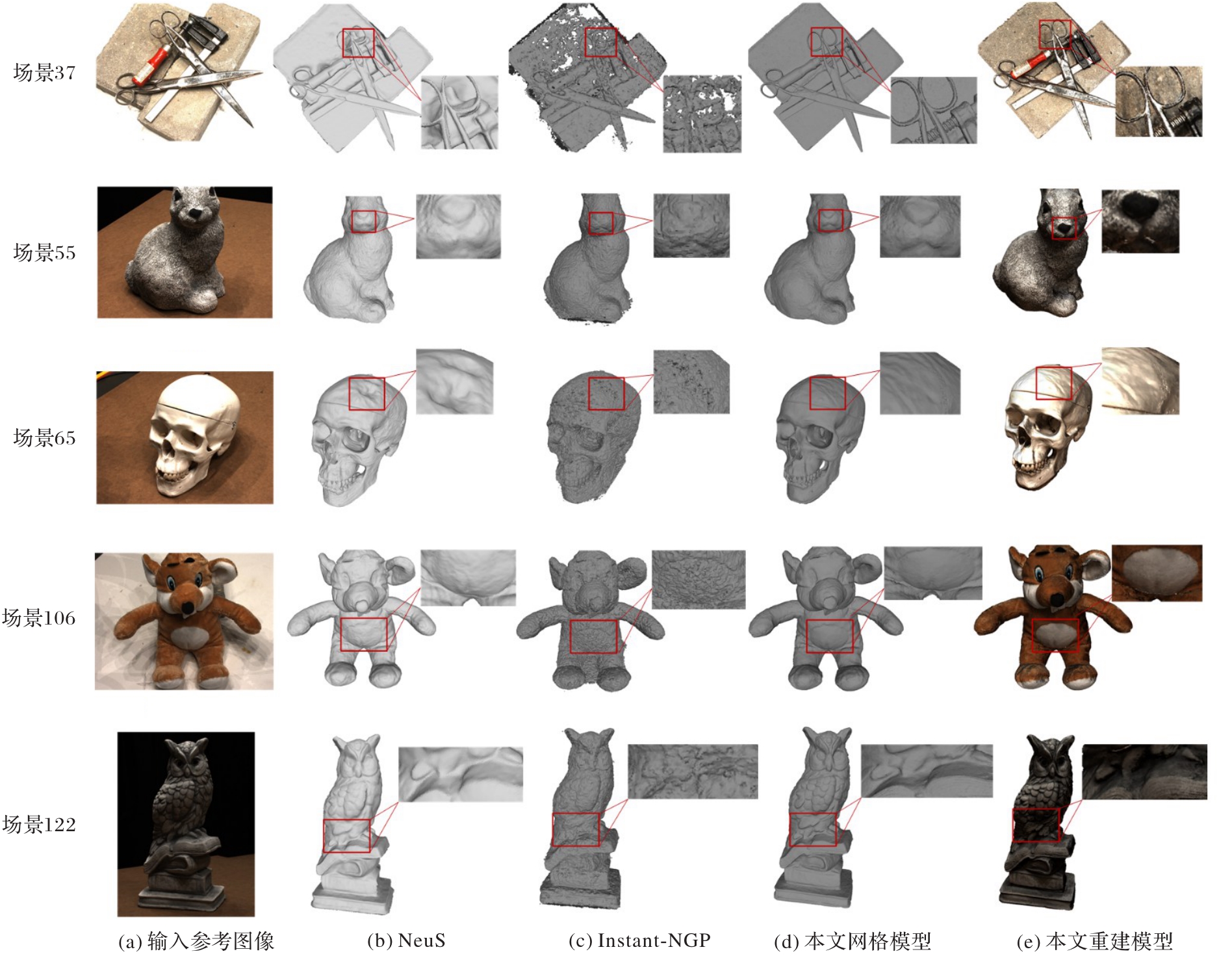
图3 DTU数据集上的重建结果对比
Fig. 3 Comparison of 3D reconstruction results on DTU dataset
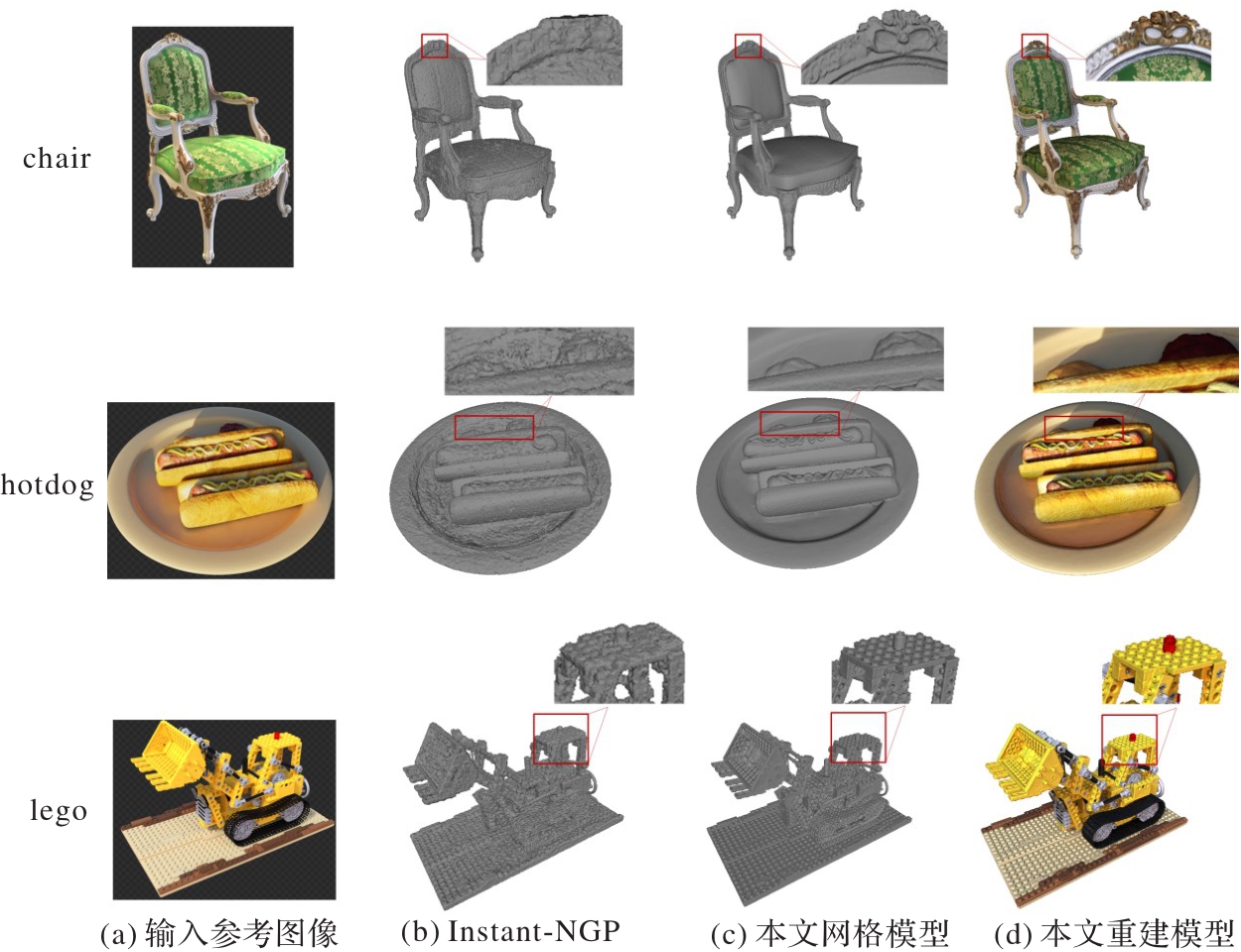
图4 Nerf-Synthetic数据集上的重建结果对比
Fig. 4 Comparison of 3D reconstruction results on Nerf-Synthetic dataset
表4 DTU数据集上的消融实验结果
Tab. 4 Ablation experimental results on DTU dataset
| [1] | MILDENHALL B, SRINIVASAN P P, TANCIK M, et al. NeRF: representing scenes as neural radiance fields for view synthesis[J]. Communications of the ACM, 2022, 65(1): 99-106. |
| [2] | WANG P, LIU L, LIU Y, et al. NeuS: learning neural implicit surfaces by volume rendering for multi-view reconstruction[C]// Proceedings of the 35th International Conference on Neural Information Processing Systems. Red Hook: Curran Associates Inc., 2021: 27171-27183. |
| [3] | HUANG B, YU Z, CHEN A, et al. 2D Gaussian splatting for geometrically accurate radiance fields[C]// Proceedings of the 2024 ACM SIGGRAPH Conference. New York: ACM, 2024: No.32. |
| [4] | YU Z, SATTLER T, GEIGER A. Gaussian opacity fields: efficient adaptive surface reconstruction in unbounded scenes[J]. ACM Transactions on Graphics, 2024, 43(6): No.271. |
| [5] | LI R, TANCIK M, KANAZAWA A. NeRFAcc: a general NeRF acceleration toolbox[EB/OL]. [2024-10-08].. |
| [6] | MIN C, CHA S, WON C, et al. TSDF-Sampling: efficient sampling for neural surface field using truncated signed distance field[EB/OL]. [2024-10-08].. |
| [7] | YAO Y, LUO Z, LI S, et al. MVSNet: depth inference for unstructured multi-view stereo[C]// Proceedings of the 2018 European Conference on Computer Vision, LNCS 11212. Cham: Springer, 2018: 785-801. |
| [8] | YOO J C, HAN T H. Fast normalized cross-correlation[J]. Circuits, Systems, and Signal Processing, 2009, 28(6): 819-843. |
| [9] | SCHÖNBERGER J L, ZHENG E, FRAHM J M, et al. Pixelwise view selection for unstructured multi-view stereo[C]// Proceedings of the 2016 European Conference on Computer Vision, LNCS 9907. Cham: Springer, 2016: 501-518. |
| [10] | REISER C, PENG S, LIAO Y, et al. KiloNeRF: speeding up neural radiance fields with thousands of tiny MLPs[C]// Proceedings of the 2021 IEEE/CVF International Conference on Computer Vision. Piscataway: IEEE, 2021: 14315-14325. |
| [11] | BARRON J T, MILDENHALL B, TANCIK M, et al. Mip-NeRF: a multiscale representation for anti-aliasing neural radiance fields[C]// Proceedings of the 2021 IEEE/CVF International Conference on Computer Vision. Piscataway: IEEE, 2021: 5835-5844. |
| [12] | YU A, LI R, TANCIK M, et al. PlenOctrees for real-time rendering of neural radiance fields[C]// Proceedings of the 2021 IEEE/CVF International Conference on Computer Vision. Piscataway: IEEE, 2021: 5732-5741. |
| [13] | TANCIK M, WEBER E, NG E, et al. Nerfstudio: a modular framework for neural radiance field development[C]// Proceedings of the ACM SIGGRAPH 2023 Conference. New York: ACM, 2023: 1-12. |
| [14] | SUN C, SUN M, CHEN H T. Direct voxel grid optimization: super-fast convergence for radiance fields reconstruction[C]// Proceedings of the 2022 IEEE/CVF Conference on Computer Vision and Pattern Recognition. Piscataway: IEEE, 2022: 5449-5459. |
| [15] | WANG J, BLEJA T, AGAPITO L. GO-Surf: neural feature grid optimization for fast, high-fidelity RGB-D surface reconstruction[C]// Proceedings of the 2022 International Conference on 3D Vision. Piscataway: IEEE, 2022: 433-442. |
| [16] | MÜlLLER T, EVANS A, SCHIED C, et al. Instant neural graphics primitives with a multiresolution hash encoding[J]. ACM Transactions on Graphics, 2022, 41(4): No.102. |
| [17] | LI H, YANG X, ZHAI H, et al. Vox-Surf: voxel-based implicit surface representation[J]. IEEE Transactions on Visualization and Computer Graphics, 2024, 30(3): 1743-1755. |
| [18] | WANG Y, HAN Q, HABERMANN M, et al. NeuS2: fast learning of neural implicit surfaces for multi-view reconstruction[C]// Proceedings of the 2023 IEEE/CVF International Conference on Computer Vision. Piscataway: IEEE, 2023: 3272-3283. |
| [19] | ZHAO F, JIANG Y, YAO K, et al. Human performance modeling and rendering via neural animated mesh[J]. ACM Transactions on Graphics, 2022, 41(6): No.235. |
| [20] | XU J, XU Q, LIAO X, et al. PR-NeuS: a prior-based residual learning paradigm for fast multi-view neural surface reconstruction[EB/OL]. [2024-10-08].. |
| [21] | YU Z, PENG S, NIEMEYER M, et al. MonoSDF: exploring monocular geometric cues for neural implicit surface reconstruction[C]// Proceedings of the 36th International Conference on Neural Information Processing Systems. Red Hook: Curran Associates Inc., 2022: 25018-25032. |
| [22] | FU Q, XU Q, ONG Y S, et al. Geo-NeuS: geometry-consistent neural implicit surfaces learning for multi-view reconstruction [C]// Proceedings of the 36th International Conference on Neural Information Processing Systems. Red Hook: Curran Associates Inc., 2022: 3403-3416. |
| [23] | LI Z, MÜLLER T, EVANS A, et al. Neuralangelo: high-fidelity neural surface reconstruction[C]// Proceedings of the 2023 IEEE/CVF Conference on Computer Vision and Pattern Recognition. Piscataway: IEEE, 2023: 8456-8465. |
| [24] | ZHONG L, YANG L, LI K, et al. Color-NeuS: reconstructing neural implicit surfaces with color[C]// Proceedings of the 2024 International Conference on 3D Vision. Piscataway: IEEE, 2024: 631-640. |
| [25] | SUN J, CHEN X, WANG Q, et al. Neural 3D reconstruction in the wild[C]// Proceedings of the 2022 ACM SIGGRAPH Conference. New York: ACM, 2022: No.26. |
| [26] | JENSEN R, DAHL A, VOGIATZIS G, et al. Large scale multi-view stereopsis evaluation[C]// Proceedings of the 2014 IEEE Conference on Computer Vision and Pattern Recognition. Piscataway: IEEE, 2014: 406-413. |
| [27] | BARROW H G, TENENBAUM J M, BOLLES R C, et al. Parametric correspondence and chamfer matching: two new techniques for image matching[C]// Proceedings of the 5th International Joint Conference on Artificial Intelligence. San Francisco: Morgan Kaufmann Publishers Inc., 1977: 659-663. |
| [28] | HORÉ A, ZIOU D. Image quality metrics: PSNR vs. SSIM[C]// Proceedings of the 20th International Conference on Pattern Recognition. Piscataway: IEEE, 2010: 2366-2369. |
| [1] | 李俊伯, 秦品乐, 曾建潮, 李萌. 基于超分辨率网络的CT三维重建算法[J]. 《计算机应用》唯一官方网站, 2022, 42(2): 584-591. |
| [2] | 张豪, 张强, 邵思羽, 丁海斌. 深度学习在单图像三维模型重建的应用[J]. 计算机应用, 2020, 40(8): 2351-2357. |
| [3] | 郭艺辉, 黄承慧, 钟雪灵, 陆寄远. 方向感知的网格模型特征识别[J]. 计算机应用, 2019, 39(12): 3673-3677. |
| [4] | 刘思奇, 张来峰, 范立成, 盛小明. 基于医学图像序列面绘制的骨组织快速成型方法[J]. 计算机应用, 2017, 37(5): 1456-1459. |
| [5] | 李肖, 葛宝臻, 罗其俊, 李云鹏, 田庆国. 自由双目立体视觉摄像机动态外参数的获取[J]. 计算机应用, 2017, 37(10): 2888-2894. |
| [6] | 吴茜 贾婧 曹瑞芬 裴曦 吴爱东 吴宜灿 FDS团队. 三维医学图像配准在图像引导放疗中的应用[J]. 计算机应用, 2013, 33(09): 2675-2678. |
| [7] | 陈维涛 陈东帆 韩兴乾 周晨 高祥. 声带麻痹植入手术的有限元仿真模拟[J]. 计算机应用, 2013, 33(03): 896-900. |
| [8] | 李怀泽 沈会良 程岳. 基于旋转多视角深度配准的三维重建方法[J]. 计算机应用, 2012, 32(12): 3365-3368. |
| [9] | 赵璐璐 耿国华 王小凤 刘倩. 基于未标定多幅图的三维重建算法[J]. 计算机应用, 2012, 32(10): 2802-2805. |
| [10] | 陈敏 张志毅 田素垒 张娴. 基于三角形外接圆的轮廓对应算法[J]. 计算机应用, 2012, 32(03): 722-724. |
| [11] | 马伟 陈家新 潘维薇. 基于体素相似度的医学图像层间插值方法[J]. 计算机应用, 2012, 32(02): 538-553. |
| [12] | 杨军 石传奎 党建武. 基于序列图像的鲁棒三维重建方法[J]. 计算机应用, 2011, 31(06): 1566-1568. |
| [13] | 封泽希 张辉 谢永明 朱敏. 基于4目阵列的计算机视觉三维重建算法[J]. 计算机应用, 2011, 31(04): 1043-1046. |
| [14] | 娄静涛 王炜 张茂军 陈旺. 基于单幅全向图像的空间水平直线定位新方法[J]. 计算机应用, 2009, 29(09): 2593-2595. |
| [15] | 黎蔚 韩利华 陈家新 冀治航. 一种辅助轮廓线的断层医学图像三维重建算法[J]. 计算机应用, 2008, 28(9): 2278-2280. |
| 阅读次数 | ||||||
|
全文 |
|
|||||
|
摘要 |
|
|||||
