


《计算机应用》唯一官方网站 ›› 2026, Vol. 46 ›› Issue (3): 933-939.DOI: 10.11772/j.issn.1001-9081.2025040395
郭纪新, 张婷( )
)
收稿日期:2025-04-14
修回日期:2025-06-05
接受日期:2025-06-11
发布日期:2025-06-23
出版日期:2026-03-10
通讯作者:
张婷
作者简介:郭纪新(2000—),男,河南许昌人,硕士研究生,主要研究方向:图像处理、图像去雾
基金资助:Received:2025-04-14
Revised:2025-06-05
Accepted:2025-06-11
Online:2025-06-23
Published:2026-03-10
Contact:
Ting ZHANG
About author:GUO Jixin, born in 2000, M. S. candidate. His research interests include image processing, image dehazing.
Supported by:摘要:
基于Transformer的图像去雾算法取得了较好去雾效果,但存在网络参数量大和去雾速度慢的问题。为实现对去雾网络冗余部分的定向修剪,在不影响去雾质量的前提下缩短去雾时间,提出一种基于组件协同优化剪枝的Transformer图像去雾方法CCOP-IDT(Component Collaborative Optimization Pruning Image Dehazing Transformer)。首先,采用5级Transformer构建去雾网络预训练模型;其次,将网络剪枝建模为优化问题,使用费雪信息评估权重参数重要度,并利用黑塞矩阵衡量剪枝组件对网络输出的联合影响,从而建立多种剪枝组件的协同优化方法;最后,采用进化算法求解最优剪枝率序列,从而得到预训练模型的最优子网络。实验结果表明,剪枝后的网络参数量控制在0.476×10⁶,相较于剪枝前减少了28.8%,去雾时间缩短了25.0%;在合成有雾数据集RESIDE-6K上,所提方法的峰值信噪比(PSNR)达到29.60 dB,结构相似度(SSIM)达到0.968 7,与剪枝前相比仅分别降低了1.63%和0.46%。可见,在定量和定性评估上,所提方法都表现良好,能够在基本保持量化指标和主观观感的前提下,大幅减少模型参数量,提高图像去雾速度。
中图分类号:
郭纪新, 张婷. 基于组件协同优化剪枝的Transformer图像去雾[J]. 计算机应用, 2026, 46(3): 933-939.
Jixin GUO, Ting ZHANG. Transformer image dehazing based on component collaborative optimization pruning[J]. Journal of Computer Applications, 2026, 46(3): 933-939.
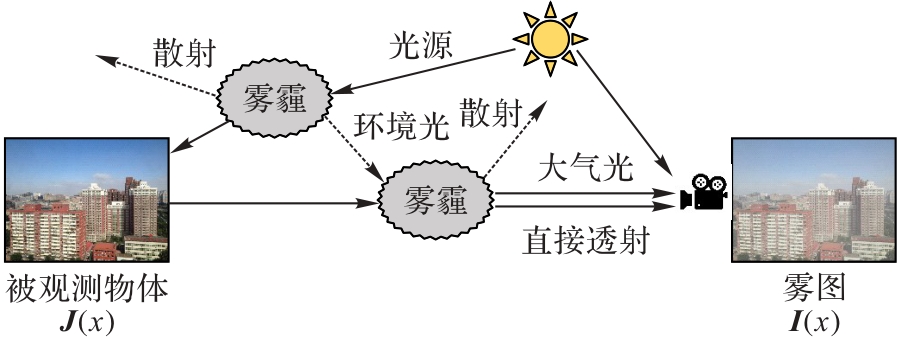
图1 大气散射模型原理
Fig. 1 Principle of atmospheric scattering model
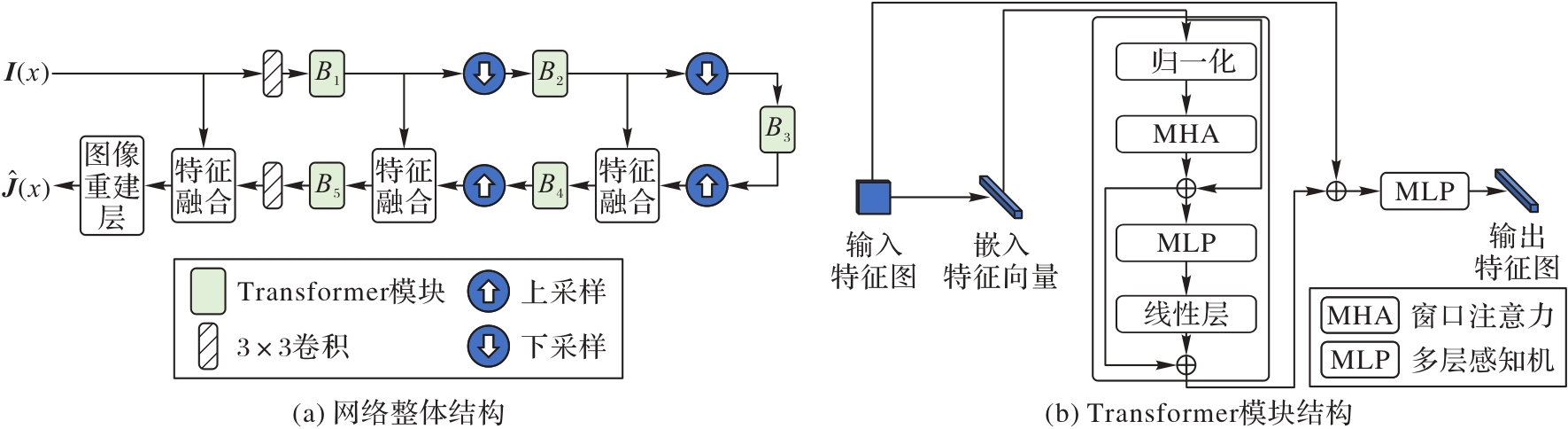
图2 图像去雾网络的结构
Fig. 2 Structure of image dehazing network
| 模块 | 深度 | 注意头数 | 输出特征向量维度 | 参数量/106 |
|---|---|---|---|---|
| B1 | 4 | 2 | [24,256,256] | 0.019 |
| B2 | 4 | 4 | [48,128,128] | 0.112 |
| B3 | 4 | 6 | [96,64,64] | 0.446 |
| B4 | 2 | 1 | [48,128,128] | 0.031 |
| B5 | 2 | 1 | [24,256,256] | 0.008 |
表1 各Transformer模块的结构参数
Tab. 1 Structure parameters of Transformer blocks
| 模块 | 深度 | 注意头数 | 输出特征向量维度 | 参数量/106 |
|---|---|---|---|---|
| B1 | 4 | 2 | [24,256,256] | 0.019 |
| B2 | 4 | 4 | [48,128,128] | 0.112 |
| B3 | 4 | 6 | [96,64,64] | 0.446 |
| B4 | 2 | 1 | [48,128,128] | 0.031 |
| B5 | 2 | 1 | [24,256,256] | 0.008 |
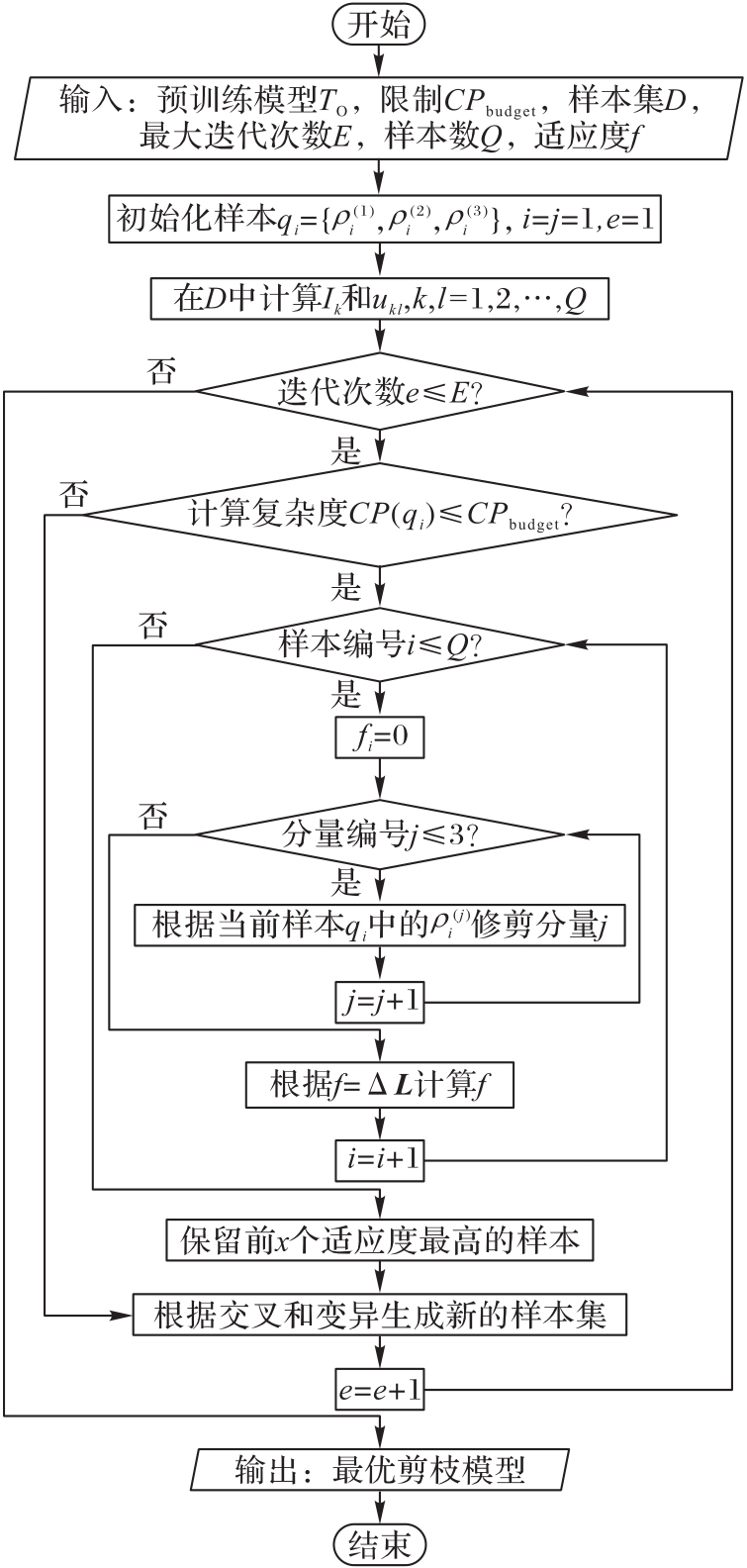
图3 进化算法求解最优剪枝子网络的流程
Fig. 3 Flow of evolutionary algorithm solving optimal pruning sub-network
| 项目 | 属性 |
|---|---|
| CPU | Intel Core i7-7700K |
| CPU基准频率 | 4.20 GHz |
| GPU | NVIDIA GeForce RTX 2080Ti |
| 显存 | 11 GB |
| CUDA | 11.6 |
| Python版本 | 3.8 |
| 深度学习框架 | PyTorch 1.12.1 |
| batch size | 4 |
| epoch | 300 |
| 学习率 | 4×10⁻⁴ |
| 优化器 | Adam |
表2 实验平台配置与训练参数设置
Tab. 2 Experimental platform configuration and training parameter setting
| 项目 | 属性 |
|---|---|
| CPU | Intel Core i7-7700K |
| CPU基准频率 | 4.20 GHz |
| GPU | NVIDIA GeForce RTX 2080Ti |
| 显存 | 11 GB |
| CUDA | 11.6 |
| Python版本 | 3.8 |
| 深度学习框架 | PyTorch 1.12.1 |
| batch size | 4 |
| epoch | 300 |
| 学习率 | 4×10⁻⁴ |
| 优化器 | Adam |
| 方法 | 去雾指标 | 效率指标 | |||
|---|---|---|---|---|---|
| PSNR/dB | SSIM | 参数量/106 | 平均 耗时/s | 计算量/GFLOPs | |
| FFA-Net[ | 21.98 | 0.892 9 | 4.456 | 0.891 | 575.60 |
| RefineDNet[ | 20.62 | 0.841 9 | 65.795 | 0.303 | 27.82 |
| DehazeFormer[ | 29.99 | 0.971 7 | 0.686 | 0.139 | 13.32 |
| 本文方法-剪枝前 | 30.09 | 0.973 2 | 0.669 | 0.132 | 12.56 |
| 本文方法-剪枝后 | 29.60 | 0.968 7 | 0.476 | 0.099 | 5.24 |
表3 不同去雾方法的定量实验结果对比
Tab. 3 Comparison of quantitative experimental results of different dehazing methods
| 方法 | 去雾指标 | 效率指标 | |||
|---|---|---|---|---|---|
| PSNR/dB | SSIM | 参数量/106 | 平均 耗时/s | 计算量/GFLOPs | |
| FFA-Net[ | 21.98 | 0.892 9 | 4.456 | 0.891 | 575.60 |
| RefineDNet[ | 20.62 | 0.841 9 | 65.795 | 0.303 | 27.82 |
| DehazeFormer[ | 29.99 | 0.971 7 | 0.686 | 0.139 | 13.32 |
| 本文方法-剪枝前 | 30.09 | 0.973 2 | 0.669 | 0.132 | 12.56 |
| 本文方法-剪枝后 | 29.60 | 0.968 7 | 0.476 | 0.099 | 5.24 |
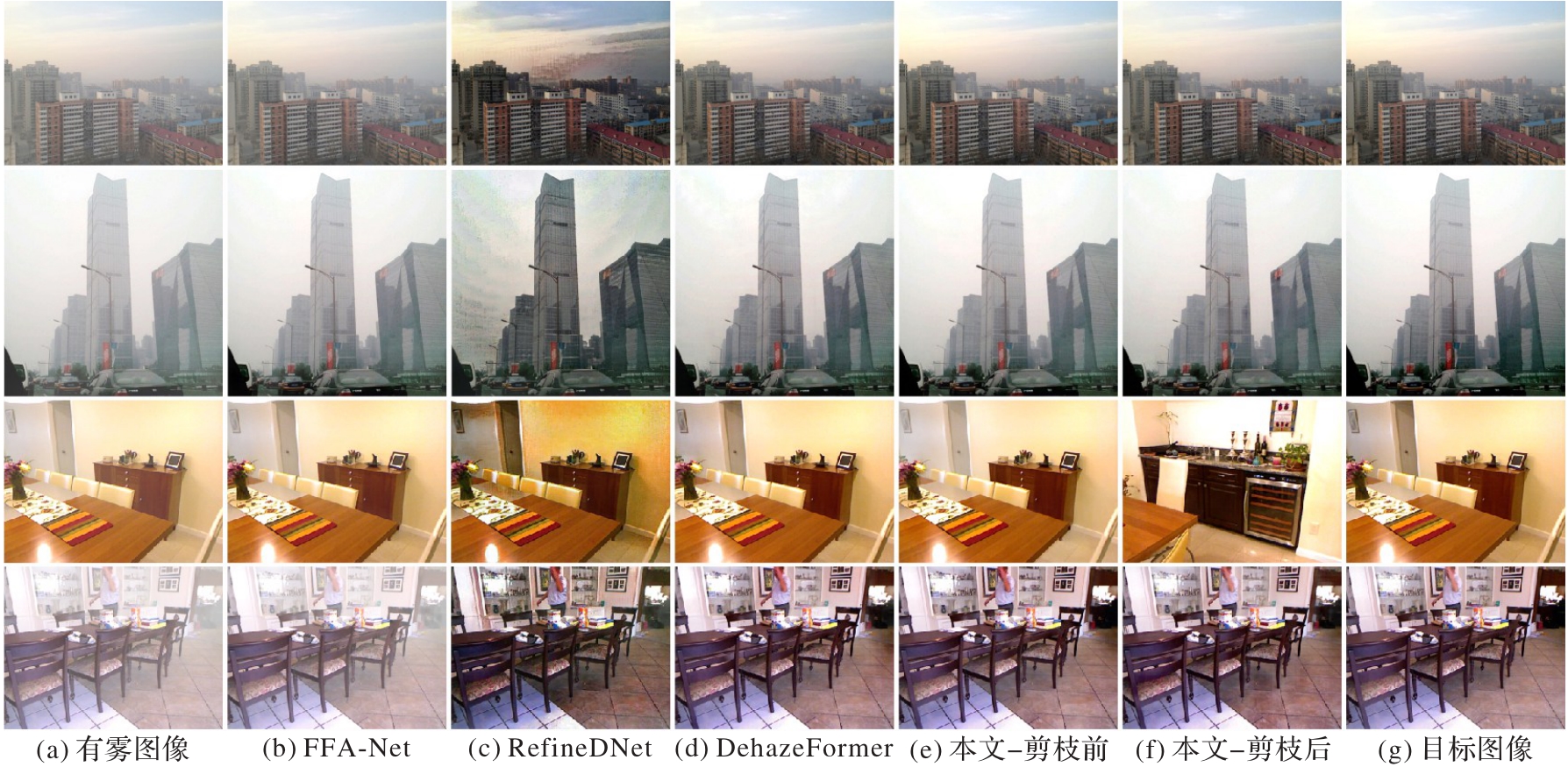
图4 不同方法对合成图像去雾的定性实验结果
Fig. 4 Qualitative experimental results of different methods for dehazing synthetic images
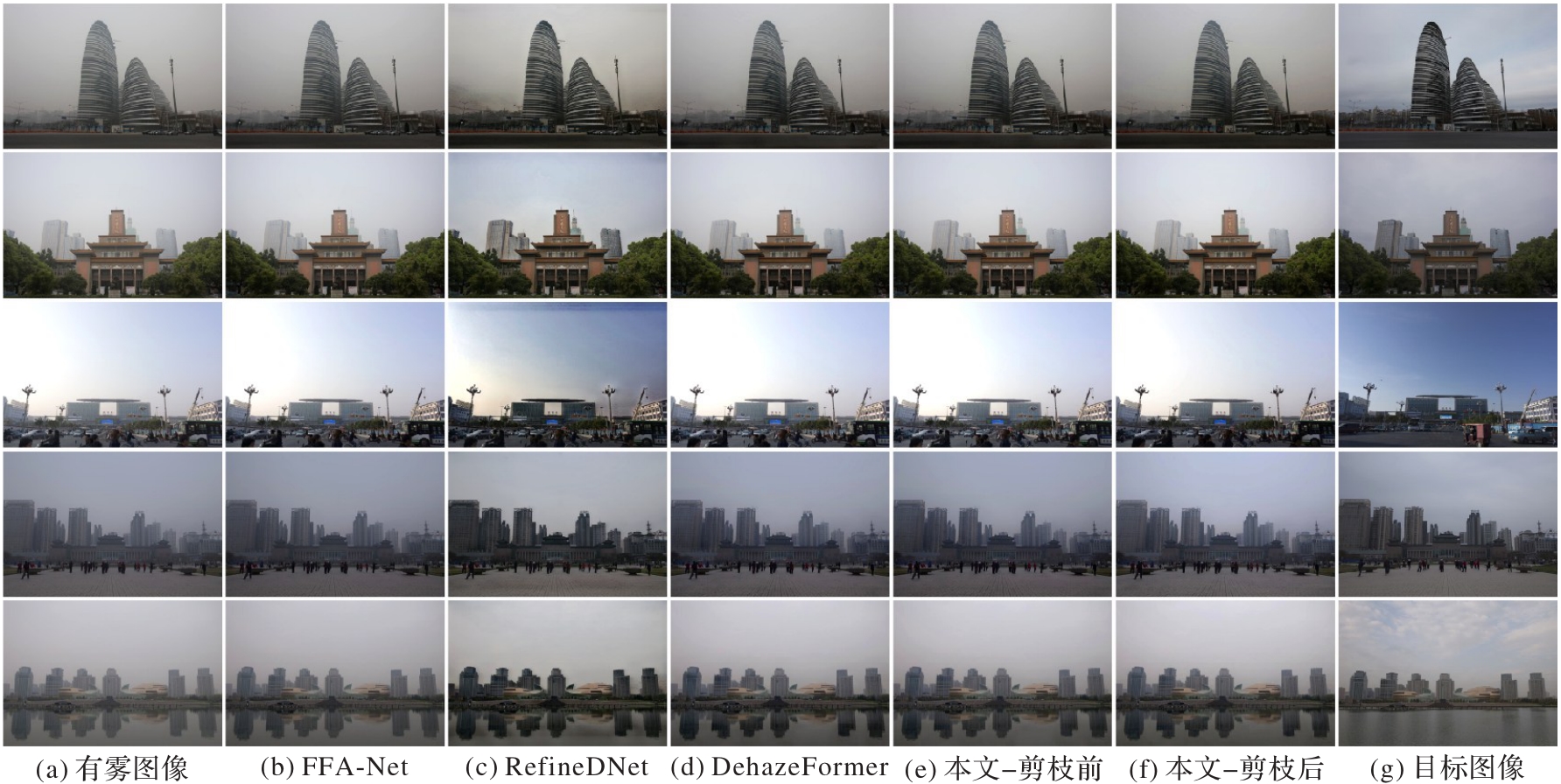
图5 不同方法对真实图像去雾的定性实验结果
Fig. 5 Qualitative experimental results of different methods for dehazing real images
| 规模 | 方法 | 剪枝策略 | PSNR/dB | SSIM | 参数总量/106 | 计算量/GFLOPs | ||
|---|---|---|---|---|---|---|---|---|
| ρ(1) | ρ(2) | ρ(3) | ||||||
0.5×10⁶以内模型 (CPbudget=5.5 GFLOPs) | 本文策略 | 0.032 | 0.133 | 0.300 | 29.60 | 0.968 7 | 0.476 | 5.24 |
| 对照组① | 0.000 | 0.267 | 0.000 | 28.61 | 0.963 3 | 0.494 | 8.90 | |
| 对照组② | 0.000 | 0.000 | 0.400 | 29.01 | 0.966 6 | 0.481 | 5.18 | |
0.4×10⁶以内模型 (CPbudget=4.5 GFLOPs) | 本文策略 | 0.021 | 0.033 | 0.471 | 28.88 | 0.967 3 | 0.364 | 4.24 |
| 对照组③ | 0.000 | 0.333 | 0.000 | 28.64 | 0.963 5 | 0.397 | 6.32 | |
| 对照组④ | 0.000 | 0.000 | 0.556 | 27.55 | 0.955 4 | 0.408 | 4.92 | |
表4 不同剪枝策略下网络的去雾指标与效率指标
Tab. 4 Dehazing and efficiency metrics of networks under different pruning strategies
| 规模 | 方法 | 剪枝策略 | PSNR/dB | SSIM | 参数总量/106 | 计算量/GFLOPs | ||
|---|---|---|---|---|---|---|---|---|
| ρ(1) | ρ(2) | ρ(3) | ||||||
0.5×10⁶以内模型 (CPbudget=5.5 GFLOPs) | 本文策略 | 0.032 | 0.133 | 0.300 | 29.60 | 0.968 7 | 0.476 | 5.24 |
| 对照组① | 0.000 | 0.267 | 0.000 | 28.61 | 0.963 3 | 0.494 | 8.90 | |
| 对照组② | 0.000 | 0.000 | 0.400 | 29.01 | 0.966 6 | 0.481 | 5.18 | |
0.4×10⁶以内模型 (CPbudget=4.5 GFLOPs) | 本文策略 | 0.021 | 0.033 | 0.471 | 28.88 | 0.967 3 | 0.364 | 4.24 |
| 对照组③ | 0.000 | 0.333 | 0.000 | 28.64 | 0.963 5 | 0.397 | 6.32 | |
| 对照组④ | 0.000 | 0.000 | 0.556 | 27.55 | 0.955 4 | 0.408 | 4.92 | |
| [1] | NARASIMHAN S G, NAYAR S K. Vision and the atmosphere[J]. International Journal of Computer Vision, 2002, 48(3): 233-254. |
| [2] | VASWANI A, SHAZEER N, PARMAR N, et al. Attention is all you need [C]// Proceedings of the 31st International Conference on Neural Information Processing Systems. Red Hook: Curran Associates Inc., 2017: 6000-6010. |
| [3] | ZHENG C, LI Z, ZHANG K, et al. SAViT: structure-aware vision Transformer pruning via collaborative optimization [C]// Proceedings of the 36th International Conference on Neural Information Processing Systems. Red Hook: Curran Associates Inc., 2022: 9010-9023. |
| [4] | RAHMAN Z, JOBSON D J, WOODELL G A. Multi-scale retinex for color image enhancement [C]// Proceedings of the 3rd IEEE International Conference on Image Processing — Volume 3. Piscataway: IEEE, 1996: 1003-1006. |
| [5] | HE K, SUN J, TANG X. Single image haze removal using dark channel prior [J]. IEEE Transactions on Pattern Analysis and Machine Intelligence, 2011, 33(12): 2341-2353. |
| [6] | CAI B, XU X, JIA K, et al. DehazeNet: an end-to-end system for single image haze removal [J]. IEEE Transactions on Image Processing, 2016, 25(11): 5187-5198. |
| [7] | QIN X, WANG Z, BAI Y, et al. FFA-Net: feature fusion attention network for single image dehazing [C]// Proceedings of the 34th AAAI Conference on Artificial Intelligence. Palo Alto: AAAI Press, 2020: 11908-11915. |
| [8] | ZHAO S, ZHANG L, SHEN Y, et al. RefineDNet: a weakly supervised refinement framework for single image dehazing [J]. IEEE Transactions on Image Processing, 2021, 30: 3391-3404. |
| [9] | 张婷,赵杏,陈文欣. 基于条件生成对抗网络的图像去雾方法[J]. 计算机应用, 2021, 41(S2): 248-253. |
| ZHANG T, ZHAO X, CHEN W X. Image dehazing method based on conditional generative adversarial network [J]. Journal of Computer Applications, 2021, 41(S2): 248-253. | |
| [10] | SONG Y, HE Z, QIAN H, et al. Vision Transformers for single image dehazing [J]. IEEE Transactions on Image Processing, 2023, 32: 1927-1941. |
| [11] | QIU Y, ZHANG K, WANG C, et al. MB-TaylorFormer: multi-branch efficient Transformer expanded by Taylor formula for image dehazing [C]// Proceedings of the 2023 IEEE/CVF International Conference on Computer Vision. Piscataway: IEEE, 2023: 12756-12767. |
| [12] | LIU Y, LIU H, LI L, et al. A data-centric solution to nonhomogeneous dehazing via Vision Transformer [C]// Proceedings of the 2023 IEEE/CVF Conference on Computer Vision and Pattern Recognition Workshops. Piscataway: IEEE, 2023: 1406-1415. |
| [13] | GUO C, YAN Q, ANWAR S, et al. Image dehazing Transformer with transmission-aware 3D position embedding [C]// Proceedings of the 2022 IEEE/CVF Conference on Computer Vision and Pattern Recognition. Piscataway: IEEE, 2022: 5802-5810. |
| [14] | LI X, HUA Z, LI J. Two-stage single image dehazing network using Swin-Transformer [J]. IET Image Processing, 2022, 16(9): 2518-2534. |
| [15] | 杨赟辉,程虎,魏敬和,等. 面向Transformer模型边缘端部署的常用激活函数高精度轻量级量化推理方法[J]. 电子学报, 2024, 52(10): 3301-3311. |
| YANG Y H, CHENG H, WEI J H, et al. High-precision lightweight quantization inference method for prevalent activation functions in Transformer models in edge device deployment [J]. Acta Electronica Sinica, 2024, 52(10): 3301-3311. | |
| [16] | 邱淼波,高晋,林述波,等. 线性分解注意力的边缘端高效Transformer跟踪[J]. 中国图象图形学报, 2025, 30(2): 485-502. |
| QIU M B, GAO J, LIN S B, et al. Efficient Transformer tracking for the edge end with linearly decomposed attention [J]. Journal of Image and Graphics, 2025, 30(2): 485-502. | |
| [17] | LeCUN Y, DENKER J S, SOLLA S A. Optimal brain damage[C]// Proceedings of the 1989 Advances in Neural Information Processing Systems. Cambridge: MIT Press, 1989: 598-605. |
| [18] | TANG Y, HAN K, WANG Y, et al. Patch slimming for efficient Vision Transformers [C]// Proceedings of the 2022 IEEE/CVF Conference on Computer Vision and Pattern Recognition. Piscataway: IEEE, 2022: 12155-12164. |
| [19] | YU F, HUANG K, WANG M, et al. Width & depth pruning for Vision Transformers [C]// Proceedings of the 36th AAAI Conference on Artificial Intelligence. Palo Alto: AAAI Press, 2022: 3143-3151. |
| [20] | YANG H, YIN H, SHEN M, et al. Global Vision Transformer pruning with hessian-aware saliency [C]// Proceedings of the 2023 IEEE/CVF Conference on Computer Vision and Pattern Recognition. Piscataway: IEEE, 2023: 18547-18557. |
| [21] | WANG H, DEDHIA B, JHA N K. Zero-TPrune: zero-shot token pruning through leveraging of the attention graph in pre-trained Transformers [C]// Proceedings of the 2024 IEEE/CVF Conference on Computer Vision and Pattern Recognition. Piscataway: IEEE, 2024: 16070-16079. |
| [22] | CAO J, YE P, LI S, et al. MADTP: multimodal alignment-guided dynamic token pruning for accelerating vision-language Transformer [C]// Proceedings of the 2024 IEEE/CVF Conference on Computer Vision and Pattern Recognition. Piscataway: IEEE, 2024: 15710-15719. |
| [23] | GUO J, ZHANG T. Transformer-based image dehazing with accurate color restoration [C]// Proceedings of the 13th International Conference on Computing and Pattern Recognition. New York: ACM, 2025: 265-271. |
| [24] | LIU L, ZHANG S, KUANG Z, et al. Group Fisher pruning for practical network compression [C]// Proceedings of the 38th International Conference on Machine Learning. New York: JMLR.org, 2021: 7021-7032. |
| [25] | LI B, REN W, FU D, et al. Benchmarking single-image dehazing and beyond [J]. IEEE Transactions on Image Processing, 2019, 28(1): 492-505. |
| [26] | ZHAO S, ZHANG L, HUANG S, et al. Dehazing evaluation: real-world benchmark datasets, criteria, and baselines [J]. IEEE Transactions on Image Processing, 2020, 29: 6947-6962. |
| [1] | 张健, 于剑波, 汤健. 基于多层预处理的城市固废焚烧状态识别方法[J]. 《计算机应用》唯一官方网站, 2026, 46(3): 940-949. |
| [2] | 黄萍, 李清, 邱海枫, 王程斯, 黄安子, 樊龙. 轻量化输电线路缺陷检测方法[J]. 《计算机应用》唯一官方网站, 2026, 46(3): 969-979. |
| [3] | 刘汉卿, 桑国明, 张益嘉. 结合密集多尺度特征融合和特征知识增强Transformer的遥感图像描述模型[J]. 《计算机应用》唯一官方网站, 2026, 46(3): 741-749. |
| [4] | 张春雨, 刘建昌, 刘圆超, 张伟. 基于两阶段填充采样的昂贵多目标进化算法[J]. 《计算机应用》唯一官方网站, 2026, 46(2): 485-496. |
| [5] | 熊前龙, 秦进. 混合启发信息指导神经网络架构搜索算法[J]. 《计算机应用》唯一官方网站, 2026, 46(2): 395-405. |
| [6] | 冉敏, 潘大志. 融合变异策略与邻接信息的差分进化算法[J]. 《计算机应用》唯一官方网站, 2026, 46(1): 188-197. |
| [7] | 姚理进, 张迪, 周丕宇, 曲志坚, 王海鹏. 基于Transformer和门控循环单元的磷酸化肽从头测序算法[J]. 《计算机应用》唯一官方网站, 2026, 46(1): 297-304. |
| [8] | 桑雨, 贡同, 赵琛, 于博文, 李思漫. 具有光度对齐的域适应夜间目标检测方法[J]. 《计算机应用》唯一官方网站, 2026, 46(1): 242-251. |
| [9] | 王丽芳, 任文婧, 郭晓东, 张荣国, 胡立华. 用于低剂量CT图像降噪的多路特征生成对抗网络[J]. 《计算机应用》唯一官方网站, 2026, 46(1): 270-279. |
| [10] | 吴俊衡, 王晓东, 何启学. 基于统计分布感知与频域双通道融合的时序预测模型[J]. 《计算机应用》唯一官方网站, 2026, 46(1): 113-123. |
| [11] | 景攀峰, 梁宇栋, 李超伟, 郭俊茹, 郭晋育. 基于师生学习的半监督图像去雾算法[J]. 《计算机应用》唯一官方网站, 2025, 45(9): 2975-2983. |
| [12] | 王芳, 胡静, 张睿, 范文婷. 内容引导下多角度特征融合医学图像分割网络[J]. 《计算机应用》唯一官方网站, 2025, 45(9): 3017-3025. |
| [13] | 李进, 刘立群. 基于残差Swin Transformer的SAR与可见光图像融合[J]. 《计算机应用》唯一官方网站, 2025, 45(9): 2949-2956. |
| [14] | 吕景刚, 彭绍睿, 高硕, 周金. 复频域注意力和多尺度频域增强驱动的语音增强网络[J]. 《计算机应用》唯一官方网站, 2025, 45(9): 2957-2965. |
| [15] | 周金, 李玉芝, 张徐, 高硕, 张立, 盛家川. 复杂电磁环境下的调制识别网络[J]. 《计算机应用》唯一官方网站, 2025, 45(8): 2672-2682. |
| 阅读次数 | ||||||
|
全文 |
|
|||||
|
摘要 |
|
|||||
