


《计算机应用》唯一官方网站 ›› 2026, Vol. 46 ›› Issue (9): 2838-2846.DOI: 10.11772/j.issn.1001-9081.2025080969
• 数据科学与技术 • 上一篇
龚镇辉1,2, 史晓雨1,2( ), 鲁云1,2, 刘阳成3, 尚明生1,2
收稿日期:2025-08-26
修回日期:2025-11-03
接受日期:2025-11-07
发布日期:2025-11-17
出版日期:2026-09-10
通讯作者:
史晓雨
作者简介:龚镇辉(2000—),男,福建漳州人,硕士研究生,主要研究方向:深度学习、强化学习、推荐系统、群体公平性基金资助:
Zhenhui GONG1,2, Xiaoyu SHI1,2(), Yun LU1,2, Yangcheng LIU3, Mingsheng SHANG1,2
Received:2025-08-26
Revised:2025-11-03
Accepted:2025-11-07
Online:2025-11-17
Published:2026-09-10
Contact:
Xiaoyu SHI
About author:GONG Zhenhui, born in 2000, M. S. candidate. His researchinterests include deep learning, reinforcement learning, recommender systems, group fairness.摘要:
大语言模型(LLM)为推荐系统带来了更强的语义理解和个性化推荐能力,但它在实际应用中面临着严重的用户公平性挑战。现有LLM公平推荐方法多依赖于用显式敏感属性进行约束或重加权,在用户敏感属性因隐私保护或不可获取而缺失的场景下,通常难以适用。针对这一问题,提出一种敏感属性无关的LLM公平推荐框架(FAIR-SAA)。该框架通过动态提示优化与对抗重加权方法,在无须访问敏感属性的情况下实现推荐公平性提升。具体而言,在第一阶段,采用动态提示优化策略,在微调过程中识别高损失样本,将它作为上下文示例以缓解刻板印象模式;在第二阶段,引入对抗重加权机制动态关注模型表现不佳的分布区域,从而增强代表性不足样本对模型更新的影响。在MovieLens-1M等3个公开数据集上的实验结果表明,FAIR-SAA在保持推荐精度与双阶段语义对齐推荐范式(BIGRec)模型基线推荐精度相当的同时,将性别群体的归一化折损累积增益NDCG@10与命中率HR@10平均降低74.47%与61.76%;即便与敏感属性完全可见的公平推荐方法面向公平性的共形阈值与提示工程(FACTER)框架相比,在以BIGRec为基础推荐模型的情况下,FAIR-SAA在58.33%的公平性指标上仍具竞争力。FAIR-SAA为现实环境下隐私保护场景中的推荐公平性问题提供了一种有效的解决方案。
中图分类号:
龚镇辉, 史晓雨, 鲁云, 刘阳成, 尚明生. 面向敏感属性缺失的大语言模型公平推荐框架[J]. 计算机应用, 2026, 46(9): 2838-2846.
Zhenhui GONG, Xiaoyu SHI, Yun LU, Yangcheng LIU, Mingsheng SHANG. Fair recommendation framework for large language models with sensitive attribute absence[J]. Journal of Computer Applications, 2026, 46(9): 2838-2846.
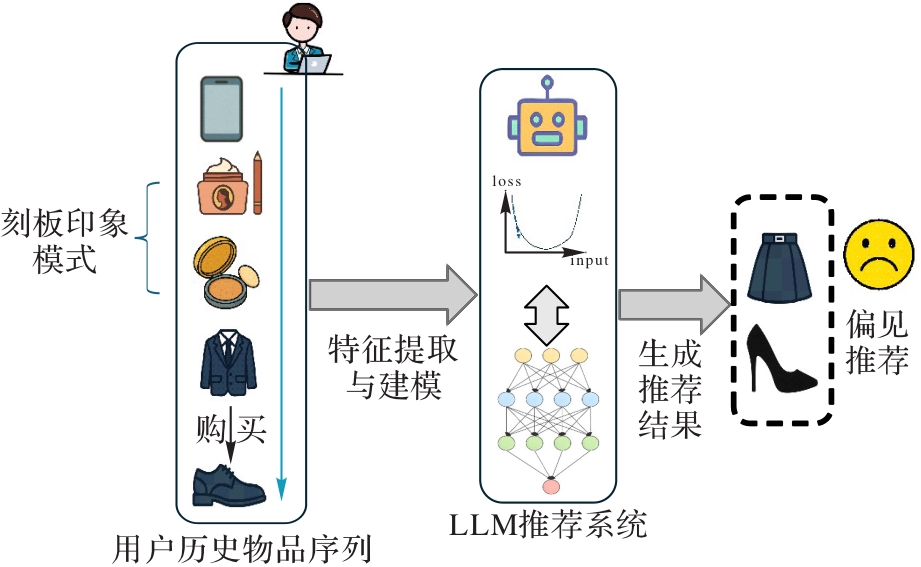
图1 用户敏感信息偏见的示例
Fig. 1 Example of bias of user sensitive information
| 数据集 | 指标 | 男性用户 | 女性用户 |
|---|---|---|---|
| MovieLens-1M | NDCG@5 | 0.019 5 | 0.014 4 |
| Loss | 0.430 2 | 0.570 0 | |
| Max Grad | 0.644 5 | 0.822 2 | |
| LastFM-360K | NDCG@5 | 0.013 5 | 0.013 1 |
| Loss | 0.961 0 | 0.977 8 | |
| Max Grad | 0.771 2 | 0.807 8 |
表1 BIGRec在不同数据集上的指标对比
Tab. 1 Comparison of BIGRec indicators on different datasets
| 数据集 | 指标 | 男性用户 | 女性用户 |
|---|---|---|---|
| MovieLens-1M | NDCG@5 | 0.019 5 | 0.014 4 |
| Loss | 0.430 2 | 0.570 0 | |
| Max Grad | 0.644 5 | 0.822 2 | |
| LastFM-360K | NDCG@5 | 0.013 5 | 0.013 1 |
| Loss | 0.961 0 | 0.977 8 | |
| Max Grad | 0.771 2 | 0.807 8 |
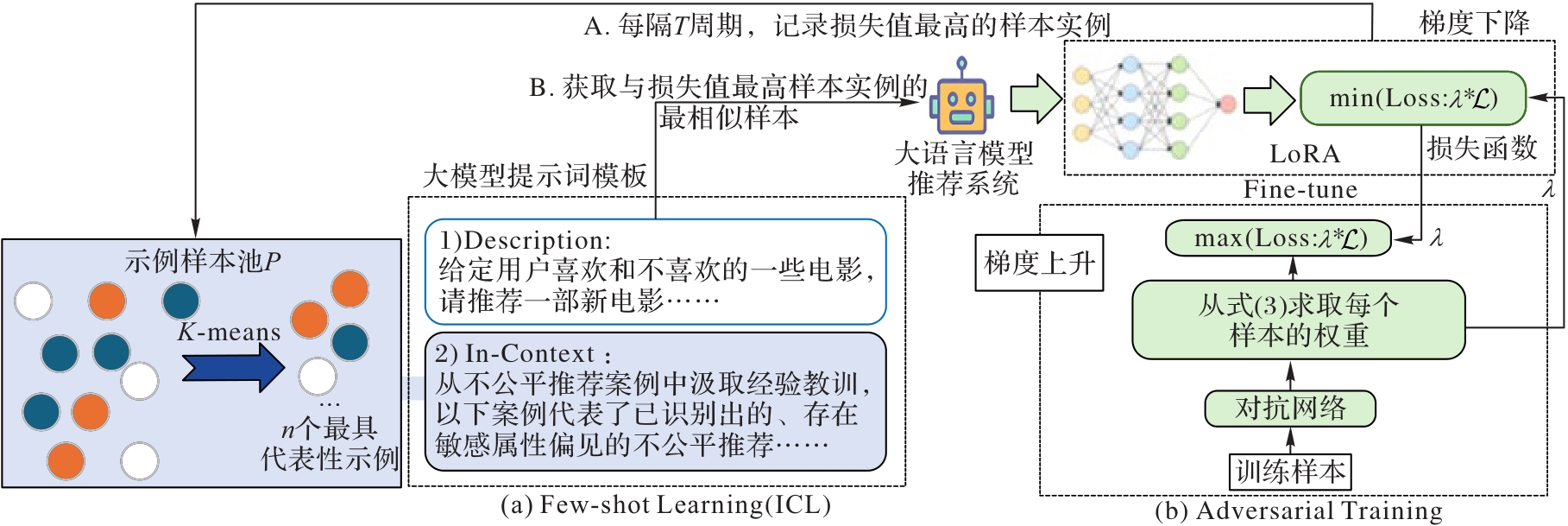
图2 FAIR-SAA的结构
Fig. 2 Structure of FAIR-SAA
| 模型 | 基准 | k | ML-1M | ML-100K | LastFM-360K | |||||||||
|---|---|---|---|---|---|---|---|---|---|---|---|---|---|---|
| 性别 | 年龄 | 性别 | 年龄 | 性别 | 年龄 | |||||||||
| BIGRec | Naive | 3 | 0.004 2 | 0.006 3 | 0.003 0 | 0.005 4 | 0.006 6 | 0.004 3 | 0.002 5 | 0.002 8 | 0.000 4 | 0.000 2 | 0.014 4 | 0.013 9 |
| 10 | 0.005 8 | 0.010 5 | 0.003 9 | 0.007 3 | 0.008 0 | 0.007 7 | 0.001 8 | 0.001 2 | 0.000 4 | 0.002 1 | 0.014 0 | 0.012 1 | ||
| FAIR-SAA | 3 | 0.002 3 | 0.003 4 | 0.002 9 | 0.004 7 | 0.000 1 | 0.002 2 | 0.000 9 | 0.000 5 | 0.000 4 | 0.000 1 | 0.010 9 | 0.010 3 | |
| 10 | 0.002 6 | 0.004 0 | 0.005 7 | 0.011 7 | 0.000 3 | 0.001 6 | 0.001 7 | 0.002 4 | 0.000 6 | 0.002 1 | 0.009 2 | 0.005 4 | ||
| FACTER | 3 | 0.001 2 | 0.001 1 | 0.008 8 | 0.010 8 | 0.001 8 | 0.001 9 | 0.015 6 | 0.018 2 | 0.000 4 | 0.000 4 | 0.004 4 | 0.004 4 | |
| 10 | 0.000 1 | 0.003 1 | 0.005 3 | 0.000 1 | 0.004 0 | 0.008 4 | 0.016 1 | 0.019 4 | 0.003 0 | 0.007 6 | 0.001 3 | 0.010 1 | ||
| TALLRec | Naive | 3 | 0.001 1 | 0.001 9 | 0.006 1 | 0.007 8 | 0.002 2 | 0.004 0 | 0.012 2 | 0.014 5 | 0.004 1 | 0.003 3 | 0.019 4 | 0.018 4 |
| 10 | 0.004 0 | 0.009 4 | 0.008 4 | 0.014 6 | 0.000 9 | 0.004 9 | 0.010 1 | 0.009 2 | 0.004 0 | 0.003 1 | 0.020 2 | 0.020 2 | ||
| FAIR-SAA | 3 | 0.002 2 | 0.002 0 | 0.003 1 | 0.003 2 | 0.006 6 | 0.006 4 | 0.000 9 | 0.001 8 | 0.002 7 | 0.001 7 | 0.015 2 | 0.014 3 | |
| 10 | 0.002 2 | 0.001 8 | 0.002 7 | 0.001 8 | 0.004 4 | 0.000 6 | 0.000 9 | 0.002 6 | 0.003 1 | 0.002 5 | 0.015 0 | 0.013 1 | ||
| FACTER | 3 | 0.004 8 | 0.005 2 | 0.002 7 | 0.002 0 | 0.002 5 | 0.002 5 | 0.002 2 | 0.003 0 | 0.001 1 | 0.003 0 | 0.002 8 | 0.002 3 | |
| 10 | 0.006 2 | 0.009 4 | 0.006 9 | 0.015 1 | 0.004 8 | 0.009 8 | 0.004 7 | 0.009 9 | 0.001 0 | 0.002 6 | 0.001 3 | 0.002 1 | ||
| DRFO | 3 | 0.000 8 | 0.002 7 | 0.006 8 | 0.009 2 | 0.002 2 | 0.001 9 | 0.012 9 | 0.016 3 | 0.000 1 | 0.000 2 | 0.001 9 | 0.002 4 | |
| 10 | 0.004 0 | 0.006 7 | 0.006 9 | 0.009 1 | 0.005 7 | 0.017 7 | 0.019 6 | 0.035 5 | 0.000 1 | 0.000 2 | 0.003 0 | 0.005 8 | ||
表2 群体公平性指标的实验结果
Tab. 2 Experimental results of group fairness metrics
| 模型 | 基准 | k | ML-1M | ML-100K | LastFM-360K | |||||||||
|---|---|---|---|---|---|---|---|---|---|---|---|---|---|---|
| 性别 | 年龄 | 性别 | 年龄 | 性别 | 年龄 | |||||||||
| BIGRec | Naive | 3 | 0.004 2 | 0.006 3 | 0.003 0 | 0.005 4 | 0.006 6 | 0.004 3 | 0.002 5 | 0.002 8 | 0.000 4 | 0.000 2 | 0.014 4 | 0.013 9 |
| 10 | 0.005 8 | 0.010 5 | 0.003 9 | 0.007 3 | 0.008 0 | 0.007 7 | 0.001 8 | 0.001 2 | 0.000 4 | 0.002 1 | 0.014 0 | 0.012 1 | ||
| FAIR-SAA | 3 | 0.002 3 | 0.003 4 | 0.002 9 | 0.004 7 | 0.000 1 | 0.002 2 | 0.000 9 | 0.000 5 | 0.000 4 | 0.000 1 | 0.010 9 | 0.010 3 | |
| 10 | 0.002 6 | 0.004 0 | 0.005 7 | 0.011 7 | 0.000 3 | 0.001 6 | 0.001 7 | 0.002 4 | 0.000 6 | 0.002 1 | 0.009 2 | 0.005 4 | ||
| FACTER | 3 | 0.001 2 | 0.001 1 | 0.008 8 | 0.010 8 | 0.001 8 | 0.001 9 | 0.015 6 | 0.018 2 | 0.000 4 | 0.000 4 | 0.004 4 | 0.004 4 | |
| 10 | 0.000 1 | 0.003 1 | 0.005 3 | 0.000 1 | 0.004 0 | 0.008 4 | 0.016 1 | 0.019 4 | 0.003 0 | 0.007 6 | 0.001 3 | 0.010 1 | ||
| TALLRec | Naive | 3 | 0.001 1 | 0.001 9 | 0.006 1 | 0.007 8 | 0.002 2 | 0.004 0 | 0.012 2 | 0.014 5 | 0.004 1 | 0.003 3 | 0.019 4 | 0.018 4 |
| 10 | 0.004 0 | 0.009 4 | 0.008 4 | 0.014 6 | 0.000 9 | 0.004 9 | 0.010 1 | 0.009 2 | 0.004 0 | 0.003 1 | 0.020 2 | 0.020 2 | ||
| FAIR-SAA | 3 | 0.002 2 | 0.002 0 | 0.003 1 | 0.003 2 | 0.006 6 | 0.006 4 | 0.000 9 | 0.001 8 | 0.002 7 | 0.001 7 | 0.015 2 | 0.014 3 | |
| 10 | 0.002 2 | 0.001 8 | 0.002 7 | 0.001 8 | 0.004 4 | 0.000 6 | 0.000 9 | 0.002 6 | 0.003 1 | 0.002 5 | 0.015 0 | 0.013 1 | ||
| FACTER | 3 | 0.004 8 | 0.005 2 | 0.002 7 | 0.002 0 | 0.002 5 | 0.002 5 | 0.002 2 | 0.003 0 | 0.001 1 | 0.003 0 | 0.002 8 | 0.002 3 | |
| 10 | 0.006 2 | 0.009 4 | 0.006 9 | 0.015 1 | 0.004 8 | 0.009 8 | 0.004 7 | 0.009 9 | 0.001 0 | 0.002 6 | 0.001 3 | 0.002 1 | ||
| DRFO | 3 | 0.000 8 | 0.002 7 | 0.006 8 | 0.009 2 | 0.002 2 | 0.001 9 | 0.012 9 | 0.016 3 | 0.000 1 | 0.000 2 | 0.001 9 | 0.002 4 | |
| 10 | 0.004 0 | 0.006 7 | 0.006 9 | 0.009 1 | 0.005 7 | 0.017 7 | 0.019 6 | 0.035 5 | 0.000 1 | 0.000 2 | 0.003 0 | 0.005 8 | ||
| 模型 | 基准 | k | ML-1M | ML-100K | LastFM-360K | |||
|---|---|---|---|---|---|---|---|---|
| NDCG | HR | NDCG | HR | NDCG | HR | |||
| BIGRec | Naive | 3 | 0.014 9 | 0.017 6 | 0.015 8 | 0.020 0 | 0.013 2 | 0.013 8 |
| 10 | 0.020 5 | 0.033 4 | 0.023 7 | 0.042 4 | 0.014 4 | 0.017 4 | ||
| FAIR-SAA | 3 | 0.016 3 | 0.019 0 | 0.015 4 | 0.020 0 | 0.012 4 | 0.013 0 | |
| 10 | 0.023 0 | 0.037 8 | 0.022 9 | 0.041 2 | 0.014 0 | 0.017 4 | ||
| FACTER | 3 | 0.018 6 | 0.022 7 | 0.013 7 | 0.018 1 | 0.007 7 | 0.008 7 | |
| 10 | 0.024 6 | 0.039 3 | 0.018 9 | 0.033 4 | 0.001 0 | 0.015 1 | ||
| TALLRec | Naive | 3 | 0.011 9 | 0.013 8 | 0.014 2 | 0.018 1 | 0.012 9 | 0.013 8 |
| 10 | 0.018 0 | 0.030 6 | 0.022 3 | 0.041 2 | 0.014 4 | 0.018 2 | ||
| FAIR-SAA | 3 | 0.011 3 | 0.013 0 | 0.015 2 | 0.018 5 | 0.012 6 | 0.013 4 | |
| 10 | 0.015 5 | 0.025 2 | 0.023 2 | 0.041 2 | 0.014 4 | 0.018 6 | ||
| FACTER | 3 | 0.014 8 | 0.017 1 | 0.009 7 | 0.012 3 | 0.007 9 | 0.008 7 | |
| 10 | 0.022 8 | 0.040 3 | 0.015 4 | 0.028 1 | 0.009 3 | 0.012 8 | ||
| DRFO | 3 | 0.013 7 | 0.018 6 | 0.018 7 | 0.024 4 | 0.006 9 | 0.009 3 | |
| 10 | 0.020 9 | 0.038 8 | 0.031 9 | 0.060 6 | 0.012 3 | 0.024 9 | ||
表3 推荐性能指标的实验结果
Tab. 3 Experimental results of recommendation performance metrics
| 模型 | 基准 | k | ML-1M | ML-100K | LastFM-360K | |||
|---|---|---|---|---|---|---|---|---|
| NDCG | HR | NDCG | HR | NDCG | HR | |||
| BIGRec | Naive | 3 | 0.014 9 | 0.017 6 | 0.015 8 | 0.020 0 | 0.013 2 | 0.013 8 |
| 10 | 0.020 5 | 0.033 4 | 0.023 7 | 0.042 4 | 0.014 4 | 0.017 4 | ||
| FAIR-SAA | 3 | 0.016 3 | 0.019 0 | 0.015 4 | 0.020 0 | 0.012 4 | 0.013 0 | |
| 10 | 0.023 0 | 0.037 8 | 0.022 9 | 0.041 2 | 0.014 0 | 0.017 4 | ||
| FACTER | 3 | 0.018 6 | 0.022 7 | 0.013 7 | 0.018 1 | 0.007 7 | 0.008 7 | |
| 10 | 0.024 6 | 0.039 3 | 0.018 9 | 0.033 4 | 0.001 0 | 0.015 1 | ||
| TALLRec | Naive | 3 | 0.011 9 | 0.013 8 | 0.014 2 | 0.018 1 | 0.012 9 | 0.013 8 |
| 10 | 0.018 0 | 0.030 6 | 0.022 3 | 0.041 2 | 0.014 4 | 0.018 2 | ||
| FAIR-SAA | 3 | 0.011 3 | 0.013 0 | 0.015 2 | 0.018 5 | 0.012 6 | 0.013 4 | |
| 10 | 0.015 5 | 0.025 2 | 0.023 2 | 0.041 2 | 0.014 4 | 0.018 6 | ||
| FACTER | 3 | 0.014 8 | 0.017 1 | 0.009 7 | 0.012 3 | 0.007 9 | 0.008 7 | |
| 10 | 0.022 8 | 0.040 3 | 0.015 4 | 0.028 1 | 0.009 3 | 0.012 8 | ||
| DRFO | 3 | 0.013 7 | 0.018 6 | 0.018 7 | 0.024 4 | 0.006 9 | 0.009 3 | |
| 10 | 0.020 9 | 0.038 8 | 0.031 9 | 0.060 6 | 0.012 3 | 0.024 9 | ||
| 模型 | k | ML-1M | LastFM-360K | ||||||
|---|---|---|---|---|---|---|---|---|---|
| NDCG | HR | NDCG | HR | ||||||
| FAIR-SAA(完整模型) | 10 | 0.002 6 | 0.004 0 | 0.023 0 | 0.037 8 | 0.000 6 | 0.002 1 | 0.014 0 | 0.017 4 |
| 自适应提示 | 10 | 0.004 9 | 0.006 4 | 0.022 2 | 0.035 6 | 0.002 5 | 0.001 7 | 0.011 1 | 0.013 4 |
| 对抗重加权学习 | 10 | 0.003 7 | 0.004 5 | 0.020 9 | 0.032 8 | 0.001 5 | 0.002 5 | 0.012 0 | 0.015 0 |
表4 消融实验结果
Tab. 4 Ablation study results
| 模型 | k | ML-1M | LastFM-360K | ||||||
|---|---|---|---|---|---|---|---|---|---|
| NDCG | HR | NDCG | HR | ||||||
| FAIR-SAA(完整模型) | 10 | 0.002 6 | 0.004 0 | 0.023 0 | 0.037 8 | 0.000 6 | 0.002 1 | 0.014 0 | 0.017 4 |
| 自适应提示 | 10 | 0.004 9 | 0.006 4 | 0.022 2 | 0.035 6 | 0.002 5 | 0.001 7 | 0.011 1 | 0.013 4 |
| 对抗重加权学习 | 10 | 0.003 7 | 0.004 5 | 0.020 9 | 0.032 8 | 0.001 5 | 0.002 5 | 0.012 0 | 0.015 0 |
| m | NDCG@10 | HR@10 | 性别 | 年龄 | ||
|---|---|---|---|---|---|---|
| 1 | 0.021 2 | 0.034 4 | 0.004 5 | 0.007 0 | 0.005 0 | 0.009 8 |
| 2 | 0.024 6 | 0.039 6 | 0.008 6 | 0.012 9 | 0.005 8 | 0.010 4 |
| 4 | 0.022 9 | 0.036 4 | 0.005 1 | 0.005 2 | 0.006 0 | 0.014 8 |
| 6 | 0.022 0 | 0.035 6 | 0.006 6 | 0.006 4 | 0.009 5 | 0.016 2 |
| 8 | 0.023 0 | 0.037 8 | 0.002 6 | 0.004 0 | 0.005 8 | 0.011 7 |
| 16 | 0.022 9 | 0.037 0 | 0.005 6 | 0.007 0 | 0.006 9 | 0.013 1 |
表5 上下文示例样本数对性能的影响
Tab. 5 Impact of number of contextual instance samples on performance
| m | NDCG@10 | HR@10 | 性别 | 年龄 | ||
|---|---|---|---|---|---|---|
| 1 | 0.021 2 | 0.034 4 | 0.004 5 | 0.007 0 | 0.005 0 | 0.009 8 |
| 2 | 0.024 6 | 0.039 6 | 0.008 6 | 0.012 9 | 0.005 8 | 0.010 4 |
| 4 | 0.022 9 | 0.036 4 | 0.005 1 | 0.005 2 | 0.006 0 | 0.014 8 |
| 6 | 0.022 0 | 0.035 6 | 0.006 6 | 0.006 4 | 0.009 5 | 0.016 2 |
| 8 | 0.023 0 | 0.037 8 | 0.002 6 | 0.004 0 | 0.005 8 | 0.011 7 |
| 16 | 0.022 9 | 0.037 0 | 0.005 6 | 0.007 0 | 0.006 9 | 0.013 1 |
| K | NDCG@10 | HR@10 | 性别 | 年龄 | ||
|---|---|---|---|---|---|---|
| 2 | 0.017 2 | 0.029 4 | 0.007 5 | 0.006 4 | 0.003 8 | 0.006 8 |
| 4 | 0.020 4 | 0.033 4 | 0.004 7 | 0.008 0 | 0.000 1 | 0.001 0 |
| 8 | 0.023 0 | 0.037 8 | 0.002 6 | 0.004 0 | 0.005 8 | 0.011 7 |
| 16 | 0.017 9 | 0.029 2 | 0.009 4 | 0.010 0 | 0.001 0 | 0.006 5 |
表6 聚类簇数对性能的影响
Tab. 6 Impact of cluster count on performance
| K | NDCG@10 | HR@10 | 性别 | 年龄 | ||
|---|---|---|---|---|---|---|
| 2 | 0.017 2 | 0.029 4 | 0.007 5 | 0.006 4 | 0.003 8 | 0.006 8 |
| 4 | 0.020 4 | 0.033 4 | 0.004 7 | 0.008 0 | 0.000 1 | 0.001 0 |
| 8 | 0.023 0 | 0.037 8 | 0.002 6 | 0.004 0 | 0.005 8 | 0.011 7 |
| 16 | 0.017 9 | 0.029 2 | 0.009 4 | 0.010 0 | 0.001 0 | 0.006 5 |
| 类别 | 电影名称 |
|---|---|
| 真实交互 | The Princess Bride (1987) |
| 高分偏好 | The Forrest Gump (1994);The Casablanca (1942) |
| 低分记录 | The Caligula (1980); The Halloween 4: The Return of Michael Myers (1988) |
表7 User_ID 6021的用户画像与真实交互
Tab. 7 User profile and actual interactions of User_ID 6021
| 类别 | 电影名称 |
|---|---|
| 真实交互 | The Princess Bride (1987) |
| 高分偏好 | The Forrest Gump (1994);The Casablanca (1942) |
| 低分记录 | The Caligula (1980); The Halloween 4: The Return of Michael Myers (1988) |
| 排名 | 模型 | 推荐电影 | 类型 |
|---|---|---|---|
| 1 | BIGRec | The Bridge on the River Kwai (1957) | Drama, War |
| FAIR-SAA | The Godfather (1972) | Action, Crime, Drama | |
| 2 | BIGRec | The Bridge at Remagen (1969) | Action, War |
| FAIR-SAA | The Princess Bride (1987) | Action, Adventure, Comedy, Romance | |
| 3 | BIGRec | The Band Wagon (1953) | Comedy, Musical |
| FAIR-SAA | The Big Lebowski (1998) | Comedy, Crime | |
| 4 | BIGRec | The Great Escape (1963) | Adventure, War |
| FAIR-SAA | The Towering Inferno (1974) | Action, Drama |
表8 User_ID 6021的不同模型的推荐列表对比
Tab. 8 Comparison of recommendation lists from different models for User_ID 6021
| 排名 | 模型 | 推荐电影 | 类型 |
|---|---|---|---|
| 1 | BIGRec | The Bridge on the River Kwai (1957) | Drama, War |
| FAIR-SAA | The Godfather (1972) | Action, Crime, Drama | |
| 2 | BIGRec | The Bridge at Remagen (1969) | Action, War |
| FAIR-SAA | The Princess Bride (1987) | Action, Adventure, Comedy, Romance | |
| 3 | BIGRec | The Band Wagon (1953) | Comedy, Musical |
| FAIR-SAA | The Big Lebowski (1998) | Comedy, Crime | |
| 4 | BIGRec | The Great Escape (1963) | Adventure, War |
| FAIR-SAA | The Towering Inferno (1974) | Action, Drama |
| [1] | Gao Y, Sheng T, Xiang Y, et al. Chat-REC: towards interactive and explainable LLMs-augmented recommender system[PP/OL]. V2. arXiv (2023-04-04) [2024-08-01].. |
| [2] | Li Y, Ge Y, Zhang Y. Tutorial on fairness of machine learning in recommender systems [C]// SIGIR 2021. New York: ACM, 2021: 2654-2657. |
| [3] | Zhang J, Bao K, Zhang Y, et al. Is ChatGPT fair for recommendation? evaluating fairness in large language model recommendation [C]// RecSys 2023. New York: ACM, 2023: 993-999. |
| [4] | Deldjoo Y, Nazary F. A normative framework for benchmarking consumer fairness in large language model recommender system [PP/OL]. V2. arXiv (2024-09-11) [2025-09-03]. . |
| [5] | Zhao Z, Fan W, Li J, et al. Recommender systems in the era of Large Language Models (LLMs) [J]. IEEE Transactions on Knowledge and Data Engineering, 2024, 36(11): 6889-6907. |
| [6] | Li Y, Du M, Song R, et al. A survey on fairness in large language models[PP/OL]. V2. arXiv (2024-02-21) [2024-09-03].. |
| [7] | Ren W, Wang L, Liu K, et al. Mitigating popularity bias in recommendation with unbalanced interactions: a gradient perspective [C]// ICDM 2022. Piscataway: IEEE, 2022: 438-447. |
| [8] | Brown A, Tomasev N, Freyberg J, et al. Detecting shortcut learning for fair medical AI using shortcut testing [J]. Nature Communications, 2023, 14: No.4314. |
| [9] | Erion G, Janizek J D, Sturmfels P, et al. Improving performance of deep learning models with axiomatic attribution priors and expected gradients[J]. Nature Machine Intelligence, 2021, 3(7): 620-631. |
| [10] | Sundararajan M, Taly A, Yan Q. Axiomatic attribution for deep networks [J]. Journal of Machine Learning Research, 2017, 70: 3319-3328. |
| [11] | Zeng H, He Z, Yue Z, et al. Fair sequential recommendation without user demographics [C]// SIGIR 2024. New York: ACM, 2024: 395-404. |
| [12] | Bao K, Zhang J, Wang W, et al. A bi-step grounding paradigm for large language models in recommendation systems [J]. ACM Transactions on Recommender Systems, 2025, 3(4): No.53. |
| [13] | Shi X, Liu Q, Xie H, et al. Relieving popularity bias in interactive recommendation: a diversity-novelty-aware reinforcement learning approach [J]. ACM Transactions on Information Systems, 2024, 42(2): No.52. |
| [14] | Shi T, Zhang Y, Zhang J, et al. Fair recommendations with limited sensitive attributes: a distributionally robust optimization approach [C]// SIGIR 2024. New York: ACM, 2024: 448-457. |
| [15] | Li Y, Chen H, Fu Z, et al. User-oriented fairness in recommendation [C]// WWW 2021. New York: ACM, 2021: 624-632. |
| [16] | 李家宁,熊睿彬,兰艳艳,等. 因果机器学习的前沿进展综述[J]. 计算机研究与发展, 2023, 60(1): 59-84. |
| Li Jianing, Xiong Ruibin, Lan Yanyan, et al. Overview of the frontier progress of causal machine learning [J]. Journal of Computer Research and Development, 2023, 60(1): 59-84. | |
| [17] | Beutel A, Chen J, Doshi T, et al. Fairness in recommendation ranking through pairwise comparisons [C]// KDD 2019. New York: ACM, 2019: 2212-2220. |
| [18] | Hua W, Ge Y, Xu S, et al. UP5: unbiased foundation model for fairness-aware recommendation [C]// EACL (Volume 1: Long Papers) 2024. Stroudsburg: ACL, 2024: 1899-1912. |
| [19] | Fayyazi A, Kamal M, Pedram M. FACTER: fairness-aware conformal thresholding and prompt engineering for enabling fair LLM-based recommender systems [J]. Journal of Machine Learning Research, 2025, 267: 16407-16422. |
| [20] | 闫萌,徐偲,黄海槟,等. 基于大语言模型的可信多模态推荐算法[J]. 计算机研究与发展, 2025, 62(7): 1611-1621. |
| Yan Meng, Xu Cai, Huang Haibin, et al. Large language model-based trusted multi-modal recommendation algorithm[J]. Journal of Computer Research and Development, 2025, 62(7): 1611-1621. | |
| [21] | 高云帆,郁董卿,王思琪,等.大语言模型驱动的选址推荐系统[J]. 计算机研究与发展, 2024, 61(7): 1681-1696. |
| Gao Yunfan, Yu Dongqing, Wang Siqi, et al. Large language model powered site selection recommender system [J]. Journal of Computer Research and Development, 2024, 61(7): 1681-1696. | |
| [22] | Zhu X, Wang Y, Gao H, et al. Recommender systems meet large language model agents: a survey [J]. Foundations and Trends® in Privacy and Security, 2025, 7(4): 247-396. |
| [23] | Zhang C, Chen S, Zhang X, et al. Reinforcing long-term performance in recommender systems with user-oriented exploration policy [C]// SIGIR 2024. New York: ACM, 2024: 1850-1860. |
| [24] | Bao K, Zhang J, Zhang Y, et al. TALLRec: an effective and efficient tuning framework to align large language model with recommendation [C]// RecSys 2023. New York: ACM, 2023: 1007-1014. |
| [25] | Lahoti P, Beutel A, Chen J, et al. Fairness without demographics through adversarially reweighted learning [C]// NeurIPS 2020. Red Hook: Curran Associates Inc., 2020: 728-740. |
| [26] | Wu Y, Xie R, Zhu Y, et al. Selective fairness in recommendation via prompts [C]// SIGIR 2022. New York: ACM, 2022: 2657-2662. |
| [27] | Harper F M, Konstan J A. The MovieLens datasets: history and context [J]. ACM Transactions on Interactive Intelligent Systems, 2015, 5(4): No.19. |
| [28] | Music Technology Group, Universitat Pompeu Fabra. Last.fm dataset 360K [DS/OL]. (2010-03) [2025-01-23].. |
| [29] | Wei T, He J. Comprehensive fair meta-learned recommender system [C]// KDD 2022. New York: ACM, 2022: 1989-1999. |
| [1] | 霍耀冉, 李会芝, 曾大和, 唐震宇, 刘辰梅, 吴岩, 张啸, 陈思芹, 杨厚晖. 基于LLM的动态规则生成与神经符号推理合同审查框架[J]. 《计算机应用》唯一官方网站, 2026, 46(9): 2820-2826. |
| [2] | 何丽, 李志强, 宋雨浩, 王晓. 基于关键帧和摘要的视频问答方法[J]. 《计算机应用》唯一官方网站, 2026, 46(9): 2793-2799. |
| [3] | 王梦婷, 高拴梁, 廖文睿, 李赓, 张嘉兴, 祝远芳, 赵天歌, 刘勇慧, 梁红茹. 面向航空领域的消息一致性解析框架[J]. 《计算机应用》唯一官方网站, 2026, 46(8): 2681-2690. |
| [4] | 刘新亮, 徐雨时, 李杜白, 任延昭. 基于知识图谱的问答方法综述[J]. 《计算机应用》唯一官方网站, 2026, 46(8): 2394-2410. |
| [5] | 张悦, 郭羽含. 大语言模型驱动的语义量化网约车时空需求预测方法[J]. 《计算机应用》唯一官方网站, 2026, 46(8): 2467-2476. |
| [6] | 程雅典, 李颖颖, 张平, 邱芳冰, 柴晓楠, 舒玉巧. 基于双角色交互机制的心理健康大语言模型[J]. 《计算机应用》唯一官方网站, 2026, 46(7): 2054-2063. |
| [7] | 朱林凯, 杨璐, 张弘杰, 吴子衿, 刘璐. LLM与SWRL驱动的跨境数据合规异构跨链智能合约生成框架[J]. 《计算机应用》唯一官方网站, 2026, 46(7): 2074-2084. |
| [8] | 侯迪迪, 洪少东, 付玉杰, 崔允贺, 申国伟. 基于大语言模型链接的网络安全实体识别方法[J]. 《计算机应用》唯一官方网站, 2026, 46(7): 2064-2073. |
| [9] | 王昱麒, 张仰森, 王璞. 融合知识增强和对比学习的高中英语阅读理解模型[J]. 《计算机应用》唯一官方网站, 2026, 46(7): 2096-2103. |
| [10] | 高远, 陈学斌, 王柳, 马凯光. 基于双粒度隐私保护的分布式图发布方法[J]. 《计算机应用》唯一官方网站, 2026, 46(7): 2164-2173. |
| [11] | 李佳航, 韩启龙, 李丽洁, 张慧. 基于大语言模型的超关系知识图谱限定符增强方法[J]. 《计算机应用》唯一官方网站, 2026, 46(7): 2043-2053. |
| [12] | 熊龙雨, 杜圣东, 史浩琛, 胡节, 杨燕, 李天瑞. 基于知识增强大语言模型架构的政务热线问答系统[J]. 《计算机应用》唯一官方网站, 2026, 46(6): 1721-1727. |
| [13] | 王劲滔, 高志霖, 孟琪翔, 卜凡亮. 基于大语言模型重构案件信息的类案检索方法[J]. 《计算机应用》唯一官方网站, 2026, 46(6): 1785-1792. |
| [14] | 易宇声, 黄兆豪, 邓梓昊, 孔蕾蕾, 齐浩亮. 面向信创数据库迁移的多知识库协同大语言模型提示框架CORER[J]. 《计算机应用》唯一官方网站, 2026, 46(6): 1811-1817. |
| [15] | 蔡泰鑫, 魏凤凤. 面向多解旅行商问题的大语言模型增强蚁群优化算法[J]. 《计算机应用》唯一官方网站, 2026, 46(6): 1712-1720. |
| 阅读次数 | ||||||
|
全文 |
|
|||||
|
摘要 |
|
|||||
