


Journal of Computer Applications ›› 2026, Vol. 46 ›› Issue (10): 3065-3075.DOI: 10.11772/j.issn.1001-9081.2025091152
• Artificial intelligence •
Han WANG, Ruiqi YU, Shuang REN( )
)
Received:2025-09-29
Revised:2025-12-09
Accepted:2025-12-12
Online:2025-12-26
Published:2026-10-10
Contact:
Shuang REN
About author:WANG Han, born in 2001, M. S. candidate. His research interests include artificial intelligence, quantum computing.Supported by:
王涵, 于瑞祺, 任爽()
通讯作者:
任爽
作者简介:王涵(2001—),男,山西大同人,硕士研究生,主要研究方向:人工智能、量子计算基金资助:CLC Number:
Han WANG, Ruiqi YU, Shuang REN. Survey on differentiable neural architecture search methods[J]. Journal of Computer Applications, 2026, 46(10): 3065-3075.
王涵, 于瑞祺, 任爽. 可微神经架构搜索方法综述[J]. 《计算机应用》唯一官方网站, 2026, 46(10): 3065-3075.
Add to citation manager EndNote|Ris|BibTeX
URL: https://www.joca.cn/EN/10.11772/j.issn.1001-9081.2025091152
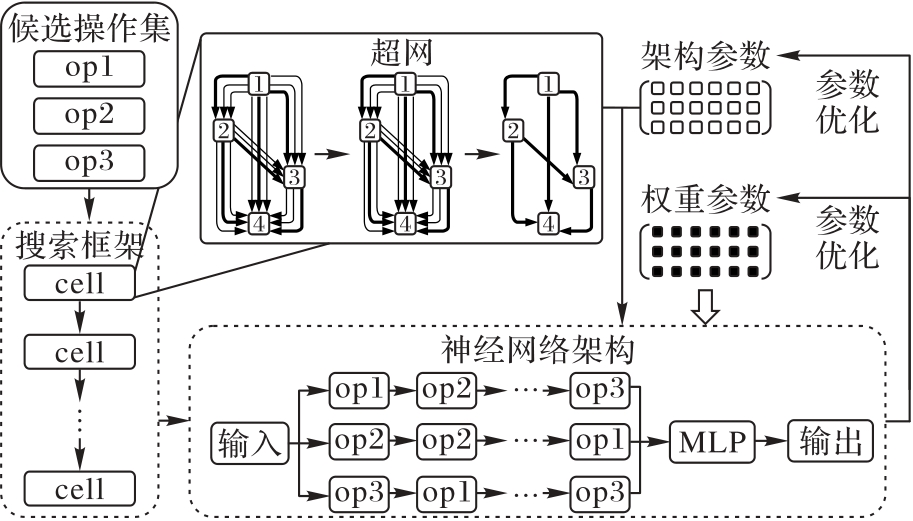
Fig. 1 Basic paradigm of DNAS
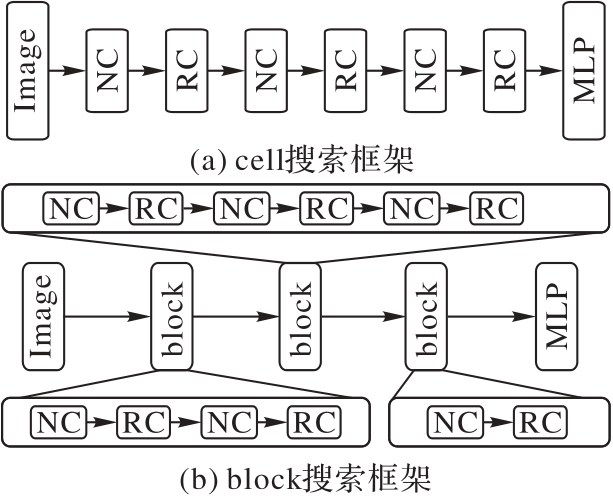
Fig. 2 Basic frameworks of DNAS
| 操作集 | 包含操作 |
|---|---|
| DARTS[ | 3×3和5×5深度可分离卷积,3×3和5×5 扩张深度可分离卷积,3×3最大池化, 3×3平均池化,跳跃连接,零映射 |
| MobileNetV2 | 3×3MBConv,5×5MBConv,7×7MBConv, 跳跃连接,零映射 |
| NAS-Bench-101[ | 1×1卷积,3×3卷积,3×3最大池化 |
| NAS-Bench-201[ | 1×1卷积,3×3卷积,3×3平均池化, 跳跃连接,零映射 |
Tab. 1 Common operation sets
| 操作集 | 包含操作 |
|---|---|
| DARTS[ | 3×3和5×5深度可分离卷积,3×3和5×5 扩张深度可分离卷积,3×3最大池化, 3×3平均池化,跳跃连接,零映射 |
| MobileNetV2 | 3×3MBConv,5×5MBConv,7×7MBConv, 跳跃连接,零映射 |
| NAS-Bench-101[ | 1×1卷积,3×3卷积,3×3最大池化 |
| NAS-Bench-201[ | 1×1卷积,3×3卷积,3×3平均池化, 跳跃连接,零映射 |
| 基准 | 数据集 | 搜索空间 | 包含已测试架构数 | 测试算法 |
|---|---|---|---|---|
| NAS-Bench-101[ | CIFAR-10 | NAS-Bench-101 | 423 000 | 无 |
| NAS-Bench-1Shot1[ | CIFAR-10 | NAS-Bench-101 | 423 000 | iDARTS[ |
| NAS-Bench-201[ | CIFAR-10,CIFAR-100, ImageNet | NAS-Bench-201 | 16 000 | iDARTS[ Fa[ SP-DARTS[ |
| NATS-Bench[ | CIFAR-10,CIFAR-100, ImageNet | NAS-Bench-201 | 48 000 | CDARTS[ |
| NAS-Bench-301[ | 自定义数据集 | DARTS | 使用代理模型实时计算 | 无 |
| NAS-Bench-360[ | 10个数据集 | 允许自定义搜索空间 | 15 000 | 无 |
Tab. 2 Benchmark tests for DNAS algorithms
| 基准 | 数据集 | 搜索空间 | 包含已测试架构数 | 测试算法 |
|---|---|---|---|---|
| NAS-Bench-101[ | CIFAR-10 | NAS-Bench-101 | 423 000 | 无 |
| NAS-Bench-1Shot1[ | CIFAR-10 | NAS-Bench-101 | 423 000 | iDARTS[ |
| NAS-Bench-201[ | CIFAR-10,CIFAR-100, ImageNet | NAS-Bench-201 | 16 000 | iDARTS[ Fa[ SP-DARTS[ |
| NATS-Bench[ | CIFAR-10,CIFAR-100, ImageNet | NAS-Bench-201 | 48 000 | CDARTS[ |
| NAS-Bench-301[ | 自定义数据集 | DARTS | 使用代理模型实时计算 | 无 |
| NAS-Bench-360[ | 10个数据集 | 允许自定义搜索空间 | 15 000 | 无 |

Fig. 3 Correspondence between DNAS challenges and research directions
| 算法优化层级 | 算法研究点 |
|---|---|
| 搜索目标优化 | 搜索评价方法,硬件延迟约束 |
| 搜索步骤优化 | 采样方法,搜索框架优化,参数优化策略 |
| 搜索策略优化 | 剪枝方法,渐进式优化,联合优化与蒸馏方法, 变分算法,结合方法 |
Tab. 3 Hierarchical structure of DNAS research content
| 算法优化层级 | 算法研究点 |
|---|---|
| 搜索目标优化 | 搜索评价方法,硬件延迟约束 |
| 搜索步骤优化 | 采样方法,搜索框架优化,参数优化策略 |
| 搜索策略优化 | 剪枝方法,渐进式优化,联合优化与蒸馏方法, 变分算法,结合方法 |
| 算法 | 类型 | 搜索 架构 | Top-1 准确率/% | 参数量/106 | 实验耗时 (GPU Days) | 候选操作集 | 解决问题 | 性能提升点 |
|---|---|---|---|---|---|---|---|---|
| DARTS[ | baseline | cell | 73.3 | 4.7 | 4.00 | DARTS | 无 | 通过连续松弛方法将离散架构映射为连续参数,通过梯度下降提升搜索效率 |
| DARTS+[ | 早停 | cell | 76.1 | 5.1 | 6.8 | MobileNet-like | 架构崩溃现象 | 通过早停增强模型稳定性,避免架构崩溃现象 |
| DARTS-EGS[ | 采样方法 | cell | 75.1 | 4.7 | 1.5 | DARTS | 计算资源瓶颈 | 通过Gumbel-Softmax进行离散化采样,降低内存占用 |
| GDAS[ | 采样方法 | block | 72.5 | 4.4 | 0.17 | DARTS | 计算资源瓶颈 | 通过Gumbel-Softmax进行离散化采样,降低内存占用 |
| Fair DARTS[ | 采样方法 | cell | 77.2 | 5.3 | 3 | MobileNet-like | 架构崩溃现象 | 通过sigmoid采样消除梯度不平衡,避免架构崩溃现象 |
| DARTS-PT[ | 采样方法 | cell | 74.5 | 4.6 | — | DARTS | 得分函数低效 | 通过扰动算法获取操作全局贡献,增强搜索算法稳定性 |
| DNAL[ | 采样方法 | block | 70.91 | 2.8 | — | MobileNet-like | 架构崩溃现象 | 通过sigmoid采样消除梯度不平衡,避免架构崩溃现象 |
| Shapley-NAS[ | 采样方法 | cell | 46.85 | 5.4 | 4.2 | NAS-Bench-201 | 得分函数低效 | 通过Shapley值获取操作全局贡献,增强模型稳定性 |
| NashNAS[ | 采样方法 | cell | — | 3.6* | — | NASNet | 得分函数低效 | 通过Nash平衡获取操作全局贡献,增强模型稳定性 |
| FBNet[ | 硬件延迟约束 | block | 74.9 | 5.5 | 9 | MobileNet-like | 硬件延迟评价 | 通过连续松弛方法衡量硬件延迟,提升硬件可部署性 |
| HardCoRe-NAS[ | 硬件延迟约束 | block | 77.9 | 7.7 | 16.7 | custom | 硬件延迟评价 | 通过连续松弛方法衡量硬件延迟,提升硬件可部署性 |
| ProxylessNAS[ | 硬件延迟约束, 参数优化方法 | block | 74.2 | 5.7 | 8.3 | MobileNet-like | 硬件延迟评价 | 通过连续松弛方法衡量硬件延迟,提升硬件可部署性 |
| PC-DARTS[ | 剪枝方法 | cell | 75.8 | 5.3 | 3.8 | DARTS | 计算资源瓶颈 | 通过剪枝加速搜索过程,提升搜索效率 |
| ADARTS[ | 剪枝方法 | cell | — | 2.9* | — | DARTS | 计算资源瓶颈 | 通过剪枝修剪通道,快速降低内存占用,提升搜索效率 |
| EPC-DARTS[ | 剪枝方法 | cell | 84.02 | 3.2 | 0.2 | DARTS | 计算资源瓶颈 | 通过剪枝修剪通道,快速降低内存占用,提升搜索效率 |
| FP-DARTS[ | 剪枝方法 | cell | 75.3 | 3.8 | 0.04 | DARTS | 计算资源瓶颈 | 通过剪枝加速搜索过程,提升搜索效率 |
| EnTranNAS[ | 剪枝方法, 联合优化 | cell | 76.2 | 5.2 | 2.1 | custom | 计算资源瓶颈 | 通过剪枝加速搜索过程,提升搜索效率;通过联合优化缓解搜索与评估阶段的优化误差问题 |
| AtomNAS[ | 剪枝方法, 搜索框架优化 | block | 75.9 | 4.7 | 25.5 | custom | 计算资源瓶颈 | 通过剪枝加速搜索过程,通过细化候选操作粒度提升搜索框架可表达性 |
| Single-Path NAS[ | 搜索框架优化 | block | 74.96 | 5.7 | 0.16 | MobileNet-like | 计算资源瓶颈 | 通过权重共享实现操作复用,降低内存消耗 |
| DMaskingNAS[ | 搜索框架优化 | block | 77.2 | 4 | 25 | custom | 计算资源瓶颈 | 通过权重共享实现操作复用,降低内存消耗 |
| DenseNAS[ | 搜索框架优化 | block | 75.3 | 24.7 | 2.67 | MobileNet-like | 计算资源瓶颈 | 通过设计搜索框架提升模型表现能力 |
| DARTS V2[ | 搜索框架优化 | cell | 74.3 | 5.3 | 0.3 | DARTS | 计算资源瓶颈 | 通过简化搜索框架降低优化误差,提升模型泛化能力 |
| Single-DARTS[ | 参数优化方法 | cell | 46.34 | 6.6 | — | DARTS | 得分函数低效 | 通过同步优化提升算法参数优化能力 |
| iDARTS[ | 参数优化方法 | cell | 75.7 | 3.8 | — | DARTS | 得分函数低效 | 通过隐函数定理实现双级参数同步优化,提升参数优化能力 |
| RF-DARTS[ | 参数优化方法 | block | 76 | 4.6 | — | DARTS | 得分函数低效 | 通过批归一化层训练提升模型性能 |
| P-DARTS[ | 渐进式优化 | cell | 75.3 | 5.1 | 0.3 | DARTS | 计算资源瓶颈 | 通过渐进式优化弥合优化误差,提升最终模型准确率 |
| OFA[ | 渐进式优化 | block | 80 | 7.7 | 1.7 | custom | 计算资源瓶颈 | 通过渐进式优化弥合优化误差,提升最终模型准确率 |
| SP-DARTS[ | 联合优化 | cell | 45.26 | 4.9 | 0.085 | NAS-Bench-201 | 优化差距现象 | 通过联合优化弥合连续参数与离散架构之间的误差,提升最终模型准确率 |
| BigNAS[ | 蒸馏算法 | block | 80.9 | 9.5 | — | MobileNet-like | 优化差距现象 | 通过自蒸馏算法提升模型泛化能力 |
| CDARTS[ | 蒸馏算法 | cell | 76.3 | 6.1 | 1.7 | DARTS | 优化差距现象 | 通过循环搜索策略和內省蒸馏提升模型泛化能力 |
| SD-DARTS[ | 蒸馏算法 | cell | 75 | 4.7 | 0.37 | DARTS | 优化差距现象 | 通过邻域蒸馏提升模型泛化能力 |
| VIM-NAS[ | 变分算法 | cell | 46.27 | 3.9 | 0.26 | DARTS | 计算资源瓶颈 | 挖掘架构参数与数据集的后验关系,提升准确率 |
| E2NAS[ | 变分算法 | cell | 45.07 | 1.7* | — | NAS-Bench-201 | 计算资源瓶颈 | 通过变分算法拟合神经网络输出,绕过神经网络搭建,降低内存消耗 |
| UNAS[ | 结合方法 | cell | 75.4 | 5.7 | 4.3 | MobileNet-like | 计算资源瓶颈 | 建立可微指标与不可微指标的联合评价体系,兼容强化学习和可微方法 |
| CARS[ | 结合方法 | cell | 75.2 | 5.1 | 0.4 | DARTS | 计算资源瓶颈 | 结合进化算法与可微方法,降低内存消耗的同时加速架构搜索 |
| RADARS[ | 结合方法 | block | 73.8 | — | 3.08 | MobileNet-like | 计算资源瓶颈 | 通过强化学习迭代剪枝加速架构搜索 |
Tab. 4 Comparison of DNAS algorithms
| 算法 | 类型 | 搜索 架构 | Top-1 准确率/% | 参数量/106 | 实验耗时 (GPU Days) | 候选操作集 | 解决问题 | 性能提升点 |
|---|---|---|---|---|---|---|---|---|
| DARTS[ | baseline | cell | 73.3 | 4.7 | 4.00 | DARTS | 无 | 通过连续松弛方法将离散架构映射为连续参数,通过梯度下降提升搜索效率 |
| DARTS+[ | 早停 | cell | 76.1 | 5.1 | 6.8 | MobileNet-like | 架构崩溃现象 | 通过早停增强模型稳定性,避免架构崩溃现象 |
| DARTS-EGS[ | 采样方法 | cell | 75.1 | 4.7 | 1.5 | DARTS | 计算资源瓶颈 | 通过Gumbel-Softmax进行离散化采样,降低内存占用 |
| GDAS[ | 采样方法 | block | 72.5 | 4.4 | 0.17 | DARTS | 计算资源瓶颈 | 通过Gumbel-Softmax进行离散化采样,降低内存占用 |
| Fair DARTS[ | 采样方法 | cell | 77.2 | 5.3 | 3 | MobileNet-like | 架构崩溃现象 | 通过sigmoid采样消除梯度不平衡,避免架构崩溃现象 |
| DARTS-PT[ | 采样方法 | cell | 74.5 | 4.6 | — | DARTS | 得分函数低效 | 通过扰动算法获取操作全局贡献,增强搜索算法稳定性 |
| DNAL[ | 采样方法 | block | 70.91 | 2.8 | — | MobileNet-like | 架构崩溃现象 | 通过sigmoid采样消除梯度不平衡,避免架构崩溃现象 |
| Shapley-NAS[ | 采样方法 | cell | 46.85 | 5.4 | 4.2 | NAS-Bench-201 | 得分函数低效 | 通过Shapley值获取操作全局贡献,增强模型稳定性 |
| NashNAS[ | 采样方法 | cell | — | 3.6* | — | NASNet | 得分函数低效 | 通过Nash平衡获取操作全局贡献,增强模型稳定性 |
| FBNet[ | 硬件延迟约束 | block | 74.9 | 5.5 | 9 | MobileNet-like | 硬件延迟评价 | 通过连续松弛方法衡量硬件延迟,提升硬件可部署性 |
| HardCoRe-NAS[ | 硬件延迟约束 | block | 77.9 | 7.7 | 16.7 | custom | 硬件延迟评价 | 通过连续松弛方法衡量硬件延迟,提升硬件可部署性 |
| ProxylessNAS[ | 硬件延迟约束, 参数优化方法 | block | 74.2 | 5.7 | 8.3 | MobileNet-like | 硬件延迟评价 | 通过连续松弛方法衡量硬件延迟,提升硬件可部署性 |
| PC-DARTS[ | 剪枝方法 | cell | 75.8 | 5.3 | 3.8 | DARTS | 计算资源瓶颈 | 通过剪枝加速搜索过程,提升搜索效率 |
| ADARTS[ | 剪枝方法 | cell | — | 2.9* | — | DARTS | 计算资源瓶颈 | 通过剪枝修剪通道,快速降低内存占用,提升搜索效率 |
| EPC-DARTS[ | 剪枝方法 | cell | 84.02 | 3.2 | 0.2 | DARTS | 计算资源瓶颈 | 通过剪枝修剪通道,快速降低内存占用,提升搜索效率 |
| FP-DARTS[ | 剪枝方法 | cell | 75.3 | 3.8 | 0.04 | DARTS | 计算资源瓶颈 | 通过剪枝加速搜索过程,提升搜索效率 |
| EnTranNAS[ | 剪枝方法, 联合优化 | cell | 76.2 | 5.2 | 2.1 | custom | 计算资源瓶颈 | 通过剪枝加速搜索过程,提升搜索效率;通过联合优化缓解搜索与评估阶段的优化误差问题 |
| AtomNAS[ | 剪枝方法, 搜索框架优化 | block | 75.9 | 4.7 | 25.5 | custom | 计算资源瓶颈 | 通过剪枝加速搜索过程,通过细化候选操作粒度提升搜索框架可表达性 |
| Single-Path NAS[ | 搜索框架优化 | block | 74.96 | 5.7 | 0.16 | MobileNet-like | 计算资源瓶颈 | 通过权重共享实现操作复用,降低内存消耗 |
| DMaskingNAS[ | 搜索框架优化 | block | 77.2 | 4 | 25 | custom | 计算资源瓶颈 | 通过权重共享实现操作复用,降低内存消耗 |
| DenseNAS[ | 搜索框架优化 | block | 75.3 | 24.7 | 2.67 | MobileNet-like | 计算资源瓶颈 | 通过设计搜索框架提升模型表现能力 |
| DARTS V2[ | 搜索框架优化 | cell | 74.3 | 5.3 | 0.3 | DARTS | 计算资源瓶颈 | 通过简化搜索框架降低优化误差,提升模型泛化能力 |
| Single-DARTS[ | 参数优化方法 | cell | 46.34 | 6.6 | — | DARTS | 得分函数低效 | 通过同步优化提升算法参数优化能力 |
| iDARTS[ | 参数优化方法 | cell | 75.7 | 3.8 | — | DARTS | 得分函数低效 | 通过隐函数定理实现双级参数同步优化,提升参数优化能力 |
| RF-DARTS[ | 参数优化方法 | block | 76 | 4.6 | — | DARTS | 得分函数低效 | 通过批归一化层训练提升模型性能 |
| P-DARTS[ | 渐进式优化 | cell | 75.3 | 5.1 | 0.3 | DARTS | 计算资源瓶颈 | 通过渐进式优化弥合优化误差,提升最终模型准确率 |
| OFA[ | 渐进式优化 | block | 80 | 7.7 | 1.7 | custom | 计算资源瓶颈 | 通过渐进式优化弥合优化误差,提升最终模型准确率 |
| SP-DARTS[ | 联合优化 | cell | 45.26 | 4.9 | 0.085 | NAS-Bench-201 | 优化差距现象 | 通过联合优化弥合连续参数与离散架构之间的误差,提升最终模型准确率 |
| BigNAS[ | 蒸馏算法 | block | 80.9 | 9.5 | — | MobileNet-like | 优化差距现象 | 通过自蒸馏算法提升模型泛化能力 |
| CDARTS[ | 蒸馏算法 | cell | 76.3 | 6.1 | 1.7 | DARTS | 优化差距现象 | 通过循环搜索策略和內省蒸馏提升模型泛化能力 |
| SD-DARTS[ | 蒸馏算法 | cell | 75 | 4.7 | 0.37 | DARTS | 优化差距现象 | 通过邻域蒸馏提升模型泛化能力 |
| VIM-NAS[ | 变分算法 | cell | 46.27 | 3.9 | 0.26 | DARTS | 计算资源瓶颈 | 挖掘架构参数与数据集的后验关系,提升准确率 |
| E2NAS[ | 变分算法 | cell | 45.07 | 1.7* | — | NAS-Bench-201 | 计算资源瓶颈 | 通过变分算法拟合神经网络输出,绕过神经网络搭建,降低内存消耗 |
| UNAS[ | 结合方法 | cell | 75.4 | 5.7 | 4.3 | MobileNet-like | 计算资源瓶颈 | 建立可微指标与不可微指标的联合评价体系,兼容强化学习和可微方法 |
| CARS[ | 结合方法 | cell | 75.2 | 5.1 | 0.4 | DARTS | 计算资源瓶颈 | 结合进化算法与可微方法,降低内存消耗的同时加速架构搜索 |
| RADARS[ | 结合方法 | block | 73.8 | — | 3.08 | MobileNet-like | 计算资源瓶颈 | 通过强化学习迭代剪枝加速架构搜索 |
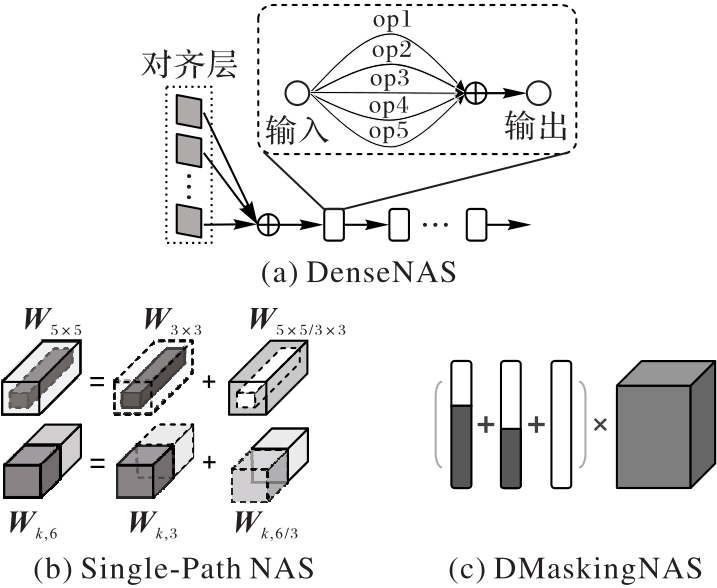
Fig. 4 Structural details of selected DNAS algorithm frameworks
| [1] | Li S, Tan M, Pang R, et al. Searching for fast model families on datacenter accelerators[C]// CVPR 2021. Piscataway: IEEE, 2021: 8081-8091. |
| [2] | Real E, Aggarwal A, Huang Y, et al. Regularized evolution for image classifier architecture search[J]. Proceedings of the AAAI Conference on Artificial Intelligence, 2019, 33(1): 4780-4789. |
| [3] | Liu H, Simonyan K, Yang Y. DARTS: differentiable architecture search[PP/OL]. V2. arXiv (2019-04-23) [2025-07-11].. |
| [4] | Heuillet A, Nasser A, Arioui H, et al. Efficient automation of neural network design: a survey on differentiable neural architecture search[J]. ACM Computing Surveys, 2024, 56(11): No.270. |
| [5] | Zoph B, Vasudevan V, Shlens J, et al. Learning transferable architectures for scalable image recognition[C]// CVPR 2018. Piscataway: IEEE, 2018: 8697-8710. |
| [6] | Tan M, Chen B, Pang R, et al. MnasNet: platform-aware neural architecture search for mobile[C]// CVPR 2019. Piscataway: IEEE, 2019: 2815-2823. |
| [7] | Ying C, Klein A, Real E, et al. NAS-Bench-101: towards reproducible neural architecture search[J]. Proceedings of Machine Learning Research, 2019, 97: 7105-7114. |
| [8] | Dong X, Yang Y. NAS-Bench-201: extending the scope of reproducible neural architecture search[PP/OL]. V2. arXiv (2020-01-15) [2025-05-11].. |
| [9] | Zela A, Siems J, Hutter F. NAS-Bench-1Shot1: benchmarking and dissecting one-shot neural architecture search[PP/OL]. V2. arXiv (2020-04-12) [2025-07-11].. |
| [10] | Dong X, Liu L, Musial K, et al. NATS-Bench: benchmarking NAS algorithms for architecture topology and size[J]. IEEE Transactions on Pattern Analysis and Machine Intelligence, 2022, 44(7): 3634-3646. |
| [11] | Siems J, Zimmer L, Zela A, et al. NAS-Bench-301 and the case for surrogate benchmarks for neural architecture search[PP/OL]. V3. arXiv (2020-11-05) [2025-07-11].. |
| [12] | Tu R, Roberts N, Khodak M, et al. NAS-Bench-360: benchmarking neural architecture search on diverse tasks[C]// NeurIPS 2022. Red Hook: Curran Associates Inc., 2022: 12380-12394. |
| [13] | Zhang M, Su S, Pan S, et al. iDARTS: differentiable architecture search with stochastic implicit gradients[J]. Proceedings of Machine Learning Research, 2021, 139: 12557-12566. |
| [14] | Wang Y, Liu Y, Dai W, et al. Learning latent architectural distribution in differentiable neural architecture search via variational information maximization[C]// ICCV 2021. Piscataway: IEEE, 2021: 12292-12301. |
| [15] | Xiao H, Wang Z, Zhu Z, et al. Shapley-NAS: discovering operation contribution for neural architecture search[C]// CVPR 2022. Piscataway: IEEE, 2022: 11882-11891. |
| [16] | Li Q, Xue C, Li M, et al. Neural architecture selection as a Nash equilibrium with batch entanglement[J]. IEEE Transactions on Neural Networks and Learning Systems, 2024, 35(11): 15195-15209. |
| [17] | Ji J, Wang X. Fast progressive differentiable architecture search based on adaptive task granularity reorganization[J]. Information Sciences, 2023, 645: No.119326. |
| [18] | Hou P, Jin Y, Chen Y. Single-DARTS: towards stable architecture search[C]// ICCVW 2021. Piscataway: IEEE, 2021: 373-382. |
| [19] | Zhang X, Li Y, Zhang X, et al. Differentiable architecture search with random features[C]// CVPR 2023. Piscataway: IEEE, 2023: 16060-16069. |
| [20] | Zhang J, Ding Z. Robustifying DARTS by eliminating information bypass leakage via explicit sparse regularization[C]// ICDM 2021. Piscataway: IEEE, 2021: 877-885. |
| [21] | Zhu X, Li J, Liu Y, et al. Improving differentiable architecture search via self-distillation[J]. Neural Networks, 2023, 167: 656-667. |
| [22] | Zhang M, Li H, Pan S, et al. Differentiable neural architecture search in equivalent space with exploration enhancement[C]// NeurIPS 2020. Red Hook: Curran Associates Inc., 2020: 13341-13351. |
| [23] | Yu H, Peng H, Huang Y, et al. Cyclic differentiable architecture search[J]. IEEE Transactions on Pattern Analysis and Machine Intelligence, 2023, 45(1): 211-228. |
| [24] | Xiang L, Dudziak L, Abdelfattah M S, et al. Zero-cost operation scoring in differentiable architecture search[J]. Proceedings of the AAAI Conference on Artificial Intelligence, 2023, 37(9): 10453-10463. |
| [25] | Wang R, Cheng M, Chen X, et al. Rethinking architecture selection in differentiable NAS[PP/OL]. arXiv (2021-08-10) [2025-07-15].. |
| [26] | Cai H, Zhu L, Han S. ProxylessNAS: direct neural architecture search on target task and hardware[PP/OL]. V2. arXiv (2019-02-23) [2025-07-11].. |
| [27] | Liang H, Zhang S, Sun J, et al. DARTS+: improved differentiable architecture search with early stopping[PP/OL]. V2. arXiv (2020-10-20) [2025-07-11].. |
| [28] | Chu X, Zhou T, Zhang B, et al. Fair DARTS: eliminating unfair advantages in differentiable architecture search[C]// ECCV 2020, LNCS 12360. Cham: Springer, 2020: 465-480. |
| [29] | Chen X, Xie L, Wu J, et al. Progressive differentiable architecture search: bridging the depth gap between search and evaluation[C]// ICCV 2019. Piscataway: IEEE, 2019: 1294-1303. |
| [30] | Chang J, Zhang X, Guo Y, et al. Differentiable architecture search with ensemble Gumbel-Softmax[PP/OL]. arXiv (2019-05-06) [2025-07-11].. |
| [31] | Dong X, Yang Y. Searching for a robust neural architecture in four GPU hours[C]// CVPR 2019. Piscataway: IEEE, 2019: 1761-1770. |
| [32] | Wang X, Chu X, Fan Y, et al. ROME: robustifying memory-efficient NAS via topology disentanglement and gradient accumulation[C]// ICCV 2023. Piscataway: IEEE, 2023: 5916-5926. |
| [33] | Soro B, Song C. Enhancing differentiable architecture search: a study on small number of cell blocks in the search stage, and important branches-based cells selection[C]// ICCVW 2023. Piscataway: IEEE, 2023: 1245-1253. |
| [34] | Chen X, Hsieh C J. Stabilizing differentiable architecture search via perturbation-based regularization[J]. Proceedings of Machine Learning Research, 2020, 119: 1554-1565. |
| [35] | Yu J, Jin P, Liu H, et al. BigNAS: scaling up neural architecture search with big single-stage models[C]// ECCV 2020, LNCS 12352. Cham: Springer, 2020: 702-717. |
| [36] | Wu B, Dai X, Zhang P, et al. FBNet: hardware-aware efficient ConvNet design via differentiable neural architecture search[C]// CVPR 2019. Piscataway: IEEE, 2019: 10726-10734. |
| [37] | Nayman N, Aflalo Y, Noy A, et al. HardCoRe-NAS: hard constrained differentiable neural architecture search[J]. Proceedings of Machine Learning Research, 2021, 139: 7979-7990. |
| [38] | Guo Q, Wu X J, Kittler J, et al. Differentiable neural architecture learning for efficient neural networks[J]. Pattern Recognition, 2022, 126: No.108448. |
| [39] | Xu Y, Xie L, Zhang X, et al. PC-DARTS: partial channel connections for memory-efficient architecture search[PP/OL]. V4. arXiv (2020-04-07) [2025-07-11].. |
| [40] | Xue Y, Qin J. Partial connection based on channel attention for differentiable neural architecture search[J]. IEEE Transactions on Industrial Informatics, 2023, 19(5): 6804-6813. |
| [41] | Cai Z, Chen L, Liu H L. EPC-DARTS: efficient partial channel connection for differentiable architecture search[J]. Neural Networks, 2023, 166: 344-353. |
| [42] | Yang Y, You S, Li H, et al. Towards improving the consistency, efficiency, and flexibility of differentiable neural architecture search[C]// CVPR 2021. Piscataway: IEEE, 2021: 6663-6672. |
| [43] | Mei J, Li Y, Lian X, et al. AtomNAS: fine-grained end-to-end neural architecture search[PP/OL]. V2. arXiv (2020-02-23) [2025-08-04].. |
| [44] | Stamoulis D, Ding R, Wang D, et al. Single-Path NAS: designing hardware-efficient ConvNets in less than 4 hours[C]// ECML PKDD 2019, LNCS 11907. Cham: Springer, 2019: 481-497. |
| [45] | Wan A, Dai X, Zhang P, et al. FBNetV2: differentiable neural architecture search for spatial and channel dimensions[C]// CVPR 2020. Piscataway: IEEE, 2020: 12962-12971. |
| [46] | Fang J, Sun Y, Zhang Q, et al. Densely connected search space for more flexible neural architecture search[C]// CVPR 2020. Piscataway: IEEE, 2020: 10625-10634. |
| [47] | Cai H, Gan C, Wang T, et al. Once-for-all: train one network and specialize it for efficient deployment[PP/OL]. V5. arXiv (2020-04-29) [2025-07-11].. |
| [48] | Vahdat A, Mallya A, Liu M Y, et al. UNAS: differentiable architecture search meets reinforcement learning[C]// CVPR 2020. Piscataway: IEEE, 2020: 11263-11272. |
| [49] | Yang Z, Wang Y, Chen X, et al. CARS: continuous evolution for efficient neural architecture search[C]// CVPR 2020. Piscataway: IEEE, 2020: 1826-1835. |
| [50] | Yan Z, Jiang W, Hu X S, et al. RADARS: memory efficient reinforcement learning aided differentiable neural architecture search[C]// ASP-DAC 2022. Piscataway: IEEE, 2022: 128-133. |
| [51] | Fan Z, Hu G, Sun X, et al. Self-attention neural architecture search for semantic image segmentation[J]. Knowledge-Based Systems, 2022, 239: No.107968. |
| [52] | Wei L, Zhao H, He Z, et al. Neural architecture search for GNN-based graph classification[J]. ACM Transactions on Information Systems, 2024, 42(1): No.1. |
| [53] | Yan C, Chang X, Li Z, et al. ZeroNAS: differentiable generative adversarial networks search for zero-shot learning[J]. IEEE Transactions on Pattern Analysis and Machine Intelligence, 2022, 44(12): 9733-9740. |
| [54] | Zhao Y, Dong L, Shen Y, et al. Memory-efficient differentiable Transformer architecture search[C]// Findings of the Association for Computational Linguistics: ACL-IJCNLP 2021. Stroudsburg: ACL, 2021: 4254-4264. |
| [55] | Wu P, Neri F, Feng Z. DASViT: differentiable architecture search for vision Transformer[PP/OL]. arXiv (2025-07-17) [2025-07-21].. |
| [56] | Zhang S X, Hsieh C Y, Zhang S, et al. Differentiable quantum architecture search[J]. Quantum Science and Technology, 2022, 7(4): No.045023. |
| [57] | Wu W, Yan G, Lu X, et al. QuantumDARTS: differentiable quantum architecture search for variational quantum algorithms[J]. Proceedings of Machine Learning Research, 2023, 202: 37745-37764. |
| [1] | Yadong JIN, Jing FAN, Enkang XI, Hua DONG, Hao YU, Yihang SUN. Personalized federated learning intelligent edge aggregation method for space-air-ground integrated networks [J]. Journal of Computer Applications, 2026, 46(8): 2555-2566. |
| [2] | Zhanjun LIU, Yunpeng SONG, Shengbao WANG. Extremely large-scale MIMO channel estimation in hybrid field based on adaptive gradient matching pursuit algorithm [J]. Journal of Computer Applications, 2025, 45(12): 3931-3938. |
| [3] | Shufen ZHANG, Benjian TANG, Zikun TIAN, Xiaoyang QING. Survey of federated learning based on differential privacy [J]. Journal of Computer Applications, 2025, 45(10): 3221-3230. |
| [4] | Ye TIAN, Jinjin CHEN, Xingyi ZHANG. Hybrid optimizer combining evolutionary computation and gradient descent for constrained multi-objective optimization [J]. Journal of Computer Applications, 2024, 44(5): 1386-1392. |
| [5] | Yu ZHANG, Ying CAI, Jianyang CUI, Meng ZHANG, Yanfang FAN. Gradient descent with momentum algorithm based on differential privacy in convolutional neural network [J]. Journal of Computer Applications, 2023, 43(12): 3647-3653. |
| [6] | Lei TIAN, Lina GE. Advertising recommendation algorithm based on differential privacy [J]. Journal of Computer Applications, 2023, 43(11): 3346-3350. |
| [7] | WANG Jinkai, JIA Xu. Vein recognition algorithm based on Siamese nonnegative matrix factorization with transferability [J]. Journal of Computer Applications, 2021, 41(3): 898-903. |
| [8] | WANG Jinkai, JIA Xu. Vehicle face recognition algorithm based on NMF with weighted and orthogonal constraints [J]. Journal of Computer Applications, 2020, 40(4): 1050-1055. |
| [9] | CHENG Qiwei, CHEN Qimai, HE Chaobo, LIU Hai. Overlapping community detection method based on improved symmetric binary nonnegative matrix factorization [J]. Journal of Computer Applications, 2020, 40(11): 3203-3210. |
| [10] | FAN Wei, XIE Cong, XIAO Chunjing, CAO Shuyan. Random walking recommendation algorithm based on combinational category space [J]. Journal of Computer Applications, 2019, 39(4): 984-988. |
| [11] | QIU Ningjia, CONG Lin, ZHOU Sicheng, WANG Peng, LI Yanfang. SVD-CNN barrage text classification algorithm combined with improved active learning [J]. Journal of Computer Applications, 2019, 39(3): 644-650. |
| [12] | ZHOU Ruihuan, ZHAO Hongyu. List-wise matrix factorization algorithm with combination of item popularity [J]. Journal of Computer Applications, 2018, 38(7): 1877-1881. |
| [13] | LI Shuangli, LI Zhihua, YU Xinrong, YAN Chengyu. Workload uncertainty-based virtual machine consolidation method [J]. Journal of Computer Applications, 2018, 38(6): 1658-1664. |
| [14] | HU Min, CHEN Yuanhui, HUANG Hongcheng. Supernetwork link prediction method based on spatio-temporal relation in location-based social network [J]. Journal of Computer Applications, 2018, 38(6): 1682-1690. |
| [15] | WANG Lifang, CHENG Xi, QIN Pinle, GAO Yuan. Non-rigid multi-modal medical image registration based on multi-channel sparse coding [J]. Journal of Computer Applications, 2018, 38(4): 1127-1133. |
| Viewed | ||||||
|
Full text |
|
|||||
|
Abstract |
|
|||||
