


Journal of Computer Applications ›› 2026, Vol. 46 ›› Issue (5): 1518-1525.DOI: 10.11772/j.issn.1001-9081.2025050654
• Cyber security • Previous Articles
Yunle WANG, Xiang FENG( ), Huiqun YU
Received:2025-06-13
Revised:2025-07-17
Accepted:2025-07-22
Online:2025-08-01
Published:2026-05-10
Contact:
Xiang FENG
About author:WANG Yunle, born in 1999, M. S. candidate. Her research interests include differential privacy, multi-agent systems.Supported by:
王云乐, 冯翔(), 虞慧群
通讯作者:
冯翔
作者简介:王云乐(1999—),女,云南临沧人,硕士研究生,CCF会员,主要研究方向:差分隐私、多智能体系统基金资助:CLC Number:
Yunle WANG, Xiang FENG, Huiqun YU. VLMDs-Privacy: privacy-enhanced strategy for cooperative decision-making in socially-aware multi-agent systems[J]. Journal of Computer Applications, 2026, 46(5): 1518-1525.
王云乐, 冯翔, 虞慧群. 社会意识多智能体协同决策的隐私增强策略VLMDs-Privacy[J]. 《计算机应用》唯一官方网站, 2026, 46(5): 1518-1525.
Add to citation manager EndNote|Ris|BibTeX
URL: https://www.joca.cn/EN/10.11772/j.issn.1001-9081.2025050654
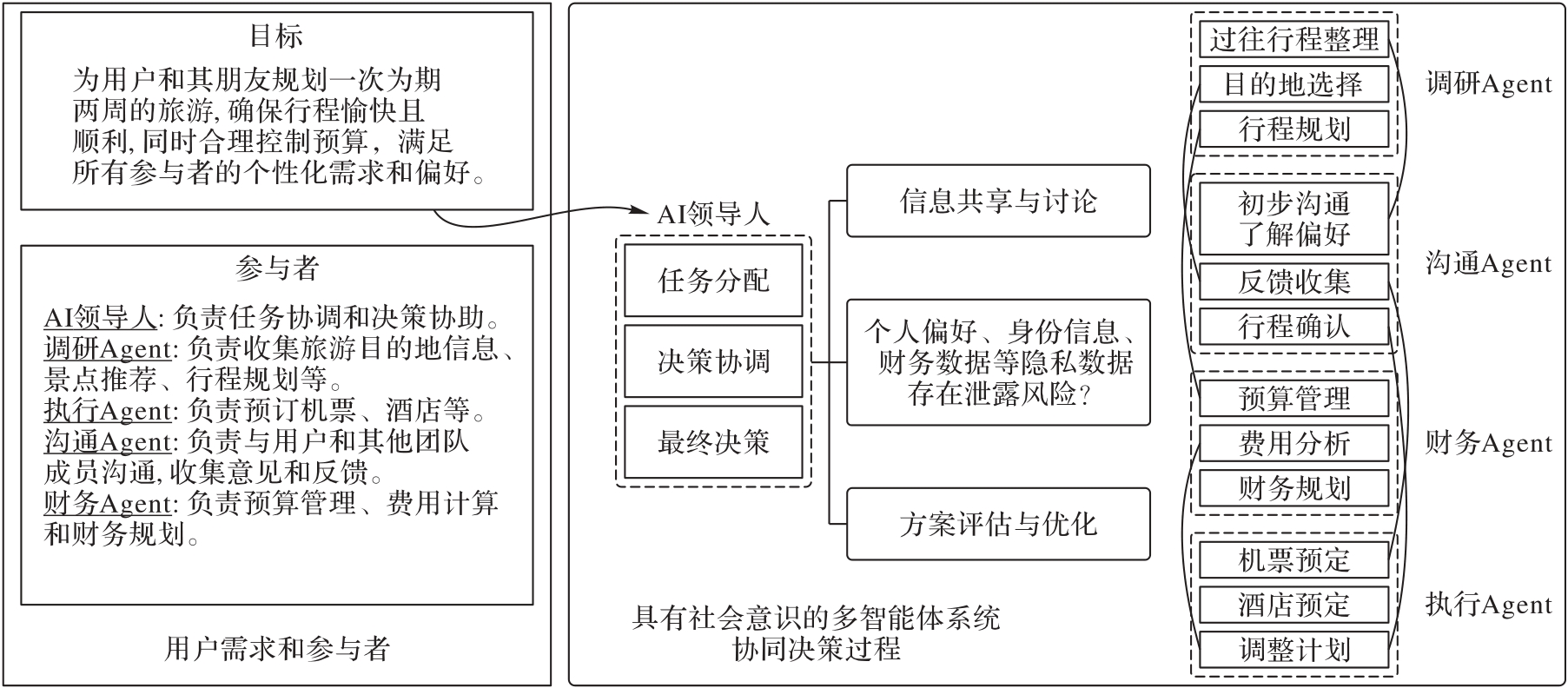
Fig. 1 Decision-making process of socially-aware MAS in making own travel plan
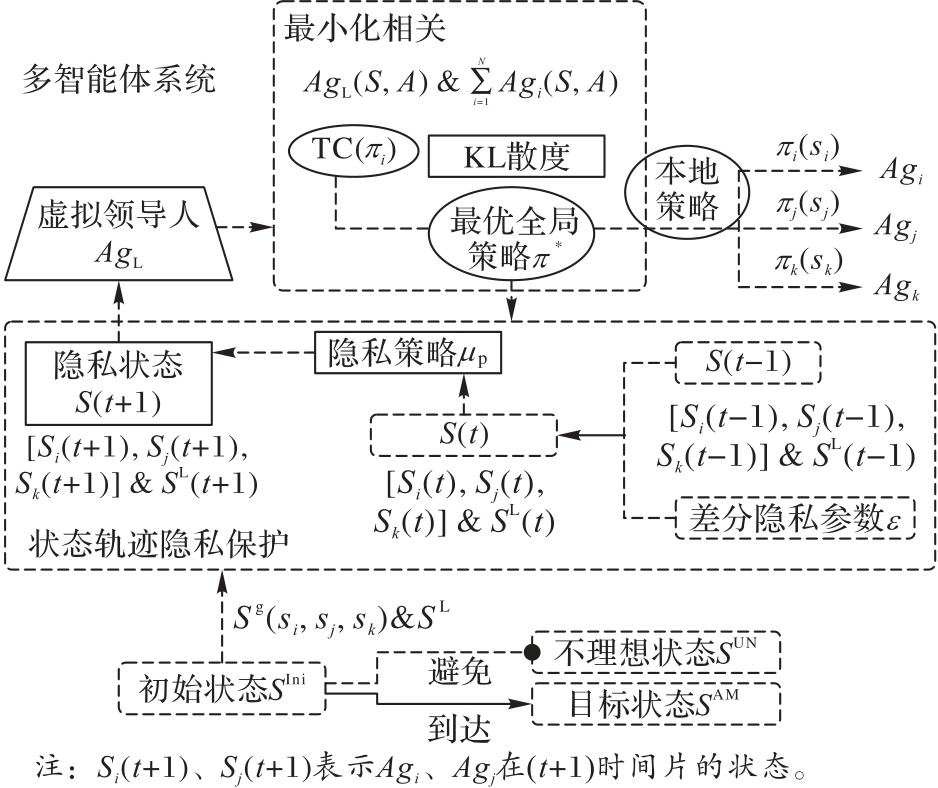
Fig. 2 Flowchart of VLMDs-Privacy
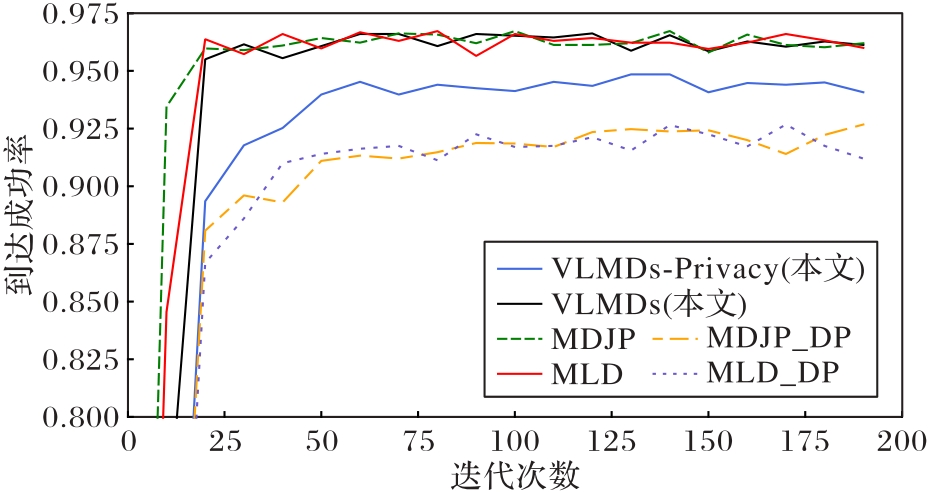
Fig. 3 Comparison of arrival success rates for different algorithms in MAN scenarios
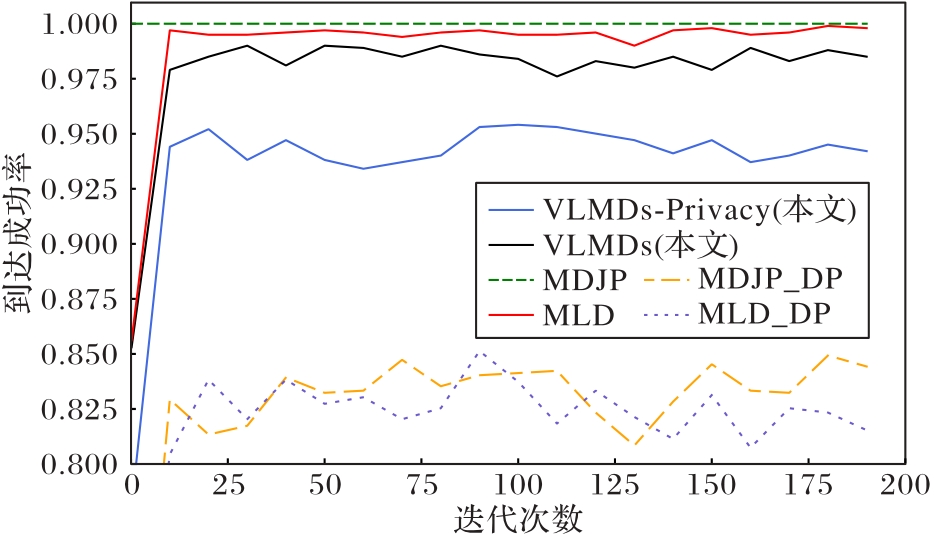
Fig. 4 Comparison of arrival success rates for different algorithms in MADR scenarios
| 到达成功率/% | ||||
|---|---|---|---|---|
| MLD_DP | MDJP_DP | VLDPs-Privacy | VLMDs-Privacy | |
| 0.1 | 91.6 | 91.6 | 10.6 | 94.1 |
| 1 | 92.0 | 92.1 | 12.2 | 94.7 |
| 5 | 92.6 | 92.5 | 30.8 | 94.5 |
| 10 | 94.8 | 94.9 | 86.3 | 95.3 |
| 无隐私 | 96.3 | 96.2 | 99.0 | 96.5 |
Tab. 1 Arrival success rates of various algorithms under different privacy parameters ε (MANC)
| 到达成功率/% | ||||
|---|---|---|---|---|
| MLD_DP | MDJP_DP | VLDPs-Privacy | VLMDs-Privacy | |
| 0.1 | 91.6 | 91.6 | 10.6 | 94.1 |
| 1 | 92.0 | 92.1 | 12.2 | 94.7 |
| 5 | 92.6 | 92.5 | 30.8 | 94.5 |
| 10 | 94.8 | 94.9 | 86.3 | 95.3 |
| 无隐私 | 96.3 | 96.2 | 99.0 | 96.5 |
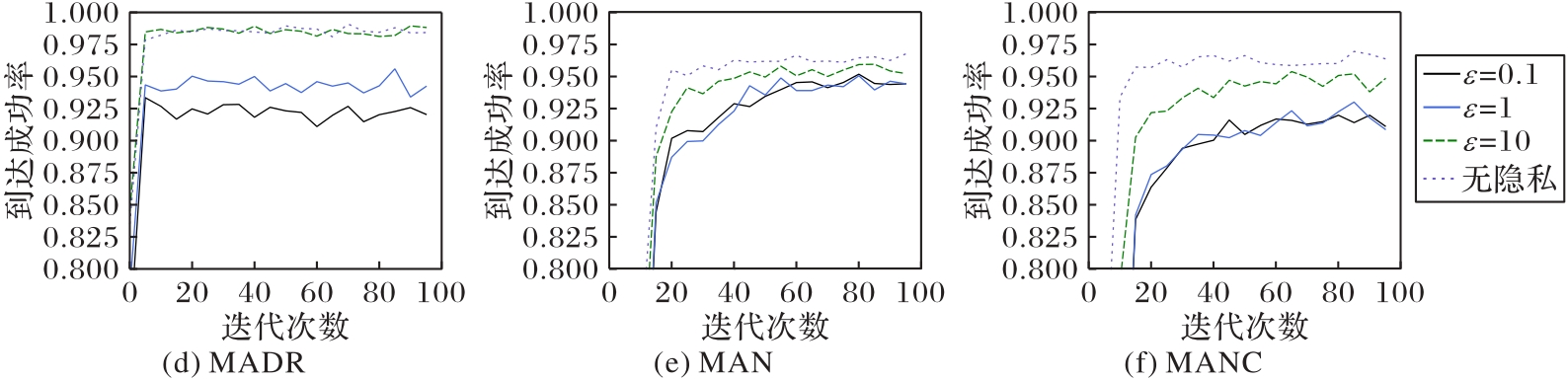
Fig. 5 Arrival success rate for different number of iterations
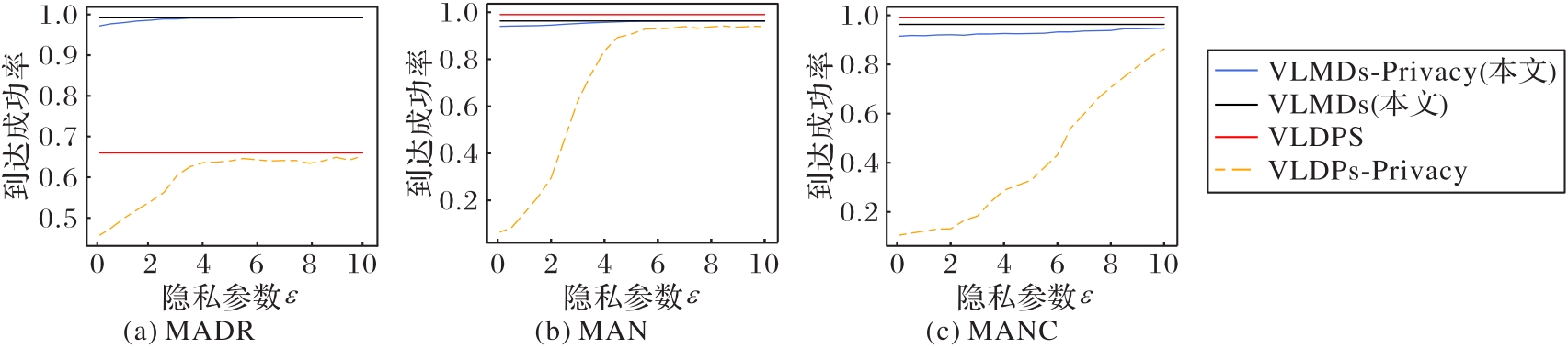
Fig. 6 Arrival success rate for different privacy parameters
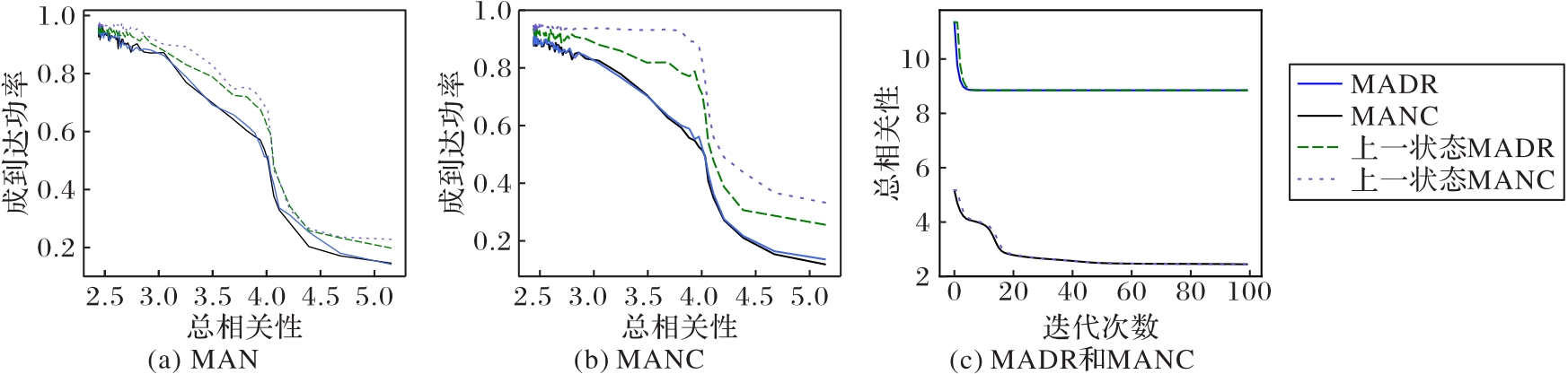
Fig. 7 Influence of global correlation on arrival success rate and iteration convergence
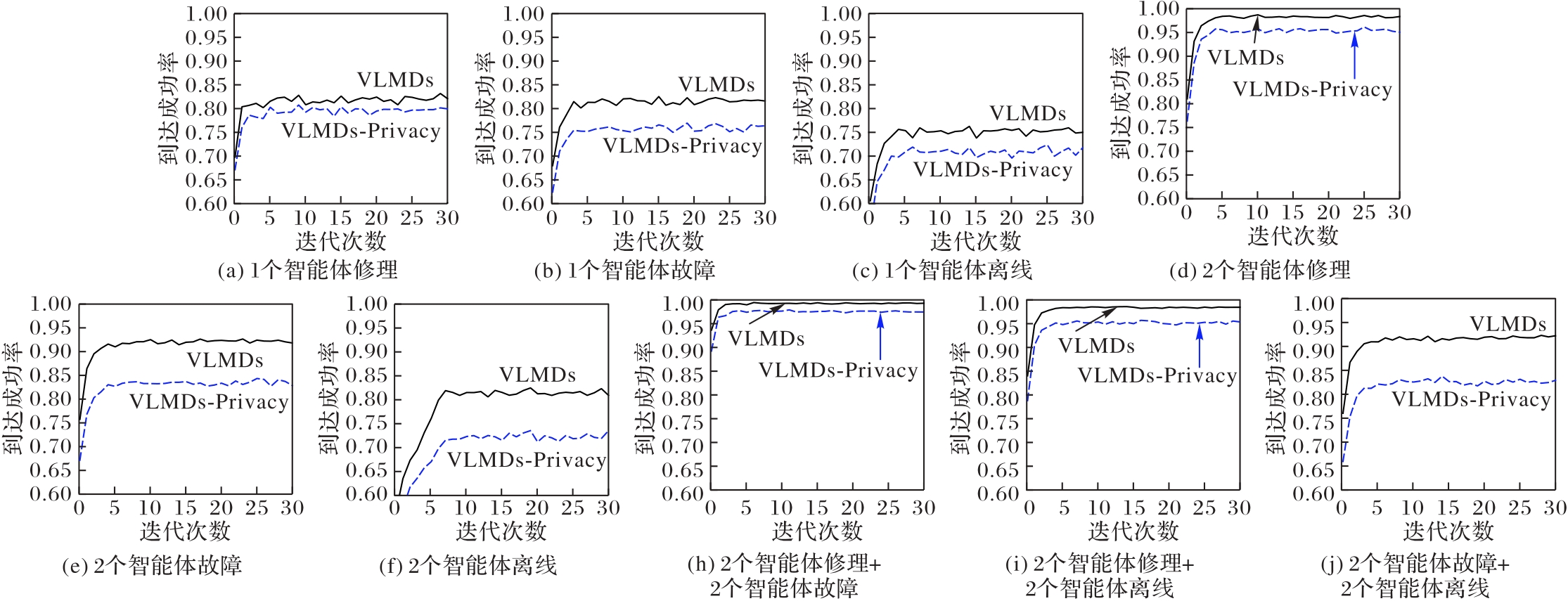
Fig. 8 Arrival success rates of different communities in different initial states (MADR)
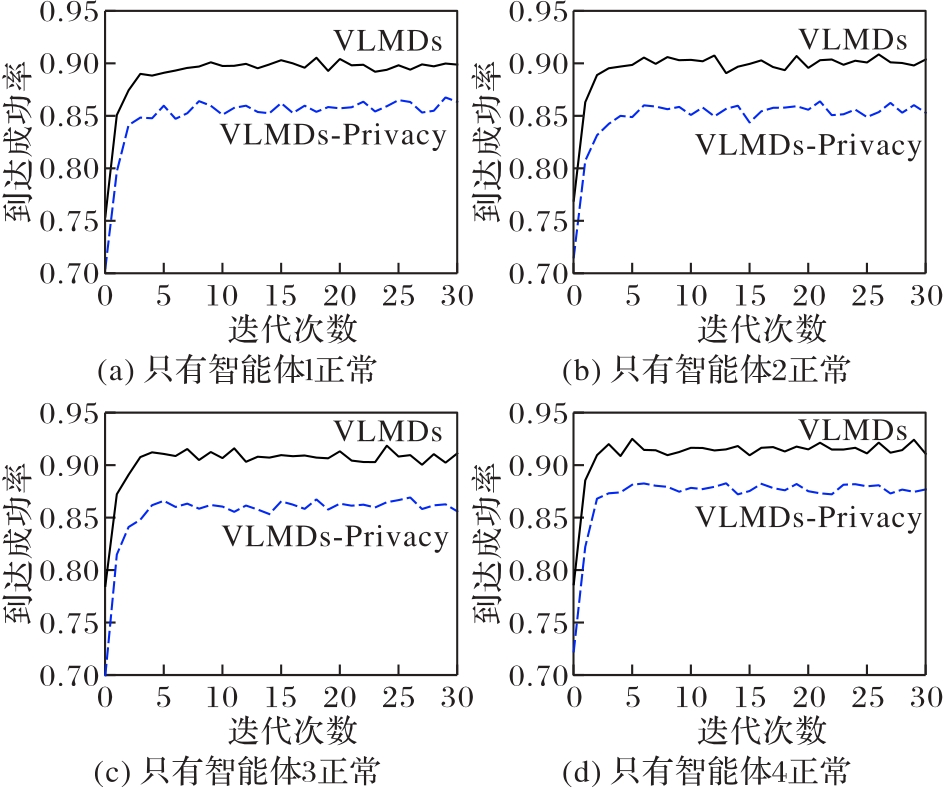
Fig. 9 Arrival success rates with only one agent working properly
| [1] | LI Y, MA D, AN Z, et al. V2X-Sim: multi-agent collaborative perception dataset and benchmark for autonomous driving[J]. IEEE Robotics and Automation Letters, 2022, 7(4): 10914-10921. |
| [2] | YING C, ZHENG N, WU Y, et al. Privacy-preserving adaptive resilient consensus for multiagent systems under cyberattacks[J]. IEEE Transactions on Industrial Informatics, 2024, 20(2): 1630-1640. |
| [3] | LIU Y, ZHOU Y, YANG L, et al. Simulating staff activities in healthcare environments: an empirical multi-agent modeling approach[J]. Journal of Building Engineering, 2024, 84: No.108580. |
| [4] | KHAN H I, FRIDOVICH-KEIL D. Leadership inference for multi-agent interactions[J]. IEEE Robotics and Automation Letters, 2024, 9(5): 4671-4678. |
| [5] | NI J, SHI P. Adaptive neural network fixed-time leader–follower consensus for multiagent systems with constraints and disturbances[J]. IEEE Transactions on Cybernetics, 2021, 51(4): 1835-1848. |
| [6] | ZHANG L, LI Y, LU J, et al. Bipartite event-triggered impulsive output consensus for switching multi-agent systems with dynamic leader[J]. Information Sciences, 2022, 612: 414-426. |
| [7] | WANG P, WEN G, HUANG T, et al. Asymptotical neuro-adaptive consensus of multi-agent systems with a high dimensional leader and directed switching topology[J]. IEEE Transactions on Neural Networks and Learning Systems, 2023, 34(11): 9149-9160. |
| [8] | LIU Y, DONG X, SHI P, et al. Distributed fault-tolerant formation tracking control for multiagent systems with multiple leaders and constrained actuators[J]. IEEE Transactions on Cybernetics, 2023, 53(6): 3738-3747. |
| [9] | ZHANG H, LI W, ZHANG J, et al. Fully distributed dynamic event-triggered bipartite formation tracking for multiagent systems with multiple nonautonomous leaders[J]. IEEE Transactions on Neural Networks and Learning Systems, 2023, 34(10): 7453-7466. |
| [10] | RADFORD A, KIM J W, HALLACY C, et al. Learning transferable visual models from natural language supervision[C]// Proceedings of the 38th International Conference on Machine Learning. New York: JMLR.org, 2021: 8748-8763. |
| [11] | 秦臻,庄添铭,朱国淞,等. 面向人工智能模型的安全攻击和防御策略综述[J]. 计算机研究与发展, 2024, 61(10): 2627-2648. |
| QIN Z, ZHUANG T M, ZHU G S, et al. Survey of security attack and defense strategies for artificial intelligence model[J]. Journal of Computer Research and Development, 2024, 61(10): 2627-2648. | |
| [12] | YAN B, SHI P, LIM C C, et al. Optimal robust formation control for heterogeneous multi-agent systems based on reinforcement learning[J]. International Journal of Robust and Nonlinear Control, 2022, 32(5): 2683-2704. |
| [13] | ZHANG W, JIANG B, LI M, et al. Privacy-preserving aggregate mobility data release: an information-theoretic deep reinforcement learning approach[J]. IEEE Transactions on Information Forensics and Security, 2022, 17: 849-864. |
| [14] | HASSAN A, DEKA D, DWORKIN Y. Privacy-aware load ensemble control: a linearly-solvable MDP approach[J]. IEEE Transactions on Smart Grid, 2022, 13(1): 255-267. |
| [15] | DWORK C. Differential privacy[C]// Proceedings of the 2006 International Colloquium on Automata, Languages, and Programming, LNCS 4052. Berlin: Springer, 2006: 1-12. |
| [16] | YE D, ZHU T, ZHOU W, et al. Differentially private malicious agent avoidance in multiagent advising learning[J]. IEEE Transactions on Cybernetics, 2020, 50(10): 4214-4227. |
| [17] | NGO D D, VIETRI G, WU Z S. Improved regret for differentially private exploration in linear MDP[C]// Proceedings of the 39th International Conference on Machine Learning. New York: JMLR.org, 2022: 16529-16552. |
| [18] | CHEN B, LEAHY K, JONES A, et al. Differential privacy for symbolic systems with application to Markov chains[J]. Automatica, 2023, 152: No.110908. |
| [19] | SEO K, YANG J. Differentially private actor and its eligibility trace[J]. Electronics, 2020, 9(9): No.1486. |
| [20] | ERDEMIR E, DRAGOTTI P L, GÜNDÜZ D. Privacy-aware time-series data sharing with deep reinforcement learning[J]. IEEE Transactions on Information Forensics and Security, 2021, 16: 389-401. |
| [1] | Lili HE, Xinru GUAN, Lei ZHANG, Sheng JIANG, Chengjie JIANG. Panorama and future of location privacy protection in internet of vehicles [J]. Journal of Computer Applications, 2026, 46(3): 809-820. |
| [2] | Huan PING, Zhanguo XIA, Sicheng LIU, Qihan LIU, Chunlei LI. Terminal data privacy-preserving scheme based on hierarchical federated learning [J]. Journal of Computer Applications, 2026, 46(3): 830-838. |
| [3] | Yan YAN, Feifei LI, Yaqin LYU, Tao FENG. Secure and efficient frequency estimation method based on shuffled differential privacy [J]. Journal of Computer Applications, 2025, 45(8): 2600-2611. |
| [4] | Chao XU, Shufen ZHANG, Haitian CHEN, Lulu PENG, Shuaihua ZHANG. Federated learning method based on adaptive differential privacy and client selection optimization [J]. Journal of Computer Applications, 2025, 45(2): 482-489. |
| [5] | Haitian CHEN, Xuebin CHEN, Ruikui MA, Shuaihua ZHANG. Federated learning privacy protection scheme based on local differential privacy for remote sensing data [J]. Journal of Computer Applications, 2025, 45(2): 506-517. |
| [6] | Xiang KUANG, Zhen MA, Wanchun ZHU, Zhi ZHANG, Yunfei CUI. Secure and reliable service function chain deployment based on encoder-decoder structured reinforcement learning [J]. Journal of Computer Applications, 2025, 45(12): 3947-3956. |
| [7] | Shufen ZHANG, Benjian TANG, Zikun TIAN, Xiaoyang QING. Survey of federated learning based on differential privacy [J]. Journal of Computer Applications, 2025, 45(10): 3221-3230. |
| [8] | Yan YAN, Xingying QIAN, Pengbin YAN, Jie YANG. Federated learning-based statistical prediction and differential privacy protection method for location big data [J]. Journal of Computer Applications, 2025, 45(1): 127-135. |
| [9] | Zhizheng ZHANG, Xiaojian ZHANG, Junqing WANG, Guanghui FENG. Federated spatial data publication method with differential privacy and secure aggregation [J]. Journal of Computer Applications, 2024, 44(9): 2777-2784. |
| [10] | Tingwei CHEN, Jiacheng ZHANG, Junlu WANG. Random validation blockchain construction for federated learning [J]. Journal of Computer Applications, 2024, 44(9): 2770-2776. |
| [11] | Peng PENG, Zhiwei NI, Xuhui ZHU, Qian CHEN. Interference trajectory publication based on improved glowworm swarm algorithm and differential privacy [J]. Journal of Computer Applications, 2024, 44(2): 496-503. |
| [12] | Rui GAO, Xuebin CHEN, Zucuan ZHANG. Dynamic social network privacy publishing method for partial graph updating [J]. Journal of Computer Applications, 2024, 44(12): 3831-3838. |
| [13] | Xuebin CHEN, Liyang SHAN, Rumin GUO. Review of histogram publication methods based on differential privacy [J]. Journal of Computer Applications, 2024, 44(10): 3114-3121. |
| [14] | Antai SUN, Ye LIU, Dongmei XU. Dynamic surface asymptotic compensation algorithm for multi-agent systems [J]. Journal of Computer Applications, 2024, 44(10): 3151-3157. |
| [15] | Xueran XU, Geng YANG, Yuxian HUANG. Differential privacy clustering algorithm in horizontal federated learning [J]. Journal of Computer Applications, 2024, 44(1): 217-222. |
| Viewed | ||||||
|
Full text |
|
|||||
|
Abstract |
|
|||||
