


Journal of Computer Applications ›› 2026, Vol. 46 ›› Issue (5): 1658-1666.DOI: 10.11772/j.issn.1001-9081.2025050658
• Frontier and comprehensive applications • Previous Articles
Chi ZHANG1, Xianjing MENG1( ), Changhao DOU1, Qian WANG1, Leilei GENG1, Xiaoming XI2
Received:2025-06-16
Revised:2025-08-01
Accepted:2025-08-08
Online:2025-08-15
Published:2026-05-10
Contact:
Xianjing MENG
About author:ZHANG Chi, born in 2001, M. S. candidate. His research interests include finger vein recognition.Supported by:
张驰1, 孟宪静1(), 窦长昊1, 王倩1, 耿蕾蕾1, 袭肖明2
通讯作者:
孟宪静
作者简介:张驰(2001—),男,山东菏泽人,硕士研究生,CCF会员,主要研究方向:手指静脉识别基金资助:CLC Number:
Chi ZHANG, Xianjing MENG, Changhao DOU, Qian WANG, Leilei GENG, Xiaoming XI. MD-FVR: cascaded finger vein recognition network based on multi-domain feature fusion[J]. Journal of Computer Applications, 2026, 46(5): 1658-1666.
张驰, 孟宪静, 窦长昊, 王倩, 耿蕾蕾, 袭肖明. MD-FVR:基于多域特征融合的级联手指静脉识别网络[J]. 《计算机应用》唯一官方网站, 2026, 46(5): 1658-1666.
Add to citation manager EndNote|Ris|BibTeX
URL: https://www.joca.cn/EN/10.11772/j.issn.1001-9081.2025050658
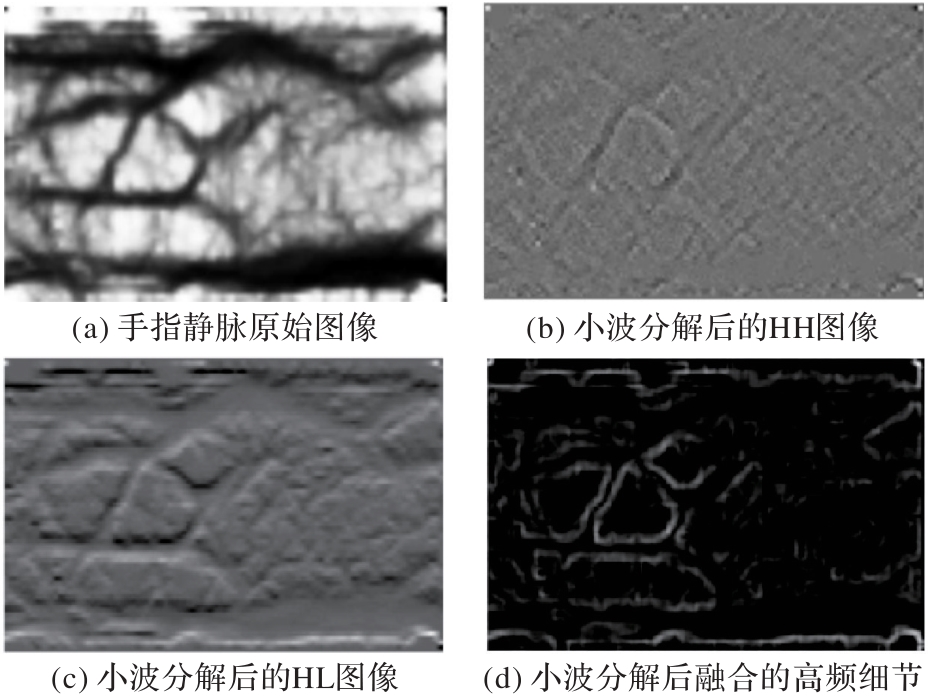
Fig. 1 Partial wavelet transform images of finger vein image
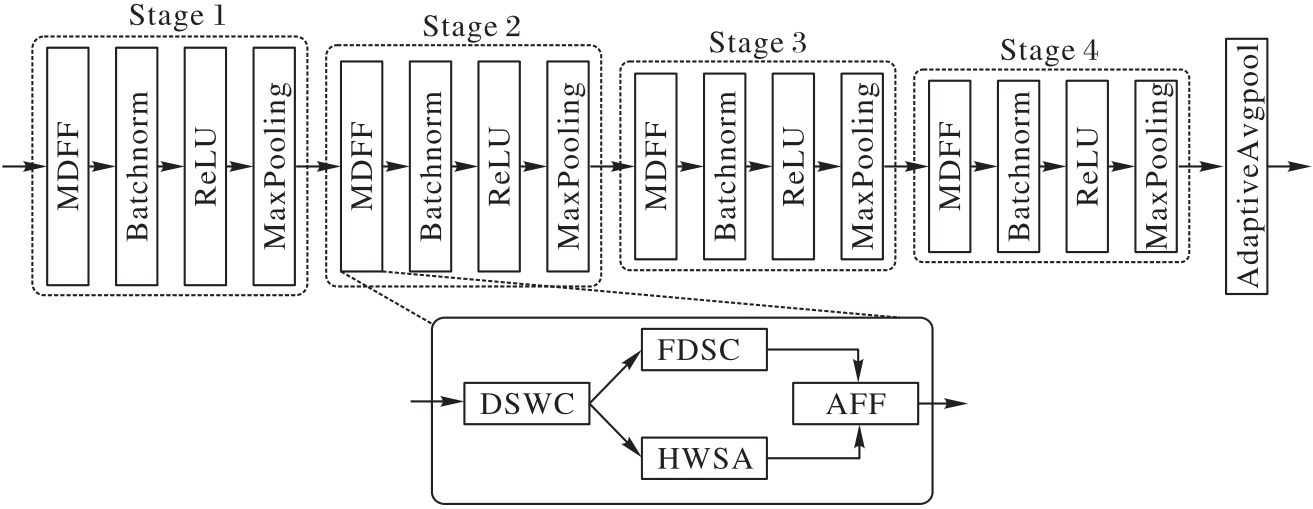
Fig. 2 Overall structure of MD-FVR
| 层次 | 输入尺寸 | 输出尺寸 | 输入的通道数 | 输出的通道数 |
|---|---|---|---|---|
| Stage 1 | 128×128 | 64×64 | 3 | 16 |
| Stage 2 | 64×64 | 32×32 | 16 | 64 |
| Stage 3 | 32×32 | 16×16 | 64 | 256 |
| Stage 4 | 16×16 | 8×8 | 256 | 1 024 |
Tab. 1 Parameter settings for different layers of MD-FVR
| 层次 | 输入尺寸 | 输出尺寸 | 输入的通道数 | 输出的通道数 |
|---|---|---|---|---|
| Stage 1 | 128×128 | 64×64 | 3 | 16 |
| Stage 2 | 64×64 | 32×32 | 16 | 64 |
| Stage 3 | 32×32 | 16×16 | 64 | 256 |
| Stage 4 | 16×16 | 8×8 | 256 | 1 024 |
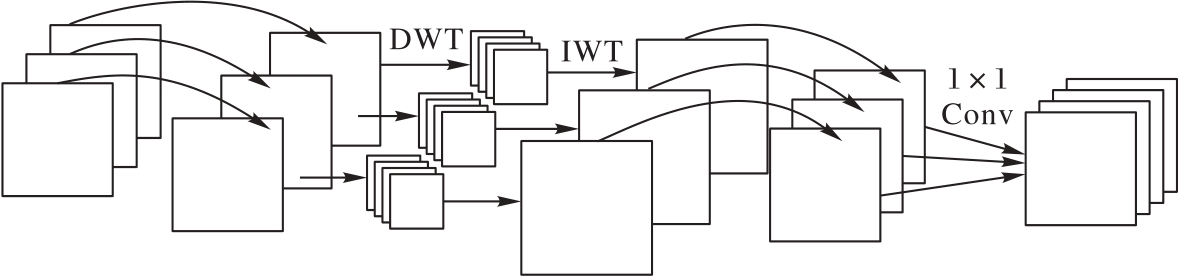
Fig. 3 Structure of DSWC

Fig. 4 Structure of HWSA
| 数据集 | ACC | EER |
|---|---|---|
| HKPU | 99.68 | 0.35 |
| SDUMLA-HMT | 99.53 | 0.41 |
Tab. 2 Performance comparison of MD-FVR on two datasets
| 数据集 | ACC | EER |
|---|---|---|
| HKPU | 99.68 | 0.35 |
| SDUMLA-HMT | 99.53 | 0.41 |
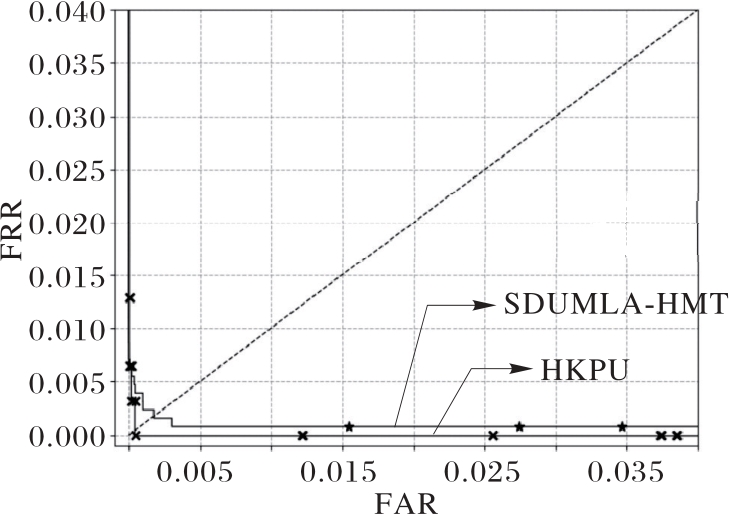
Fig. 5 ROC curves of two experimental datasets
| 消融模块 | HKPU | SDUMLA-HMT | ||
|---|---|---|---|---|
| ACC | EER | ACC | EER | |
| MD-FVR | 99.68 | 0.35 | 99.53 | 0.41 |
| DSWC | 99.13 | 0.56 | 99.21 | 0.85 |
| HWSA | 98.56 | 0.54 | 99.21 | 0.78 |
| FDSC | 99.36 | 0.75 | 99.27 | 0.95 |
| CPCA | 98.93 | 0.43 | 99.06 | 0.86 |
Tab. 3 Ablation experiment results of MDFF on two datasets unit: %
| 消融模块 | HKPU | SDUMLA-HMT | ||
|---|---|---|---|---|
| ACC | EER | ACC | EER | |
| MD-FVR | 99.68 | 0.35 | 99.53 | 0.41 |
| DSWC | 99.13 | 0.56 | 99.21 | 0.85 |
| HWSA | 98.56 | 0.54 | 99.21 | 0.78 |
| FDSC | 99.36 | 0.75 | 99.27 | 0.95 |
| CPCA | 98.93 | 0.43 | 99.06 | 0.86 |
| 训练样本数 | SDUMLA-HMT数据集 | HKPU数据集 | ||
|---|---|---|---|---|
| ACC/% | EER/% | ACC/% | EER/% | |
| 3 | 94.23 | 3.46 | 98.71 | 1.18 |
| 4 | 99.53 | 0.41 | 99.52 | 0.47 |
| 5 | 98.89 | 1.02 | 99.68 | 0.35 |
Tab. 4 Performance comparison with three training samples
| 训练样本数 | SDUMLA-HMT数据集 | HKPU数据集 | ||
|---|---|---|---|---|
| ACC/% | EER/% | ACC/% | EER/% | |
| 3 | 94.23 | 3.46 | 98.71 | 1.18 |
| 4 | 99.53 | 0.41 | 99.52 | 0.47 |
| 5 | 98.89 | 1.02 | 99.68 | 0.35 |
| 层次数 | HKPU | SDUMLA-HMT | ||
|---|---|---|---|---|
| ACC/% | EER/% | ACC/% | EER/% | |
| 3 | 99.26 | 0.82 | 99.15 | 0.87 |
| 4 | 99.68 | 0.35 | 99.53 | 0.41 |
| 5 | 99.45 | 0.59 | 99.32 | 0.61 |
Tab. 5 Performance comparison of three module cascades
| 层次数 | HKPU | SDUMLA-HMT | ||
|---|---|---|---|---|
| ACC/% | EER/% | ACC/% | EER/% | |
| 3 | 99.26 | 0.82 | 99.15 | 0.87 |
| 4 | 99.68 | 0.35 | 99.53 | 0.41 |
| 5 | 99.45 | 0.59 | 99.32 | 0.61 |
| 网络 | SDUMLA-HMT | HKPU |
|---|---|---|
| PCANet[ | 98.19 | — |
| DFCNN[ | 92.22 | 96.98 |
| ResNet+SE[ | 96.70 | 99.04 |
| ECA-Resnet[ | 99.25 | 99.07 |
| ViT-Cap[ | 93.24 | 95.61 |
| ALANet[ | 94.50 | |
| LetNet[ | 99.50 | 96.10 |
| FV-EffResNet[ | 98.45 | — |
| LightNet[ | 95.95 | 97.33 |
| FV-DDC[ | 98.74 | 99.62 |
| MD-FVR | 99.53 | 99.68 |
Tab. 6 Accuracy comparison of different experimental networks unit: %
| 网络 | SDUMLA-HMT | HKPU |
|---|---|---|
| PCANet[ | 98.19 | — |
| DFCNN[ | 92.22 | 96.98 |
| ResNet+SE[ | 96.70 | 99.04 |
| ECA-Resnet[ | 99.25 | 99.07 |
| ViT-Cap[ | 93.24 | 95.61 |
| ALANet[ | 94.50 | |
| LetNet[ | 99.50 | 96.10 |
| FV-EffResNet[ | 98.45 | — |
| LightNet[ | 95.95 | 97.33 |
| FV-DDC[ | 98.74 | 99.62 |
| MD-FVR | 99.53 | 99.68 |
| 网络 | SDUMLA-HMT | HKPU |
|---|---|---|
| DenseNet-161[ | 2.35 | 0.33 |
| FCGAN[ | 0.87 | 0.52 |
| Densenet-161[ | 0.02 | 1.87 |
| ResNet+SE[ | 2.14 | 0.28 |
| ECA-Resnet[ | 1.53 | 1.30 |
| CycleGAN+DenseNet161[ | 3.40 | 0.85 |
| Triplet-Classifier GAN[ | 1.33 | 0.40 |
| ViT-Cap[ | 1.30 | 1.66 |
| FVFSNet[ | 1.10 | 0.81 |
| LetNet[ | 0.15 | 1.21 |
| FV-EffResNet[ | 0.43 | — |
| LightNet[ | 0.43 | 0.51 |
| MD-FVR | 0.41 | 0.35 |
Tab. 7 EER comparison of different experimental networks
| 网络 | SDUMLA-HMT | HKPU |
|---|---|---|
| DenseNet-161[ | 2.35 | 0.33 |
| FCGAN[ | 0.87 | 0.52 |
| Densenet-161[ | 0.02 | 1.87 |
| ResNet+SE[ | 2.14 | 0.28 |
| ECA-Resnet[ | 1.53 | 1.30 |
| CycleGAN+DenseNet161[ | 3.40 | 0.85 |
| Triplet-Classifier GAN[ | 1.33 | 0.40 |
| ViT-Cap[ | 1.30 | 1.66 |
| FVFSNet[ | 1.10 | 0.81 |
| LetNet[ | 0.15 | 1.21 |
| FV-EffResNet[ | 0.43 | — |
| LightNet[ | 0.43 | 0.51 |
| MD-FVR | 0.41 | 0.35 |
| [1] | KOLIVAND H, ASADIANFAM S, AKINTOYE K A, et al. Finger vein recognition techniques: a comprehensive review[J]. Multimedia Tools and Applications, 2023, 82(22): 33541-33575. |
| [2] | ROSDI B A, SHING C W, SUANDI S A. Finger vein recognition using local line binary pattern[J]. Sensors, 2011, 11(12): 11357-11371. |
| [3] | MENG X, YANG G, YIN Y, et al. Finger vein recognition based on local directional code[J]. Sensors, 2012, 12(11): 14937-14952. |
| [4] | YANG J, SHI Y. Finger-vein ROI localization and vein ridge enhancement[J]. Pattern Recognition Letters, 2012, 33(12): 1569-1579. |
| [5] | XI X, YANG L, YIN Y. Learning discriminative binary codes for finger vein recognition[J]. Pattern Recognition, 2017, 66: 26-33. |
| [6] | ZHANG G, MENG X. High security finger vein recognition based on robust keypoint correspondence clustering[J]. IEEE Access, 2021, 9: 154058-154070. |
| [7] | YU C B, QIN H F, ZHANG L, et al. Finger-vein image recognition combining modified Hausdorff distance with minutiae feature matching[J]. Journal of Biomedical Science and Engineering, 2009, 2: 261-272. |
| [8] | KIM H, LEE E J, YOON G J, et al. Illumination normalization for SIFT based finger vein authentication[C]// Proceedings of the 2012 International Symposium on Visual Computing, LNCS 7432. Berlin: Springer, 2012: 21-30. |
| [9] | SONG W, KIM T, KIM H C, et al. A finger-vein verification system using mean curvature[J]. Pattern Recognition Letters, 2011, 32(11): 1541-1547. |
| [10] | CHO S R, PARK Y H, NAM G P, et al. Enhancement of finger-vein image by vein line tracking and adaptive Gabor filtering for finger-vein recognition[J]. Applied Mechanics and Materials, 2012, 145: 219-223. |
| [11] | DAMAVANDINEJADMONFARED S, MOBARAKEH A K, PASHNA M, et al. Finger vein recognition using PCA-based methods[J]. International Scholarly and Scientific Research and Innovation, 2012, 6(6): 593-595. |
| [12] | YANG G, XI X, YIN Y. Finger vein recognition based on (2D)2 PCA and metric learning[J]. BioMed Research International, 2012, 2012: No.324249. |
| [13] | WU J D, LIU C T. Finger-vein pattern identification using SVM and neural network technique[J]. Expert Systems with Applications, 2011, 38(11): 14284-14289. |
| [14] | PARK K R. Finger vein recognition by combining global and local features based on SVM[J]. Computing and Informatics, 2012, 30(2): 295-309. |
| [15] | ZHANG Z B, WU D Y, MA S L, et al. Multiscale feature extraction of finger-vein patterns based on wavelet and local interconnection structure neural network[C]// Proceedings of the 2005 International Conference on Neural Networks and Brain. Piscataway: IEEE, 2005: 1081-1084. |
| [16] | LU Y, XIE S J, YOON S, et al. Robust finger vein ROI localization based on flexible segmentation[J]. Sensors, 2013, 13(11): 14339-14366. |
| [17] | HUANG Y, MA H, WANG M. Axially-enhanced local attention network for finger vein recognition[J]. IEEE Transactions on Instrumentation and Measurement, 2023, 72: No.5020210. |
| [18] | QI Y, HE Y, QI X, et al. Dynamic snake convolution based on topological geometric constraints for tubular structure segmentation[C]// Proceedings of the 2023 IEEE/CVF International Conference on Computer Vision. Piscataway: IEEE, 2023: 6047-6056. |
| [19] | PAN Z, WANG J, WANG G, et al. Multi-scale deep representation aggregation for vein recognition[J]. IEEE Transactions on Information Forensics and Security, 2021, 16: 1-15. |
| [20] | KUZU R S, PICIUCCO E, MAIORANA E, et al. On-the-fly finger-vein-based biometric recognition using deep neural networks[J]. IEEE Transactions on Information Forensics and Security, 2020, 15: 2641-2654. |
| [21] | HUANG J, TU M, YANG W, et al. Joint attention network for finger vein authentication[J]. IEEE Transactions on Instrumentation and Measurement, 2021, 70: No.2513911. |
| [22] | YANG W, LUO W, KANG W, et al. FVRAS-Net: an embedded Finger-Vein Recognition and AntiSpoofing system using a unified CNN[J]. IEEE Transactions on Instrumentation and Measurement, 2020, 69(11): 8690-8701. |
| [23] | SHAHREZA O, MARCEL S. Towards protecting and enhancing vascular biometric recognition methods via biohashing and deep neural networks[J]. IEEE Transactions on Biometrics, Behavior, and Identity Science, 2021, 3(3): 394-404. |
| [24] | QIN H, EL-YACOUBI M A. Deep representation for finger-vein image quality assessment[J]. IEEE Transactions on Circuits and Systems for Video Technology, 2018, 28(8): 1677-1693. |
| [25] | REN H, SUN L, GUO J, et al. Finger vein recognition system with template protection based on convolutional neural network[J]. Knowledge-Based Systems, 2021, 227: No.107159. |
| [26] | HOU B, YAN R. ArcVein-arccosine center loss for finger-vein verification[J]. IEEE Transactions on Instrumentation and Measurement, 2021, 70: No.5007411. |
| [27] | YANG J, YAN M. An improved method for finger-vein image enhancement[C]// Proceedings of the IEEE 10th International Conference on Signal Processing. Piscataway: IEEE, 2010: 1706-1709. |
| [28] | HUANG J, ZHENG A, SHAKEEL M S, et al. FVFSNet: frequency-spatial coupling network for finger vein authentication[J]. IEEE Transactions on Information Forensics and Security, 2023, 18: 1322-1334. |
| [29] | KUMAR A, ZHOU Y. Human identification using finger images[J]. IEEE Transactions on Image Processing, 2012, 21(4): 2228-2244. |
| [30] | YIN Y, LIU L, SUN X. SDUMLA-HMT: a multimodal biometric database[C]// Chinese Conference on Biometric Recognition, LNCS 7098. Berlin: Springer, 2011: 260-268. |
| [31] | MENG X J, XI X M, YANG G P, et al. Finger vein recognition based on deformation information[J]. SCIENCE CHINA Information Sciences, 2018, 61(5): No.052103. |
| [32] | KAMARUDDINN M, ROSDI B A. A new filter generation method in PCANet for finger vein recognition[J]. IEEE Access, 2019, 7: 132966-132978. |
| [33] | ZHONG Y, LI J, CHAI T, et al. Different dimension issues in deep feature space for finger-vein recognition[C]// Proceedings of the 2021 Chinese Conference on Biometric Recognition, LNCS 12878. Cham: Springer, 2021: 295-303. |
| [34] | LI Y, LU H, WANG Y, et al. ViT-Cap: a novel vision transformer-based capsule network model for finger vein recognition[J]. Applied Sciences, 2022, 12(20): No.10364. |
| [35] | LI M, GONG Y, ZHENG Z. Finger vein identification based on large kernel convolution and attention mechanism[J]. Sensors, 2024, 24(4): No.1132. |
| [36] | TAHIR Y S, ROSDI B A. FV-EffResNet: an efficient lightweight convolutional neural network for finger vein recognition[J]. PeerJ Computer Science, 2024, 10: No.e1837. |
| [37] | GUO Z, MA H, LI A. A lightweight finger multimodal recognition model based on detail optimization and perceptual compensation embedding[J]. Computer Standards and Interfaces, 2025, 92: No.103937. |
| [38] | REN H, SUN L, REN J, et al. FV-DDC: a novel finger-vein recognition model with deformation detection and correction[J]. Biomedical Signal Processing and Control, 2025, 100(Pt A): No.107098. |
| [39] | SONG J M, KIM W, PARK K R. Finger-vein recognition based on deep DenseNet using composite image[J]. IEEE Access, 2019, 7: 66845-66863. |
| [40] | ZHANG J, LU Z, LI M, et al. GAN-based image augmentation for finger-vein biometric recognition[J]. IEEE Access, 2019, 7: 183118-183132. |
| [41] | KUZU R S, MAIORANA E, CAMPISI P. Loss functions for CNN-based biometric vein recognition[C]// Proceedings of the 28th European Signal Processing Conference. Piscataway: IEEE, 2021: 750-754. |
| [42] | NOH K J, CHOI J, HONG J S, et al. Finger-vein recognition using heterogeneous databases by domain adaption based on a cycle-consistent adversarial network[J]. Sensors, 2021, 21(2): No.524. |
| [43] | HOU B, YAN R. Triplet-classifier GAN for finger-vein verification[J]. IEEE Transactions on Instrumentation and Measurement, 2022, 71: No.2505112. |
| [1] | Xiaobo QI, Jing ZHANG, Ying SHI, Hui QI, Hangyuan DU. Multiple active learning method based on concept drift detection [J]. Journal of Computer Applications, 2026, 46(5): 1388-1396. |
| [2] | Rifeng ZHANG, Guangming LI, Yurong OUYANG. Low-light image enhancement network guided by reflection prior map [J]. Journal of Computer Applications, 2026, 46(2): 546-554. |
| [3] | Ning CAO, Xin WEN, Yanrong HAO, Rui CAO. Lightweight motor imagery electroencephalogram decoding neural network with multi-domain feature fusion [J]. Journal of Computer Applications, 2026, 46(1): 289-296. |
| [4] | Erkang XIANG, Rong HUANG, Aihua DONG. Open set recognition method with open generation and feature optimization [J]. Journal of Computer Applications, 2025, 45(7): 2195-2202. |
| [5] | Qiaoling QI, Xiaoxiao WANG, Qianqian ZHANG, Peng WANG, Yongfeng DONG. Label noise adaptive learning algorithm based on meta-learning [J]. Journal of Computer Applications, 2025, 45(7): 2113-2122. |
| [6] | Huibin WANG, Zhan’ao HU, Jie HU, Yuanwei XU, Bo WEN. Time series forecasting model based on segmented attention mechanism [J]. Journal of Computer Applications, 2025, 45(7): 2262-2268. |
| [7] | Lu CHEN, Huaiyao WANG, Jingyang LIU, Tao YAN, Bin CHEN. Robotic grasp detection with feature fusion of spatial-Fourier domain information under low-light environments [J]. Journal of Computer Applications, 2025, 45(5): 1686-1693. |
| [8] | Huahua WANG, Zijian FAN, Ze LIU. Image adversarial example generation method based on multi-space probability enhancement [J]. Journal of Computer Applications, 2025, 45(3): 883-890. |
| [9] | Handa MA, Yadong WU. Multi-domain spatiotemporal hierarchical graph neural network for air quality prediction [J]. Journal of Computer Applications, 2025, 45(2): 444-452. |
| [10] | Benchen YANG, Haoran LI, Haibo JIN. Multi-focus image fusion network with cascade fusion and enhanced reconstruction [J]. Journal of Computer Applications, 2025, 45(2): 594-600. |
| [11] | Sheng YANG, Yan LI. Contrastive knowledge distillation method for object detection [J]. Journal of Computer Applications, 2025, 45(2): 354-361. |
| [12] | Xintao DUAN, Mengru BAO, Yinhang WU, Chuan QIN. Active protection method for deep neural network model based on four-dimensional Chen chaotic system [J]. Journal of Computer Applications, 2025, 45(11): 3621-3631. |
| [13] | Rui SHI, Yong LI, Yanhan ZHU. Adversarial sample attack algorithm of modulation signal based on equalization of feature gradient [J]. Journal of Computer Applications, 2024, 44(8): 2521-2527. |
| [14] | Mei WANG, Xuesong SU, Jia LIU, Ruonan YIN, Shan HUANG. Time series classification method based on multi-scale cross-attention fusion in time-frequency domain [J]. Journal of Computer Applications, 2024, 44(6): 1842-1847. |
| [15] | Bin XIAO, Mo YANG, Min WANG, Guangyuan QIN, Huan LI. Domain generalization method of phase-frequency fusion from independent perspective [J]. Journal of Computer Applications, 2024, 44(4): 1002-1009. |
| Viewed | ||||||
|
Full text |
|
|||||
|
Abstract |
|
|||||
