


《计算机应用》唯一官方网站 ›› 2026, Vol. 46 ›› Issue (10): 3298-3306.DOI: 10.11772/j.issn.1001-9081.2025091085
• 计算机软件技术 • 上一篇
徐晓龙1, 王俊峰1,2( ), 吴鹏3, 曹先省4
收稿日期:2025-09-19
修回日期:2025-09-30
接受日期:2025-10-11
发布日期:2025-10-30
出版日期:2026-10-10
通讯作者:
王俊峰
作者简介:徐晓龙(2000—),男,新疆乌鲁木齐人,硕士研究生,主要研究方向:大语言模型、测试用例自动生成基金资助:
Xiaolong XU1, Junfeng WANG1,2(), Peng WU3, Xiansheng CAO4
Received:2025-09-19
Revised:2025-09-30
Accepted:2025-10-11
Online:2025-10-30
Published:2026-10-10
Contact:
Junfeng WANG
About author:XU Xiaolong, born in 2000, M. S. candidate. His research interests include large language models, automated test case generation.Supported by:摘要:
自动化单元测试生成是现代化软件开发提升开发效率、确保软件质量保障的关键,大语言模型(LLM)因具备良好的代码理解能力被应用于测试用例自动生成,但在处理复杂函数时面临深层分支路径难覆盖等问题。因此,本文提出PyULLM方法,将路径约束分片与LLM的生成能力有机结合以解决上述难题。具体地:通过前序遍历抽象语法树,系统化收集所有的路径约束;基于此,建立细粒度的代码行?路径约束映射关系;根据得到的映射关系,对路径约束集合进行智能化分片。这种分片处理机制使LLM能聚焦于特定路径约束,可以显著提升复杂场景下生成单元测试用例的覆盖率。实验结果表明,相较于SOTA(State Of The Arts)工具Pynguin,PyULLM的行覆盖率(LC)和分支覆盖率(BC)分别提升了24.16和26.61个百分点;相较于当前先进的CodaMosa方法,PyULLM的LC和BC分别提升了19.06和21.72个百分点。可见,PyULLM能为复杂函数有效生成单元测试用例。
中图分类号:
徐晓龙, 王俊峰, 吴鹏, 曹先省. 基于路径约束分片驱动大语言模型的单元测试生成方法[J]. 计算机应用, 2026, 46(10): 3298-3306.
Xiaolong XU, Junfeng WANG, Peng WU, Xiansheng CAO. Unit test generation method based on path constraint sharding driven large language model[J]. Journal of Computer Applications, 2026, 46(10): 3298-3306.
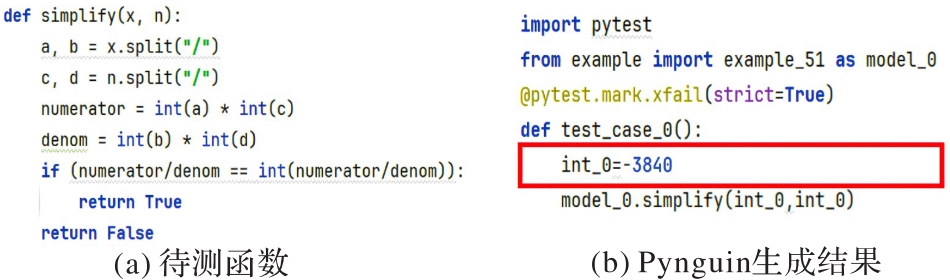
图1 Pynguin单元测试生成的示例
Fig. 1 Example of Pynguin unit test generation
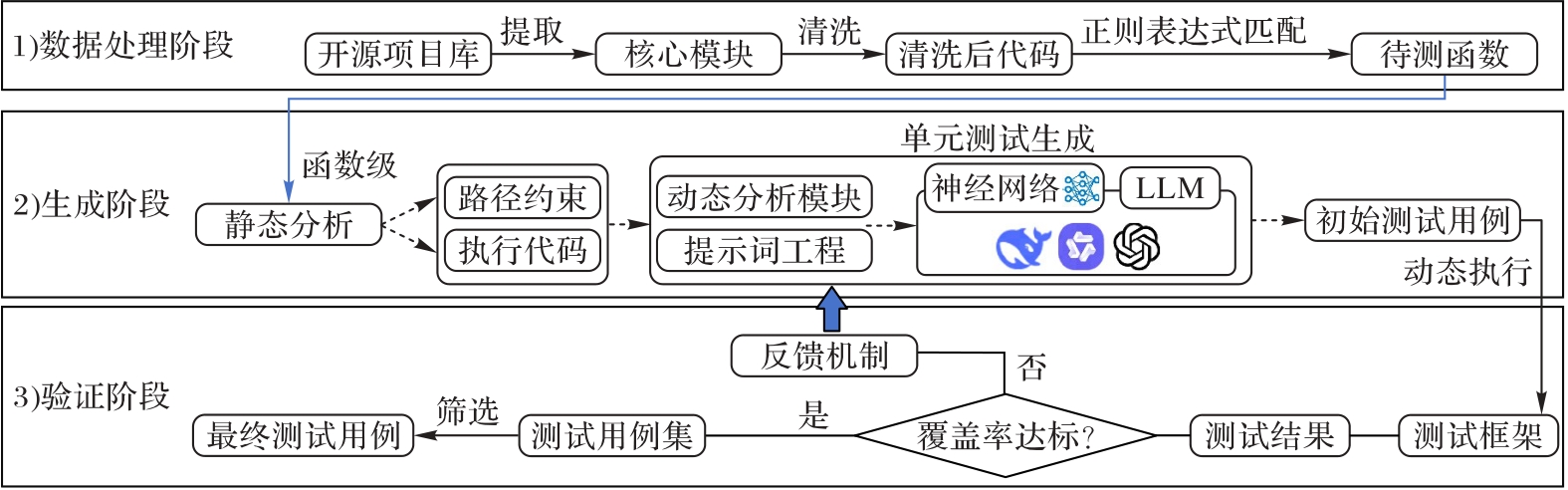
图2 PyULLM方法的整体框架
Fig. 2 Overall framework of PyULLM method
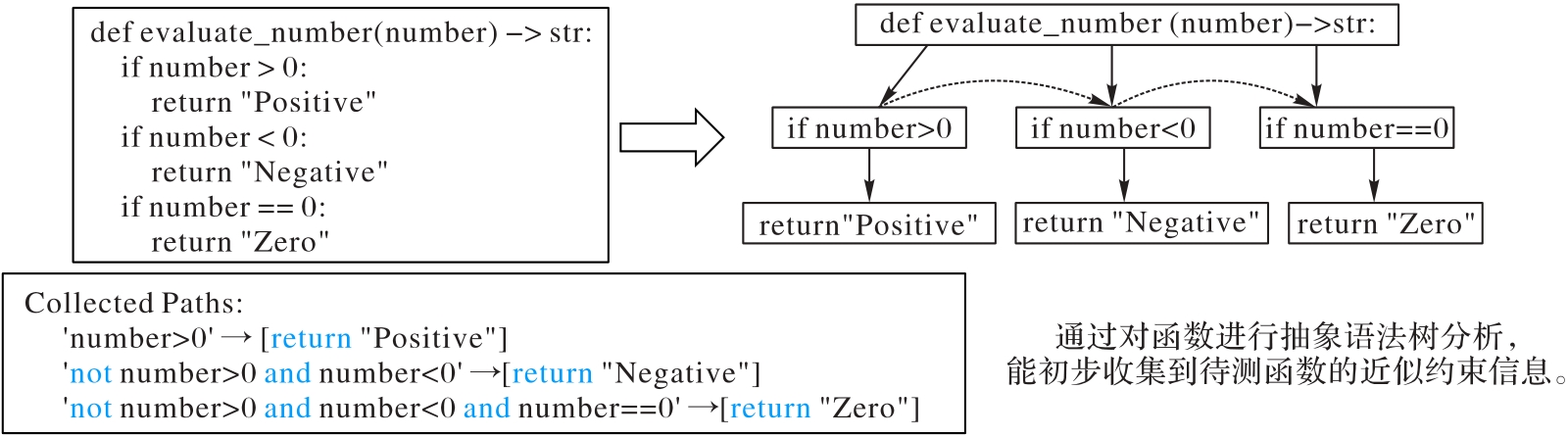
图3 路径约束收集的示例
Fig. 3 Example of path constraint collection
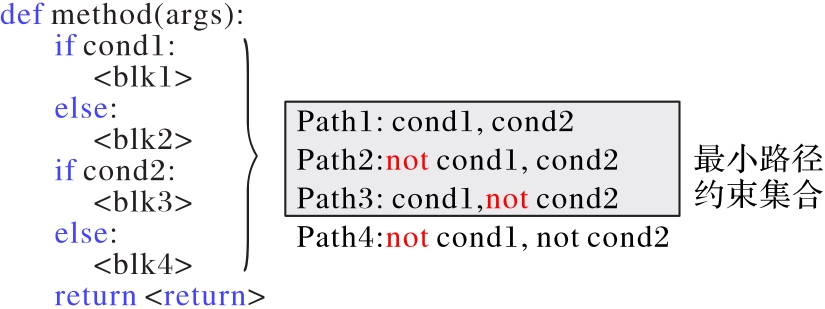
图4 路径约束的最小化
Fig. 4 Path constraint minimization
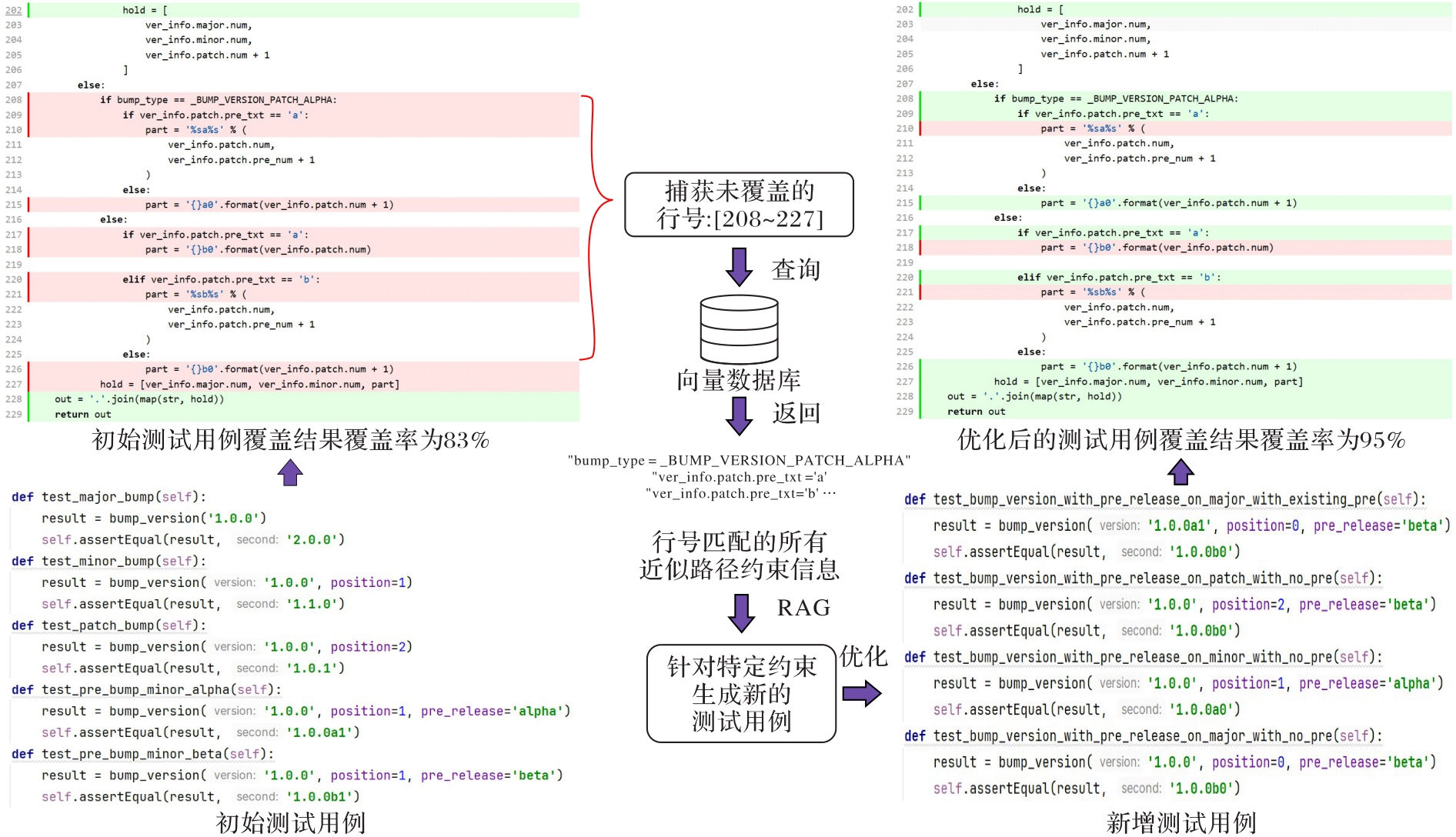
图5 基于反馈的LLM测试用例的生成验证过程
Fig. 5 Verification process of feedback-guided LLM test case generation
项目 序号 | 项目名 | 模块数 | 代码行数 | ||
|---|---|---|---|---|---|
| 最少 | 平均 | 最多 | |||
| 1 | apimd | 2 | 111 | 291 | 471 |
| 2 | codetiming | 1 | 45 | 45 | 45 |
| 3 | dataclasses-json | 4 | 55 | 194 | 286 |
| 4 | docstring_parse | 5 | 14 | 120 | 198 |
| 5 | flutes | 3 | 13 | 99 | 216 |
| 6 | flutils | 9 | 21 | 127 | 263 |
| 7 | httpie | 19 | 9 | 129 | 393 |
| 8 | isort | 2 | 109 | 110 | 111 |
| 9 | mimesis | 15 | 25 | 75 | 188 |
| 10 | py_backwards | 19 | 8 | 50 | 189 |
| 11 | pyMonet | 10 | 23 | 51 | 75 |
| 12 | pypara | 6 | 7 | 195 | 743 |
| 13 | semantic-release | 6 | 21 | 84 | 254 |
| 14 | string-utils | 3 | 55 | 157 | 230 |
| 15 | pytutils | 11 | 4 | 56 | 243 |
| 16 | sty | 2 | 19 | 56 | 94 |
| 17 | sanic | 6 | 19 | 139 | 505 |
| 18 | thonny | 3 | 24 | 217 | 521 |
| 19 | typesystem | 10 | 32 | 197 | 603 |
| 20 | blib2to3 | 6 | 52 | 271 | 555 |
| 21 | cookiecutter | 5 | 18 | 60 | 111 |
| 22 | ansible | 60 | 8 | 132 | 1 110 |
| 23 | PySnooper | 4 | 68 | 144 | 336 |
| 24 | tqdm | 6 | 16 | 75 | 202 |
| 25 | thefxxk | 4 | 6 | 36 | 156 |
| 26 | tornado | 13 | 100 | 288 | 600 |
| 27 | youtube-dl | 8 | 24 | 203 | 873 |
表1 基准数据集的统计信息
Tab. 1 Statistics of benchmark dataset
项目 序号 | 项目名 | 模块数 | 代码行数 | ||
|---|---|---|---|---|---|
| 最少 | 平均 | 最多 | |||
| 1 | apimd | 2 | 111 | 291 | 471 |
| 2 | codetiming | 1 | 45 | 45 | 45 |
| 3 | dataclasses-json | 4 | 55 | 194 | 286 |
| 4 | docstring_parse | 5 | 14 | 120 | 198 |
| 5 | flutes | 3 | 13 | 99 | 216 |
| 6 | flutils | 9 | 21 | 127 | 263 |
| 7 | httpie | 19 | 9 | 129 | 393 |
| 8 | isort | 2 | 109 | 110 | 111 |
| 9 | mimesis | 15 | 25 | 75 | 188 |
| 10 | py_backwards | 19 | 8 | 50 | 189 |
| 11 | pyMonet | 10 | 23 | 51 | 75 |
| 12 | pypara | 6 | 7 | 195 | 743 |
| 13 | semantic-release | 6 | 21 | 84 | 254 |
| 14 | string-utils | 3 | 55 | 157 | 230 |
| 15 | pytutils | 11 | 4 | 56 | 243 |
| 16 | sty | 2 | 19 | 56 | 94 |
| 17 | sanic | 6 | 19 | 139 | 505 |
| 18 | thonny | 3 | 24 | 217 | 521 |
| 19 | typesystem | 10 | 32 | 197 | 603 |
| 20 | blib2to3 | 6 | 52 | 271 | 555 |
| 21 | cookiecutter | 5 | 18 | 60 | 111 |
| 22 | ansible | 60 | 8 | 132 | 1 110 |
| 23 | PySnooper | 4 | 68 | 144 | 336 |
| 24 | tqdm | 6 | 16 | 75 | 202 |
| 25 | thefxxk | 4 | 6 | 36 | 156 |
| 26 | tornado | 13 | 100 | 288 | 600 |
| 27 | youtube-dl | 8 | 24 | 203 | 873 |
| 项目名 | 行覆盖率 | 分支覆盖率 | ||||
|---|---|---|---|---|---|---|
| PyULLM | CodaMosa | Pynguin | PyULLM | CodaMosa | Pynguin | |
| 平均 | 82.22 | 63.16 | 58.06 | 79.11 | 57.39 | 52.50 |
| apimd | 74.50 | 61.00 | 53.50 | 66.50 | 50.50 | 46.50 |
| codetiming | 74.60 | 48.60 | 36.80 | 70.80 | 41.00 | 29.60 |
| dataclasses-json | 94.00 | 82.00 | 61.67 | 92.00 | 77.00 | 54.67 |
| docstring_parse | 100.00 | 100.00 | 100.00 | 100.00 | 79.00 | 87.00 |
| flutes | 73.25 | 57.25 | 53.00 | 69.25 | 54.50 | 50.25 |
| flutils | 77.25 | 42.00 | 42.75 | 72.00 | 35.50 | 36.50 |
| httpie | 80.20 | 64.80 | 52.00 | 77.80 | 57.60 | 44.60 |
| isort | 87.22 | 71.11 | 61.56 | 84.00 | 66.78 | 57.67 |
| mimesis | 70.47 | 45.58 | 43.53 | 64.89 | 40.21 | 38.68 |
| py_backwards | 90.00 | 78.00 | 78.00 | 89.50 | 75.50 | 75.50 |
| pyMonet | 93.33 | 71.20 | 64.73 | 91.60 | 67.07 | 61.00 |
| pypara | 75.33 | 57.28 | 58.33 | 73.50 | 51.78 | 52.72 |
| semantic-release | 98.60 | 75.70 | 72.40 | 98.20 | 67.90 | 64.90 |
| string-utils | 79.80 | 66.60 | 67.20 | 76.20 | 60.60 | 60.40 |
| pytutils | 67.75 | 48.00 | 34.50 | 65.00 | 42.00 | 29.50 |
| sty | 88.91 | 51.82 | 50.91 | 86.18 | 45.55 | 45.00 |
| sanic | 74.50 | 55.50 | 51.50 | 71.00 | 51.00 | 46.67 |
| thonny | 98.67 | 69.67 | 73.00 | 98.67 | 68.67 | 72.00 |
| typesystem | 95.67 | 73.33 | 85.00 | 93.67 | 69.67 | 80.00 |
| blib2to3 | 97.00 | 88.50 | 73.50 | 95.50 | 85.50 | 67.00 |
| cookiecutter | 86.75 | 72.00 | 70.75 | 82.75 | 65.75 | 66.00 |
| ansible | 56.00 | 22.50 | 29.50 | 49.50 | 18.50 | 25.00 |
| PySnooper | 79.33 | 62.58 | 52.50 | 74.92 | 57.08 | 46.83 |
| tqdm | 78.83 | 65.83 | 46.17 | 75.83 | 60.00 | 39.50 |
| thefxxk | 86.11 | 68.89 | 56.44 | 83.22 | 64.56 | 51.33 |
| tornado | 68.88 | 47.00 | 45.13 | 64.50 | 42.63 | 40.88 |
| youtube-dl | 73.06 | 58.65 | 53.16 | 68.90 | 53.65 | 47.73 |
表2 复杂方法的行覆盖率和分支覆盖率对比 (%)
Tab. 2 Comparison of line coverage ratio and branch coverage ratio of complex methods
| 项目名 | 行覆盖率 | 分支覆盖率 | ||||
|---|---|---|---|---|---|---|
| PyULLM | CodaMosa | Pynguin | PyULLM | CodaMosa | Pynguin | |
| 平均 | 82.22 | 63.16 | 58.06 | 79.11 | 57.39 | 52.50 |
| apimd | 74.50 | 61.00 | 53.50 | 66.50 | 50.50 | 46.50 |
| codetiming | 74.60 | 48.60 | 36.80 | 70.80 | 41.00 | 29.60 |
| dataclasses-json | 94.00 | 82.00 | 61.67 | 92.00 | 77.00 | 54.67 |
| docstring_parse | 100.00 | 100.00 | 100.00 | 100.00 | 79.00 | 87.00 |
| flutes | 73.25 | 57.25 | 53.00 | 69.25 | 54.50 | 50.25 |
| flutils | 77.25 | 42.00 | 42.75 | 72.00 | 35.50 | 36.50 |
| httpie | 80.20 | 64.80 | 52.00 | 77.80 | 57.60 | 44.60 |
| isort | 87.22 | 71.11 | 61.56 | 84.00 | 66.78 | 57.67 |
| mimesis | 70.47 | 45.58 | 43.53 | 64.89 | 40.21 | 38.68 |
| py_backwards | 90.00 | 78.00 | 78.00 | 89.50 | 75.50 | 75.50 |
| pyMonet | 93.33 | 71.20 | 64.73 | 91.60 | 67.07 | 61.00 |
| pypara | 75.33 | 57.28 | 58.33 | 73.50 | 51.78 | 52.72 |
| semantic-release | 98.60 | 75.70 | 72.40 | 98.20 | 67.90 | 64.90 |
| string-utils | 79.80 | 66.60 | 67.20 | 76.20 | 60.60 | 60.40 |
| pytutils | 67.75 | 48.00 | 34.50 | 65.00 | 42.00 | 29.50 |
| sty | 88.91 | 51.82 | 50.91 | 86.18 | 45.55 | 45.00 |
| sanic | 74.50 | 55.50 | 51.50 | 71.00 | 51.00 | 46.67 |
| thonny | 98.67 | 69.67 | 73.00 | 98.67 | 68.67 | 72.00 |
| typesystem | 95.67 | 73.33 | 85.00 | 93.67 | 69.67 | 80.00 |
| blib2to3 | 97.00 | 88.50 | 73.50 | 95.50 | 85.50 | 67.00 |
| cookiecutter | 86.75 | 72.00 | 70.75 | 82.75 | 65.75 | 66.00 |
| ansible | 56.00 | 22.50 | 29.50 | 49.50 | 18.50 | 25.00 |
| PySnooper | 79.33 | 62.58 | 52.50 | 74.92 | 57.08 | 46.83 |
| tqdm | 78.83 | 65.83 | 46.17 | 75.83 | 60.00 | 39.50 |
| thefxxk | 86.11 | 68.89 | 56.44 | 83.22 | 64.56 | 51.33 |
| tornado | 68.88 | 47.00 | 45.13 | 64.50 | 42.63 | 40.88 |
| youtube-dl | 73.06 | 58.65 | 53.16 | 68.90 | 53.65 | 47.73 |
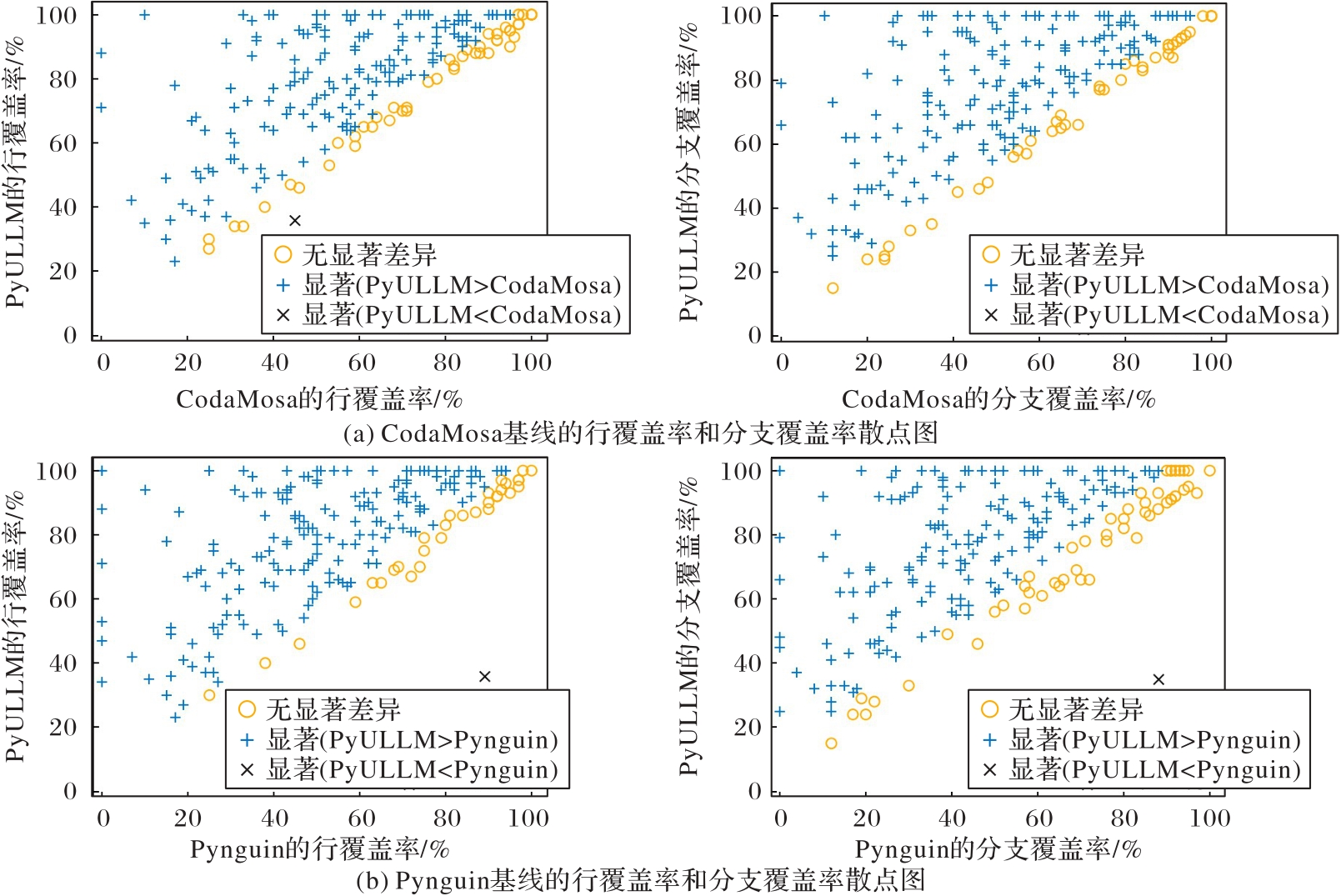
图6 PyULLM平均覆盖率的散点图
Fig. 6 Scatter plots of average coverage for PyULLM
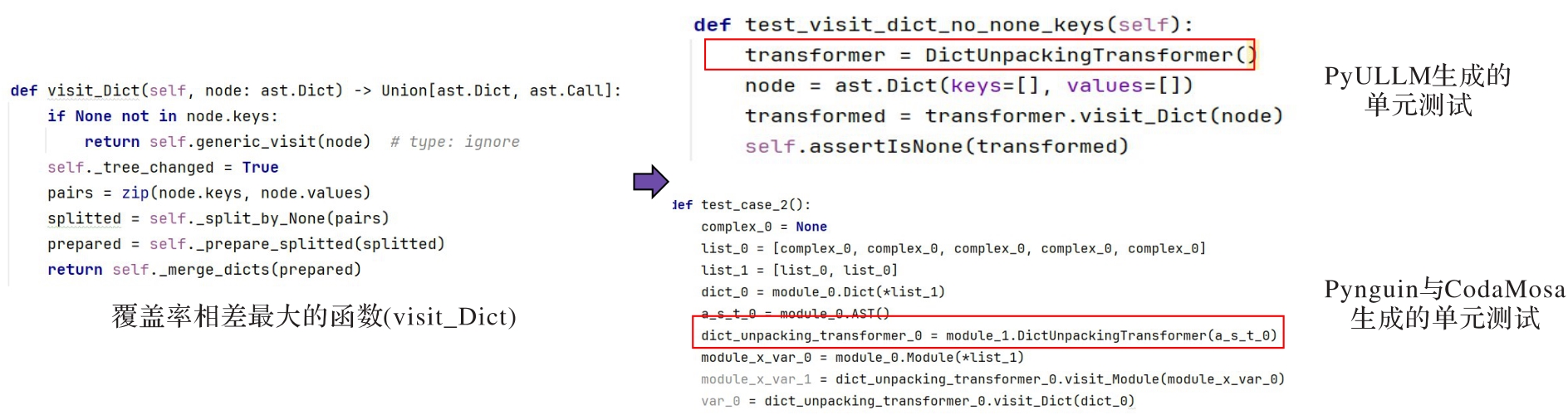
图7 案例分析
Fig. 7 Case study
| 项目名 | star数/103 | 项目名 | star数/103 |
|---|---|---|---|
| apis | 320 | localstack | 56 |
| system_design | 279 | scrapy | 53 |
| AutoGpt | 169 | requests | 52 |
| transformers | 136 | hackingtool | 51 |
| yt_dlp | 93 | odoo | 39 |
| django | 81 | sentry | 39 |
| whisper | 72 | black | 39 |
| flask | 68 | mitmproxy | 37 |
| sherlock | 61 | streamlit | 36 |
| comfyui | 60 | gradio | 34 |
| open-interpreter | 57 |
表3 开放场景数据集
Tab. 3 Open scenario dataset
| 项目名 | star数/103 | 项目名 | star数/103 |
|---|---|---|---|
| apis | 320 | localstack | 56 |
| system_design | 279 | scrapy | 53 |
| AutoGpt | 169 | requests | 52 |
| transformers | 136 | hackingtool | 51 |
| yt_dlp | 93 | odoo | 39 |
| django | 81 | sentry | 39 |
| whisper | 72 | black | 39 |
| flask | 68 | mitmproxy | 37 |
| sherlock | 61 | streamlit | 36 |
| comfyui | 60 | gradio | 34 |
| open-interpreter | 57 |
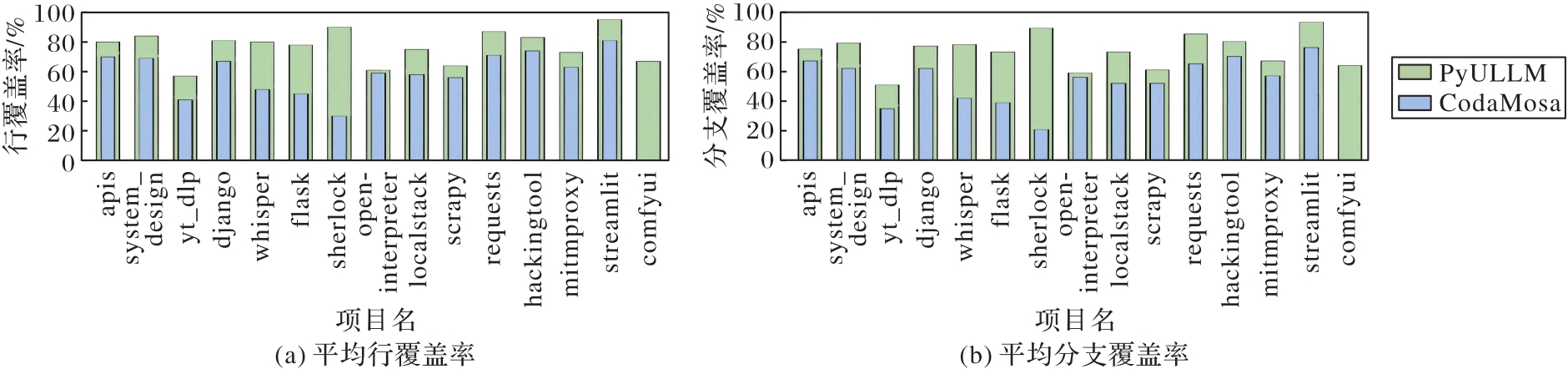
图8 开放场景下的平均覆盖率
Fig. 8 Average coverage in open scenario
| 项目名 | 行覆盖率 | 分支覆盖率 | ||
|---|---|---|---|---|
| PyULLM | Direct | PyULLM | Direct | |
| 平均 | 82.22 | 61.21 | 79.11 | 56.05 |
| apimd | 74.50 | 54.00 | 66.50 | 47.50 |
| codetiming | 74.60 | 34.00 | 70.80 | 28.60 |
| dataclasses-json | 94.00 | 46.00 | 92.00 | 36.33 |
| docstring_parse | 100.00 | 100.00 | 100.00 | 90.00 |
| flutes | 73.25 | 56.75 | 69.25 | 53.75 |
| flutils | 77.25 | 38.75 | 72.00 | 37.75 |
| httpie | 80.20 | 63.40 | 77.80 | 57.00 |
| isort | 87.22 | 52.89 | 84.00 | 49.11 |
| mimesis | 70.47 | 52.84 | 64.89 | 46.32 |
| py_backwards | 90.00 | 84.00 | 89.50 | 81.50 |
| pyMonet | 93.33 | 77.80 | 91.60 | 74.27 |
| pypara | 75.33 | 62.78 | 73.50 | 59.22 |
| semantic-release | 98.60 | 72.30 | 98.20 | 64.60 |
| string-utils | 79.80 | 64.80 | 76.20 | 57.40 |
| pytutils | 67.75 | 52.25 | 65.00 | 46.00 |
| sty | 88.91 | 66.64 | 86.18 | 61.82 |
| sanic | 74.50 | 51.33 | 71.00 | 46.50 |
| thonny | 98.67 | 73.00 | 98.67 | 72.00 |
| typesystem | 95.67 | 90.67 | 93.67 | 87.67 |
| blib2to3 | 97.00 | 79.50 | 95.50 | 73.50 |
| cookiecutter | 86.75 | 68.25 | 82.75 | 62.50 |
| ansible | 56.00 | 29.00 | 49.50 | 24.00 |
| PySnooper | 79.33 | 52.33 | 74.92 | 46.50 |
| tqdm | 78.83 | 59.50 | 75.83 | 53.50 |
| thefxxk | 86.11 | 66.89 | 83.22 | 62.00 |
| tornado | 68.88 | 50.38 | 64.50 | 46.63 |
| youtube-dl | 73.06 | 52.73 | 68.90 | 47.51 |
表4 消融实验结果 (%)
Tab. 4 Ablation experimental results
| 项目名 | 行覆盖率 | 分支覆盖率 | ||
|---|---|---|---|---|
| PyULLM | Direct | PyULLM | Direct | |
| 平均 | 82.22 | 61.21 | 79.11 | 56.05 |
| apimd | 74.50 | 54.00 | 66.50 | 47.50 |
| codetiming | 74.60 | 34.00 | 70.80 | 28.60 |
| dataclasses-json | 94.00 | 46.00 | 92.00 | 36.33 |
| docstring_parse | 100.00 | 100.00 | 100.00 | 90.00 |
| flutes | 73.25 | 56.75 | 69.25 | 53.75 |
| flutils | 77.25 | 38.75 | 72.00 | 37.75 |
| httpie | 80.20 | 63.40 | 77.80 | 57.00 |
| isort | 87.22 | 52.89 | 84.00 | 49.11 |
| mimesis | 70.47 | 52.84 | 64.89 | 46.32 |
| py_backwards | 90.00 | 84.00 | 89.50 | 81.50 |
| pyMonet | 93.33 | 77.80 | 91.60 | 74.27 |
| pypara | 75.33 | 62.78 | 73.50 | 59.22 |
| semantic-release | 98.60 | 72.30 | 98.20 | 64.60 |
| string-utils | 79.80 | 64.80 | 76.20 | 57.40 |
| pytutils | 67.75 | 52.25 | 65.00 | 46.00 |
| sty | 88.91 | 66.64 | 86.18 | 61.82 |
| sanic | 74.50 | 51.33 | 71.00 | 46.50 |
| thonny | 98.67 | 73.00 | 98.67 | 72.00 |
| typesystem | 95.67 | 90.67 | 93.67 | 87.67 |
| blib2to3 | 97.00 | 79.50 | 95.50 | 73.50 |
| cookiecutter | 86.75 | 68.25 | 82.75 | 62.50 |
| ansible | 56.00 | 29.00 | 49.50 | 24.00 |
| PySnooper | 79.33 | 52.33 | 74.92 | 46.50 |
| tqdm | 78.83 | 59.50 | 75.83 | 53.50 |
| thefxxk | 86.11 | 66.89 | 83.22 | 62.00 |
| tornado | 68.88 | 50.38 | 64.50 | 46.63 |
| youtube-dl | 73.06 | 52.73 | 68.90 | 47.51 |
| [1] | Health RTI, Social, and Research Economics. The economic impacts of inadequate infrastructure for software testing[R/OL]. (2002-05) [2025-07-03].. |
| [2] | 陆俊豪. 基于符号执行的单元测试用例自动生成的覆盖率优化研究[D]. 深圳:深圳大学, 2023. |
| Lu Junhao. Research on coverage optimization of automatic generation of unit test cases based on symbolic execution[D]. Shenzhen: Shenzhen University, 2023. | |
| [3] | 傅瑞华,李凡,王俊峰. 基于损失函数的单元测试用例自动化生成算法研究与实现[J]. 四川大学学报(自然科学版), 2022, 59(3): 51-58. |
| Fu Ruihua, Li Fan, Wang Junfeng. Research and implementation of an algorithm for automatic generation for unit test cases based on loss function[J]. Journal of Sichuan University (Natural Science Edition), 2022, 59(3): 51-58. | |
| [4] | Lukaszuk S, Fraser G. Pynguin: automated unit test generation for Python[C]// ICSE-Companion 2022. New York: ACM, 2022: 168-172. |
| [5] | Pacheco C, Ernst M D. Randoop: feedback-directed random testing for Java[C]// OOPSLA 2007. New York: ACM, 2007: 815-816. |
| [6] | Fraser G, Arcuri A. EvoSuite: automatic test suite generation for object-oriented software[C]// ESEC/FSE 2011. New York: ACM, 2011: 416-419. |
| [7] | Lemieux C, Inala J P, Lahiri S K, et al. CodaMosa: escaping coverage plateaus in test generation with pre-trained large language models[C]// ICSE 2023. Piscataway: IEEE, 2023: 919-931. |
| [8] | Chen Y, Hu Z, Zhi C, et al. ChatUniTest: a framework for LLM-based test generation[C]// FSE 2024. New York: ACM, 2024: 572-576. |
| [9] | 香佳宏,徐霄阳,孔繁初,等. 大模型在软件缺陷检测与修复的应用发展综述[J]. 软件学报, 2025, 36(4): 1489-1529. |
| Xiang Jiahong, Xu Xiaoyang, Kong Fanchu, et al. Survey on application and development of large language models in software defect detection and repair[J]. Journal of Software, 2025, 36(4): 1489-1529. | |
| [10] | Cadar C, Dunbar D, Engler D R. KLEE: unassisted and automatic generation of high-coverage tests for complex systems programs[C]// OSDI 2008. Berkeley: USENIX Association, 2008, 8: 209-224. |
| [11] | Chipounov V, Kuznetsov V, Candea G. The S2E platform: design, implementation, and applications[J]. ACM Transactions on Computer Systems, 2012, 30(1): No.2. |
| [12] | Rawat S, Jain V, Kumar A, et al. VUzzer: application-aware evolutionary fuzzing[EB/OL]. (2017) [2025-07-03].. |
| [13] | Hu X, Liu Z, Xia X, et al. Identify and update test cases when production code changes: a Transformer-based approach[C]// ASE 2023. Piscataway: IEEE, 2023: 1111-1122. |
| [14] | Rao N, Jain K, Alon U, et al. CAT-LM training language models on aligned code and tests[C]// ASE 2023. Piscataway: IEEE, 2023: 409-420. |
| [15] | Alagarsamy S, Tantithamthavorn C, Aleti A. A3Test: assertion-augmented automated test case generation[J]. Information and Software Technology, 2024, 176: No.107565. |
| [16] | Yang Y, Xia X, Lo D, et al. A survey on deep learning for software engineering[J]. ACM Computing Surveys, 2022, 54(10s): No.206. |
| [17] | Chen M, Tworek J, Jun H, et al. Evaluating large language models trained on code[PP/OL]. V2. arXiv (2021-07-14) [2025-07-10].. |
| [18] | Wang J, Huang Y, Chen C, et al. Software testing with large language models: survey, landscape, and vision[J]. IEEE Transactions on Software Engineering, 2024, 50(4): 911-936. |
| [19] | Yuan Z, Liu M, Ding S, et al. Evaluating and improving ChatGPT for unit test generation[J]. Proceedings of the ACM on Software Engineering, 2024, 1(FSE): No.76. |
| [20] | Baars A, Harman M, Hassoun Y, et al. Symbolic search-based testing[C]// ASE 2011. Piscataway: IEEE, 2011: 53-62. |
| [21] | Tillmann N, de Halleux J. Pex-white box test generation for. NET[C]// TAP 2008, LNCS 4966. Berlin: Springer, 2008: 134-153. |
| [22] | Poeplau S, Francillon A. Symbolic execution with SymCC: don't interpret, compile![C]// USENIX Security 2020. Berkeley: USENIX Association, 2020: 181-198. |
| [23] | Fioraldi A, Mantovani A, Maier D, et al. Dissecting American Fuzzy Lop: a FuzzBench evaluation[J]. ACM Transactions on Software Engineering and Methodology, 2023, 32(2): No.52. |
| [24] | Tufano M, Drain D, Svyatkovskiy A, et al. Unit test case generation with Transformers and focal context[PP/OL]. V2. arXiv (2021-05-20) [2025-05-19].. |
| [25] | Wang Z, Liu K, Li G, et al. HITS: high-coverage LLM-based unit test generation via method slicing[C]// ASE 2024. New York: ACM, 2024: 1258-1268. |
| [26] | Wei J, Wang X, Schuurmans D, et al. Chain-of-thought prompting elicits reasoning in large language models[C]// NeurIPS 2022. Red Hook: Curran Associates Inc., 2022: 24824-24837. |
| [27] | Zhang Z, Zhang A, Li M, et al. Automatic chain of thought prompting in large language models[PP/OL]. arXiv (2022-10-07) [2025-06-04].. |
| [28] | Panichella A, Kifetew F M, Tonella P. Automated test case generation as a many-objective optimisation problem with dynamic selection of the targets[J]. IEEE Transactions on Software Engineering, 2018, 44(2): 122-158. |
| [29] | Ryan G, Jain S, Shang M, et al. Code-aware prompting: a study of coverage-guided test generation in regression setting using LLM[J]. Proceedings of the ACM on Software Engineering, 2024, 1(FSE): No.43. |
| [30] | Jain S M. Introduction to Transformers for NLP with the Hugging Face library and models to solve problems[M]. Berkeley: Apress, 2022. |
| [31] | Zhu Q, Guo D, Shao Z, et al. DeepSeek-Coder-V2: breaking the barrier of closed-source models in code intelligence[PP/OL]. arXiv (2024-06-17) [2025-07-03].. |
| [32] | Imambi S, Prakash K B, Kanagachidambaresan G R. PyTorch[M]// Prakash K B, Kanagachidambaresan G R. Programming with TensorFlow: solution for edge computing applications, EAISICC. Cham: Springer, 2021: 87-104. |
| [33] | De Leon F, Gómez P, Martinez-Velasco J A, et al. Transformers[M]// Martinez-Velasco J A. Power system transients. Boca Raton, FL: CRC Press, 2010: 177-250. |
| [34] | Kwon W, Li Z, Zhuang S, et al. Efficient memory management for large language model serving with PagedAttention[C]// SOSP 2023. New York: ACM, 2023: 611-626. |
| [35] | Xia C S, Paltenghi M, Le Tian J, et al. Fuzz4All: universal fuzzing with large language models[C]// ICSE 2024. New York: ACM, 2024: No.126. |
| [36] | Yang C, Deng Y, Lu R, et al. WhiteFox: white-box compiler fuzzing empowered by large language models[J]. Proceedings of the ACM on Programming Languages, 2024, 8(OOPSLA2): No.296. |
| [37] | Widyasari R, Sim S Q, Lok C, et al. BugsinPy: a database of existing bugs in Python programs to enable controlled testing and debugging studies[C]// ESEC/FSE 2020. New York: ACM, 2020: 1556-1560. |
| [38] | Arcuri A. Many Independent Objective (MIO) algorithm for test suite generation[C]// SSBSE 2017, LNCS 10452. Cham: Springer, 2017: 3-17. |
| [39] | Arcuri A. Test suite generation with the Many Independent Objective (MIO) algorithm[J]. Information and Software Technology, 2018, 104: 195-206. |
| [40] | Yang L, Yang C, Gao S, et al. On the evaluation of large language models in unit test generation[C]// ASE 2024. New York: ACM, 2024: 1607-1619. |
| [41] | Li J, Li G, Li Y, et al. Structured chain-of-thought prompting for code generation[J]. ACM Transactions on Software Engineering and Methodology, 2025, 34(2): No.37. |
| [42] | Chia Y K, Chen G, Tuan L A, et al. Contrastive chain-of-thought prompting[PP/OL]. arXiv (2023-11-15) [2025-05-19].. |
| [43] | Madaan A, Tandon N, Gupta P, et al. Self-Refine: iterative refinement with self-feedback[C]// NeurIPS 2023. Red Hook: Curran Associates Inc., 2023: 46534-46594. |
| [44] | Shang Y, Chen Y, Cruz F. Improving proximal policy optimization algorithm in interactive multi-agent systems[C]// ICDL 2024. Piscataway: IEEE, 2024: 1-6. |
| [45] | Rafailov R, Sharma A, Mitchell E, et al. Direct preference optimization: your language model is secretly a reward model[C]// NeurIPS 2023. Red Hook: Curran Associates Inc., 2023: 53728-53741. |
| [1] | 余梦姣, 金敏, 刘新华. 人-多智能体协同驱动的敏捷增强开发框架[J]. 《计算机应用》唯一官方网站, 2026, 46(9): 2938-2947. |
| [2] | 边赟, 王海全, 陈义, 崔喆. 具备可解释性的软件缺陷预测数据集构建方法[J]. 《计算机应用》唯一官方网站, 2026, 46(9): 2948-2958. |
| [3] | 龚镇辉, 史晓雨, 鲁云, 刘阳成, 尚明生. 面向敏感属性缺失的大语言模型公平推荐框架[J]. 《计算机应用》唯一官方网站, 2026, 46(9): 2838-2846. |
| [4] | 霍耀冉, 李会芝, 曾大和, 唐震宇, 刘辰梅, 吴岩, 张啸, 陈思芹, 杨厚晖. 基于LLM的动态规则生成与神经符号推理合同审查框架[J]. 《计算机应用》唯一官方网站, 2026, 46(9): 2820-2826. |
| [5] | 何丽, 李志强, 宋雨浩, 王晓. 基于关键帧和摘要的视频问答方法[J]. 《计算机应用》唯一官方网站, 2026, 46(9): 2793-2799. |
| [6] | 刘新亮, 徐雨时, 李杜白, 任延昭. 基于知识图谱的问答方法综述[J]. 《计算机应用》唯一官方网站, 2026, 46(8): 2394-2410. |
| [7] | 张悦, 郭羽含. 大语言模型驱动的语义量化网约车时空需求预测方法[J]. 《计算机应用》唯一官方网站, 2026, 46(8): 2467-2476. |
| [8] | 王梦婷, 高拴梁, 廖文睿, 李赓, 张嘉兴, 祝远芳, 赵天歌, 刘勇慧, 梁红茹. 面向航空领域的消息一致性解析框架[J]. 《计算机应用》唯一官方网站, 2026, 46(8): 2681-2690. |
| [9] | 朱林凯, 杨璐, 张弘杰, 吴子衿, 刘璐. LLM与SWRL驱动的跨境数据合规异构跨链智能合约生成框架[J]. 《计算机应用》唯一官方网站, 2026, 46(7): 2074-2084. |
| [10] | 程雅典, 李颖颖, 张平, 邱芳冰, 柴晓楠, 舒玉巧. 基于双角色交互机制的心理健康大语言模型[J]. 《计算机应用》唯一官方网站, 2026, 46(7): 2054-2063. |
| [11] | 侯迪迪, 洪少东, 付玉杰, 崔允贺, 申国伟. 基于大语言模型链接的网络安全实体识别方法[J]. 《计算机应用》唯一官方网站, 2026, 46(7): 2064-2073. |
| [12] | 王昱麒, 张仰森, 王璞. 融合知识增强和对比学习的高中英语阅读理解模型[J]. 《计算机应用》唯一官方网站, 2026, 46(7): 2096-2103. |
| [13] | 李佳航, 韩启龙, 李丽洁, 张慧. 基于大语言模型的超关系知识图谱限定符增强方法[J]. 《计算机应用》唯一官方网站, 2026, 46(7): 2043-2053. |
| [14] | 王劲滔, 高志霖, 孟琪翔, 卜凡亮. 基于大语言模型重构案件信息的类案检索方法[J]. 《计算机应用》唯一官方网站, 2026, 46(6): 1785-1792. |
| [15] | 熊龙雨, 杜圣东, 史浩琛, 胡节, 杨燕, 李天瑞. 基于知识增强大语言模型架构的政务热线问答系统[J]. 《计算机应用》唯一官方网站, 2026, 46(6): 1721-1727. |
| 阅读次数 | ||||||
|
全文 |
|
|||||
|
摘要 |
|
|||||
