


《计算机应用》唯一官方网站 ›› 2026, Vol. 46 ›› Issue (10): 3354-3364.DOI: 10.11772/j.issn.1001-9081.2025091135
• 前沿与综合应用 • 上一篇
吕海燕( ), 周立军, 张杰, 赵媛, 王丽娜
收稿日期:2025-09-26
修回日期:2025-11-20
接受日期:2025-11-21
发布日期:2025-12-04
出版日期:2026-10-10
通讯作者:
吕海燕
作者简介:周立军(1982—),男,湖南岳阳人,教授,硕士,CCF会员,主要研究方向:计算智能、航空气象数据同化基金资助:
Haiyan LYU(), Lijun ZHOU, Jie ZHANG, Yuan ZHAO, Lina WANG
Received:2025-09-26
Revised:2025-11-20
Accepted:2025-11-21
Online:2025-12-04
Published:2026-10-10
Contact:
Haiyan LYU
About author:ZHOU Lijun, born in 1982, M. S., professor. His research interests include computational intelligence, aviation meteorological data assimilation.Supported by:摘要:
数据同化(DA)是现代数值天气预报(NWP)系统的核心,但传统方法面临非线性、非高斯假设与计算成本高昂的瓶颈。深度学习(DL)具备强大的非线性拟合与端到端优化能力,为解决上述挑战提供了革命性范式。从计算机科学视角,本文系统梳理DL在气象DA领域的组件替代、范式革新、系统重构三级演进脉络。首先,阐述DL作为代理模型替代观测算子、订正模型误差等传统瓶颈环节的组件替代阶段;其次,剖析以变分自编码器(VAE)和扩散模型为代表的生成式模型,将同化问题重构为概率性生成任务,实现范式革新;进而论述以FengWu、FuXi等人工智能(AI)气象大模型为代表的系统重构阶段,将同化模块深度内嵌,构建同化?预报一体化闭环系统;最后,从物理一致性、数据依赖性、业务部署可行性等方面探讨该领域面临的核心挑战,并展望神经符号融合、开放基准构建等未来研究方向。
中图分类号:
吕海燕, 周立军, 张杰, 赵媛, 王丽娜. 深度学习在气象数据同化中的应用演进与展望[J]. 计算机应用, 2026, 46(10): 3354-3364.
Haiyan LYU, Lijun ZHOU, Jie ZHANG, Yuan ZHAO, Lina WANG. Evolution and prospect of deep learning in meteorological data assimilation[J]. Journal of Computer Applications, 2026, 46(10): 3354-3364.
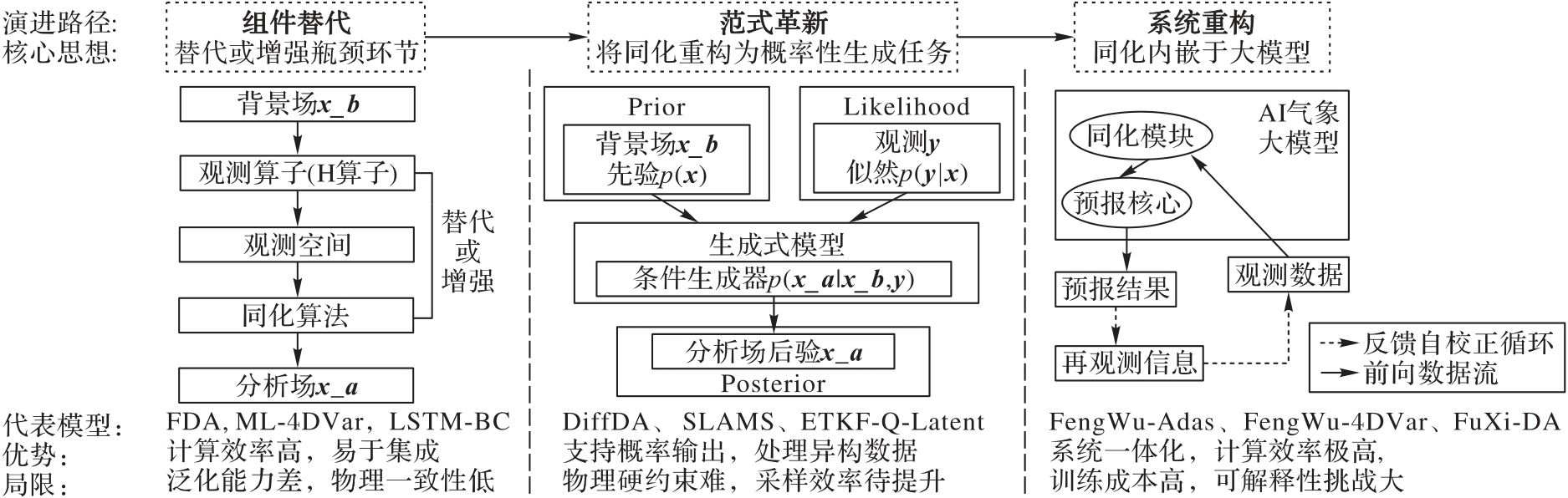
图1 深度学习在气象数据同化中的应用研究演进路径
Fig. 1 Evolutionary path of research on application of deep learning in meteorological data assimilation
| 处理方法 | 应用场景 | 误差评价指标 | 偏差校正后性能 | 无偏差校正性能 | 计算时间/s |
|---|---|---|---|---|---|
| LSTM+分区IDW | 青藏高原积雪 | NSE | 0.79 | 0.19 | 2.8 |
| LSTM | 沙尘暴PM10校正 | RMSE | 58.6 μg/m³ | 89.4 μg/m³ | 3.2 |
| 变分偏差校正 | 传统气象同化 | RMSE相对降低值 | 19.7% | — | 900~1 500 |
表1 时序处理方法的性能对比
Tab. 1 Performance comparison of time-series processing methods
| 处理方法 | 应用场景 | 误差评价指标 | 偏差校正后性能 | 无偏差校正性能 | 计算时间/s |
|---|---|---|---|---|---|
| LSTM+分区IDW | 青藏高原积雪 | NSE | 0.79 | 0.19 | 2.8 |
| LSTM | 沙尘暴PM10校正 | RMSE | 58.6 μg/m³ | 89.4 μg/m³ | 3.2 |
| 变分偏差校正 | 传统气象同化 | RMSE相对降低值 | 19.7% | — | 900~1 500 |
| 方法类别 | 代表性工作 | 核心思想 | 主要优势 | 关键挑战 | 物理一致性 |
|---|---|---|---|---|---|
| 观测算子代理 | 文献[ | 用NN学习H算子的 输入‒输出映射 | 推理快,计算成本降低 | 依赖训练数据,外推风险高, 缺乏可解释性 | 低(黑箱代理,不保证 辐射传输物理过程) |
误差/偏差 混合订正 | 文献[ | 在传统同化器上叠加 AI订正模块 | 捕捉复杂非线性误差, 提升自适应性 | 训练数据需求大,可能引入 伪相关 | 中(依赖基础同化器的 物理框架) |
| 同化算法替代 | 文献[ | 用NN端到端学习同化 算法的输入‒输出映射 | 计算效率指数级提升, 简化流程 | 泛化性差,难以保证物理守恒性 | 低(纯数据驱动,易 产生物理不协调场) |
| 时序处理 | 文献[ | 用LSTM等模型处理 观测序列的时变特性 | 有效建模动态偏差和 长期依赖 | 存在模型漂移,需与BC结合 | 中(依赖具体实现, 本身不施加物理约束) |
表2 深度学习在传统数据同化环节的组件替代方法对比
Tab. 2 Comparison of component replacement methods using deep learning in traditional data assimilation steps
| 方法类别 | 代表性工作 | 核心思想 | 主要优势 | 关键挑战 | 物理一致性 |
|---|---|---|---|---|---|
| 观测算子代理 | 文献[ | 用NN学习H算子的 输入‒输出映射 | 推理快,计算成本降低 | 依赖训练数据,外推风险高, 缺乏可解释性 | 低(黑箱代理,不保证 辐射传输物理过程) |
误差/偏差 混合订正 | 文献[ | 在传统同化器上叠加 AI订正模块 | 捕捉复杂非线性误差, 提升自适应性 | 训练数据需求大,可能引入 伪相关 | 中(依赖基础同化器的 物理框架) |
| 同化算法替代 | 文献[ | 用NN端到端学习同化 算法的输入‒输出映射 | 计算效率指数级提升, 简化流程 | 泛化性差,难以保证物理守恒性 | 低(纯数据驱动,易 产生物理不协调场) |
| 时序处理 | 文献[ | 用LSTM等模型处理 观测序列的时变特性 | 有效建模动态偏差和 长期依赖 | 存在模型漂移,需与BC结合 | 中(依赖具体实现, 本身不施加物理约束) |
| 方法类别 | 技术路径 | 代表性工作 | 核心机制 | 主要优势 | 关键挑战 |
|---|---|---|---|---|---|
| 基于VAE | 数据重建 | DDA[ | 利用CVAE从稀疏观测中重建出完整的 伪观测场,再输入传统同化系统 (如EnSRF) | 兼容现有业务系统,有效解决 观测稀疏区域的同化难题 | 本质仍为混合方法, 未完全脱离传统同化 框架的束缚 |
完全潜在 空间同化 | ETKF-Q-Latent[ | 将编码、同化分析、动力学传播和解码 全流程置于VAE构建的低维潜在空间 中执行 | 极大降低计算复杂度,缓解 维度灾难;低维空间中线性 假设更合理 | 性能高度依赖潜在空间 能否准确捕捉关键的 大气动力学特征 | |
基于扩散 模型 | 全球 高分辨率 同化 | DiffDA[ | 通过软掩码和克里金插值将稀疏观测 融入去噪过程,直接生成全球高分辨率 后验样本 | 首个全球高分辨率机器学习 同化方案,分析场质量高, 速度快(15~30 min) | 训练计算成本高昂,对 极度稀疏观测(<1%)的 处理效果需进一步验证 |
多模态 数据融合 | SLAMS[ Appa[ | 将背景场与多源异构观测(如地面、 卫星)统一映射至潜在空间,利用 扩散模型进行条件生成 | 首个多模态生成式同化框架, 对低质量输入鲁棒性强;可 验证物理一致性 | 异构数据映射与融合的 复杂性;如何有效施加 多变量间的物理约束 | |
零样本 适应性 | SDA[ | 将观测作为推理阶段的引导,模型 无需重新训练新的观测类型或网络 | 强大的通用性和灵活性;可自然生成集合,为概率性预报和 不确定性量化奠定基础 | 如何在不重新训练的 情况下,保证对新观测 类型实现最优融合 |
表3 生成式模型驱动的概率性同化方法的对比
Tab. 3 Comparison of probabilistic assimilation methods driven by generative models
| 方法类别 | 技术路径 | 代表性工作 | 核心机制 | 主要优势 | 关键挑战 |
|---|---|---|---|---|---|
| 基于VAE | 数据重建 | DDA[ | 利用CVAE从稀疏观测中重建出完整的 伪观测场,再输入传统同化系统 (如EnSRF) | 兼容现有业务系统,有效解决 观测稀疏区域的同化难题 | 本质仍为混合方法, 未完全脱离传统同化 框架的束缚 |
完全潜在 空间同化 | ETKF-Q-Latent[ | 将编码、同化分析、动力学传播和解码 全流程置于VAE构建的低维潜在空间 中执行 | 极大降低计算复杂度,缓解 维度灾难;低维空间中线性 假设更合理 | 性能高度依赖潜在空间 能否准确捕捉关键的 大气动力学特征 | |
基于扩散 模型 | 全球 高分辨率 同化 | DiffDA[ | 通过软掩码和克里金插值将稀疏观测 融入去噪过程,直接生成全球高分辨率 后验样本 | 首个全球高分辨率机器学习 同化方案,分析场质量高, 速度快(15~30 min) | 训练计算成本高昂,对 极度稀疏观测(<1%)的 处理效果需进一步验证 |
多模态 数据融合 | SLAMS[ Appa[ | 将背景场与多源异构观测(如地面、 卫星)统一映射至潜在空间,利用 扩散模型进行条件生成 | 首个多模态生成式同化框架, 对低质量输入鲁棒性强;可 验证物理一致性 | 异构数据映射与融合的 复杂性;如何有效施加 多变量间的物理约束 | |
零样本 适应性 | SDA[ | 将观测作为推理阶段的引导,模型 无需重新训练新的观测类型或网络 | 强大的通用性和灵活性;可自然生成集合,为概率性预报和 不确定性量化奠定基础 | 如何在不重新训练的 情况下,保证对新观测 类型实现最优融合 |
| 评估维度 | 方法 | 典型指标 | 性能表现 | 数据来源 |
|---|---|---|---|---|
| 真实性 | DiffDA[ | 500 hPa位势高度RMSE | 93.158(0.25°) | ERA5 |
| SDA[ | 10 m风U分量RMSE | 10%低于HRRR(3 km) | 美国中部气象站 | |
| SLAMS[ | Wasserstein距离 | 比单模态降低35%(多模态) | 多源观测 | |
| 鲁棒性 | SLAMS[ | 20×粗化数据Wasserstein距离 | <0.2(所有变量) | 合成观测 |
| SDA[ | 极度稀疏观测(1/18)RMSE | 保持合理结构 | Kolmogorov流 | |
| Appa[ | 零样本适应RMSE | 与重训练相当(<5%差异) | 多类型观测 | |
| 物理一致性 | Appa[ | 500 hPa风‒压梯度角度 | 85°~95°(符合地转平衡) | 数值验证 |
| SDA[ | 冷池发散风场‒降水相关性 | >0.8(物理合理) | 观测验证 | |
| SLAMS[ | 热力学变量能量谱 | 与ERA5谱差异<15% | 能量谱分析 | |
| 计算效率 | DiffDA[ | 全球0.25°同化时间 | 15~30 min(单GPU) | NVIDIA A100 |
| Appa[ | 25 h轨迹生成 | 20 s(单GPU) | RTX 6000 Ada | |
| SDA[ | 单次3 km同化 | 10 s(单GPU) | RTX 6000 Ada |
表4 生成式同化方法的实验性能对比
Tab. 4 Experimental performance comparison of generative assimilation methods
| 评估维度 | 方法 | 典型指标 | 性能表现 | 数据来源 |
|---|---|---|---|---|
| 真实性 | DiffDA[ | 500 hPa位势高度RMSE | 93.158(0.25°) | ERA5 |
| SDA[ | 10 m风U分量RMSE | 10%低于HRRR(3 km) | 美国中部气象站 | |
| SLAMS[ | Wasserstein距离 | 比单模态降低35%(多模态) | 多源观测 | |
| 鲁棒性 | SLAMS[ | 20×粗化数据Wasserstein距离 | <0.2(所有变量) | 合成观测 |
| SDA[ | 极度稀疏观测(1/18)RMSE | 保持合理结构 | Kolmogorov流 | |
| Appa[ | 零样本适应RMSE | 与重训练相当(<5%差异) | 多类型观测 | |
| 物理一致性 | Appa[ | 500 hPa风‒压梯度角度 | 85°~95°(符合地转平衡) | 数值验证 |
| SDA[ | 冷池发散风场‒降水相关性 | >0.8(物理合理) | 观测验证 | |
| SLAMS[ | 热力学变量能量谱 | 与ERA5谱差异<15% | 能量谱分析 | |
| 计算效率 | DiffDA[ | 全球0.25°同化时间 | 15~30 min(单GPU) | NVIDIA A100 |
| Appa[ | 25 h轨迹生成 | 20 s(单GPU) | RTX 6000 Ada | |
| SDA[ | 单次3 km同化 | 10 s(单GPU) | RTX 6000 Ada |
| 架构范式 | 代表工作 | 核心机制 | 主要优势 | 关键挑战 |
|---|---|---|---|---|
| 显式:专用网络 | FengWu-Adas[ | 专用网络,自我纠正循环 | 动态适应,持续学习,闭环优化 | 需独立设计同化网络,融合机制的 物理可解释性 |
| 显式:可微分内化 | FengWu-4DVar[ | 自动微分内化4DVar | 计算效率极高,理论基础强 (源于4DVar) | 依赖模型完全可微分,AD内存开销大 |
| 显式:通用融合网络 | FuXi-DA[ | 通用融合网络替代B/H矩阵 | 完全摒弃传统算子,高度通用 | 训练数据需求极大,对复杂观测的 泛化能力弱 |
| 隐式:端到端训练 | GraphCast[ | 端到端训练学习映射 | 架构简洁,预报性能卓越 | 依赖高质量再分析数据,灵活性差 |
表5 端到端AI大模型在气象数据同化中的代表性架构的对比
Tab. 5 Comparison of representative architectures for end-to-end AI large models applied in meteorological data assimilation
| 架构范式 | 代表工作 | 核心机制 | 主要优势 | 关键挑战 |
|---|---|---|---|---|
| 显式:专用网络 | FengWu-Adas[ | 专用网络,自我纠正循环 | 动态适应,持续学习,闭环优化 | 需独立设计同化网络,融合机制的 物理可解释性 |
| 显式:可微分内化 | FengWu-4DVar[ | 自动微分内化4DVar | 计算效率极高,理论基础强 (源于4DVar) | 依赖模型完全可微分,AD内存开销大 |
| 显式:通用融合网络 | FuXi-DA[ | 通用融合网络替代B/H矩阵 | 完全摒弃传统算子,高度通用 | 训练数据需求极大,对复杂观测的 泛化能力弱 |
| 隐式:端到端训练 | GraphCast[ | 端到端训练学习映射 | 架构简洁,预报性能卓越 | 依赖高质量再分析数据,灵活性差 |
| 方法 | 分辨率 | 硬件配置 | 单次同化时间 | 相较于传统方法的加速比 |
|---|---|---|---|---|
| 4DVar(传统) | 0.25°(全球) | 256 CPU核心集群 | 4~6 h | 1×(基准) |
| DiffDA | 0.25°(全球) | 单A100 GPU | 15~30 min | 8~24× |
| FengWu-4DVar | 1.4°(全球) | 单A100 GPU | (30.4±0.5) s | >500× |
| Appa | 0.25°(全球) | 单RTX 6000 Ada | (75±3) s(25 h轨迹) | >150× |
| SDA | 3 km(区域) | 单RTX 6000 Ada | (10±0.8) s(24 h轨迹) | >180× |
| FuXi-DA | 0.25°(全球) | 单A100 GPU | <10 s | >1 440× |
| ETKF-Q-Latent | 400维(增强Lorenz) | 单Tesla P100 GPU | (6.52±0.12) s | 2.5× |
表6 不同数据同化方法的计算效率实测对比
Tab. 6 Measured computational efficiency comparison of different data assimilation methods
| 方法 | 分辨率 | 硬件配置 | 单次同化时间 | 相较于传统方法的加速比 |
|---|---|---|---|---|
| 4DVar(传统) | 0.25°(全球) | 256 CPU核心集群 | 4~6 h | 1×(基准) |
| DiffDA | 0.25°(全球) | 单A100 GPU | 15~30 min | 8~24× |
| FengWu-4DVar | 1.4°(全球) | 单A100 GPU | (30.4±0.5) s | >500× |
| Appa | 0.25°(全球) | 单RTX 6000 Ada | (75±3) s(25 h轨迹) | >150× |
| SDA | 3 km(区域) | 单RTX 6000 Ada | (10±0.8) s(24 h轨迹) | >180× |
| FuXi-DA | 0.25°(全球) | 单A100 GPU | <10 s | >1 440× |
| ETKF-Q-Latent | 400维(增强Lorenz) | 单Tesla P100 GPU | (6.52±0.12) s | 2.5× |
| [1] | Kalnay E. Atmospheric modeling, data assimilation and predictability[M]. Cambridge: Cambridge University Press, 2003. |
| [2] | Asch M, Bocquet M, Nodet M. Data assimilation: methods, algorithms, and applications[M]. Philadelphia, PA: SIAM, 2016. |
| [3] | Bouttier F, Courtier P. Data assimilation concepts and methods[M]. Reading: ECMWF, 2002. |
| [4] | Daley R. Atmospheric data analysis[M]. Cambridge: Cambridge University Press, 1993. |
| [5] | Lorenc A C. Analysis method for numerical weather prediction[J]. Quarterly Journal of the Royal Meteorological Society, 1986, 112(474): 1177-1194. |
| [6] | Bauer P, Thorpe A, Brunet G. The quiet revolution of numerical weather prediction[J]. Nature, 2015, 525(7567): 47-55. |
| [7] | Hersbach H, Bell B, Berrisford P, et al. The ERA5 global reanalysis[J]. Quarterly Journal of the Royal Meteorological Society, 2020, 146(730): 1999-2049. |
| [8] | Zhao D, Zhang L, Zhou T, et al. Contributions of local and remote atmospheric moisture fluxes to East China precipitation estimated from CRA-40 reanalysis[J]. Journal of Meteorological Research, 2021, 35(1): 32-45. |
| [9] | Kalman R E. A new approach to linear filtering and prediction problems[J]. Journal of Basic Engineering, 1960, 82(1): 35-45. |
| [10] | Welch G, Bishop G. An introduction to the Kalman filter[EB/OL]. (2021) [2025-07-28].. |
| [11] | Kovvali N, Banavar M, Spanias A. An introduction to Kalman filtering with MATLAB examples, SLSP[M]. Cham: Springer, 2022. |
| [12] | le Dimet F X, Talagrand O. Variational algorithms for analysis and assimilation of meteorological observations: theoretical aspects[J]. Tellus A: Dynamic Meteorology and Oceanography, 1986, 38A(2): 97-110. |
| [13] | Courtier P, Thépaut J N, Hollingsworth A. A strategy for operational implementation of 4D-Var, using an incremental approach[J]. Quarterly Journal of the Royal Meteorological Society, 1994, 120(519): 1367-1387. |
| [14] | Rabier F, Järvinen H, Klinker E, et al. The ECMWF operational implementation of four-dimensional variational assimilation. Ⅰ: experimental results with simplified physics[J]. Quarterly Journal of the Royal Meteorological Society, 2000, 126(564): 1143-1170. |
| [15] | Evensen G. The ensemble Kalman filter: theoretical formulation and practical implementation[J]. Ocean Dynamics, 2003, 53(4): 343-367. |
| [16] | Houtekamer P L, Mitchell H L. A sequential ensemble Kalman filter for atmospheric data assimilation[J]. Monthly Weather Review, 2001, 129(1): 123-137. |
| [17] | Carrassi A, Bocquet M, Bertino L, et al. Data assimilation in the geosciences: an overview of methods, issues, and perspectives[J]. WIREs Climate Change, 2018, 9(5): No.e535. |
| [18] | Ide K, Courtier P, Ghil M, et al. Unified notation for data assimilation: operational, sequential and variational[J]. Journal of the Meteorological Society of Japan, 1997, 75(1B): 181-189. |
| [19] | van Leeuwen P J. Nonlinear data assimilation in geosciences: an extremely efficient particle filter[J]. Quarterly Journal of the Royal Meteorological Society, 2010, 136(653): 1991-1999. |
| [20] | Han X, Li X. An evaluation of the nonlinear/non-Gaussian filters for the sequential data assimilation[J]. Remote Sensing of Environment, 2008, 112(4): 1434-1449. |
| [21] | Majumdar S J. A review of targeted observations[J]. Bulletin of the American Meteorological Society, 2016, 97(12): 2287-2303. |
| [22] | Saito K. The JMA nonhydrostatic model and its applications to operation and research[M]// Yucel I. Atmospheric model applications. London: InTechOpen Limited, 2012: 85-110. |
| [23] | Snyder C, Bengtsson T, Bickel P, et al. Obstacles to high-dimensional particle filtering[J]. Monthly Weather Review, 2008, 136(12): 4629-4640. |
| [24] | Bonavita M, Hólm E, Isaksen L, et al. The evolution of the ECMWF hybrid data assimilation system[J]. Quarterly Journal of the Royal Meteorological Society, 2016, 142(694): 287-303. |
| [25] | Bousserez N, Guerrette J J, Henze D K. Enhanced parallelization of the incremental 4D-Var data assimilation algorithm using the Randomized Incremental Optimal Technique[J]. Quarterly Journal of the Royal Meteorological Society, 2020, 146(728): 1351-1371. |
| [26] | Bannister R N. A review of forecast error covariance statistics in atmospheric variational data assimilation. Ⅰ: characteristics and measurements of forecast error covariances[J]. Quarterly Journal of the Royal Meteorological Society, 2008, 134(637): 1951-1970. |
| [27] | Hamill T M, Snyder C. A hybrid ensemble Kalman filter-3D variational analysis scheme[J]. Monthly Weather Review, 2000, 128(8): 2905-2919. |
| [28] | LeCun Y, Bengio Y, Hinton G. Deep learning[J]. Nature, 2015, 521(7553): 436-444. |
| [29] | Tian X, Holdaway D, Kleist D. Exploring the use of machine learning weather models in data assimilation[PP/OL]. arXiv (2024-11-22) [2025-07-28].. |
| [30] | Geer A J. Learning earth system models from observations: machine learning or data assimilation?[J]. Philosophical Transactions of the Royal Society A, 2021, 379(2194): No.20200089. |
| [31] | Karniadakis G E, Kevrekidis I G, Lu L, et al. Physics-informed machine learning[J]. Nature Reviews Physics, 2021, 3(6): 422-440. |
| [32] | Buizza C, Casas C Q, Nadler P, et al. Data learning: integrating data assimilation and machine learning[J]. Journal of Computational Science, 2022, 58: No.101525. |
| [33] | Scarlett J, Heckel R, Rodrigues M R D, et al. Theoretical perspectives on deep learning methods in inverse problems[J]. IEEE Journal on Selected Areas in Information Theory, 2022, 3(3): 433-453. |
| [34] | Papamakarios G, Nalisnick E, Rezende D J, et al. Normalizing flows for probabilistic modeling and inference[J]. Journal of Machine Learning Research, 2021, 22: 1-64. |
| [35] | Biswas A, Al Nasim M A, Imran A, et al. Generative adversarial networks for data augmentation[M]// Zheng B, Andrei S, Sarker M K, et al. Data driven approaches on medical imaging. Cham: Springer, 2023: 159-177. |
| [36] | Schultz M G, Betancourt C, Gong B, et al. Can deep learning beat numerical weather prediction?[J]. Philosophical Transactions of the Royal Society A, 2021, 379(2194): No.20200097. |
| [37] | Huang L, Gianinazzi L, Yu Y, et al. DiffDA: a diffusion model for weather-scale data assimilation[J]. Proceedings of Machine Learning Research, 2024, 235: 19798-19815. |
| [38] | Chen K, Bai L, Ling F, et al. Towards an end-to-end artificial intelligence driven global weather forecasting system[PP/OL]. V4. arXiv (2024-12-04) [2025-12-28].. |
| [39] | Xiao Y, Bai L, Xue W, et al. FengWu-4DVar: coupling the data-driven weather forecasting model with 4D variational assimilation[PP/OL]. V2. arXiv (2024-05-19) [2025-07-28].. |
| [40] | Blackwell W J. A neural-network technique for the retrieval of atmospheric temperature and moisture profiles from high spectral resolution sounding data[J]. IEEE Transactions on Geoscience and Remote Sensing, 2005, 43(11): 2535-2546. |
| [41] | 蒋鸿儒,方巍. 深度学习在气象数据订正中的应用综述[J]. 计算机应用, 2024, 44(12): 3930-3940. |
| Jiang Hongru, Fang Wei. Survey of application of deep learning in meteorological data correction[J]. Journal of Computer Applications, 2024, 44(12): 3930-3940. | |
| [42] | Bonavita M, Laloyaux P. Machine learning for model error inference and correction[J]. Journal of Advances in Modeling Earth Systems, 2020, 12(12): No.e2020MS002232. |
| [43] | Saunders R, Hocking J, Rayer P, et al. RTTOV-10 science and validation report[R/OL]. (2012-01-23) [2025-08-10].. |
| [44] | Eyre J. A fast radiative transfer model for satellite sounding systems[EB/OL]. (1991-03) [2025-08-10].. |
| [45] | Yang J, Ding S, Dong P, et al. Advanced radiative transfer modeling system developed for satellite data assimilation and remote sensing applications[J]. Journal of Quantitative Spectroscopy and Radiative Transfer, 2020, 251: No.107043. |
| [46] | Bonavita M, Arcucci R, Carrassi A, et al. Machine learning for earth system observation and prediction[J]. Bulletin of the American Meteorological Society, 2021, 102(4): E710-E716. |
| [47] | Jing S. Data assimilation with a machine-learned observation operator and application to the assimilation of satellite data for sea ice models[D]. Reading: University of Reading, 2019. |
| [48] | Liang X, Garrett K, Liu Q, et al. A deep-learning-based microwave radiative transfer emulator for data assimilation and remote sensing[J]. IEEE Journal of Selected Topics in Applied Earth Observations and Remote Sensing, 2022, 15: 8819-8833. |
| [49] | Reichstein M, Camps-Valls G, Stevens B, et al. Deep learning and process understanding for data-driven Earth system science[J]. Nature, 2019, 566(7743): 195-204. |
| [50] | Gneiting T. Correlation functions for atmospheric data analysis[J]. Quarterly Journal of the Royal Meteorological Society, 1999, 125(559): 2449-2464. |
| [51] | Wang Y, Shi L, Lin L, et al. A robust data-worth analysis framework for soil moisture flow by hybridizing sequential data assimilation and machine learning[J]. Vadose Zone Journal, 2020, 19(1): No.e20026. |
| [52] | Brajard J, Carrassi A, Bocquet M, et al. Combining data assimilation and machine learning to emulate a dynamical model from sparse and noisy observations: a case study with the Lorenz 96 model[J]. Journal of Computational Science, 2020, 44: No.101171. |
| [53] | Peng Z, Lei L, Tan Z M. A hybrid deep learning and data assimilation method for model error estimation[J]. SCIENCE CHINA Earth Sciences, 2024, 67(12): 3655-3670. |
| [54] | Cintra R S, de Campos Velho H F. Data assimilation by artificial neural networks for an atmospheric general circulation model[M]// El-Shahat A. Advanced applications for artificial neural networks. London: InTechOpen Limited, 2018: 265. |
| [55] | Wu P, Chang X, Yuan W, et al. Fast Data Assimilation (FDA): data assimilation by machine learning for faster optimize model state[J]. Journal of Computational Science, 2021, 51: No.101323. |
| [56] | Dong R, Leng H, Zhao J, et al. A framework for four-dimensional variational data assimilation based on machine learning[J]. Entropy, 2022, 24(2): No.264. |
| [57] | Cai S, Fang F, Wang Y. Advancing neural network-based data assimilation for large-scale spatiotemporal systems with sparse observations[J]. Physics of Fluids, 2024, 36(9): No.096616. |
| [58] | Jin J, Lin X H, Segers A, et al. Machine learning for observation bias correction with application to dust storm data assimilation[J]. Atmospheric Chemistry and Physics, 2019, 19(15): 10009-10026. |
| [59] | Cui G, Anderson M, Bales R. Mapping of snow water equivalent by a deep-learning model assimilating snow observations[J]. Journal of Hydrology, 2023, 616: No.128835. |
| [60] | Kumar P. Diffusion models and generative artificial intelligence: frameworks, applications and challenges[J]. Archives of Computational Methods in Engineering, 2025, 32(7): 4049-4092. |
| [61] | Kingma D P, Welling M. Auto-encoding variational Bayes[PP/OL]. V11. arXiv (2022-12-10) [2025-07-28].. |
| [62] | Aggarwal A, Mittal M, Battineni G. Generative adversarial network: an overview of theory and applications[J]. International Journal of Information Management Data Insights, 2021, 1(1): No.100004. |
| [63] | Huang Y, Huang J, Liu Y, et al. Diffusion model-based image editing: a survey[J]. IEEE Transactions on Pattern Analysis and Machine Intelligence, 2025, 47(6): 4409-4437. |
| [64] | Komanduri A, Wu X, Wu Y, et al. From identifiable causal representations to controllable counterfactual generation: a survey on causal generative modeling[PP/OL]. V2. arXiv (2024-03-23) [2025-07-28].. |
| [65] | Arcucci R, Zhu J, Hu S, et al. Deep data assimilation: integrating deep learning with data assimilation[J]. Applied Sciences, 2021, 11(3): No.1114. |
| [66] | Wang Y, Shi X, Lei L, et al. Deep learning augmented data assimilation: reconstructing missing information with convolutional autoencoders[J]. Monthly Weather Review, 2022, 150(8): 1977-1991. |
| [67] | Peyron M, Fillion A, Gürol S, et al. Latent space data assimilation by using deep learning[J]. Quarterly Journal of the Royal Meteorological Society, 2021, 147(740): 3759-3777. |
| [68] | Lim J H, Kovachki N B, Baptista R, et al. Score-based diffusion models in function space[J]. Journal of Machine Learning Research, 2025, 26: 1-62. |
| [69] | Qu Y, Nathaniel J, Li S, et al. Deep generative data assimilation in multimodal setting[C]// CVPRW 2024. Piscataway: IEEE, 2024: 449-459. |
| [70] | Andry G, Lewin S, Rozet F, et al. Appa: bending weather dynamics with latent diffusion models for global data assimilation[PP/OL]. V3. arXiv (2022-11-18) [2025-11-28]. . |
| [71] | Rozet F, Louppe G. Score-based data assimilation[C]// NeurIPS 2023. Red Hook: Curran Associates Inc., 2023: 40521-40541. |
| [72] | Manshausen P, Cohen Y, Harrington P, et al. Generative data assimilation of sparse weather station observations at kilometer scales[J]. Journal of Advances in Modeling Earth Systems, 2025, 17(10): No.e2024MS004505. |
| [73] | He Y H, Chan P W. A study of the extended-range weather forecasts by artificial intelligence models Pangu-Weather and FengWu [J]. Weather, 2025, 80(4): 134-138. |
| [74] | Xu X, Sun X, Han W, et al. FuXi-DA: a generalized deep learning data assimilation framework for assimilating satellite observations[J]. npj Climate and Atmospheric Science, 2025, 8: No.156. |
| [75] | Lam R, Sanchez-Gonzalez A, Willson M, et al. Learning skillful medium-range global weather forecasting[J]. Science, 2023, 382(6677): 1416-1421. |
| [76] | Yang X, Dong Z. Kalman filter-based differential privacy federated learning method[J]. Applied Sciences, 2022, 12(15): No.7787. |
| [77] | Chen Y, Chen W. Kalman filter aided federated Koopman learning[J]. IEEE Transactions on Signal Processing, 2025, 73: 2879-2895. |
| [78] | Polato M. Federated variational autoencoder for collaborative filtering[C]// IJCNN 2021. Piscataway: IEEE, 2021: 1-8. |
| [79] | Raissi M, Perdikaris P, Karniadakis G E. Physics-informed neural networks: a deep learning framework for solving forward and inverse problems involving nonlinear partial differential equations[J]. Journal of Computational Physics, 2019, 378: 686-707. |
| [80] | Krasnopolsky V. Applying machine learning in numerical weather and climate modeling systems[J]. Climate, 2024, 12(6): No.78. |
| [81] | Ham Y G, Kim J H, Luo J J. Deep learning for multi-year ENSO forecasts[J]. Nature, 2019, 573(7775): 568-572. |
| [82] | Wang X, Liu Z, Huang B. Robust and privacy-preserving federated learning scheme based on cipher-text-selected users[J]. Computer Networks, 2025, 259: No.111072. |
| [83] | Ge Y, Liu S, Fu Z, et al. A survey on trustworthy recommender systems[J]. ACM Transactions on Recommender Systems, 2025, 3(2): No.13. |
| [84] | Bauer P, Dueben P D, Hoefler T, et al. The digital revolution of Earth-system science[J]. Nature Computational Science, 2021, 1(2): 104-113. |
| [85] | Rasp S, Dueben P D, Scher S, et al. WeatherBench: a benchmark data set for data-driven weather forecasting[J]. Journal of Advances in Modeling Earth Systems, 2020, 12(11): No.e2020MS002203. |
| [86] | Seo J, Yoo S, Chang J, et al. SE(3)-equivariant robot learning and control: a tutorial survey[J]. International Journal of Control, Automation and Systems, 2025, 23(5): 1271-1306. |
| [87] | Rolnick D, Donti P L, Kaack L H, et al. Tackling climate change with machine learning[J]. ACM Computing Surveys, 2023, 55(2): No.42. |
| [1] | 周益民, 符雯惠, 罗杰, 王娟. 基于时空特征增强网络的端到端抗屏摄攻击鲁棒视频水印[J]. 《计算机应用》唯一官方网站, 2026, 46(9): 2889-2897. |
| [2] | 崔伟, 张平, 肖卓凌, 陈卓航. 基于视觉SLAM的增量式语义建图系统[J]. 《计算机应用》唯一官方网站, 2026, 46(9): 2800-2808. |
| [3] | 刘赏, 汤兆森, 刘鸿月, 董林芳, 周金. 共享语义条件下面向模态缺失的多模态情感分析模型[J]. 《计算机应用》唯一官方网站, 2026, 46(9): 2761-2768. |
| [4] | 刘新亮, 徐雨时, 李杜白, 任延昭. 基于知识图谱的问答方法综述[J]. 《计算机应用》唯一官方网站, 2026, 46(8): 2394-2410. |
| [5] | 郭晓金, 隋旭洋, 周柯男. 基于深度学习的STAR⁃RIS辅助混合场通信系统信道估计[J]. 《计算机应用》唯一官方网站, 2026, 46(8): 2548-2554. |
| [6] | 刘明, 沈东奇, 孟子洋. 双分支结构下多层次特征融合的点云配准网络[J]. 《计算机应用》唯一官方网站, 2026, 46(8): 2584-2593. |
| [7] | 刘凤春, 邵馨莹, 张春英, 王立亚, 任静. 多尺度特征优化的单目深度估计框架FCMdepth[J]. 《计算机应用》唯一官方网站, 2026, 46(8): 2603-2611. |
| [8] | 刘威, 李维刚, 田志强. 面向点云分类与分割的层次化旋转不变几何结构的表征学习方法[J]. 《计算机应用》唯一官方网站, 2026, 46(8): 2594-2602. |
| [9] | 刘晶, 赵邵泽, 刘鑫刚, 牛浩哲, 季海鹏. 跨工况下基于改进CGAN的钛合金显微组织数据生成方法[J]. 《计算机应用》唯一官方网站, 2026, 46(7): 2373-2382. |
| [10] | 凌妙根, 井瑞, 方巍. 可解释性深度学习在热带气旋预报中的应用研究综述[J]. 《计算机应用》唯一官方网站, 2026, 46(7): 2318-2326. |
| [11] | 武湘怡, 叶海良, 曹飞龙. 基于平滑-锐化图卷积的点云补全方法[J]. 《计算机应用》唯一官方网站, 2026, 46(7): 2267-2276. |
| [12] | 杜秀丽, 高星, 张校毓, 潘成胜, 邹启杰. 基于密集时空可变形注意力的视频快照压缩成像重建方法[J]. 《计算机应用》唯一官方网站, 2026, 46(7): 2288-2296. |
| [13] | 杜艺, 续明进, 孔佳仪, 王力瑶, 赵晨. 基于YOLOv11的低秩自适应参数高效微调算法[J]. 《计算机应用》唯一官方网站, 2026, 46(6): 1738-1745. |
| [14] | 熊珍凯, 徐梦军, 孙胤胤, 王鑫. 基于改进YOLOv8的复杂天气环境下海面船舶检测算法[J]. 《计算机应用》唯一官方网站, 2026, 46(6): 1998-2006. |
| [15] | 何丽丽, 曹勐, 张磊, 潘洪军, 刘义, 孙成心. 基于Kolmogorov-Arnold网络与扩散Transformer的手语生成模型[J]. 《计算机应用》唯一官方网站, 2026, 46(6): 1801-1810. |
| 阅读次数 | ||||||
|
全文 |
|
|||||
|
摘要 |
|
|||||
