


《计算机应用》唯一官方网站 ›› 2026, Vol. 46 ›› Issue (8): 2421-2431.DOI: 10.11772/j.issn.1001-9081.2026010069
袁立宁1,2( )
)
收稿日期:2026-01-26
修回日期:2026-04-22
接受日期:2026-04-22
发布日期:2026-04-30
出版日期:2026-08-10
通讯作者:
袁立宁
作者简介:袁立宁(1995—),男,河北唐山人,高级工程师,博士研究生,CCF会员,主要研究方向:情报学、图表示学习。
基金资助:
Lining YUAN1,2()
Received:2026-01-26
Revised:2026-04-22
Accepted:2026-04-22
Online:2026-04-30
Published:2026-08-10
Contact:
Lining YUAN
Supported by:摘要:
概率化图表示学习(GRL)模型常依赖KL(Kullback-Leibler)散度约束节点表示的潜在分布,存在后验坍塌、支撑集敏感以及训练梯度不稳定等问题。为此,提出一种基于Wasserstein距离的GRL模型——Wasserstein图自编码器(WGAE),将二阶Wasserstein距离的闭式解作为正则化项,从最优传输理论视角约束潜在分布。相较于KL散度,Wasserstein距离的优势是支撑集鲁棒性与梯度连续性,使概率化GRL模型能避免因后验坍塌导致的表示退化,鼓励模型学习几何结构更清晰且维度间更解纠缠的潜在表示,并优化训练动态。实验结果表明,WGAE不仅提升了下游任务的预测性能,还改善了表示质量与训练动态。通过基准图数据集的多项实验全面验证了所提模型在预测精度、训练稳定性、信息编码效率、抗数据扰动以及嵌入空间解纠缠等方面的优势。可见,Wasserstein正则化能够与多种先进的GRL机制互补增强并带来稳定的性能增益,为构建更稳健且更高效的GRL优化组件提供现实依据。
中图分类号:
袁立宁. 基于Wasserstein正则化增强的图表示学习[J]. 计算机应用, 2026, 46(8): 2421-2431.
Lining YUAN. Graph representation learning enhanced by Wasserstein regularization[J]. Journal of Computer Applications, 2026, 46(8): 2421-2431.
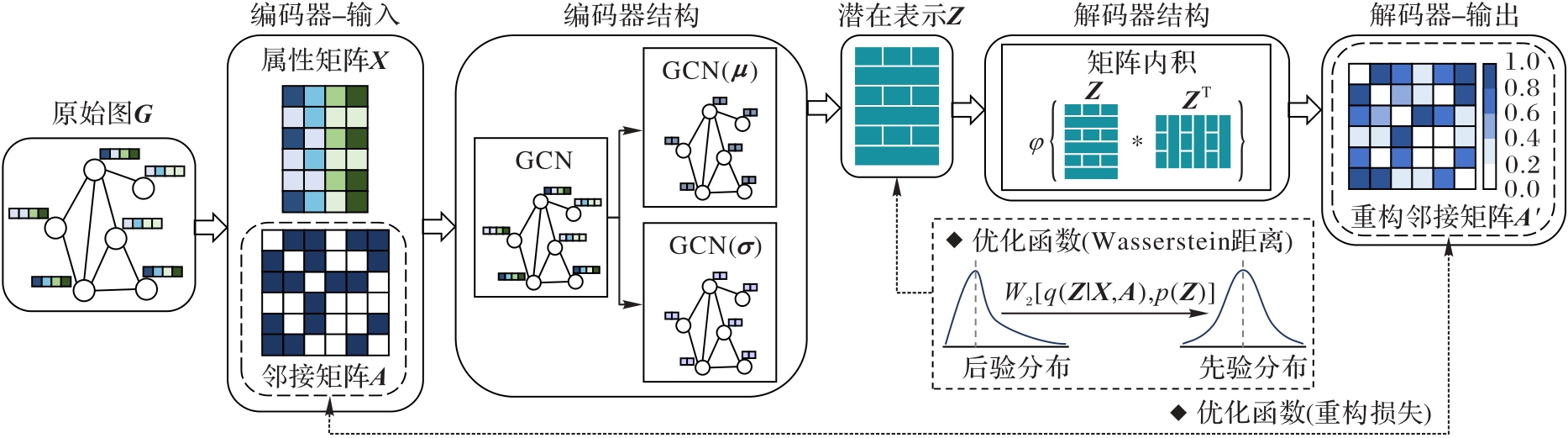
图1 WGAE模型结构
Fig. 1 Model structure of WGAE
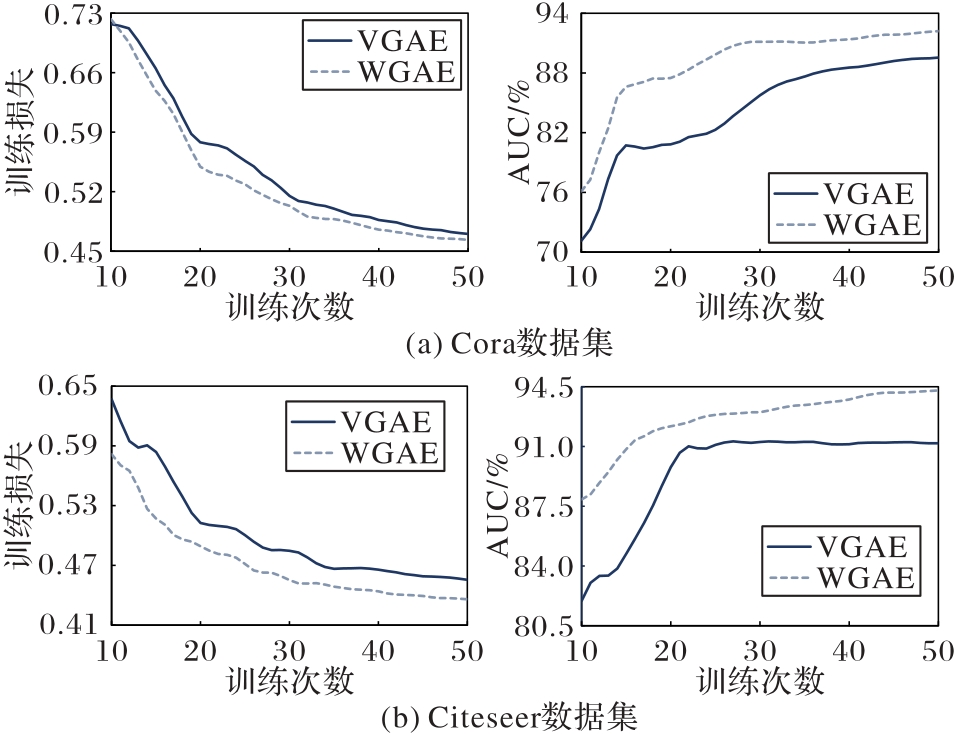
图2 模型收敛实验结果
Fig. 2 Experimental results of model convergence
| 模型 | Cora | Citeseer | Pubmed | ||||||
|---|---|---|---|---|---|---|---|---|---|
| AUC/% | AP/% | ↑KL散度 | AUC/% | AP/% | ↑KL散度 | AUC/% | AP/% | ↑KL散度 | |
| VGAE | 92.07±0.95 | 93.00±0.84 | — | 90.67±1.22 | 91.79±1.14 | — | 94.40±0.88 | 94.64±0.92 | — |
| WGAE | 92.68±0.48 | 93.55±0.57 | 0.61/0.55 | 92.20±0.64 | 93.15±0.76 | 1.53/1.36 | 94.99±0.30 | 95.14±0.38 | 0.59/0.50 |
| VGNAE | 90.36±0.78 | 91.51±0.55 | — | 90.10±1.15 | 91.49±0.93 | — | 93.33±0.30 | 93.99±0.31 | — |
| WGNAE | 91.01±0.58 | 91.97±0.53 | 0.65/0.46 | 90.64±0.74 | 92.04±0.56 | 0.54/0.55 | 93.57±0.16 | 94.18±0.17 | 0.24/0.19 |
| MSVGAE | 93.12±0.68 | 93.21±0.62 | — | 93.13±1.01 | 93.12±1.09 | — | 93.10±0.70 | 92.82±0.70 | — |
| MSWGAE | 93.37±0.34 | 93.39±0.47 | 0.53/0.18 | 93.90±0.57 | 93.98±0.75 | 0.77/0.86 | 93.43±0.37 | 93.17±0.32 | 0.33/0.35 |
| MoVGAE | 93.90±0.67 | 94.27±0.55 | — | 93.91±0.70 | 94.33±0.66 | — | 95.50±0.34 | 95.69±0.35 | — |
| MoWGAE | 94.25±0.34 | 94.61±0.28 | 0.35/0.34 | 94.53±0.69 | 94.94±0.61 | 0.62/0.61 | 95.63±0.19 | 95.82±0.14 | 0.13/0.13 |
| Self-VGAE | 94.47±0.73 | 94.72±0.69 | — | 94.57±0.87 | 94.59±0.86 | — | 95.03±0.67 | 94.98±0.68 | — |
| Self-WGAE | 94.67±0.54 | 94.96±0.40 | 0.20/0.24 | 95.47±0.60 | 95.53±0.71 | 0.90/0.94 | 95.34±0.23 | 95.31±0.29 | 0.31/0.33 |
| DVGAE | 90.49±0.42 | 90.22±0.77 | — | 91.17±1.09 | 90.53±1.05 | — | 93.75±0.79 | 93.30±0.76 | — |
| DWGAE | 90.63±0.24 | 90.52±0.41 | 0.14/0.30 | 92.10±0.85 | 91.66±1.03 | 0.93/1.13 | 94.10±0.35 | 93.66±0.45 | 0.35/0.36 |
| VDGAE | 94.47±0.86 | 95.13±0.62 | — | 96.54±0.43 | 96.80±0.29 | — | 96.50±0.29 | 96.57±0.29 | — |
| WDGAE | 94.95±0.43 | 95.30±0.47 | 0.48/0.17 | 96.84±0.21 | 97.17+0.23 | 0.30/0.37 | 96.79±0.14 | 96.78±0.24 | 0.29/0.21 |
表1 性能提升实验结果
Tab. 1 Experiment results of performance improvement
| 模型 | Cora | Citeseer | Pubmed | ||||||
|---|---|---|---|---|---|---|---|---|---|
| AUC/% | AP/% | ↑KL散度 | AUC/% | AP/% | ↑KL散度 | AUC/% | AP/% | ↑KL散度 | |
| VGAE | 92.07±0.95 | 93.00±0.84 | — | 90.67±1.22 | 91.79±1.14 | — | 94.40±0.88 | 94.64±0.92 | — |
| WGAE | 92.68±0.48 | 93.55±0.57 | 0.61/0.55 | 92.20±0.64 | 93.15±0.76 | 1.53/1.36 | 94.99±0.30 | 95.14±0.38 | 0.59/0.50 |
| VGNAE | 90.36±0.78 | 91.51±0.55 | — | 90.10±1.15 | 91.49±0.93 | — | 93.33±0.30 | 93.99±0.31 | — |
| WGNAE | 91.01±0.58 | 91.97±0.53 | 0.65/0.46 | 90.64±0.74 | 92.04±0.56 | 0.54/0.55 | 93.57±0.16 | 94.18±0.17 | 0.24/0.19 |
| MSVGAE | 93.12±0.68 | 93.21±0.62 | — | 93.13±1.01 | 93.12±1.09 | — | 93.10±0.70 | 92.82±0.70 | — |
| MSWGAE | 93.37±0.34 | 93.39±0.47 | 0.53/0.18 | 93.90±0.57 | 93.98±0.75 | 0.77/0.86 | 93.43±0.37 | 93.17±0.32 | 0.33/0.35 |
| MoVGAE | 93.90±0.67 | 94.27±0.55 | — | 93.91±0.70 | 94.33±0.66 | — | 95.50±0.34 | 95.69±0.35 | — |
| MoWGAE | 94.25±0.34 | 94.61±0.28 | 0.35/0.34 | 94.53±0.69 | 94.94±0.61 | 0.62/0.61 | 95.63±0.19 | 95.82±0.14 | 0.13/0.13 |
| Self-VGAE | 94.47±0.73 | 94.72±0.69 | — | 94.57±0.87 | 94.59±0.86 | — | 95.03±0.67 | 94.98±0.68 | — |
| Self-WGAE | 94.67±0.54 | 94.96±0.40 | 0.20/0.24 | 95.47±0.60 | 95.53±0.71 | 0.90/0.94 | 95.34±0.23 | 95.31±0.29 | 0.31/0.33 |
| DVGAE | 90.49±0.42 | 90.22±0.77 | — | 91.17±1.09 | 90.53±1.05 | — | 93.75±0.79 | 93.30±0.76 | — |
| DWGAE | 90.63±0.24 | 90.52±0.41 | 0.14/0.30 | 92.10±0.85 | 91.66±1.03 | 0.93/1.13 | 94.10±0.35 | 93.66±0.45 | 0.35/0.36 |
| VDGAE | 94.47±0.86 | 95.13±0.62 | — | 96.54±0.43 | 96.80±0.29 | — | 96.50±0.29 | 96.57±0.29 | — |
| WDGAE | 94.95±0.43 | 95.30±0.47 | 0.48/0.17 | 96.84±0.21 | 97.17+0.23 | 0.30/0.37 | 96.79±0.14 | 96.78±0.24 | 0.29/0.21 |
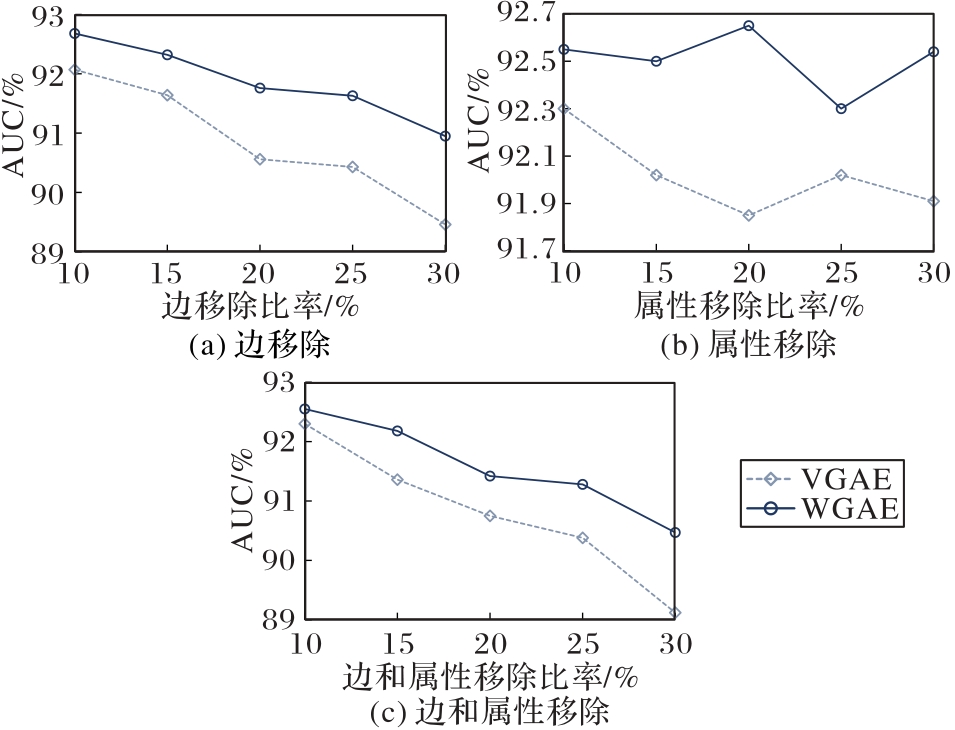
图3 泛化性与鲁棒性实验结果(Cora数据集)
Fig. 3 Experiment results of generalization and robustness (Cora dataset)
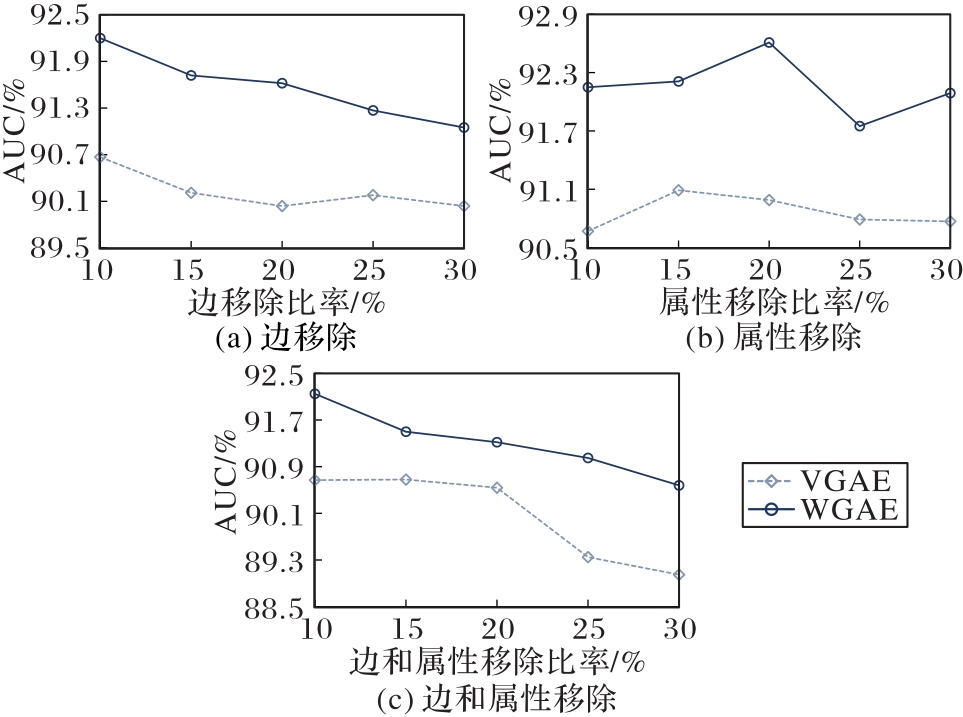
图4 泛化性与鲁棒性实验结果(Citeseer数据集)
Fig. 4 Experiment results of generalization and robustness (Citeseer dataset)
| 变体 | Cora | Citeseer | ||
|---|---|---|---|---|
| AUC | AP | AUC | AP | |
| KL | 92.07±0.95 | 93.00±0.84 | 90.67±1.22 | 91.79±1.14 |
| Wasserstein-S | 92.33±0.85 | 93.32±0.63 | 92.02±0.98 | 93.12±1.06 |
| Wasserstein-2 | 92.68±0.48 | 93.55±0.57 | 92.20±0.64 | 93.15±0.76 |
表2 消融实验结果 (%)
Tab. 2 Results of ablation study
| 变体 | Cora | Citeseer | ||
|---|---|---|---|---|
| AUC | AP | AUC | AP | |
| KL | 92.07±0.95 | 93.00±0.84 | 90.67±1.22 | 91.79±1.14 |
| Wasserstein-S | 92.33±0.85 | 93.32±0.63 | 92.02±0.98 | 93.12±1.06 |
| Wasserstein-2 | 92.68±0.48 | 93.55±0.57 | 92.20±0.64 | 93.15±0.76 |
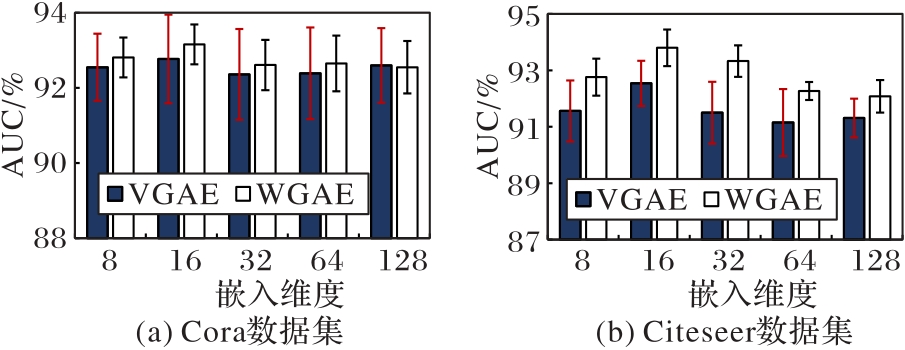
图5 超参数嵌入维度实验结果
Fig. 5 Experiment results of hyperparameter embedding dimensions
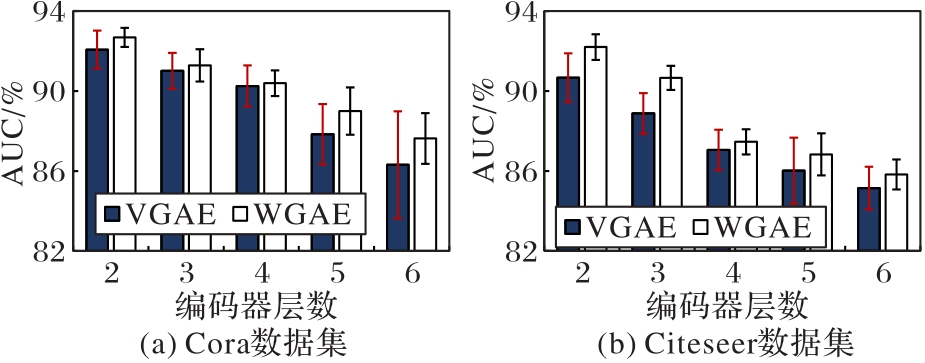
图6 超参数编码器层数实验结果
Fig. 6 Experiment results of hyperparameter encoder layers
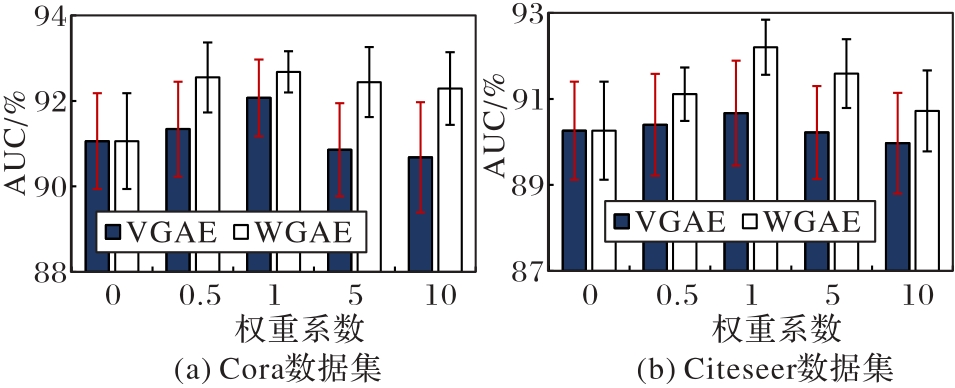
图7 超参数正则化权重系数实验结果
Fig. 7 Experiment results of hyperparameter regularization weight coefficients
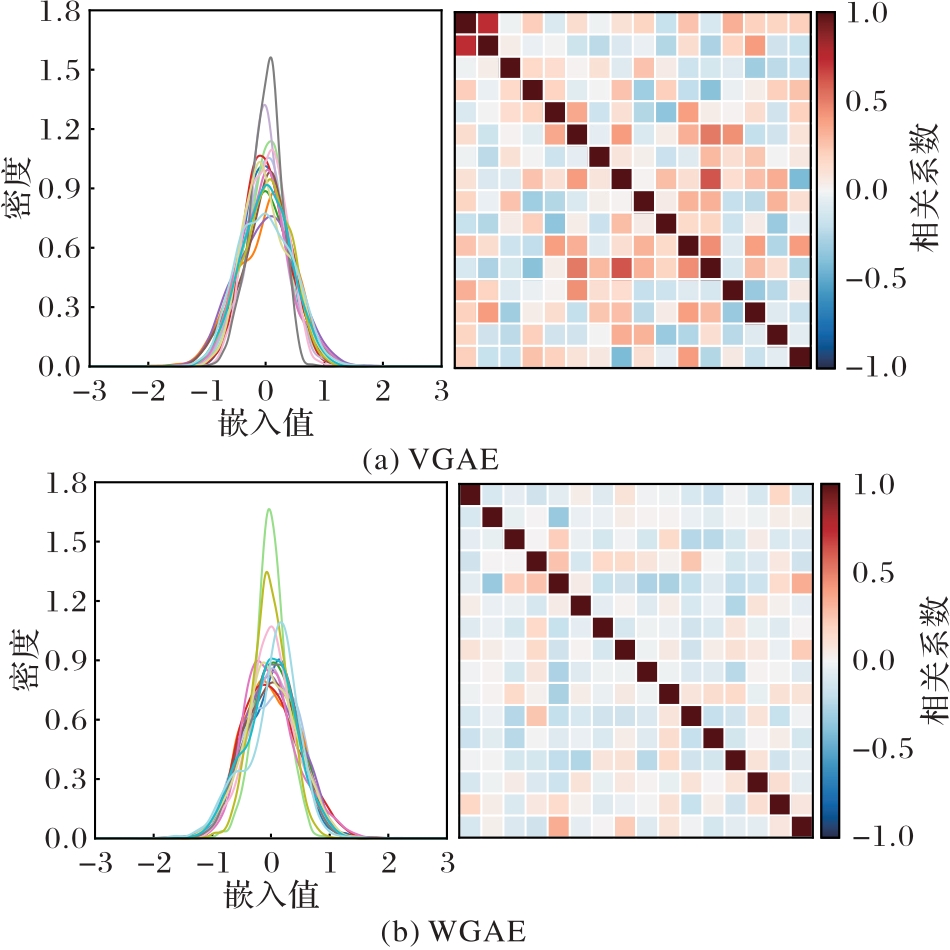
图8 KDE可视化和相关性热图(Cora数据集)
Fig. 8 KDE visualizations and correlation heatmaps (Cora dataset)
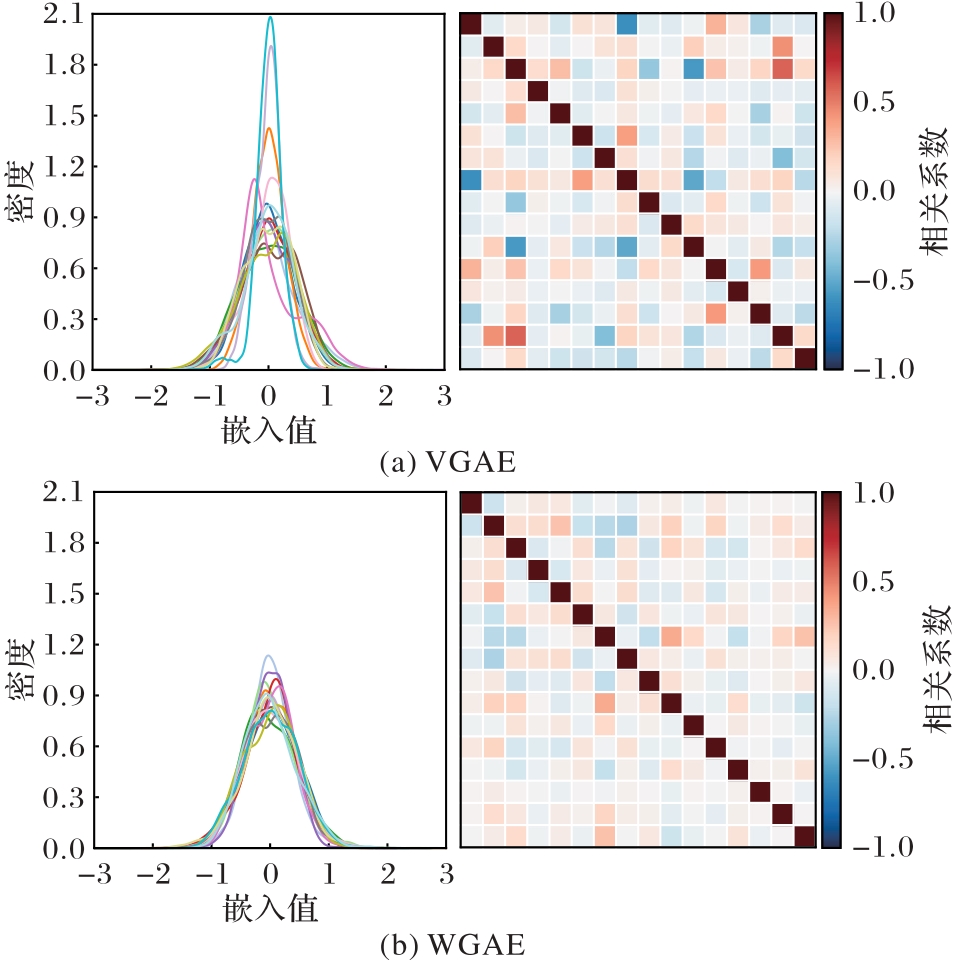
图9 KDE可视化和相关性热图(Citeseer数据集)
Fig. 9 KDE visualizations and correlation heatmaps (Citeseer dataset)
| 变体 | Cora | Citeseer | ||
|---|---|---|---|---|
| AUC | AP | AUC | AP | |
| WARGA | 91.87±0.66 | 93.19±0.89 | 89.76±1.08 | 91.79±1.14 |
| WGAE | 92.68±0.48 | 93.55±0.57 | 92.20±0.64 | 93.15±0.76 |
表3 Wasserstein变体实验 (%)
Tab. 3 Experiments on Wasserstein variants
| 变体 | Cora | Citeseer | ||
|---|---|---|---|---|
| AUC | AP | AUC | AP | |
| WARGA | 91.87±0.66 | 93.19±0.89 | 89.76±1.08 | 91.79±1.14 |
| WGAE | 92.68±0.48 | 93.55±0.57 | 92.20±0.64 | 93.15±0.76 |
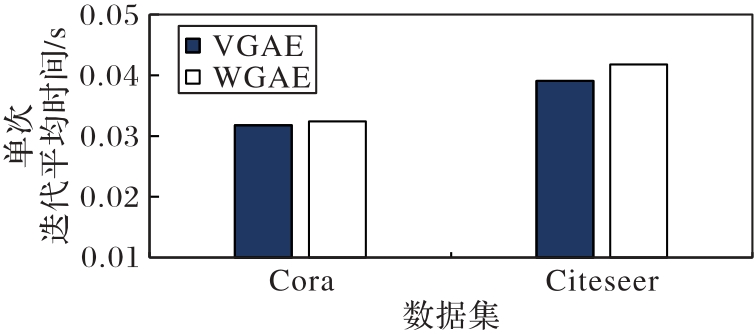
图10 训练时间对比
Fig. 10 Training time comparison
| 模型 | 年份 | 不同数据集的AUC/% | Avg.Rank | ||
|---|---|---|---|---|---|
| Cora | Citeseer | Pubmed | |||
| CGCL | 2024 | 94.80 | 93.80 | 96.00 | 6.0 |
| DSDN | 2024 | 92.01 | 94.23 | 97.17 | 5.3 |
| LTLP | 2024 | 93.16 | 92.89 | 96.90 | 6.7 |
| MoVGAE | 2024 | 94.49 | 94.45 | 96.01 | 5.3 |
| Self-VGAE | 2024 | 95.04 | 95.46 | 95.96 | |
| SimDiff | 2025 | 92.00 | 90.88 | 94.39 | 11.0 |
| VGNN-NF | 2025 | 90.81 | 5.7 | ||
| QVGAE | 2025 | 91.80 | 91.40 | 8.3 | |
| MCAS | 2025 | 93.04 | 93.76 | 95.36 | 8.0 |
| PEGN | 2025 | 95.00 | 93.10 | 96.80 | 5.7 |
| SPG4LP | 2026 | 92.43 | 92.71 | 92.89 | 10.0 |
| WGAE | — | 95.46 | 96.92 | 97.17 | 1.0 |
表4 模型对比实验结果
Tab. 4 Experiment results on different models
| 模型 | 年份 | 不同数据集的AUC/% | Avg.Rank | ||
|---|---|---|---|---|---|
| Cora | Citeseer | Pubmed | |||
| CGCL | 2024 | 94.80 | 93.80 | 96.00 | 6.0 |
| DSDN | 2024 | 92.01 | 94.23 | 97.17 | 5.3 |
| LTLP | 2024 | 93.16 | 92.89 | 96.90 | 6.7 |
| MoVGAE | 2024 | 94.49 | 94.45 | 96.01 | 5.3 |
| Self-VGAE | 2024 | 95.04 | 95.46 | 95.96 | |
| SimDiff | 2025 | 92.00 | 90.88 | 94.39 | 11.0 |
| VGNN-NF | 2025 | 90.81 | 5.7 | ||
| QVGAE | 2025 | 91.80 | 91.40 | 8.3 | |
| MCAS | 2025 | 93.04 | 93.76 | 95.36 | 8.0 |
| PEGN | 2025 | 95.00 | 93.10 | 96.80 | 5.7 |
| SPG4LP | 2026 | 92.43 | 92.71 | 92.89 | 10.0 |
| WGAE | — | 95.46 | 96.92 | 97.17 | 1.0 |
| 模型 | Cornell | Texas | Wisconsin | |||
|---|---|---|---|---|---|---|
| AUC | AP | AUC | AP | AUC | AP | |
| VGAE | 76.84 | 81.05 | 79.79 | 83.91 | 76.48 | 80.55 |
| WGAE | 83.76 | 86.29 | 82.36 | 86.06 | 77.15 | 80.80 |
表5 异配图实验结果 (%)
Tab. 5 Experiment results of homophilic graph
| 模型 | Cornell | Texas | Wisconsin | |||
|---|---|---|---|---|---|---|
| AUC | AP | AUC | AP | AUC | AP | |
| VGAE | 76.84 | 81.05 | 79.79 | 83.91 | 76.48 | 80.55 |
| WGAE | 83.76 | 86.29 | 82.36 | 86.06 | 77.15 | 80.80 |
| [1] | Nandan M, Mitra S, De D. GraphXAI: a survey of Graph Neural Networks (GNNs) for Explainable AI (XAI)[J]. Neural Computing and Applications, 2025, 37(17): 10949-11000. |
| [2] | Kipf T N, Welling M. Variational graph auto-encoders[PP/OL]. V1. arXiv (2016-11-21) [2026-03-10]. . |
| [3] | Kingma D P, Welling M. Auto-encoding variational Bayes[PP/OL]. V11. arXiv (2022-12-10) [2026-03-10].. |
| [4] | Berahmand K, Nasiri E, Rostami M, et al. A modified DeepWalk method for link prediction in attributed social network[J]. Computing, 2021, 103(10): 2227-2249. |
| [5] | Ahn S J, Kim M. Variational graph normalized AutoEncoders[C]// CIKM 2021. New York: ACM, 2021: 2827-2831. |
| [6] | Guo Z, Wang F, Yao K, et al. Multi-scale variational graph autoencoder for link prediction[C]// WSDM 2022. New York: ACM, 2022: 334-342. |
| [7] | Yuan L, Jiang P, Wen Z, et al. Improving variational graph autoencoders with multi-order graph convolutions[J]. IEEE Access, 2024, 12: 46919-46929. |
| [8] | 袁立宁,文竹,冯文刚,等. 基于自监督信息增强的图表示学习[J]. 广西科学, 2024, 31(2): 323-334. |
| Yuan Lining, Wen Zhu, Feng Wengang, et al. Graph representation learning enhanced by self-supervised information[J]. Guangxi Sciences, 2024, 31(2): 323-334. | |
| [9] | Li H, Liu Y, Liu Y, et al. D-VGAEAD: a dual-decoder variational graph autoencoder for anomaly detection based on attribute networks[J]. Computers and Security, 2026, 162: No.104784. |
| [10] | Fu J, Xu X, Zhang X, et al. Variational disentangled graph auto-encoders for link prediction[J]. IEEE Transactions on Network Science and Engineering, 2026, 13: 3144-3157. |
| [11] | Korbak T. Aligning language models with human preferences[PP/OL]. V1. arXiv (2024-04-18) [2026-03-10].. |
| [12] | Penaloza E, Vattikonda D, Gontier N, et al. Privileged information distillation for language models[PP/OL]. V3. arXiv (2026-02-16) [2026-03-10].. |
| [13] | Wu X, Manton J H, Aickelin U, et al. On the generalization for transfer learning: an information-theoretic analysis[J]. IEEE Transactions on Information Theory, 2024, 70(10): 7089-7124. |
| [14] | Bach E, Baptista R, Sanz-Alonso D, et al. Machine learning for inverse problems and data assimilation[PP/OL]. V2. arXiv (2025-10-06) [2026-03-10].. |
| [15] | Tolstikhin I, Bousquet O, Gelly S, et al. Wasserstein auto-encoders[PP/OL]. V4. arXiv (2019-12-05) [2026-03-10].. |
| [16] | Zhang K, Shen J, He G, et al. A transformative topological representation for link modeling, prediction and cross-domain network analysis[J]. IEEE Transactions on Pattern Analysis and Machine Intelligence, 2024, 46(9): 6126-6138. |
| [17] | Wang Y, Wang D, Liu H, et al. Optimizing long-tailed link prediction in graph neural networks through structure representation enhancement[C]// KDD 2024. New York: ACM, 2024: 3222-3232. |
| [18] | Zhang Z, Zheng F, Wang B, et al. Cycle based link prediction method for cross-granularity contrast learning[C]// MedAI 2024. Piscataway: IEEE, 2024: 449-455. |
| [19] | Su H, Li Z, Yuan C A, et al. Variational graph neural network based on normalizing flows[J]. IEEE Transactions on Signal and Information Processing over Networks, 2025, 11: 177-186. |
| [20] | Yao Y, Guo P, Mao Z, et al. Multi-scale contrastive learning via aggregated subgraph for link prediction[J]. Applied Intelligence, 2025, 55(7): No.489. |
| [21] | Yan Z, Zhao Q, Ye Z, et al. Enhancing graph representation learning with localized topological features[J]. Journal of Machine Learning Research, 2025, 26: 1-36. |
| [22] | Devale S, Seshadri K. Design and evaluation of a quantum variational graph auto-encoder using quantum graph neural networks[J]. Quantum Machine Intelligence, 2025, 7(2): No.95. |
| [23] | Gholipour H, Bozorgnia F, Hambarde K, et al. A Laplacian-based quantum graph neural networks for quantum semi-supervised learning[J]. Quantum Information Processing, 2025, 24(4): No.106. |
| [24] | 袁锦辉,卢山,何洁月. 基于大语言模型的标签引导鲁棒增强图表示学习[J]. 南京大学学报(自然科学), 2025, 61(6): 891-907. |
| Yuan Jinhui, Lu Shan, He Jieyue. Label-guided robust enhanced graph representation learning based on large language models[J]. Journal of Nanjing University (Natural Science), 2025, 61(6): 891-907. | |
| [25] | Kang J C, Cho N W. Simplified and adjustable graph diffusion neural networks[J]. Systems, 2025, 13(11): No.1040. |
| [26] | 李志仁,郑卫国. 基于简单路径图的链接预测[J]. 计算机工程, 2026, 52(1): 95-104. |
| Li Zhiren, Zheng Weiguo. Link prediction based on simple path graphs[J]. Computer Engineering, 2026, 52(1): 95-104. | |
| [27] | 秦者云,卢宪凯,聂秀山,等. 基于结构关系建模的自监督图表示学习[J]. 软件学报, 2026, 37(2): 700-715. |
| Qin Zheyun, Lu Xianlai, Nie Xiushan, et al. Self-supervised graph representation learning via structural relation modeling[J]. Journal of Software, 2026, 37(2): 700-715. | |
| [28] | Liang H, Gao J. Wasserstein adversarially regularized graph autoencoder[J]. Neurocomputing, 2023, 541: No.126235. |
| [29] | Riaz R, Han G, Shaukat K, et al. A novel ensemble Wasserstein GAN framework for effective anomaly detection in industrial internet of things environments[J]. Scientific Reports, 2025, 15: No.26786. |
| [30] | 袁立宁,李欣,王晓冬,等. 图嵌入模型综述[J]. 计算机科学与探索, 2022, 16(1): 59-87. |
| Yuan Lining, Li Xin, Wang Xiaodong, et al. Graph embedding models: a survey[J]. Journal of Frontiers of Computer Science and Technology, 2022, 16(1): 59-87. | |
| [31] | Xu M, Fralick D, Zheng J Z, et al. The differences and similarities between two-sample t-test and paired t-test[J]. Shanghai Archives of Psychiatry, 2017, 29(3): 184-188. |
| [32] | Kushinsky Y, Maron H, Dym N, et al. Sinkhorn algorithm for lifted assignment problems[J]. SIAM Journal on Imaging Sciences, 2019, 12(2): 716-735. |
| [33] | Mohi Ud Din A, Qureshi S. Limits of depth: over-smoothing and over-squashing in GNNs[J]. Big Data Mining and Analytics, 2024, 7(1): 205-216. |
| [34] | Zhang G, Yuan G, Cheng D, et al. Disentangled contrastive learning for fair graph representations[J]. Neural Networks, 2025, 181: No.106781. |
| [35] | Zhou L, Guo Y, Zhang Z. Multi-view attributed graph clustering based on graph diffusion convolution with adaptive fusion[J]. Expert Systems with Applications, 2025, 260: No.125286. |
| [36] | Corli S, Moro L, Dragoni D, et al. Quantum machine learning algorithms for anomaly detection: a review[J]. Future Generation Computer Systems, 2025, 166: No.107632. |
| [37] | Pei H, Wei B, Chang K C C, et al. Geom-GCN: geometric graph convolutional networks[PP/OL]. V2. arXiv(2020-02-14) [2026-03-10].. |
| [38] | Leskovec J, Sosič R. SNAP: a general-purpose network analysis and graph-mining library[J]. ACM Transactions on Intelligent Systems and Technology, 2017, 8(1): No.1. |
| [1] | 董汦楗, 顾瑞春. 融合动态特征对齐与温度感知聚合的联邦学习框架[J]. 《计算机应用》唯一官方网站, 2026, 46(6): 1746-1755. |
| [2] | 于巧, 黄子睿, 程圣懿, 祝义, 张淑涛. 基于边权重的软件漏洞检测方法[J]. 《计算机应用》唯一官方网站, 2026, 46(2): 518-527. |
| [3] | 李玟, 李开荣, 杨凯. 基于数据增强的子图感知对比学习[J]. 《计算机应用》唯一官方网站, 2026, 46(1): 1-9. |
| [4] | 王义, 马应龙. 基于项图动态适应性生成的多任务社交项推荐方法[J]. 《计算机应用》唯一官方网站, 2025, 45(8): 2592-2599. |
| [5] | 周天彤, 郑妍琪, 魏韬, 戴亚康, 邹凌. 融合变分图自编码器与局部-全局图网络的认知负荷脑电识别模型[J]. 《计算机应用》唯一官方网站, 2025, 45(6): 1849-1857. |
| [6] | 杜郁, 朱焱. 构建预训练动态图神经网络预测学术合作行为消失[J]. 《计算机应用》唯一官方网站, 2024, 44(9): 2726-2731. |
| [7] | 李烨恒, 罗光圣, 苏前敏. 基于改进YOLOv5的Logo检测算法[J]. 《计算机应用》唯一官方网站, 2024, 44(8): 2580-2587. |
| [8] | 黎施彬, 龚俊, 汤圣君. 基于Graph Transformer的半监督异配图表示学习模型[J]. 《计算机应用》唯一官方网站, 2024, 44(6): 1816-1823. |
| [9] | 张玉莲, 姚姗姗, 王超, 畅江. 基于不确定性学习的文本无关的说话人确认方法[J]. 《计算机应用》唯一官方网站, 2023, 43(12): 3727-3732. |
| [10] | 李亚鸣, 邢凯, 邓洪武, 王志勇, 胡璇. 基于小样本无梯度学习的卷积结构预训练模型性能优化方法[J]. 《计算机应用》唯一官方网站, 2022, 42(2): 365-374. |
| [11] | 甘岚, 沈鸿飞, 王瑶, 张跃进. 基于改进DCGAN的数据增强方法[J]. 计算机应用, 2021, 41(5): 1305-1313. |
| [12] | 张变兰, 路永钢, 张海涛. 基于KL散度和近邻点间距离的球面嵌入算法[J]. 计算机应用, 2017, 37(3): 680-683. |
| [13] | 曹小鹿, 辛云宏. 基于Wasserstein距离概率分布模型的非线性降维[J]. 计算机应用, 2017, 37(10): 2819-2822. |
| [14] | 徐文轩, 张莉. 基于单核苷酸统计和支持向量机集成的人类基因启动子识别[J]. 计算机应用, 2015, 35(10): 2808-2812. |
| [15] | 余艳. 融合KL散度和移地距离的高斯混合模型相似性度量方法[J]. 计算机应用, 2014, 34(3): 828-832. |
| 阅读次数 | ||||||
|
全文 |
|
|||||
|
摘要 |
|
|||||
