


《计算机应用》唯一官方网站 ›› 2026, Vol. 46 ›› Issue (9): 3035-3042.DOI: 10.11772/j.issn.1001-9081.2025081016
• 前沿与综合应用 • 上一篇
徐晓翠, 李波( ), 邹宇童
收稿日期:2025-09-04
修回日期:2025-11-13
接受日期:2025-11-17
发布日期:2025-11-21
出版日期:2026-09-10
通讯作者:
李波
作者简介:徐晓翠(2000—),女,浙江金华人,硕士研究生,主要研究方向:自然语言处理、脑电图信号解码
Xiaocui XU, Bo LI(), Yutong ZOU
Received:2025-09-04
Revised:2025-11-13
Accepted:2025-11-17
Online:2025-11-21
Published:2026-09-10
Contact:
Bo LI
About author:XU Xiaocui, born in 2000, M. S. candidate. Her research interests include natural language processing, electroencephalography signal decoding.摘要:
针对现有面向文本的脑电信号(EEG)解码方法偏重全局建模,忽视通道间局部关联且未实现EEG与文本表征精确对齐的问题,提出一种基于双分支表征融合与跨模态对齐的EEG解码模型。采用并行双分支架构获取EEG信号的高质量表征:时空结构建模分支通过双向长短期记忆(Bi-LSTM)网络、深度可分离卷积与门控轴向自注意力机制分层捕获信号的短时依赖、邻近通道空间相关性与跨步长程关系;上下文融合分支则基于多层Transformer编码器,通过交叉注意力融合两路表征以互补整合。为了弱化模态间的语义差异,引入三元组损失与协方差对齐的联合损失,分别从EEG与文本表征样本对间的几何距离和二阶统计特性两方面约束向量对齐。实验结果表明,在ZuCo数据集上,所提模型的BLEU-1(BiLingual Evaluation Understudy-1)相较于主流基线EEG2Text提升了1.16个百分点,验证了它在面向文本的EEG解码任务中的有效性。
中图分类号:
徐晓翠, 李波, 邹宇童. 基于双分支表征融合与跨模态对齐的脑电信号解码模型[J]. 计算机应用, 2026, 46(9): 3035-3042.
Xiaocui XU, Bo LI, Yutong ZOU. EEG decoding model based on dual-branch representation fusion and cross-modal alignment[J]. Journal of Computer Applications, 2026, 46(9): 3035-3042.
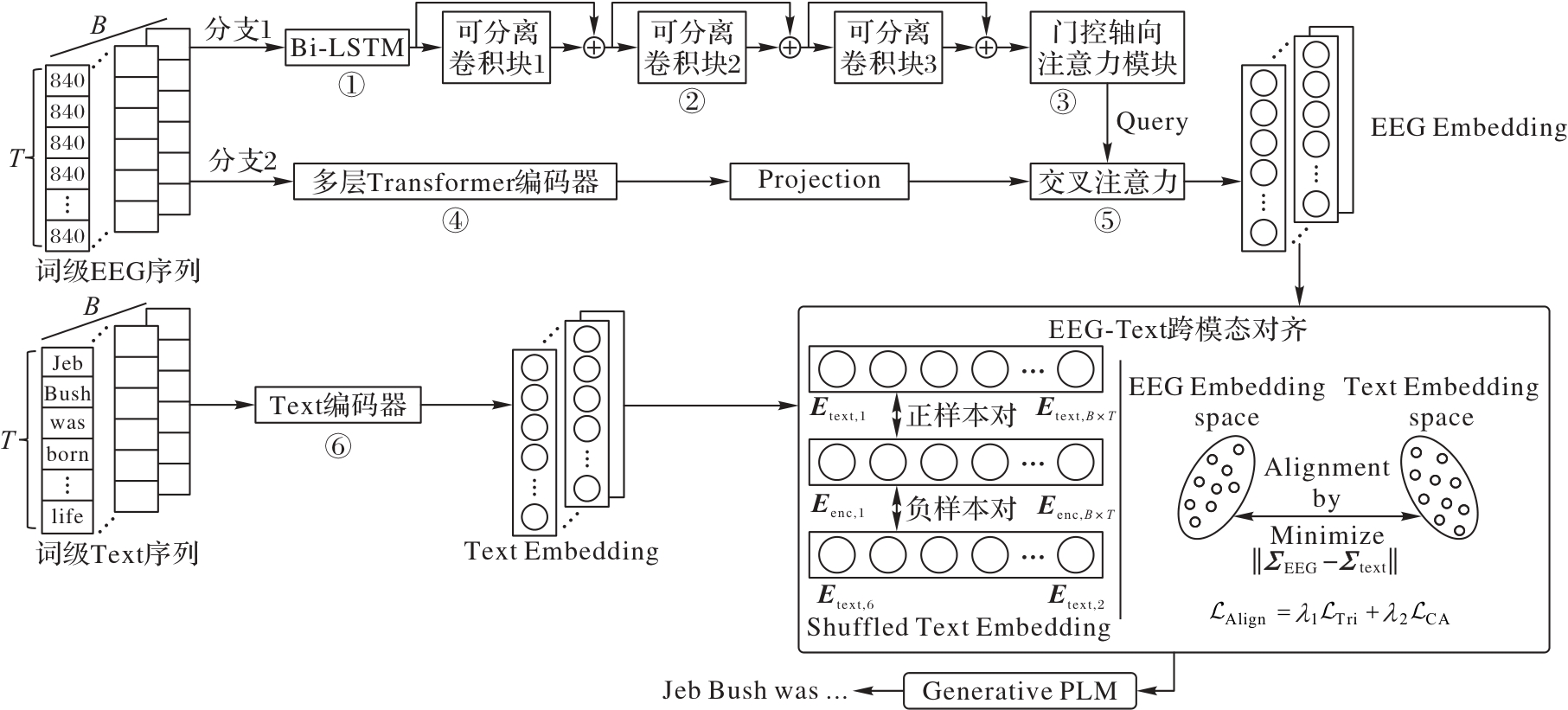
图1 本文模型架构
Fig. 1 Architecture of proposed model
| 数据集 | 受试者数 | 唯一句子数 | 训练样本数 | 测试样本数 |
|---|---|---|---|---|
| SR v1.0 | 12 | 400 | 3 391 | 418 |
| NR v1.0 | 12 | 300 | 2 406 | 321 |
| NR v2.0 | 18 | 349 | 4 456 | 601 |
表1 ZuCo数据集的详细信息
Tab. 1 Detailed information of ZuCo datasets
| 数据集 | 受试者数 | 唯一句子数 | 训练样本数 | 测试样本数 |
|---|---|---|---|---|
| SR v1.0 | 12 | 400 | 3 391 | 418 |
| NR v1.0 | 12 | 300 | 2 406 | 321 |
| NR v2.0 | 18 | 349 | 4 456 | 601 |
| 序号 | 模块 | 参数设置 |
|---|---|---|
| 1 | Bi-LSTM | Insize=840, bidirectional, layers=1, hiddensize=420, outsize=1 024, 激活=GELU |
| 2 | 深度可分离 卷积块 | Insize=840, layers=3, outsize=840; depthwise: kernel=3,stride=1,pad=1; Pointwise: kernel_size=1;outsize=840;激活=ReLU |
| 3 | 门控轴向 自注意力 | Insize=840, layers=6, len=56, heads=8, ffn_dim=2 048;时间轴MHSA dim=840; 通道轴MHSA dim=56;门控激活=Sigmoid |
| 4 | Transformer 编码器 | Insize=840, layers=6, d_model=840, heads=8, ffndim=2 048,outsize=840; projection: insize=840, outsize=1 024 |
| 5 | 交叉 注意力层 | Insize=1 024, embed_dim=1 024, num_heads=8, outsize=1 024 |
| 6 | TextEncoder | Model=BART-Large, outsize=1 024 |
表2 模型网络设置
Tab. 2 Model network setting
| 序号 | 模块 | 参数设置 |
|---|---|---|
| 1 | Bi-LSTM | Insize=840, bidirectional, layers=1, hiddensize=420, outsize=1 024, 激活=GELU |
| 2 | 深度可分离 卷积块 | Insize=840, layers=3, outsize=840; depthwise: kernel=3,stride=1,pad=1; Pointwise: kernel_size=1;outsize=840;激活=ReLU |
| 3 | 门控轴向 自注意力 | Insize=840, layers=6, len=56, heads=8, ffn_dim=2 048;时间轴MHSA dim=840; 通道轴MHSA dim=56;门控激活=Sigmoid |
| 4 | Transformer 编码器 | Insize=840, layers=6, d_model=840, heads=8, ffndim=2 048,outsize=840; projection: insize=840, outsize=1 024 |
| 5 | 交叉 注意力层 | Insize=1 024, embed_dim=1 024, num_heads=8, outsize=1 024 |
| 6 | TextEncoder | Model=BART-Large, outsize=1 024 |
| 基线ID | EEG编码器 | 预训练语言模型 |
|---|---|---|
| EEG2Text[ | MTE | BART-Large[ |
| EEG2Text-B1 | MTE | BART-Base |
| EEG2Text-B2 | MTE | T5-base[ |
| EEG2Text-B3 | MTE | Pegasus-Large[ |
| EEG2Text-B4 | MTE | Pegasus-Sum |
表3 基准模型信息
Tab. 3 Information of baseline model
| 基线ID | EEG编码器 | 预训练语言模型 |
|---|---|---|
| EEG2Text[ | MTE | BART-Large[ |
| EEG2Text-B1 | MTE | BART-Base |
| EEG2Text-B2 | MTE | T5-base[ |
| EEG2Text-B3 | MTE | Pegasus-Large[ |
| EEG2Text-B4 | MTE | Pegasus-Sum |
| 模型 | BLEU-1 | BLEU-2 | BLEU-3 | BLEU-4 | ROUGE-p | ROUGE-r | ROUGE-f |
|---|---|---|---|---|---|---|---|
| EEG2Text | 40.12 | 23.18 | 12.61 | 6.80 | 28.84 | 31.69 | 30.10 |
| EEG2Text-B1 | 39.97 | 22.04 | 11.51 | 6.43 | 30.30 | 29.31 | 29.73 |
| EEG2Text-B2 | 30.42 | 16.38 | 8.75 | 4.56 | 13.80 | 20.99 | 15.30 |
| EEG2Text-B3 | 39.74 | 22.43 | 12.66 | 6.75 | 30.30 | 30.12 | 30.09 |
| EEG2Text-B4 | 38.98 | 21.36 | 11.81 | 6.38 | 29.69 | 29.02 | 29.24 |
| 本文模型 | 41.28 | 24.14 | 13.88 | 8.01 | 32.31 | 29.90 | 31.01 |
表4 不同模型的实验结果 (%)
Tab. 4 Experiment results of different models
| 模型 | BLEU-1 | BLEU-2 | BLEU-3 | BLEU-4 | ROUGE-p | ROUGE-r | ROUGE-f |
|---|---|---|---|---|---|---|---|
| EEG2Text | 40.12 | 23.18 | 12.61 | 6.80 | 28.84 | 31.69 | 30.10 |
| EEG2Text-B1 | 39.97 | 22.04 | 11.51 | 6.43 | 30.30 | 29.31 | 29.73 |
| EEG2Text-B2 | 30.42 | 16.38 | 8.75 | 4.56 | 13.80 | 20.99 | 15.30 |
| EEG2Text-B3 | 39.74 | 22.43 | 12.66 | 6.75 | 30.30 | 30.12 | 30.09 |
| EEG2Text-B4 | 38.98 | 21.36 | 11.81 | 6.38 | 29.69 | 29.02 | 29.24 |
| 本文模型 | 41.28 | 24.14 | 13.88 | 8.01 | 32.31 | 29.90 | 31.01 |
| 模型 | BLEU-1 | BLEU-2 | BLEU-3 | BLEU-4 | ROUGE-p | ROUGE-r | ROUGE-f |
|---|---|---|---|---|---|---|---|
| 本文模型 | 41.28 | 24.14 | 13.88 | 8.01 | 32.31 | 29.90 | 31.01 |
| 消融1 | 40.35 | 23.14 | 12.94 | 7.28 | 31.95 | 29.19 | 30.47 |
| 消融2 | 40.00 | 22.60 | 12.11 | 6.37 | 31.77 | 29.19 | 30.38 |
| 消融3 | 40.38 | 23.21 | 12.74 | 6.92 | 32.54 | 29.44 | 30.87 |
表5 消融实验结果 (%)
Tab. 5 Ablation experiment results
| 模型 | BLEU-1 | BLEU-2 | BLEU-3 | BLEU-4 | ROUGE-p | ROUGE-r | ROUGE-f |
|---|---|---|---|---|---|---|---|
| 本文模型 | 41.28 | 24.14 | 13.88 | 8.01 | 32.31 | 29.90 | 31.01 |
| 消融1 | 40.35 | 23.14 | 12.94 | 7.28 | 31.95 | 29.19 | 30.47 |
| 消融2 | 40.00 | 22.60 | 12.11 | 6.37 | 31.77 | 29.19 | 30.38 |
| 消融3 | 40.38 | 23.21 | 12.74 | 6.92 | 32.54 | 29.44 | 30.87 |
| BLEU-1/% | ROUGE-f/% | ||
|---|---|---|---|
| 1.0 | 1.0 | 41.28 | 31.01 |
| 1.0 | 0.0 | 40.52 | 30.80 |
| 0.0 | 1.0 | 39.73 | 30.52 |
| 2.0 | 1.0 | 40.43 | 30.40 |
| 1.5 | 1.0 | 40.91 | 30.93 |
| 1.2 | 0.8 | 41.13 | 31.04 |
表6 联合损失的权重对模型性能的影响
Tab. 6 Impact of weights of joint loss on model performance
| BLEU-1/% | ROUGE-f/% | ||
|---|---|---|---|
| 1.0 | 1.0 | 41.28 | 31.01 |
| 1.0 | 0.0 | 40.52 | 30.80 |
| 0.0 | 1.0 | 39.73 | 30.52 |
| 2.0 | 1.0 | 40.43 | 30.40 |
| 1.5 | 1.0 | 40.91 | 30.93 |
| 1.2 | 0.8 | 41.13 | 31.04 |
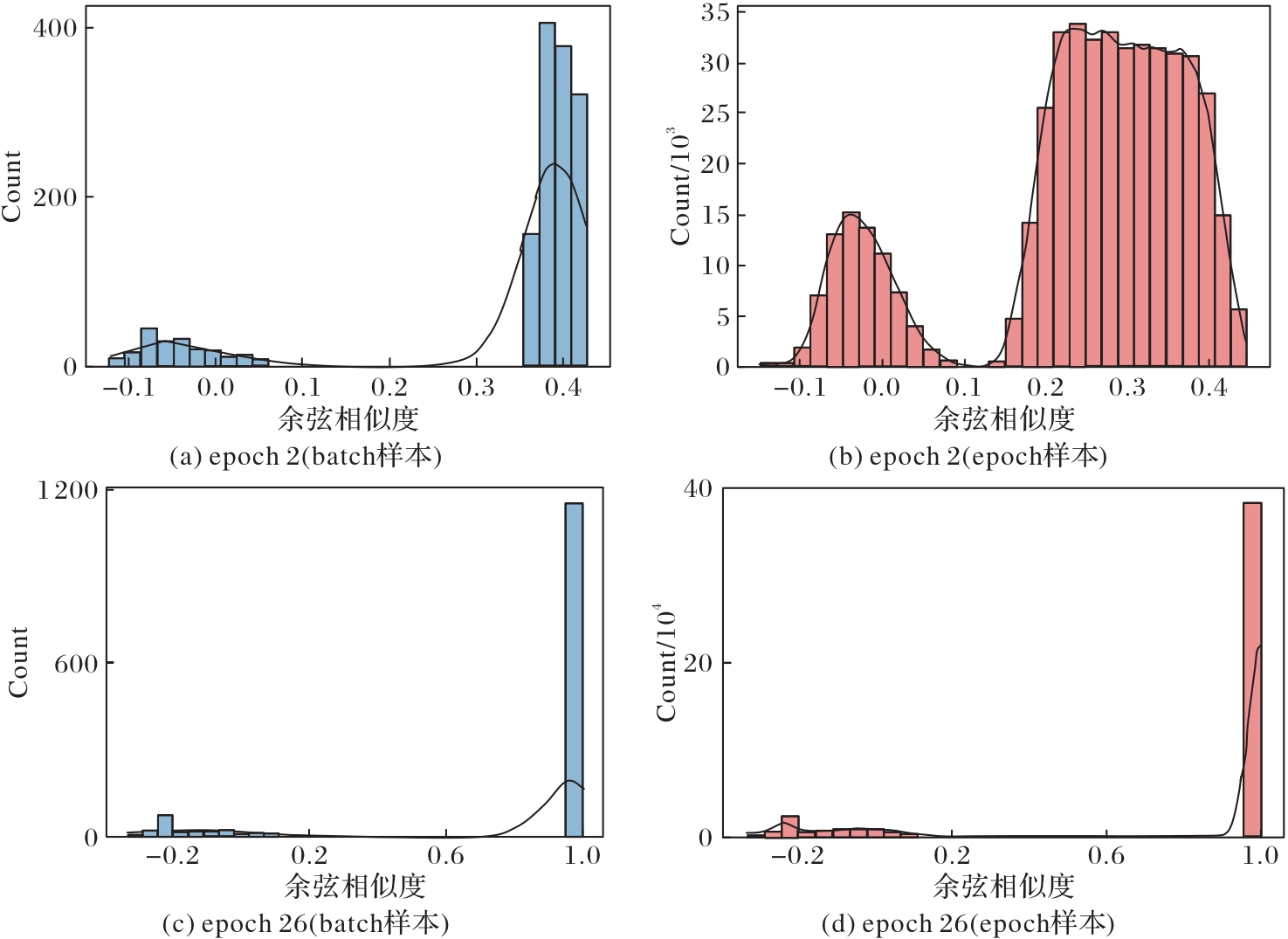
图2 EEG-Text表征相似性直方图
Fig. 2 EEG-Text representation similarity histograms
| 示例 | 类型 | 内容 |
|---|---|---|
| 1 | 目标句 | While attending |
| 生成句 | in | |
| 2 | 目标句 | Jeb |
| 生成句 | ||
| 3 | 目标句 | Their three children, now grown, are |
| 生成句 | first children, all grown, are all,. | |
| 4 | 目标句 | Bush attended the Studies in |
| 生成句 | was the | |
| 5 | 目标句 | Jeb |
| 生成句 |
表7 案例分析
Tab. 7 Case study
| 示例 | 类型 | 内容 |
|---|---|---|
| 1 | 目标句 | While attending |
| 生成句 | in | |
| 2 | 目标句 | Jeb |
| 生成句 | ||
| 3 | 目标句 | Their three children, now grown, are |
| 生成句 | first children, all grown, are all,. | |
| 4 | 目标句 | Bush attended the Studies in |
| 生成句 | was the | |
| 5 | 目标句 | Jeb |
| 生成句 |
| [1] | Gibson M, Newman-Norlund R, Bonilha L, et al. The Aphasia Recovery Cohort, an open-source chronic stroke repository [J]. Scientific Data, 2024, 11: No.981. |
| [2] | Peitz D, Schumann-Werner B, Hussmann K, et al. Success rates of intensive aphasia therapy: real-world data from 448 patients between 2003 and 2020 [J]. Journal of Neurology, 2024, 271(11): 7169-7183. |
| [3] | Le H, Lui F, Lui M Y. Aphasia[EB/OL]. (2024-10-29) [2025-09-02].. |
| [4] | Birbaumer N, Cohen L G. Brain-computer interfaces: communication and restoration of movement in paralysis [J]. The Journal of Physiology, 2007, 579(3): 621-636. |
| [5] | Metzger S L, Littlejohn K T, Silva A B, et al. A high-performance speech neuroprosthesis for speech decoding and avatar control [J]. Nature, 2023, 620(7976): 1031-1036. |
| [6] | Akbari H, Khalighinejad B, Herrero J L, et al. Towards reconstructing intelligible speech from the human auditory cortex[J]. Scientific Reports, 2019, 9: No.874. |
| [7] | Panachakel J T, Ramakrishnan A G. Decoding covert speech from EEG: a comprehensive review [J]. Frontiers in Neuroscience, 2021, 15: No.642251. |
| [8] | Willett F R, Avansino D T, Hochberg L R, et al. High-performance brain-to-text communication via handwriting [J]. Nature, 2021, 593(7858): 249-254. |
| [9] | Moses D A, Metzger S L, Liu J R, et al. Neuroprosthesis for decoding speech in a paralyzed person with anarthria [J]. The New England Journal of Medicine, 2021, 385(3): 217-227. |
| [10] | 陈景霞,郝为,张鹏伟,等. 基于混合神经网络的脑电时空特征情感分类[J]. 软件学报, 2021, 32(12): 3869-3883. |
| Chen Jingxia, Hao Wei, Zhang Pengwei, et al. Emotion classification of spatiotemporal EEG features using hybrid neural networks [J]. Journal of Software, 2021, 32(12): 3869-3883. | |
| [11] | 李锦瑶,杜肖兵,朱志亮,等. 脑电情绪识别的深度学习研究综述[J]. 软件学报, 2023, 34(1): 255-276. |
| Li Jingyao, Du Xiaobing, Zhu Zhiliang, et al. Deep learning for EEG-based emotion recognition: a survey [J]. Journal of Software, 2023, 34(1): 255-276. | |
| [12] | Nicolas-Alonso L F, Gomez-Gil J. Brain-computer interfaces, a review [J]. Sensors, 2012, 12(2): 1211-1279. |
| [13] | Mahajan G, Divija L, Jeevan R, et al. A survey on deciphering of EEG waves [C]// ISI 2023, SIST 389. Singapore: Springer, 2025: 391-404. |
| [14] | Srivastava A, Shinde T, Ansari R A, et al. Think2Type: thoughts to text using EEG waves [J]. International Journal of Engineering Research, 2020, 9(6): 659-664. |
| [15] | Wang Z, Ji H. Open vocabulary electroencephalography-to-text decoding and zero-shot sentiment classification [J]. Proceedings of the AAAI Conference on Artificial Intelligence, 2022, 36(5): 5350-5358. |
| [16] | Lewis M, Liu Y, Goyal N, et al. BART: denoising sequence-to-sequence pre-training for natural language generation, translation, and comprehension [C]// ACL 2020. Stroudsburg: ACL, 2020: 7871-7880. |
| [17] | Brigham K, Kumar B V K V. Imagined speech classification with EEG signals for silent communication: a preliminary investigation into synthetic telepathy [C]// 2010 4th International Conference on Bioinformatics and Biomedical Engineering. Piscataway: IEEE, 2010: 1-4. |
| [18] | Wehbe L, Vaswani A, Knight K, Mitchell T. Aligning context-based statistical models of language with brain activity during reading [C]// EMNLP 2014. Stroudsburg: ACL, 2014: 233-243. |
| [19] | 代成龙,李光辉,李栋,等. 多项正则化约束的伪标签传播优化脑电信号聚类[J]. 计算机研究与发展, 2024, 61(1): 156-171. |
| Dai Chenglong, Li Guanghui, Li Dong, et al. Electroencephalogram clustering with multiple regularization constrained pseudo label propagation optimization [J]. Journal of Computer Research and Development, 2024, 61(1): 156-171. | |
| [20] | Makin J G, Moses D A, Chang E F. Machine translation of cortical activity to text with an encoder-decoder framework [J]. Nature Neuroscience, 2020, 23(4): 575-582. |
| [21] | Hollenstein N, Rengli C, Glaus B, et al. Decoding EEG brain activity for multimodal natural language processing [J]. Frontiers in Human Neuroscience, 2021, 15: No.659410. |
| [22] | Qiu J, Han W, Zhu J, et al. Can brain signals reveal inner alignment with human languages? [C]// Findings of the Association for Computational Linguistics: EMNLP 2023. Stroudsburg: ACL, 2023: 1789-1804. |
| [23] | Défossez A, Caucheteux C, Rapin J, et al. Decoding speech perception from non-invasive brain recordings [J]. Nature Machine Intelligence, 2023, 5(10): 1097-1107. |
| [24] | Amrani H, Micucci D, Napoletano P. Deep representation learning for open vocabulary electroencephalography-to-text decoding [J]. IEEE Journal of Biomedical and Health Informatics, 2026, 30(4): 3593-3600. |
| [25] | Duan Y, Zhou J, Wang Z, et al. DeWave: discrete encoding of EEG waves for EEG-to-text translation [C]// NeurIPS 2023. Red Hook: Curran Associates Inc., 2023: 9907-9918. |
| [26] | Schroff F, Kalenichenko D, Philbin J. FaceNet: a unified embedding for face recognition and clustering [C]// CVPR 2015. Piscataway: IEEE, 2015: 815-823. |
| [27] | Sun B, Saenko K. Deep CORAL: correlation alignment for deep domain adaptation[C]// ECCV 2016. Cham: Springer, 2016: 443-450. |
| [28] | Hollenstein N, Rotsztejn J, Troendle M, et al. ZuCo, a simultaneous EEG and eye-tracking resource for natural sentence reading [J]. Scientific Data, 2018, 5: No.180291. |
| [29] | Hollenstein N, Troendle M, Zhang C, et al. ZuCo 2.0: a dataset of physiological recordings during natural reading and annotation[C]// LREC 2020. Stroudsburg: ACL, 2020: 138-146. |
| [30] | Paszke A, Gross S, Massa F, et al. PyTorch: an imperative style, high-performance deep learning library [C]// NeurIPS 2019. Red Hook: Curran Associates Inc., 2019: 8026-8037. |
| [31] | Wolf T, Debut L, Sanh V, et al. Transformers: state-of-the-art natural language processing [C]// EMNLP 2020: System Demonstrations. Stroudsburg: ACL, 2020: 38-45. |
| [32] | Raffel C, Shazeer N, Roberts A, et al. Exploring the limits of transfer learning with a unified text-to-text Transformer [J]. Journal of Machine Learning Research, 2020, 21: 1-67. |
| [33] | Zhang J, Zhao Y, Saleh M, et al. PEGASUS: pre-training with extracted gap-sentences for abstractive summarization [J]. Proceedings of Machine Learning Research, 2020, 119: 11328-11339. |
| [34] | Papineni K, Roukos S, Ward T, Zhu W J. BLEU: a method for automatic evaluation of machine translation [C]// ACL 2002. Stroudsburg: ACL, 2002: 311-318. |
| [35] | Lin C Y. ROUGE: a package for automatic evaluation of summaries [C]// ACL-04 Workshop: Text Summarization Branches Out. Stroudsburg: ACL, 2004: 74-81. |
| [1] | 董思语, 贾鑫, 张密, 陈新文, 孙昕霙, 程方骁. 基于CNN-Transformer编码器和多维脑电特征融合的抑郁状态识别模型[J]. 《计算机应用》唯一官方网站, 2026, 46(9): 3025-3034. |
| [2] | 何戡, 马洪峰, 宗学军, 史洪岩, 连莲, 宁博伟. 融合双通道语义特征的工业控制协议模糊测试方法DCSFFuzzer[J]. 《计算机应用》唯一官方网站, 2026, 46(9): 2877-2888. |
| [3] | 陈江彦, 王彦丹, 刘翼虎, 马应龙. 基于协同查询优化的长尾目标检测框架[J]. 《计算机应用》唯一官方网站, 2026, 46(9): 2769-2775. |
| [4] | 杨定礼, 卫元芳, 胡文瑞, 孔力杨, 于银山. 时空建模与层次化特征增强的行人重识别算法[J]. 《计算机应用》唯一官方网站, 2026, 46(9): 2776-2786. |
| [5] | 闫江毓, 王世乾, 王红. 基于改进带梯度惩罚的Wasserstein生成对抗网络和时频特征融合的窃电检测方法[J]. 《计算机应用》唯一官方网站, 2026, 46(8): 2691-2698. |
| [6] | 黄麟, 李英顺, 佟维妍, 张树园, 王子涵. 基于改进实时检测Transformer的遥感图像目标检测算法[J]. 《计算机应用》唯一官方网站, 2026, 46(8): 2652-2659. |
| [7] | 刘明, 沈东奇, 孟子洋. 双分支结构下多层次特征融合的点云配准网络[J]. 《计算机应用》唯一官方网站, 2026, 46(8): 2584-2593. |
| [8] | 张国有, 聂宏宇, 潘理虎, 雷润东. 基于多层感知机级联宽度学习系统的点云语义分割网络Point-MLPBLS[J]. 《计算机应用》唯一官方网站, 2026, 46(7): 2259-2266. |
| [9] | 肖海林, 曹清阳, 蒋海龙, 张中山, 胡智群. 基于深度神经网络的正交频分复用系统信道估计算法[J]. 《计算机应用》唯一官方网站, 2026, 46(7): 2250-2258. |
| [10] | 朱松浩, 赵芝芸, 王梦灵. 基于轻量残差与亮度感知动态特征融合的低光图像增强网络[J]. 《计算机应用》唯一官方网站, 2026, 46(6): 1936-1946. |
| [11] | 吕超, 马歌谣. 基于冗余特征抑制的轻量级人体姿态估计网络[J]. 《计算机应用》唯一官方网站, 2026, 46(6): 1973-1980. |
| [12] | 吴闵奇, 杨元华, 李航, 胡雅琴, 汤智豪, 梅腾. 基于图Transformer和RT-DETR的轻量化水下小目标检测[J]. 《计算机应用》唯一官方网站, 2026, 46(5): 1586-1595. |
| [13] | 张红瑞, 冯威铭, 杨潞霞, 马永杰. 基于YOLO11改进的水下小目标检测算法CSAF-YOLO[J]. 《计算机应用》唯一官方网站, 2026, 46(5): 1578-1585. |
| [14] | 廖雪超, 陈睿. 电动汽车锂离子电池预测-评估故障检测框架[J]. 《计算机应用》唯一官方网站, 2026, 46(5): 1614-1623. |
| [15] | 黄雨倩, 黄辉, 秦永彬, 黄瑞章, 陈艳平, 周裕林, 孙倩. 融合全局和局部语义的司法要素抽取方法[J]. 《计算机应用》唯一官方网站, 2026, 46(5): 1460-1467. |
| 阅读次数 | ||||||
|
全文 |
|
|||||
|
摘要 |
|
|||||
