


《计算机应用》唯一官方网站 ›› 2026, Vol. 46 ›› Issue (7): 2250-2258.DOI: 10.11772/j.issn.1001-9081.2025060782
肖海林1( ), 曹清阳2, 蒋海龙2, 张中山3, 胡智群4
收稿日期:2025-07-16
修回日期:2025-09-18
接受日期:2025-09-25
发布日期:2025-10-09
出版日期:2026-07-10
通讯作者:
肖海林
作者简介:曹清阳(2001—),男,安徽合肥人,硕士研究生,主要研究方向:无线通信、信道估计基金资助:
Hailin XIAO1(), Qingyang CAO2, Hailong JIANG2, Zhongshan ZHANG3, Zhiqun HU4
Received:2025-07-16
Revised:2025-09-18
Accepted:2025-09-25
Online:2025-10-09
Published:2026-07-10
Contact:
Hailin XIAO
About author:CAO Qingyang, born in 2001, M. S. candidate. His research interests include wireless communications, channel estimation.Supported by:摘要:
针对正交频分复用(OFDM)系统中信道估计精度受限及复杂度较高的问题,提出一种基于深度神经网络(DNN)的OFDM系统信道估计算法。首先,利用所提DNN模型替代传统通信系统中依赖的信道估计与均衡过程,并以接收端的导频信息和数据块作为输入特征,实现对信道特性的快速学习与估计;其次,在模型训练阶段,构建包含导频块和数据块的OFDM帧,并结合无线信道传播模型生成大规模的仿真数据对,以保证训练数据覆盖多种复杂信道环境和噪声条件;最后,利用OFDM系统完成对输入输出关系的非线性映射,并将该映射关系转化为适合DNN监督学习的任务,从而使训练完成的模型能在接收端高效输出精确的信道估计结果,且实现对原始传输数据的可靠恢复并提升系统的整体性能。同时,基于现场可编程门阵列(FPGA)设计了DNN模型训练的主要计算模块,实现对训练模型的实时监控与优化。实验结果表明,与最小二乘(LS)算法、最小均方误差(MMSE)算法以及DFT-LS-WIENER算法相比,在信噪比(SNR)为10 dB时,本文算法分别将误码率(BER)降低了92.82%、80.32%、72.27%,归一化均方误差(NMSE)也小于对比算法。本文算法在复杂信道条件下具有良好的抗干扰性能和估计精度;而且在FPGA硬件平台上的资源消耗适中,运行功耗处于可控范围内,可部署在FPGA上。
中图分类号:
肖海林, 曹清阳, 蒋海龙, 张中山, 胡智群. 基于深度神经网络的正交频分复用系统信道估计算法[J]. 计算机应用, 2026, 46(7): 2250-2258.
Hailin XIAO, Qingyang CAO, Hailong JIANG, Zhongshan ZHANG, Zhiqun HU. Channel estimation algorithm for orthogonal frequency division multiplexing system based on deep neural network[J]. Journal of Computer Applications, 2026, 46(7): 2250-2258.
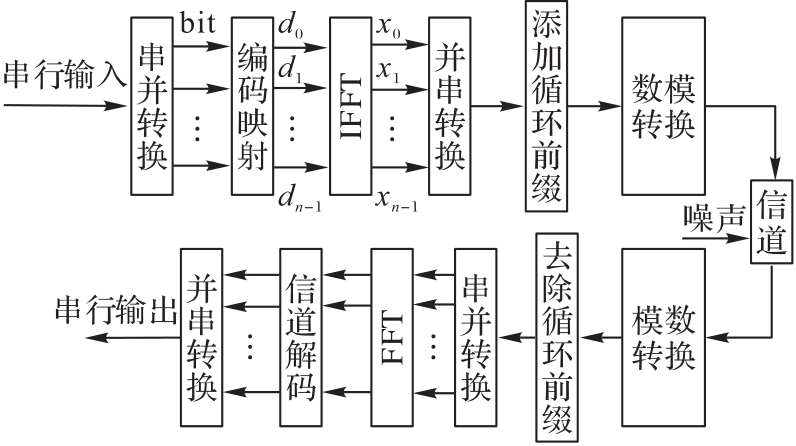
图1 OFDM系统的结构框图
Fig. 1 Block diagram of OFDM system
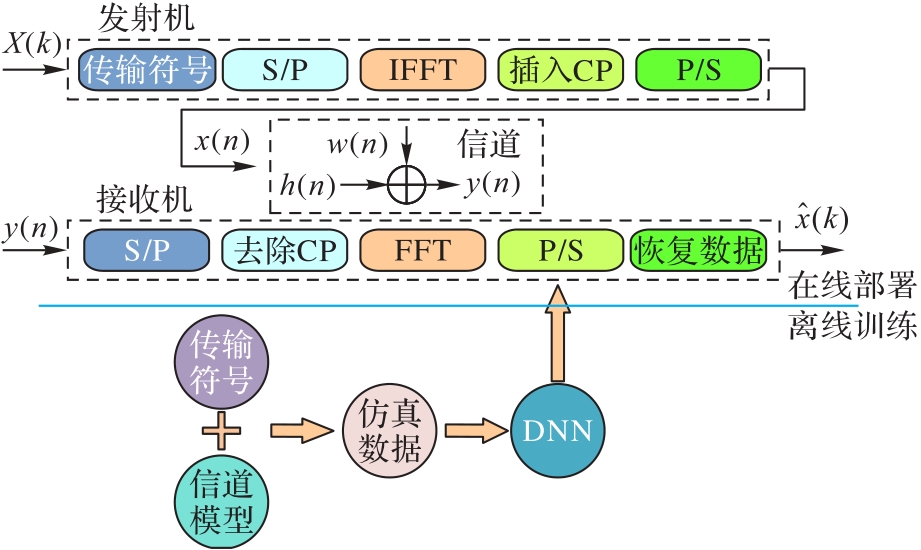
图2 DNN信道估计算法的系统模型
Fig. 2 System model of DNN channel estimation algorithm
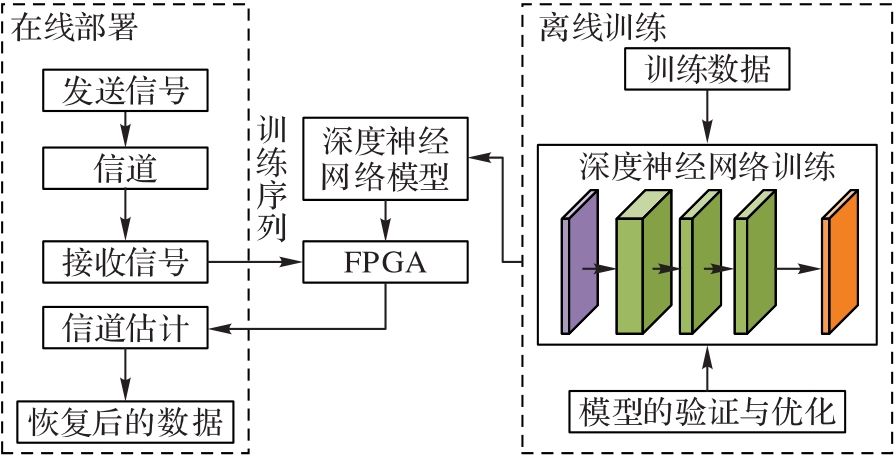
图3 FPGA硬件系统的架构
Fig. 3 Architecture of FPGA hardware system
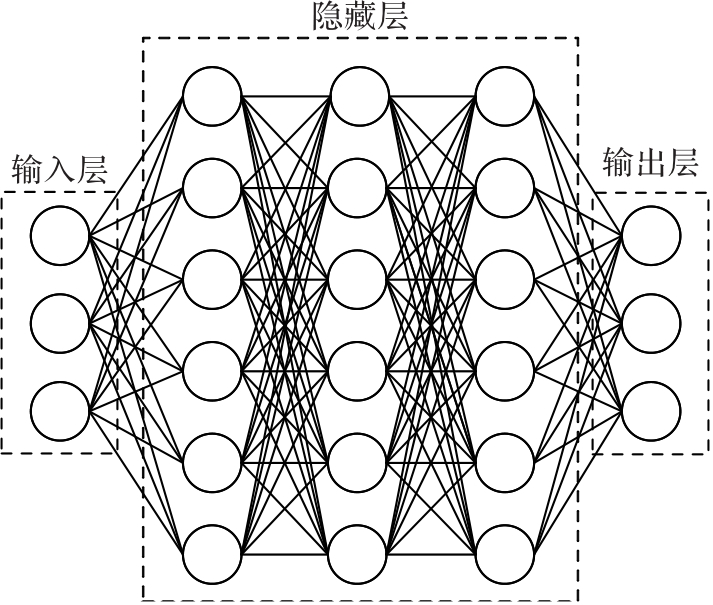
图4 DNN模型的结构
Fig. 4 Structure of DNN model
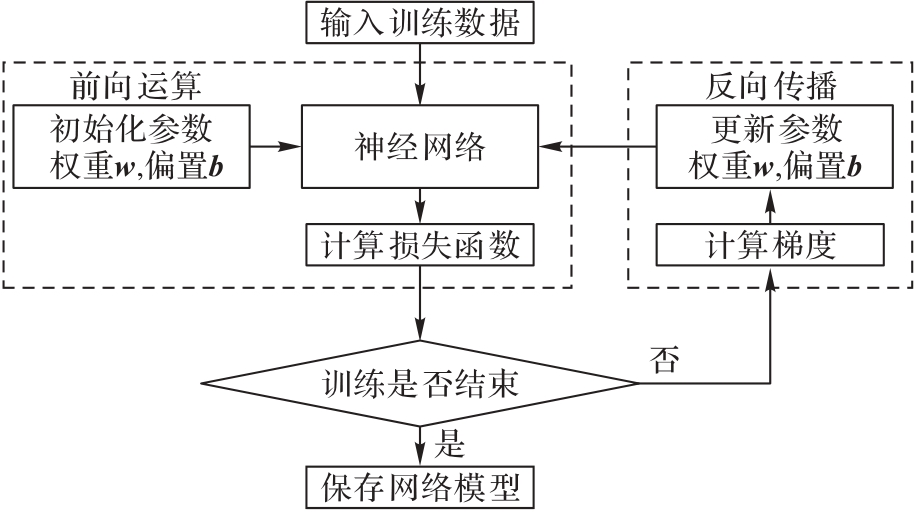
图5 DNN模型的训练过程
Fig. 5 Training process of DNN model
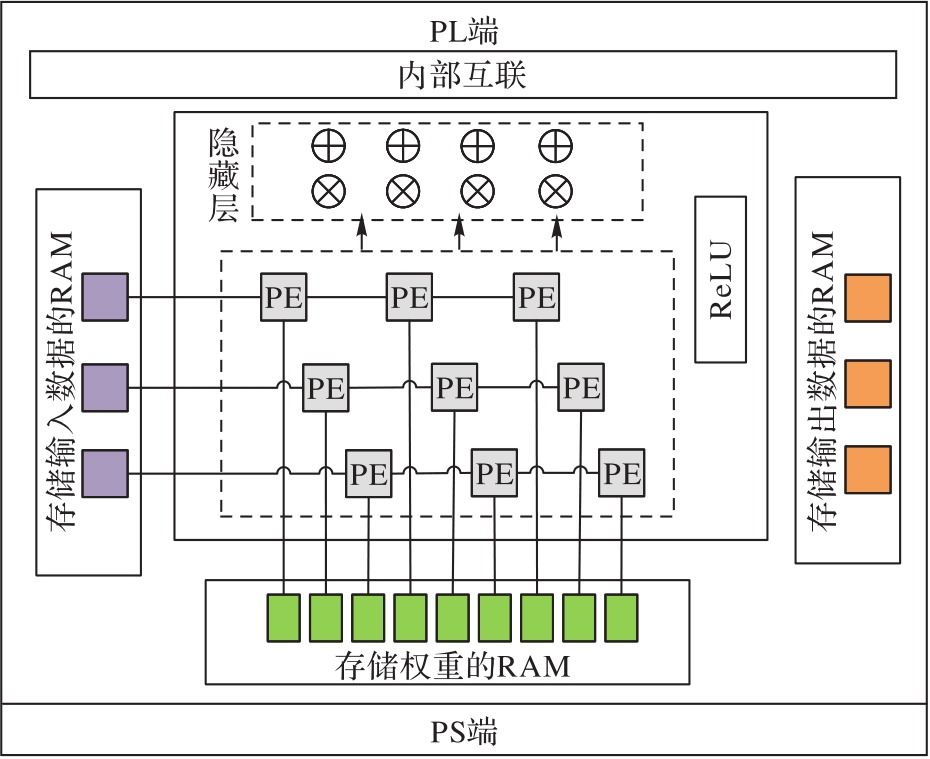
图6 DNN模型的FPGA设计的总体框图
Fig. 6 Overall block diagram of FPGA design of DNN model
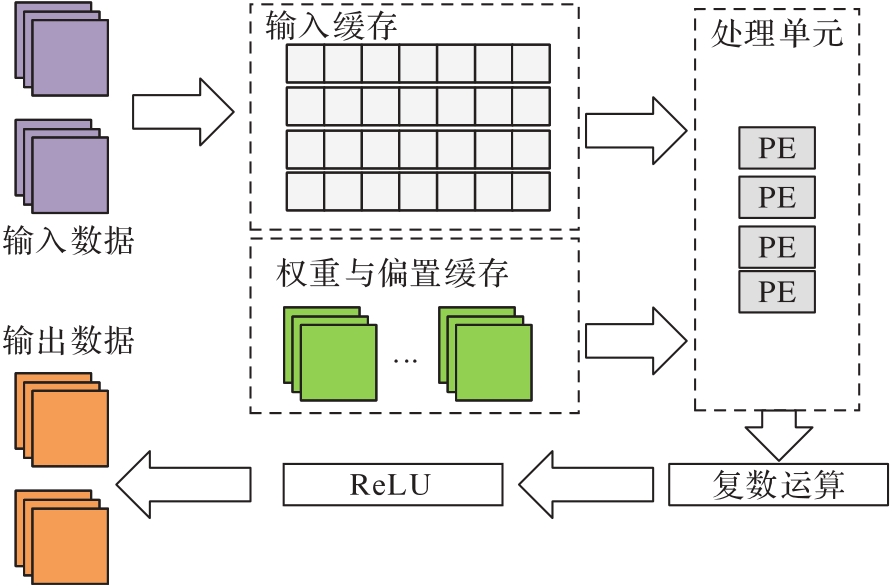
图7 复数计算流程
Fig. 7 Complex number calculation process
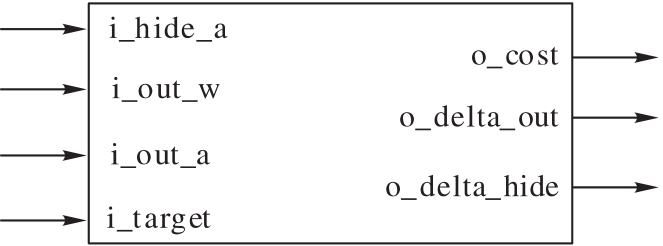
图8 神经元误差值计算模块
Fig. 8 Neuron error value calculation module
| 名称 | I/O类型 | 说明 |
|---|---|---|
| i_hide_a | input | 隐藏层激活值 |
| i_out_w | input | 输出层权重值 |
| i_out_a | input | 输出层激活值 |
| i_target | input | 目标值 |
| o_cost | output | 输出层损失值 |
| o_delta_out | output | 输出层误差值 |
| o_delta_hide | output | 隐藏层误差值 |
表1 神经元误差值计算模块的信号端口
Tab. 1 Signal ports of neuron error value calculation module
| 名称 | I/O类型 | 说明 |
|---|---|---|
| i_hide_a | input | 隐藏层激活值 |
| i_out_w | input | 输出层权重值 |
| i_out_a | input | 输出层激活值 |
| i_target | input | 目标值 |
| o_cost | output | 输出层损失值 |
| o_delta_out | output | 输出层误差值 |
| o_delta_hide | output | 隐藏层误差值 |
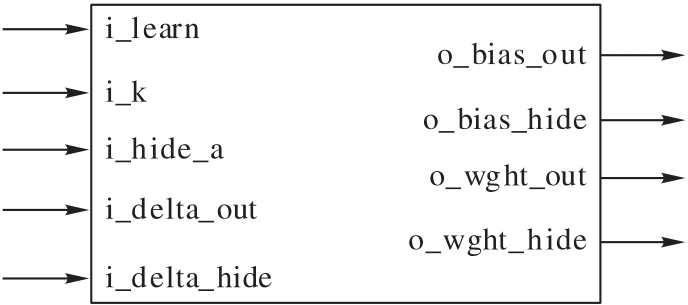
图9 权重与偏置更新模块
Fig. 9 Weight and bias update module
| 名称 | I/O类型 | 说明 |
|---|---|---|
| clk | input | 时钟信号 |
| rst | input | 复位信号 |
| en | input | 使能信号 |
| i_learn | input | 学习率 |
| i_k | input | 输入层激活值 |
| i_hide_a | input | 隐藏层激活值 |
| i_delta_out | input | 输出层误差值 |
| i_delta_hide | input | 隐藏层误差值 |
| o_bias_out | output | 输出层偏置更新值 |
| o_bias_hide | output | 隐藏层偏置更新值 |
| o_wght_out | output | 输出层权重更新值 |
| o_wght_hide | output | 隐藏层权重更新值 |
表2 权重与偏置更新模块的信号端口
Tab. 2 Signal ports of weight and bias update module
| 名称 | I/O类型 | 说明 |
|---|---|---|
| clk | input | 时钟信号 |
| rst | input | 复位信号 |
| en | input | 使能信号 |
| i_learn | input | 学习率 |
| i_k | input | 输入层激活值 |
| i_hide_a | input | 隐藏层激活值 |
| i_delta_out | input | 输出层误差值 |
| i_delta_hide | input | 隐藏层误差值 |
| o_bias_out | output | 输出层偏置更新值 |
| o_bias_hide | output | 隐藏层偏置更新值 |
| o_wght_out | output | 输出层权重更新值 |
| o_wght_hide | output | 隐藏层权重更新值 |
| 参数 | 设置 |
|---|---|
| 信道模型 | 瑞利信道 |
子载波数量 载波频率 | 64 5.2 GHz |
| 子载波间隔 | 15 kHz |
| 系统采样频率 | 15.36 MHz |
| 调制方式 | 16QAM |
| 噪声类型 | AWGN |
| SNR范围/dB | 0~30 |
表3 OFDM系统的仿真参数设置
Tab. 3 Simulation parameter setting of OFDM system
| 参数 | 设置 |
|---|---|
| 信道模型 | 瑞利信道 |
子载波数量 载波频率 | 64 5.2 GHz |
| 子载波间隔 | 15 kHz |
| 系统采样频率 | 15.36 MHz |
| 调制方式 | 16QAM |
| 噪声类型 | AWGN |
| SNR范围/dB | 0~30 |
| 参数 | 设置 |
|---|---|
| 隐藏层结构 | 3层 |
| 隐藏层激活函数 | ReLU |
| 各层神经元个数 | 104 |
| 验证集比例 | 25%(从训练集中) |
| 测试集比例 | 20%(从原始数据中) |
| 迭代次数 | 500 |
表4 DNN模型的仿真参数设置
Tab. 4 Simulation parameter settings of DNN model
| 参数 | 设置 |
|---|---|
| 隐藏层结构 | 3层 |
| 隐藏层激活函数 | ReLU |
| 各层神经元个数 | 104 |
| 验证集比例 | 25%(从训练集中) |
| 测试集比例 | 20%(从原始数据中) |
| 迭代次数 | 500 |
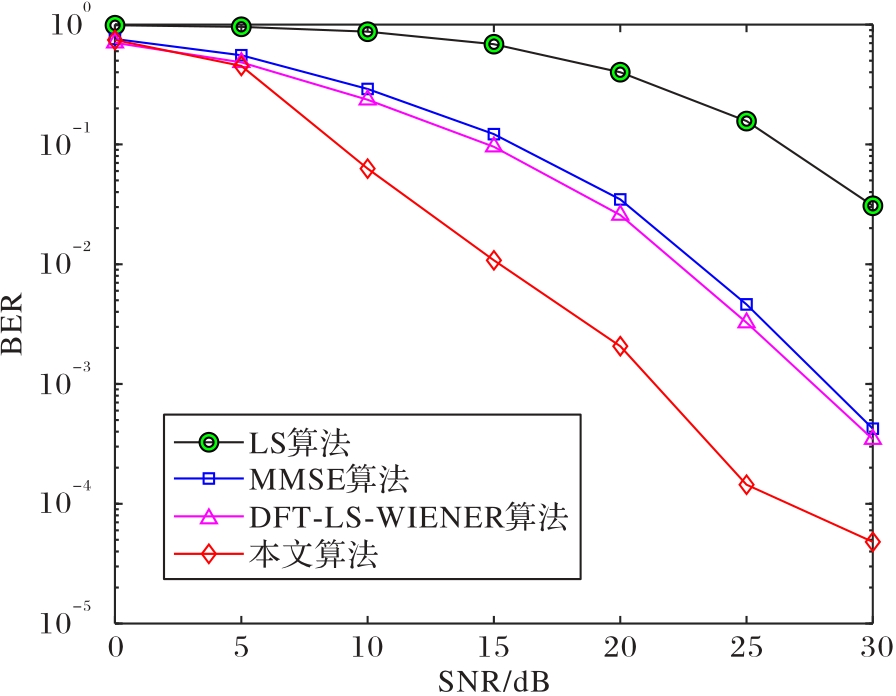
图10 不同信道估计算法在不同SNR条件下的BER性能对比
Fig. 10 Comparison of BER performance of different channel estimation algorithms under different SNR conditions
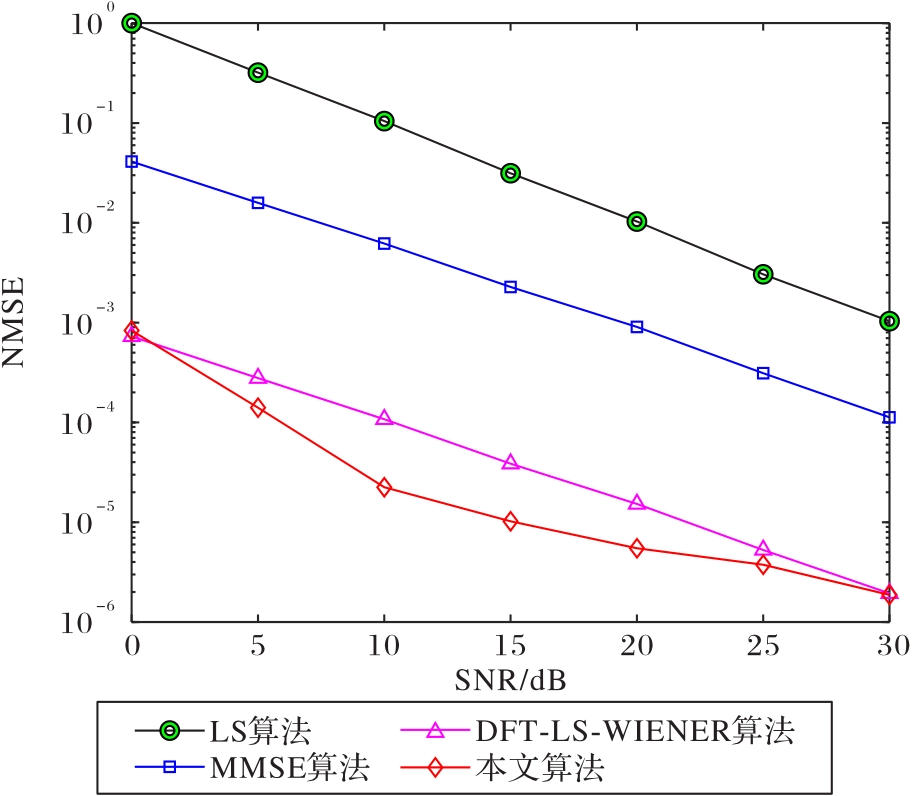
图11 不同信道估计算法在不同SNR条件下的NMSE性能对比
Fig. 11 Comparison of NMSE performance of different channel estimation algorithms under different SNR conditions
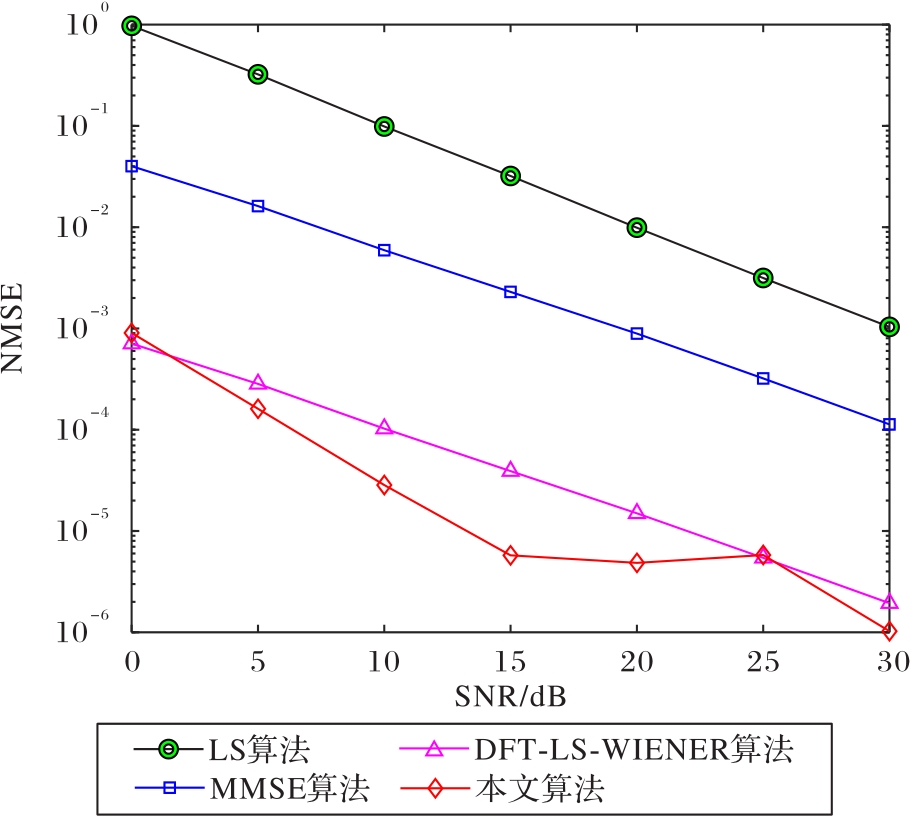
图12 移动速度设为30 km/h时的NMSE性能对比
Fig. 12 Comparison of NMSE performance with movement speed of 30 km/h
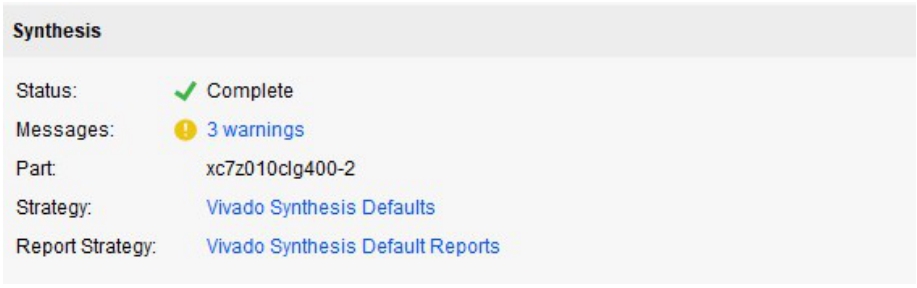
图13 综合与布局布线结果
Fig. 13 Synthesis and place and route results
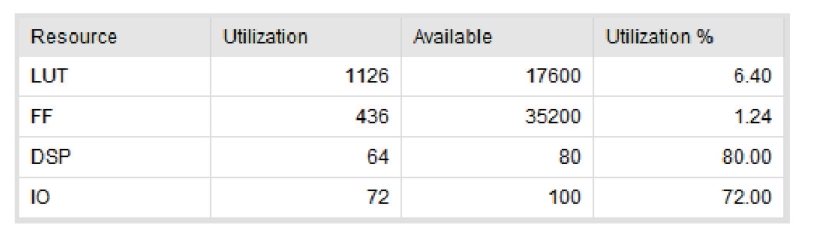
图14 电路资源消耗报告
Fig. 14 Circuit resource consumption report
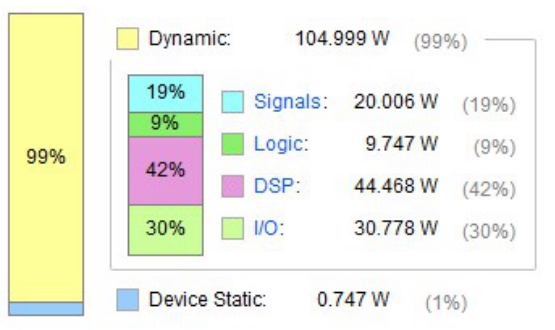
图15 电路运行功耗报告
Fig. 15 Circuit operation power consumption report
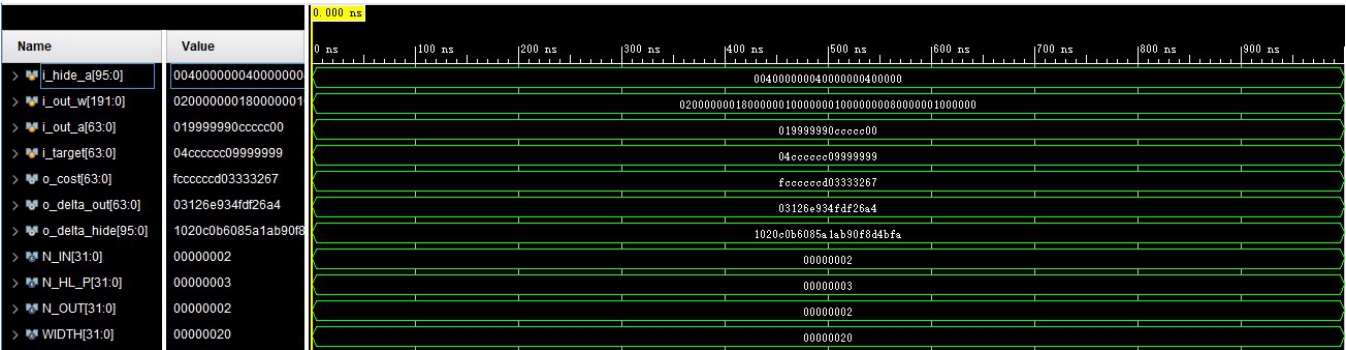
图16 神经元误差值计算模块的仿真波形图
Fig. 16 Simulated waveform diagram of neuron error value calculation module
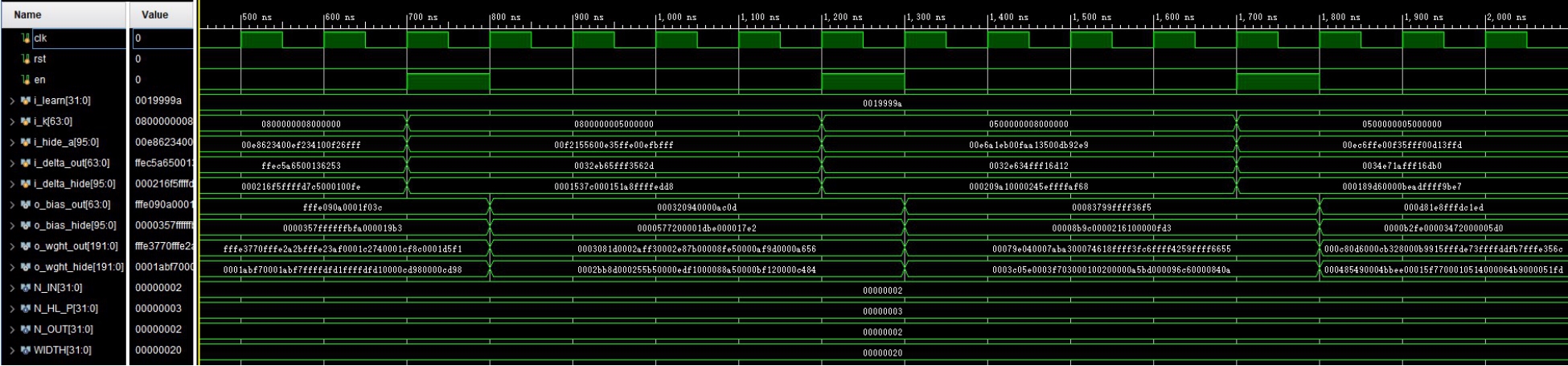
图17 权重与偏置更新模块的仿真波形图
Fig. 17 Simulated waveform diagram of weight and bias update module
| [1] | Hu J, Bai Z, Yang J, et al. DNN and LS based channel estimation in OTFS system [C]// ICCT 2023. Piscataway: IEEE, 2023: 106-110. |
| [2] | 李攀攀,谢正霞,乐光学,等.基于深度学习的无线通信接收方法研究进展与趋势[J].电信科学, 2022, 38(2): 1-17. |
| Li Panpan, Xie Zhengxia, Yue Guangxue, et al. Research progress and trends of deep learning based wireless communication receiving method [J]. Telecommunications Science, 2022, 38(2): 1-17. | |
| [3] | Kim H, Seol K, Kim J, et al. A DNN-based channel estimation scheme for PMCH in LTE-based 5G terrestrial broadcast system [C]// BMSB 2022. Piscataway: IEEE, 2022: 1-5. |
| [4] | 谢斌,陈博,乐鸿浩.基于正交频分复用的线性最小均方误差信道估计改进算法[J].计算机应用, 2015, 35(11): 3265-3269. |
| Xie Bin, Chen Bo, Le Honghao. Improved linear minimum mean square error channel estimation algorithm based on orthogonal frequency division multiplexing [J]. Journal of Computer Applications, 2015, 35(11): 3265-3269. | |
| [5] | Konstantinidis S, Freear S. Performance analysis of Tikhonov regularized LS channel estimation for MIMO OFDM systems with virtual carriers [J]. Wireless Personal Communications, 2012, 64(4): 703-717. |
| [6] | Zaib A, Khattak S. Structure-based low complexity MMSE channel estimator for OFDM wireless systems [J]. Wireless Personal Communications, 2017, 97(4): 5657-5674. |
| [7] | Jo J, Sohn I. On the optimality of training signals for MMSE channel estimation in MIMO-OFDM systems [J]. EURASIP Journal on Wireless Communications and Networking, 2015, 2015: No.105. |
| [8] | Ge L, Shi C, Niu S, et al. Mixed RNN-DNN based channel prediction for massive MIMO OFDM systems [J]. IET Communications, 2023, 17(19): 2152-2161. |
| [9] | Shankar R. Bi-directional LSTM based channel estimation in 5G massive MIMO OFDM systems over TDL-C model with Rayleigh fading distribution [J]. International Journal of Communication Systems, 2023, 36(16): No.e5585. |
| [10] | Ge L, Guo Y, Zhang Y, et al. Deep neural network based channel estimation for massive MIMO-OFDM systems with imperfect channel state information [J]. IEEE Systems Journal, 2022, 16(3): 4675-4685. |
| [11] | Zhu Y, Qian R, Lv X, et al. A DNN-based OFDM channel estimation algorithm without training overheads [C]// ITAIC 2023. Piscataway: IEEE, 2023: 687-691. |
| [12] | Haq S A U, Gizzini A K, Shrey S, et al. Deep neural network augmented wireless channel estimation for preamble-based OFDM PHY on Zynq system on chip [J]. IEEE Transactions on Very Large Scale Integration (VLSI) Systems, 2023, 31(7): 1026-1038. |
| [13] | Glint T, Gupta A, Giftson D, et al. Impact of optimal design point on performance metrics of DNN accelerators in FPGA [C]// ISPASS 2023. Piscataway: IEEE, 2023: 328-330. |
| [14] | Chu Y, Yuan Y, Feng B. FPGA implementation scheme of channel estimation method for leakage suppression [C]// ICMSP 2024. Piscataway: IEEE, 2024: 1-6. |
| [15] | Tsai T H, Ho Y C, Sheu M H, et al. Implementation of FPGA-based accelerator for deep neural networks [C]// DDECS 2019. Piscataway: IEEE, 2019: 1-4. |
| [16] | He H, Wen C K, Jin S, et al. Deep learning-based channel estimation for beamspace mmWave massive MIMO systems [J]. IEEE Wireless Communications Letters, 2018, 7(5): 852-855. |
| [17] | Yallapu S, Sravani P, Koushik R S, et al. Robust channel estimation and performance evaluation of OFDM through AWGN channel [C]// DICCT2024. Piscataway: IEEE, 2024: 514-517. |
| [18] | Zhu Y, Fan D, Mu Y, et al. Model-driven time-varying channel estimation method for OFDM system based on neural network [C]// ICCT 2024. Piscataway: IEEE, 2024: 1520-1524. |
| [19] | Chen S, Liu C, Huang L, et al. Estimation of pilot-assisted OFDM channel based on multi-resolution deep neural networks [C]// ICUS 2022. Piscataway: IEEE, 2022: 764-769. |
| [20] | Dhanasekaran S, Palanisamy S, Hajjej F, et al. Discrete Fourier transform with denoise model based least square wiener channel estimator for channel estimation in MIMO-OFDM [J]. Entropy, 2022, 24(11): No.1601. |
| [1] | 祁晓博, 张晶, 史颖, 亓慧, 杜航原. 基于概念漂移检测的多重主动学习方法[J]. 《计算机应用》唯一官方网站, 2026, 46(5): 1388-1396. |
| [2] | 张驰, 孟宪静, 窦长昊, 王倩, 耿蕾蕾, 袭肖明. MD-FVR:基于多域特征融合的级联手指静脉识别网络[J]. 《计算机应用》唯一官方网站, 2026, 46(5): 1658-1666. |
| [3] | 麦超云, 柯晓鹏, 钟东洲, 洪晓纯, 陈潘荣, 苏志远. 基于混合精度策略的LDLT矩阵分解FPGA加速器设计[J]. 《计算机应用》唯一官方网站, 2026, 46(4): 1218-1226. |
| [4] | 李琼, 陈纯毅, 张振忠, 于波, 于海洋, 胡小娟. 基于差分的多级量化共享密钥提取方案[J]. 《计算机应用》唯一官方网站, 2026, 46(3): 839-846. |
| [5] | 肖海林, 杨昱东, 杨紫伊, 刘海龙, 王玉, 张中山, 戴晓明. R22FFT算法的FPGA硬件结构优化设计与实现[J]. 《计算机应用》唯一官方网站, 2025, 45(8): 2637-2645. |
| [6] | 齐巧玲, 王啸啸, 张茜茜, 汪鹏, 董永峰. 基于元学习的标签噪声自适应学习算法[J]. 《计算机应用》唯一官方网站, 2025, 45(7): 2113-2122. |
| [7] | 王慧斌, 胡展傲, 胡节, 徐袁伟, 文博. 基于分段注意力机制的时间序列预测模型[J]. 《计算机应用》唯一官方网站, 2025, 45(7): 2262-2268. |
| [8] | 向尔康, 黄荣, 董爱华. 开放生成与特征优化的开集识别方法[J]. 《计算机应用》唯一官方网站, 2025, 45(7): 2195-2202. |
| [9] | 陈路, 王怀瑶, 刘京阳, 闫涛, 陈斌. 融合空间-傅里叶域信息的机器人低光环境抓取检测[J]. 《计算机应用》唯一官方网站, 2025, 45(5): 1686-1693. |
| [10] | 王丹, 张文豪, 彭丽娟. 基于深度学习的智能反射面辅助通信系统信道估计[J]. 《计算机应用》唯一官方网站, 2025, 45(5): 1613-1618. |
| [11] | 王华华, 范子健, 刘泽. 基于多空间概率增强的图像对抗样本生成方法[J]. 《计算机应用》唯一官方网站, 2025, 45(3): 883-890. |
| [12] | 杨晟, 李岩. 面向目标检测的对比知识蒸馏方法[J]. 《计算机应用》唯一官方网站, 2025, 45(2): 354-361. |
| [13] | 杨本臣, 李浩然, 金海波. 级联融合与增强重建的多聚焦图像融合网络[J]. 《计算机应用》唯一官方网站, 2025, 45(2): 594-600. |
| [14] | 刘占军, 宋云鹏, 王盛宝. 基于自适应梯度匹配追踪算法的超大规模多输入多输出混合场信道估计[J]. 《计算机应用》唯一官方网站, 2025, 45(12): 3931-3938. |
| [15] | 段新涛, 保梦茹, 武银行, 秦川. 基于四维Chen混沌系统的深度神经网络模型主动保护方法[J]. 《计算机应用》唯一官方网站, 2025, 45(11): 3621-3631. |
| 阅读次数 | ||||||
|
全文 |
|
|||||
|
摘要 |
|
|||||
