


《计算机应用》唯一官方网站 ›› 2026, Vol. 46 ›› Issue (8): 2584-2593.DOI: 10.11772/j.issn.1001-9081.2025070887
刘明1,2, 沈东奇1,2( ), 孟子洋1,2
收稿日期:2025-08-04
修回日期:2025-09-29
接受日期:2025-10-10
发布日期:2025-11-05
出版日期:2026-08-10
通讯作者:
沈东奇
作者简介:刘明(1973—),男,云南曲靖人,研究员,博士,主要研究方向:自动控制与导航、机器人SLAM算法基金资助:
Ming LIU1,2, Dongqi SHEN1,2(), Ziyang MENG1,2
Received:2025-08-04
Revised:2025-09-29
Accepted:2025-10-10
Online:2025-11-05
Published:2026-08-10
Contact:
Dongqi SHEN
About author:LIU Ming, born in 1973, Ph. D., research fellow. His research interests include automatic control and navigation, robot SLAM algorithms.Supported by:摘要:
针对点云配准中因部分重叠、遮挡与噪声干扰导致的配准精度差与鲁棒性不足的问题,提出一种双分支结构下的多层次特征融合的点云配准网络DMFNet(Dual-branch Multi-level Feature Fusion Network)。该网络在编码阶段并行设置旋转分支与平移分支,并在浅层、中层与深层分别引入自注意力融合与交叉注意力融合模块,从而实现源点云与参考点云之间的多尺度特征交互与深度融合,同时,设计了旋转与平移特征融合模块以增强姿态估计能力;在回归阶段基于轻量级Set Transformer回归器,采用多层诱导注意力块与注意力池化模块来直接回归四元数与平移向量。DMFNet不依赖重叠区域的检测或显式掩码估计,具备更强的适应性与泛化能力。在ModelNet40数据集上与6种点云配准方法进行对比实验,并在斯坦福3D扫描数据集进行泛化能力实验。实验结果表明,在ModelNet40数据集上添加噪声的情况下二次采样,相较于最大极大团配准(MAC)方法,DMFNet在RMSE(t)和Error(R)指标上分别降低了21.32%和14.47%,展现出更优的鲁棒性与配准精度。
中图分类号:
刘明, 沈东奇, 孟子洋. 双分支结构下多层次特征融合的点云配准网络[J]. 计算机应用, 2026, 46(8): 2584-2593.
Ming LIU, Dongqi SHEN, Ziyang MENG. Point cloud registration network with dual-branch multi-level feature fusion[J]. Journal of Computer Applications, 2026, 46(8): 2584-2593.
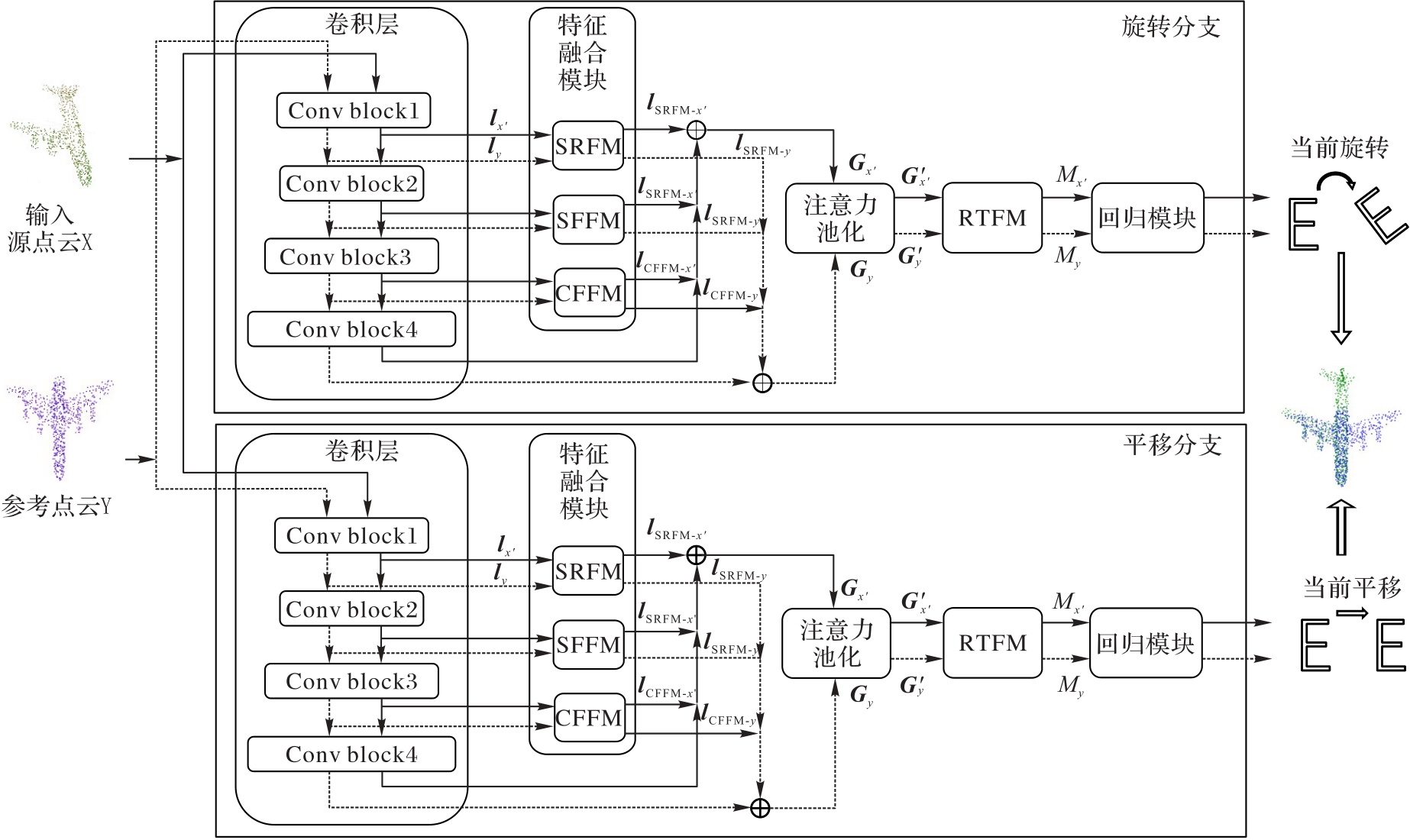
图1 DMFNet的框架
Fig. 1 Framework of DMFNet
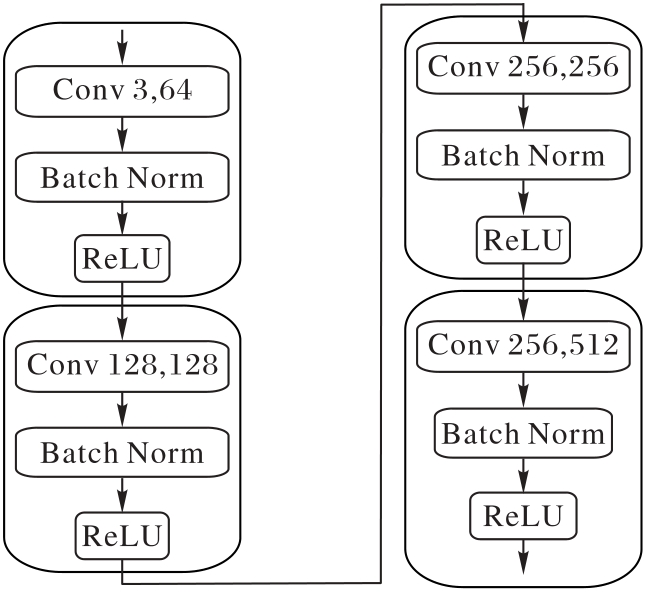
图2 卷积层
Fig. 2 Convolutional layer
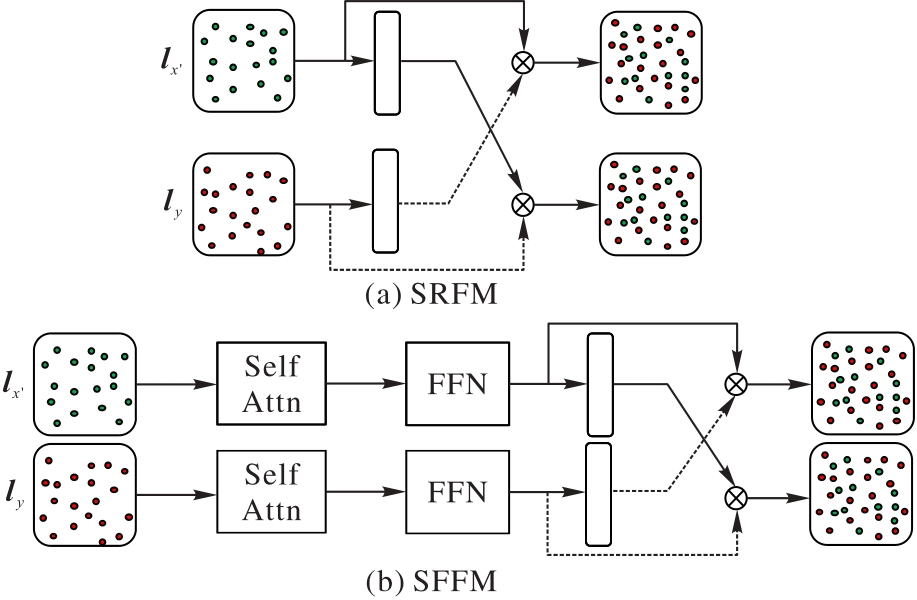
图3 SRFM和SFFM特征融合模块
Fig. 3 SRFM and SFFM feature fusion modules
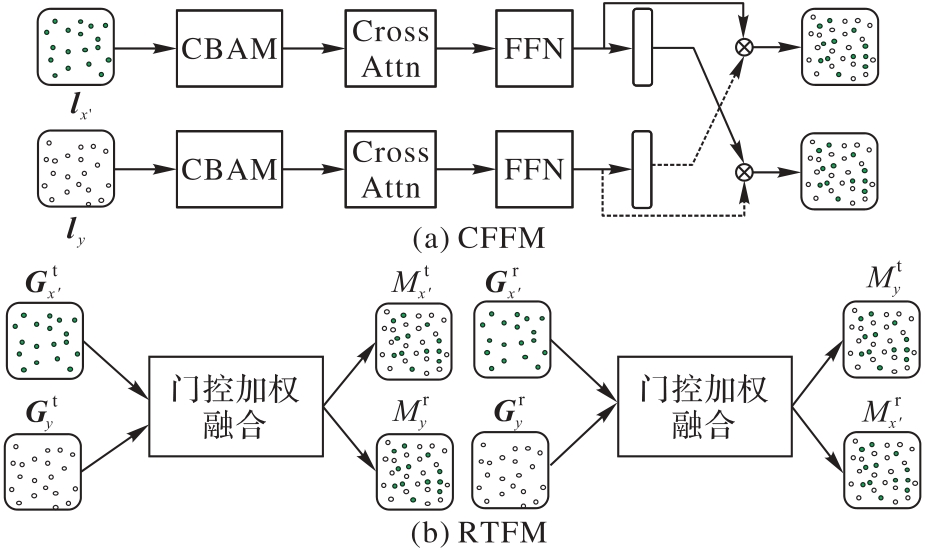
图4 CFFM和RTFM特征融合模块
Fig. 4 CFFM and RTFM feature fusion modules

图5 回归模块的结构
Fig. 5 Structure of regression module
| 方法 | RMSE(R) | RMSE(t) | MAE(R) | MAE(t) | Error(R) | Error(t) | ||||||
|---|---|---|---|---|---|---|---|---|---|---|---|---|
| OS | TS | OS | TS | OS | TS | OS | TS | OS | TS | OS | TS | |
| PointNetLK | 22.666 | 26.354 | 0.235 8 | 0.263 1 | 14.062 | 19.256 | 0.161 1 | 0.168 9 | 28.359 | 36.265 | 0.341 2 | 0.359 5 |
| DCP | 12.315 | 12.356 | 0.069 9 | 0.086 9 | 9.135 | 8.956 | 0.056 2 | 0.058 3 | 7.754 | 9.165 | 0.102 8 | 0.134 2 |
| RPMNet | 1.356 | 2.247 | 0.022 5 | 0.027 6 | 0.729 | 1.165 | 0.008 5 | 0.014 2 | 1.446 | 2.256 | 0.019 1 | 0.031 1 |
| RGM | 3.511 | 4.977 | 0.040 4 | 0.048 9 | 1.301 | 1.810 | 0.014 1 | 0.019 5 | 2.506 | 3.523 | 0.029 1 | 0.039 1 |
| OMNet | 0.773 | 1.391 | 0.015 2 | 0.023 1 | 0.271 | 0.569 | 0.005 6 | 0.009 5 | 0.556 | 1.121 | 0.012 1 | 0.019 7 |
| MAC | 0.761 | 0.985 | 0.013 3 | 0.020 3 | 0.248 | 0.487 | 0.005 1 | 0.009 0 | 0.485 | 0.956 | 0.010 3 | 0.017 1 |
| FINet | 0.735 | 1.288 | 0.011 5 | 0.019 5 | 0.231 | 0.357 | 0.003 5 | 0.006 1 | 0.497 | 0.710 | 0.008 1 | 0.014 9 |
| DMFNet | 0.731 | 0.823 | 0.011 2 | 0.019 2 | 0.228 | 0.356 | 0.003 1 | 0.006 9 | 0.452 | 0.703 | 0.007 9 | 0.014 1 |
表1 未见点云的实验结果
Tab. 1 Experimental results on unseen point clouds
| 方法 | RMSE(R) | RMSE(t) | MAE(R) | MAE(t) | Error(R) | Error(t) | ||||||
|---|---|---|---|---|---|---|---|---|---|---|---|---|
| OS | TS | OS | TS | OS | TS | OS | TS | OS | TS | OS | TS | |
| PointNetLK | 22.666 | 26.354 | 0.235 8 | 0.263 1 | 14.062 | 19.256 | 0.161 1 | 0.168 9 | 28.359 | 36.265 | 0.341 2 | 0.359 5 |
| DCP | 12.315 | 12.356 | 0.069 9 | 0.086 9 | 9.135 | 8.956 | 0.056 2 | 0.058 3 | 7.754 | 9.165 | 0.102 8 | 0.134 2 |
| RPMNet | 1.356 | 2.247 | 0.022 5 | 0.027 6 | 0.729 | 1.165 | 0.008 5 | 0.014 2 | 1.446 | 2.256 | 0.019 1 | 0.031 1 |
| RGM | 3.511 | 4.977 | 0.040 4 | 0.048 9 | 1.301 | 1.810 | 0.014 1 | 0.019 5 | 2.506 | 3.523 | 0.029 1 | 0.039 1 |
| OMNet | 0.773 | 1.391 | 0.015 2 | 0.023 1 | 0.271 | 0.569 | 0.005 6 | 0.009 5 | 0.556 | 1.121 | 0.012 1 | 0.019 7 |
| MAC | 0.761 | 0.985 | 0.013 3 | 0.020 3 | 0.248 | 0.487 | 0.005 1 | 0.009 0 | 0.485 | 0.956 | 0.010 3 | 0.017 1 |
| FINet | 0.735 | 1.288 | 0.011 5 | 0.019 5 | 0.231 | 0.357 | 0.003 5 | 0.006 1 | 0.497 | 0.710 | 0.008 1 | 0.014 9 |
| DMFNet | 0.731 | 0.823 | 0.011 2 | 0.019 2 | 0.228 | 0.356 | 0.003 1 | 0.006 9 | 0.452 | 0.703 | 0.007 9 | 0.014 1 |
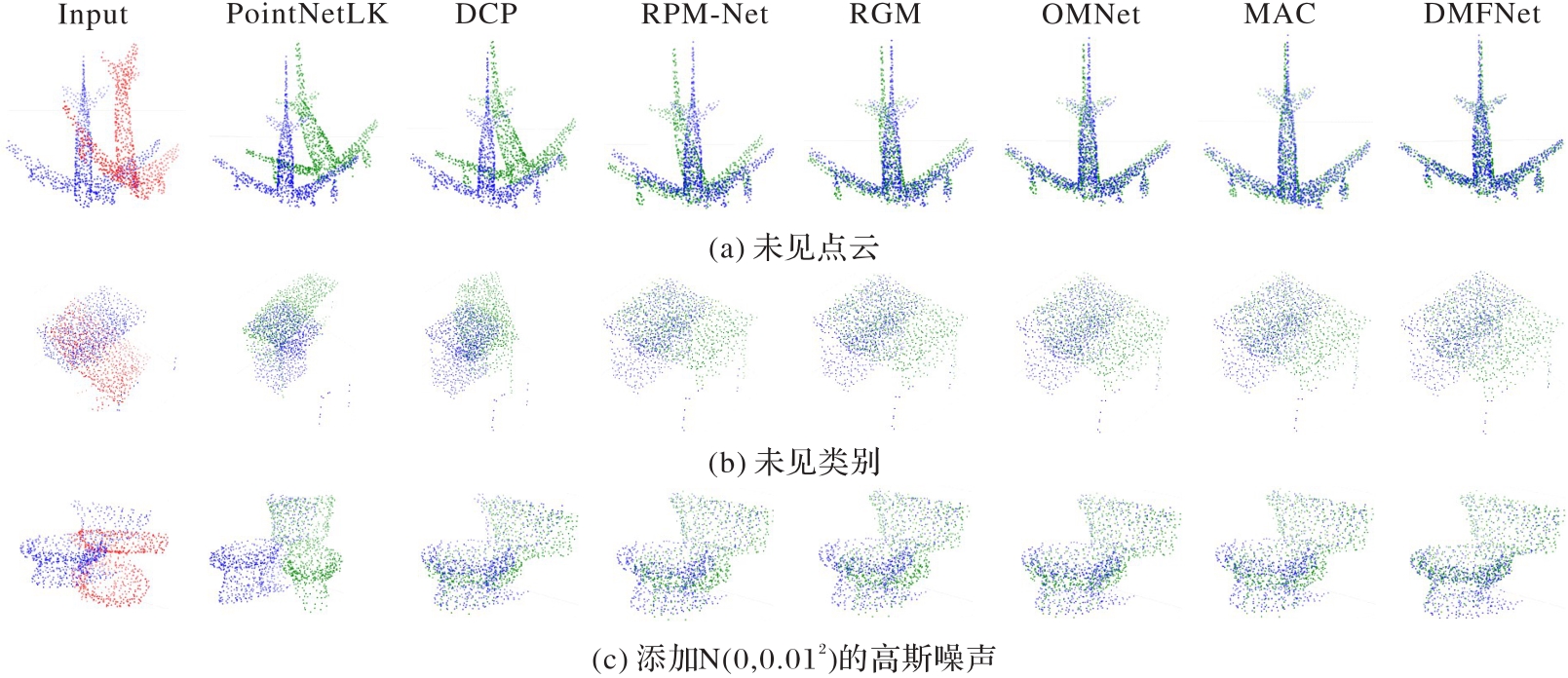
图6 ModelNet40数据集上的配准可视化结果
Fig. 6 Registration visualization results on ModelNet40 dataset
| 方法 | RMSE(R) | RMSE(t) | MAE(R) | MAE(t) | Error(R) | Error(t) | ||||||
|---|---|---|---|---|---|---|---|---|---|---|---|---|
| OS | TS | OS | TS | OS | TS | OS | TS | OS | TS | OS | TS | |
| PointNetLK | 26.911 | 45.265 | 0.252 5 | 0.356 2 | 18.658 | 28.456 | 0.175 3 | 0.231 5 | 36.748 | 53.514 | 0.367 5 | 0.461 2 |
| DCP | 13.521 | 12.956 | 0.082 5 | 0.111 2 | 10.221 | 9.512 | 0.059 6 | 0.075 1 | 12.543 | 11.212 | 0.122 5 | 0.151 1 |
| RPM-Net | 3.938 | 7.546 | 0.044 1 | 0.056 4 | 1.386 | 2.518 | 0.015 1 | 0.026 4 | 2.608 | 4.751 | 0.031 8 | 0.054 6 |
| RGM | 4.986 | 7.359 | 0.040 4 | 0.063 1 | 1.702 | 2.214 | 0.016 8 | 0.023 1 | 3.255 | 4.395 | 0.034 8 | 0.050 2 |
| OMNet | 3.722 | 4.164 | 0.040 3 | 0.042 2 | 1.327 | 1.702 | 0.016 1 | 0.018 1 | 2.666 | 3.258 | 0.033 0 | 0.038 8 |
| MAC | 3.624 | 4.561 | 0.036 8 | 0.038 4 | 1.275 | 1.538 | 0.014 9 | 0.016 8 | 2.586 | 2.914 | 0.031 2 | 0.036 6 |
| FINet | 3.641 | 4.123 | 0.036 4 | 0.041 1 | 1.287 | 1.421 | 0.013 5 | 0.015 7 | 2.514 | 2.697 | 0.029 4 | 0.036 3 |
| DMFNet | 3.361 | 3.845 | 0.032 9 | 0.034 1 | 1.251 | 1.395 | 0.012 8 | 0.015 5 | 2.462 | 2.687 | 0.028 8 | 0.033 0 |
表2 未见类别的实验结果
Tab. 2 Experimental results on unseen categories
| 方法 | RMSE(R) | RMSE(t) | MAE(R) | MAE(t) | Error(R) | Error(t) | ||||||
|---|---|---|---|---|---|---|---|---|---|---|---|---|
| OS | TS | OS | TS | OS | TS | OS | TS | OS | TS | OS | TS | |
| PointNetLK | 26.911 | 45.265 | 0.252 5 | 0.356 2 | 18.658 | 28.456 | 0.175 3 | 0.231 5 | 36.748 | 53.514 | 0.367 5 | 0.461 2 |
| DCP | 13.521 | 12.956 | 0.082 5 | 0.111 2 | 10.221 | 9.512 | 0.059 6 | 0.075 1 | 12.543 | 11.212 | 0.122 5 | 0.151 1 |
| RPM-Net | 3.938 | 7.546 | 0.044 1 | 0.056 4 | 1.386 | 2.518 | 0.015 1 | 0.026 4 | 2.608 | 4.751 | 0.031 8 | 0.054 6 |
| RGM | 4.986 | 7.359 | 0.040 4 | 0.063 1 | 1.702 | 2.214 | 0.016 8 | 0.023 1 | 3.255 | 4.395 | 0.034 8 | 0.050 2 |
| OMNet | 3.722 | 4.164 | 0.040 3 | 0.042 2 | 1.327 | 1.702 | 0.016 1 | 0.018 1 | 2.666 | 3.258 | 0.033 0 | 0.038 8 |
| MAC | 3.624 | 4.561 | 0.036 8 | 0.038 4 | 1.275 | 1.538 | 0.014 9 | 0.016 8 | 2.586 | 2.914 | 0.031 2 | 0.036 6 |
| FINet | 3.641 | 4.123 | 0.036 4 | 0.041 1 | 1.287 | 1.421 | 0.013 5 | 0.015 7 | 2.514 | 2.697 | 0.029 4 | 0.036 3 |
| DMFNet | 3.361 | 3.845 | 0.032 9 | 0.034 1 | 1.251 | 1.395 | 0.012 8 | 0.015 5 | 2.462 | 2.687 | 0.028 8 | 0.033 0 |
| 方法 | RMSE(R) | MAE(R) | RMSE(t) | MAE(t) | Error(R) | Error(t) | ||||||
|---|---|---|---|---|---|---|---|---|---|---|---|---|
| OS | TS | OS | TS | OS | TS | OS | TS | OS | TS | OS | TS | |
| PointNetLK | 25.482 | 28.654 | 19.299 | 21.456 | 0.256 2 | 0.256 2 | 0.186 6 | 0.195 4 | 37.699 | 42.564 | 0.385 5 | 0.395 6 |
| DCP | 13.956 | 12.546 | 10.256 | 9.852 | 0.079 8 | 0.101 2 | 0.061 5 | 0.078 4 | 12.021 | 12.425 | 0.125 6 | 0.154 5 |
| RPMNet | 4.117 | 6.212 | 1.589 | 2.412 | 0.047 1 | 0.064 2 | 0.018 1 | 0.028 6 | 2.985 | 4.985 | 0.038 8 | 0.054 6 |
| RGM | 5.968 | 6.452 | 2.459 | 3.123 | 0.057 9 | 0.065 4 | 0.025 0 | 0.031 2 | 4.769 | 6.523 | 0.051 6 | 0.062 3 |
| OMNet | 3.571 | 4.414 | 1.580 | 1.952 | 0.039 1 | 0.048 8 | 0.017 7 | 0.022 2 | 3.072 | 3.845 | 0.035 3 | 0.043 2 |
| MAC | 3.501 | 4.121 | 1.426 | 1.812 | 0.036 6 | 0.046 9 | 0.017 2 | 0.019 8 | 2.885 | 3.688 | 0.033 1 | 0.040 2 |
| FINet | 3.754 | 3.956 | 1.395 | 1.691 | 0.034 0 | 0.037 4 | 0.014 9 | 0.017 6 | 2.771 | 3.264 | 0.031 6 | 0.036 6 |
| DMFNet | 3.415 | 3.741 | 1.369 | 1.689 | 0.033 9 | 0.036 9 | 0.015 9 | 0.017 9 | 2.662 | 3.154 | 0.030 0 | 0.035 5 |
表3 添加高斯噪声的实验结果
Tab. 3 Experimental results with adding Gaussian noise
| 方法 | RMSE(R) | MAE(R) | RMSE(t) | MAE(t) | Error(R) | Error(t) | ||||||
|---|---|---|---|---|---|---|---|---|---|---|---|---|
| OS | TS | OS | TS | OS | TS | OS | TS | OS | TS | OS | TS | |
| PointNetLK | 25.482 | 28.654 | 19.299 | 21.456 | 0.256 2 | 0.256 2 | 0.186 6 | 0.195 4 | 37.699 | 42.564 | 0.385 5 | 0.395 6 |
| DCP | 13.956 | 12.546 | 10.256 | 9.852 | 0.079 8 | 0.101 2 | 0.061 5 | 0.078 4 | 12.021 | 12.425 | 0.125 6 | 0.154 5 |
| RPMNet | 4.117 | 6.212 | 1.589 | 2.412 | 0.047 1 | 0.064 2 | 0.018 1 | 0.028 6 | 2.985 | 4.985 | 0.038 8 | 0.054 6 |
| RGM | 5.968 | 6.452 | 2.459 | 3.123 | 0.057 9 | 0.065 4 | 0.025 0 | 0.031 2 | 4.769 | 6.523 | 0.051 6 | 0.062 3 |
| OMNet | 3.571 | 4.414 | 1.580 | 1.952 | 0.039 1 | 0.048 8 | 0.017 7 | 0.022 2 | 3.072 | 3.845 | 0.035 3 | 0.043 2 |
| MAC | 3.501 | 4.121 | 1.426 | 1.812 | 0.036 6 | 0.046 9 | 0.017 2 | 0.019 8 | 2.885 | 3.688 | 0.033 1 | 0.040 2 |
| FINet | 3.754 | 3.956 | 1.395 | 1.691 | 0.034 0 | 0.037 4 | 0.014 9 | 0.017 6 | 2.771 | 3.264 | 0.031 6 | 0.036 6 |
| DMFNet | 3.415 | 3.741 | 1.369 | 1.689 | 0.033 9 | 0.036 9 | 0.015 9 | 0.017 9 | 2.662 | 3.154 | 0.030 0 | 0.035 5 |
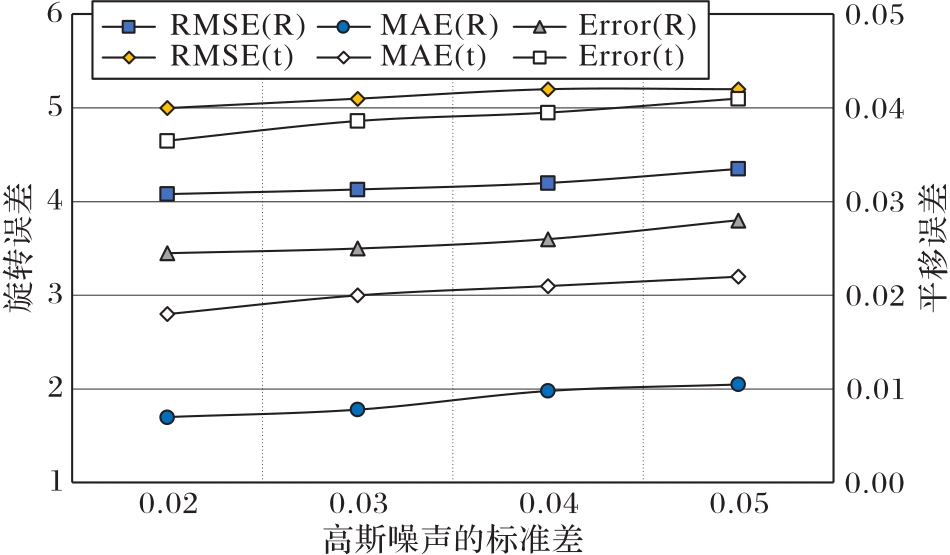
图7 不同高斯噪声下的实验结果
Fig. 7 Experimental results under different levels of Gaussian noise
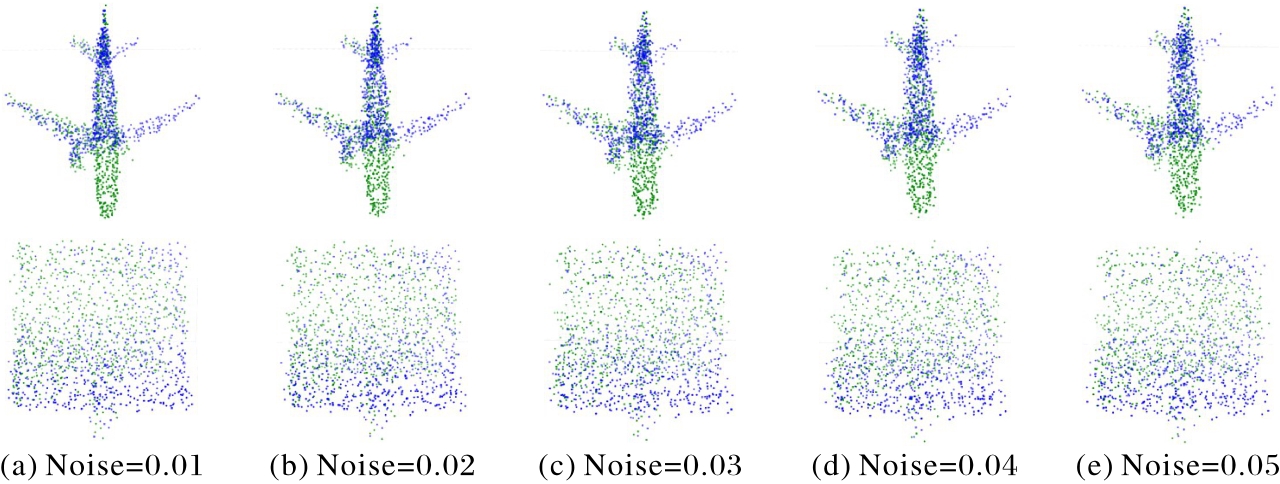
图8 不同高斯噪声下的可视化结果
Fig. 8 Visualization results under different levels of Gaussian noise
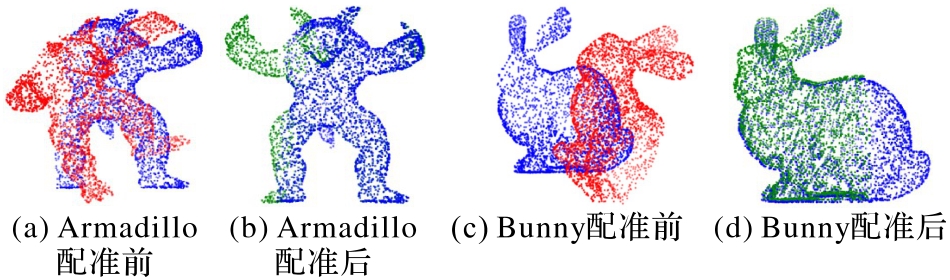
图9 Stanford数据集上的配准可视化结果
Fig. 9 Registration visualization results on Stanford dataset
| 模型 | RMSE(R) | RMSE(t) | MAE(R) | MAE(t) | Error(R) | Error(t) |
|---|---|---|---|---|---|---|
| Armadillo | 1.445 | 0.008 8 | 0.438 | 0.011 1 | 1.322 | 0.009 5 |
| Bunny | 1.429 | 0.008 5 | 0.420 | 0.010 9 | 1.317 | 0.009 3 |
表4 Stanford数据集实验结果
Tab. 4 Experimental results on Stanford dataset
| 模型 | RMSE(R) | RMSE(t) | MAE(R) | MAE(t) | Error(R) | Error(t) |
|---|---|---|---|---|---|---|
| Armadillo | 1.445 | 0.008 8 | 0.438 | 0.011 1 | 1.322 | 0.009 5 |
| Bunny | 1.429 | 0.008 5 | 0.420 | 0.010 9 | 1.317 | 0.009 3 |
| Branch | RMSE(R) | RMSE(t) | Error(R) | Error(t) |
|---|---|---|---|---|
| Single Branch | 5.323 | 0.054 8 | 5.174 | 0.072 5 |
| Dual Branches | 5.135 | 0.052 2 | 4.943 | 0.071 1 |
表5 分支消融实验结果
Tab. 5 Branch ablation experiment results
| Branch | RMSE(R) | RMSE(t) | Error(R) | Error(t) |
|---|---|---|---|---|
| Single Branch | 5.323 | 0.054 8 | 5.174 | 0.072 5 |
| Dual Branches | 5.135 | 0.052 2 | 4.943 | 0.071 1 |
| 序号 | SRFM | SFFM | CFFM | RTFM | Lpose | Ltriplet | Ldropout | RMSE(R) | RMSE(t) | Error(R) | Error(t) |
|---|---|---|---|---|---|---|---|---|---|---|---|
| 1 | 5.135 | 0.052 2 | 4.943 | 0.071 1 | |||||||
| 2 | √ | 4.911 | 0.049 8 | 4.661 | 0.068 6 | ||||||
| 3 | √ | √ | 4.394 | 0.046 2 | 4.134 | 0.057 6 | |||||
| 4 | √ | √ | √ | 3.965 | 0.040 9 | 3.435 | 0.045 1 | ||||
| 5 | √ | √ | √ | √ | 3.518 | 0.036 2 | 2.913 | 0.036 5 | |||
| 6 | √ | √ | √ | √ | √ | 3.484 | 0.035 7 | 2.806 | 0.034 8 | ||
| 7 | √ | √ | √ | √ | √ | √ | 3.429 | 0.034 8 | 2.701 | 0.031 5 | |
| 8 | √ | √ | √ | √ | √ | √ | √ | 3.415 | 0.033 9 | 2.662 | 0.030 0 |
表6 特征融合模块和损失函数消融实验结果
Tab. 6 Ablation experiment results of feature fusion module and loss function
| 序号 | SRFM | SFFM | CFFM | RTFM | Lpose | Ltriplet | Ldropout | RMSE(R) | RMSE(t) | Error(R) | Error(t) |
|---|---|---|---|---|---|---|---|---|---|---|---|
| 1 | 5.135 | 0.052 2 | 4.943 | 0.071 1 | |||||||
| 2 | √ | 4.911 | 0.049 8 | 4.661 | 0.068 6 | ||||||
| 3 | √ | √ | 4.394 | 0.046 2 | 4.134 | 0.057 6 | |||||
| 4 | √ | √ | √ | 3.965 | 0.040 9 | 3.435 | 0.045 1 | ||||
| 5 | √ | √ | √ | √ | 3.518 | 0.036 2 | 2.913 | 0.036 5 | |||
| 6 | √ | √ | √ | √ | √ | 3.484 | 0.035 7 | 2.806 | 0.034 8 | ||
| 7 | √ | √ | √ | √ | √ | √ | 3.429 | 0.034 8 | 2.701 | 0.031 5 | |
| 8 | √ | √ | √ | √ | √ | √ | √ | 3.415 | 0.033 9 | 2.662 | 0.030 0 |
| [1] | Chen X, Ma H, Wan J, et al. Multi-view 3D object detection network for autonomous driving[C]// CVPR 2017. Piscataway: IEEE, 2017: 6526-6534. |
| [2] | Geiger A, Lenz P, Urtasun R. Are we ready for autonomous driving? the KITTI vision benchmark suite[C]// CVPR 2012. Piscataway: IEEE, 2012: 3354-3361. |
| [3] | Yurtsever E, Lambert J, Carballo A, et al. A survey of autonomous driving: common practices and emerging technologies [J]. IEEE Access, 2020, 8: 58443-58469. |
| [4] | 单明亮,叶俊,严鹏,等. MSC-Net:基于多尺度一致性的点云配准网络[J]. 激光与光电子学进展, 2025, 62(14): No.1428003. |
| Shan Mingliang, Ye Jun, Yan Peng, et al. MSC-Net: multi-scale coherence-based point cloud registration network[J]. Laser and Optoelectronics Progress, 2025, 62(14): No.1428003. | |
| [5] | 谭耀昌,杨俊伟,李昆洋,等. 基于角度约束和极大团的点云配准算法[J]. 激光与光电子学进展, 2025, 62(12): No.1215012. |
| Tan Yaochang, Yang Junwei, Li Kunyang, et al. Point cloud registration algorithm based on angle constraint and maximal clique[J]. Laser and Optoelectronics Progress, 2025, 62(12): No.1215012. | |
| [6] | Izadinia H, Seitz S M. Scene recomposition by learning-based ICP[C]// CVPR 2020. Piscataway: IEEE, 2020: 927-936. |
| [7] | Rusinkiewicz S, Levoy M. Efficient variants of the ICP algorithm[C]// 3DIM 2001. Piscataway: IEEE, 2001: 145-152. |
| [8] | Yang J, Li H, Campbell D, et al. Go-ICP: a globally optimal solution to 3D ICP point-set registration[J]. IEEE Transactions on Pattern Analysis and Machine Intelligence, 2016, 38(11): 2241-2254. |
| [9] | Wang Y, Sun Y, Liu Z, et al. Dynamic graph CNN for learning on point clouds[J]. ACM Transactions on Graphics, 2019, 38(5): No.146. |
| [10] | Aoki Y, Goforth H, Srivatsan R A, et al. PointNetLK: robust and efficient point cloud registration using PointNet[C]// CVPR 2019. Piscataway: IEEE, 2019: 7156-7165. |
| [11] | Qi C R, Su H, Mo K, et al. PointNet: deep learning on point sets for 3D classification and segmentation[C]// CVPR 2017. Piscataway: IEEE, 2017: 77-85. |
| [12] | Yuan W, Eckart B, Kim K, et al. DeepGMR: learning latent gaussian mixture models for registration[C]// ECCV 2020, LNCS 12350. Cham: Springer, 2020: 733-750. |
| [13] | 秦庭威,赵鹏程,秦品乐,等. 基于残差注意力机制的点云配准算法[J]. 计算机应用, 2022, 42(7): 2184-2191. |
| Qin Tingwei, Zhao Pengcheng, Qin Pinle, et al. Point cloud registration algorithm based on residual attention mechanism[J]. Journal of Computer Applications, 2022, 42(7): 2184-2191. | |
| [14] | 梁杰涛,罗兵,付兰慧,等. 基于坐标几何采样的点云配准方法[J]. 计算机应用, 2025, 45(1): 214-222. |
| Liang Jietao, Luo Bing, Fu Lanhui, et al. Point cloud registration method based on coordinate geometric sampling[J]. Journal of Computer Applications, 2025, 45(1): 214-222. | |
| [15] | Yew Z J, Lee G H. RPM-Net: robust point matching using learned features[C]// CVPR 2020. Piscataway: IEEE, 2020: 11821-11830. |
| [16] | Sarode V, Li X, Goforth H, et al. PCRNet: point cloud registration network using PointNet encoding[PP/OL]. V2. arXiv (2019-11-04) [2025-09-22].. |
| [17] | Wang Y, Solomon J. PRNet: self-supervised learning for partial-to-partial registration[C]// NeurIPS 2019. Red Hook: Curran Associates Inc., 2019: 8714-8826. |
| [18] | Vaswani A, Shazeer N, Parmar N, et al. Attention is all you need[C]// NeurIPS 2017. Red Hook: Curran Associates Inc., 2017: 6000-6010. |
| [19] | Mei G, Tang H, Huang X, et al. Unsupervised deep probabilistic approach for partial point cloud registration[C]// CVPR 2023. Piscataway: IEEE, 2023: 13611-13620. |
| [20] | Wang Y, Solomon J. Deep closest point: learning representations for point cloud registration[C]// ICCV 2019. Piscataway: IEEE, 2019: 3522-3531. |
| [21] | Shi C, Chen X, Huang K, et al. Keypoint matching for point cloud registration using multiplex dynamic graph attention networks[J]. IEEE Robotics and Automation Letters, 2021, 6(4): 8221-8228. |
| [22] | Fu K, Liu S, Luo X, et al. Robust point cloud registration framework based on deep graph matching[C]// CVPR 2021. Piscataway: IEEE, 2021: 8889-8898. |
| [23] | Yew Z J, Lee G H. REGTR: end-to-end point cloud correspondences with Transformers[C]// CVPR 2022. Piscataway: IEEE, 2022: 6667-6676. |
| [24] | Zhang X, Yang J, Zhang S, et al. 3D registration with maximal cliques[C]// CVPR 2023. Piscataway: IEEE, 2023: 17745-17754. |
| [25] | 喇孝伟,胡立华,胡建华,等. 融合位置编码和重叠掩模的低重叠点云配准网络[J]. 计算机应用, 2026, 46(2): 536-545. |
| Xiaowei La, Hu Lihua, Hu Jianwei, et al. Low-overlap point cloud registration network integrating position encoding and overlapping masks[J]. Journal of Computer Applications, 2026, 46(2): 536-545. | |
| [26] | Li Y, Bu R, Sun M, et al. PointCNN: convolution on X-transformed points[C]// NeurIPS 2018. Red Hook: Curran Associates Inc., 2018: 828-838. |
| [27] | Xu H, Ye N, Liu G, et al. FINet: dual branches feature interaction for partial-to-partial point cloud registration[J]. Proceedings of the AAAI Conference on Artificial Intelligence, 2022, 36(3): 2848-2856. |
| [28] | Woo S H, Park J, Lee J Y, et al. CBAM: convolutional block attention module[C]// ECCV 2018, LNCS 11211. Cham: Springer, 2018: 3-19. |
| [29] | Shoemake K. Animating rotation with quaternion curves[C]// SIGGRAPH 1985. New York: ACM, 1985: 245-254. |
| [30] | Kingma D P, Ba J L. Adam: a method for stochastic optimization[PP/OL]. V9. arXiv (2017-01-30) [2026-06-20].. |
| [31] | Wu Z, Song S, Khosla A, et al. 3D ShapeNets: a deep representation for volumetric shapes[C]// CVPR 2015. Piscataway: IEEE, 2015: 1912-1920. |
| [32] | Curless B, Levoy M. A volumetric method for building complex models from range images[C]// SIGGRAPH 1996. New York: ACM, 1996: 303-312. |
| [1] | 李光辉, 屈立成. 基于改进Lite-Mono架构的动态空洞卷积和分层注意力模型[J]. 《计算机应用》唯一官方网站, 2026, 46(8): 2567-2576. |
| [2] | 郭晓金, 隋旭洋, 周柯男. 基于深度学习的STAR⁃RIS辅助混合场通信系统信道估计[J]. 《计算机应用》唯一官方网站, 2026, 46(8): 2548-2554. |
| [3] | 刘晶, 赵邵泽, 刘鑫刚, 牛浩哲, 季海鹏. 跨工况下基于改进CGAN的钛合金显微组织数据生成方法[J]. 《计算机应用》唯一官方网站, 2026, 46(7): 2373-2382. |
| [4] | 凌妙根, 井瑞, 方巍. 可解释性深度学习在热带气旋预报中的应用研究综述[J]. 《计算机应用》唯一官方网站, 2026, 46(7): 2318-2326. |
| [5] | 颜建强, 董贝贝, 曲博婷, 彭晨. 融合多源信息与图级注意力的双向扩散动态图卷积交通流预测网络[J]. 《计算机应用》唯一官方网站, 2026, 46(7): 2327-2333. |
| [6] | 杜秀丽, 高星, 张校毓, 潘成胜, 邹启杰. 基于密集时空可变形注意力的视频快照压缩成像重建方法[J]. 《计算机应用》唯一官方网站, 2026, 46(7): 2288-2296. |
| [7] | 张国有, 聂宏宇, 潘理虎, 雷润东. 基于多层感知机级联宽度学习系统的点云语义分割网络Point-MLPBLS[J]. 《计算机应用》唯一官方网站, 2026, 46(7): 2259-2266. |
| [8] | 武湘怡, 叶海良, 曹飞龙. 基于平滑-锐化图卷积的点云补全方法[J]. 《计算机应用》唯一官方网站, 2026, 46(7): 2267-2276. |
| [9] | 刘雯玲, 李勇, 李佳慧, 张厚康. 面向不均匀雾霾遥感图像的无监督去雾方法[J]. 《计算机应用》唯一官方网站, 2026, 46(7): 2297-2306. |
| [10] | 杜艺, 续明进, 孔佳仪, 王力瑶, 赵晨. 基于YOLOv11的低秩自适应参数高效微调算法[J]. 《计算机应用》唯一官方网站, 2026, 46(6): 1738-1745. |
| [11] | 张雅淞, 丛碧辉, 许爽. 引入聚类系数的图神经网络节点分类模型[J]. 《计算机应用》唯一官方网站, 2026, 46(6): 1855-1862. |
| [12] | 秦隽, 焦新涛, 曾碧卿. 融合BiLSTM-Transformer与Kolmogorov-Arnold网络的非侵入式负荷监测方法[J]. 《计算机应用》唯一官方网站, 2026, 46(6): 2026-2033. |
| [13] | 吕超, 马歌谣. 基于冗余特征抑制的轻量级人体姿态估计网络[J]. 《计算机应用》唯一官方网站, 2026, 46(6): 1973-1980. |
| [14] | 何运平, 王雷春, 宋芮芮, 卢祥凤, 魏金香, 刘小萌. 基于对比不变性和强化特定性的双通道多模态情感分析模型[J]. 《计算机应用》唯一官方网站, 2026, 46(6): 1767-1775. |
| [15] | 姚力挽, 刘海龙, 曾张帆. 基于频域驱动及扩散融合的声纳图像增强算法[J]. 《计算机应用》唯一官方网站, 2026, 46(6): 1947-1955. |
| 阅读次数 | ||||||
|
全文 |
|
|||||
|
摘要 |
|
|||||
