

Journal of Computer Applications ›› 2026, Vol. 46 ›› Issue (10): 3093-3100.DOI: 10.11772/j.issn.1001-9081.2025091087
• Artificial intelligence • Previous Articles
Yuzhen WU, Chen PAN( ), Qiannan LI
Received:2025-09-19
Revised:2025-11-10
Accepted:2025-11-12
Online:2025-11-19
Published:2026-10-10
Contact:
Chen PAN
About author:WU Yuzhen, born in 2001, M. S. candidate. Her research interests include machine vision, artificial intelligence, pattern recognition.Supported by:
吴雨臻, 潘晨(), 栗倩楠
通讯作者:
潘晨
作者简介:吴雨臻(2001—),女,浙江温州人,硕士研究生,主要研究方向:机器视觉、人工智能、模式识别基金资助:CLC Number:
Yuzhen WU, Chen PAN, Qiannan LI. Multi-model collaborative continual learning framework based on filtering mechanism[J]. Journal of Computer Applications, 2026, 46(10): 3093-3100.
吴雨臻, 潘晨, 栗倩楠. 基于筛选机制的多模型协同持续学习框架[J]. 《计算机应用》唯一官方网站, 2026, 46(10): 3093-3100.
Add to citation manager EndNote|Ris|BibTeX
URL: https://www.joca.cn/EN/10.11772/j.issn.1001-9081.2025091087
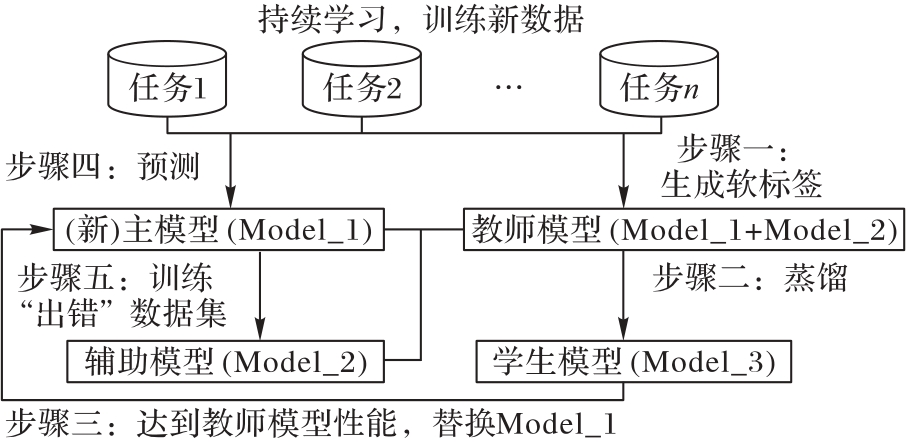
Fig. 1 Continuous learning flow of three-model framework
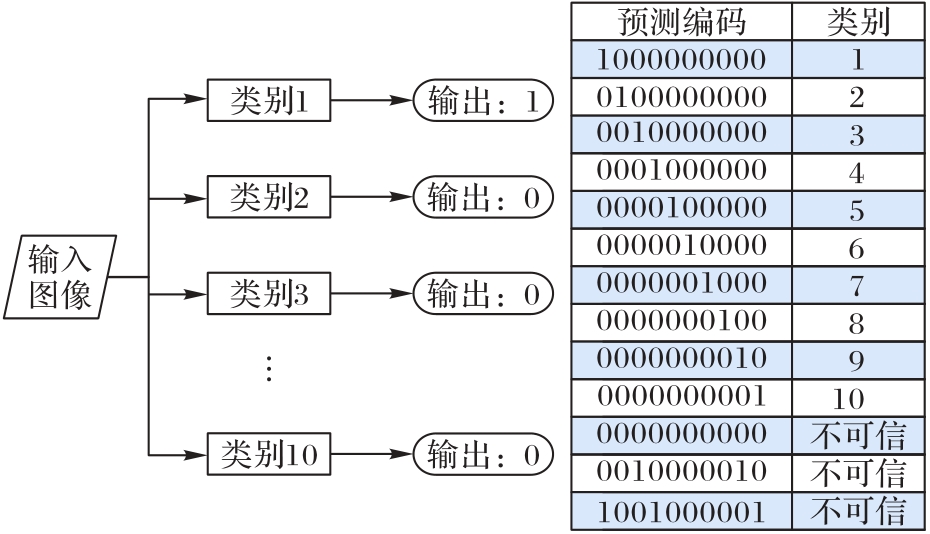
Fig. 2 Output encoding and discriminative rules of auxiliary model
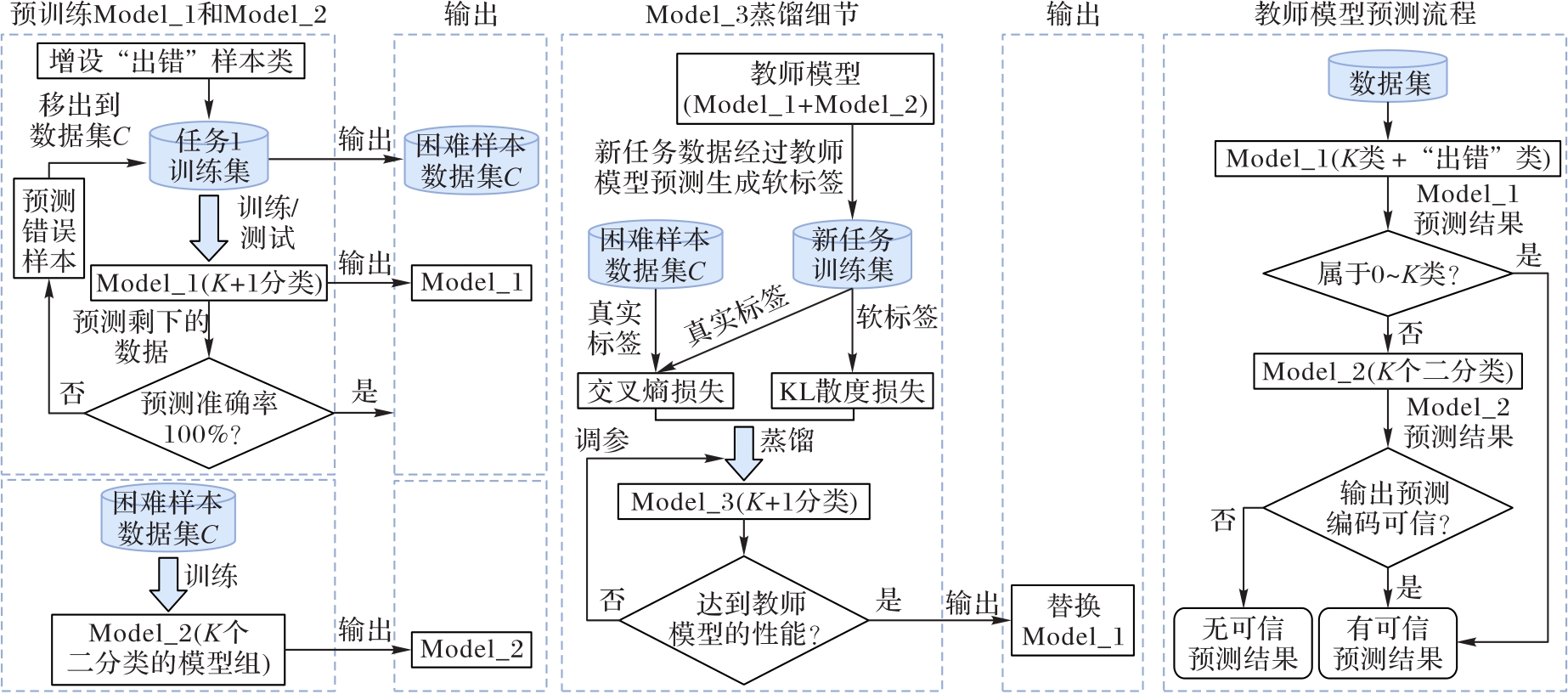
Fig. 3 Detailed training and predicting flows of three models
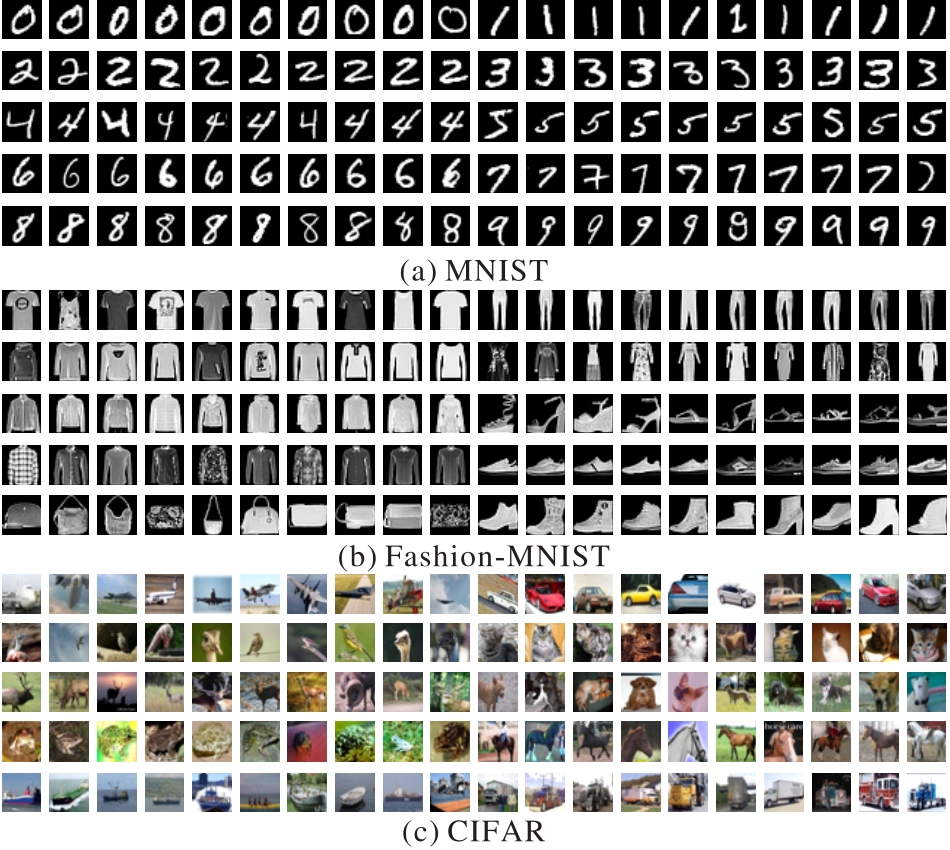
Fig. 4 Dataset image examples
| 模型 | 10 000张测试样本上的准确率 | ||
|---|---|---|---|
| AlexNet | ResNet-18 | ResNet-50 | |
| Model_1 | 99.34 | 99.38 | 99.22 |
| Model_1+Model_2 | 99.49 | 99.55 | 99.39 |
| Model_3 | 99.55 | 99.53 | 99.50 |
| 新Model_1+新Model_2 | 99.67 | 99.56 | 99.58 |
Tab. 1 Comparison of validity experimental results
| 模型 | 10 000张测试样本上的准确率 | ||
|---|---|---|---|
| AlexNet | ResNet-18 | ResNet-50 | |
| Model_1 | 99.34 | 99.38 | 99.22 |
| Model_1+Model_2 | 99.49 | 99.55 | 99.39 |
| Model_3 | 99.55 | 99.53 | 99.50 |
| 新Model_1+新Model_2 | 99.67 | 99.56 | 99.58 |
| 迭代轮数 | 训练数据规模/103 | 困难样本数据规模 | ||
|---|---|---|---|---|
| AlexNet | ResNet-18 | ResNet-50 | ||
| 第一轮 | 20 | 243 | 152 | 168 |
| 第二轮 | 30 | 62 | 8 | 48 |
Tab. 2 Comparison of training set sizes and hard sample sizes
| 迭代轮数 | 训练数据规模/103 | 困难样本数据规模 | ||
|---|---|---|---|---|
| AlexNet | ResNet-18 | ResNet-50 | ||
| 第一轮 | 20 | 243 | 152 | 168 |
| 第二轮 | 30 | 62 | 8 | 48 |
| 方法 | Fashion-MNIST | CIFAR-10 | ||||
|---|---|---|---|---|---|---|
| AAC | BWT | FWT | AAC | BWT | FWT | |
| EWC[ | 0.937 5 | -0.063 7 | 0.798 7 | 0.903 5 | -0.075 5 | 0.717 9 |
| GEM[ | -0.051 4 | 0.794 8 | 0.919 6 | 0.729 6 | ||
| iCaRL[ | 0.912 3 | -0.033 5 | 0.768 1 | 0.879 0 | -0.070 2 | 0.694 5 |
| DER[ | 0.950 9 | -0.054 1 | -0.070 5 | 0.749 8 | ||
| CBP[ | 0.942 4 | -0.064 0 | 0.794 7 | 0.909 6 | -0.071 6 | 0.720 5 |
| 本文框架 | 0.955 0 | 0.834 4 | 0.927 6 | -0.064 5 | ||
Tab. 3 Performance comparison of different methods in task-increment experiments
| 方法 | Fashion-MNIST | CIFAR-10 | ||||
|---|---|---|---|---|---|---|
| AAC | BWT | FWT | AAC | BWT | FWT | |
| EWC[ | 0.937 5 | -0.063 7 | 0.798 7 | 0.903 5 | -0.075 5 | 0.717 9 |
| GEM[ | -0.051 4 | 0.794 8 | 0.919 6 | 0.729 6 | ||
| iCaRL[ | 0.912 3 | -0.033 5 | 0.768 1 | 0.879 0 | -0.070 2 | 0.694 5 |
| DER[ | 0.950 9 | -0.054 1 | -0.070 5 | 0.749 8 | ||
| CBP[ | 0.942 4 | -0.064 0 | 0.794 7 | 0.909 6 | -0.071 6 | 0.720 5 |
| 本文框架 | 0.955 0 | 0.834 4 | 0.927 6 | -0.064 5 | ||
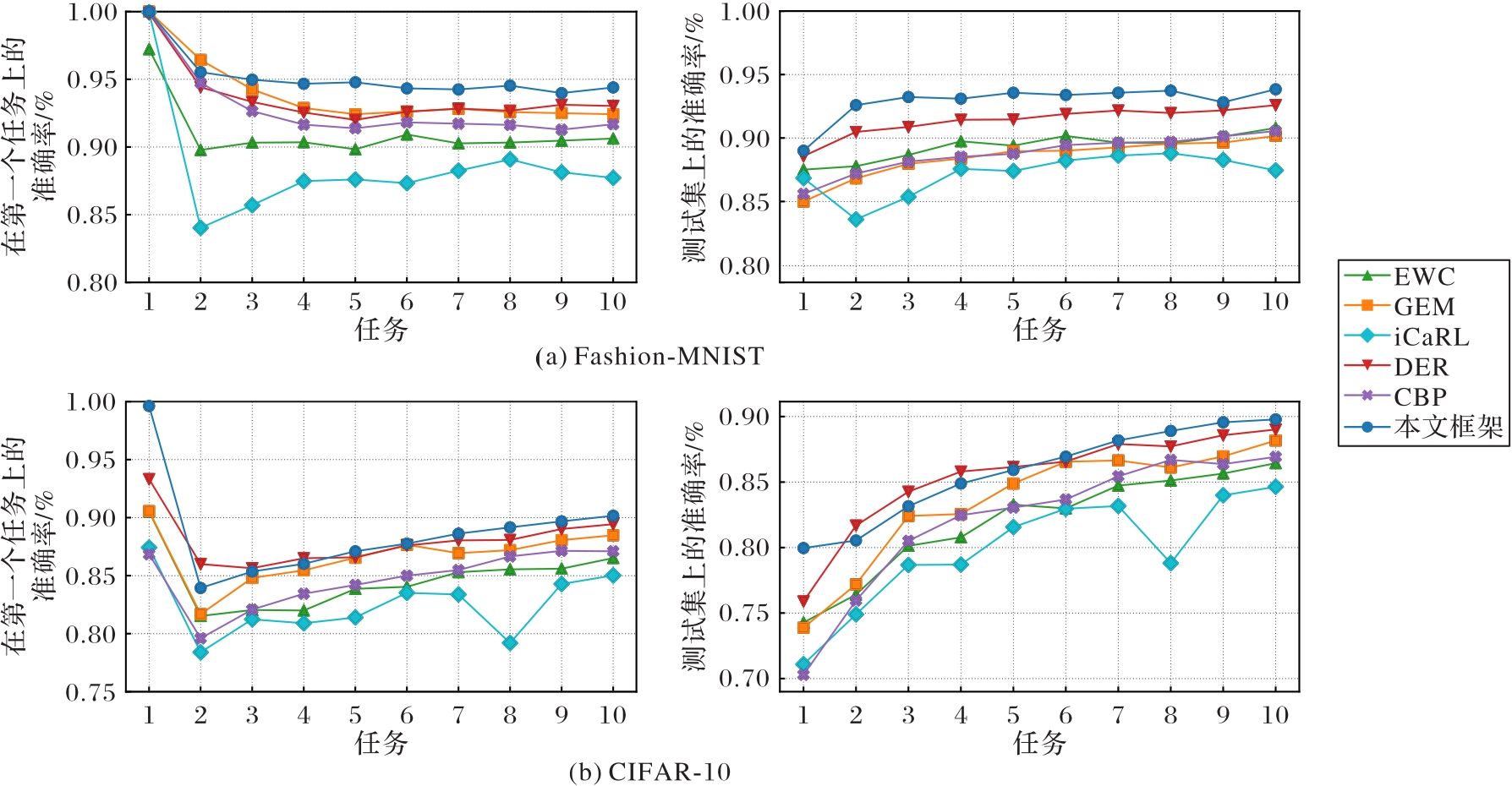
Fig. 5 Comparison of experimental results of different methods on Fashion-MNIST and CIFAR-10 datasets
| 方法 | 参数量/104 | 训练时间/s | 所占内存/MB |
|---|---|---|---|
| EWC | 1 117 | 297.22 | 865.99 |
| GEM | 1 117 | 8 133.75 | 1 590.49 |
| iCaRL | 1 117 | 100.52 | 690.20 |
| DER | 1 117 | 317.52 | 690.26 |
| CBP | 1 117 | 257.10 | 690.73 |
| 本文框架 | 13 394 | 881.27 | 974.90 |
Tab. 4 Statistics of model complexity and resource overhead for different methods
| 方法 | 参数量/104 | 训练时间/s | 所占内存/MB |
|---|---|---|---|
| EWC | 1 117 | 297.22 | 865.99 |
| GEM | 1 117 | 8 133.75 | 1 590.49 |
| iCaRL | 1 117 | 100.52 | 690.20 |
| DER | 1 117 | 317.52 | 690.26 |
| CBP | 1 117 | 257.10 | 690.73 |
| 本文框架 | 13 394 | 881.27 | 974.90 |
| 方法 | AAC | 方法 | AAC |
|---|---|---|---|
| 基线方法 | 39.9 | DFCIL[ | |
| EWC[ | 39.9 | DFGR[ | 46.6 |
| LWF[ | 41.4 | 本文框架 | 70.1 |
| MFGR[ | 42.3 |
Tab. 5 Performance comparison of different methods in Fashion-MNIST class-incremental experiments
| 方法 | AAC | 方法 | AAC |
|---|---|---|---|
| 基线方法 | 39.9 | DFCIL[ | |
| EWC[ | 39.9 | DFGR[ | 46.6 |
| LWF[ | 41.4 | 本文框架 | 70.1 |
| MFGR[ | 42.3 |
| 方法 | 平均准确率 | 最终准确率 |
|---|---|---|
| DFCIL[ | 43.32 | 21.18 |
| PASS[ | 41.84 | 27.45 |
| IL2A[ | 40.54 | 21.15 |
| R-DFCIL[ | 49.74 | 31.46 |
| SSRE[ | 31.07 | 16.99 |
| FeTriL[ | 37.25 | 20.62 |
| SEED[ | 57.42 | 42.87 |
| DiffClass[ | 67.10 | |
| 本文框架 | 63.30 |
Tab. 6 Performance comparison of different methods in CIFAR-100 class-incremental experiments
| 方法 | 平均准确率 | 最终准确率 |
|---|---|---|
| DFCIL[ | 43.32 | 21.18 |
| PASS[ | 41.84 | 27.45 |
| IL2A[ | 40.54 | 21.15 |
| R-DFCIL[ | 49.74 | 31.46 |
| SSRE[ | 31.07 | 16.99 |
| FeTriL[ | 37.25 | 20.62 |
| SEED[ | 57.42 | 42.87 |
| DiffClass[ | 67.10 | |
| 本文框架 | 63.30 |
| ResNet-18 | 困难样本 筛选 | 辅助 模型 | 最后一个任务完成后的准确率 | |||
|---|---|---|---|---|---|---|
| Fashion-MNIST | CIFAR-10 | |||||
| 训练集 | 测试集 | 训练集 | 测试集 | |||
| √ | 93.98 | 91.83 | 90.04 | 87.34 | ||
| √ | √ | 93.92 | 91.65 | 90.05 | 86.88 | |
| √ | √ | 95.16 | 93.22 | 91.23 | 88.17 | |
| √ | √ | √ | 95.50 | 93.84 | 92.76 | 89.78 |
Tab. 7 Results of ablation experiments
| ResNet-18 | 困难样本 筛选 | 辅助 模型 | 最后一个任务完成后的准确率 | |||
|---|---|---|---|---|---|---|
| Fashion-MNIST | CIFAR-10 | |||||
| 训练集 | 测试集 | 训练集 | 测试集 | |||
| √ | 93.98 | 91.83 | 90.04 | 87.34 | ||
| √ | √ | 93.92 | 91.65 | 90.05 | 86.88 | |
| √ | √ | 95.16 | 93.22 | 91.23 | 88.17 | |
| √ | √ | √ | 95.50 | 93.84 | 92.76 | 89.78 |
| [1] | Wang L, Zhang X, Su H, et al. A comprehensive survey of continual learning: theory, method and application[J]. IEEE Transactions on Pattern Analysis and Machine Intelligence, 2024, 46(8): 5362-5383. |
| [2] | McCloskey M, Cohen N J. Catastrophic interference in connectionist networks: the sequential learning problem[J]. Psychology of Learning and Motivation, 1989, 24: 109-165. |
| [3] | Ganaie M A, Hu M, Malik A K, et al. Ensemble deep learning: a review[J]. Engineering Applications of Artificial Intelligence, 2022, 115: No.105151. |
| [4] | Parisi G I, Kemker R, Part J L, et al. Continual lifelong learning with neural networks: a review[J]. Neural Networks, 2019, 113: 54-71. |
| [5] | de Lange M, Aljundi R, Masana M, et al. A continual learning survey: defying forgetting in classification tasks[J]. IEEE Transactions on Pattern Analysis and Machine Intelligence, 2022, 44(7): 3366-3385. |
| [6] | Kirkpatrick J, Pascanu R, Rabinowitz N, et al. Overcoming catastrophic forgetting in neural networks[J]. Proceedings of the National Academy of Sciences of the United States of America, 2017, 114(13): 3521-3526. |
| [7] | Zenke F, Poole B, Ganguli S. Continual learning through synaptic intelligence[J]. Proceedings of Machine Learning Research, 2017, 70: 3987-3995. |
| [8] | Aljundi R, Babiloni F, Elhoseiny M, et al. Memory aware synapses: learning what (not) to forget[C]// ECCV 2018, LNCS 11207. Cham: Springer, 2018: 144-161. |
| [9] | Kumar S, Marklund H, van Roy B. Maintaining plasticity in continual learning via regenerative regularization[PP/OL]. V3. arXiv (2024-10-03) [2025-09-16].. |
| [10] | Rebuffi S A, Kolesnikov A, Sperl G, et al. iCaRL: Incremental classifier and representation learning[C]// CVPR 2017. Piscataway: IEEE, 2017: 5533-5542. |
| [11] | Lopez-Paz D, Ranzato M. Gradient episodic memory for continual learning[C]// NeurIPS 2017. Red Hook: Curran Associates Inc., 2017: 6470-6479. |
| [12] | Bellitto G, Salanitri F P, Pennisi M, et al. Saliency-driven experience replay for continual learning[C]// NeurIPS 2024. Red Hook: Curran Associates Inc., 2024: 103356-103383. |
| [13] | Smith J S, Valkov L, Halbe S, et al. Adaptive memory replay for continual learning[C]// CVPRW 2024. Piscataway: IEEE, 2024: 3605-3615. |
| [14] | Gou J, Yu B, Maybank S J, et al. Knowledge distillation: a survey[J]. International Journal of Computer Vision, 2021, 129(6): 1789-1819. |
| [15] | Li Z, Hoiem D. Learning without forgetting[J]. IEEE Transactions on Pattern Analysis and Machine Intelligence, 2018, 40(12): 2935-2947. |
| [16] | Heo B, Kim J, Yun S, et al. A comprehensive overhaul of feature distillation[C]// ICCV 2019. Piscataway: IEEE, 2019: 1921-1930. |
| [17] | Guo Z, Yan H, Li H, et al. Class attention transfer based knowledge distillation[C]// CVPR 2023. Piscataway: IEEE, 2023: 11868-11877. |
| [18] | Huang G. Dynamic neural networks: advantages and challenges[J]. National Science Review, 2024, 11(8): No.nwae088. |
| [19] | Mu S, Lin S. A comprehensive survey of mixture-of-experts: algorithms, theory, and applications[PP/OL]. V3. arXiv (2025-04-18) [2025-09-28].. |
| [20] | Hinton G, Vinyals O, Dean J. Distilling the knowledge in a neural network[PP/OL]. arXiv (2015-03-09) [2025-09-16].. |
| [21] | LeCun Y, Bottou L, Bengio Y, et al. Gradient-based learning applied to document recognition[J]. Proceedings of the IEEE, 1998, 86(11): 2278-2324. |
| [22] | Xiao H, Rasul K, Vollgraf R. Fashion-MNIST: a novel image dataset for benchmarking machine learning algorithms[PP/OL]. V2. arXiv (2017-09-15) [2025-09-16].. |
| [23] | Krizhevsky A. Learning multiple layers of features from tiny images[R/OL]. (2009-04-08) [2025-09-16].. |
| [24] | Krizhevsky A, Sutskever I, Hinton G E. ImageNet classification with deep convolutional neural networks[C]// NeurIPS 2012 — Volume 1. Red Hook: Curran Associates Inc., 2012: 1097-1105. |
| [25] | He K, Zhang X, Ren S, et al. Deep residual learning for image recognition[C]// CVPR 2016. Piscataway: IEEE, 2016: 770-778. |
| [26] | Buzzega P, Boschini M, Porrello A, et al. Dark experience for general continual learning: a strong, simple baseline[C]// NeurIPS 2020. Red Hook: Curran Associates Inc., 2020: 15920-15930. |
| [27] | Dohare S, Hernandez-Garcia J F, Lan Q, et al. Loss of plasticity in deep continual learning[J]. Nature, 2024, 632(8026): 768-774. |
| [28] | Younis S, Seeger B. Data-free generative replay for class-incremental learning on imbalanced data[PP/OL]. arXiv (2024-06-07) [2025-10-05].. |
| [29] | Xin X, Zhong Y, Hou Y, et al. Memory-free generative replay for class-incremental learning[PP/OL]. arXiv (2021-09-01) [2025-10-05].. |
| [30] | Smith J, Hsu Y C, Balloch J, et al. Always be dreaming: a new approach for data-free class-incremental learning[C]// ICCV 2021. Piscataway: IEEE, 2021: 9354-9364. |
| [31] | Zhu F, Zhang X Y, Wang C, et al. Prototype augmentation and self-supervision for incremental learning[C]// CVPR 2021. Piscataway: IEEE, 2021: 5867-5876. |
| [32] | Zhu F, Cheng Z, Zhang X Y, et al. Class-incremental learning via dual augmentation[C]// NeurIPS 2021. Red Hook: Curran Associates Inc., 2021: 14306-14318. |
| [33] | Gao Q, Zhao C, Ghanem B, et al. R-DFCIL: relation guided representation learning for data-free class incremental learning[C]// ECCV 2022, LNCS 13683. Cham: Springer, 2022: 423-439. |
| [34] | Zhu K, Zhai W, Cao Y, et al. Self-sustaining representation expansion for non-exemplar class-incremental learning[C]// CVPR 2022. Piscataway: IEEE, 2022: 9286-9295. |
| [35] | Petit G, Popescu A, Schindler H, et al. FeTriL: feature translation for exemplar-free class-incremental learning[C]// WACV 2023. Piscataway: IEEE, 2023: 3900-3909. |
| [36] | Rypeść G, Cygert S, Khan V, et al. Divide and not forget: ensemble of selectively trained experts in continual learning[PP/OL]. V3. arXiv (2024-03-19) [2025-09-28].. |
| [37] | Meng Z, Zhang J, Yang C, et al. DiffClass: diffusion-based class incremental learning[C]// ECCV 2024, LNCS 15145. Cham: Springer, 2025: 142-159. |
| [1] | Hu WANG, Xiaofeng WANG, Ke LI, Yunjie MA. Federated class-incremental learning method of label semantic embedding with multi-head self-attention [J]. Journal of Computer Applications, 2025, 45(10): 3083-3090. |
| [2] | Xue LI, Guangle YAO, Honghui WANG, Jun LI, Haoran ZHOU, Shaoze YE. Remote sensing image classification based on sample incremental learning [J]. Journal of Computer Applications, 2024, 44(3): 732-736. |
| [3] | Zhongyuan ZHANG, Wei DAI, Guangyu LI, Xiaoqing CHEN, Qibo DENG. Cooperative obstacle avoidance algorithm based on improved artificial potential field and consensus protocol [J]. Journal of Computer Applications, 2023, 43(8): 2644-2650. |
| [4] | Yichi CHEN, Bin CHEN. Review of lifelong learning in computer vision [J]. Journal of Computer Applications, 2023, 43(6): 1785-1795. |
| [5] | Yingqi LI, Weifeng JI, Jiang WENG, Xuan WU, Xiuyu SHEN, Yan SUN. Virus propagation model and stability analysis of heterogeneous backup network [J]. Journal of Computer Applications, 2023, 43(4): 1176-1182. |
| [6] | Tian CHEN, Jianyong LU, Jun LIU, Huaguo LIANG, Yingchun LU. Reconfigurable test scheme for 3D stacked integrated circuits based on 3D linear feedback shift register [J]. Journal of Computer Applications, 2023, 43(3): 949-955. |
| [7] | LIAO Fakang, ZHOU Yali, ZHANG Qizhi. Walking control and stability analysis of flexible biped robot with variable length legs [J]. Journal of Computer Applications, 2023, 43(1): 312-320. |
| [8] | Kaiwang ZHANG, Fei HUI, Guoxiang ZHANG, Qi SHI, Zhizhong LIU. Car-following model of intelligent connected vehicles based on time-delayed velocity difference and velocity limit [J]. Journal of Computer Applications, 2022, 42(9): 2936-2942. |
| [9] | Hanlun LI, Jianguo REN. Malware propagation model based on characteristic behavior detection in P2P networks [J]. Journal of Computer Applications, 2022, 42(7): 2125-2131. |
| [10] | Huaiqing HE, Jianqing YAN, Kanghua HUI. Lightweight face recognition method based on deep residual network [J]. Journal of Computer Applications, 2022, 42(7): 2030-2036. |
| [11] | Xinlin XIE, Yi XIAO, Xinying XU. Lung nodule classification algorithm based on neural network architecture search [J]. Journal of Computer Applications, 2022, 42(5): 1424-1430. |
| [12] | Ying LEI, Wanbo ZHENG, Wei WEI, Yunni XIA, Xiaobo LI, Chengwu LIU, Hong XIE. Task offloading method based on probabilistic performance awareness and evolutionary game strategy in “cloud + edge” hybrid environment [J]. Journal of Computer Applications, 2021, 41(11): 3302-3308. |
| [13] | LIU Feng. Drug abuse epidemiologic model based on prevention and therapy strategy [J]. Journal of Computer Applications, 2020, 40(9): 2768-2773. |
| [14] | WU Sanzhu, LI Peng, WU Sanbin. Virus propagation suppression model in mobile wireless sensor networks [J]. Journal of Computer Applications, 2020, 40(1): 129-135. |
| [15] | WANG Dezhi, WANG Peng. Multi-scale quantum harmonic oscillator algorithm without energy level stability criterion [J]. Journal of Computer Applications, 2019, 39(9): 2641-2645. |
| Viewed | ||||||
|
Full text |
|
|||||
|
Abstract |
|
|||||
