


Journal of Computer Applications ›› 2026, Vol. 46 ›› Issue (1): 52-59.DOI: 10.11772/j.issn.1001-9081.2025010114
• Artificial intelligence • Previous Articles Next Articles
Fei WANG1, Ye TAO1( ), Jiawang LIU1, Wei LI2, Xiugong QIN3, Ning ZHANG4
Received:2025-02-07
Revised:2025-04-06
Accepted:2025-04-08
Online:2026-01-10
Published:2026-01-10
Contact:
Ye TAO
About author:WANG Fei, born in 1999, M. S. candidate. Her research interests include natural language processing, knowledge graph.Supported by:
王菲1, 陶冶1(), 刘家旺1, 李伟2, 秦修功3, 张宁4
通讯作者:
陶冶
作者简介:王菲(1999—),女,山东潍坊人,硕士研究生,主要研究方向:自然语言处理、知识图谱基金资助:CLC Number:
Fei WANG, Ye TAO, Jiawang LIU, Wei LI, Xiugong QIN, Ning ZHANG. Bimodal fusion method for constructing spatio-temporal knowledge graph in smart home space[J]. Journal of Computer Applications, 2026, 46(1): 52-59.
王菲, 陶冶, 刘家旺, 李伟, 秦修功, 张宁. 面向智慧家庭空间的时空知识图谱的双模态融合构建方法[J]. 《计算机应用》唯一官方网站, 2026, 46(1): 52-59.
Add to citation manager EndNote|Ris|BibTeX
URL: https://www.joca.cn/EN/10.11772/j.issn.1001-9081.2025010114
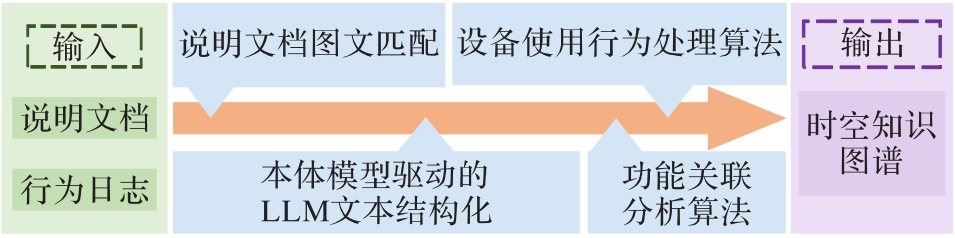
Fig. 1 Bimodal knowledge extraction framework integrating relative location information of description documents and user behavior logs

Fig. 2 Flow of construction module of description document knowledge graph
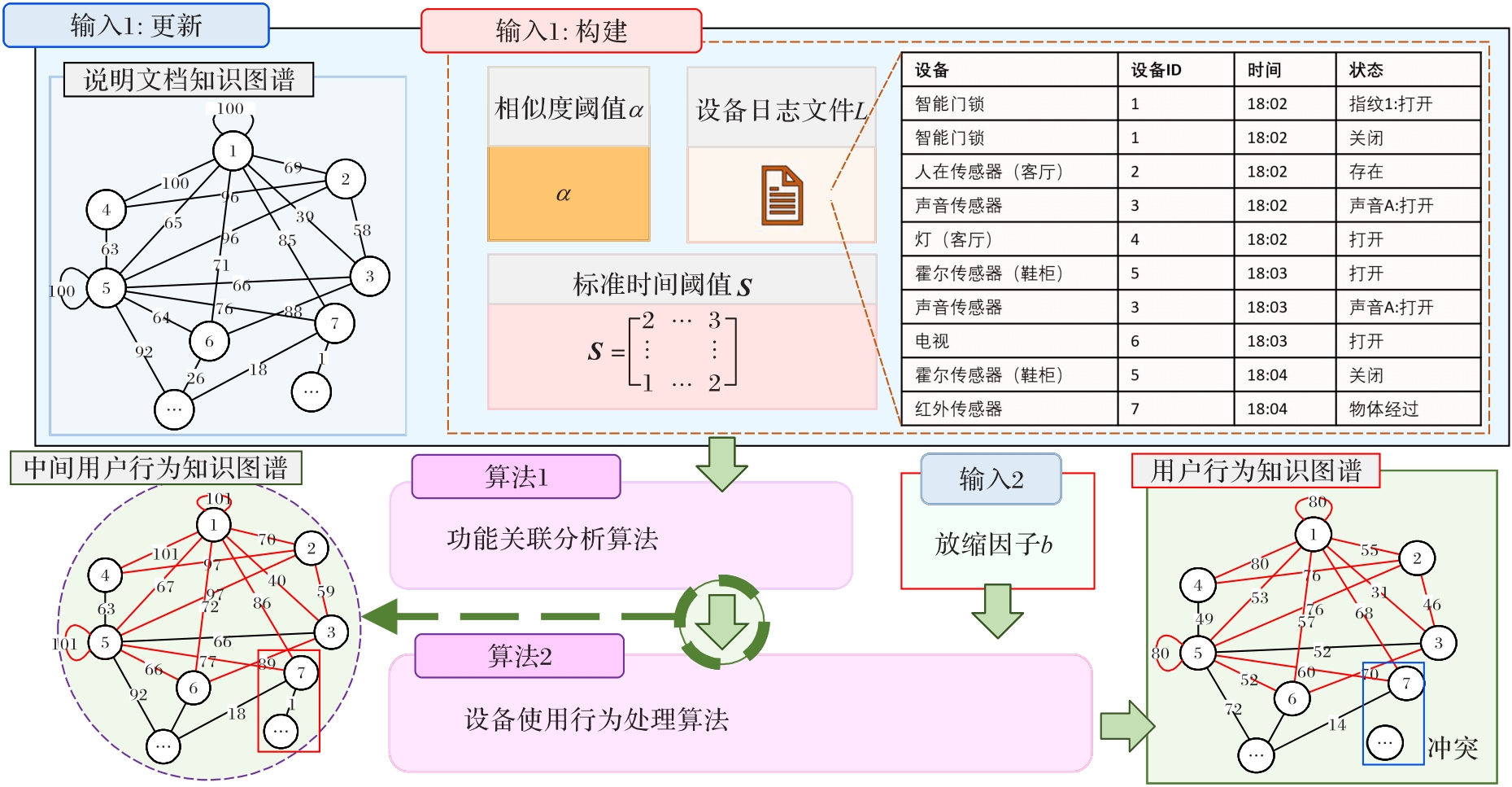
Fig. 3 Flow of construction module of user behavior knowledge graph
| 方法 | F1 | 准确率 | ||
|---|---|---|---|---|
| FUNSD | SROIE | RVL-CDIP | CMDLA | |
| BERT[ | 65.63 | 90.25 | — | 67.32 |
| LayoutLM[ | 78.95 | 94.93 | — | 79.28 |
| LayoutLMv2[ | 82.76 | 94.95 | 95.25 | 89.95 |
| LayoutLMv3[ | 90.29 | 96.56 | 95.44 | 92.34 |
| ERNIE-Layout[ | 93.12 | 95.64 | 93.14 | |
| GeoLayoutLM[ | 91.58 | 97.97 | 96.15 | |
| 本文方法 | 97.18 | 96.39 | ||
Tab. 1 Comparison of information extraction performance on different datasets
| 方法 | F1 | 准确率 | ||
|---|---|---|---|---|
| FUNSD | SROIE | RVL-CDIP | CMDLA | |
| BERT[ | 65.63 | 90.25 | — | 67.32 |
| LayoutLM[ | 78.95 | 94.93 | — | 79.28 |
| LayoutLMv2[ | 82.76 | 94.95 | 95.25 | 89.95 |
| LayoutLMv3[ | 90.29 | 96.56 | 95.44 | 92.34 |
| ERNIE-Layout[ | 93.12 | 95.64 | 93.14 | |
| GeoLayoutLM[ | 91.58 | 97.97 | 96.15 | |
| 本文方法 | 97.18 | 96.39 | ||
| 方法 | CMDLA准确率/% |
|---|---|
| ERNIE-Layout[ | 89.26 |
| GeoLayoutLM[ | 95.92 |
| 本文方法 | 96.39 |
Tab. 2 Comparison of accuracy of different methods on CMDLA dataset
| 方法 | CMDLA准确率/% |
|---|---|
| ERNIE-Layout[ | 89.26 |
| GeoLayoutLM[ | 95.92 |
| 本文方法 | 96.39 |
| 方法 | CMDLA准确率/% |
|---|---|
| w/o 相对位置融合模块 | 90.67 |
| w/o 本体模型融合模块 | 95.24 |
| 本文方法 | 96.39 |
Tab. 3 Ablation experimental results on CMDLA dataset
| 方法 | CMDLA准确率/% |
|---|---|
| w/o 相对位置融合模块 | 90.67 |
| w/o 本体模型融合模块 | 95.24 |
| 本文方法 | 96.39 |
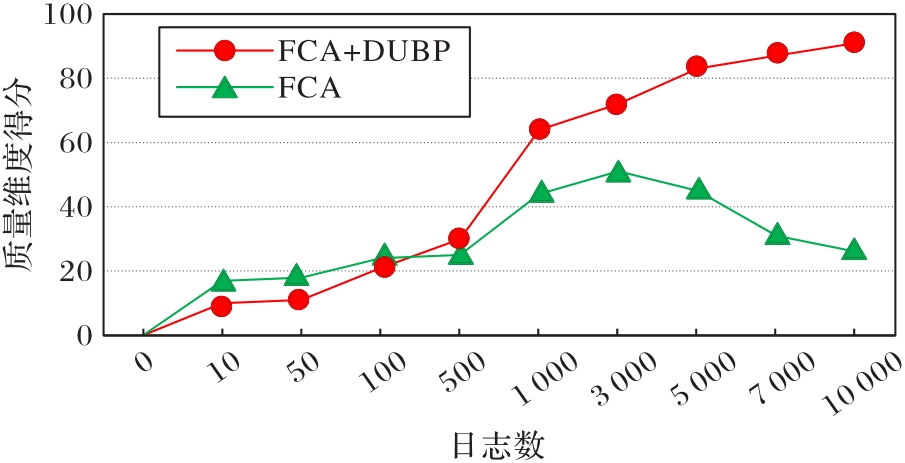
Fig. 4 Impact of log quantity and DUBP algorithm on quality of knowledge graph
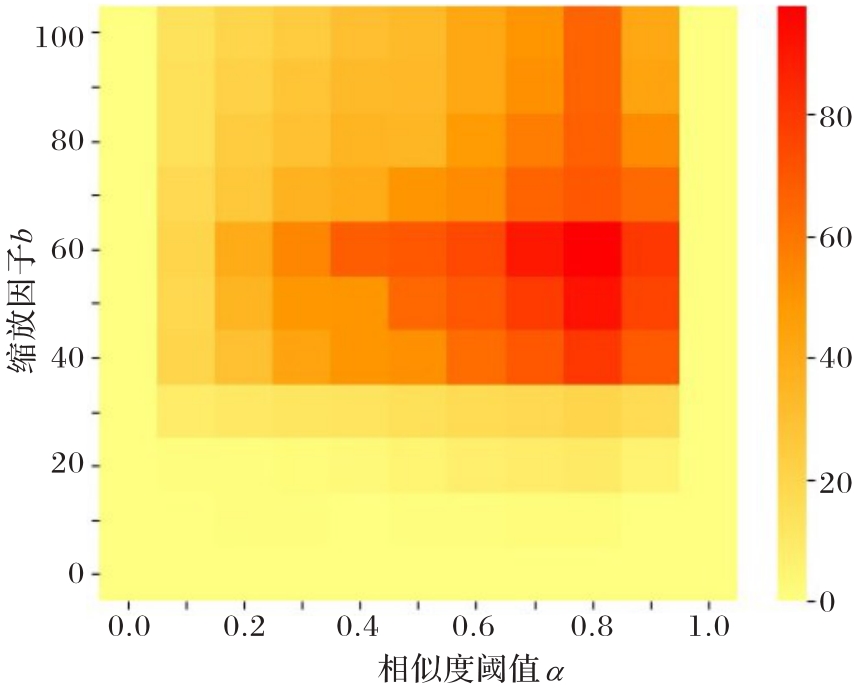
Fig. 5 Impact of parameter settings α and b on quality of knowledge graph construction
| α | 准确率/% | 召回率/% | F1/% |
|---|---|---|---|
| 0.7 | 88.3 | 95.2 | 91.6 |
| 0.8 | 94.1 | 90.5 | 92.3 |
| 0.9 | 96.8 | 82.1 | 88.8 |
Tab. 4 Impact of different α values on functional association analysis
| α | 准确率/% | 召回率/% | F1/% |
|---|---|---|---|
| 0.7 | 88.3 | 95.2 | 91.6 |
| 0.8 | 94.1 | 90.5 | 92.3 |
| 0.9 | 96.8 | 82.1 | 88.8 |
| 平均处理时间/s | 小概率事件误删率/% | |
|---|---|---|
| 50 | 12.3±0.5 | 18.7 |
| 60 | 13.1±0.6 | 8.2 |
| 70 | 14.5±0.7 | 5.4 |
Tab. 5 Comparison of time consumption and false deletion rate under different b values
| 平均处理时间/s | 小概率事件误删率/% | |
|---|---|---|
| 50 | 12.3±0.5 | 18.7 |
| 60 | 13.1±0.6 | 8.2 |
| 70 | 14.5±0.7 | 5.4 |
| [1] | STOLOJESCU-CRISAN C, CRISAN C, BUTUNOI B P. An IoT-based smart home automation system [J]. Sensors, 2021, 21(11): No.3784. |
| [2] | ORFANOS V A, KAMINARIS S D, PAPAGEORGAS P, et al. A comprehensive review of IoT networking technologies for smart home automation applications [J]. Journal of Sensor and Actuator Networks, 2023, 12(2): No.30. |
| [3] | 杜永杰,王杰,陈天璐,等.基于知识塔群的智慧家庭场景自生成技术研究[J].家电科技, 2024(S1): 120-124. |
| DU Y J, WANG J, CHEN T L, et al. Self-generation of smart home scenarios based on knowledge tower clusters [J]. Journal of Appliance Science and Technology, 2024(S1): 120-124. | |
| [4] | NIRANJANA R, ARVIND S, VIGNESH M, et al. Effectual home automation using ESP32 NodeMCU [C]// Proceedings of the 2022 International Conference on Automation, Computing and Renewable Systems. Piscataway: IEEE, 2022: 1-5. |
| [5] | CHAVIS J S, BUCZAK A, RUBIN A, et al. Connected Home Automated Security Monitor (CHASM): protecting IoT through application of machine learning [C]// Proceedings of the 10th Annual Computing and Communication Workshop and Conference. Piscataway: IEEE, 2020: 684-690. |
| [6] | AMRU M, KANNAN R J, GANESH E N, et al. Network intrusion detection system by applying ensemble model for smart home [J]. International Journal of Electrical and Computer Engineering, 2024, 14(3): 3485-3494. |
| [7] | VARDAKIS G, HATZIVASILIS G, KOUTSAKI E, et al. Review of smart-home security using the Internet of Things [J]. Electronics, 2024, 13(16): No.3343. |
| [8] | RAZA A, LI J, GHADI Y, et al. Smart home energy management systems: research challenges and survey [J]. Alexandria Engineering Journal, 2024, 92: 117-170. |
| [9] | JRHILIFA I, OUADI H, JILBAB A, et al. Forecasting smart home electricity consumption using VMD-Bi-GRU [J]. Energy Efficiency, 2024, 17(4): No.35. |
| [10] | BRUSH A J B, LEE B, MAHAJAN R, et al. Home automation in the wild: challenges and opportunities [C]// Proceedings of the 2011 SIGCHI Conference on Human Factors in Computing Systems. New York: ACM, 2011: 2115-2124. |
| [11] | SOVACOOL B K, FURSZYFER DEL RIO D D. Smart home technologies in Europe: a critical review of concepts, benefits, risks and policies [J]. Renewable and Sustainable Energy Reviews, 2020, 120: No.109663. |
| [12] | HUDA N U, AHMED I, ADNAN M, et al. Experts and intelligent systems for smart homes’ Transformation to Sustainable Smart Cities: a comprehensive review [J]. Expert Systems with Applications, 2024, 238(Pt F): No.122380. |
| [13] | TAO Y, LIU J, LI H, et al. KFEX-N: a table-text data question-answering model based on knowledge-fusion encoder and EX-N tree decoder [J]. Neurocomputing, 2024, 593: No.127795. |
| [14] | MOHAMED S K, NOUNU A, NOVÁČEK V. Biological applications of knowledge graph embedding models [J]. Briefings in Bioinformatics, 2021, 22(2): 1679-1693. |
| [15] | WANG J, WANG X, MA C, et al. A survey on the development status and application prospects of knowledge graph in smart grids [J]. IET Generation, Transmission and Distribution, 2021, 15(3): 383-407. |
| [16] | SON J Y, PARK J H, MOON K D, et al. Resource-aware smart home management system by constructing resource relation graph [J]. IEEE Transactions on Consumer Electronics, 2011, 57(3): 1112-1119. |
| [17] | WANG T, CHEN W, LIU L, et al. Detecting smart home automation application interferences with domain knowledge [C]// Proceedings of the 38th IEEE/ACM International Conference on Automated Software Engineering. Piscataway: IEEE, 2023: 1086-1097. |
| [18] | LI W, WANG J, JIAO S, et al. Augmented assembly work instruction knowledge graph for adaptive presentation [C]// Proceedings of the 2021 International Conference on Intelligent Robotics and Applications, LNCS 13013. Cham: Springer, 2021: 793-803. |
| [19] | ZHANG Z, AI Q, YAN J, et al. Knowledge graph construction method of bridge design codes based on ontology and specification parsing [C]// Proceedings of the 2024 Asia Simulation Conference, CCIS 2170. Singapore: Springer, 2024: 58-69. |
| [20] | LI J, LIU S, LIU A, et al. Knowledge graph construction for SOFL formal specifications [J]. International Journal of Software Engineering and Knowledge Engineering, 2022, 32(4): 605-644. |
| [21] | FENG X, ZHANG Y, MENG M H, et al. Detecting contradictions from IoT protocol specification documents based on neural generated knowledge graph [J]. ISA Transactions, 2023, 141: 10-19. |
| [22] | WANG Z, PAN J S, CHEN Q, et al. BiLSTM-CRF-KG: a construction method of software requirements specification graph [J]. Applied Sciences, 2022, 12(12): No.6016. |
| [23] | XU Y, LI M, CUI L, et al. LayoutLM: pre-training of text and layout for document image understanding [C]// Proceedings of the 26th ACM SIGKDD International Conference on Knowledge Discovery and Data Mining. New York: ACM, 2020: 1192-1200. |
| [24] | XU Y, XU Y, LV T, et al. LayoutLMv2: multi-modal pre-training for visually-rich document understanding [C]// Proceedings of the 59th Annual Meeting of the Association for Computational Linguistics and the 11th International Joint Conference on Natural Language Processing (Volume 1: Long Papers). Stroudsburg: ACL, 2021: 2579-2591. |
| [25] | HUANG Y, LV T, CUI L, et al. Layoutlmv3: pre-training for document AI with unified text and image masking [C]// Proceedings of the 30th ACM International Conference on Multimedia. New York: ACM, 2022: 4083-4091. |
| [26] | PENG Q, PAN Y, WANG W, et al. ERNIE-Layout: layout knowledge enhanced pre-training for visually-rich document understanding [C]// Findings of the Association for Computational Linguistics: EMNLP 2022. Stroudsburg: ACL, 2022: 3744-3756. |
| [27] | LUO C, CHENG C, ZHENG Q, et al. GeoLayoutLM: geometric pre-training for visual information extraction [C]// Proceedings of the 2023 IEEE/CVF Conference on Computer Vision and Pattern Recognition. Piscataway: IEEE, 2023: 7092-7101. |
| [28] | LIU Y D, ZHANG X, HE S L, et al. UniParser: a unified log parser for heterogeneous log data [C]// Proceedings of the ACM Web Conference 2022. New York: ACM, 2022: 1893-1901. |
| [29] | WANG X H, ZHANG X, LI L Q, et al. SPINE: a scalable log parser with feedback guidance [C]// Proceedings of the 30th ACM Joint European Software Engineering Conference and Symposium on the Foundations of Software Engineering. New York: ACM, 2022: 1198-1208. |
| [30] | HE P, ZHU J, HE S, et al. Towards automated log parsing for large-scale log data analysis [J]. IEEE Transactions on Dependable and Secure Computing, 2018, 15(6): 931-944. |
| [31] | LEE Y, KIM J, KANG P. LAnoBERT: system log anomaly detection based on BERT masked language model [J]. Applied Soft Computing, 2023, 146: No.110689. |
| [32] | DEVLIN J, CHANG M W, LEE K, et al. BERT: pre-training of deep bidirectional Transformers for language understanding [C]// Proceedings of the 2019 Conference of the North American Chapter of the Association for Computational Linguistics: Human Language Technologies (Volume 1: Long and Short Papers). Stroudsburg: ACL, 2019: 4171-4186. |
| [33] | JAUME G, EKENEL H K, THIRAN J P. FUNSD: a dataset for form understanding in noisy scanned documents [C]// Proceedings of the 2019 International Conference on Document Analysis and Recognition Workshops — Volume 2. Piscataway: IEEE, 2019: 1-6. |
| [34] | HUANG Z, CHEN K, HE J, et al. ICDAR2019 competition on scanned receipt OCR and information extraction [C]// Proceedings of the 2019 International Conference on Document Analysis and Recognition. Piscataway: IEEE, 2019: 1516-1520. |
| [35] | HARLEY A W, UFKES A, DERPANIS K G. Evaluation of deep convolutional nets for document image classification and retrieval [C]// Proceedings of the 13th International Conference on Document Analysis and Recognition. Piscataway: IEEE, 2015: 991-995. |
| [36] | PAN Z, WU F, ZHANG B. Fine-grained image-text matching by cross-modal hard aligning network [C]// Proceedings of the 2023 IEEE/CVF Conference on Computer Vision and Pattern Recognition. Piscataway: IEEE, 2023: 19275-19284. |
| [37] | TRAJANOSKA M, STOJANOV R, TRAJANOV D. Enhancing knowledge graph construction using large language models [EB/OL]. [2024-05-08]. . |
| [38] | CHEN H, CAO G, CHEN J, et al. A practical framework for evaluating the quality of knowledge graph [C]// Proceedings of the 2019 China Conference on Knowledge Graph and Semantic Computing, CCIS 1134. Singapore: Springer, 2019: 111-122. |
| [1] | Yanan LI, Mengyang GUO, Guojun DENG, Yunfeng CHEN, Jianji REN, Yongliang YUAN. Method for life prediction of parallel branching engine based on multi-modal fusion features [J]. Journal of Computer Applications, 2026, 46(1): 305-313. |
| [2] | Chao LIU, Yanhua YU. Knowledge-aware recommendation model combining denoising strategy and multi-view contrastive learning [J]. Journal of Computer Applications, 2025, 45(9): 2827-2837. |
| [3] | Shuang LIU, Daqing LIU, Jiana MENG, Di ZHAO. Hyper-relational knowledge graph completion method fusing noise filtering [J]. Journal of Computer Applications, 2025, 45(6): 1817-1826. |
| [4] | Zixin XU, Xiuwen YI, Jie BAO, Tianrui LI, Junbo ZHANG, Yu ZHENG. Construction and application of knowledge graph for epidemiological investigation [J]. Journal of Computer Applications, 2025, 45(4): 1340-1348. |
| [5] | Sheping ZHAI, Qing YANG, Yan HUANG, Rui YANG. Knowledge graph completion using hierarchical attention fusing directed relationships and relational paths [J]. Journal of Computer Applications, 2025, 45(4): 1148-1156. |
| [6] | Liqin WANG, Zhilei GENG, Yingshuang LI, Yongfeng DONG, Meng BIAN. Open-world knowledge reasoning model based on path and enhanced triplet text [J]. Journal of Computer Applications, 2025, 45(4): 1177-1183. |
| [7] | Chun XU, Shuangyan JI, Huan MA, Enwei SUN, Mengmeng WANG, Mingyu SU. Consultation recommendation method based on knowledge graph and dialogue structure [J]. Journal of Computer Applications, 2025, 45(4): 1157-1168. |
| [8] | Chengzhe YUAN, Guohua CHEN, Dingding LI, Yuan ZHU, Ronghua LIN, Hao ZHONG, Yong TANG. ScholatGPT: a large language model for academic social networks and its intelligent applications [J]. Journal of Computer Applications, 2025, 45(3): 755-764. |
| [9] | Xuefei ZHANG, Liping ZHANG, Sheng YAN, Min HOU, Yubo ZHAO. Personalized learning recommendation in collaboration of knowledge graph and large language model [J]. Journal of Computer Applications, 2025, 45(3): 773-784. |
| [10] | Yan YANG, Feng YE, Dong XU, Xuejie ZHANG, Jin XU. Construction of digital twin water conservancy knowledge graph integrating large language model and prompt learning [J]. Journal of Computer Applications, 2025, 45(3): 785-793. |
| [11] | Meng WANG, Daqian ZHANG, Bingyan ZHOU, Qianying MA, Jidong LYU. Fault diagnosis method for train control on-board interface equipment of CTCS-3 based on temporal knowledge graph completion [J]. Journal of Computer Applications, 2025, 45(2): 677-684. |
| [12] | Qijian CAI, Wei TAN. Semantic graph enhanced multi-modal recommendation algorithm [J]. Journal of Computer Applications, 2025, 45(2): 421-427. |
| [13] | Jincai YANG, Qixu BAN, Xusheng YANG, Xianjun SHEN. Multi-label classification method integrating external semantic knowledge [J]. Journal of Computer Applications, 2025, 45(12): 3757-3763. |
| [14] | Haoxiang XU, Dunhui YU, Yichen DENG, Kui XIAO. Knowledge graph constrained question answering model based on hierarchical reinforcement learning [J]. Journal of Computer Applications, 2025, 45(12): 3764-3770. |
| [15] | Huilin GUI, Kun YUE, Liang DUAN. Multimodal knowledge graph link prediction method based on fusing image and textual information [J]. Journal of Computer Applications, 2025, 45(11): 3540-3546. |
| Viewed | ||||||
|
Full text |
|
|||||
|
Abstract |
|
|||||
