


《计算机应用》唯一官方网站 ›› 2026, Vol. 46 ›› Issue (8): 2660-2667.DOI: 10.11772/j.issn.1001-9081.2025070817
• 多媒体计算与计算机仿真 • 上一篇
白杰龙, 方晨韵, 乔志伟( )
)
收稿日期:2025-07-22
修回日期:2025-09-25
接受日期:2025-09-25
发布日期:2025-11-05
出版日期:2026-08-10
通讯作者:
乔志伟
作者简介:白杰龙(2000—),男,山西吕梁人,硕士研究生,主要研究方向:医学图像重建、图像处理基金资助:
Jielong BAI, Chenyun FANG, Zhiwei QIAO()
Received:2025-07-22
Revised:2025-09-25
Accepted:2025-09-25
Online:2025-11-05
Published:2026-08-10
Contact:
Zhiwei QIAO
About author:BAI Jielong, born in 2000, M. S. candidate. His research interests include medical image reconstruction, image processing.Supported by:摘要:
稀疏计算机断层成像(CT)重建能够降低患者的辐射剂量,对临床诊断具有重要意义。在基于深度学习的图像重建任务中,经典的Uformer (U-shape Transformer)、Restormer (Restoration Transformer)和AST (Adaptive Sparse Transformer)等网络未考虑图像的多尺度与方向信息,从而忽略了局部细节和全局结构的平衡,伪影抑制效果有限。针对上述问题,提出一种多尺度注意力自适应融合Transformer(MAAF-Transformer)网络。该网络采用并行注意力融合策略,结合多尺度通道方向感知注意力(MSCDA)模块捕获伪影特征,并利用卷积自适应空间通道注意力(CASCA)模块动态调节权重,然后通过门控深度卷积前馈网络(GDFN)筛选有效信息。实验结果表明,在60个稀疏角度下,MAAF-Transformer相较于经典Uformer在峰值信噪比(PSNR)上提高了0.714 1 dB、结构相似性(SSIM)上提高了0.33%,而均方根误差(RMSE)上降低了7.76%,并在视觉效果上同样表现优异。可见,MAAF-Transformer的稀疏重建精度更高,抑制伪影能力更强。
中图分类号:
白杰龙, 方晨韵, 乔志伟. 基于多尺度注意力自适应融合的稀疏CT伪影抑制Transformer网络[J]. 计算机应用, 2026, 46(8): 2660-2667.
Jielong BAI, Chenyun FANG, Zhiwei QIAO. Sparse CT artifact suppresion Transformer network based on multi-scale attention adaptive fusion[J]. Journal of Computer Applications, 2026, 46(8): 2660-2667.
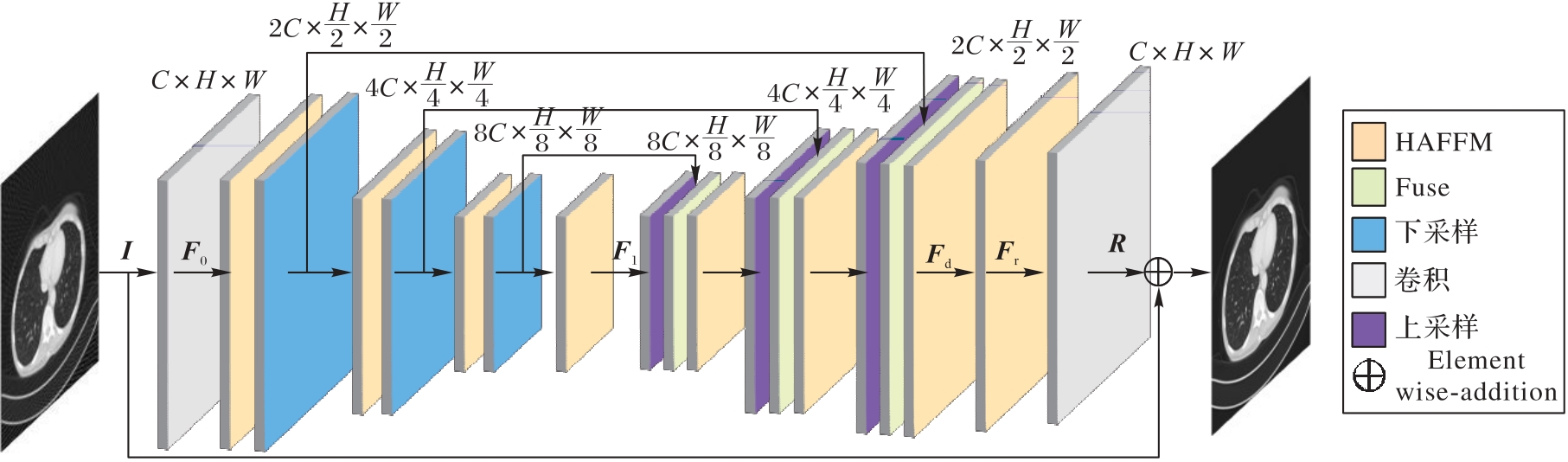
图1 本文网络的整体结构
Fig. 1 Overall structure of proposed network
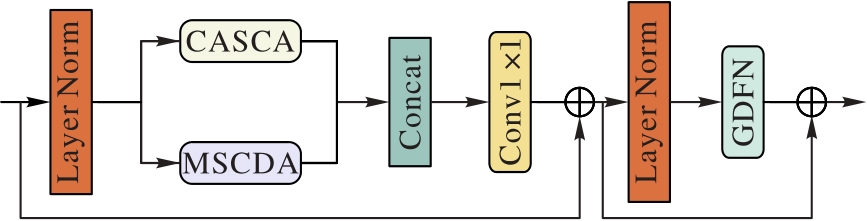
图2 混合注意力前馈模块网络的结构
Fig. 2 Structure of HAFFM
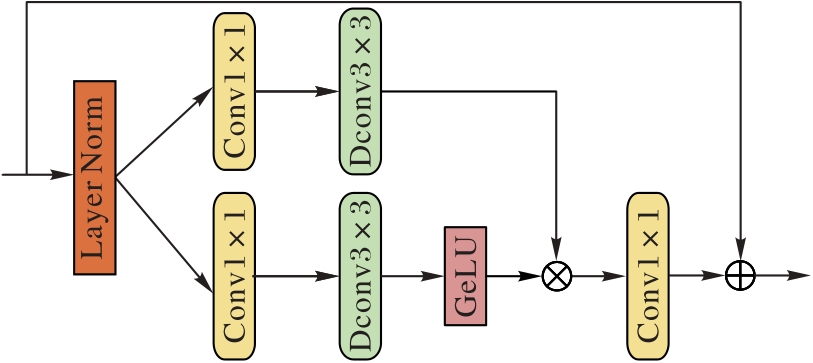
图3 门控深度卷积前馈网络的结构
Fig. 3 Structure of GDFN
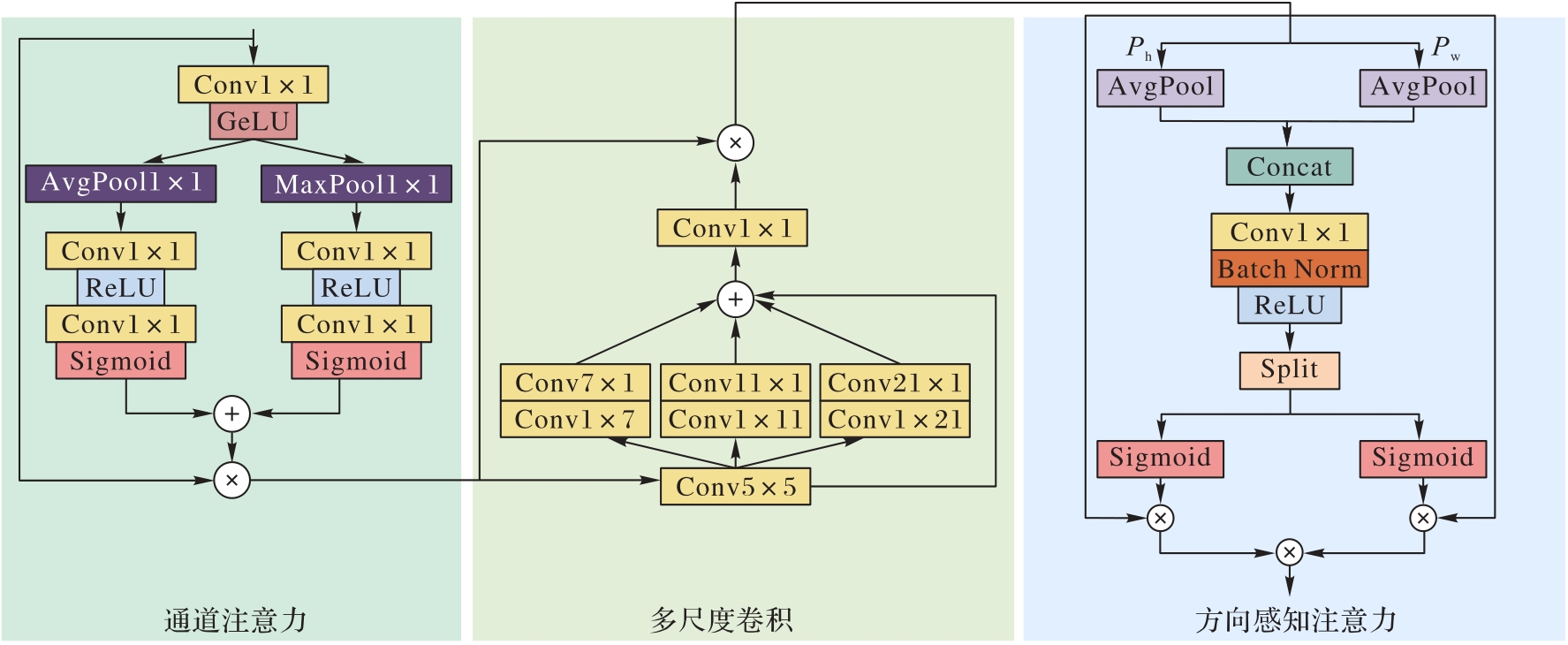
图4 多尺度通道方向感知注意力网络的结构
Fig. 4 Structure of multi-scale channel direction-aware attention network
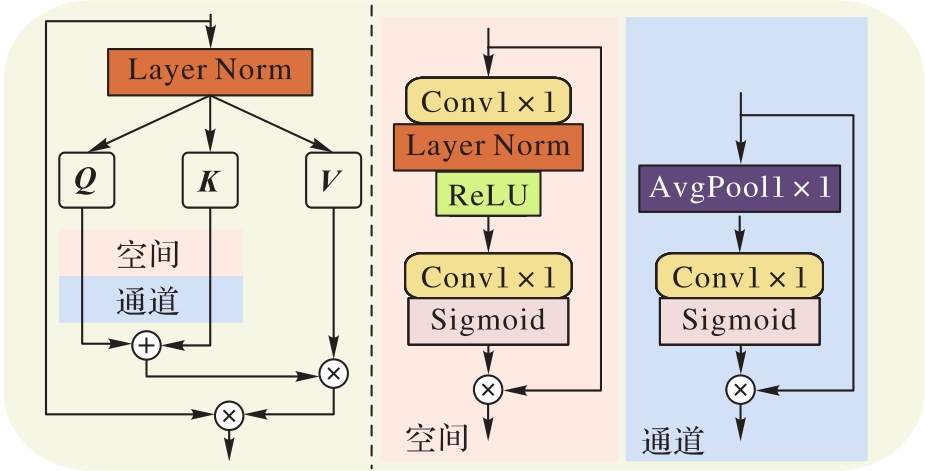
图5 卷积自适应空间通道注意力的结构
Fig. 5 Structure of CASCA
| 模型 | 15视角 | 30视角 | ||||
|---|---|---|---|---|---|---|
| PSNR/dB | SSIM | RMSE | PSNR/dB | SSIM | RMSE | |
| DnCNN[ | 28.321 6 | 0.841 9 | 0.038 9 | 31.739 8 | 0.893 0 | 0.026 2 |
| RED-CNN[ | 29.372 6 | 0.866 7 | 0.034 3 | 32.765 7 | 0.907 7 | 0.023 2 |
| U-Net[ | 31.516 3 | 0.892 5 | 0.026 9 | 35.082 4 | 0.928 2 | 0.017 8 |
| FBPConvNet[ | 31.642 5 | 0.893 6 | 0.026 5 | 35.422 0 | 0.930 9 | 0.017 2 |
| Uformer[ | 32.022 9 | 0.898 0 | 0.025 3 | 35.683 7 | 0.934 6 | 0.016 6 |
| Restormer[ | 31.981 3 | 0.898 1 | 0.025 5 | 35.734 0 | 0.934 1 | 0.016 5 |
| AST[ | 32.340 5 | 0.894 4 | 0.024 4 | 35.972 6 | 0.935 8 | 0.015 9 |
| MAAF⁃Transformer | 32.9030 | 0.9075 | 0.0229 | 36.3056 | 0.938 4 | 0.015 5 |
| 模型 | 60视角 | 90视角 | ||||
| PSNR/dB | SSIM | RMSE | PSNR/dB | SSIM | RMSE | |
| DnCNN[ | 33.849 0 | 0.932 9 | 0.020 6 | 35.467 9 | 0.950 4 | 0.017 1 |
| RED-CNN[ | 35.417 3 | 0.944 3 | 0.017 1 | 36.630 3 | 0.956 7 | 0.014 9 |
| U-Net[ | 37.946 0 | 0.953 8 | 0.012 8 | 39.175 6 | 0.962 5 | 0.011 1 |
| FBPConvNet[ | 38.565 8 | 0.956 9 | 0.011 9 | 39.715 2 | 0.964 0 | 0.010 5 |
| Uformer[ | 38.795 2 | 0.959 1 | 0.011 6 | 39.992 4 | 0.965 8 | 0.010 1 |
| Restormer[ | 39.013 5 | 0.959 5 | 0.011 3 | 40.256 7 | 0.966 7 | 0.009 8 |
| AST[ | 39.213 6 | 0.960 7 | 0.011 1 | 40.424 7 | 0.967 3 | 0.009 7 |
| MAAF⁃Transformer | 39.509 3 | 0.962 3 | 0.010 7 | 40.521 9 | 0.967 7 | 0.0095 |
表1 不同稀疏角度下不同模型在测试集上的实验结果
Tab. 1 Experimental results of different models on test set under different sparse angles
| 模型 | 15视角 | 30视角 | ||||
|---|---|---|---|---|---|---|
| PSNR/dB | SSIM | RMSE | PSNR/dB | SSIM | RMSE | |
| DnCNN[ | 28.321 6 | 0.841 9 | 0.038 9 | 31.739 8 | 0.893 0 | 0.026 2 |
| RED-CNN[ | 29.372 6 | 0.866 7 | 0.034 3 | 32.765 7 | 0.907 7 | 0.023 2 |
| U-Net[ | 31.516 3 | 0.892 5 | 0.026 9 | 35.082 4 | 0.928 2 | 0.017 8 |
| FBPConvNet[ | 31.642 5 | 0.893 6 | 0.026 5 | 35.422 0 | 0.930 9 | 0.017 2 |
| Uformer[ | 32.022 9 | 0.898 0 | 0.025 3 | 35.683 7 | 0.934 6 | 0.016 6 |
| Restormer[ | 31.981 3 | 0.898 1 | 0.025 5 | 35.734 0 | 0.934 1 | 0.016 5 |
| AST[ | 32.340 5 | 0.894 4 | 0.024 4 | 35.972 6 | 0.935 8 | 0.015 9 |
| MAAF⁃Transformer | 32.9030 | 0.9075 | 0.0229 | 36.3056 | 0.938 4 | 0.015 5 |
| 模型 | 60视角 | 90视角 | ||||
| PSNR/dB | SSIM | RMSE | PSNR/dB | SSIM | RMSE | |
| DnCNN[ | 33.849 0 | 0.932 9 | 0.020 6 | 35.467 9 | 0.950 4 | 0.017 1 |
| RED-CNN[ | 35.417 3 | 0.944 3 | 0.017 1 | 36.630 3 | 0.956 7 | 0.014 9 |
| U-Net[ | 37.946 0 | 0.953 8 | 0.012 8 | 39.175 6 | 0.962 5 | 0.011 1 |
| FBPConvNet[ | 38.565 8 | 0.956 9 | 0.011 9 | 39.715 2 | 0.964 0 | 0.010 5 |
| Uformer[ | 38.795 2 | 0.959 1 | 0.011 6 | 39.992 4 | 0.965 8 | 0.010 1 |
| Restormer[ | 39.013 5 | 0.959 5 | 0.011 3 | 40.256 7 | 0.966 7 | 0.009 8 |
| AST[ | 39.213 6 | 0.960 7 | 0.011 1 | 40.424 7 | 0.967 3 | 0.009 7 |
| MAAF⁃Transformer | 39.509 3 | 0.962 3 | 0.010 7 | 40.521 9 | 0.967 7 | 0.0095 |
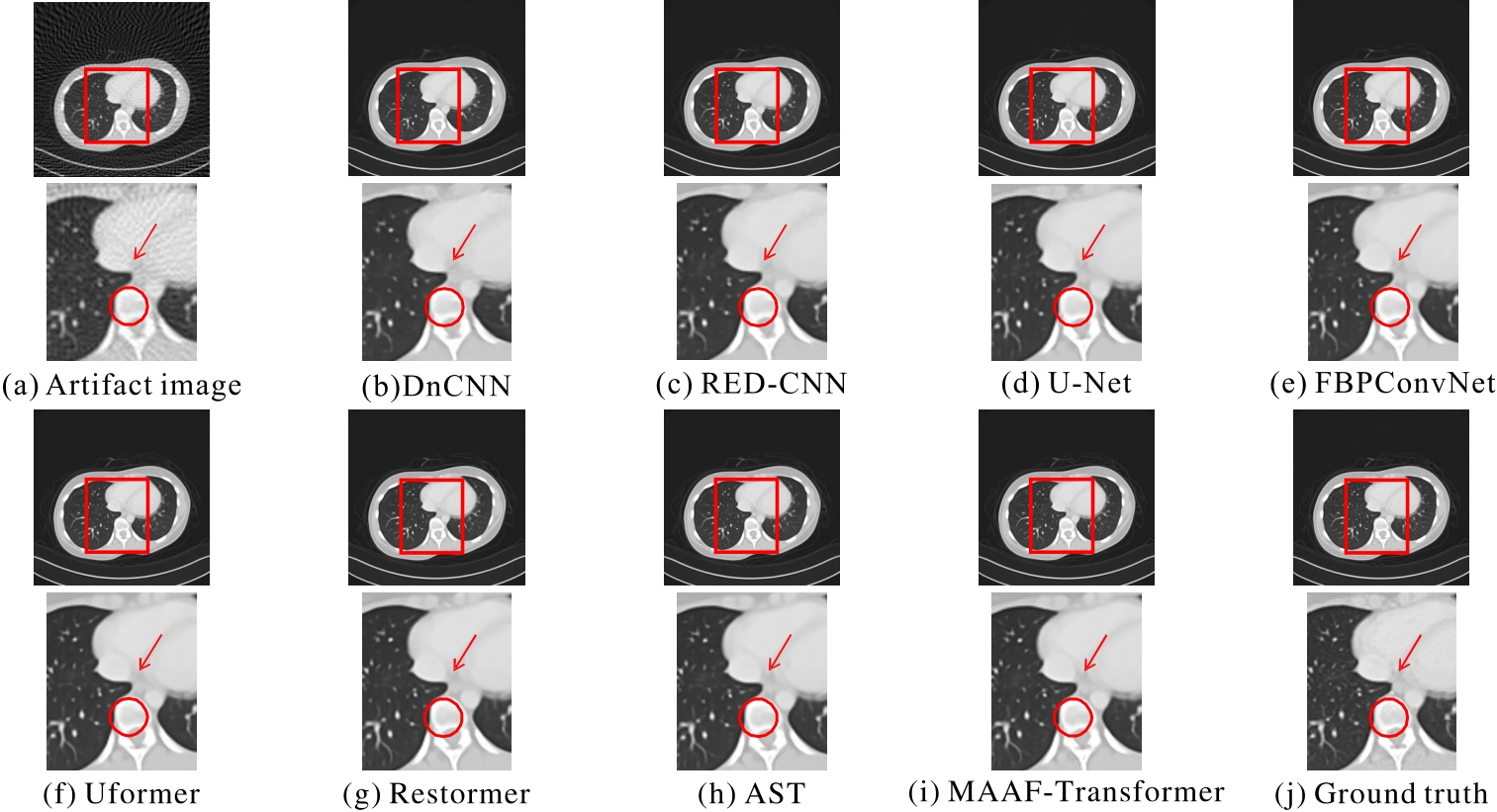
图6 60视角下采用不同模型的胸部CT图像重建结果及其局部放大图
Fig. 6 Reconstruction results and local magnification of chest CT images using different models at 60 sparse angles
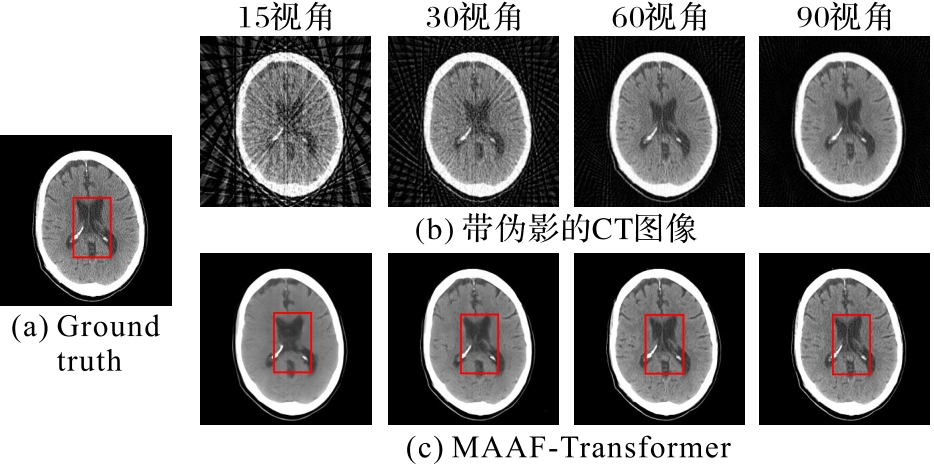
图7 不同视角下头部CT图像的重建结果
Fig. 7 Reconstruction results of head CT images at different sparse angles
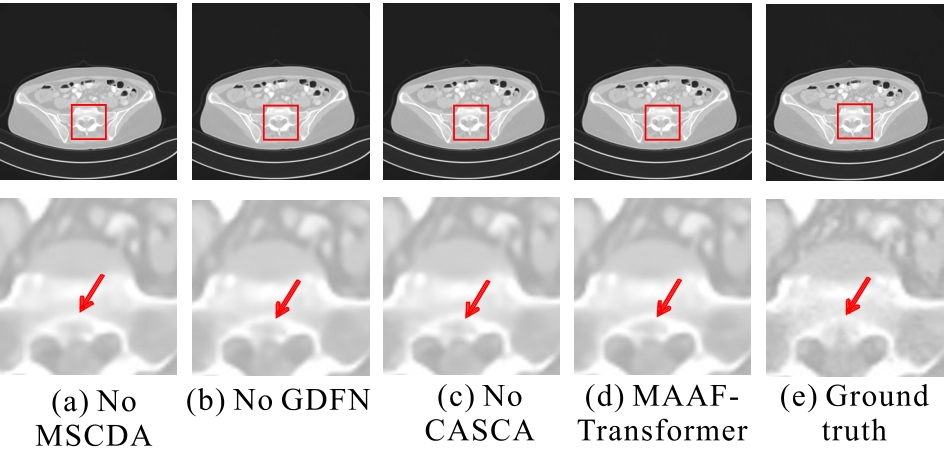
图8 60视角下的消融实验中腹部CT图像重建结果及其局部放大图
Fig. 8 Reconstruction results and local magnification of abdominal CT images in ablation experiments at 60 sparse angles
| 模型 | PSNR/dB | SSIM | RMSE |
|---|---|---|---|
| No GDFN | 39.201 4 | 0.960 9 | 0.011 1 |
| No CASCA | 39.242 5 | 0.960 8 | 0.011 1 |
| No MSCDA | 39.264 3 | 0.960 9 | 0.011 0 |
| MAAF⁃Transformer | 39.509 3 | 0.962 3 | 0.010 7 |
表2 60视角下的消融实验在测试集上的结果
Tab. 2 Ablation experimental results on test set at 60 sparse angles
| 模型 | PSNR/dB | SSIM | RMSE |
|---|---|---|---|
| No GDFN | 39.201 4 | 0.960 9 | 0.011 1 |
| No CASCA | 39.242 5 | 0.960 8 | 0.011 1 |
| No MSCDA | 39.264 3 | 0.960 9 | 0.011 0 |
| MAAF⁃Transformer | 39.509 3 | 0.962 3 | 0.010 7 |
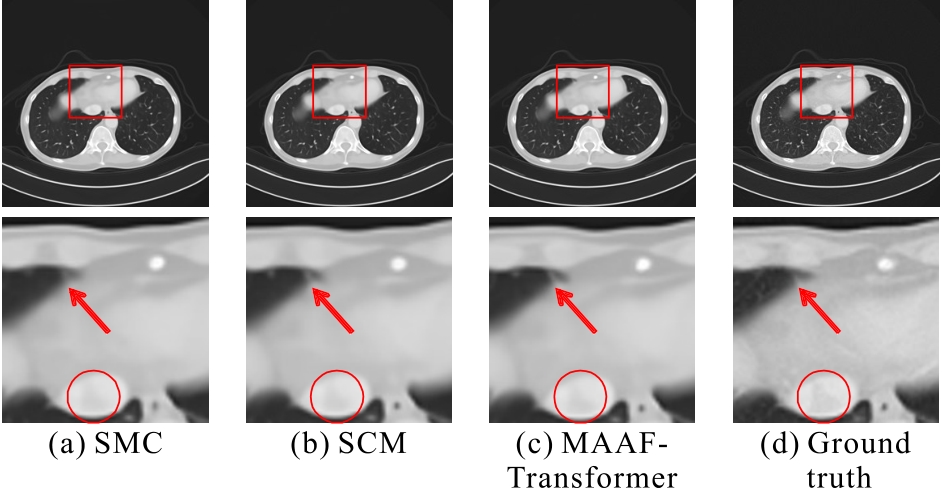
图9 60视角下CASCA模块与MSCDA模块交互范式的肺部CT图像重建结果及其局部放大
Fig. 9 Reconstruction results and local magnification of lung CT images using interaction paradigms between CASCA module and MSCDA module at 60 sparse angles
| 模块 | PSNR/dB | SSIM | RMSE |
|---|---|---|---|
| SMC | 39.209 4 | 0.960 5 | 0.011 1 |
| SCM | 39.423 0 | 0.961 8 | 0.010 8 |
| MAAF⁃Transformer | 39.509 3 | 0.962 3 | 0.010 7 |
表3 60视角下CASCA模块与MSCDA模块交互范式在测试集上的实验结果
Tab. 3 Experimental results of interaction paradigms between CASCA module and MSCDA module on test set at 60 sparse angles
| 模块 | PSNR/dB | SSIM | RMSE |
|---|---|---|---|
| SMC | 39.209 4 | 0.960 5 | 0.011 1 |
| SCM | 39.423 0 | 0.961 8 | 0.010 8 |
| MAAF⁃Transformer | 39.509 3 | 0.962 3 | 0.010 7 |
| [1] | Rybicki F J, Otero H J, Steigner M L, et al. Initial evaluation of coronary images from 320-detector row computed tomography[J]. The International Journal of Cardiovascular Imaging, 2008, 24(5): 535-546. |
| [2] | Dilmanian F A, Zhong Z, Ren B, et al. Computed tomography of X-ray index of refraction using the diffraction enhanced imaging method[J]. Physics in Medicine and Biology, 2000, 45(4): No.933. |
| [3] | Wang D, Fan F, Wu Z, et al. CTformer: convolution-free Token2Token dilated Vision Transformer for low-dose CT denoising[J]. Physics in Medicine and Biology, 2023, 68(6): No.065012. |
| [4] | Kramer B S, Berg C D, Aberle D R, et al. Lung cancer screening with low-dose helical CT: results from the National Lung Screening Trial (NLST)[J]. Journal of Medical Screening, 2011, 18(3): 109-111. |
| [5] | Mostafapour S, Greuter M, van Snick J H, et al. Ultra-low dose CT scanning for PET/CT[J]. Medical Physics, 2024, 51(1): 139-155. |
| [6] | Han Y. Hierarchical decomposed dual-domain deep learning for sparse-view CT reconstruction[J]. Physics in Medicine and Biology, 2024, 69(8): No.085019. |
| [7] | Sun C, Liu Y, Yang H. Degradation-aware deep learning framework for sparse-view CT reconstruction[J]. Tomography, 2021, 7(4): 932-949. |
| [8] | 刘宇,张鹏程,张丽媛,等. 基于低秩与全变分联合正则化的低剂量CT图像重建[J]. 计算机应用, 2025, 45(3): 978-987. |
| Liu Yu, Zhang Pengcheng, Zhang Liyuan, et al. Low-dose CT image reconstruction based on low-rank and total variation joint regularization[J]. Journal of Computer Applications, 2025, 45(3): 978-987. | |
| [9] | 马靓怡,乔志伟. 基于Chambolle-Pock框架的核TV多通道图像重建算法[J]. CT理论与应用研究, 2022, 31(6): 731-747. |
| Ma Jingyi, Qiao Zhiwei. Nuclear TV multi-channel image reconstruction algorithms based on Chambolle-Pock framework[J]. CT Theory and Applications, 2022, 31(6): 731-747. | |
| [10] | 陈蒙蒙,乔志伟. 基于融合通道注意力的Uformer的CT图像稀疏重建[J]. 计算机应用, 2023, 43(9): 2948-2954. |
| Chen Mengmeng, Qiao Zhiwei. Sparse reconstruction of CT images based on Uformer with fused channel attention[J]. Journal of Computer Applications, 2023, 43(9): 2948-2954. | |
| [11] | Pan X, Sidky E Y, Vannier M. Why do commercial CT scanners still employ traditional, filtered back-projection for image reconstruction?[J]. Inverse Problems, 2009, 25(12): No.123009. |
| [12] | Liu Y, Liang Z, Ma J, et al. Total variation-stokes strategy for sparse-view X-ray CT image reconstruction[J]. IEEE Transactions on Medical Imaging, 2014, 33(3): 749-763. |
| [13] | Wang Z, Cun X, Bao J, et al. Uformer: a general U-shaped Transformer for image restoration[C]// CVPR 2022. Piscataway: IEEE, 2022: 17662-17672. |
| [14] | Zamir S W, Arora A, Khan S, et al. Restormer: efficient transformer for high-resolution image restoration[C]// CVPR 2022. Piscataway: IEEE, 2022: 5718-5729. |
| [15] | Zhou S, Chen D, Pan J, et al. Adapt or perish: adaptive sparse Transformer with attentive feature refinement for image restoration[C]// CVPR 2024. Piscataway: IEEE, 2024: 2952-2963. |
| [16] | Niu S, Gao Y, Bian Z, et al. Sparse-view X-Ray CT reconstruction via total generalized variation regularization[J]. Physics in Medicine and Biology, 2014, 59(12): No.2997. |
| [17] | Han Y S, Jin K H, Kim K, et al. Sparse-view X-Ray spectral CT reconstruction using annihilating filter-based low rank hankel matrix approach[C]// ISBI 2016. Piscataway: IEEE, 2016: 573-576. |
| [18] | Zhang H, Ma J, Wang J, et al. Adaptive nonlocal means-regularized iterative image reconstruction for sparse-view CT[C]// PNSS/MIC 2014. Piscataway: IEEE, 2014: 1-7. |
| [19] | Lee H, Lee J, Kim H, et al. Deep-neural-network-based sinogram synthesis for sparse-view CT image reconstruction[J]. IEEE Transactions on Radiation and Plasma Medical Sciences, 2019, 3(2): 109-119. |
| [20] | 刘安阳,赵怀慈,蔡文龙,等. 基于主动判别机制的自适应生成对抗网络图像去模糊算法[J]. 计算机应用, 2023, 43(7): 2288-2294. |
| Liu Anyang, Zhao Huaici, Cai Wenlong, et al. Adaptive image deblurring generative adversarial network algorithm based on active discrimination mechanism[J]. Journal of Computer Applications, 2023, 43(7): 2288-2294. | |
| [21] | Sun C, Salimi Y, Angeliki N, et al. An efficient dual-domain deep learning network for sparse-view CT reconstruction[J]. Computer Methods and Programs in Biomedicine, 2024, 256: No.108376. |
| [22] | Jin K H, McCann M T, Froustey E, et al. Deep convolutional neural network for inverse problems in imaging[J]. IEEE Transactions on Image Processing, 2017, 26(9): 4509-4522. |
| [23] | Chen H, Zhang Y, Kalra M K, et al. Low-dose CT with a residual encoder-decoder convolutional neural network[J]. IEEE Transactions on Medical Imaging, 2017, 36(12): 2524-2535. |
| [24] | Jiang Y, Yang C, Yang P, et al. Scatter correction of cone-beam CT using a deep residual convolution neural network[J]. Physics in Medicine and Biology, 2019, 64(14): No.145003. |
| [25] | Zhong A, Li B, Luo N, et al. Image restoration for low-dose CT via transfer learning and residual network[J]. IEEE Access, 2020, 8: 112078-112091. |
| [26] | Xue H, Zhang Q, Zou S, et al. LCPR-Net: low-count PET image reconstruction using the domain transform and cycle-consistent generative adversarial networks[J]. Quantitative Imaging in Medicine and Surgery, 2021, 11(2): 749-762. |
| [27] | Dosovitskiy A, Beyer L, Kolesnikov A, et al. An image is worth 16×16 words: Transformers for image recognition at scale[PP/OL]. V2. arXiv (2020-10-22) [2025-05-20].. |
| [28] | Liu Z, Lin Y, Cao Y, et al. Swin Transformer: hierarchical Vision Transformer using shifted windows[C]// ICCV 2021. Piscataway: IEEE, 2021: 9992-10002. |
| [29] | Yan H, Fang C, Liu P, et al. CGP-Uformer: a low-dose CT image denoising Uformer based on channel graph perception[J]. Journal of X-Ray Science and Technology, 2023, 31(6): 1189-1205. |
| [30] | Huang H, Chen Z, Zou Y, et al. Channel prior convolutional attention for medical image segmentation[J]. Computers in Biology and Medicine, 2024, 178: No.108784. |
| [31] | Cui Y, Tha K K, Terasaka S, et al. Prognostic imaging biomarkers in glioblastoma: development and independent validation on the basis of multiregion and quantitative analysis of MR images[J]. Radiology, 2016, 278(2): 546-553. |
| [32] | Bakas S, Akbari H, Sotiras A, et al. Advancing the cancer genome atlas glioma MRI collections with expert segmentation labels and radiomic features[J]. Scientific Data, 2017, 4: No.170117. |
| [33] | Kong Y, Xu M, Wei X, et al. CT imaging-based radiomics signatures improve prognosis prediction in postoperative colorectal cancer[J]. Journal of X-Ray Science and Technology, 2023, 31(6): 1281-1294. |
| [34] | Lai W S, Huang J B, Ahuja N, et al. Deep Laplacian pyramid networks for fast and accurate super-resolution[C]// CVPR 2017. Piscataway: IEEE, 2017: 5835-5843. |
| [35] | Ramanarayanan S, Murugesan B, Kalyanasundaram A, et al. MRI super-resolution using Laplacian pyramid convolutional neural networks with isotropic undecimated wavelet loss[C]// EMBC 2020. Piscataway: IEEE, 2020: 1584-1587. |
| [36] | Gajera B, Kapil S R, Ziaei D, et al. CT-scan denoising using a Charbonnier loss generative adversarial network[J]. IEEE Access, 2021, 9: 84093-84109. |
| [37] | Horé A, Ziou D. Image quality metrics: PSNR vs. SSIM[C]// ICPR 2010. Piscataway: IEEE, 2010: 2366-2369. |
| [38] | Bai S B, Wang J, Lü G N, et al. GIS-based logistic regression for landslide susceptibility mapping of the Zhongxian segment in the Three Gorges area, China[J]. Geomorphology, 2010, 115(1/2): 23-31. |
| [39] | Zhang K, Zuo W, Chen Y, et al. Beyond a Gaussian denoiser: residual learning of deep cnn for image denoising[J]. IEEE Transactions on Image Processing, 2017, 26(7): 3142-3155. |
| [40] | Ronneberger O, Fischer P, Brox T. U-net: convolutional networks for biomedical image segmentation[C]// MICCAI 2015, LNCS 9351. Cham: Springer, 2015: 234-241. |
| [1] | 李光辉, 屈立成. 基于改进Lite-Mono架构的动态空洞卷积和分层注意力模型[J]. 《计算机应用》唯一官方网站, 2026, 46(8): 2567-2576. |
| [2] | 黄麟, 李英顺, 佟维妍, 张树园, 王子涵. 基于改进实时检测Transformer的遥感图像目标检测算法[J]. 《计算机应用》唯一官方网站, 2026, 46(8): 2652-2659. |
| [3] | 郭晓金, 隋旭洋, 周柯男. 基于深度学习的STAR⁃RIS辅助混合场通信系统信道估计[J]. 《计算机应用》唯一官方网站, 2026, 46(8): 2548-2554. |
| [4] | 刘明, 沈东奇, 孟子洋. 双分支结构下多层次特征融合的点云配准网络[J]. 《计算机应用》唯一官方网站, 2026, 46(8): 2584-2593. |
| [5] | 刘凤春, 邵馨莹, 张春英, 王立亚, 任静. 多尺度特征优化的单目深度估计框架FCMdepth[J]. 《计算机应用》唯一官方网站, 2026, 46(8): 2603-2611. |
| [6] | 刘威, 李维刚, 田志强. 面向点云分类与分割的层次化旋转不变几何结构的表征学习方法[J]. 《计算机应用》唯一官方网站, 2026, 46(8): 2594-2602. |
| [7] | 汤莉, 张健宇, 姚睿. 基于改进YOLOv11的雾天目标检测算法[J]. 《计算机应用》唯一官方网站, 2026, 46(8): 2630-2639. |
| [8] | 颜建强, 董贝贝, 曲博婷, 彭晨. 融合多源信息与图级注意力的双向扩散动态图卷积交通流预测网络[J]. 《计算机应用》唯一官方网站, 2026, 46(7): 2327-2333. |
| [9] | 杜秀丽, 高星, 张校毓, 潘成胜, 邹启杰. 基于密集时空可变形注意力的视频快照压缩成像重建方法[J]. 《计算机应用》唯一官方网站, 2026, 46(7): 2288-2296. |
| [10] | 张国有, 聂宏宇, 潘理虎, 雷润东. 基于多层感知机级联宽度学习系统的点云语义分割网络Point-MLPBLS[J]. 《计算机应用》唯一官方网站, 2026, 46(7): 2259-2266. |
| [11] | 刘雯玲, 李勇, 李佳慧, 张厚康. 面向不均匀雾霾遥感图像的无监督去雾方法[J]. 《计算机应用》唯一官方网站, 2026, 46(7): 2297-2306. |
| [12] | 朱莉, 米路革麻, 朱春强, 徐婉茹, 高靖凯, 屈锦琪. 基于动态卷积分解和多尺度图的短期电力负荷预测模型[J]. 《计算机应用》唯一官方网站, 2026, 46(7): 2334-2346. |
| [13] | 何运平, 王雷春, 宋芮芮, 卢祥凤, 魏金香, 刘小萌. 基于对比不变性和强化特定性的双通道多模态情感分析模型[J]. 《计算机应用》唯一官方网站, 2026, 46(6): 1767-1775. |
| [14] | 姚力挽, 刘海龙, 曾张帆. 基于频域驱动及扩散融合的声纳图像增强算法[J]. 《计算机应用》唯一官方网站, 2026, 46(6): 1947-1955. |
| [15] | 吕超, 马歌谣. 基于冗余特征抑制的轻量级人体姿态估计网络[J]. 《计算机应用》唯一官方网站, 2026, 46(6): 1973-1980. |
| 阅读次数 | ||||||
|
全文 |
|
|||||
|
摘要 |
|
|||||
