


《计算机应用》唯一官方网站 ›› 2026, Vol. 46 ›› Issue (8): 2494-2504.DOI: 10.11772/j.issn.1001-9081.2025070851
邱原1, 彭海龙1, 费蓉1,2( ), 徐庆征3, 李仟禧1, 薛诚1
收稿日期:2025-07-29
修回日期:2025-11-04
接受日期:2025-11-06
发布日期:2025-12-22
出版日期:2026-08-10
通讯作者:
费蓉
作者简介:邱原(1983—),男,陕西汉中人,讲师,博士,CCF会员,主要研究方向:人工智能、数据挖掘基金资助:
Yuan QIU1, Hailong PENG1, Rong FEI1,2(), Qingzheng XU3, Qianxi LI1, Cheng XUE1
Received:2025-07-29
Revised:2025-11-04
Accepted:2025-11-06
Online:2025-12-22
Published:2026-08-10
Contact:
Rong FEI
About author:QIU Yuan, born in 1983, Ph. D., lecturer. His research interests include artificial intelligence, data mining.Supported by:摘要:
引文网络中的学术群体识别旨在揭示学者间的内在关联。然而,节点属性(内容特征)与拓扑结构(关联模式)的异质性导致融合时易出现特征错位与信息稀释,且现有方法常忽略由高连接度节点构成的核心子网络所蕴含的稳定关联模式,这些制约了识别精度。为了解决上述问题,提出一种多视图注意力融合的学术群体识别(MAFCI)方法。所提方法采用双视图设计:一个视图对原始节点属性与邻接矩阵进行编码,另一个视图融合由k-core提取的核心节点信息及其拓扑结构;采用稀疏图注意力机制分别从两个视图中提取低维嵌入,并通过动态加权策略实现多源信息的自适应融合,以兼顾局部结构与全局语义。解码器通过内积重构邻接矩阵,并基于注意力机制恢复节点属性与核心信息;同时,引入自监督聚类损失,引导嵌入表示向判别性聚类中心收敛,增强群体边界的区分度。在Cora、Citeseer、ACM和DBLP 4个引文网络数据集上的实验结果表明,MAFCI方法在多数核心评价指标上优于DDGAE(Deep Dual Graph Attention auto-Encoder)和BCDAN(Balanced method for Community Detection in Attribute Networks)等9个先进基线方法。具体地,在DBLP数据集上,MAFCI方法的归一化互信息(NMI)达到0.513,准确率(ACC)达到0.809,分别较最优基线方法提升了2.3和1.3个百分点;在ACM数据集上,MAFCI方法的NMI为0.674,F1分数为0.903,分别较最优基线方法提升了1.2和0.8个百分点;在Citeseer数据集上,MAFCI方法的NMI达到0.448,较最优基线方法提升了0.7个百分点;在Cora数据集上,MAFCI方法的NMI达到0.543,同样优于所有对比方法。可见,MAFCI方法通过双视图稀疏注意力与动态融合机制,有效提升了学术群体识别的准确性与鲁棒性,在不同规模与结构的引文网络上均表现出良好泛化能力。
中图分类号:
邱原, 彭海龙, 费蓉, 徐庆征, 李仟禧, 薛诚. 多视图注意力融合的引文网络学术群体识别[J]. 计算机应用, 2026, 46(8): 2494-2504.
Yuan QIU, Hailong PENG, Rong FEI, Qingzheng XU, Qianxi LI, Cheng XUE. Multi-view attention fusion for academic community identification in citation networks[J]. Journal of Computer Applications, 2026, 46(8): 2494-2504.
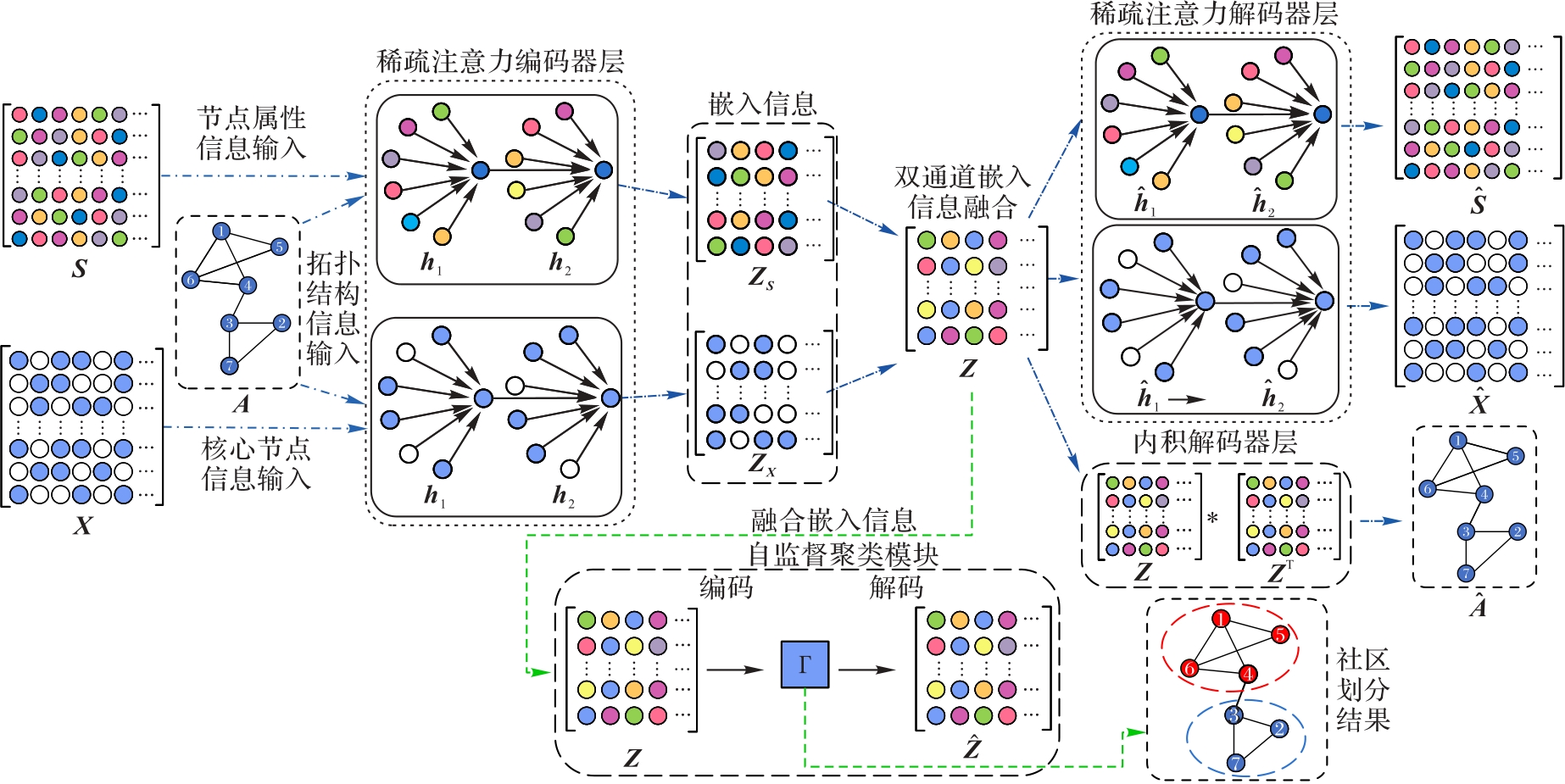
图1 MAFCI方法的框架
Fig. 1 Framework of MAFCI method
| 数据集 | 节点数 | 属性维度 | 边数 | 类别数 |
|---|---|---|---|---|
| Cora | 2 708 | 1 433 | 5 278 | 7 |
| Citeseer | 3 327 | 3 703 | 4 552 | 6 |
| DBLP | 4 057 | 334 | 3 528 | 4 |
| ACM | 3 025 | 1 870 | 13 128 | 3 |
表1 数据集详细信息总览
Tab. 1 Overview of dataset details
| 数据集 | 节点数 | 属性维度 | 边数 | 类别数 |
|---|---|---|---|---|
| Cora | 2 708 | 1 433 | 5 278 | 7 |
| Citeseer | 3 327 | 3 703 | 4 552 | 6 |
| DBLP | 4 057 | 334 | 3 528 | 4 |
| ACM | 3 025 | 1 870 | 13 128 | 3 |
| 数据集 | 评价指标 | DAEGC | ARGA | ARVGA | MVGRL | DCRN | CDBNE | DDGAE | GATFELPA | BCDAN | MAFCI |
|---|---|---|---|---|---|---|---|---|---|---|---|
| Cora | ACC | 0.679 | 0.652 | 0.642 | 0.658 | 0.621 | 0.689 | 0.733 | 0.731 | 0.692 | 0.704 |
| NMI | 0.477 | 0.448 | 0.451 | 0.466 | 0.461 | 0.491 | 0.540 | 0.531 | 0.532 | 0.543 | |
| ARI | 0.428 | 0.352 | 0.375 | 0.438 | 0.328 | 0.447 | 0.515 | 0.514 | 0.521 | 0.504 | |
| F1 | 0.643 | 0.624 | 0.638 | 0.645 | 0.493 | 0.670 | 0.702 | 0.697 | 0.673 | 0.681 | |
| Citeseer | ACC | 0.648 | 0.610 | 0.607 | 0.681 | 0.682 | 0.691 | 0.705 | 0.689 | 0.707 | 0.709 |
| NMI | 0.389 | 0.347 | 0.322 | 0.416 | 0.407 | 0.422 | 0.439 | 0.441 | 0.433 | 0.448 | |
| ARI | 0.380 | 0.350 | 0.320 | 0.410 | 0.428 | 0.441 | 0.450 | 0.446 | 0.465 | 0.455 | |
| F1 | 0.607 | 0.580 | 0.566 | 0.607 | 0.619 | 0.468 | 0.650 | 0.633 | 0.646 | 0.628 | |
| ACM | ACC | 0.879 | 0.866 | 0.842 | 0.866 | 0.895 | 0.684 | 0.896 | 0.893 | 0.889 | 0.903 |
| NMI | 0.586 | 0.637 | 0.524 | 0.613 | 0.661 | 0.432 | 0.661 | 0.662 | 0.651 | 0.674 | |
| ARI | 0.622 | 0.648 | 0.582 | 0.661 | 0.716 | 0.406 | 0.728 | 0.725 | 0.715 | 0.734 | |
| F1 | 0.892 | 0.863 | 0.839 | 0.871 | 0.892 | 0.641 | 0.894 | 0.895 | 0.890 | 0.903 | |
| DBLP | ACC | 0.632 | 0.650 | 0.552 | 0.432 | 0.791 | 0.647 | 0.796 | 0.698 | 0.762 | 0.809 |
| NMI | 0.342 | 0.309 | 0.263 | 0.162 | 0.490 | 0.340 | 0.474 | 0.467 | 0.426 | 0.513 | |
| ARI | 0.211 | 0.380 | 0.199 | 0.124 | 0.534 | 0.305 | 0.556 | 0.572 | 0.451 | 0.571 | |
| F1 | 0.619 | 0.652 | 0.692 | 0.410 | 0.790 | 0.660 | 0.795 | 0.762 | 0.725 | 0.805 |
表2 不同对比方法在4个数据集上实验结果总览
Tab. 2 Overview of experimental results using different comparison methods on four datasets
| 数据集 | 评价指标 | DAEGC | ARGA | ARVGA | MVGRL | DCRN | CDBNE | DDGAE | GATFELPA | BCDAN | MAFCI |
|---|---|---|---|---|---|---|---|---|---|---|---|
| Cora | ACC | 0.679 | 0.652 | 0.642 | 0.658 | 0.621 | 0.689 | 0.733 | 0.731 | 0.692 | 0.704 |
| NMI | 0.477 | 0.448 | 0.451 | 0.466 | 0.461 | 0.491 | 0.540 | 0.531 | 0.532 | 0.543 | |
| ARI | 0.428 | 0.352 | 0.375 | 0.438 | 0.328 | 0.447 | 0.515 | 0.514 | 0.521 | 0.504 | |
| F1 | 0.643 | 0.624 | 0.638 | 0.645 | 0.493 | 0.670 | 0.702 | 0.697 | 0.673 | 0.681 | |
| Citeseer | ACC | 0.648 | 0.610 | 0.607 | 0.681 | 0.682 | 0.691 | 0.705 | 0.689 | 0.707 | 0.709 |
| NMI | 0.389 | 0.347 | 0.322 | 0.416 | 0.407 | 0.422 | 0.439 | 0.441 | 0.433 | 0.448 | |
| ARI | 0.380 | 0.350 | 0.320 | 0.410 | 0.428 | 0.441 | 0.450 | 0.446 | 0.465 | 0.455 | |
| F1 | 0.607 | 0.580 | 0.566 | 0.607 | 0.619 | 0.468 | 0.650 | 0.633 | 0.646 | 0.628 | |
| ACM | ACC | 0.879 | 0.866 | 0.842 | 0.866 | 0.895 | 0.684 | 0.896 | 0.893 | 0.889 | 0.903 |
| NMI | 0.586 | 0.637 | 0.524 | 0.613 | 0.661 | 0.432 | 0.661 | 0.662 | 0.651 | 0.674 | |
| ARI | 0.622 | 0.648 | 0.582 | 0.661 | 0.716 | 0.406 | 0.728 | 0.725 | 0.715 | 0.734 | |
| F1 | 0.892 | 0.863 | 0.839 | 0.871 | 0.892 | 0.641 | 0.894 | 0.895 | 0.890 | 0.903 | |
| DBLP | ACC | 0.632 | 0.650 | 0.552 | 0.432 | 0.791 | 0.647 | 0.796 | 0.698 | 0.762 | 0.809 |
| NMI | 0.342 | 0.309 | 0.263 | 0.162 | 0.490 | 0.340 | 0.474 | 0.467 | 0.426 | 0.513 | |
| ARI | 0.211 | 0.380 | 0.199 | 0.124 | 0.534 | 0.305 | 0.556 | 0.572 | 0.451 | 0.571 | |
| F1 | 0.619 | 0.652 | 0.692 | 0.410 | 0.790 | 0.660 | 0.795 | 0.762 | 0.725 | 0.805 |
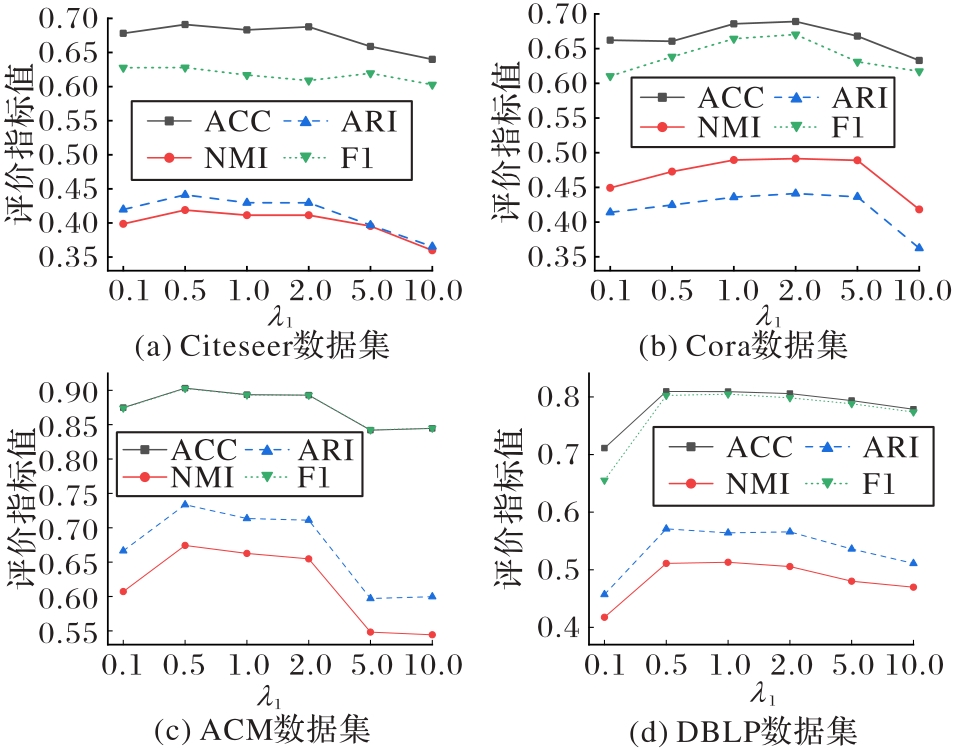
图2 不同超参数λ1下MAFCI方法的性能
Fig. 2 Performance of MAFCI method under different hyperparameter λ1
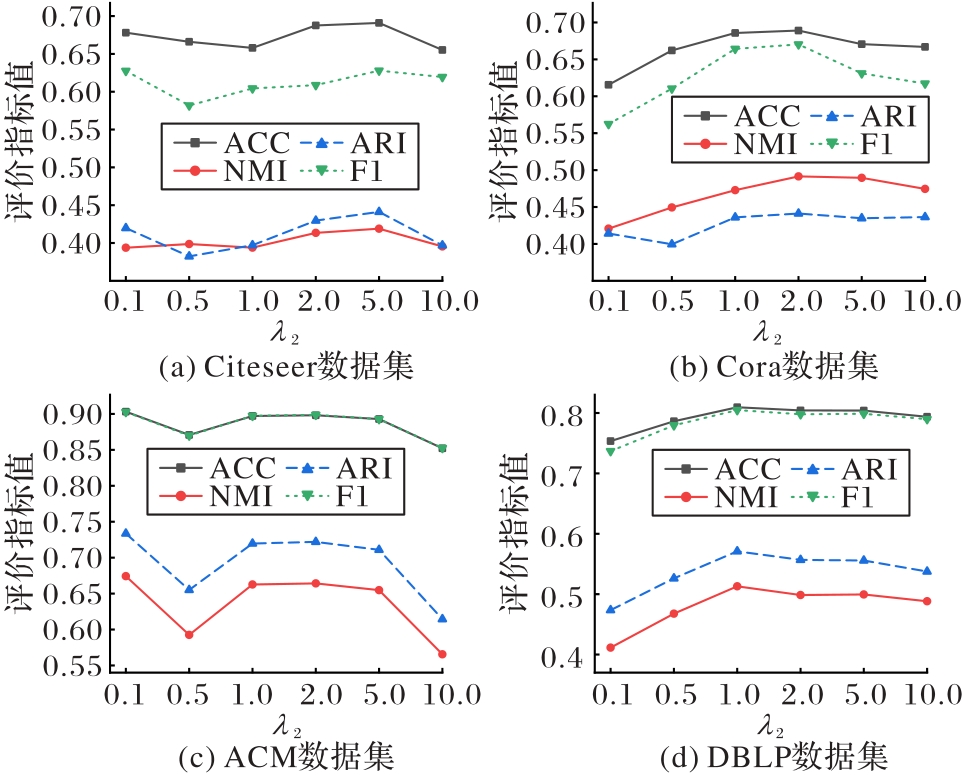
图3 不同超参数λ2下MAFCI方法的性能
Fig. 3 Performance of MAFCI method under different hyperparameter λ2
| 超参数 | Cora | Citeseer | ACM | DBLP |
|---|---|---|---|---|
| λ1 | 2.0 | 0.5 | 0.2 | 0.5 |
| λ2 | 2.0 | 5.0 | 0.1 | 1.0 |
表3 MAFCI方法的最佳性能表现时超参数λ1与λ2的取值
Tab. 3 Values of hyperparameters λ1 and λ2 under optimal performance of MAFCI method
| 超参数 | Cora | Citeseer | ACM | DBLP |
|---|---|---|---|---|
| λ1 | 2.0 | 0.5 | 0.2 | 0.5 |
| λ2 | 2.0 | 5.0 | 0.1 | 1.0 |
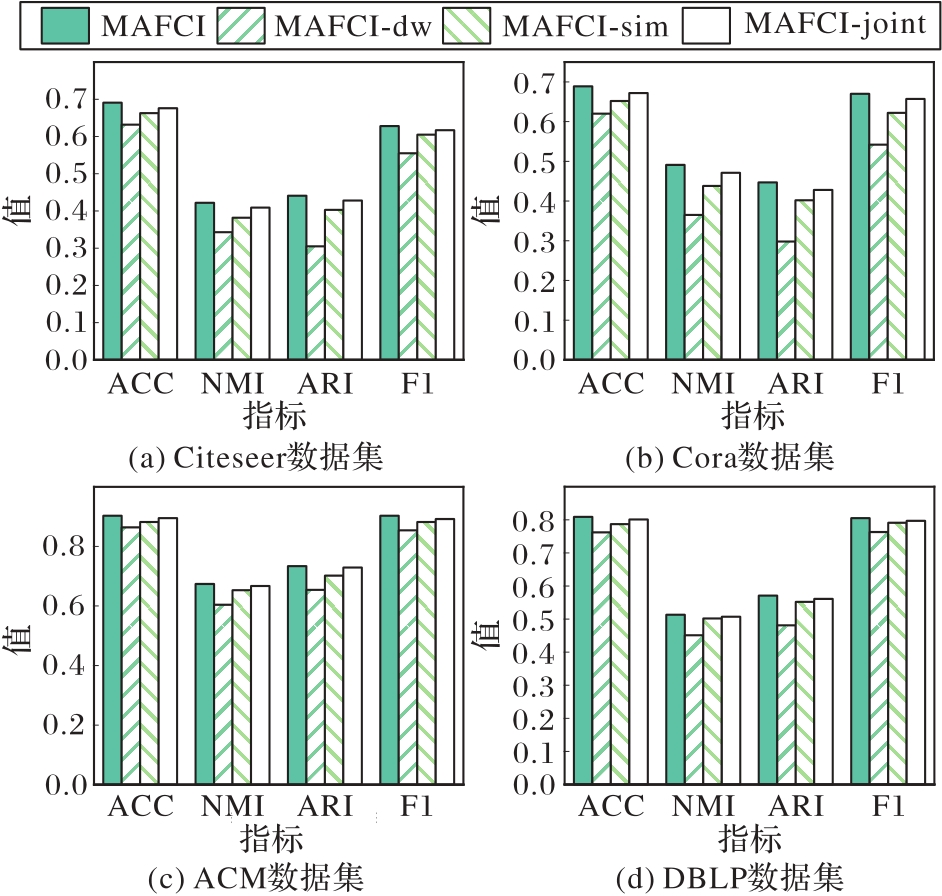
图4 消融实验
Fig. 4 Ablation experiments
| 数据集 | SpGAT/106 | Clustering Module/103 | 总参数量/106 |
|---|---|---|---|
| Cora | 1.61 | 1.79 | 1.61 |
| Citeseer | 3.94 | 1.54 | 3.94 |
| ACM | 2.06 | 0.77 | 2.06 |
| DBLP | 0.48 | 1.02 | 0.48 |
表4 MAFCI模型参数量
Tab. 4 MAFCI model parameters
| 数据集 | SpGAT/106 | Clustering Module/103 | 总参数量/106 |
|---|---|---|---|
| Cora | 1.61 | 1.79 | 1.61 |
| Citeseer | 3.94 | 1.54 | 3.94 |
| ACM | 2.06 | 0.77 | 2.06 |
| DBLP | 0.48 | 1.02 | 0.48 |
| 数据集 | SpGAT模块 | 聚类模块 | 总浮点计算量 |
|---|---|---|---|
| Cora | 15.34 | 9.72 | 25.06 |
| Citeseer | 42.88 | 10.24 | 53.12 |
| ACM | 21.66 | 4.66 | 26.32 |
| DBLP | 10.68 | 8.32 | 19.00 |
表5 MAFCI 模型浮点计算量 (MFLOPs)
Tab. 5 MAFCI model floating-point operations
| 数据集 | SpGAT模块 | 聚类模块 | 总浮点计算量 |
|---|---|---|---|
| Cora | 15.34 | 9.72 | 25.06 |
| Citeseer | 42.88 | 10.24 | 53.12 |
| ACM | 21.66 | 4.66 | 26.32 |
| DBLP | 10.68 | 8.32 | 19.00 |
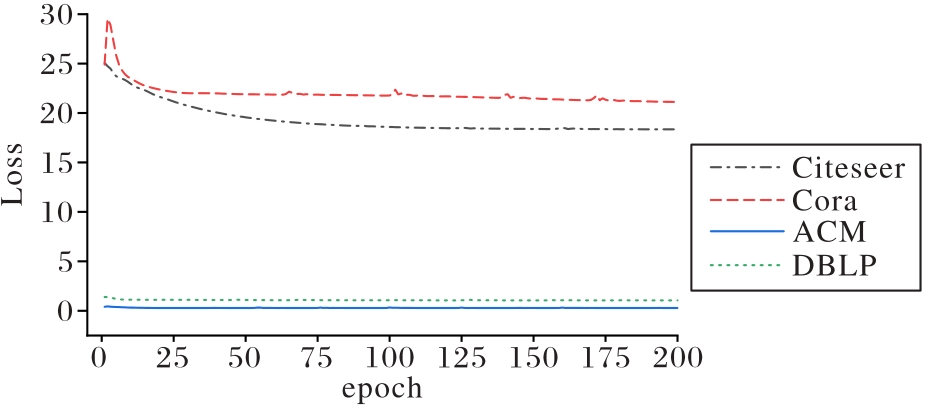
图5 MAFCI模型在不同数据集上的收敛性
Fig. 5 Convergence of MAFCI model on different datasets
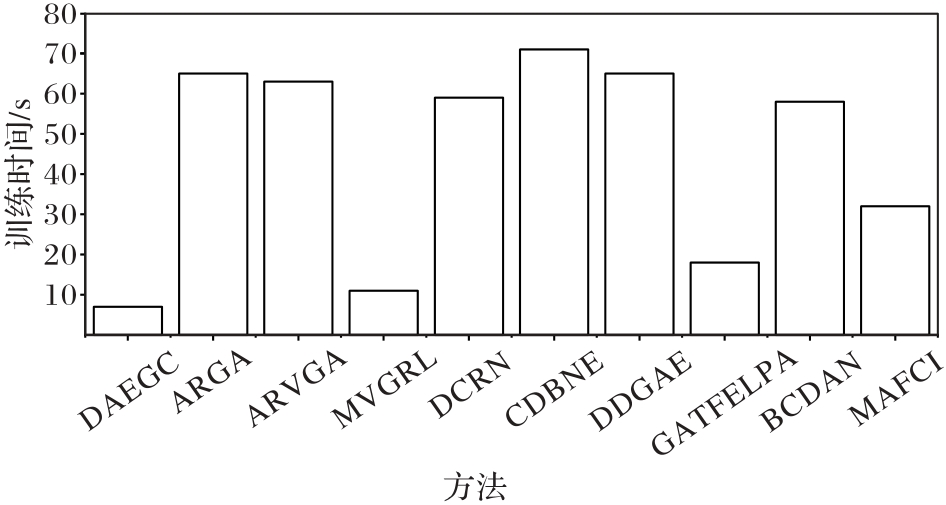
图6 不同方法在Cora数据集上的训练时间
Fig. 6 Training time of different methods on Cora dataset
| [1] | Girvan M, Newman M E J. Community structure in social and biological networks[J]. Proceedings of the National Academy of Sciences of the United States of America, 2002, 99(12): 7821-7826. |
| [2] | Zhu J, Yaseen A. A recommender for research collaborators using graph neural networks[J]. Frontiers in Artificial Intelligence, 2022, 5: No.881704. |
| [3] | Yan D, Bai J, Li C. Comparison of typical clustering algorithms for patent citation network[C]// CISAI 2021. Piscataway: IEEE, 2021: 322-325. |
| [4] | Huong V T, Koch T. Clustering scientific publications: lessons learned through experiments with a real citation network[PP/OL]. V1. arXiv (2025-05-15) [2025-09-26].. |
| [5] | 李成赞,黎建辉,王学志,等. 基于引文网络社区发现的数据推荐研究[J]. 情报学报, 2021, 40(8): 879-886. |
| Li Chengzan, Li Jianhui, Wang Xuezhi, et al. Research on data recommendation based on community detection of citation network[J]. Journal of the China Society for Scientific and Technical Information, 2021, 40(8): 879-886. | |
| [6] | Wang S, Yang J, Yao J, et al. An overview of advanced deep graph node clustering[J]. IEEE Transactions on Computational Social Systems, 2024, 11(1): 1302-1314. |
| [7] | Su X, Xue S, Liu F, et al. A comprehensive survey on community detection with deep learning[J]. IEEE Transactions on Neural Networks and Learning Systems, 2024, 35(6): 4682-4702. |
| [8] | Wei X, Zhang Z, Huang H, et al. An overview on deep clustering[J]. Neurocomputing, 2024, 590: No.127761. |
| [9] | 林欣蕊,王晓菲,朱焱. 基于局部扩展社区发现的学术异常引用群体检测[J]. 计算机应用, 2024, 44(6): 1855-1861. |
| Lin Xinrui, Wang Xiaofei, Zhu Yan. Academic anomaly citation group detection based on local extended community detection[J]. Journal of Computer Applications, 2024, 44(6): 1855-1861. | |
| [10] | Peng H, Fei R, Wan Y, et al. Deep embedding clustering on citation networks for community detection[C]// HDIS 2023. Piscataway: IEEE, 2023: 81-87. |
| [11] | Newman M E J, Girvan M. Finding and evaluating community structure in networks[J]. Physical Review E, 2004, 69(2): No.026113. |
| [12] | Blondel V D, Guillaume J L, Lambiotte R, et al. Fast unfolding of communities in large networks[J]. Journal of Statistical Mechanics: Theory and Experiment, 2008, 2008(10): No.P10008. |
| [13] | 陈吉成,陈鸿昶. 基于张量建模和进化K均值聚类的社区检测方法[J]. 计算机应用, 2021, 41(11): 3120-3126. |
| Chen Jicheng, Chen Hongchang. Community detection method based on tensor modeling and evolutionary K-means clustering[J]. Journal of Computer Applications, 2021, 41(11): 3120-3126. | |
| [14] | 刘世梁,王义,马应龙. 考虑社区规模不平衡的非重叠社区检测[J]. 计算机应用, 2024, 44(11): 3396-3402. |
| Liu Shiliang, Wang Yi, Ma Yinglong. Non-overlapping community detection with imbalanced community sizes[J]. Journal of Computer Applications, 2024, 44(11): 3396-3402. | |
| [15] | Kipf T N, Welling M. Semi-supervised classification with graph convolutional networks[PP/OL]. V4. arXiv (2017-02-22) [2025-09-26]. . |
| [16] | Kipf T N, Welling M. Variational graph auto-encoders[PP/OL]. V1. arXiv (2016-11-21) [2025-09-26].. |
| [17] | Wang C, Pan S, Hu R, et al. Attributed graph clustering: a deep attentional embedding approach[C]// IJCAI 2019. California: IJCAI, 2019: 3670-3676. |
| [18] | Pan S, Hu R, Long G, et al. Adversarially regularized graph autoencoder for graph embedding[C]// IJCAI 2018. California: IJCAI, 2018: 2609-2615. |
| [19] | Veličković P, Cucurull G, Casanova A, et al. Graph attention networks[PP/OL]. V3. arXiv (2018-02-04) [2025-03-10].. |
| [20] | Liu Y, Peng Y, Chen H, et al. BCDAN: a balanced method for community detection in attributed networks[J]. Neurocomputing, 2025, 644: No.130411. |
| [21] | Tang F, Li J, Liu X, et al. GATFELPA integrates graph attention networks and enhanced label propagation for robust community detection[J]. Scientific Reports, 2025, 15: No.3952. |
| [22] | Boubekki A, Kampffmeyer M, Brefeld U, et al. Joint optimization of an autoencoder for clustering and embedding[J]. Machine Learning, 2021, 110(7): 1901-1937. |
| [23] | Kong Y X, Shi G Y, Wu R J, et al. k-core: Theories and applications[J]. Physics Reports, 2019, 832: 1-32. |
| [24] | Ahn S J, Kim M. Variational graph normalized auto-encoders[C]// CIKM 2021. New York: ACM, 2021: 2827-2831. |
| [25] | Perozzi B, Al-Rfou R, Skiena S. DeepWalk: online learning of social representations[C]// KDD 2014. New York: ACM, 2014: 701-710. |
| [26] | Cao S, Lu W, Xu Q. Deep neural networks for learning graph representations[J]. Proceedings of the AAAI Conference on Artificial Intelligence, 2016, 30(1): 1145-1152. |
| [27] | Wang C, Pan S, Long G, et al. MGAE: marginalized graph autoencoder for graph clustering[C]// CIKM 2017. New York: ACM, 2017: 889-898. |
| [28] | Salehi A, Davulcu H. Graph attention auto-encoders[PP/OL]. V1. arXiv (2019-05-26) [2025-05-12].. |
| [29] | Liu C, Yang Y, Ding Y, et al. DAG: deep adaptive and generative K-free community detection on attributed graphs[C]// KDD 2024. New York: ACM, 2024: 5454-5465. |
| [30] | Liu H, Wei J, Xu T. Community detection based on community perspective and graph convolutional network[J]. Expert Systems with Applications, 2023, 231: No.120748. |
| [31] | Zhang X, Liu H, Wu X M, et al. Spectral embedding network for attributed graph clustering[J]. Neural Networks, 2021, 142: 388-396. |
| [32] | Zhou X, Su L, Li X, et al. Community detection based on unsupervised attributed network embedding[J]. Expert Systems with Applications, 2023, 213(Pt A): No.118937. |
| [33] | Wu X, Lu W, Quan Y, et al. Deep dual graph attention auto-encoder for community detection[J]. Expert Systems with Applications, 2024, 238(Pt D): No.122182. |
| [34] | Kang Z, Xie X, Li B, et al. CDC: a simple framework for complex data clustering[J]. IEEE Transactions on Neural Networks and Learning Systems, 2025, 36(7): 13177-13188. |
| [35] | Falih I, Grozavu N, Kanawati R, et al. Community detection in attributed network[C]// WWW 2018. Republic and Canton of Geneva: International World Wide Web Conferences Steering Committee, 2018: 1299-1306. |
| [36] | 杜航原,张晶,王文剑. 一种深度自监督聚类集成算法[J]. 智能系统学报, 2020, 15(6): 1113-1120. |
| Du Hangyuan, Zhang Jing, Wang Wenjian. A deep self-supervised clustering ensemble algorithm[J]. CAAI Transactions on Intelligent Systems, 2020, 15(6): 1113-1120. | |
| [37] | Sen P, Namata G, Bilgic M, et al. Collective classification in network data[J]. AI Magazine, 2008, 29(3): 93-106. |
| [38] | Shchur O, Mumme M, Bojchevski A, et al. Pitfalls of graph neural network evaluation[PP/OL]. V2. arXiv (2019-06-18) [2025-03-10].. |
| [39] | Hassani K, Khasahmadi A H. Contrastive multi-view representation learning on graphs[J]. Proceedings of Machine Learning Research, 2020, 119: 4116-4126. |
| [40] | Liu Y, Tu W, Zhou S, et al. Deep graph clustering via dual correlation reduction[J]. Proceedings of the AAAI Conference on Artificial Intelligence, 2022, 36(7): 7603-7611. |
| [1] | 袁立宁. 基于Wasserstein正则化增强的图表示学习[J]. 《计算机应用》唯一官方网站, 2026, 46(8): 2421-2431. |
| [2] | 陈宇, 戚帅康, 许莉薇, 朱浩天. 融合多尺度小波增强与自监督学习的社交机器人检测框架[J]. 《计算机应用》唯一官方网站, 2026, 46(6): 1756-1766. |
| [3] | 王美华, 黄杰, 温雯, 蔡瑞初, 黄沛杰, 徐禹洪, 林新龙. 基于梯度正交投影的动态知识图谱持续嵌入方法[J]. 《计算机应用》唯一官方网站, 2026, 46(6): 1776-1784. |
| [4] | 王静红, 陈潇, 马迎梅, 李笔, 米据生, 王威. 基于自适应学习的多层次邻域对比属性图聚类[J]. 《计算机应用》唯一官方网站, 2026, 46(6): 1836-1843. |
| [5] | 张婧, 刘松华, 朱远乾. 基于频谱感知和层次卷积的时间序列表示方法[J]. 《计算机应用》唯一官方网站, 2026, 46(4): 1124-1130. |
| [6] | 于巧, 黄子睿, 程圣懿, 祝义, 张淑涛. 基于边权重的软件漏洞检测方法[J]. 《计算机应用》唯一官方网站, 2026, 46(2): 518-527. |
| [7] | 李玟, 李开荣, 杨凯. 基于数据增强的子图感知对比学习[J]. 《计算机应用》唯一官方网站, 2026, 46(1): 1-9. |
| [8] | 程梓洋, 黄瑞章, 薛菁菁. 深度演化主题聚类模型[J]. 《计算机应用》唯一官方网站, 2026, 46(1): 85-94. |
| [9] | 张博瀚, 吕乐, 荆军昌, 刘栋. 基于遗传算法的属性网络社区隐藏方法[J]. 《计算机应用》唯一官方网站, 2025, 45(9): 2817-2826. |
| [10] | 曲鹏欢, 魏巍, 闫京, 王锋. 基于双补全的不完整多视图度量学习[J]. 《计算机应用》唯一官方网站, 2025, 45(9): 2755-2763. |
| [11] | 王义, 马应龙. 基于项图动态适应性生成的多任务社交项推荐方法[J]. 《计算机应用》唯一官方网站, 2025, 45(8): 2592-2599. |
| [12] | 王海杰, 张广鑫, 史海, 陈树. 基于实体表示增强的文档级关系抽取[J]. 《计算机应用》唯一官方网站, 2025, 45(6): 1809-1816. |
| [13] | 龙雨菲, 牟宇辰, 刘晔. 基于张量化图卷积网络和对比学习的多源数据表示学习模型[J]. 《计算机应用》唯一官方网站, 2025, 45(5): 1372-1378. |
| [14] | 胡林波, 倪志伟, 程家乐, 刘文涛, 朱旭辉. 融合社区检测的协作众包任务分配方法[J]. 《计算机应用》唯一官方网站, 2025, 45(2): 534-545. |
| [15] | 吕乐, 张博瀚, 荆军昌, 刘栋. 基于持久性的多目标节点隐藏方法[J]. 《计算机应用》唯一官方网站, 2025, 45(10): 3203-3213. |
| 阅读次数 | ||||||
|
全文 |
|
|||||
|
摘要 |
|
|||||
