


《计算机应用》唯一官方网站 ›› 2026, Vol. 46 ›› Issue (9): 2741-2751.DOI: 10.11772/j.issn.1001-9081.2025081017
• 人工智能 • 上一篇
王星尧1,2,3, 陈学斌1,2,3( )
)
收稿日期:2025-09-04
修回日期:2025-10-10
接受日期:2025-10-20
发布日期:2025-11-07
出版日期:2026-09-10
通讯作者:
陈学斌
作者简介:王星尧(1999—),男,河北唐山人,硕士研究生,CCF会员,主要研究方向:数据安全、隐私保护基金资助:
Xingyao WANG1,2,3, Xuebin CHEN1,2,3()
Received:2025-09-04
Revised:2025-10-10
Accepted:2025-10-20
Online:2025-11-07
Published:2026-09-10
Contact:
Xuebin CHEN
About author:WANG Xingyao, born in 1999, M. S. candidate. His research interests include data security, privacy protection.Supported by:摘要:
联邦学习作为人工智能领域的重要研究方向,在保障数据隐私的前提下,通过分布式协同训练构建全局模型,为隐私敏感场景下的联合建模提供了新范式。然而,现有方法在面对客户端异构数据时,存在性能退化、训练振荡和收敛缓慢等问题。因此,提出一种基于原型聚类与费舍尔信息矩阵自适应加权融合的联邦学习算法——FedPFA。首先,服务器对客户端上传的原型表示进行聚类,以缓解数据分布差异并增强全局模型的一致性与泛化能力;其次,结合客户端的费舍尔信息矩阵迹估计值为原型分配差异化权重,从而在融合过程中突出高质量客户端的贡献,抑制噪声或训练不足客户端的干扰。在MNIST、Fashion-MNIST和CIFAR-10数据集上的实验结果表明,与联邦全局预测头(FedGH)算法相比,在客户端数为20、参与率为0.3的情况下,FedPFA的准确率分别提高了19.64、26.14和16.15个百分点。FedPFA在保证性能提升的同时,显著提高了全局模型的收敛速度与稳定性,并在多种数据集上展现出良好的鲁棒性与实际应用价值。
中图分类号:
王星尧, 陈学斌. 基于原型聚类和费舍尔信息矩阵加权融合的联邦学习算法[J]. 计算机应用, 2026, 46(9): 2741-2751.
Xingyao WANG, Xuebin CHEN. Federated learning algorithm based on prototype clustering and Fisher information matrix weighted fusion[J]. Journal of Computer Applications, 2026, 46(9): 2741-2751.
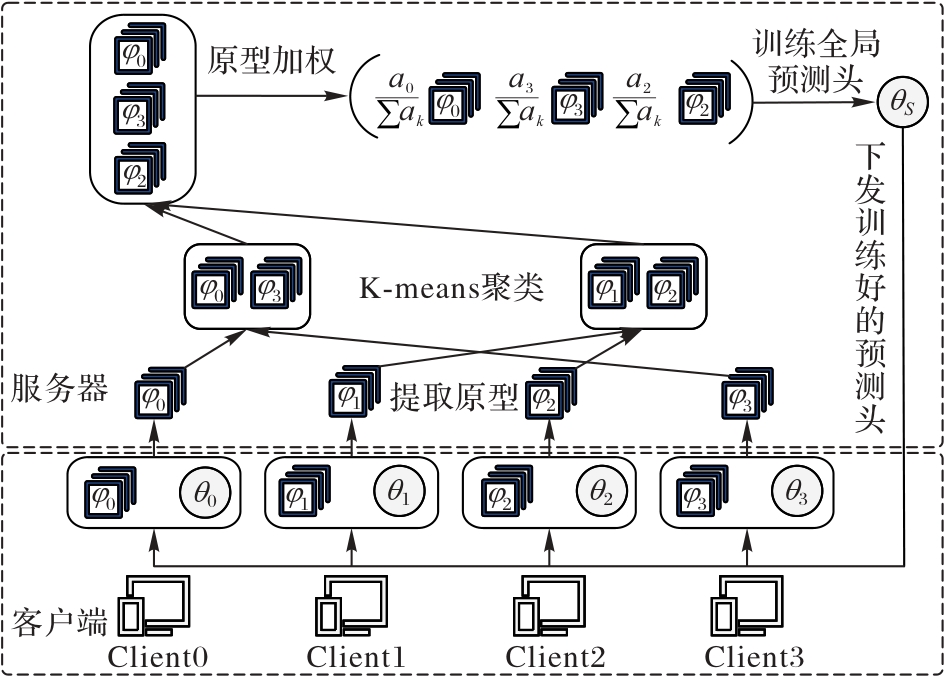
图1 FedPFA的框架
Fig. 1 Framework of FedPFA

图2 不同算法在3种数据集上的准确率和损失曲线对比(20个客户端)
Fig. 2 Accuracy and loss curve comparison of different algorithms on three datasets (20 clients)
| 算法 | MNIST | Fashion-MNIST | CIFAR-10 | |||||||||
|---|---|---|---|---|---|---|---|---|---|---|---|---|
| Acc/% | Loss | Acc/% | Loss | Acc/% | Loss | Acc/% | Loss | Acc/% | Loss | Acc/% | Loss | |
| FedAvg | 82.96 | 0.479 | 86.66 | 0.371 | 63.41 | 1.037 | 67.19 | 0.858 | 40.95 | 1.722 | 47.09 | 1.445 |
| FedProx | 82.26 | 0.502 | 85.10 | 0.412 | 60.53 | 1.147 | 68.10 | 0.844 | 37.44 | 1.829 | 41.48 | 1.617 |
| FedProto | 81.61 | 0.076 | 96.69 | 0.040 | 65.37 | 0.134 | 85.34 | 0.102 | 75.55 | 0.153 | 84.28 | 0.014 |
| FedGH | 78.48 | 1.668 | 88.91 | 0.996 | 64.68 | 2.814 | 81.34 | 0.895 | 72.18 | 2.283 | 78.32 | 2.085 |
| FedCross | 97.80 | 0.066 | 97.77 | 0.067 | 89.30 | 0.287 | 89.43 | 0.285 | 88.19 | 0.258 | 88.94 | 0.268 |
| FedPFA | 98.12 | 0.047 | 98.86 | 0.006 | 90.82 | 0.614 | 92.40 | 0.302 | 88.33 | 0.047 | 89.19 | 0.001 |
表1 不同算法在3种数据集上的性能对比结果(20个客户端)
Tab. 1 Performance comparison results of different algorithms on three datasets (20 clients)
| 算法 | MNIST | Fashion-MNIST | CIFAR-10 | |||||||||
|---|---|---|---|---|---|---|---|---|---|---|---|---|
| Acc/% | Loss | Acc/% | Loss | Acc/% | Loss | Acc/% | Loss | Acc/% | Loss | Acc/% | Loss | |
| FedAvg | 82.96 | 0.479 | 86.66 | 0.371 | 63.41 | 1.037 | 67.19 | 0.858 | 40.95 | 1.722 | 47.09 | 1.445 |
| FedProx | 82.26 | 0.502 | 85.10 | 0.412 | 60.53 | 1.147 | 68.10 | 0.844 | 37.44 | 1.829 | 41.48 | 1.617 |
| FedProto | 81.61 | 0.076 | 96.69 | 0.040 | 65.37 | 0.134 | 85.34 | 0.102 | 75.55 | 0.153 | 84.28 | 0.014 |
| FedGH | 78.48 | 1.668 | 88.91 | 0.996 | 64.68 | 2.814 | 81.34 | 0.895 | 72.18 | 2.283 | 78.32 | 2.085 |
| FedCross | 97.80 | 0.066 | 97.77 | 0.067 | 89.30 | 0.287 | 89.43 | 0.285 | 88.19 | 0.258 | 88.94 | 0.268 |
| FedPFA | 98.12 | 0.047 | 98.86 | 0.006 | 90.82 | 0.614 | 92.40 | 0.302 | 88.33 | 0.047 | 89.19 | 0.001 |
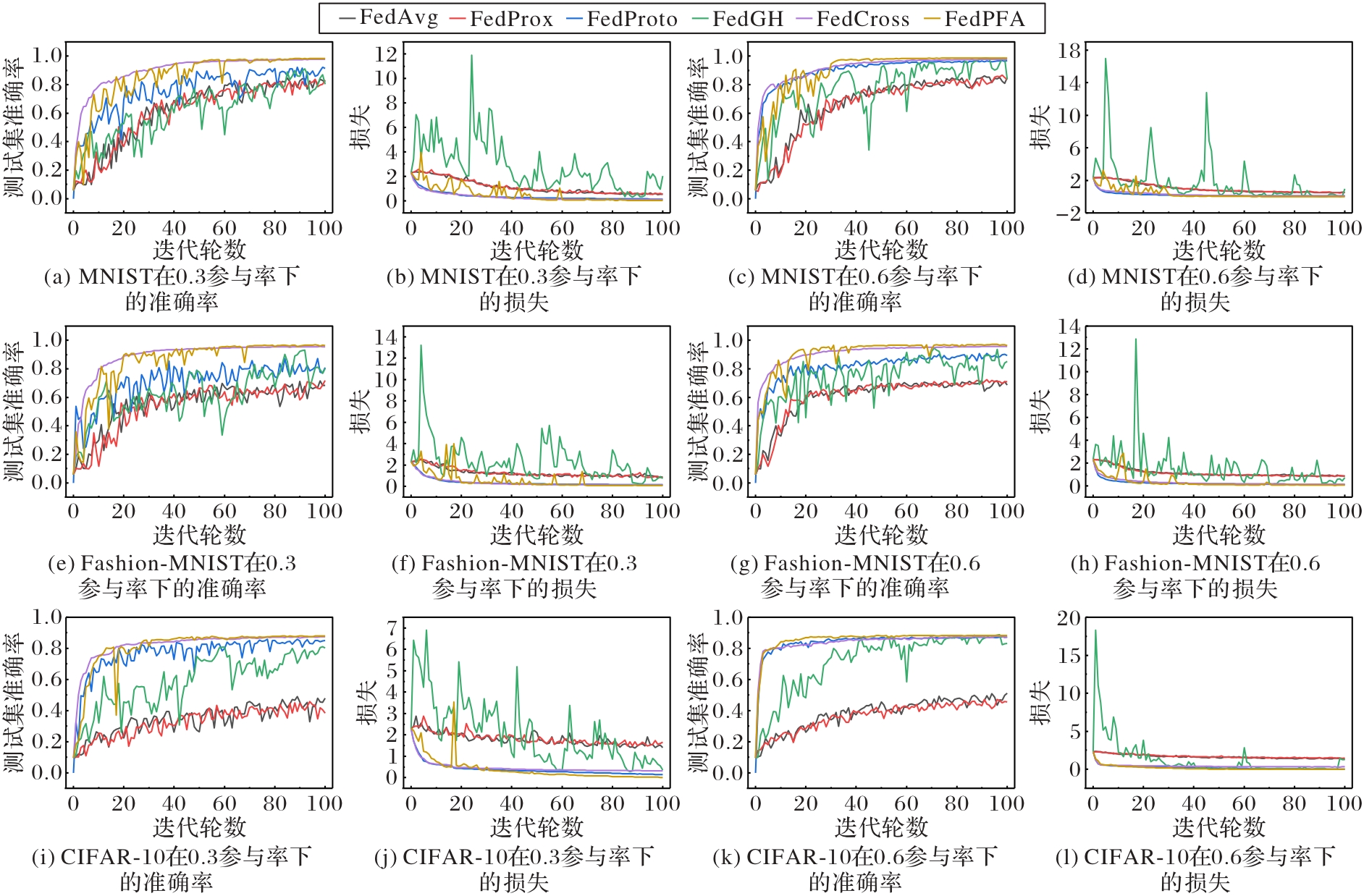
图3 不同算法在3种数据集上的准确率和损失曲线对比(50个客户端)
Fig. 3 Accuracy and loss curve comparison of different algorithms on three datasets (50 clients)
| 算法 | MNIST | Fashion-MNIST | CIFAR-10 | |||||||||
|---|---|---|---|---|---|---|---|---|---|---|---|---|
| Acc/% | Loss | Acc/% | Loss | Acc/% | Loss | Acc/% | Loss | Acc/% | Loss | Acc/% | Loss | |
| FedAvg | 80.30 | 0.586 | 82.66 | 0.539 | 65.11 | 0.984 | 69.10 | 0.891 | 43.05 | 1.561 | 47.09 | 1.423 |
| FedProx | 79.35 | 0.611 | 82.11 | 0.553 | 65.17 | 0.986 | 70.07 | 0.864 | 40.87 | 1.599 | 44.11 | 1.502 |
| FedProto | 88.40 | 0.153 | 96.22 | 0.079 | 79.80 | 0.177 | 88.61 | 0.118 | 83.77 | 0.189 | 86.91 | 0.039 |
| FedGH | 79.68 | 1.353 | 92.70 | 0.391 | 79.68 | 1.167 | 84.02 | 0.611 | 72.64 | 1.039 | 86.00 | 0.200 |
| FedCross | 97.02 | 0.087 | 97.54 | 0.082 | 95.35 | 0.144 | 95.45 | 0.142 | 87.05 | 0.330 | 87.19 | 0.323 |
| FedPFA | 97.21 | 0.059 | 98.59 | 0.004 | 96.36 | 0.085 | 96.63 | 0.057 | 87.64 | 0.046 | 88.22 | 0.001 |
表2 不同算法在3种数据集上的性能对比结果(50个客户端)
Tab. 2 Performance comparison results of different algorithms on three datasets (50 clients)
| 算法 | MNIST | Fashion-MNIST | CIFAR-10 | |||||||||
|---|---|---|---|---|---|---|---|---|---|---|---|---|
| Acc/% | Loss | Acc/% | Loss | Acc/% | Loss | Acc/% | Loss | Acc/% | Loss | Acc/% | Loss | |
| FedAvg | 80.30 | 0.586 | 82.66 | 0.539 | 65.11 | 0.984 | 69.10 | 0.891 | 43.05 | 1.561 | 47.09 | 1.423 |
| FedProx | 79.35 | 0.611 | 82.11 | 0.553 | 65.17 | 0.986 | 70.07 | 0.864 | 40.87 | 1.599 | 44.11 | 1.502 |
| FedProto | 88.40 | 0.153 | 96.22 | 0.079 | 79.80 | 0.177 | 88.61 | 0.118 | 83.77 | 0.189 | 86.91 | 0.039 |
| FedGH | 79.68 | 1.353 | 92.70 | 0.391 | 79.68 | 1.167 | 84.02 | 0.611 | 72.64 | 1.039 | 86.00 | 0.200 |
| FedCross | 97.02 | 0.087 | 97.54 | 0.082 | 95.35 | 0.144 | 95.45 | 0.142 | 87.05 | 0.330 | 87.19 | 0.323 |
| FedPFA | 97.21 | 0.059 | 98.59 | 0.004 | 96.36 | 0.085 | 96.63 | 0.057 | 87.64 | 0.046 | 88.22 | 0.001 |
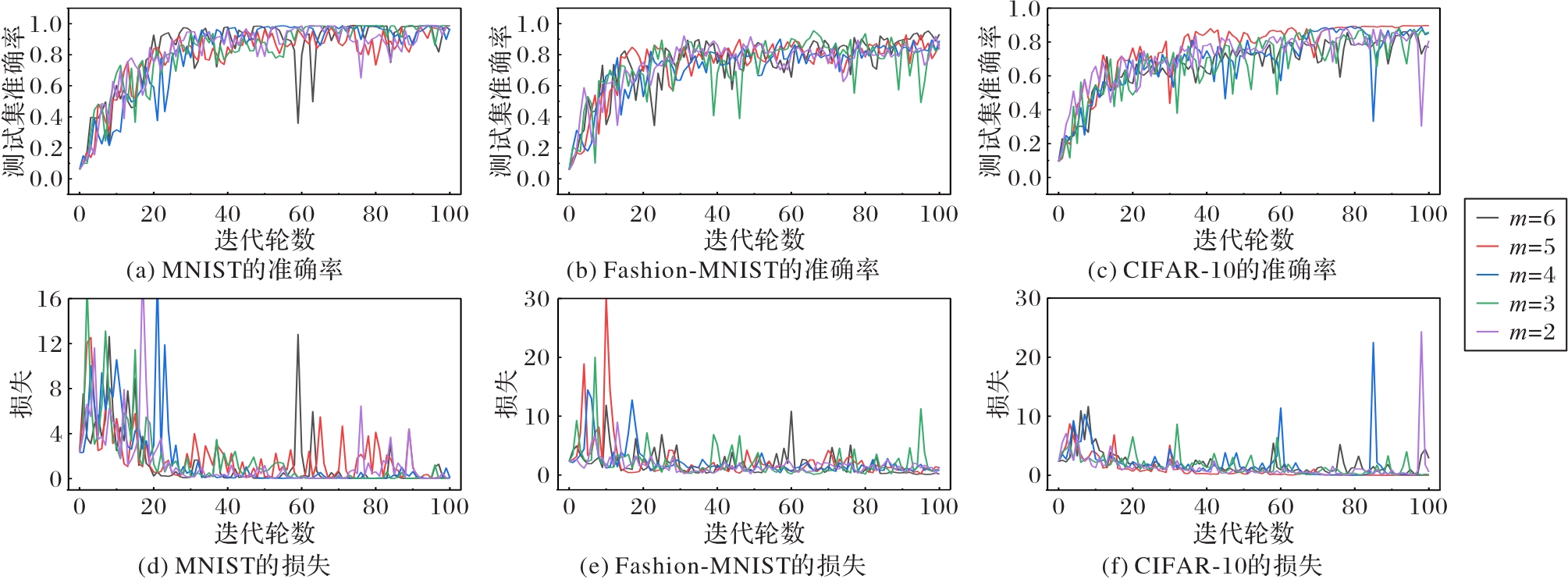
图4 不同聚类数在3个数据集上的准确率和损失曲线对比(20个客户端,参与率为0.3)
Fig. 4 Accuracy and loss curve comparison of different cluster numbers on three datasets (20 clients, 0.3 participation rate)
| m | MNIST | Fashion-MNIST | CIFAR-10 | |||
|---|---|---|---|---|---|---|
| Acc/% | Loss | Acc/% | Loss | Acc/% | Loss | |
| 6 | 95.62 | 0.257 | 86.55 | 0.926 | 78.42 | 1.323 |
| 5 | 90.04 | 1.156 | 82.28 | 1.498 | 87.59 | 0.039 |
| 4 | 95.38 | 0.188 | 82.66 | 1.239 | 83.89 | 0.986 |
| 3 | 96.93 | 0.119 | 79.70 | 1.804 | 80.26 | 0.680 |
| 2 | 90.85 | 0.894 | 80.01 | 1.369 | 80.50 | 1.282 |
表3 不同聚类数在3个数据集上的性能对比结果(20个客户端,参与率为0.3)
Tab. 3 Performance comparison results of different cluster numbers on three datasets (20 clients, 0.3 participation rate)
| m | MNIST | Fashion-MNIST | CIFAR-10 | |||
|---|---|---|---|---|---|---|
| Acc/% | Loss | Acc/% | Loss | Acc/% | Loss | |
| 6 | 95.62 | 0.257 | 86.55 | 0.926 | 78.42 | 1.323 |
| 5 | 90.04 | 1.156 | 82.28 | 1.498 | 87.59 | 0.039 |
| 4 | 95.38 | 0.188 | 82.66 | 1.239 | 83.89 | 0.986 |
| 3 | 96.93 | 0.119 | 79.70 | 1.804 | 80.26 | 0.680 |
| 2 | 90.85 | 0.894 | 80.01 | 1.369 | 80.50 | 1.282 |
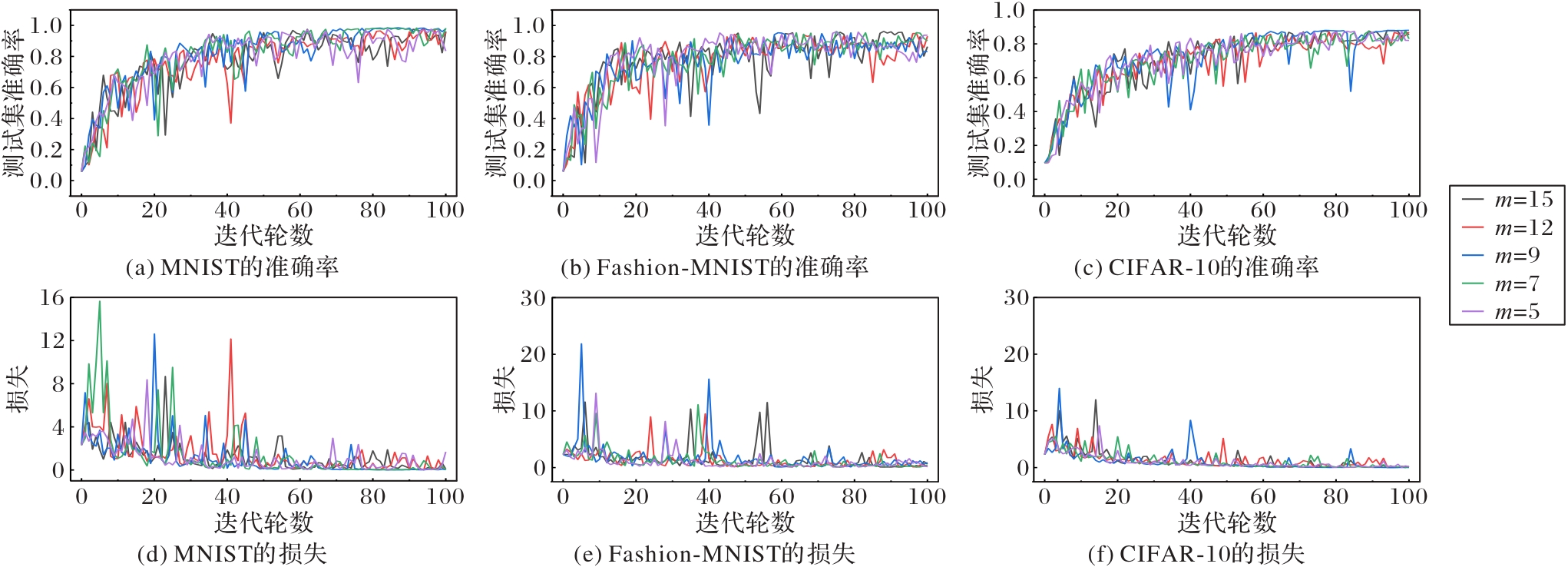
图5 不同聚类数在3个数据集上的准确率和损失曲线对比(50个客户端,参与率为0.3)
Fig. 5 Accuracy and loss curve comparison of different cluster numbers on three datasets (50 clients, 0.3 participation rate)
| m | MNIST | Fashion-MNIST | CIFAR-10 | |||
|---|---|---|---|---|---|---|
| Acc/% | Loss | Acc/% | Loss | Acc/% | Loss | |
| 15 | 89.71 | 0.474 | 88.80 | 0.580 | 84.45 | 0.248 |
| 12 | 90.91 | 0.568 | 85.31 | 0.844 | 80.96 | 0.547 |
| 9 | 96.76 | 0.123 | 86.23 | 0.803 | 85.49 | 0.177 |
| 7 | 95.74 | 0.159 | 89.41 | 0.415 | 81.71 | 0.383 |
| 5 | 89.13 | 0.542 | 87.41 | 0.596 | 83.40 | 0.258 |
表4 不同聚类数在3个数据集上的性能对比结果(50个客户端,参与率为0.3)
Tab. 4 Performance comparison results of different cluster numbers on three datasets (50 clients, 0.3 participation rate)
| m | MNIST | Fashion-MNIST | CIFAR-10 | |||
|---|---|---|---|---|---|---|
| Acc/% | Loss | Acc/% | Loss | Acc/% | Loss | |
| 15 | 89.71 | 0.474 | 88.80 | 0.580 | 84.45 | 0.248 |
| 12 | 90.91 | 0.568 | 85.31 | 0.844 | 80.96 | 0.547 |
| 9 | 96.76 | 0.123 | 86.23 | 0.803 | 85.49 | 0.177 |
| 7 | 95.74 | 0.159 | 89.41 | 0.415 | 81.71 | 0.383 |
| 5 | 89.13 | 0.542 | 87.41 | 0.596 | 83.40 | 0.258 |
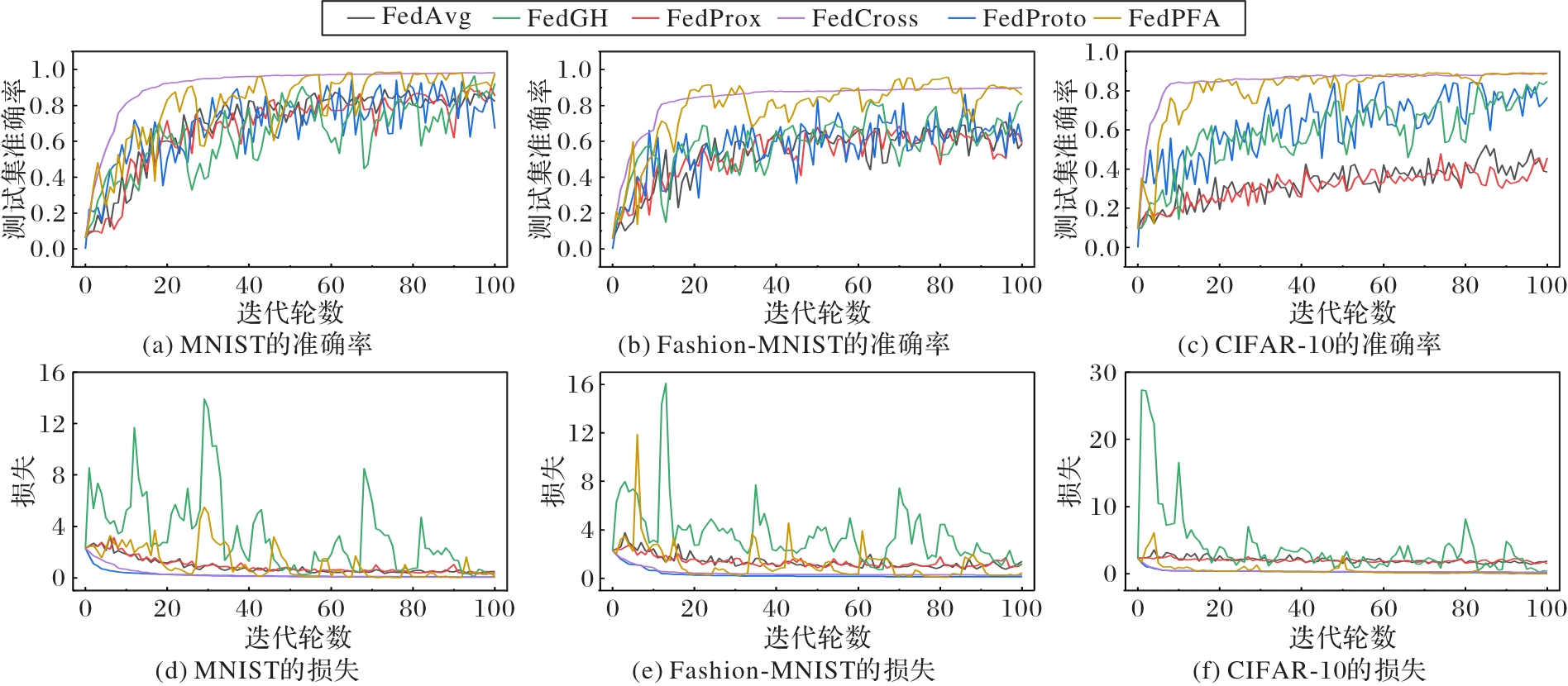
图6 单独使用自适应加权融合算法的准确率和损失曲线对比
Fig. 6 Accuracy and loss curve comparison using adaptive weighted fusion algorithm alone
| 算法 | MNIST | Fashion-MNIST | CIFAR-10 | |||
|---|---|---|---|---|---|---|
| Acc/% | Loss | Acc/% | Loss | Acc/% | Loss | |
| FedAvg | 82.96 | 0.479 | 63.41 | 1.037 | 40.95 | 1.722 |
| FedProx | 82.26 | 0.502 | 60.53 | 1.147 | 37.44 | 1.829 |
| FedProto | 81.61 | 0.076 | 65.37 | 0.134 | 75.55 | 0.153 |
| FedGH | 78.48 | 1.668 | 64.68 | 2.814 | 72.18 | 2.283 |
| FedCross | 97.80 | 0.066 | 89.30 | 0.287 | 88.19 | 0.258 |
| FedPFA | 95.13 | 0.230 | 86.90 | 0.491 | 87.59 | 0.071 |
表5 单独使用自适应加权融合算法的性能对比结果
Tab. 5 Performance comparison results using adaptive weighted fusion algorithm alone
| 算法 | MNIST | Fashion-MNIST | CIFAR-10 | |||
|---|---|---|---|---|---|---|
| Acc/% | Loss | Acc/% | Loss | Acc/% | Loss | |
| FedAvg | 82.96 | 0.479 | 63.41 | 1.037 | 40.95 | 1.722 |
| FedProx | 82.26 | 0.502 | 60.53 | 1.147 | 37.44 | 1.829 |
| FedProto | 81.61 | 0.076 | 65.37 | 0.134 | 75.55 | 0.153 |
| FedGH | 78.48 | 1.668 | 64.68 | 2.814 | 72.18 | 2.283 |
| FedCross | 97.80 | 0.066 | 89.30 | 0.287 | 88.19 | 0.258 |
| FedPFA | 95.13 | 0.230 | 86.90 | 0.491 | 87.59 | 0.071 |
| 算法 | ||
|---|---|---|
| FedAvg | 34 | 2 317.07 |
| FedProx | 45 | 2 829.78 |
| FedProto | 31 | 3 092.16 |
| FedGH | 48 | 2 669.11 |
| FedCross | 10 | 2 539.87 |
| FedPFA | 12 | 2 939.82 |
表6 不同算法的运行时间对比
Tab. 6 Running time comparison of different algorithms
| 算法 | ||
|---|---|---|
| FedAvg | 34 | 2 317.07 |
| FedProx | 45 | 2 829.78 |
| FedProto | 31 | 3 092.16 |
| FedGH | 48 | 2 669.11 |
| FedCross | 10 | 2 539.87 |
| FedPFA | 12 | 2 939.82 |
| [1] | McMahan H B, Moore E, Ramage D, et al. Communication-efficient learning of deep networks from decentralized data [J]. Proceedings of Machine Learning Research, 2017, 54: 1273-1282. |
| [2] | 管桂林,陶政坪,支婷,等. 面向医疗场景的去中心化联邦学习隐私保护方法[J]. 计算机应用, 2024, 44(): 112-117. |
| Guan Guilin, Tao Zhengping, Zhi Ting, et al. Decentralized federated learning privacy protection method for medical scenarios [J]. Journal of Computer Applications, 2024, 44(): 112-117. | |
| [3] | Ramaswamy S, Mathews R, Rao K, et al. Federated learning for emoji prediction in a mobile keyboard [PP/OL]. arXiv (2019-06-11) [2025-04-12].. |
| [4] | 陈泉. 联邦学习在工业物联网设备安全防护中的应用研究[J]. 中国宽带, 2025, 21(8): 61-63. |
| Chen Quan. Research on the application of federated learning in the security protection of industrial Internet of Things equipment [J]. China Broadband, 2025, 21(8): 61-63. | |
| [5] | Mendieta M, Yang T, Wang P, et al. Local learning matters: rethinking data heterogeneity in federated learning [C]// CVPR 2022. Piscataway: IEEE, 2022: 8387-8396. |
| [6] | 田浩迪,张冠华,龙伟,等. 面向客户端数据异构性问题的联邦学习算法综述[J]. 计算机与网络, 2025, 51(3): 246-252. |
| Tian Haodi, Zhang Guanhua, Long Wei, et al. Survey of federated learning algorithms for client data heterogeneity problems [J]. Computer and Network, 2025, 51(3): 246-252. | |
| [7] | Zawad S, Ali A, Chen P Y, et al. Curse or redemption? how data heterogeneity affects the robustness of federated learning [J]. Proceedings of the AAAI Conference on Artificial Intelligence, 2021, 35(12): 10807-10814. |
| [8] | Li T, Sahu A K, Zaheer M, et al. Federated optimization in heterogeneous networks [EB/OL]. (2020) [2025-05-22].. |
| [9] | Karimireddy S P, Kale S, Mohri M, et al. SCAFFOLD: stochastic controlled averaging for federated learning [J]. Proceedings of Machine Learning Research, 2020, 119: 5132-5143. |
| [10] | Acar D A E, Zhao Y, Navarro R M, et al. Federated learning based on dynamic regularization [PP/OL]. V2. arXiv (2021-11-09) [2025-05-13].. |
| [11] | Li Q, He B, Song D. Model-contrastive federated learning [C]// CVPR 2021. Piscataway: IEEE, 2021: 10708-10717. |
| [12] | Zhang J, Li Z, Li B, et al. Federated learning with label distribution skew via logits calibration [J]. Proceedings of Machine Learning Research, 2022, 162: 26311-26329. |
| [13] | Sun Y, Mao Y, Zhang J. MimiC: combating client dropouts in federated learning by mimicking central updates [J]. IEEE Transactions on Mobile Computing, 2024, 23(7): 7572-7584. |
| [14] | Hu M, Zhou P, Yue Z, et al. FedCross: towards accurate federated learning via multi-model cross-aggregation [C]// ICDE 2024. Piscataway: IEEE, 2024: 2137-2150. |
| [15] | EL-Rifai O, Ali M B, Megdiche I, et al. A survey on cluster-based federated learning [PP/OL]. arXiv (2025-01-29) [2025-09-18].. |
| [16] | Duan M, Liu D, Ji X, et al. FedGroup: efficient federated learning via decomposed similarity-based clustering [C]// ISPA/BDCloud/SocialCom/SustainCom 2021. Piscataway: IEEE, 2021: 228-237. |
| [17] | Wang Z, Xu H, Liu J, et al. Accelerating federated learning with cluster construction and hierarchical aggregation [J]. IEEE Transactions on Mobile Computing, 2023, 22(7): 3805-3822. |
| [18] | Zhou Y, Shi M, Tian Y, et al. Federated cINN clustering for accurate clustered federated learning [C]// ICASSP 2024. Piscataway: IEEE, 2024: 5590-5594. |
| [19] | Tian P, Liao W, Yu W, et al. WSCC: a weight-similarity-based client clustering approach for non-IID federated learning [J]. IEEE Internet of Things Journal, 2022, 9(20): 20243-20256. |
| [20] | Liang T, Yuan C, Lu C, et al. Efficient one-off clustering for personalized federated learning [J]. Knowledge-Based Systems, 2023, 277: No.110813. |
| [21] | Cai L, Chen N, Cao Y, et al. FedCE: personalized federated learning method based on clustering ensembles [C]// MM 2023. New York: ACM, 2023: 1625-1633. |
| [22] | Al-Saedi A A, Boeva V, Casalicchio E. FedCO: communication-efficient federated learning via clustering optimization [J]. Future Internet, 2022, 14(12): No.377. |
| [23] | Li Y, Wang X, An L. Hierarchical clustering-based personalized federated learning for robust and fair human activity recognition[J]. Proceedings of the ACM on Interactive, Mobile, Wearable and Ubiquitous Technologies, 2023, 7(1): No.20. |
| [24] | Tan Y, Long G, Liu L, et al. FedProto: federated prototype learning across heterogeneous clients [J]. Proceedings of the AAAI Conference on Artificial Intelligence, 2022, 36(8): 8432-8440. |
| [25] | Dai Y, Chen Z, Li J, et al. Tackling data heterogeneity in federated learning with class prototypes [J]. Proceedings of the AAAI Conference on Artificial Intelligence, 2023, 37(6): 7314-7322. |
| [26] | Mu X, Shen Y, Cheng K, et al. FedProc: prototypical contrastive federated learning on non-IID data [J]. Future Generation Computer Systems, 2023, 143: 93-104. |
| [27] | Yi L, Wang G, Liu X, et al. FedGH: heterogeneous federated learning with generalized global header [C]// MM 2023. New York: ACM, 2023: 8686-8696. |
| [28] | Chai L, Xie J, Zhou N. Prototype-based fine-tuning for mitigating data heterogeneity in federated learning [J]. Future Generation Computer Systems, 2025, 170: No.107831. |
| [29] | Zhang J, Liu Y, Hua Y, et al. FedTGP: trainable global prototypes with adaptive-margin-enhanced contrastive learning for data and model heterogeneity in federated learning [J]. Proceedings of the AAAI Conference on Artificial Intelligence, 2024, 38(15): 16768-16776. |
| [30] | Cheng D, Zhang L, Bu C, et al. ProtoHAR: prototype guided personalized federated learning for human activity recognition [J]. IEEE Journal of Biomedical and Health Informatics, 2023, 27(8): 3900-3911. |
| [1] | 金亚东, 范菁, 郗恩康, 董华, 俞浩, 孙伊航. 面向空天地一体化网络的个性化联邦学习智能边缘聚合方法[J]. 《计算机应用》唯一官方网站, 2026, 46(8): 2555-2566. |
| [2] | 孙天乐, 曹腾飞. 车联网中基于Stackelberg博弈的联邦学习质量感知激励机制[J]. 《计算机应用》唯一官方网站, 2026, 46(7): 2229-2238. |
| [3] | 钟琪, 张淑芬, 张镇博, 李涛. 基于梯度特征的联邦学习后门防御算法[J]. 《计算机应用》唯一官方网站, 2026, 46(7): 2184-2195. |
| [4] | 任志强, 陈学斌, 屈昌盛. 面向联邦学习中拜占庭攻击的主动防御框架[J]. 《计算机应用》唯一官方网站, 2026, 46(7): 2196-2207. |
| [5] | 董汦楗, 顾瑞春. 融合动态特征对齐与温度感知聚合的联邦学习框架[J]. 《计算机应用》唯一官方网站, 2026, 46(6): 1746-1755. |
| [6] | 俞浩, 范菁, 郗恩康, 金亚东, 董华, 孙伊航. 边缘异构下的高效联邦分割学习框架HEFSL[J]. 《计算机应用》唯一官方网站, 2026, 46(5): 1397-1407. |
| [7] | 姜志, 陈学斌, 罗长银, 甄子业. 联邦学习中改进Kolmogorov-Arnold网络的混合优化框架[J]. 《计算机应用》唯一官方网站, 2026, 46(4): 1023-1033. |
| [8] | 马凯光, 陈学斌, 菅银龙, 王柳, 高远. 基于混合序列模型与联邦类平衡算法的网络入侵检测[J]. 《计算机应用》唯一官方网站, 2026, 46(3): 857-866. |
| [9] | 郗恩康, 范菁, 金亚东, 董华, 俞浩, 孙伊航. 联邦学习在隐私安全领域面临的威胁综述[J]. 《计算机应用》唯一官方网站, 2026, 46(3): 798-808. |
| [10] | 平欢, 夏战国, 刘思诚, 刘奇翰, 李春磊. 基于多层联邦学习的终端数据隐私保护方案[J]. 《计算机应用》唯一官方网站, 2026, 46(3): 830-838. |
| [11] | 王磊, 周文轩, 贾柠晖, 屈志昊. 面向隐私敏感物联网数据的联邦学习双向通信压缩[J]. 《计算机应用》唯一官方网站, 2026, 46(3): 887-898. |
| [12] | 钟琪, 张淑芬, 张镇博, 菅银龙, 景忠瑞. 面向联邦学习的投毒攻击检测与防御机制[J]. 《计算机应用》唯一官方网站, 2026, 46(2): 445-457. |
| [13] | 张珂嘉, 方志军, 周南润, 史志才. 基于模型预分配与自蒸馏的个性化联邦学习方法[J]. 《计算机应用》唯一官方网站, 2026, 46(1): 10-20. |
| [14] | 菅银龙, 陈学斌, 景忠瑞, 钟琪, 张镇博. 联邦学习中基于条件生成对抗网络的数据增强方案[J]. 《计算机应用》唯一官方网站, 2026, 46(1): 21-32. |
| [15] | 俞浩, 范菁, 孙伊航, 金亚东, 郗恩康, 董华. 边缘异构下的联邦分割学习优化方法[J]. 《计算机应用》唯一官方网站, 2026, 46(1): 33-42. |
| 阅读次数 | ||||||
|
全文 |
|
|||||
|
摘要 |
|
|||||
