


《计算机应用》唯一官方网站 ›› 2026, Vol. 46 ›› Issue (9): 2776-2786.DOI: 10.11772/j.issn.1001-9081.2025081053
• 人工智能 • 上一篇
杨定礼( ), 卫元芳, 胡文瑞, 孔力杨, 于银山
收稿日期:2025-09-11
修回日期:2025-12-18
接受日期:2026-01-04
发布日期:2026-02-12
出版日期:2026-09-10
通讯作者:
杨定礼
作者简介:杨定礼(1973—),男,淮安金湖人,副教授,硕士,CCF会员,主要研究方向:深度学习、图像信号处理基金资助:
Dingli YANG(), Yuanfang WEI, Wenrui HU, Liyang KONG, Yinshan YU
Received:2025-09-11
Revised:2025-12-18
Accepted:2026-01-04
Online:2026-02-12
Published:2026-09-10
Contact:
Dingli YANG
About author:YANG Dingli, born in 1973, M. S., associate professor. His research interests include deep learning, image signal processing.Supported by:摘要:
针对遮挡、视角变化及姿态变化等复杂场景下的行人重识别(Re-ID)匹配困难的问题,提出一种时空建模与层次化特征增强的Re-ID算法,通过三阶段渐进式的特征优化框架,实现全局一致性与局部判别性的协同提升。首先,在骨干网络提取外观特征后,引入双池化时序注意力机制,该机制结合全局平均池化与时间平均池化捕获序列特征的互补信息,并通过通道与空间交互进行时空依赖建模,从而突出运动相关特征并缓解遮挡导致的局部信息缺失;其次,针对人体部位特征分布不均的问题,构建柔性特征融合模块,通过可学习权重自适应地聚合多部位特征,抑制遮挡噪声并增强判别性局部特征,从而获得全局与局部层次化表示;最后,在分类层前设计置信度校准网络,通过残差学习优化身份预测的置信度分布,提升跨摄像头检索精度。在Market-1501公开数据集上进行系统评估的结果表明,所提算法的平均精度均值(mAP)达到93.2%,Rank-1达到97.4%,相较于基线算法BPBReIDHR(Body Part-Based ReID model),分别提升了3.8和1.7个百分点。所提算法通过时空建模与层次化特征增强的结合能显著提升复杂场景下的Re-ID性能。
中图分类号:
杨定礼, 卫元芳, 胡文瑞, 孔力杨, 于银山. 时空建模与层次化特征增强的行人重识别算法[J]. 计算机应用, 2026, 46(9): 2776-2786.
Dingli YANG, Yuanfang WEI, Wenrui HU, Liyang KONG, Yinshan YU. Spatio-temporal modeling and hierarchical feature enhancement for person re-identification[J]. Journal of Computer Applications, 2026, 46(9): 2776-2786.
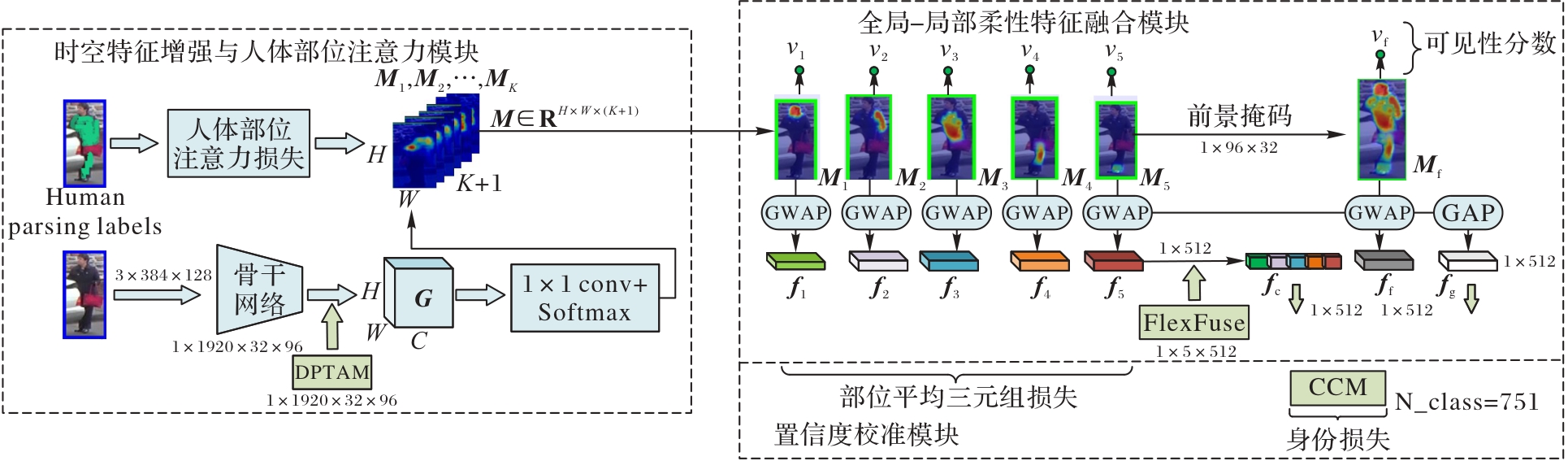
图1 本文算法的网络结构
Fig. 1 Network structure of proposed algorithm
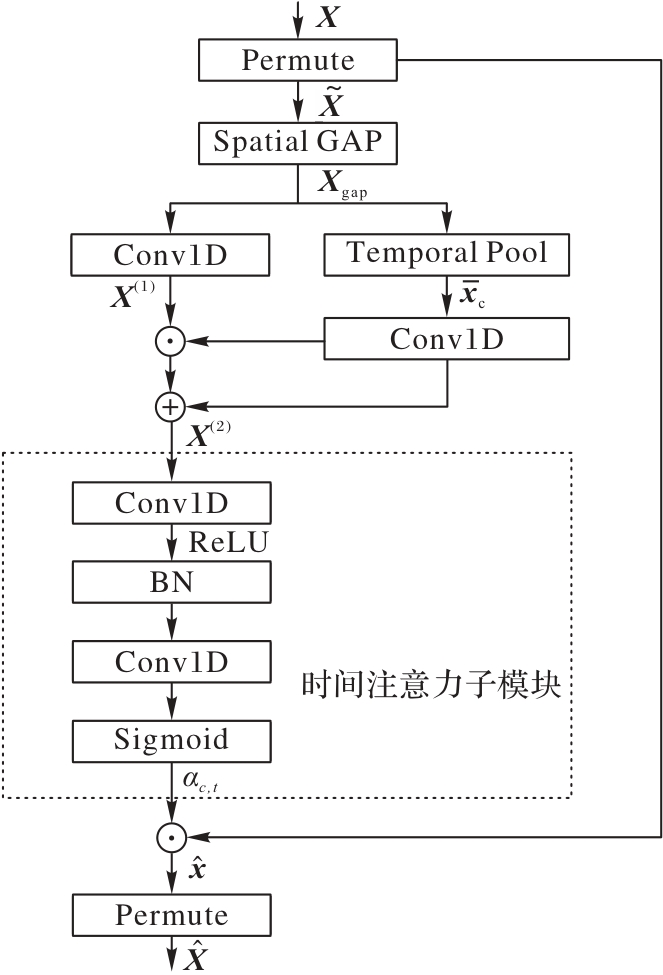
图2 DPTAM的网络结构
Fig. 2 Network structure of DPTAM
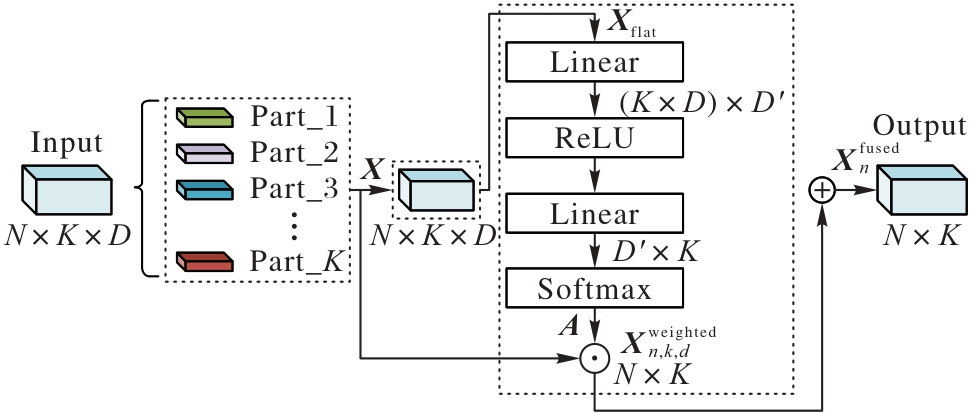
图3 FlexFuse的网络结构
Fig. 3 Network structure of FlexFuse
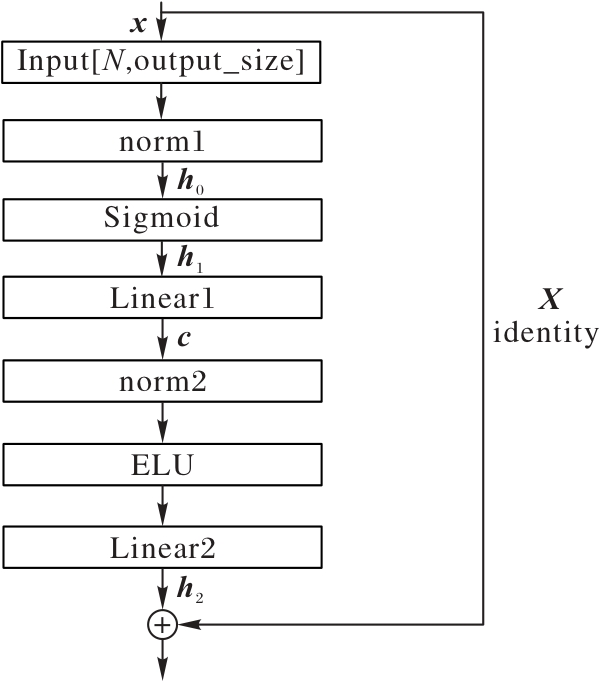
图4 CCM Block的网络结构
Fig. 4 Network structure of CCM Block
| Rank-1/% | mAP/% | Rank-1/% | mAP/% | ||
|---|---|---|---|---|---|
| 0.10 | 94.2 | 83.7 | 0.35 | 97.3 | 93.2 |
| 0.20 | 94.5 | 84.0 | 0.50 | 96.7 | 92.5 |
表1 不同结构损失权重λpa对模型性能的影响
Tab. 1 Impact of structure loss weight λpa on model performance
| Rank-1/% | mAP/% | Rank-1/% | mAP/% | ||
|---|---|---|---|---|---|
| 0.10 | 94.2 | 83.7 | 0.35 | 97.3 | 93.2 |
| 0.20 | 94.5 | 84.0 | 0.50 | 96.7 | 92.5 |
| 数据集 | 摄像机数 | 身份数 | 图像数 |
|---|---|---|---|
| Market-1501[ | 6 | 1 501 | 32 668 |
| Occluded-Duke[ | 8 | 1 404 | 46 261 |
| Occluded-ReID[ | 1 | 200 | 2 000 |
| P-DukeMTMC | 8 | 1 812 | 85 324 |
表2 数据集信息
Tab. 2 Dataset information
| 数据集 | 摄像机数 | 身份数 | 图像数 |
|---|---|---|---|
| Market-1501[ | 6 | 1 501 | 32 668 |
| Occluded-Duke[ | 8 | 1 404 | 46 261 |
| Occluded-ReID[ | 1 | 200 | 2 000 |
| P-DukeMTMC | 8 | 1 812 | 85 324 |
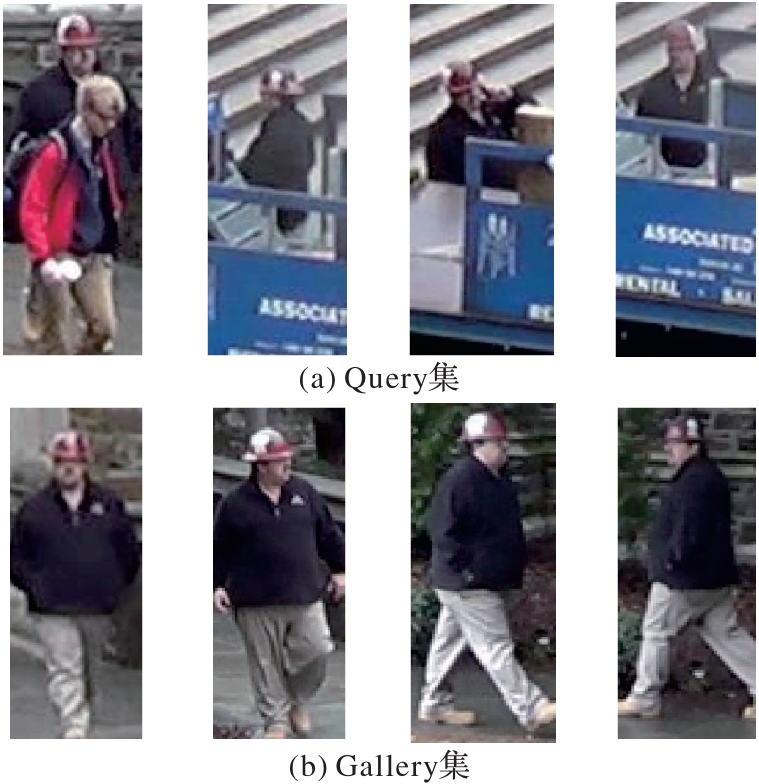
图5 P-DukeMTMC数据集的行人图片示例
Fig. 5 Sample images of pedestrian from P-DukeMTMC dataset
| 方法 | Market-1501 | Occluded-Duke | Occluded-ReID | P-DukeMTMC | ||||
|---|---|---|---|---|---|---|---|---|
| Rank-1 | mAP | Rank-1 | mAP | Rank-1 | mAP | Rank-1 | mAP | |
| BoT[ | 94.5 | 85.9 | 51.4 | 44.7 | 58.4 | 52.3 | 87.0 | 74.9 |
| SGAM[ | 91.4 | 67.3 | 55.1 | 35.3 | — | — | — | — |
| PGFA[ | 91.2 | 76.8 | 51.4 | 37.3 | — | — | 44.2 | 23.1 |
| MHSA[ | 94.6 | 84.0 | 59.7 | 44.8 | — | — | 70.7 | 41.1 |
| VGTri[ | — | — | 62.2 | 46.3 | 81.0 | 71.0 | — | — |
| OAMN[ | 93.2 | 79.8 | 62.6 | 46.1 | — | — | — | — |
| HG[ | 95.6 | 86.1 | 61.4 | 50.5 | — | — | — | — |
| SSGR[ | 96.1 | 89.3 | 69.0 | 57.2 | 78.5 | 72.9 | — | — |
| PVPM[ | — | — | — | — | 66.8 | 59.5 | 85.1 | 69.9 |
| HOReID[ | 94.2 | 84.9 | 55.1 | 43.8 | 80.3 | 70.2 | — | — |
| TransReIDDeiT[ | 95.2 | 89.5 | — | — | — | — | — | — |
| TransReIDViT[ | 95.1 | 88.5 | — | — | — | — | — | — |
| PFD[ | 95.5 | 89.7 | 69.5 | 61.8 | 81.5 | 83.0 | — | — |
| LDS[ | 95.8 | 90.3 | 64.3 | 55.7 | — | — | 91.9 | 82.9 |
| FED[ | 95.0 | 86.3 | 68.1 | 56.4 | 86.3 | 79.3 | — | — |
| PGFL[ | 95.3 | 87.2 | 63.0 | 54.1 | 80.7 | 70.3 | 81.1 | 64.2 |
| PAT[ | 95.4 | 88.0 | 64.5 | 53.6 | 81.6 | 72.1 | — | — |
| BPBReIDRI | 95.7 | 88.4 | 71.3 | 57.5 | 77.0 | 70.9 | 91.3 | 79.2 |
| BPBReIDHR | 95.7 | 89.4 | 75.1 | 62.5 | 82.9 | 75.2 | 93.0 | 83.2 |
| 本文方法 | 97.4 | 93.2 | 77.7 | 66.4 | 84.6 | 78.9 | 95.2 | 86.8 |
表3 不同方法在遮挡行人数据集上的实验结果 (%)
Tab. 3 Experimental results of different methods on occlusion pedestrian dataset
| 方法 | Market-1501 | Occluded-Duke | Occluded-ReID | P-DukeMTMC | ||||
|---|---|---|---|---|---|---|---|---|
| Rank-1 | mAP | Rank-1 | mAP | Rank-1 | mAP | Rank-1 | mAP | |
| BoT[ | 94.5 | 85.9 | 51.4 | 44.7 | 58.4 | 52.3 | 87.0 | 74.9 |
| SGAM[ | 91.4 | 67.3 | 55.1 | 35.3 | — | — | — | — |
| PGFA[ | 91.2 | 76.8 | 51.4 | 37.3 | — | — | 44.2 | 23.1 |
| MHSA[ | 94.6 | 84.0 | 59.7 | 44.8 | — | — | 70.7 | 41.1 |
| VGTri[ | — | — | 62.2 | 46.3 | 81.0 | 71.0 | — | — |
| OAMN[ | 93.2 | 79.8 | 62.6 | 46.1 | — | — | — | — |
| HG[ | 95.6 | 86.1 | 61.4 | 50.5 | — | — | — | — |
| SSGR[ | 96.1 | 89.3 | 69.0 | 57.2 | 78.5 | 72.9 | — | — |
| PVPM[ | — | — | — | — | 66.8 | 59.5 | 85.1 | 69.9 |
| HOReID[ | 94.2 | 84.9 | 55.1 | 43.8 | 80.3 | 70.2 | — | — |
| TransReIDDeiT[ | 95.2 | 89.5 | — | — | — | — | — | — |
| TransReIDViT[ | 95.1 | 88.5 | — | — | — | — | — | — |
| PFD[ | 95.5 | 89.7 | 69.5 | 61.8 | 81.5 | 83.0 | — | — |
| LDS[ | 95.8 | 90.3 | 64.3 | 55.7 | — | — | 91.9 | 82.9 |
| FED[ | 95.0 | 86.3 | 68.1 | 56.4 | 86.3 | 79.3 | — | — |
| PGFL[ | 95.3 | 87.2 | 63.0 | 54.1 | 80.7 | 70.3 | 81.1 | 64.2 |
| PAT[ | 95.4 | 88.0 | 64.5 | 53.6 | 81.6 | 72.1 | — | — |
| BPBReIDRI | 95.7 | 88.4 | 71.3 | 57.5 | 77.0 | 70.9 | 91.3 | 79.2 |
| BPBReIDHR | 95.7 | 89.4 | 75.1 | 62.5 | 82.9 | 75.2 | 93.0 | 83.2 |
| 本文方法 | 97.4 | 93.2 | 77.7 | 66.4 | 84.6 | 78.9 | 95.2 | 86.8 |
| 人体部位特征 | mAP | Rank-1 | Rank-5 | Rank-10 |
|---|---|---|---|---|
| P0 | 93.7 | 97.6 | 99.4 | 99.6 |
| P1 | 16.3 | 42.4 | 61.1 | 68.0 |
| P2 | 57.9 | 80.0 | 91.1 | 94.2 |
| P3 | 54.4 | 79.0 | 90.2 | 93.2 |
| P4 | 51.3 | 73.7 | 87.7 | 91.3 |
| P5 | 25.2 | 48.5 | 67.6 | 73.0 |
表4 不同人体部位特征嵌入的独立检索性能 (%)
Tab. 4 Independent retrieval performance of different body part feature embeddings
| 人体部位特征 | mAP | Rank-1 | Rank-5 | Rank-10 |
|---|---|---|---|---|
| P0 | 93.7 | 97.6 | 99.4 | 99.6 |
| P1 | 16.3 | 42.4 | 61.1 | 68.0 |
| P2 | 57.9 | 80.0 | 91.1 | 94.2 |
| P3 | 54.4 | 79.0 | 90.2 | 93.2 |
| P4 | 51.3 | 73.7 | 87.7 | 91.3 |
| P5 | 25.2 | 48.5 | 67.6 | 73.0 |
| 方法 | DPTAM | FlexFuse | CCM | mAP/% | Rank-1/% | FLOPs/109 | 参数量/106 | 帧率/(frame·s-1) |
|---|---|---|---|---|---|---|---|---|
| Baseline | 89.4 | 95.7 | 8.07 | 39.85 | 34.05 | |||
| +DPTAM | | 92.9 | 96.0 | 8.02 | 50.91 | 32.84 | ||
| +FlexFuse | | 89.5 | 95.8 | 8.00 | 39.62 | 34.09 | ||
| +DPTAM+FlexFuse | | | 93.1 | 97.3 | 8.02 | 50.68 | 32.02 | |
| +DPTAM+CCM | | | 93.0 | 97.4 | 8.02 | 51.51 | 33.13 | |
| 本文方法 | | | | 93.2 | 97.4 | 8.02 | 51.28 | 33.88 |
表5 各个模块的消融实验结果
Tab. 5 Ablation experiment results of various modules
| 方法 | DPTAM | FlexFuse | CCM | mAP/% | Rank-1/% | FLOPs/109 | 参数量/106 | 帧率/(frame·s-1) |
|---|---|---|---|---|---|---|---|---|
| Baseline | 89.4 | 95.7 | 8.07 | 39.85 | 34.05 | |||
| +DPTAM | | 92.9 | 96.0 | 8.02 | 50.91 | 32.84 | ||
| +FlexFuse | | 89.5 | 95.8 | 8.00 | 39.62 | 34.09 | ||
| +DPTAM+FlexFuse | | | 93.1 | 97.3 | 8.02 | 50.68 | 32.02 | |
| +DPTAM+CCM | | | 93.0 | 97.4 | 8.02 | 51.51 | 33.13 | |
| 本文方法 | | | | 93.2 | 97.4 | 8.02 | 51.28 | 33.88 |
人体 部位特征 | 部位 | Query 可见性 | Gallery 可见性 | 配对 可见性 |
|---|---|---|---|---|
| P0 | 头部 | 100.0 | 99.8 | 100 |
| P1 | 躯干 | 99.5 | 83.0 | 79 |
| P2 | 上肢 | 99.7 | 99.2 | 98 |
| P3 | 手臂 | 99.6 | 98.5 | 96 |
| P4 | 手部 | 99.8 | 99.0 | 97 |
| P5 | 双脚/腿部 | 99.4 | 90.0 | 88 |
表6 Query与Gallery样本中各个身体部位的可见性分析 (%)
Tab. 6 Visibility analysis of various body parts in Query and Gallery samples
人体 部位特征 | 部位 | Query 可见性 | Gallery 可见性 | 配对 可见性 |
|---|---|---|---|---|
| P0 | 头部 | 100.0 | 99.8 | 100 |
| P1 | 躯干 | 99.5 | 83.0 | 79 |
| P2 | 上肢 | 99.7 | 99.2 | 98 |
| P3 | 手臂 | 99.6 | 98.5 | 96 |
| P4 | 手部 | 99.8 | 99.0 | 97 |
| P5 | 双脚/腿部 | 99.4 | 90.0 | 88 |
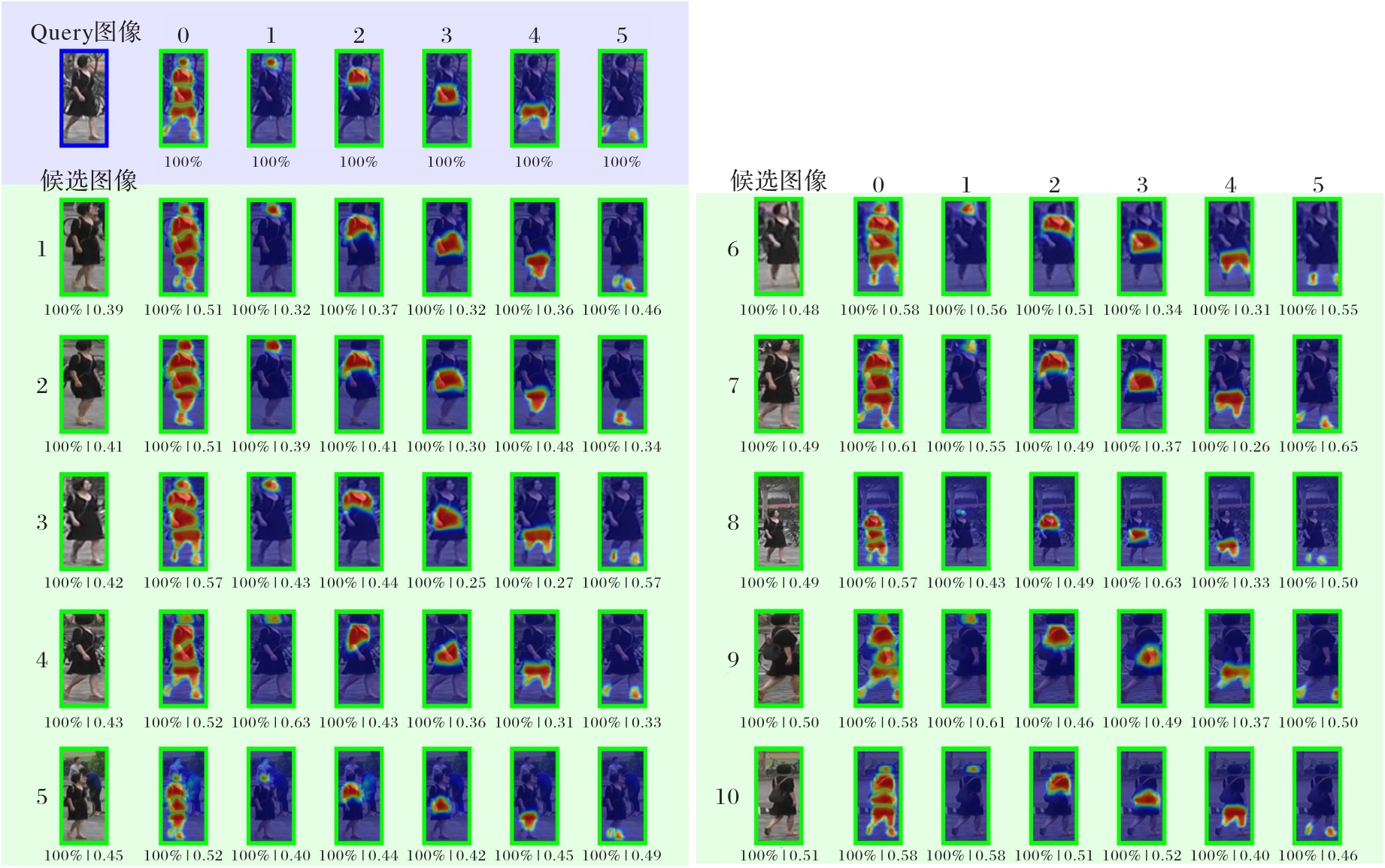
图6 无遮挡场景下的热力图可视化结果
Fig. 6 Heatmap visualization results under non-occluded scenarios

图7 部分遮挡场景下的热力图可视化结果
Fig. 7 Heatmap visualization results under partially occluded scenarios
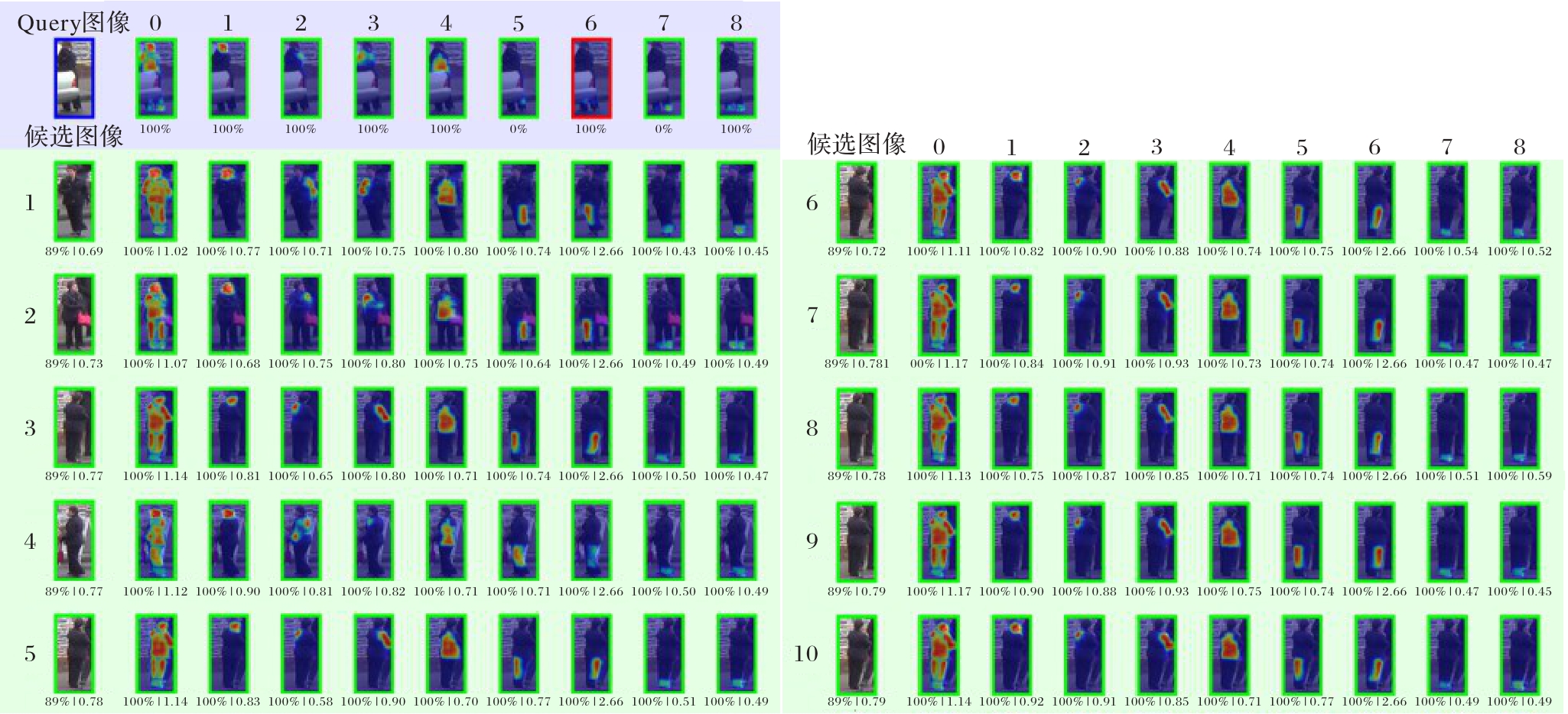
图8 强遮挡场景下的热力图可视化结果
Fig. 8 Heatmap visualization results under heavily occluded scenarios
| [1] | Ye M, Shen J, Lin G, et al. Deep learning for person re-identification: a survey and outlook [J]. IEEE Transactions on Pattern Analysis and Machine Intelligence, 2022, 44(6): 2872-2893. |
| [2] | 石瑞鑫,智敏,殷雁君. 多模态行人重识别研究综述[J]. 计算机应用研究, 2025, 42(7): 1921-1929. |
| Shi Ruixin, Zhi Min, Yin Yanjun. Review of multi-modal person re-identification [J]. Application Research of Computers, 2025, 42(7): 1921-1929. | |
| [3] | 罗浩,姜伟,范星,等. 基于深度学习的行人重识别研究进展[J]. 自动化学报, 2019, 45(11): 2032-2049. |
| Luo Hao, Jiang Wei, Fan Xing, et al. A survey on deep learning based person re-identification [J]. Acta Automatica Sinica, 2019, 45(11): 2032-2049. | |
| [4] | Sun Y, Zheng L, Yang Y, et al. Beyond part models: person retrieval with refined part pooling (and a strong convolutional baseline) [C]// ECCV 2018, LNCS 11208. Cham: Springer, 2018: 501-518. |
| [5] | Qian X, Fu Y, Xiang T, et al. Pose-normalized image generation for person re-identification [C]// ECCV 2018, LNCS 11213. Cham: Springer, 2018: 661-678. |
| [6] | Che J, Zhang Y, Yang Q, et al. Research on person re-identification based on posture guidance and feature alignment [J]. Multimedia Systems, 2023, 29(2): 763-770. |
| [7] | Yan G, Wang Z, Geng S, et al. Part-based representation enhancement for occluded person re-identification [J]. IEEE Transactions on Circuits and Systems for Video Technology, 2023, 33(8): 4217-4231. |
| [8] | Liu C, Ma H. DADnet: a network pays attention to details and improve distinguishability for person re-identification [J]. Digital Signal Processing, 2025, 159: No.105027. |
| [9] | Tang Q, Ren Y, Shan Z, et al. Dual-branch aggregation and edge refinement network for few shot semantic segmentation [J]. Multimedia Systems, 2025, 31(2): No.142. |
| [10] | Li Y, Ma M, Wu J, et al. MIE-Net: motion information enhancement network for fine-grained action recognition using RGB sensors [J]. IEEE Sensors Journal, 2024, 24(7): 11770-11782. |
| [11] | Mansourian A M, Somers V, de Vleeschouwer C, et al. Multi-task learning for joint re-identification, team affiliation, and role classification for sports visual tracking [C]// MMSports 2023. New York: ACM, 2023: 103-112. |
| [12] | Adaimi G, Kreiss S, Alahi A. Rethinking person re-identification with confidence [PP/OL]. arXiv (2019-06-11) [2025-04-21].. |
| [13] | Alnissany A, Dayoub Y. Modified centroid triplet loss for person re-identification [J]. Journal of Big Data, 2023, 10(1): No.74. |
| [14] | Alzubaidi L, Zhang J, Humaidi A J, et al. Review of deep learning: concepts, CNN architectures, challenges, applications, future directions [J]. Journal of Big Data, 2021, 8(1): No.53. |
| [15] | Touvron H, Cord M, Douze M, et al. Training data-efficient image Transformers & distillation through attention [J]. Proceedings of Machine Learning Research, 2021, 139: 10347-10357. |
| [16] | Coquenet D, Chatelain C, Paquet T. End-to-end handwritten paragraph text recognition using a vertical attention network [J]. IEEE Transactions on Pattern Analysis and Machine Intelligence, 2023, 45(1): 508-524. |
| [17] | Jiang D, Li G, Tan C, et al. Semantic segmentation for multiscale target based on object recognition using the improved Faster-RCNN model [J]. Future Generation Computer Systems, 2021, 123: 94-104. |
| [18] | Kreiss S, Bertoni L, Alahi A. PifPaf: composite fields for human pose estimation [C]// CVPR 2019. Piscataway: IEEE, 2019: 11969-11978. |
| [19] | 丁美荣,卓金鑫,陆玉武,等. 融合环境标签平滑与核范数差异的领域自适应[J]. 计算机应用, 2025, 45(4): 1130-1138. |
| Ding Meirong, Zhuo Jinxin, Lu Yuwu, et al. Domain adaptation integrating environmental label smoothing and nuclear norm disparity [J]. Journal of Computer Applications, 2025, 45(4): 1130-1138. | |
| [20] | Somers V, de Vleeschouwer C, Alahi A. Body part-based representation learning for occluded person re-identification [C]// WACV 2023. Piscataway: IEEE, 2023: 1613-1623. |
| [21] | Guo C, Pleiss G, Sun Y, et al. On calibration of modern neural networks [J]. Proceedings of Machine Learning Research, 2017, 70: 1321-1330. |
| [22] | Platt J C. Probabilistic outputs for support vector machines and comparisons to regularized likelihood methods [EB/OL]. (1999-03-26) [2025-04-24].. |
| [23] | He F, Liu T, Tao D. Why ResNet works? residuals generalize[J]. IEEE Transactions on Neural Networks and Learning Systems, 2020, 31(12): 5349-5362. |
| [24] | Luo H, Gu Y, Liao X, et al. Bag of tricks and a strong baseline for deep person re-identification [C]// CVPRW 2019. Piscataway: IEEE, 2019: 1487-1495. |
| [25] | Szegedy C, Vanhoucke V, Ioffe S, et al. Rethinking the inception architecture for computer vision [C]// CVPR 2016. Piscataway: IEEE, 2016: 2818-2826. |
| [26] | Zheng L, Shen L, Tian L, et al. Scalable person re-identification: a benchmark [C]// ICCV 2015. Piscataway: IEEE, 2015: 1116-1124. |
| [27] | Miao J, Wu Y, Liu P, et al. Pose-guided feature alignment for occluded person re-identification [C]// ICCV 2019. Piscataway: IEEE, 2019: 542-551. |
| [28] | Zhuo J, Chen Z, Lai J, et al. Occluded person re-identification[C]// ICME 2018. Piscataway: IEEE, 2018: 1-6. |
| [29] | Zhu K, Guo H, Liu Z, et al. Identity-guided human semantic parsing for person re-identification [C]// ECCV 2020, LNCS 12348. Cham: Springer, 2020: 346-363. |
| [30] | Yang Q, Wang P, Fang Z, et al. Focus on the visible regions: semantic-guided alignment model for occluded person re-identification [J]. Sensors, 2020, 20(16): No.4431. |
| [31] | Zhang Z, Bai Z, Zhou M. Pose-guided human feature aggregation for occluded person re-identification [J]. Journal of Big Data and Computing, 2023, 1(4): 31-38. |
| [32] | Tan H, Liu X, Yin B, et al. MHSA-Net: multihead self-attention network for occluded person re-identification [J]. IEEE Transactions on Neural Networks and Learning Systems, 2023, 34(11):8210-8224. |
| [33] | Chen P, Liu W, Dai P, et al. Occlude them all: occlusion-aware attention network for occluded person Re-ID [C]// ICCV 2021. Piscataway: IEEE, 2021: 11833-11842. |
| [34] | Kiran M, Praveen R G, Nguyen-Meidine L T, et al. Holistic guidance for occluded person re-identification [C]// BMVC 2021. London: BMVA Press, 2021: 115-123. |
| [35] | Yan C, Pang G, Jiao J, et al. Occluded person re-identification with single-scale global representations [C]// ICCV 2021. Piscataway: IEEE, 2021: 11855-11864. |
| [36] | Gao S, Wang J, Lu H, et al. Pose-guided visible part matching for occluded person ReID [C]// CVPR 2020. Piscataway: IEEE, 2020: 11744-11752. |
| [37] | Wang G, Yang S, Liu H, et al. High-order information matters: learning relation and topology for occluded person re-identification [C]// CVPR 2020. Piscataway: IEEE, 2020: 6448-6457. |
| [38] | He S, Luo H, Wang P, et al. TransReID: Transformer-based object re-identification [C]// ICCV 2021. Piscataway: IEEE, 2021: 14993-15002. |
| [39] | Wang T, Liu H, Song P, et al. Pose-guided feature disentangling for occluded person re-identification based on Transformer [J]. Proceedings of the AAAI conference on artificial intelligence. 2022, 36(3): 2540-2549. |
| [40] | Zang X, Li G, Gao W, et al. Learning to disentangle scenes for person re-identification [J]. Image and Vision Computing, 2021, 116: No.104330. |
| [41] | Wang Z, Zhu F, Tang S, et al. Feature erasing and diffusion network for occluded person re-identification [C]// CVPR 2022. Piscataway: IEEE, 2022: 4754-4763. |
| [42] | Zheng K, Lan C, Zeng W, et al. Pose-guided feature learning with knowledge distillation for occluded person re-identification[C]// MM 2021. New York: ACM, 2021: 4537-4545. |
| [43] | Ni H, Li Y, Gao L, et al. Part-aware transformer for generalizable person re-identification [C]// ICCV 2023. Piscataway: IEEE, 2023: 11246-11255. |
| [1] | 汤莉, 张健宇, 姚睿. 基于改进YOLOv11的雾天目标检测算法[J]. 《计算机应用》唯一官方网站, 2026, 46(8): 2630-2639. |
| [2] | 刘雯玲, 李勇, 李佳慧, 张厚康. 面向不均匀雾霾遥感图像的无监督去雾方法[J]. 《计算机应用》唯一官方网站, 2026, 46(7): 2297-2306. |
| [3] | 王梦华, 董玉坤, 程龙, 孙骏骐. 用于单目遮挡人体网格恢复的人体尺寸注意力回归方法[J]. 《计算机应用》唯一官方网站, 2026, 46(6): 1981-1988. |
| [4] | 喻小芹, 单武扬, 邱骏颖, 林宇, 杨容浩, 田茂. 亮度对比度扰动下的图像篡改定位检测网络[J]. 《计算机应用》唯一官方网站, 2026, 46(6): 1893-1903. |
| [5] | 彭文, 张博凯, 林金炜. 融合图像纹理增强与超分辨率的染色体级联分类框架[J]. 《计算机应用》唯一官方网站, 2026, 46(5): 1647-1657. |
| [6] | 张嘉祥, 李晓明, 张佳慧. 结合新类特征增强与度量机制的小样本目标检测算法[J]. 《计算机应用》唯一官方网站, 2025, 45(9): 2984-2992. |
| [7] | 张伟, 牛家祥, 马继超, 沈琼霞. 深层语义特征增强的ReLM中文拼写纠错模型[J]. 《计算机应用》唯一官方网站, 2025, 45(8): 2484-2490. |
| [8] | 刘皓宇, 孔鹏伟, 王耀力, 常青. 基于多视角信息的行人检测算法[J]. 《计算机应用》唯一官方网站, 2025, 45(7): 2325-2332. |
| [9] | 党伟超, 范英豪, 高改梅, 刘春霞. 融合时序与全局上下文特征增强的弱监督动作定位[J]. 《计算机应用》唯一官方网站, 2025, 45(3): 963-971. |
| [10] | 谢斌红, 高婉银, 陆望东, 张英俊, 张睿. 小样本相似性匹配特征增强的密集目标计数网络[J]. 《计算机应用》唯一官方网站, 2025, 45(2): 403-410. |
| [11] | 杨本臣, 李浩然, 金海波. 级联融合与增强重建的多聚焦图像融合网络[J]. 《计算机应用》唯一官方网站, 2025, 45(2): 594-600. |
| [12] | 周景, 唐振洋, 董晖, 刘心. 融合特征增强和对比学习的电力客服工单多标签文本分类方法[J]. 《计算机应用》唯一官方网站, 2025, 45(12): 3847-3854. |
| [13] | 贾洁茹, 杨建超, 张硕蕊, 闫涛, 陈斌. 基于自蒸馏视觉Transformer的无监督行人重识别[J]. 《计算机应用》唯一官方网站, 2024, 44(9): 2893-2902. |
| [14] | 王翠, 邓淼磊, 张德贤, 李磊, 杨晓艳. 基于图像的端到端行人搜索算法综述[J]. 《计算机应用》唯一官方网站, 2024, 44(8): 2544-2550. |
| [15] | 王杰, 孟华. 基于点云整体拓扑结构的图像分类算法[J]. 《计算机应用》唯一官方网站, 2024, 44(4): 1107-1113. |
| 阅读次数 | ||||||
|
全文 |
|
|||||
|
摘要 |
|
|||||
