


《计算机应用》唯一官方网站 ›› 2026, Vol. 46 ›› Issue (5): 1658-1666.DOI: 10.11772/j.issn.1001-9081.2025050658
• 前沿与综合应用 • 上一篇
张驰1, 孟宪静1( ), 窦长昊1, 王倩1, 耿蕾蕾1, 袭肖明2
收稿日期:2025-06-16
修回日期:2025-08-01
接受日期:2025-08-08
发布日期:2025-08-15
出版日期:2026-05-10
通讯作者:
孟宪静
作者简介:张驰(2001—),男,山东菏泽人,硕士研究生,CCF会员,主要研究方向:手指静脉识别基金资助:
Chi ZHANG1, Xianjing MENG1(), Changhao DOU1, Qian WANG1, Leilei GENG1, Xiaoming XI2
Received:2025-06-16
Revised:2025-08-01
Accepted:2025-08-08
Online:2025-08-15
Published:2026-05-10
Contact:
Xianjing MENG
About author:ZHANG Chi, born in 2001, M. S. candidate. His research interests include finger vein recognition.Supported by:摘要:
针对现有手指静脉识别方法主要关注空间域特征的提取,忽略了手指静脉血管作为管状树形结构在频率域的表达及其中蕴含的多尺度细节的问题,提出基于多域特征融合的级联手指静脉识别网络(MD-FVR),采用层次化的级联网络架构,每一层次由多域融合模块与基础操作构成,能实现特征的逐步提取和增强。其中,多域特征融合模块作为核心模块:首先,通过深度可分离小波卷积块(DSWC)增强结构信息;其次,利用频率域-空间耦合块(FDSC)提取频率域全局特征,弥补空间域表达的不足,并结合改进的半小波-空间注意力块(HWSA)进一步细化频率域细节的表征;最后,通过自适应特征融合模块(AFF)整合多域特征,得到最终的增强特征表示。在HKPU与SDUMLA-HMT数据集上的实验结果显示,MD-FVR识别准确率分别达到了99.68%和99.53%,且等错误率(EER)仅为0.35%和0.41%。与现有的仅在空间域或频率域提取特征的方法相比,MD-FVR方法在识别准确性与鲁棒性方面均表现出显著的优势。
中图分类号:
张驰, 孟宪静, 窦长昊, 王倩, 耿蕾蕾, 袭肖明. MD-FVR:基于多域特征融合的级联手指静脉识别网络[J]. 计算机应用, 2026, 46(5): 1658-1666.
Chi ZHANG, Xianjing MENG, Changhao DOU, Qian WANG, Leilei GENG, Xiaoming XI. MD-FVR: cascaded finger vein recognition network based on multi-domain feature fusion[J]. Journal of Computer Applications, 2026, 46(5): 1658-1666.
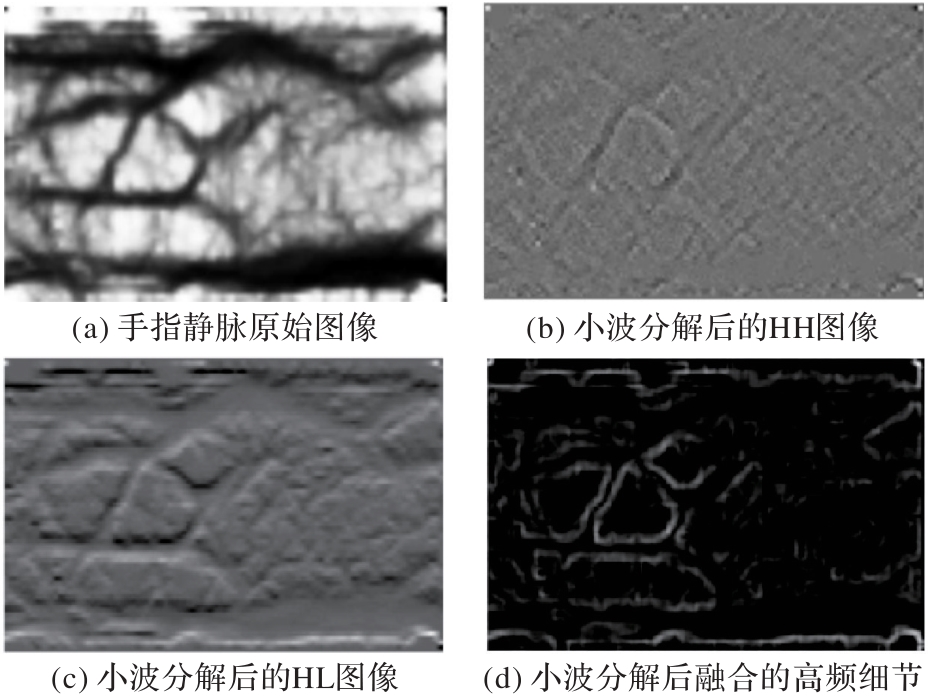
图1 手指静脉图像的部分小波变换图像
Fig. 1 Partial wavelet transform images of finger vein image
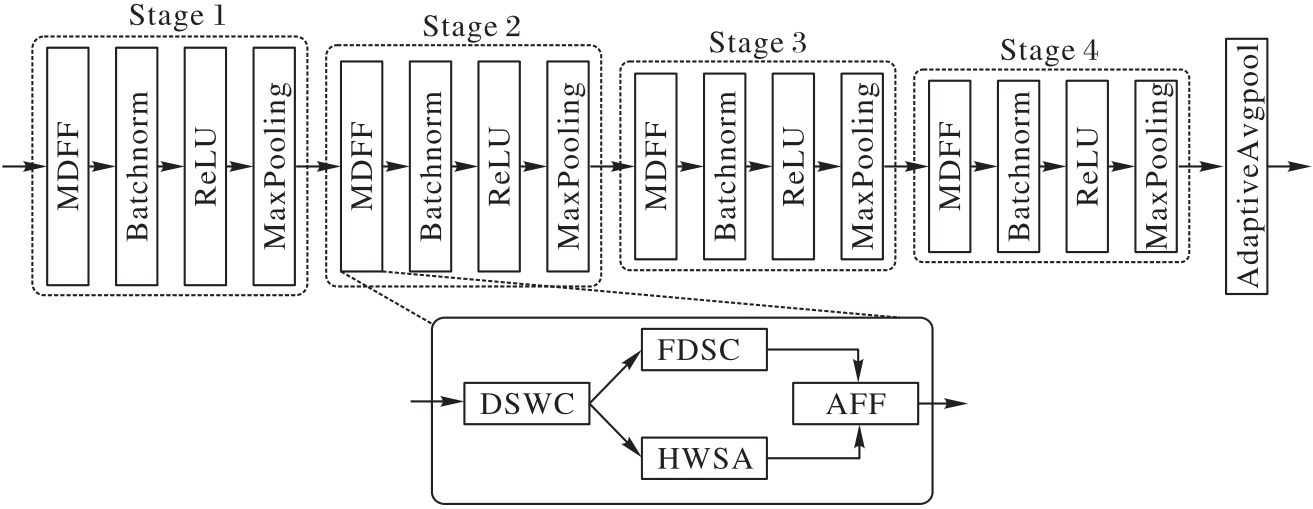
图2 MD-FVR的总体结构
Fig. 2 Overall structure of MD-FVR
| 层次 | 输入尺寸 | 输出尺寸 | 输入的通道数 | 输出的通道数 |
|---|---|---|---|---|
| Stage 1 | 128×128 | 64×64 | 3 | 16 |
| Stage 2 | 64×64 | 32×32 | 16 | 64 |
| Stage 3 | 32×32 | 16×16 | 64 | 256 |
| Stage 4 | 16×16 | 8×8 | 256 | 1 024 |
表1 MD-FVR不同层次的参数设置
Tab. 1 Parameter settings for different layers of MD-FVR
| 层次 | 输入尺寸 | 输出尺寸 | 输入的通道数 | 输出的通道数 |
|---|---|---|---|---|
| Stage 1 | 128×128 | 64×64 | 3 | 16 |
| Stage 2 | 64×64 | 32×32 | 16 | 64 |
| Stage 3 | 32×32 | 16×16 | 64 | 256 |
| Stage 4 | 16×16 | 8×8 | 256 | 1 024 |
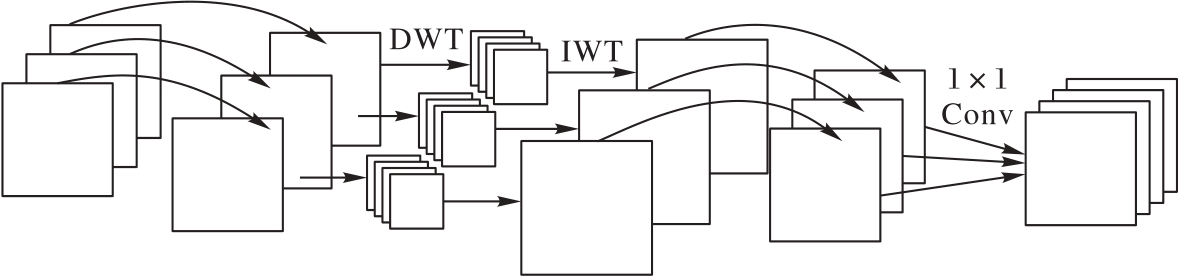
图 3 DSWC的结构
Fig. 3 Structure of DSWC

图 4 HWSA的结构
Fig. 4 Structure of HWSA
| 数据集 | ACC | EER |
|---|---|---|
| HKPU | 99.68 | 0.35 |
| SDUMLA-HMT | 99.53 | 0.41 |
表2 MD-FVR在2个数据集上的性能对比 ( %)
Tab. 2 Performance comparison of MD-FVR on two datasets
| 数据集 | ACC | EER |
|---|---|---|
| HKPU | 99.68 | 0.35 |
| SDUMLA-HMT | 99.53 | 0.41 |
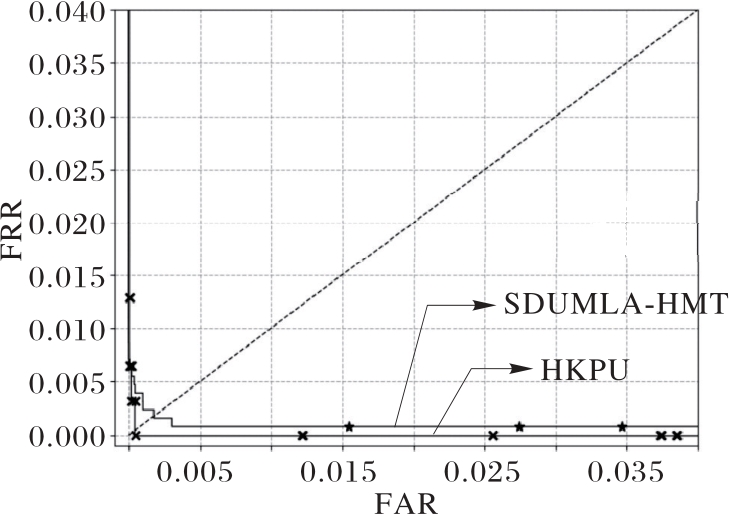
图5 2个实验数据集的ROC曲线
Fig. 5 ROC curves of two experimental datasets
| 消融模块 | HKPU | SDUMLA-HMT | ||
|---|---|---|---|---|
| ACC | EER | ACC | EER | |
| MD-FVR | 99.68 | 0.35 | 99.53 | 0.41 |
| DSWC | 99.13 | 0.56 | 99.21 | 0.85 |
| HWSA | 98.56 | 0.54 | 99.21 | 0.78 |
| FDSC | 99.36 | 0.75 | 99.27 | 0.95 |
| CPCA | 98.93 | 0.43 | 99.06 | 0.86 |
表3 MDFF在2个数据集上的消融实验结果 ( %)
Tab. 3 Ablation experiment results of MDFF on two datasets unit: %
| 消融模块 | HKPU | SDUMLA-HMT | ||
|---|---|---|---|---|
| ACC | EER | ACC | EER | |
| MD-FVR | 99.68 | 0.35 | 99.53 | 0.41 |
| DSWC | 99.13 | 0.56 | 99.21 | 0.85 |
| HWSA | 98.56 | 0.54 | 99.21 | 0.78 |
| FDSC | 99.36 | 0.75 | 99.27 | 0.95 |
| CPCA | 98.93 | 0.43 | 99.06 | 0.86 |
| 训练样本数 | SDUMLA-HMT数据集 | HKPU数据集 | ||
|---|---|---|---|---|
| ACC/% | EER/% | ACC/% | EER/% | |
| 3 | 94.23 | 3.46 | 98.71 | 1.18 |
| 4 | 99.53 | 0.41 | 99.52 | 0.47 |
| 5 | 98.89 | 1.02 | 99.68 | 0.35 |
表4 三种训练样本数下的性能对比
Tab. 4 Performance comparison with three training samples
| 训练样本数 | SDUMLA-HMT数据集 | HKPU数据集 | ||
|---|---|---|---|---|
| ACC/% | EER/% | ACC/% | EER/% | |
| 3 | 94.23 | 3.46 | 98.71 | 1.18 |
| 4 | 99.53 | 0.41 | 99.52 | 0.47 |
| 5 | 98.89 | 1.02 | 99.68 | 0.35 |
| 层次数 | HKPU | SDUMLA-HMT | ||
|---|---|---|---|---|
| ACC/% | EER/% | ACC/% | EER/% | |
| 3 | 99.26 | 0.82 | 99.15 | 0.87 |
| 4 | 99.68 | 0.35 | 99.53 | 0.41 |
| 5 | 99.45 | 0.59 | 99.32 | 0.61 |
表5 三种模块级联数的性能对比
Tab. 5 Performance comparison of three module cascades
| 层次数 | HKPU | SDUMLA-HMT | ||
|---|---|---|---|---|
| ACC/% | EER/% | ACC/% | EER/% | |
| 3 | 99.26 | 0.82 | 99.15 | 0.87 |
| 4 | 99.68 | 0.35 | 99.53 | 0.41 |
| 5 | 99.45 | 0.59 | 99.32 | 0.61 |
| 网络 | SDUMLA-HMT | HKPU |
|---|---|---|
| PCANet[ | 98.19 | — |
| DFCNN[ | 92.22 | 96.98 |
| ResNet+SE[ | 96.70 | 99.04 |
| ECA-Resnet[ | 99.25 | 99.07 |
| ViT-Cap[ | 93.24 | 95.61 |
| ALANet[ | 94.50 | |
| LetNet[ | 99.50 | 96.10 |
| FV-EffResNet[ | 98.45 | — |
| LightNet[ | 95.95 | 97.33 |
| FV-DDC[ | 98.74 | 99.62 |
| MD-FVR | 99.53 | 99.68 |
表6 不同实验网络的准确率对比 ( %)
Tab. 6 Accuracy comparison of different experimental networks unit: %
| 网络 | SDUMLA-HMT | HKPU |
|---|---|---|
| PCANet[ | 98.19 | — |
| DFCNN[ | 92.22 | 96.98 |
| ResNet+SE[ | 96.70 | 99.04 |
| ECA-Resnet[ | 99.25 | 99.07 |
| ViT-Cap[ | 93.24 | 95.61 |
| ALANet[ | 94.50 | |
| LetNet[ | 99.50 | 96.10 |
| FV-EffResNet[ | 98.45 | — |
| LightNet[ | 95.95 | 97.33 |
| FV-DDC[ | 98.74 | 99.62 |
| MD-FVR | 99.53 | 99.68 |
| 网络 | SDUMLA-HMT | HKPU |
|---|---|---|
| DenseNet-161[ | 2.35 | 0.33 |
| FCGAN[ | 0.87 | 0.52 |
| Densenet-161[ | 0.02 | 1.87 |
| ResNet+SE[ | 2.14 | 0.28 |
| ECA-Resnet[ | 1.53 | 1.30 |
| CycleGAN+DenseNet161[ | 3.40 | 0.85 |
| Triplet-Classifier GAN[ | 1.33 | 0.40 |
| ViT-Cap[ | 1.30 | 1.66 |
| FVFSNet[ | 1.10 | 0.81 |
| LetNet[ | 0.15 | 1.21 |
| FV-EffResNet[ | 0.43 | — |
| LightNet[ | 0.43 | 0.51 |
| MD-FVR | 0.41 | 0.35 |
表7 不同实验网络的等错误率对比 (单位 : %)
Tab. 7 EER comparison of different experimental networks
| 网络 | SDUMLA-HMT | HKPU |
|---|---|---|
| DenseNet-161[ | 2.35 | 0.33 |
| FCGAN[ | 0.87 | 0.52 |
| Densenet-161[ | 0.02 | 1.87 |
| ResNet+SE[ | 2.14 | 0.28 |
| ECA-Resnet[ | 1.53 | 1.30 |
| CycleGAN+DenseNet161[ | 3.40 | 0.85 |
| Triplet-Classifier GAN[ | 1.33 | 0.40 |
| ViT-Cap[ | 1.30 | 1.66 |
| FVFSNet[ | 1.10 | 0.81 |
| LetNet[ | 0.15 | 1.21 |
| FV-EffResNet[ | 0.43 | — |
| LightNet[ | 0.43 | 0.51 |
| MD-FVR | 0.41 | 0.35 |
| [1] | KOLIVAND H, ASADIANFAM S, AKINTOYE K A, et al. Finger vein recognition techniques: a comprehensive review[J]. Multimedia Tools and Applications, 2023, 82(22): 33541-33575. |
| [2] | ROSDI B A, SHING C W, SUANDI S A. Finger vein recognition using local line binary pattern[J]. Sensors, 2011, 11(12): 11357-11371. |
| [3] | MENG X, YANG G, YIN Y, et al. Finger vein recognition based on local directional code[J]. Sensors, 2012, 12(11): 14937-14952. |
| [4] | YANG J, SHI Y. Finger-vein ROI localization and vein ridge enhancement[J]. Pattern Recognition Letters, 2012, 33(12): 1569-1579. |
| [5] | XI X, YANG L, YIN Y. Learning discriminative binary codes for finger vein recognition[J]. Pattern Recognition, 2017, 66: 26-33. |
| [6] | ZHANG G, MENG X. High security finger vein recognition based on robust keypoint correspondence clustering[J]. IEEE Access, 2021, 9: 154058-154070. |
| [7] | YU C B, QIN H F, ZHANG L, et al. Finger-vein image recognition combining modified Hausdorff distance with minutiae feature matching[J]. Journal of Biomedical Science and Engineering, 2009, 2: 261-272. |
| [8] | KIM H, LEE E J, YOON G J, et al. Illumination normalization for SIFT based finger vein authentication[C]// Proceedings of the 2012 International Symposium on Visual Computing, LNCS 7432. Berlin: Springer, 2012: 21-30. |
| [9] | SONG W, KIM T, KIM H C, et al. A finger-vein verification system using mean curvature[J]. Pattern Recognition Letters, 2011, 32(11): 1541-1547. |
| [10] | CHO S R, PARK Y H, NAM G P, et al. Enhancement of finger-vein image by vein line tracking and adaptive Gabor filtering for finger-vein recognition[J]. Applied Mechanics and Materials, 2012, 145: 219-223. |
| [11] | DAMAVANDINEJADMONFARED S, MOBARAKEH A K, PASHNA M, et al. Finger vein recognition using PCA-based methods[J]. International Scholarly and Scientific Research and Innovation, 2012, 6(6): 593-595. |
| [12] | YANG G, XI X, YIN Y. Finger vein recognition based on (2D)2 PCA and metric learning[J]. BioMed Research International, 2012, 2012: No.324249. |
| [13] | WU J D, LIU C T. Finger-vein pattern identification using SVM and neural network technique[J]. Expert Systems with Applications, 2011, 38(11): 14284-14289. |
| [14] | PARK K R. Finger vein recognition by combining global and local features based on SVM[J]. Computing and Informatics, 2012, 30(2): 295-309. |
| [15] | ZHANG Z B, WU D Y, MA S L, et al. Multiscale feature extraction of finger-vein patterns based on wavelet and local interconnection structure neural network[C]// Proceedings of the 2005 International Conference on Neural Networks and Brain. Piscataway: IEEE, 2005: 1081-1084. |
| [16] | LU Y, XIE S J, YOON S, et al. Robust finger vein ROI localization based on flexible segmentation[J]. Sensors, 2013, 13(11): 14339-14366. |
| [17] | HUANG Y, MA H, WANG M. Axially-enhanced local attention network for finger vein recognition[J]. IEEE Transactions on Instrumentation and Measurement, 2023, 72: No.5020210. |
| [18] | QI Y, HE Y, QI X, et al. Dynamic snake convolution based on topological geometric constraints for tubular structure segmentation[C]// Proceedings of the 2023 IEEE/CVF International Conference on Computer Vision. Piscataway: IEEE, 2023: 6047-6056. |
| [19] | PAN Z, WANG J, WANG G, et al. Multi-scale deep representation aggregation for vein recognition[J]. IEEE Transactions on Information Forensics and Security, 2021, 16: 1-15. |
| [20] | KUZU R S, PICIUCCO E, MAIORANA E, et al. On-the-fly finger-vein-based biometric recognition using deep neural networks[J]. IEEE Transactions on Information Forensics and Security, 2020, 15: 2641-2654. |
| [21] | HUANG J, TU M, YANG W, et al. Joint attention network for finger vein authentication[J]. IEEE Transactions on Instrumentation and Measurement, 2021, 70: No.2513911. |
| [22] | YANG W, LUO W, KANG W, et al. FVRAS-Net: an embedded Finger-Vein Recognition and AntiSpoofing system using a unified CNN[J]. IEEE Transactions on Instrumentation and Measurement, 2020, 69(11): 8690-8701. |
| [23] | SHAHREZA O, MARCEL S. Towards protecting and enhancing vascular biometric recognition methods via biohashing and deep neural networks[J]. IEEE Transactions on Biometrics, Behavior, and Identity Science, 2021, 3(3): 394-404. |
| [24] | QIN H, EL-YACOUBI M A. Deep representation for finger-vein image quality assessment[J]. IEEE Transactions on Circuits and Systems for Video Technology, 2018, 28(8): 1677-1693. |
| [25] | REN H, SUN L, GUO J, et al. Finger vein recognition system with template protection based on convolutional neural network[J]. Knowledge-Based Systems, 2021, 227: No.107159. |
| [26] | HOU B, YAN R. ArcVein-arccosine center loss for finger-vein verification[J]. IEEE Transactions on Instrumentation and Measurement, 2021, 70: No.5007411. |
| [27] | YANG J, YAN M. An improved method for finger-vein image enhancement[C]// Proceedings of the IEEE 10th International Conference on Signal Processing. Piscataway: IEEE, 2010: 1706-1709. |
| [28] | HUANG J, ZHENG A, SHAKEEL M S, et al. FVFSNet: frequency-spatial coupling network for finger vein authentication[J]. IEEE Transactions on Information Forensics and Security, 2023, 18: 1322-1334. |
| [29] | KUMAR A, ZHOU Y. Human identification using finger images[J]. IEEE Transactions on Image Processing, 2012, 21(4): 2228-2244. |
| [30] | YIN Y, LIU L, SUN X. SDUMLA-HMT: a multimodal biometric database[C]// Chinese Conference on Biometric Recognition, LNCS 7098. Berlin: Springer, 2011: 260-268. |
| [31] | MENG X J, XI X M, YANG G P, et al. Finger vein recognition based on deformation information[J]. SCIENCE CHINA Information Sciences, 2018, 61(5): No.052103. |
| [32] | KAMARUDDINN M, ROSDI B A. A new filter generation method in PCANet for finger vein recognition[J]. IEEE Access, 2019, 7: 132966-132978. |
| [33] | ZHONG Y, LI J, CHAI T, et al. Different dimension issues in deep feature space for finger-vein recognition[C]// Proceedings of the 2021 Chinese Conference on Biometric Recognition, LNCS 12878. Cham: Springer, 2021: 295-303. |
| [34] | LI Y, LU H, WANG Y, et al. ViT-Cap: a novel vision transformer-based capsule network model for finger vein recognition[J]. Applied Sciences, 2022, 12(20): No.10364. |
| [35] | LI M, GONG Y, ZHENG Z. Finger vein identification based on large kernel convolution and attention mechanism[J]. Sensors, 2024, 24(4): No.1132. |
| [36] | TAHIR Y S, ROSDI B A. FV-EffResNet: an efficient lightweight convolutional neural network for finger vein recognition[J]. PeerJ Computer Science, 2024, 10: No.e1837. |
| [37] | GUO Z, MA H, LI A. A lightweight finger multimodal recognition model based on detail optimization and perceptual compensation embedding[J]. Computer Standards and Interfaces, 2025, 92: No.103937. |
| [38] | REN H, SUN L, REN J, et al. FV-DDC: a novel finger-vein recognition model with deformation detection and correction[J]. Biomedical Signal Processing and Control, 2025, 100(Pt A): No.107098. |
| [39] | SONG J M, KIM W, PARK K R. Finger-vein recognition based on deep DenseNet using composite image[J]. IEEE Access, 2019, 7: 66845-66863. |
| [40] | ZHANG J, LU Z, LI M, et al. GAN-based image augmentation for finger-vein biometric recognition[J]. IEEE Access, 2019, 7: 183118-183132. |
| [41] | KUZU R S, MAIORANA E, CAMPISI P. Loss functions for CNN-based biometric vein recognition[C]// Proceedings of the 28th European Signal Processing Conference. Piscataway: IEEE, 2021: 750-754. |
| [42] | NOH K J, CHOI J, HONG J S, et al. Finger-vein recognition using heterogeneous databases by domain adaption based on a cycle-consistent adversarial network[J]. Sensors, 2021, 21(2): No.524. |
| [43] | HOU B, YAN R. Triplet-classifier GAN for finger-vein verification[J]. IEEE Transactions on Instrumentation and Measurement, 2022, 71: No.2505112. |
| [1] | 祁晓博, 张晶, 史颖, 亓慧, 杜航原. 基于概念漂移检测的多重主动学习方法[J]. 《计算机应用》唯一官方网站, 2026, 46(5): 1388-1396. |
| [2] | 曹柠, 温昕, 郝雁嵘, 曹锐. 多域特征融合的轻量化运动想象脑电信号解码神经网络[J]. 《计算机应用》唯一官方网站, 2026, 46(1): 289-296. |
| [3] | 齐巧玲, 王啸啸, 张茜茜, 汪鹏, 董永峰. 基于元学习的标签噪声自适应学习算法[J]. 《计算机应用》唯一官方网站, 2025, 45(7): 2113-2122. |
| [4] | 王慧斌, 胡展傲, 胡节, 徐袁伟, 文博. 基于分段注意力机制的时间序列预测模型[J]. 《计算机应用》唯一官方网站, 2025, 45(7): 2262-2268. |
| [5] | 向尔康, 黄荣, 董爱华. 开放生成与特征优化的开集识别方法[J]. 《计算机应用》唯一官方网站, 2025, 45(7): 2195-2202. |
| [6] | 陈路, 王怀瑶, 刘京阳, 闫涛, 陈斌. 融合空间-傅里叶域信息的机器人低光环境抓取检测[J]. 《计算机应用》唯一官方网站, 2025, 45(5): 1686-1693. |
| [7] | 王华华, 范子健, 刘泽. 基于多空间概率增强的图像对抗样本生成方法[J]. 《计算机应用》唯一官方网站, 2025, 45(3): 883-890. |
| [8] | 马汉达, 吴亚东. 多域时空层次图神经网络的空气质量预测[J]. 《计算机应用》唯一官方网站, 2025, 45(2): 444-452. |
| [9] | 杨晟, 李岩. 面向目标检测的对比知识蒸馏方法[J]. 《计算机应用》唯一官方网站, 2025, 45(2): 354-361. |
| [10] | 杨本臣, 李浩然, 金海波. 级联融合与增强重建的多聚焦图像融合网络[J]. 《计算机应用》唯一官方网站, 2025, 45(2): 594-600. |
| [11] | 段新涛, 保梦茹, 武银行, 秦川. 基于四维Chen混沌系统的深度神经网络模型主动保护方法[J]. 《计算机应用》唯一官方网站, 2025, 45(11): 3621-3631. |
| [12] | 石锐, 李勇, 朱延晗. 基于特征梯度均值化的调制信号对抗样本攻击算法[J]. 《计算机应用》唯一官方网站, 2024, 44(8): 2521-2527. |
| [13] | 王美, 苏雪松, 刘佳, 殷若南, 黄珊. 时频域多尺度交叉注意力融合的时间序列分类方法[J]. 《计算机应用》唯一官方网站, 2024, 44(6): 1842-1847. |
| [14] | 肖斌, 杨模, 汪敏, 秦光源, 李欢. 独立性视角下的相频融合领域泛化方法[J]. 《计算机应用》唯一官方网站, 2024, 44(4): 1002-1009. |
| [15] | 颜梦玫, 杨冬平. 深度神经网络平均场理论综述[J]. 《计算机应用》唯一官方网站, 2024, 44(2): 331-343. |
| 阅读次数 | ||||||
|
全文 |
|
|||||
|
摘要 |
|
|||||
