


《计算机应用》唯一官方网站 ›› 2026, Vol. 46 ›› Issue (5): 1614-1623.DOI: 10.11772/j.issn.1001-9081.2025050574
• 前沿与综合应用 • 上一篇
廖雪超1,2( ), 陈睿1,2
收稿日期:2025-05-28
修回日期:2025-08-07
接受日期:2025-08-20
发布日期:2025-08-28
出版日期:2026-05-10
通讯作者:
廖雪超
作者简介:陈睿(2001—),男,湖北黄冈人,硕士研究生,主要研究方向:故障检测。
基金资助:
Xuechao LIAO1,2(), Rui CHEN1,2
Received:2025-05-28
Revised:2025-08-07
Accepted:2025-08-20
Online:2025-08-28
Published:2026-05-10
Contact:
Xuechao LIAO
About author:CHEN Rui, born in 2001, M. S. candidate. His research interests include fault detection.
Supported by:摘要:
针对电动汽车锂离子电池故障检测中多源异构时序数据复杂性高、异常样本稀缺及多变量关联性强的挑战,提出一种基于动态变换记忆自编码器的预测-评估故障检测框架(DTMAD),以提升故障识别准确性与模型泛化能力。首先,设计融合动态自编码器(DyAD)与门控循环单元(GRU)的联合特征编码器,对多源时序数据进行特征融合与降维处理,提取跨模态深层特征表示;同时,构建基于自注意力机制的预响应编码器,捕捉时序数据中的长期依赖关系,提升特征提取效率与精度;进一步地,引入记忆解析模块,通过残差对比学习机制融合预测路径与实际响应路径,增强模型对异常模式的检测能力。其次,基于重构误差的分布特性,通过协同异常检测算法设计评估模型。最后,通过综合的预测-评估框架,在无监督学习条件下从多源数据中提取关键响应模式并识别潜在异常。在多组多源电动汽车锂离子电池数据集上的实验结果表明,所提框架的故障检测准确率和模型稳定性均优于对比的编码器(AE)、深度支持向量数据描述(DeepSVDD)与图偏差网络(GDN)等。其中,相较于DyAD模型,DTMAD模型的接收者操作特征曲线下面积(AUROC)提升至0.900 8,且结果波动幅度由0.029降至0.026,展现出更高的检测稳定性与泛化能力。
中图分类号:
廖雪超, 陈睿. 电动汽车锂离子电池预测-评估故障检测框架[J]. 计算机应用, 2026, 46(5): 1614-1623.
Xuechao LIAO, Rui CHEN. Prediction-evaluation framework for anomaly detection in electric vehicle lithium-ion battery[J]. Journal of Computer Applications, 2026, 46(5): 1614-1623.
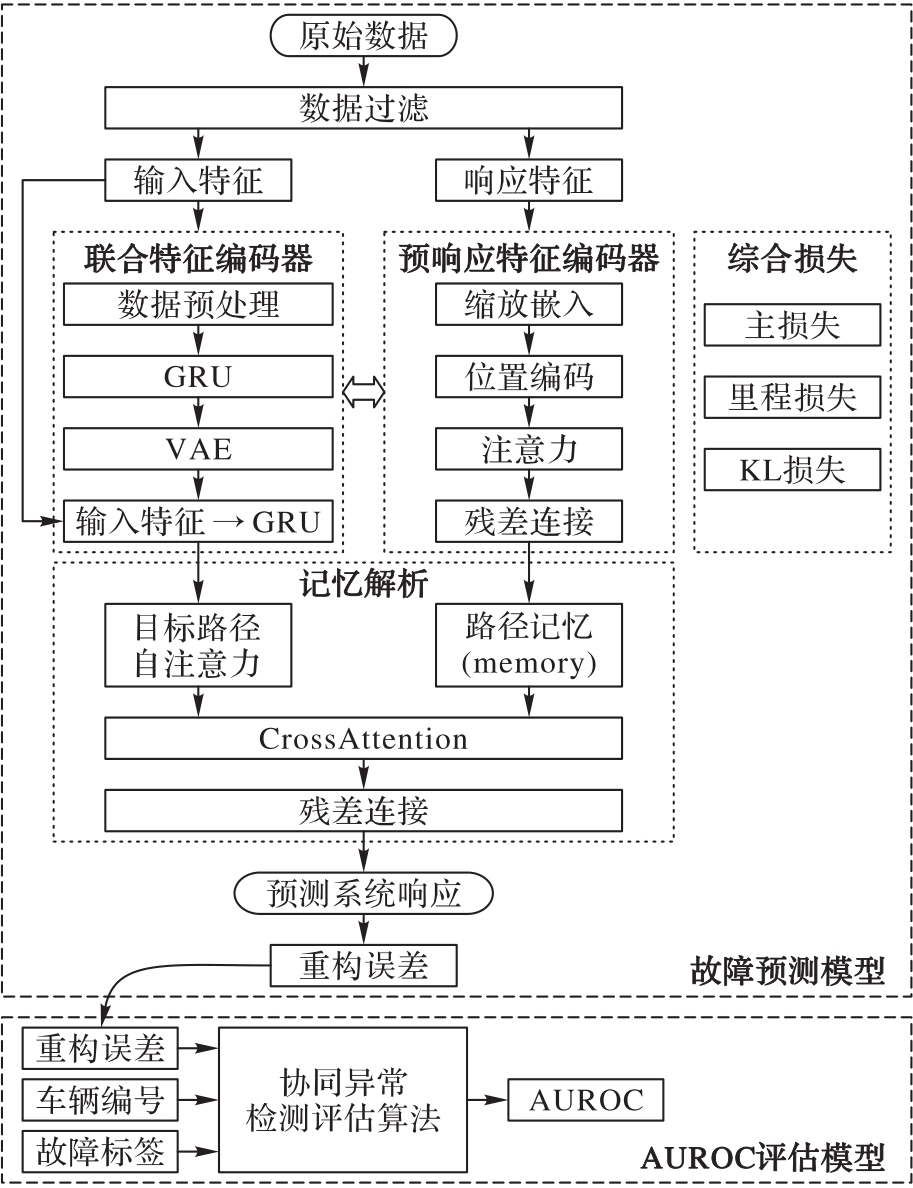
图1 预测-评估框架
Fig. 1 Prediction-evaluation framework
| 训练函数 | 定义 | 计算公式 |
|---|---|---|
| MseLoss | 均方误差 | |
| MaeLoss | 平均绝对误差 | |
| SmoothLoss | 光滑损失 |
表1 三种损失函数
Tab. 1 Three types of loss functions
| 训练函数 | 定义 | 计算公式 |
|---|---|---|
| MseLoss | 均方误差 | |
| MaeLoss | 平均绝对误差 | |
| SmoothLoss | 光滑损失 |
| 特征 | 英文 | 中文 | 特征 |
|---|---|---|---|
| X1 | SoC | 剩余电池电量 | 输入特征 |
| X2 | current | 电流 | 输入特征 |
| Y1 | Min_temp | 最小温度 | 响应特征 |
| Y2 | Max_single_volt | 最大单体电压 | 响应特征 |
| Y3 | Max_temp | 最大温度 | 响应特征 |
| Y4 | Min_single_volt | 最小单体电压 | 响应特征 |
| Y5 | volt | 电压 | 响应特征 |
| Y6 | mileage | 里程 | 弱监督特征 |
表2 特征映射
Tab. 2 Feature mapping
| 特征 | 英文 | 中文 | 特征 |
|---|---|---|---|
| X1 | SoC | 剩余电池电量 | 输入特征 |
| X2 | current | 电流 | 输入特征 |
| Y1 | Min_temp | 最小温度 | 响应特征 |
| Y2 | Max_single_volt | 最大单体电压 | 响应特征 |
| Y3 | Max_temp | 最大温度 | 响应特征 |
| Y4 | Min_single_volt | 最小单体电压 | 响应特征 |
| Y5 | volt | 电压 | 响应特征 |
| Y6 | mileage | 里程 | 弱监督特征 |
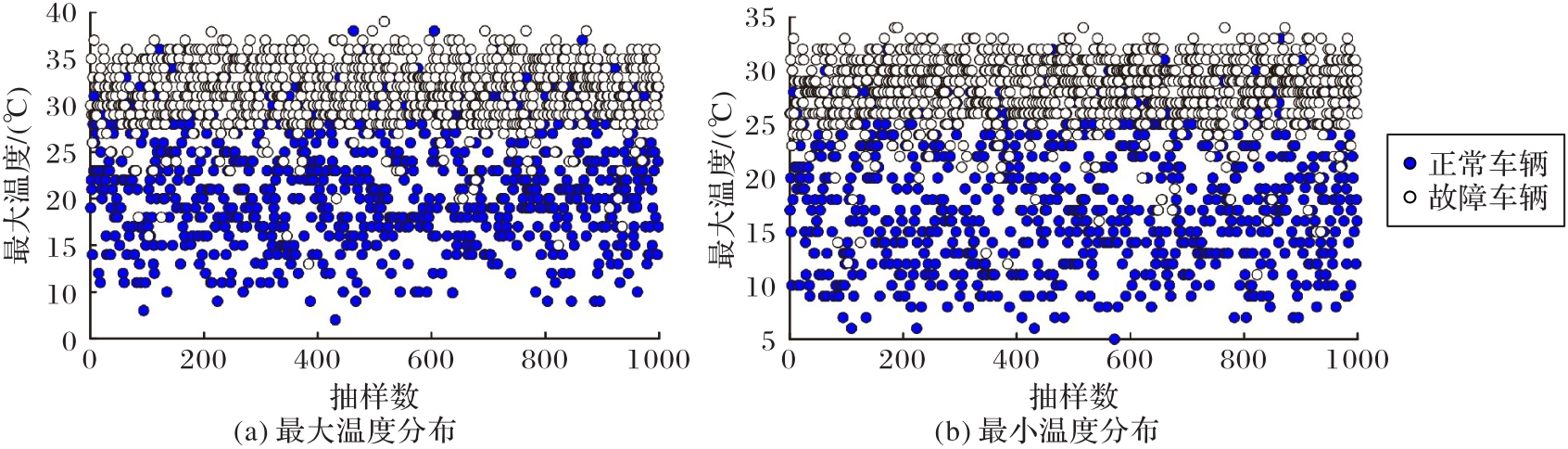
图2 温度分布的随机抽样结果a)电流:正常车辆的电流值大多稳定在-20 A附近,波动范围较小,异常值较少;故障车辆则主要分布在-60 A至-140 A区间,部分样本位于-40 A至60 A区间,整体呈现更大幅度的电流变化。
Fig. 2 Random sampling results of temperature distribution
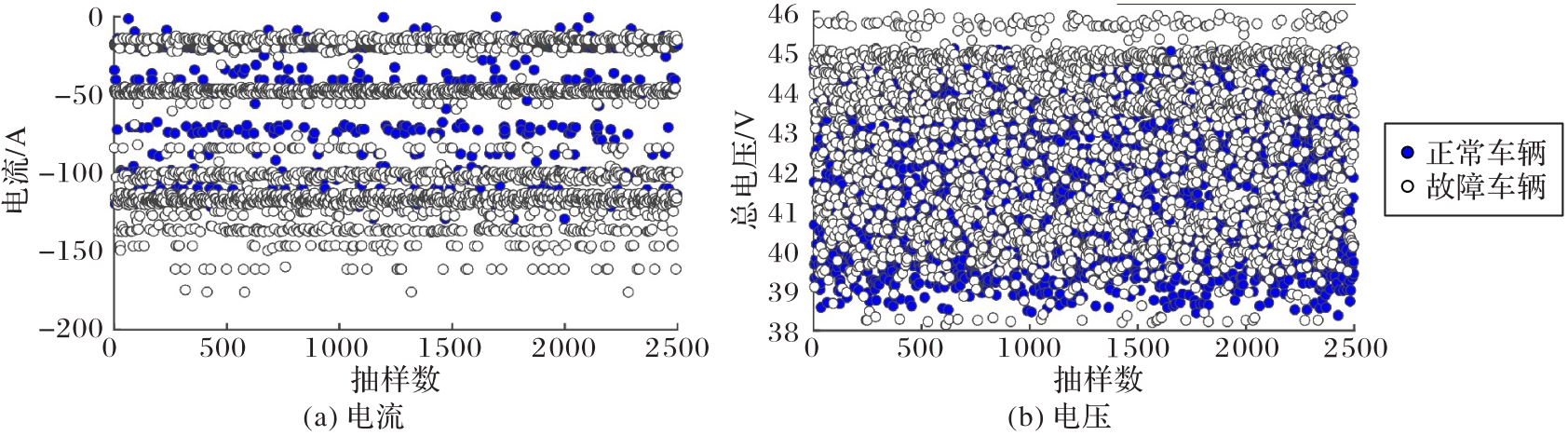
图3 充电时间片的抽样结果
Fig. 3 Sampling results of charging time slices
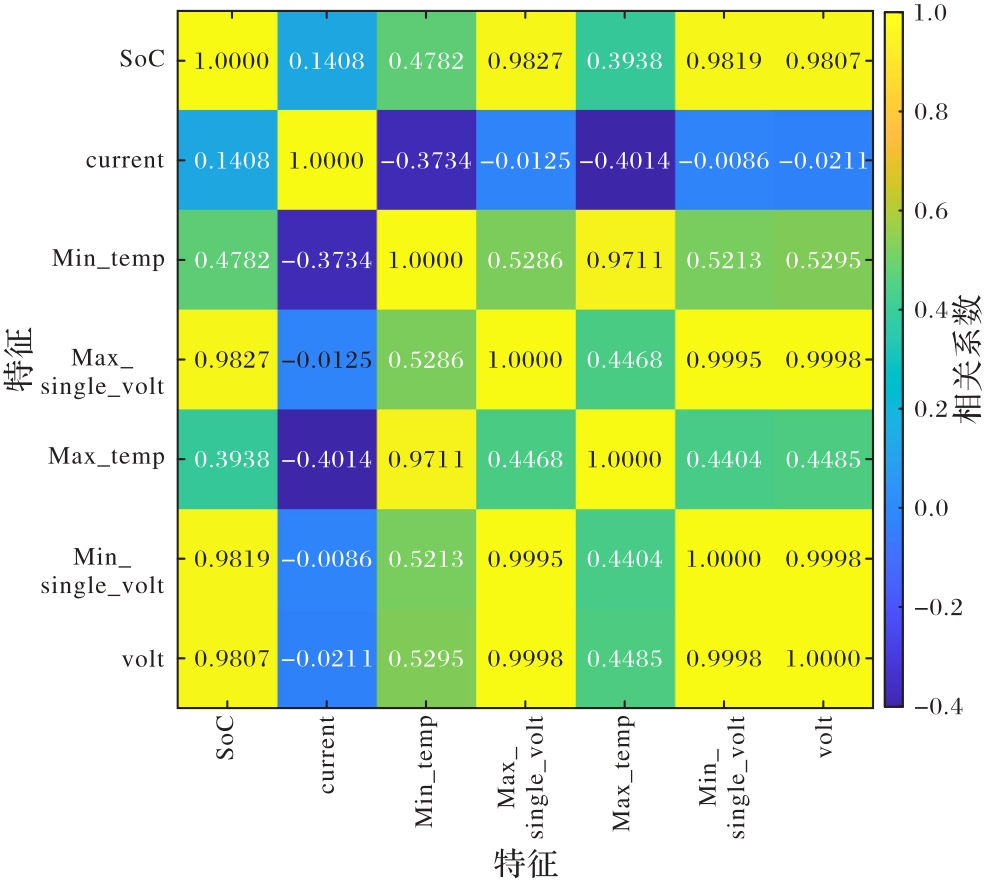
图4 特征相关系数矩阵
Fig. 4 Feature correlation coefficient matrix
| 模型设置 | 参数设置 | 模型设置 | 参数设置 |
|---|---|---|---|
| 优化器 | AdamW | 隐藏层大小 | 128 |
| 优化器参数 | 0.1 | VAE特征维度 | 16 |
| 学习率 | 0.01 | 噪声比例 | 0.01 |
| 训练轮数 | 20 | dropout | 0.1 |
| w3 | 0.1 | 多头头数 | 5 |
| 批次大小 | 128 | 前馈网络层数 | 1 024 |
| RNN网络类型 | 双向GRU | 潜在空间层数 | 16 |
| w1 | 10 | w2 | 0.001 |
表3 模型参数设置
Tab. 3 Model parameter settings
| 模型设置 | 参数设置 | 模型设置 | 参数设置 |
|---|---|---|---|
| 优化器 | AdamW | 隐藏层大小 | 128 |
| 优化器参数 | 0.1 | VAE特征维度 | 16 |
| 学习率 | 0.01 | 噪声比例 | 0.01 |
| 训练轮数 | 20 | dropout | 0.1 |
| w3 | 0.1 | 多头头数 | 5 |
| 批次大小 | 128 | 前馈网络层数 | 1 024 |
| RNN网络类型 | 双向GRU | 潜在空间层数 | 16 |
| w1 | 10 | w2 | 0.001 |
| 模型 | MseLoss | MaeLoss | SmoothLoss |
|---|---|---|---|
| AE | 0.134 47 | 0.274 87 | 0.066 63 |
| DeepSVDD | 1.958 68 | 2.058 92 | 1.985 98 |
| DyAD | 0.075 50 | 0.426 73 | 0.034 20 |
| DTAD | 0.092 13 | 0.470 81 | 0.033 44 |
| DMAD | 0.073 71 | 0.389 50 | 0.037 10 |
| DTMAD | 0.069 96 | 0.499 19 | 0.029 25 |
表4 不同损失函数的平均训练损失
Tab. 4 Average training losses of different loss functions
| 模型 | MseLoss | MaeLoss | SmoothLoss |
|---|---|---|---|
| AE | 0.134 47 | 0.274 87 | 0.066 63 |
| DeepSVDD | 1.958 68 | 2.058 92 | 1.985 98 |
| DyAD | 0.075 50 | 0.426 73 | 0.034 20 |
| DTAD | 0.092 13 | 0.470 81 | 0.033 44 |
| DMAD | 0.073 71 | 0.389 50 | 0.037 10 |
| DTMAD | 0.069 96 | 0.499 19 | 0.029 25 |
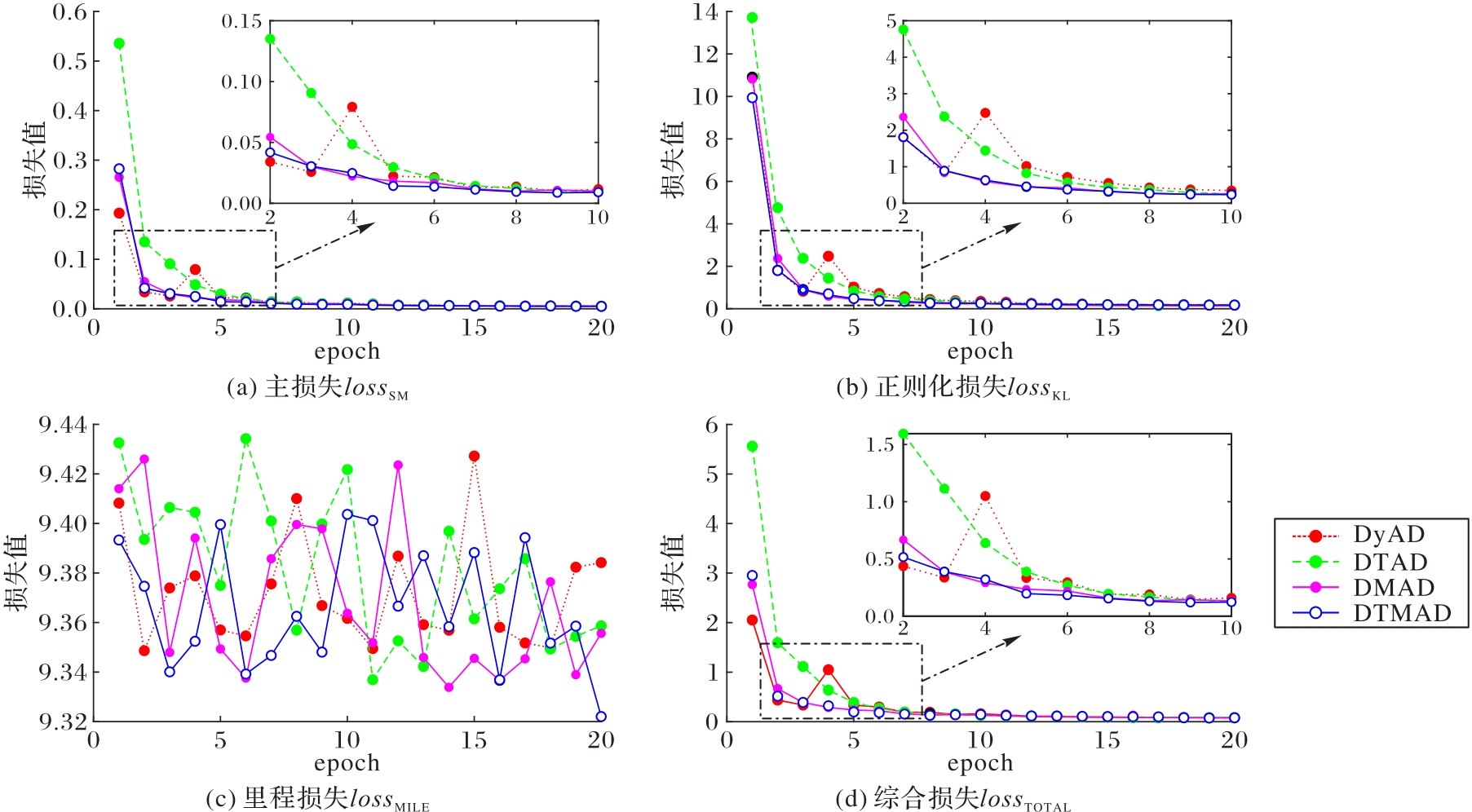
图5 不同维度损失的训练过程
Fig. 5 Training process of multi-dimensional losses
| 模型 | 主损失 | 正则化损失 | 里程损失 | 综合损失 |
|---|---|---|---|---|
| DyAD | 0.005 31 | 0.168 99 | 9.384 19 | 0.079 45 |
| DTAD | 0.005 56 | 0.155 06 | 9.358 67 | 0.080 48 |
| DMAD | 0.005 46 | 0.146 05 | 9.355 63 | 0.078 61 |
| DTMAD | 0.004 92 | 0.154 87 | 9.322 03 | 0.074 02 |
表5 各模型的综合损失的对比
Tab. 5 Total loss comparison of each model
| 模型 | 主损失 | 正则化损失 | 里程损失 | 综合损失 |
|---|---|---|---|---|
| DyAD | 0.005 31 | 0.168 99 | 9.384 19 | 0.079 45 |
| DTAD | 0.005 56 | 0.155 06 | 9.358 67 | 0.080 48 |
| DMAD | 0.005 46 | 0.146 05 | 9.355 63 | 0.078 61 |
| DTMAD | 0.004 92 | 0.154 87 | 9.322 03 | 0.074 02 |
| 隐藏层大小 | 综合损失 | AUROC | 批次大小 | 综合损失 | AUROC |
|---|---|---|---|---|---|
| 32 | 0.100 6 | 0.847 | 32 | 0.114 8 | 0.826 |
| 64 | 0.096 1 | 0.841 | 64 | 0.107 9 | 0.861 |
| 128 | 0.075 6 | 0.913 | 128 | 0.075 6 | 0.913 |
| 256 | 0.094 1 | 0.909 | 256 | 0.091 9 | 0.888 |
表6 不同超参数下的模型性能
Tab. 6 Model performance under different hyperparameters
| 隐藏层大小 | 综合损失 | AUROC | 批次大小 | 综合损失 | AUROC |
|---|---|---|---|---|---|
| 32 | 0.100 6 | 0.847 | 32 | 0.114 8 | 0.826 |
| 64 | 0.096 1 | 0.841 | 64 | 0.107 9 | 0.861 |
| 128 | 0.075 6 | 0.913 | 128 | 0.075 6 | 0.913 |
| 256 | 0.094 1 | 0.909 | 256 | 0.091 9 | 0.888 |
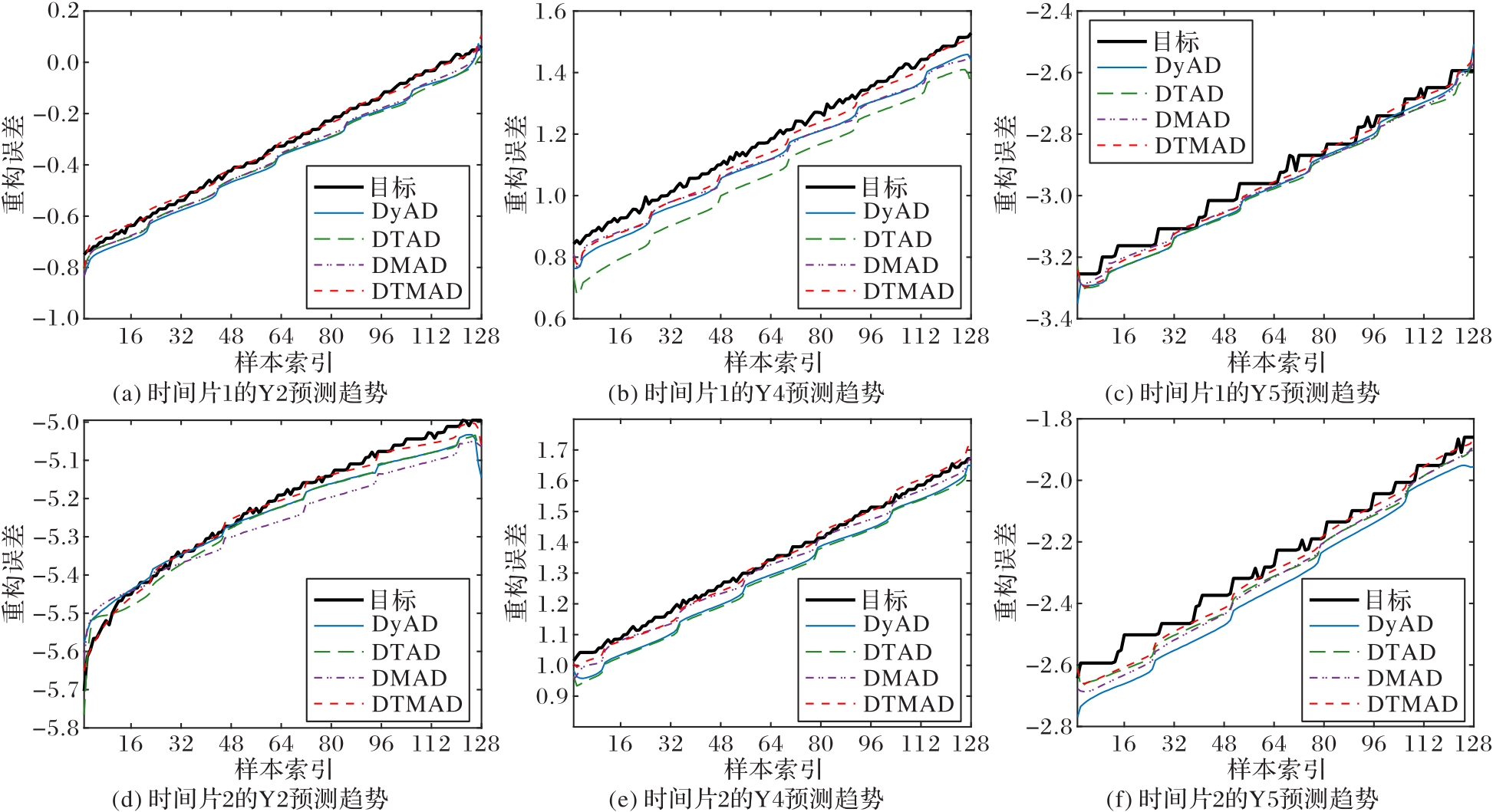
图6 不同目标特征的预测趋势对比
Fig. 6 Comparison of predicted trends for different target features
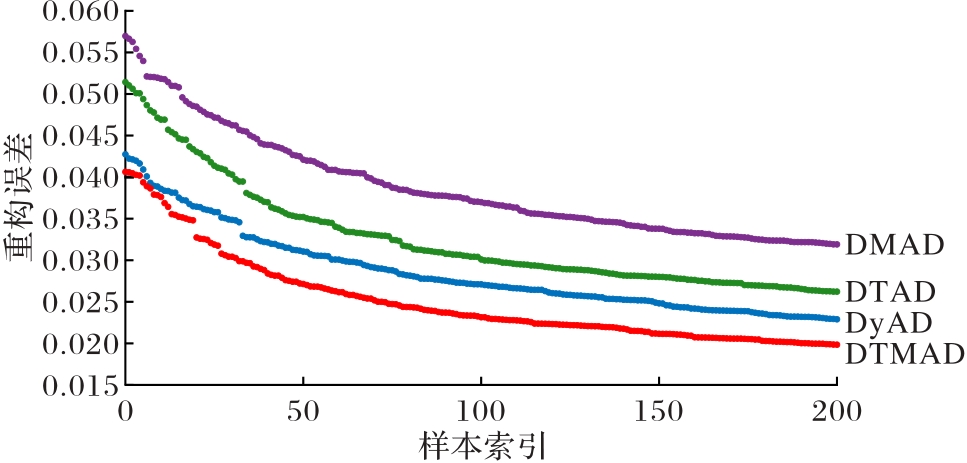
图7 重构误差对比
Fig. 7 Comparison of reconstruction error
| 模型 | 第1次 | 第2次 | 第3次 | 第4次 | 平均耗时 |
|---|---|---|---|---|---|
| DyAD | 708.7 | 709.4 | 716.4 | 680.9 | 703.875 |
| DTAD | 687.5 | 662.7 | 770.5 | 746.9 | 716.900 |
| DMAD | 781.6 | 752.1 | 779.3 | 770.8 | 770.925 |
| DTMAD | 772.2 | 802.9 | 750.4 | 794.6 | 780.025 |
表7 总耗时对比 ( s)
Tab. 7 Comparison of total time consumption
| 模型 | 第1次 | 第2次 | 第3次 | 第4次 | 平均耗时 |
|---|---|---|---|---|---|
| DyAD | 708.7 | 709.4 | 716.4 | 680.9 | 703.875 |
| DTAD | 687.5 | 662.7 | 770.5 | 746.9 | 716.900 |
| DMAD | 781.6 | 752.1 | 779.3 | 770.8 | 770.925 |
| DTMAD | 772.2 | 802.9 | 750.4 | 794.6 | 780.025 |
| 真实值 | 预测为正 | 预测为负 |
|---|---|---|
| 实际正例 | TP | FN |
| 实际负例 | FP | TN |
表8 混淆矩阵
Tab. 8 Confusion matrix
| 真实值 | 预测为正 | 预测为负 |
|---|---|---|
| 实际正例 | TP | FN |
| 实际负例 | FP | TN |
| 特征 | AUROC | 特征 | AUROC | 特征 | AUROC |
|---|---|---|---|---|---|
| Y1 | 0.865 | Y12 | 0.869 | Y123 | 0.872 |
| Y2 | 0.901 | Y13 | 0.871 | Y124 | 0.914 |
| Y3 | 0.871 | Y14 | 0.924 | Y125 | 0.895 |
| Y4 | 0.922 | Y15 | 0.872 | Y134 | 0.890 |
| Y5 | 0.880 | Y23 | 0.869 | Y135 | 0.874 |
| Y2345 | 0.923 | Y24 | 0.884 | Y145 | 0.884 |
| Y1345 | 0.905 | Y25 | 0.914 | Y234 | 0.907 |
| Y1245 | 0.906 | Y34 | 0.897 | Y235 | 0.865 |
| Y1235 | 0.909 | Y35 | 0.869 | Y245 | 0.884 |
| Y1234 | 0.895 | Y45 | 0.881 | Y345 | 0.885 |
表9 不同响应特征组合下的AUROC对比
Tab. 9 AUROC comparison under different combinations of response features
| 特征 | AUROC | 特征 | AUROC | 特征 | AUROC |
|---|---|---|---|---|---|
| Y1 | 0.865 | Y12 | 0.869 | Y123 | 0.872 |
| Y2 | 0.901 | Y13 | 0.871 | Y124 | 0.914 |
| Y3 | 0.871 | Y14 | 0.924 | Y125 | 0.895 |
| Y4 | 0.922 | Y15 | 0.872 | Y134 | 0.890 |
| Y5 | 0.880 | Y23 | 0.869 | Y135 | 0.874 |
| Y2345 | 0.923 | Y24 | 0.884 | Y145 | 0.884 |
| Y1345 | 0.905 | Y25 | 0.914 | Y234 | 0.907 |
| Y1245 | 0.906 | Y34 | 0.897 | Y235 | 0.865 |
| Y1235 | 0.909 | Y35 | 0.869 | Y245 | 0.884 |
| Y1234 | 0.895 | Y45 | 0.881 | Y345 | 0.885 |
| 模型 | AUROC | 模型 | AUROC |
|---|---|---|---|
| AE | 0.668 6 | DyAD | 0.869 1±0.029 1 |
| DeepSVDD | 0.684 1 | DTAD | 0.887 3±0.031 4 |
| GDN | 0.801 8 | DMAD | 0.885 9±0.036 7 |
| GP | 0.706 3 | DTMAD | 0.900 8±0.026 1 |
表10 模型的AUROC对比
Tab. 10 AUROC comparison of models
| 模型 | AUROC | 模型 | AUROC |
|---|---|---|---|
| AE | 0.668 6 | DyAD | 0.869 1±0.029 1 |
| DeepSVDD | 0.684 1 | DTAD | 0.887 3±0.031 4 |
| GDN | 0.801 8 | DMAD | 0.885 9±0.036 7 |
| GP | 0.706 3 | DTMAD | 0.900 8±0.026 1 |
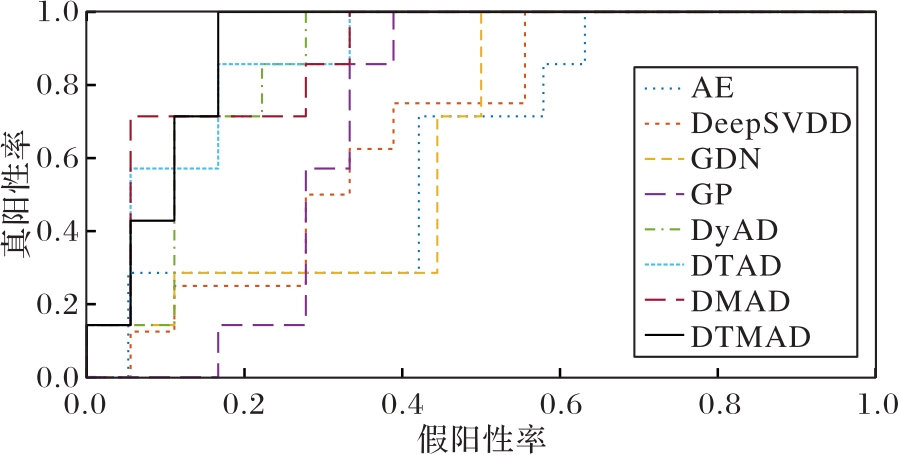
图8 AUROC对比
Fig. 8 Comparison of AUROC
| [1] | WASEEM M, AHMAD M, PARVEEN A, et al. Battery technologies and functionality of battery management system for EVs: current status, key challenges, and future prospectives[J]. Journal of Power Sources, 2023, 580: No.233349. |
| [2] | HUANG L, LIU L, LU L, et al. A review of the internal short circuit mechanism in lithium-ion batteries: inducement, detection and prevention[J]. International Journal of Energy Research, 2021, 45(11): 15797-15831. |
| [3] | KONG D, LV H, PING P, et al. A review of early warning methods of thermal runaway of lithium ion batteries[J]. Journal of Energy Storage, 2023, 64: No.107073. |
| [4] | TANG T, YANG X, LI M, et al. Deep learning model-based real-time state-of-health estimation of lithium-ion batteries under dynamic operating conditions[J]. Energy, 2025, 317: No.134697. |
| [5] | YIN Y, XU G, XIE Y, et al. Utilizing deep learning for crystal system classification in lithium-ion batteries[J]. Journal of Theory and Practice of Engineering Science, 2024, 4(3): 199-206. |
| [6] | NIU D, SONG D. Model-based robust fault diagnosis of incipient ITSC for PMSM in elevator traction system[J]. IEEE Transactions on Instrumentation and Measurement, 2023, 72: No.3533512. |
| [7] | MASOUMI Z, MOAVENI B, GAZAFRUDI S M M, et al. Signal-model-based fault diagnosis in windings of synchronous generator[J]. IEEE Transactions on Industrial Informatics, 2023, 19(3): 2942-2951. |
| [8] | PURBOWASKITO W, LAN C Y, FUH K. The potentiality of integrating model-based residuals and machine-learning classifiers: an induction motor fault diagnosis case[J]. IEEE Transactions on Industrial Informatics, 2024, 20(2): 2822-2832. |
| [9] | LIU Y, CHEN Z, WEI L, et al. Braking sensor and actuator fault diagnosis with combined model-based and data-driven pressure estimation methods[J]. IEEE Transactions on Industrial Electronics, 2023, 70(11): 11639-11648. |
| [10] | CEN J, YANG Z, LIU X, et al. A review of data-driven machinery fault diagnosis using machine learning algorithms[J]. Journal of Vibration Engineering and Technologies, 2022, 10(7): 2481-2507. |
| [11] | GUNERKAR R S, JALAN A K, BELGAMWAR S U. Fault diagnosis of rolling element bearing based on artificial neural network[J]. Journal of Mechanical Science and Technology, 2019, 33(2): 505-511. |
| [12] | 陈鑫,肖明清,文斌成,等.基于变分模态分解和混沌麻雀搜索算法优化支持向量机的滚动轴承故障诊断[J].计算机应用,2021,41(S2):118-123. |
| CHEN X, XIAO M Q, WEN B C, et al. Rolling bearing fault diagnosis based on variational mode decomposition, chaotic sparrow search algorithm and support vector machine[J]. Journal of Computer Applications, 2021, 41(S2): 118-123. | |
| [13] | CHEN Z, ZHOU D, ZIO E, et al. Adaptive transfer learning for multimode process monitoring and unsupervised anomaly detection in steam turbines[J]. Reliability Engineering and System Safety, 2023, 234: No.109162. |
| [14] | MACULOTTI G, GENTA G, QUAGLIOTTI D, et al. Gaussian process regression‐based detection and correction of disturbances in surface topography measurements[J]. Quality and Reliability Engineering International, 2022, 38(3): 1501-1518. |
| [15] | ZHANG Z, DENG X. Anomaly detection using improved deep SVDD model with data structure preservation[J]. Pattern Recognition Letters, 2021, 148: 1-6. |
| [16] | DENG A, HOOI B. Graph neural network-based anomaly detection in multivariate time series[C]// Proceedings of the 35th AAAI Conference on Artificial Intelligence. Palo Alto: AAAI Press, 2021: 4027-4035. |
| [17] | TANG C, XU L, YANG B, et al. GRU-based interpretable multivariate time series anomaly detection in industrial control system[J]. Computers and Security, 2023, 127: No.103094. |
| [18] | ZHANG X, LIU P, LIN N, et al. A novel battery abnormality detection method using interpretable Autoencoder[J]. Applied Energy, 2023, 330(Pt B): No.120312. |
| [19] | ZHANG Y, WANG J, CHEN Y, et al. Adaptive memory networks with self-supervised learning for unsupervised anomaly detection[J]. IEEE Transactions on Knowledge and Data Engineering, 2023, 35(12): 12068-12080. |
| [20] | SUN C, HE Z, LIN H, et al. Anomaly detection of power battery pack using gated recurrent units based variational autoencoder[J]. Applied Soft Computing, 2023, 132: No.109903. |
| [21] | ZHANG J, WANG Y, JIANG B, et al. Realistic fault detection of li-ion battery via dynamical deep learning[J]. Nature Communications, 2023, 14: No.5940. |
| [22] | LI Y, CHEN W, CHEN B, et al. Prototype-oriented unsupervised anomaly detection for multivariate time series[C]// Proceedings of the 40th International Conference on Machine Learning. New York: JMLR.org, 2023: 19407-19424. |
| [23] | XU J, WU H, WANG J, et al. Anomaly Transformer: time series anomaly detection with association discrepancy[EB/OL]. [2024-03-22].. |
| [24] | 郭秋亚,张兆功,胡本然,等. 数据融合在能源互联网故障诊断中的应用[J]. 计算机应用, 2024, 44(S2): 309-315. |
| GUO Q Y, ZHANG Z G, HU B R, et al. Application of data fusion in fault diagnosis of energy Internet[J]. Journal of Computer Applications, 2024, 44(S2): 309-315. | |
| [25] | TULI S, CASALE G, JENNINGS N R. TranAD: deep Transformer networks for anomaly detection in multivariate time series data[EB/OL]. [2024-03-22].. |
| [26] | YU X, ZHANG K, LIU Y, et al. Adversarial Transformer-based anomaly detection for multivariate time series[J]. IEEE Transactions on Industrial Informatics, 2025, 21(3): 2471-2480. |
| [27] | YANG Y, ZHANG C, ZHOU T, et al. DCdetector: dual attention contrastive representation learning for time series anomaly detection[C]// Proceedings of the 29th ACM SIGKDD Conference on Knowledge Discovery and Data Mining. New York: ACM, 2023: 3033-3045. |
| [1] | 黄雨倩, 黄辉, 秦永彬, 黄瑞章, 陈艳平, 周裕林, 孙倩. 融合全局和局部语义的司法要素抽取方法[J]. 《计算机应用》唯一官方网站, 2026, 46(5): 1460-1467. |
| [2] | 郑嘉丽, 周刚, 陈静, 李顺航. 基于多特征自适应融合的智能生成文本检测方法[J]. 《计算机应用》唯一官方网站, 2026, 46(5): 1433-1440. |
| [3] | 明文超, 蔺素珍, 晋赞霞. 基于场景概念引导特征融合的多波段图像描述生成方法[J]. 《计算机应用》唯一官方网站, 2026, 46(5): 1560-1567. |
| [4] | 吴闵奇, 杨元华, 李航, 胡雅琴, 汤智豪, 梅腾. 基于图Transformer和RT-DETR的轻量化水下小目标检测[J]. 《计算机应用》唯一官方网站, 2026, 46(5): 1586-1595. |
| [5] | 张红瑞, 冯威铭, 杨潞霞, 马永杰. 基于YOLO11改进的水下小目标检测算法CSAF-YOLO[J]. 《计算机应用》唯一官方网站, 2026, 46(5): 1578-1585. |
| [6] | 严心怡, 朱灵龙, 张永宏. 面向复杂交通场景的多尺度实时人车检测方法CDC-DETR[J]. 《计算机应用》唯一官方网站, 2026, 46(4): 1283-1291. |
| [7] | 李文浩, 郭银章. 基于双层多尺度动态GCN模型的城市交通流量预测[J]. 《计算机应用》唯一官方网站, 2026, 46(4): 1323-1333. |
| [8] | 刘欢娴, 王洪涛, 王宪奥, 王洪梅, 徐伟峰. 跨模态语义关联的多模态事实验证[J]. 《计算机应用》唯一官方网站, 2026, 46(4): 1069-1076. |
| [9] | 何帅, 邓春华. 基于YOLO-World的少样本学习目标检测算法[J]. 《计算机应用》唯一官方网站, 2026, 46(4): 1275-1282. |
| [10] | 刘汉卿, 桑国明, 张益嘉. 结合密集多尺度特征融合和特征知识增强Transformer的遥感图像描述模型[J]. 《计算机应用》唯一官方网站, 2026, 46(3): 741-749. |
| [11] | 付锦程, 杨仕友. 基于贝叶斯优化和特征融合混合模型的短期风电功率预测[J]. 《计算机应用》唯一官方网站, 2026, 46(2): 652-658. |
| [12] | 韩锋, 卜永丰, 梁浩翔, 黄舒雯, 张朝阳, 孙士杰. 基于多层次时空交互依赖的车辆轨迹异常检测[J]. 《计算机应用》唯一官方网站, 2026, 46(2): 604-612. |
| [13] | 梁瑾裕, 高宏娟, 杜晓飞. 基于潜在特征增强进行解耦的三维人脸生成方法[J]. 《计算机应用》唯一官方网站, 2026, 46(1): 216-223. |
| [14] | 昝志辉, 王雅静, 李珂, 杨智翔, 杨光宇. 基于SAA-CNN-BiLSTM网络的多特征融合语音情感识别方法[J]. 《计算机应用》唯一官方网站, 2026, 46(1): 69-76. |
| [15] | 曹柠, 温昕, 郝雁嵘, 曹锐. 多域特征融合的轻量化运动想象脑电信号解码神经网络[J]. 《计算机应用》唯一官方网站, 2026, 46(1): 289-296. |
| 阅读次数 | ||||||
|
全文 |
|
|||||
|
摘要 |
|
|||||
