


Journal of Computer Applications ›› 2026, Vol. 46 ›› Issue (2): 361-367.DOI: 10.11772/j.issn.1001-9081.2025030266
• Artificial intelligence • Previous Articles
Received:2025-03-18
Revised:2025-06-02
Accepted:2025-06-06
Online:2025-07-21
Published:2026-02-10
Contact:
Mingshu ZHANG
About author:LUO Hu, born in 1993, M. S. candidate. His research interests include multi-modal rumor detection.Supported by:
罗虎, 张明书( )
)
通讯作者:
张明书
作者简介:罗虎(1993—),男,陕西西安人,硕士研究生,主要研究方向:多模态谣言检测基金资助:CLC Number:
Hu LUO, Mingshu ZHANG. Rumor detection method based on cross-modal attention mechanism and contrastive learning[J]. Journal of Computer Applications, 2026, 46(2): 361-367.
罗虎, 张明书. 基于跨模态注意力机制与对比学习的谣言检测方法[J]. 《计算机应用》唯一官方网站, 2026, 46(2): 361-367.
Add to citation manager EndNote|Ris|BibTeX
URL: https://www.joca.cn/EN/10.11772/j.issn.1001-9081.2025030266
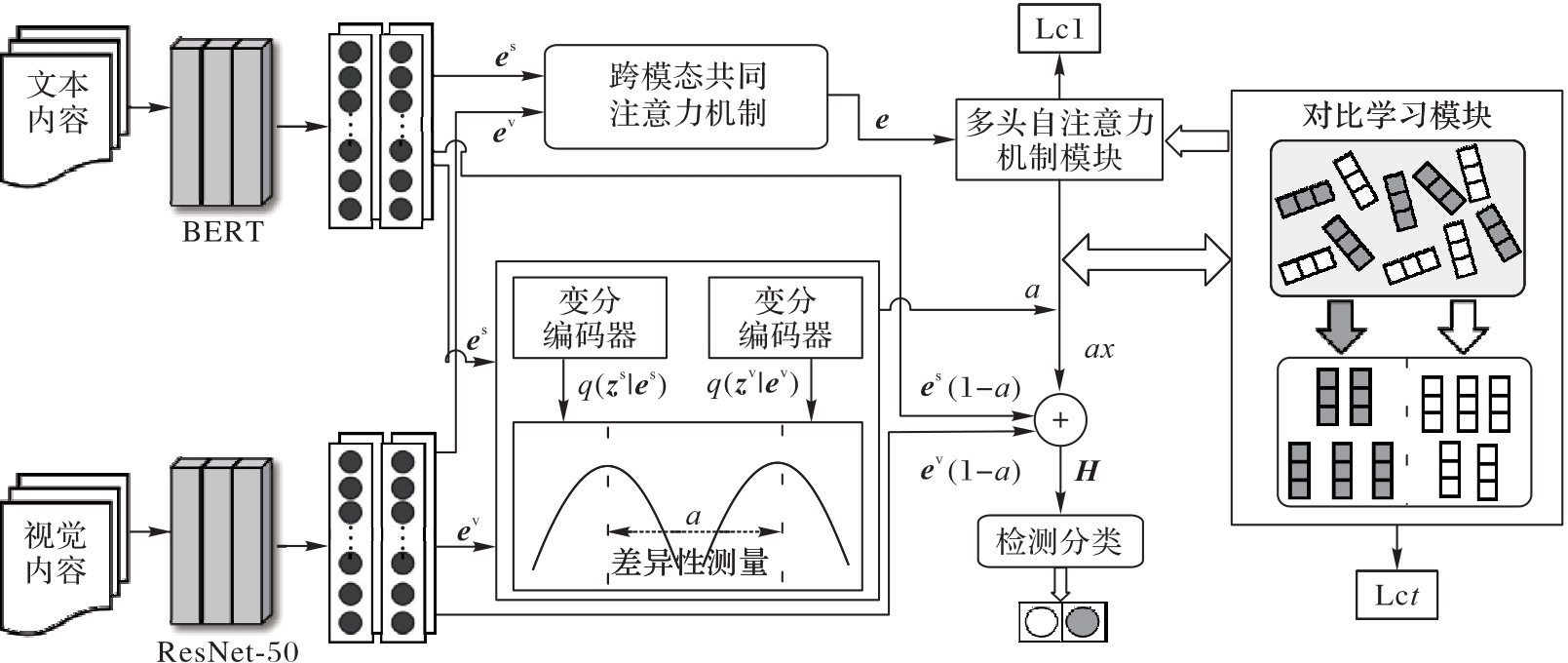
Fig. 1 Structure of CACL model
| 数据集 | 谣言数 | 非谣言数 | 合计 |
|---|---|---|---|
| 3 749 | 3 783 | 7 532 | |
| Twitter-16 | 5 007 | 6 840 | 11 847 |
Tab. 1 Datasets used in experiments
| 数据集 | 谣言数 | 非谣言数 | 合计 |
|---|---|---|---|
| 3 749 | 3 783 | 7 532 | |
| Twitter-16 | 5 007 | 6 840 | 11 847 |
| 模型 | 准确率 | 精确度 | 召回率 | F1 |
|---|---|---|---|---|
| BERT | 67.75 | 68.73 | 66.52 | 67.61 |
| ResNet-50 | 65.32 | 65.27 | 64.63 | 64.95 |
| att-RNN | 75.83 | 75.82 | 75.27 | 75.54 |
| EANN | 80.93 | 80.16 | 79.64 | 79.93 |
| SAFE | 85.02 | 85.05 | 85.02 | 85.03 |
| UPFD | 83.26 | 84.35 | 84.37 | 84.36 |
| CAFE | 84.67 | 84.65 | 84.39 | 84.52 |
| MMFN | 86.66 | 87.53 | 85.36 | 86.43 |
| CONLFE | 86.26 | 88.56 | 83.01 | 85.70 |
| CACL | 91.10 | 89.51 | 92.95 | 91.20 |
Tab. 2 Performance comparison results of different models on Weibo dataset
| 模型 | 准确率 | 精确度 | 召回率 | F1 |
|---|---|---|---|---|
| BERT | 67.75 | 68.73 | 66.52 | 67.61 |
| ResNet-50 | 65.32 | 65.27 | 64.63 | 64.95 |
| att-RNN | 75.83 | 75.82 | 75.27 | 75.54 |
| EANN | 80.93 | 80.16 | 79.64 | 79.93 |
| SAFE | 85.02 | 85.05 | 85.02 | 85.03 |
| UPFD | 83.26 | 84.35 | 84.37 | 84.36 |
| CAFE | 84.67 | 84.65 | 84.39 | 84.52 |
| MMFN | 86.66 | 87.53 | 85.36 | 86.43 |
| CONLFE | 86.26 | 88.56 | 83.01 | 85.70 |
| CACL | 91.10 | 89.51 | 92.95 | 91.20 |
| 模型 | 准确率 | 精确度 | 召回率 | F1 |
|---|---|---|---|---|
| BERT | 53.23 | 59.92 | 54.25 | 56.94 |
| ResNet-50 | 59.25 | 67.32 | 51.37 | 58.27 |
| att-RNN | 68.35 | 72.32 | 68.27 | 70.24 |
| EANN | 77.15 | 76.69 | 72.36 | 74.46 |
| SAFE | 82.37 | 81.25 | 81.07 | 81.16 |
| UPFD | 86.34 | 85.37 | 85.24 | 85.30 |
| CAFE | 84.39 | 84.84 | 83.44 | 84.13 |
| MMFN | 85.33 | 83.68 | 87.95 | 85.76 |
| CONLFE | 85.29 | 88.32 | 81.06 | 84.54 |
| CACL | 90.80 | 89.58 | 92.17 | 90.86 |
Tab. 3 Performance comparison results of different models on Twitter-16 dataset
| 模型 | 准确率 | 精确度 | 召回率 | F1 |
|---|---|---|---|---|
| BERT | 53.23 | 59.92 | 54.25 | 56.94 |
| ResNet-50 | 59.25 | 67.32 | 51.37 | 58.27 |
| att-RNN | 68.35 | 72.32 | 68.27 | 70.24 |
| EANN | 77.15 | 76.69 | 72.36 | 74.46 |
| SAFE | 82.37 | 81.25 | 81.07 | 81.16 |
| UPFD | 86.34 | 85.37 | 85.24 | 85.30 |
| CAFE | 84.39 | 84.84 | 83.44 | 84.13 |
| MMFN | 85.33 | 83.68 | 87.95 | 85.76 |
| CONLFE | 85.29 | 88.32 | 81.06 | 84.54 |
| CACL | 90.80 | 89.58 | 92.17 | 90.86 |
| 数据集 | 模型 | 准确率 | 精确度 | 召回率 | F1 |
|---|---|---|---|---|---|
| CACL_T | 74.26 | 74.35 | 74.42 | 74.38 | |
| CACL_V | 75.35 | 74.62 | 74.47 | 74.54 | |
| CACL_M | 85.48 | 85.32 | 85.25 | 85.28 | |
| CACL_MS | 90.23 | 90.27 | 90.26 | 90.26 | |
| CACL | 91.10 | 89.51 | 92.95 | 91.20 | |
| Twitter-16 | CACL_T | 72.27 | 72.32 | 72.25 | 72.28 |
| CACL_V | 78.62 | 78.37 | 78.63 | 78.50 | |
| CACL_M | 84.45 | 84.32 | 84.58 | 84.45 | |
| CACL_MS | 89.45 | 89.37 | 89.48 | 89.43 | |
| CACL | 90.80 | 89.58 | 92.17 | 90.86 |
Tab. 4 Results of ablation experiments
| 数据集 | 模型 | 准确率 | 精确度 | 召回率 | F1 |
|---|---|---|---|---|---|
| CACL_T | 74.26 | 74.35 | 74.42 | 74.38 | |
| CACL_V | 75.35 | 74.62 | 74.47 | 74.54 | |
| CACL_M | 85.48 | 85.32 | 85.25 | 85.28 | |
| CACL_MS | 90.23 | 90.27 | 90.26 | 90.26 | |
| CACL | 91.10 | 89.51 | 92.95 | 91.20 | |
| Twitter-16 | CACL_T | 72.27 | 72.32 | 72.25 | 72.28 |
| CACL_V | 78.62 | 78.37 | 78.63 | 78.50 | |
| CACL_M | 84.45 | 84.32 | 84.58 | 84.45 | |
| CACL_MS | 89.45 | 89.37 | 89.48 | 89.43 | |
| CACL | 90.80 | 89.58 | 92.17 | 90.86 |
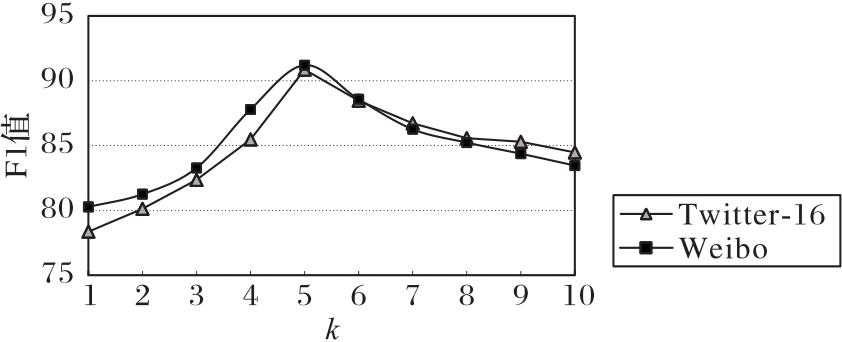
Fig. 2 Impact of k value on model performance
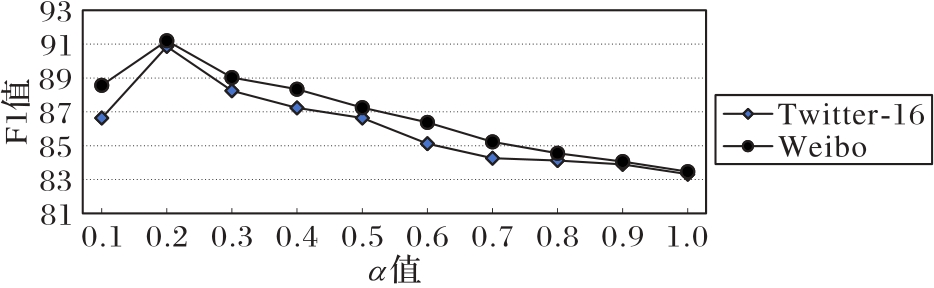
Fig. 3 Impact of α value on model performance
| [1] | 彭甜, 刘岩芳.信息传播视域下重大突发事件网络谣言传播特点及治理对策研究[J].新闻研究导刊,2023, 14(18): 19-21. |
| PENG T, LIU Y F. Research on the dissemination characteristics and governance strategies of online rumors in major emergencies from the perspective of information diffusion[J]. Journal of News Research, 2023, 14(18): 19-21. | |
| [2] | VOSOUGHI S, ROY D, ARAL S. The spread of true and false news online[J]. Science, 2018, 359(6380): 1146-1151. |
| [3] | CASTILLO C, MENDOZA M, POBLETE B. Information credibility on Twitter[C]// Proceedings of the 20th International Conference on World Wide Web. New York: ACM, 2011: 675-684. |
| [4] | LIU X, NOURBAKHSH A, LI Q, et al. Real-time rumor debunking on Twitter[C]// Proceedings of the 24th ACM International Conference on Information and Knowledge Management. New York: ACM, 2015: 1867-1870. |
| [5] | DEVLIN J, CHANG M W, LEE K, et al. BERT: pre-training of deep bidirectional transformers for language understanding[C]//Proceedings of the 2019 Conference of the North American Chapter of the Association for Computational Linguistics: Human Language Technologies, Volume 1 (Long and Short Papers). Stroudsburg: ACL, 2019: 4171-4186. |
| [6] | WANG Y, MA F, JIN Z, et al. EANN: event adversarial neural networks for multi-modal fake news detection[C]// Proceedings of the 24th ACM SIGKDD International Conference on Knowledge Discovery and Data Mining. New York: ACM, 2018: 849-857. |
| [7] | SINGHAL S, SHAH R R, CHAKRABORTY T, et al. SpotFake: a multi-modal framework for fake news detection[C]// Proceedings of the IEEE 5th International Conference on Multimedia Big Data. Piscataway: IEEE, 2019: 39-47. |
| [8] | SUN T, QIAN Z, DONG S, et al. Rumor detection on social media with graph adversarial contrastive learning[C]// Proceedings of the ACM Web Conference 2022. New York: ACM, 2022: 2789-2797. |
| [9] | YI F, LIU H, HE H, et al. A comparative analysis of active learning for rumor detection on social media platforms[J]. Applied Sciences, 2023, 13(22): No.12098. |
| [10] | ZHANG X, CAO J, LI X, et al. Mining dual emotion for fake news detection[C]// Proceedings of the 2021 Web Conference. New York: ACM, 2021: 3465-3476. |
| [11] | MA J, GAO W, MITRA P, et al. Detecting rumors from microblogs with recurrent neural networks[C]// Proceedings of the 25th International Joint Conference on Artificial Intelligence. Palo Alto: AAAI Press, 2016: 3818-3824. |
| [12] | CHEN W, ZHANG Y, YEO C K, et al. Unsupervised rumor detection based on users’ behaviors using neural networks[J]. Pattern Recognition Letters, 2018, 105: 226-233. |
| [13] | MA J, GAO W, WONG K F. Rumor detection on Twitter with tree-structured recursive neural networks[C]// Proceedings of the 56th Annual Meeting of the Association for Computational Linguistics (Volume 1: Long Papers). Stroudsburg: ACL, 2018: 1980-1989. |
| [14] | ZHANG X, PAN Y, GU X, et al. Sentiment analysis-based social network rumor detection model with bi-directional graph convolutional networks[C]// Proceedings of the SPIE 12609, International Conference on Computer Application and Information Security. Bellingham, WA: SPIE, 2023: No.126091N. |
| [15] | LIANG G, HE W, XU C, et al. Rumor identification in microblogging systems based on users’ behavior[J]. IEEE Transactions on Computational Social Systems, 2015, 2(3): 99-108. |
| [16] | BIAN T, XIAO X, XU T, et al. Rumor detection on social media with bi-directional graph convolutional networks[C]// Proceedings of the 34th AAAI Conference on Artificial Intelligence. Palo Alto: AAAI Press, 2020: 549-556. |
| [17] | WU Z, PI D, CHEN J, et al. Rumor detection based on propagation graph neural network with attention mechanism[J]. Expert Systems with Applications, 2020, 158: No.113595. |
| [18] | 徐建民,孙朋,吴树芳. 传播路径树核学习的微博谣言检测方法[J]. 计算机科学, 2022, 49(6): 342-349. |
| XU J M, SUN P, WU S F. Microblog rumor detection method based on propagation path tree kernel learning[J]. Computer Science, 2022, 49(6): 342-349. | |
| [19] | JIN Z, CAO J, GUO H, et al. Multimodal fusion with recurrent neural networks for rumor detection on microblogs[C]// Proceedings of the 25th ACM International Conference on Multimedia. New York: ACM, 2017: 795-816. |
| [20] | LIU P, QIU X, CHEN X, et al. Multi-timescale long short-term memory neural network for modelling sentences and documents[C]// Proceedings of the 2015 Conference on Empirical Methods in Natural Language Processing. Stroudsburg: ACL, 2015: 2326-2335. |
| [21] | KHATTAR D, GOUD J S, GUPTA M, et al. MVAE: multimodal variational autoencoder for fake news detection[C]// Proceedings of the World Wide Web Conference. New York: ACM, 2019: 2915-2921. |
| [22] | SINGHAL S, KABRA A, SHARMA M, et al. SpotFake+: a multimodal framework for fake news detection via transfer learning (student abstract)[C]// Proceedings of the 34th AAAI Conference on Artificial Intelligence. Palo Alto: AAAI Press, 2020: 13915-13916. |
| [23] | CHEN Y, LI D, ZHANG P, et al. Cross-modal ambiguity learning for multimodal fake news detection[C]// Proceedings of the ACM Web Conference 2022. New York: ACM, 2022: 2897-2905. |
| [24] | ZHENG J, ZHANG X, GUO S, et al. MFAN: multi-modal feature-enhanced attention networks for rumor detection[C]// Proceedings of the 31st International Joint Conference on Artificial Intelligence. California: ijcai.org, 2022: 2413-2419. |
| [25] | HE K, ZHANG X, REN S, et al. Deep residual learning for image recognition[C]// Proceedings of the 2016 IEEE Conference on Computer Vision and Pattern Recognition. Piscataway: IEEE, 2016: 770-778. |
| [26] | CHEN T, KORNBLITH S, SWERSKY K, et al. Big self-supervised models are strong semi-supervised learners[C]// Proceedings of the 34th International Conference on Neural Information Processing Systems. Red Hook: Curran Associates Inc., 2020: 22243-22255. |
| [27] | BOIDIDOU C, PAPADOPOULOS S, ZAMPOGLOU M, et al. Detection and visualization of misleading content on Twitter[J]. International Journal of Multimedia Information Retrieval, 2018, 7(1): 71-86. |
| [28] | KINGMA D P, BA J L. Adam: a method for stochastic optimization[EB/OL]. [2024-12-23].. |
| [29] | ZHOU X, WU J, ZAFARANI R. SAFE: similarity-aware multi-modal fake news detection[C]// Proceedings of the 2020 Pacific-Asia Conference on Knowledge Discovery and Data Mining, LNCS 12085. Cham: Springer, 2020: 354-367. |
| [30] | DOU Y, SHU K, XIA C, et al. User preference-aware fake news detection[C]// Proceedings of the 44th International ACM SIGIR Conference on Research and Development in Information Retrieval. New York: ACM, 2021: 2051-2055. |
| [31] | ZHOU Y, YANG Y, YING Q, et al. Multi-modal fake news detection on social media via multi-grained information fusion[C]// Proceedings of the 2023 ACM International Conference on Multimedia Retrieval. New York: ACM, 2023: 343-352. |
| [32] | WU G, WANG B, LI X, et al. Contrastive learning based on feature enhancement for multi-modal fake news detection[C]// Proceedings of the 43rd Chinese Control Conference. Piscataway: IEEE, 2024: 7610-7615. |
| [1] | Xue WANG, Liping ZHANG, Sheng YAN, Na LI, Xuefei ZHANG. Review of multi-modal knowledge graph completion methods [J]. Journal of Computer Applications, 2026, 46(2): 341-353. |
| [2] | Fei WANG, Ye TAO, Jiawang LIU, Wei LI, Xiugong QIN, Ning ZHANG. Bimodal fusion method for constructing spatio-temporal knowledge graph in smart home space [J]. Journal of Computer Applications, 2026, 46(1): 52-59. |
| [3] | Wen LI, Kairong LI, Kai YANG. Subgraph-aware contrastive learning with data augmentation [J]. Journal of Computer Applications, 2026, 46(1): 1-9. |
| [4] | Xingyao YANG, Zheng QI, Jiong YU, Zulian ZHANG, Shuai MA, Hongtao SHEN. Session-based recommendation model based on time-aware and space-enhanced dual channel graph neural network [J]. Journal of Computer Applications, 2026, 46(1): 104-112. |
| [5] | Ziyang CHENG, Ruizhang HUANG, Jingjing XUE. Deep evolutionary topic clustering model [J]. Journal of Computer Applications, 2026, 46(1): 85-94. |
| [6] | Shuwen HUANG, Keyu GUO, Xiangyu SONG, Feng HAN, Shijie SUN, Huansheng SONG. Multi-target 3D visual grounding method based on monocular images [J]. Journal of Computer Applications, 2026, 46(1): 207-215. |
| [7] | Yanan LI, Mengyang GUO, Guojun DENG, Yunfeng CHEN, Jianji REN, Yongliang YUAN. Method for life prediction of parallel branching engine based on multi-modal fusion features [J]. Journal of Computer Applications, 2026, 46(1): 305-313. |
| [8] | Bing YIN, Zhenhua LING, Yin LIN, Changfeng XI, Ying LIU. Emotion recognition method compatible with missing modal reasoning [J]. Journal of Computer Applications, 2025, 45(9): 2764-2772. |
| [9] | Chao LIU, Yanhua YU. Knowledge-aware recommendation model combining denoising strategy and multi-view contrastive learning [J]. Journal of Computer Applications, 2025, 45(9): 2827-2837. |
| [10] | Xiang WANG, Zhixiang CHEN, Guojun MAO. Multivariate time series prediction method combining local and global correlation [J]. Journal of Computer Applications, 2025, 45(9): 2806-2816. |
| [11] | Zhixiong XU, Bo LI, Xiaoyong BIAN, Qiren HU. Adversarial sample embedded attention U-Net for 3D medical image segmentation [J]. Journal of Computer Applications, 2025, 45(9): 3011-3016. |
| [12] | Zhiyuan WANG, Tao PENG, Jie YANG. Integrating internal and external data for out-of-distribution detection training and testing [J]. Journal of Computer Applications, 2025, 45(8): 2497-2506. |
| [13] | Yimeng XI, Zhen DENG, Qian LIU, Libo LIU. Cross-modal information fusion for video-text retrieval [J]. Journal of Computer Applications, 2025, 45(8): 2448-2456. |
| [14] | Yihan WANG, Chong LU, Zhongyuan CHEN. Multimodal sentiment analysis model with cross-modal text information enhancement [J]. Journal of Computer Applications, 2025, 45(7): 2237-2244. |
| [15] | Chen LIANG, Yisen WANG, Qiang WEI, Jiang DU. Source code vulnerability detection method based on Transformer-GCN [J]. Journal of Computer Applications, 2025, 45(7): 2296-2303. |
| Viewed | ||||||
|
Full text |
|
|||||
|
Abstract |
|
|||||
