


Journal of Computer Applications ›› 2026, Vol. 46 ›› Issue (4): 1096-1103.DOI: 10.11772/j.issn.1001-9081.2025040497
• Artificial intelligence • Previous Articles Next Articles
Hao LIANG1, Shaojie QIAO2( )
)
Received:2025-05-04
Revised:2025-08-22
Accepted:2025-08-28
Online:2025-09-01
Published:2026-04-10
Contact:
Shaojie QIAO
About author:LIANG Hao, born in 1976, M. S., lecturer. His research interests include big data, artificial intelligence, computer network security.
Supported by:
梁豪1, 乔少杰2()
通讯作者:
乔少杰
作者简介:梁豪(1976—),男,浙江宁波人,讲师,硕士,主要研究方向:大数据、人工智能、计算机网络安全
基金资助:CLC Number:
Hao LIANG, Shaojie QIAO. Complex query-based question-answering model integrating bidirectional sequence embeddings[J]. Journal of Computer Applications, 2026, 46(4): 1096-1103.
梁豪, 乔少杰. 融合双向序列嵌入的复杂查询问答模型[J]. 《计算机应用》唯一官方网站, 2026, 46(4): 1096-1103.
Add to citation manager EndNote|Ris|BibTeX
URL: https://www.joca.cn/EN/10.11772/j.issn.1001-9081.2025040497
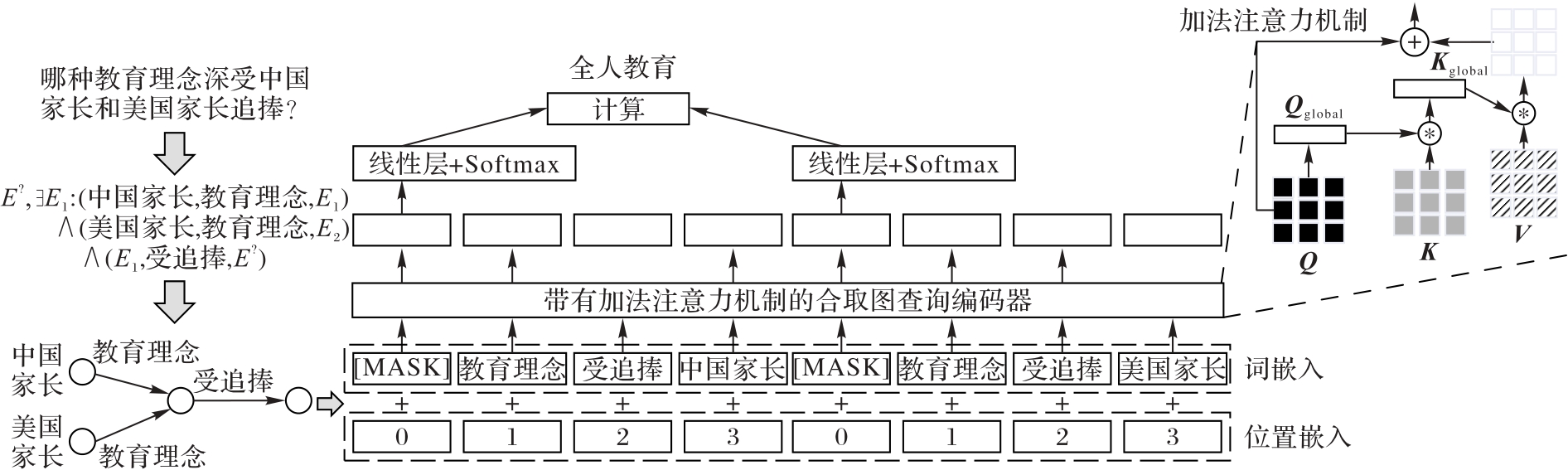
Fig. 1 Structure of BSE model
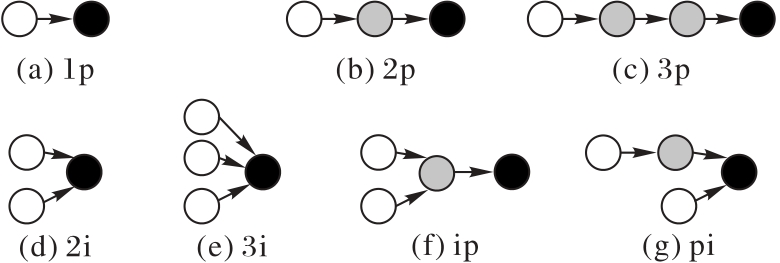
Fig. 2 Types of conjunctive queries
| 数据集 | 三元组数 | 路径数 | DAG数 | 平均 掩码数 | 平均 长度 | |
|---|---|---|---|---|---|---|
FB15K-237- CQ | 训练集 | 272 115 | 50 000 | 48 865 | 1.86 | 152 |
| 验证集 | — | — | 2 785 | 5.91 | 460 | |
| 测试集 | — | — | 2 599 | 6.05 | 479 | |
WN18RR- CQ | 训练集 | 86 835 | 10 000 | 9 465 | 1.84 | 71 |
| 验证集 | — | — | 112 | 5.13 | 198 | |
| 测试集 | — | — | 95 | 4.91 | 199 | |
Tab. 1 Description of datasets
| 数据集 | 三元组数 | 路径数 | DAG数 | 平均 掩码数 | 平均 长度 | |
|---|---|---|---|---|---|---|
FB15K-237- CQ | 训练集 | 272 115 | 50 000 | 48 865 | 1.86 | 152 |
| 验证集 | — | — | 2 785 | 5.91 | 460 | |
| 测试集 | — | — | 2 599 | 6.05 | 479 | |
WN18RR- CQ | 训练集 | 86 835 | 10 000 | 9 465 | 1.84 | 71 |
| 验证集 | — | — | 112 | 5.13 | 198 | |
| 测试集 | — | — | 95 | 4.91 | 199 | |
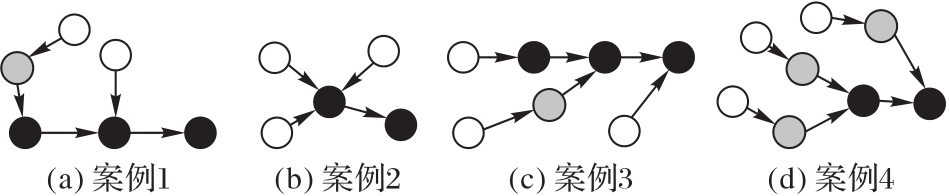
Fig. 3 Examples of random DAG and generated path queries
| 数据集 | 算法 | 1p | 2p | 3p | 2i | 3i | ip | pi | 平均值 |
|---|---|---|---|---|---|---|---|---|---|
| FB15K-237 | GQE[ | 0.402 | 0.213 | 0.155 | 0.292 | 0.406 | 0.083 | 0.170 | 0.246 |
| GQE-Double[ | 0.405 | 0.213 | 0.153 | 0.298 | 0.411 | 0.085 | 0.182 | 0.249 | |
| Q2B[ | 0.467 | 0.240 | 0.186 | 0.324 | 0.453 | 0.108 | 0.205 | 0.283 | |
| AnyCQ[ | 0.450 | 0.270 | 0.220 | 0.340 | 0.460 | 0.100 | 0.190 | 0.290 | |
| LGOT[ | 0.430 | 0.260 | 0.230 | 0.330 | 0.480 | 0.105 | 0.195 | 0.290 | |
| BiQE[ | 0.439 | 0.281 | 0.239 | 0.333 | 0.474 | 0.110 | 0.177 | 0.293 | |
| BSE | 0.442 | 0.292 | 0.248 | 0.351 | 0.492 | 0.124 | 0.191 | 0.306 | |
| NELL-995 | GQE[ | 0.418 | 0.228 | 0.205 | 0.316 | 0.447 | 0.081 | 0.186 | 0.269 |
| GQE-Double[ | 0.417 | 0.231 | 0.203 | 0.318 | 0.454 | 0.081 | 0.188 | 0.270 | |
| Q2B[ | 0.555 | 0.266 | 0.233 | 0.343 | 0.480 | 0.132 | 0.212 | 0.317 | |
| AnyCQ[ | 0.590 | 0.290 | 0.310 | 0.360 | 0.520 | 0.110 | 0.200 | 0.340 | |
| LGOT[ | 0.580 | 0.300 | 0.320 | 0.370 | 0.540 | 0.115 | 0.205 | 0.348 | |
| BiQE[ | 0.587 | 0.305 | 0.326 | 0.371 | 0.531 | 0.103 | 0.187 | 0.344 | |
| BSE | 0.595 | 0.318 | 0.340 | 0.385 | 0.551 | 0.117 | 0.203 | 0.358 |
Tab. 2 HITS@3 comparison of different models on FB15K-237 and NELL-995 datasets
| 数据集 | 算法 | 1p | 2p | 3p | 2i | 3i | ip | pi | 平均值 |
|---|---|---|---|---|---|---|---|---|---|
| FB15K-237 | GQE[ | 0.402 | 0.213 | 0.155 | 0.292 | 0.406 | 0.083 | 0.170 | 0.246 |
| GQE-Double[ | 0.405 | 0.213 | 0.153 | 0.298 | 0.411 | 0.085 | 0.182 | 0.249 | |
| Q2B[ | 0.467 | 0.240 | 0.186 | 0.324 | 0.453 | 0.108 | 0.205 | 0.283 | |
| AnyCQ[ | 0.450 | 0.270 | 0.220 | 0.340 | 0.460 | 0.100 | 0.190 | 0.290 | |
| LGOT[ | 0.430 | 0.260 | 0.230 | 0.330 | 0.480 | 0.105 | 0.195 | 0.290 | |
| BiQE[ | 0.439 | 0.281 | 0.239 | 0.333 | 0.474 | 0.110 | 0.177 | 0.293 | |
| BSE | 0.442 | 0.292 | 0.248 | 0.351 | 0.492 | 0.124 | 0.191 | 0.306 | |
| NELL-995 | GQE[ | 0.418 | 0.228 | 0.205 | 0.316 | 0.447 | 0.081 | 0.186 | 0.269 |
| GQE-Double[ | 0.417 | 0.231 | 0.203 | 0.318 | 0.454 | 0.081 | 0.188 | 0.270 | |
| Q2B[ | 0.555 | 0.266 | 0.233 | 0.343 | 0.480 | 0.132 | 0.212 | 0.317 | |
| AnyCQ[ | 0.590 | 0.290 | 0.310 | 0.360 | 0.520 | 0.110 | 0.200 | 0.340 | |
| LGOT[ | 0.580 | 0.300 | 0.320 | 0.370 | 0.540 | 0.115 | 0.205 | 0.348 | |
| BiQE[ | 0.587 | 0.305 | 0.326 | 0.371 | 0.531 | 0.103 | 0.187 | 0.344 | |
| BSE | 0.595 | 0.318 | 0.340 | 0.385 | 0.551 | 0.117 | 0.203 | 0.358 |
| 算法 | FB15K-237-CQ | FB15K-237-PATHS | WN18RR-CQ | WN18RR-PATHS | ||||
|---|---|---|---|---|---|---|---|---|
| MRR | HITS@10 | MRR | HITS@10 | MRR | HITS@10 | MRR | HITS@10 | |
| GQE-DistMult-MP[ | 0.157 | 0.269 | 0.241 | 0.376 | 0.149 | 0.148 | 0.349 | 0.400 |
| BiQE[ | 0.228 | 0.372 | 0.473 | 0.602 | 0.150 | 0.158 | 0.520 | 0.620 |
| BSE | 0.241 | 0.391 | 0.489 | 0.635 | 0.162 | 0.171 | 0.534 | 0.647 |
Tab. 3 Performance comparison of BSE and best-performed GQE and BiQE
| 算法 | FB15K-237-CQ | FB15K-237-PATHS | WN18RR-CQ | WN18RR-PATHS | ||||
|---|---|---|---|---|---|---|---|---|
| MRR | HITS@10 | MRR | HITS@10 | MRR | HITS@10 | MRR | HITS@10 | |
| GQE-DistMult-MP[ | 0.157 | 0.269 | 0.241 | 0.376 | 0.149 | 0.148 | 0.349 | 0.400 |
| BiQE[ | 0.228 | 0.372 | 0.473 | 0.602 | 0.150 | 0.158 | 0.520 | 0.620 |
| BSE | 0.241 | 0.391 | 0.489 | 0.635 | 0.162 | 0.171 | 0.534 | 0.647 |
| 算法 | AUC | APR |
|---|---|---|
| GQE-Bilinear | 91.20 | 91.10 |
| TRACTOR | 82.20 | 87.30 |
| MPQE-sum | 90.00 | 90.50 |
| BSE | 96.75 | 96.55 |
Tab. 4 Performance comparison of different models on EDUKG dataset
| 算法 | AUC | APR |
|---|---|---|
| GQE-Bilinear | 91.20 | 91.10 |
| TRACTOR | 82.20 | 87.30 |
| MPQE-sum | 90.00 | 90.50 |
| BSE | 96.75 | 96.55 |
| 算法 | 尾部查询 | 交集节点缺失 | 分支路径缺失 | |||
|---|---|---|---|---|---|---|
| MRR | HITS@10 | MRR | HITS@10 | MRR | HITS@10 | |
| GQE-DistMult-MP[ | 0.116 | 0.217 | 0.214 | 0.343 | 0.144 | 0.250 |
| BiQE[ | 0.205 | 0.319 | 0.265 | 0.439 | 0.217 | 0.361 |
| BSE | 0.217 | 0.339 | 0.278 | 0.459 | 0.224 | 0.378 |
Tab. 5 Performance comparison of BSE and best-performed GQE and BiQE on FB15K-237-CQ dataset at different positions of DAG
| 算法 | 尾部查询 | 交集节点缺失 | 分支路径缺失 | |||
|---|---|---|---|---|---|---|
| MRR | HITS@10 | MRR | HITS@10 | MRR | HITS@10 | |
| GQE-DistMult-MP[ | 0.116 | 0.217 | 0.214 | 0.343 | 0.144 | 0.250 |
| BiQE[ | 0.205 | 0.319 | 0.265 | 0.439 | 0.217 | 0.361 |
| BSE | 0.217 | 0.339 | 0.278 | 0.459 | 0.224 | 0.378 |
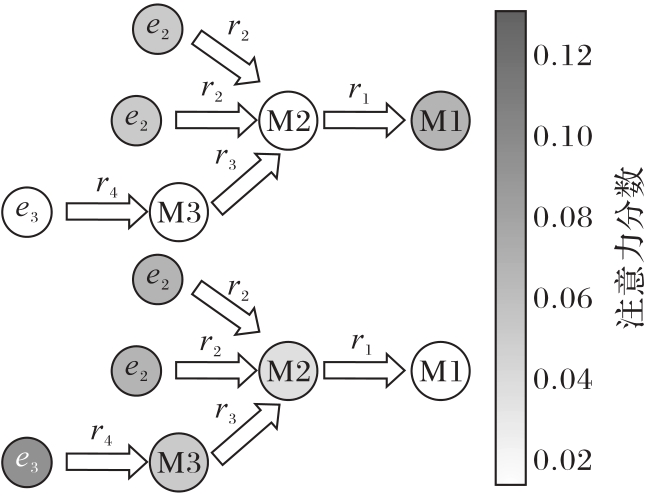
Fig. 4 Attention mechanism in BSE
| 算法 | MRR | HITS@10 |
|---|---|---|
| BSE | 0.496 | 0.621 |
| BSE(无未来上下文) | 0.443 | 0.567 |
Tab. 6 Impact of removing future context
| 算法 | MRR | HITS@10 |
|---|---|---|
| BSE | 0.496 | 0.621 |
| BSE(无未来上下文) | 0.443 | 0.567 |
| [1] | 刘莎. 我国民航教育研究的现状、热点及趋势——基于CNKI的CiteSpace知识图谱分析[J]. 中国民航飞行学院学报, 2025, 36(2): 20-24, 49. |
| LIU S. Research on status, hot spots and trends of civil aviation education in China — analysis of CiteSpace knowledge graph based on CNKI[J]. Journal of Civil Aviation Flight University of China, 2025, 36(2): 20-24, 49. | |
| [2] | 苏若涵,央青. 基于知识图谱的国际中文教育数字化研究现状与趋势[J]. 天津师范大学学报(社会科学版), 2025(2): 22-33. |
| SU R H, YANG Q. The current status and trends of digitalization research in international Chinese language education based on knowledge graphs[J]. Journal of Tianjin Normal University (Social Sciences), 2025(2): 22-33. | |
| [3] | BORDES A, USUNIER N, GARCIA-DURÁN A, et al. Translating embeddings for modeling multi-relational data[C]// Proceedings of the 27th International Conference on Neural Information Processing Systems — Volume 2. Cambridge: MIT Press, 2013: 2787-2795. |
| [4] | YANG B, YIH W T, HE X, et al. Embedding entities and relations for learning and inference in knowledge bases[EB/OL]. [2025-03-11].. |
| [5] | HAMILTON W L, BAJAJ P, ZITNIK M, et al. Embedding logical queries on knowledge graphs[C]// Proceedings of the 32nd International Conference on Neural Information Processing Systems. Red Hook: Curran Associates Inc., 2018: 2030-2041. |
| [6] | REN H, HU W, LESKOVEC J. Query2box: reasoning over knowledge graphs in vector space using box embeddings[EB/OL]. [2025-03-11].. |
| [7] | NICKEL M, MURPHY K, TRESP V, et al. A review of relational machine learning for knowledge graphs[J]. Proceedings of the IEEE, 2016, 104(1): 11-33. |
| [8] | DEVLIN J, CHANG M W, LEE K, et al. BERT: pre-training of deep bidirectional Transformers for language understanding[C]// Proceedings of the 2019 Conference of the North American Chapter of the Association for Computational Linguistics: Human Language Technologies, Volume 1 (Long and Short Papers). Stroudsburg: ACL, 2019: 4171-4186. |
| [9] | BALAŽEVIĆ I, ALLEN C, HOSPEDALES T M. TuckER: tensor factorization for knowledge graph completion[C]// Proceedings of the 2019 Conference on Empirical Methods in Natural Language Processing and the 9th International Joint Conference on Natural Language Processing. Stroudsburg: ACL, 2019: 5185-5194. |
| [10] | ZHANG S, TAY Y, YAO L, et al. Quaternion knowledge graph embeddings[C]// Proceedings of the 33rd International Conference on Neural Information Processing Systems. Red Hook: Curran Associates Inc., 2019: 2735-2745. |
| [11] | WANG M, SHEN H, WANG S, et al. Learning to hash for efficient search over incomplete knowledge graphs[C]// Proceedings of the 2019 IEEE International Conference on Data Mining. Piscataway: IEEE, 2019: 1360-1365. |
| [12] | ABBOUD R, CEYLAN I I, LUKASIEWICZ T, et al. BoxE: a box embedding model for knowledge base completion[C]// Proceedings of the 34th International Conference on Neural Information Processing Systems. Red Hook: Curran Associates Inc., 2020: 9649-9661. |
| [13] | LUO Y, WANG Q, WANG B, et al. Context-dependent knowledge graph embedding[C]// Proceedings of the 2015 Conference on Empirical Methods in Natural Language Processing. Stroudsburg: ACL, 2015: 1656-1661. |
| [14] | DAS R, DHULIAWALA S, ZAHEER M, et al. Go for a walk and arrive at the answer: reasoning over paths in knowledge bases using reinforcement learning[EB/OL]. [2025-03-11].. |
| [15] | VAKULENKO S, FERNANDEZ GARCIA J D, POLLERES A, et al. Message passing for complex question answering over knowledge graphs[C]// Proceedings of the 28th ACM International Conference on Information and Knowledge Management. New York: ACM, 2019: 1431-1440. |
| [16] | BANSAL T, JUAN D C, RAVI S, et al. A2N: attending to neighbors for knowledge graph inference[C]// Proceedings of the 57th Annual Meeting of the Association for Computational Linguistics. Stroudsburg: ACL, 2019: 4387-4392. |
| [17] | CAI L, YAN B, MAI G, et al. TransGCN: coupling transformation assumptions with graph convolutional networks for link prediction[C]// Proceedings of the 10th International Conference on Knowledge Capture. New York: ACM, 2019: 131-138. |
| [18] | MAI G, JANOWICZ K, YAN B, et al. Contextual graph attention for answering logical queries over incomplete knowledge graphs[C]// Proceedings of the 10th International Conference on Knowledge Capture. New York: ACM, 2019: 171-178. |
| [19] | ARAKELYAN E, DAZA D, MINERVINI P, et al. Complex query answering with neural link predictors[EB/OL]. [2025-03-11].. |
| [20] | FAN A, GARDENT C, BRAUD C, et al. Using local knowledge graph construction to scale Seq2Seq models to multi-document inputs[C]// Proceedings of the 2019 Conference on Empirical Methods in Natural Language Processing and the 9th International Joint Conference on Natural Language Processing. Stroudsburg: ACL, 2019: 4186-4196. |
| [21] | PETRONI F, ROCKTÄSCHEL T, LEWIS P, et al. Language models as knowledge bases?[C]// Proceedings of the 2019 Conference on Empirical Methods in Natural Language Processing and the 9th International Joint Conference on Natural Language Processing. Stroudsburg: ACL, 2019: 2463-2473. |
| [22] | YAO L, MAO C, LUO Y. KG-BERT: BERT for knowledge graph completion[EB/OL]. [2025-03-11].. |
| [23] | WANG Q, HUANG P, WANG H, et al. CoKE contextualized knowledge graph embedding[EB/OL]. [2025-03-11].. |
| [24] | KOTNIS B, LAWRENCE C, NIEPERT M. Answering complex queries in knowledge graphs with bidirectional sequence encoders[C]// Proceedings of the 35th AAAI Conference on Artificial Intelligence. Palo Alto: AAAI Press, 2021: 4968-4977. |
| [25] | GU K, MILLER J, LIANG P. Traversing knowledge graphs in vector space[C]// Proceedings of the 2015 Conference on Empirical Methods in Natural Language Processing. Computer Science. Stroudsburg: ACL, 2015: 318-327. |
| [26] | SCHLICHTKRULL M, KIPF T N, BLOEM P, et al. Modeling relational data with graph convolutional networks[C]// Proceedings of the 2018 European Semantic Web Conference, LNCS 10843. Cham: Springer, 2018: 593-607. |
| [27] | FRIEDMAN T, VAN DEN BROECK G. Symbolic querying of vector spaces: probabilistic databases meets relational embeddings[C]// Proceedings of the 36th Conference on Uncertainty in Artificial Intelligence. New York: JMLR.org, 2020: 1268-1277. |
| [28] | ZHANG S, WU Y, ZHANG X, et al. Relation-aware heterogeneous graph network for learning intermodal semantics in textbook question answering[J]. IEEE Transactions on Neural Networks and Learning System, 2024, 35(9): 11872-11883. |
| [29] | LIU L, WANG Z, QIU R, et al. Logic query of thoughts: guiding large language models to answer complex logic queries with knowledge graphs[EB/OL]. [2025-03-11].. |
| [30] | ZHAO B, SUN J, XU B, et al. EDUKG: a heterogeneous sustainable K-12 educational knowledge graph[EB/OL]. [2025-03-11].. |
| [31] | DAZA D, COCHEZ M. Message passing for query answering over knowledge graphs[EB/OL]. [2025-03-11].. |
| [1] | Kaizhou SHI, Xuan HE, Guoyi HOU, Gen LI, Shuanggao LI, Xiang HUANG. Airborne product metrological traceability knowledge graph construction method based on large language models [J]. Journal of Computer Applications, 2026, 46(4): 1086-1095. |
| [2] | Huanxian LIU, Hongtao WANG, Xian’ao WANG, Hongmei WANG, Weifeng XU. Multimodal fact verification with cross-modal semantic association [J]. Journal of Computer Applications, 2026, 46(4): 1069-1076. |
| [3] | Yiming HUANG, Xihua ZOU, Guo DENG, Di ZHENG. Pre-answering and retrieval filtering: dual-stage optimization method for RAG-based question-answering systems [J]. Journal of Computer Applications, 2026, 46(3): 696-707. |
| [4] | Chao LIU, Yanhua YU. Knowledge-aware recommendation model combining denoising strategy and multi-view contrastive learning [J]. Journal of Computer Applications, 2025, 45(9): 2827-2837. |
| [5] | Chun XU, Shuangyan JI, Huan MA, Enwei SUN, Mengmeng WANG, Mingyu SU. Consultation recommendation method based on knowledge graph and dialogue structure [J]. Journal of Computer Applications, 2025, 45(4): 1157-1168. |
| [6] | Liqin WANG, Zhilei GENG, Yingshuang LI, Yongfeng DONG, Meng BIAN. Open-world knowledge reasoning model based on path and enhanced triplet text [J]. Journal of Computer Applications, 2025, 45(4): 1177-1183. |
| [7] | Linhao LI, Yize WANG, Yingshuang LI, Yongfeng DONG, Zhen WANG. Panoptic scene graph generation method based on relation feature enhancement [J]. Journal of Computer Applications, 2025, 45(2): 584-593. |
| [8] | Jincai YANG, Qixu BAN, Xusheng YANG, Xianjun SHEN. Multi-label classification method integrating external semantic knowledge [J]. Journal of Computer Applications, 2025, 45(12): 3757-3763. |
| [9] | Rui LI, Guanfeng LI, Dezhou HU, Wenxin GAO. Knowledge graph multi-hop reasoning model fusing path and subgraph features [J]. Journal of Computer Applications, 2025, 45(1): 32-39. |
| [10] | Jianjing LI, Guanfeng LI, Feizhou QIN, Weijun LI. Multi-relation approximate reasoning model based on uncertain knowledge graph embedding [J]. Journal of Computer Applications, 2024, 44(6): 1751-1759. |
| [11] | Jie GUO, Jiayu LIN, Zuhong LIANG, Xiaobo LUO, Haitao SUN. Recommendation method based on knowledge‑awareness and cross-level contrastive learning [J]. Journal of Computer Applications, 2024, 44(4): 1121-1127. |
| [12] | Beijing ZHOU, Hairong WANG, Yimeng WANG, Lisi ZHANG, He MA. Recommendation method using knowledge graph embedding propagation [J]. Journal of Computer Applications, 2024, 44(10): 3252-3259. |
| [13] | Heng CHEN, Siyi WANG, Zhengguang LI, Guanyu LI, Xin LIU. Capsule network knowledge graph embedding model based on relational memory [J]. Journal of Computer Applications, 2022, 42(7): 1985-1992. |
| [14] | Wenjing JIANG, Xi XIONG, Zhongzhi LI, Binyong LI. Recommendation system based on non-sampling collaborative knowledge graph network [J]. Journal of Computer Applications, 2022, 42(4): 1057-1064. |
| [15] | Junhua GU, Rui WANG, Ningning LI, Suqi ZHANG. Knowledge graph attention network fusing collaborative filtering information [J]. Journal of Computer Applications, 2022, 42(4): 1087-1092. |
| Viewed | ||||||
|
Full text |
|
|||||
|
Abstract |
|
|||||
