


《计算机应用》唯一官方网站 ›› 2025, Vol. 45 ›› Issue (12): 3909-3915.DOI: 10.11772/j.issn.1001-9081.2024121844
郑浩群1,2, 蔡立志1,2( ), 杨康2, 王晓宇1
收稿日期:2024-12-31
修回日期:2025-03-18
接受日期:2025-03-20
发布日期:2025-04-11
出版日期:2025-12-10
通讯作者:
蔡立志
作者简介:郑浩群(1994—),男,福建南平人,硕士研究生,主要研究方向:网络安全基金资助:
Haoqun ZHENG1,2, Lizhi CAI1,2(), Kang YANG2, Xiaoyu WANG1
Received:2024-12-31
Revised:2025-03-18
Accepted:2025-03-20
Online:2025-04-11
Published:2025-12-10
Contact:
Lizhi CAI
About author:ZHANG Haoqun, born in 1994, M. S. candidate. His researchinterest include cybersecurity.Supported by:摘要:
针对医疗物联网(IoMT)入侵检测方法依赖数据样本的平衡性,采用有监督学习的误用检测无法应对未知攻击,而采用无监督学习的异常检测误报率高的问题,提出一种多阶段融合的IoMT入侵检测方法。首先,采用双向流特征中加入包头信息和有效载荷的特征提取方法,减少对数据样本平衡性的依赖;其次,结合有监督和无监督学习方法设计一个三阶段的入侵检测框架,即通过无监督学习的自编码器(AE)模型过滤出良性流量并检测未知攻击,而通过有监督学习的卷积神经网络(CNN)、门控循环单元(GRU)和注意力机制(Attention)的混合模型检测已知攻击减少误报,从而提高检测性能。实验结果表明,所提方法构建的多阶段医疗物联网入侵检测系统(MTIDS)在CICIoMT2024和CICIoT2023数据集上实现了99.96%的检测准确率和93.78%的F1值,相较于AE等单一有监督或无监督学习方法的入侵检测模型,均有提高,其中,MTIDS在准确率和F1值上比对比模型中最优的AE分别提升了0.82和5.58个百分点,验证了所提方法在已知和未知攻击检测方面的准确性。
中图分类号:
郑浩群, 蔡立志, 杨康, 王晓宇. 多阶段融合的医疗物联网入侵检测方法[J]. 计算机应用, 2025, 45(12): 3909-3915.
Haoqun ZHENG, Lizhi CAI, Kang YANG, Xiaoyu WANG. Intrusion detection method with multi-stage fusion for internet of medical things[J]. Journal of Computer Applications, 2025, 45(12): 3909-3915.

图1 MTIDS框架
Fig. 1 Framework of MTIDS
| 流量类型 | 攻击方式 | 描述 |
|---|---|---|
| Benign | 良性流量 | |
| Mirai | Mirai-udpplain | 物联网僵尸网络攻击 |
| Recon | Ping Sweep | 主机探测 |
| Recon VulScan | 漏洞扫描 | |
| OS Scan | 操作系统扫描 | |
| Port Scan | 端口扫描 | |
| MQTT | Malformed Data | 畸形报文攻击 |
| DoS Connect Flood | 连接泛洪攻击 | |
| DDoS Publish Flood | 分布式发布泛洪攻击 | |
| DoS Publish Flood | 发布泛洪攻击 | |
| DDoS Connect Flood | 分布式连接泛洪攻击 | |
| DoS | DoS TCP | TCP(Transmission Control Protocol)拒绝服务攻击 |
| DoS ICMP | ICMP(Internet Control Message Protocol)拒绝服务攻击 | |
| DoS SYN | SYN(SYnchronize sequence Numbers)拒绝服务攻击 | |
| DoS UDP | UDP(User Datagram Protocol) 拒绝服务攻击 | |
| DDoS | DDoS SYN | SYN分布式拒绝服务攻击 |
| DDoS TCP | TCP分布式拒绝服务攻击 | |
| DDoS ICMP | ICMP分布式拒绝服务攻击 | |
| DDoS UDP | UDP分布式拒绝服务攻击 |
表1 流量数据类型描述
Tab. 1 Traffic data type description
| 流量类型 | 攻击方式 | 描述 |
|---|---|---|
| Benign | 良性流量 | |
| Mirai | Mirai-udpplain | 物联网僵尸网络攻击 |
| Recon | Ping Sweep | 主机探测 |
| Recon VulScan | 漏洞扫描 | |
| OS Scan | 操作系统扫描 | |
| Port Scan | 端口扫描 | |
| MQTT | Malformed Data | 畸形报文攻击 |
| DoS Connect Flood | 连接泛洪攻击 | |
| DDoS Publish Flood | 分布式发布泛洪攻击 | |
| DoS Publish Flood | 发布泛洪攻击 | |
| DDoS Connect Flood | 分布式连接泛洪攻击 | |
| DoS | DoS TCP | TCP(Transmission Control Protocol)拒绝服务攻击 |
| DoS ICMP | ICMP(Internet Control Message Protocol)拒绝服务攻击 | |
| DoS SYN | SYN(SYnchronize sequence Numbers)拒绝服务攻击 | |
| DoS UDP | UDP(User Datagram Protocol) 拒绝服务攻击 | |
| DDoS | DDoS SYN | SYN分布式拒绝服务攻击 |
| DDoS TCP | TCP分布式拒绝服务攻击 | |
| DDoS ICMP | ICMP分布式拒绝服务攻击 | |
| DDoS UDP | UDP分布式拒绝服务攻击 |
| 类别 | 总样本数 | 训练样本数 | 测试样本数 |
|---|---|---|---|
| 总计 | 9 218 136 | 6 422 880 | 2 795 256 |
| Benign | 18 349 | 14 658 | 3 691 |
| Mirai | 1 189 538 | 0 | 1 189 538 |
| Recon | 20 479 | 16 385 | 4 094 |
| MQTT | 493 408 | 394 733 | 98 675 |
| DoS | 2 704 729 | 2 163 831 | 540 898 |
| DDoS | 4 791 633 | 3 833 273 | 958 360 |
表2 数据集样本数
Tab. 2 Sample sizes of dataset
| 类别 | 总样本数 | 训练样本数 | 测试样本数 |
|---|---|---|---|
| 总计 | 9 218 136 | 6 422 880 | 2 795 256 |
| Benign | 18 349 | 14 658 | 3 691 |
| Mirai | 1 189 538 | 0 | 1 189 538 |
| Recon | 20 479 | 16 385 | 4 094 |
| MQTT | 493 408 | 394 733 | 98 675 |
| DoS | 2 704 729 | 2 163 831 | 540 898 |
| DDoS | 4 791 633 | 3 833 273 | 958 360 |
| 超参数 | 异常检测器参数 | 新类型检测器参数 |
|---|---|---|
| Encoder | [70,70,50,25,12] | [150,100,50,25,12] |
| Decoder | [12,25,50,70,70] | [ |
| Activations | [Leaky ReLU, ReLU] | [Leaky ReLU, ReLU] |
| Latent | 6 | 6 |
| Loss | MAE | MAE |
| Optimizer | Adam | Adam |
| Batch size | 256 | 256 |
| Epoch size | 100 | 100 |
表3 AE模型参数
Tab. 3 Parameters of AE model
| 超参数 | 异常检测器参数 | 新类型检测器参数 |
|---|---|---|
| Encoder | [70,70,50,25,12] | [150,100,50,25,12] |
| Decoder | [12,25,50,70,70] | [ |
| Activations | [Leaky ReLU, ReLU] | [Leaky ReLU, ReLU] |
| Latent | 6 | 6 |
| Loss | MAE | MAE |
| Optimizer | Adam | Adam |
| Batch size | 256 | 256 |
| Epoch size | 100 | 100 |
| 超参数 | 参数设置 | 超参数 | 参数设置 |
|---|---|---|---|
| InputLayer | (77,1) | Activations | ReLU |
| Conv1D | (75,16) | Output activation | Sigmoid |
| MaxPooling1D | (37,16) | Loss | Binary crossentropy |
| GRU | (77,16) | Optimizer | Adam |
| Attention | (37,16) | Metrics | Accuracy |
| Flatten | 592 | Batch size | 512 |
| Dense | 64 | Epoch size | 20 |
| Dropout | 64 | ||
| Dense | 1 |
表4 CNN-GRU-Attention模型参数
Tab. 4 Parameters of CNN-GRU-Attention model
| 超参数 | 参数设置 | 超参数 | 参数设置 |
|---|---|---|---|
| InputLayer | (77,1) | Activations | ReLU |
| Conv1D | (75,16) | Output activation | Sigmoid |
| MaxPooling1D | (37,16) | Loss | Binary crossentropy |
| GRU | (77,16) | Optimizer | Adam |
| Attention | (37,16) | Metrics | Accuracy |
| Flatten | 592 | Batch size | 512 |
| Dense | 64 | Epoch size | 20 |
| Dropout | 64 | ||
| Dense | 1 |
| 模型代号 | 模型 | 准确率 | 精确率 | 召回率 | F1值 |
|---|---|---|---|---|---|
| A | SVM | 89.47 | 58.45 | 94.59 | 61.70 |
| B | RF | 93.53 | 62.21 | 96.54 | 67.91 |
| C | DNN | 89.78 | 58.47 | 94.51 | 61.73 |
| D | CNN-GRU | 89.76 | 58.38 | 94.00 | 61.59 |
| E | CNN-LSTM-Attention[ | 91.41 | 59.43 | 95.09 | 63.47 |
| F | AE[ | 99.14 | 83.12 | 95.70 | 88.20 |
| G | Magnifier[ | 98.55 | 79.86 | 96.11 | 86.14 |
| H | MTIDS | 99.96 | 90.89 | 97.10 | 93.78 |
表5 入侵检测评估 (%)
Tab. 5 Evaluation of intrusion detection
| 模型代号 | 模型 | 准确率 | 精确率 | 召回率 | F1值 |
|---|---|---|---|---|---|
| A | SVM | 89.47 | 58.45 | 94.59 | 61.70 |
| B | RF | 93.53 | 62.21 | 96.54 | 67.91 |
| C | DNN | 89.78 | 58.47 | 94.51 | 61.73 |
| D | CNN-GRU | 89.76 | 58.38 | 94.00 | 61.59 |
| E | CNN-LSTM-Attention[ | 91.41 | 59.43 | 95.09 | 63.47 |
| F | AE[ | 99.14 | 83.12 | 95.70 | 88.20 |
| G | Magnifier[ | 98.55 | 79.86 | 96.11 | 86.14 |
| H | MTIDS | 99.96 | 90.89 | 97.10 | 93.78 |
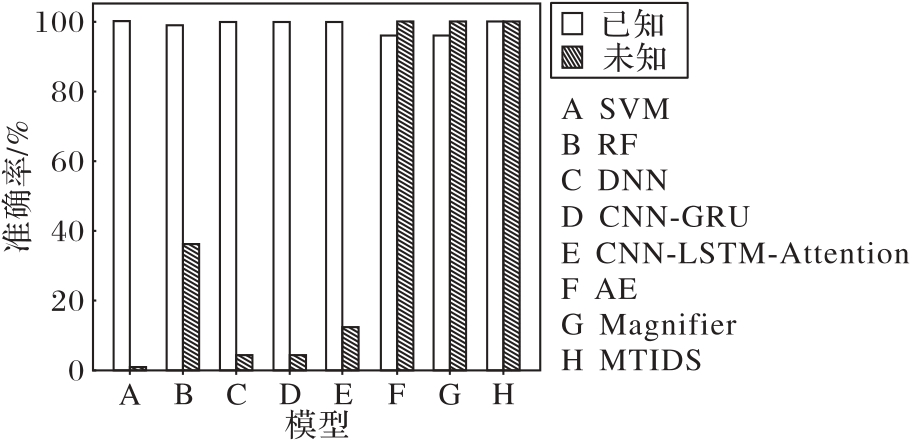
图2 已知和未知类型流量检测的准确率
Fig. 2 Accuracy of known and unknown traffic detection
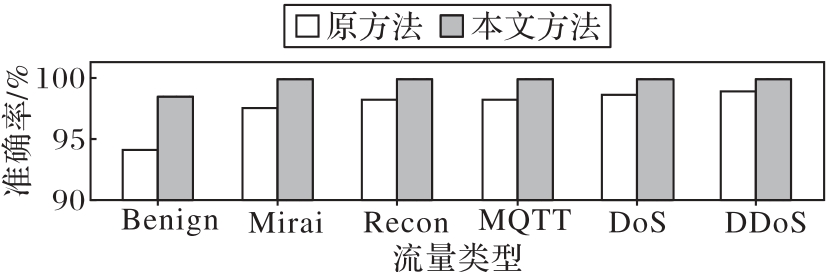
图3 特征提取评估
Fig. 3 Evaluation of feature extraction
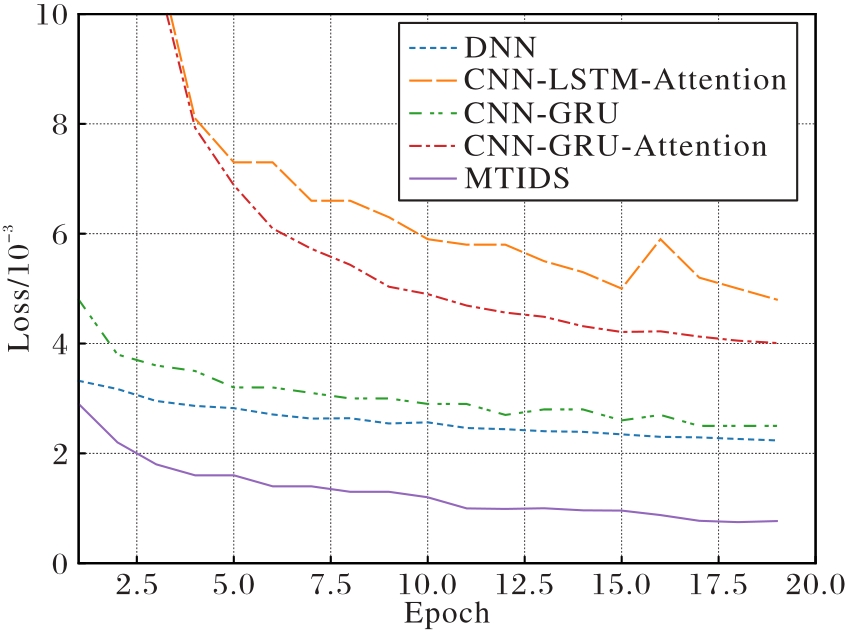
图4 Loss-Epoch迭代曲线
Fig. 4 Loss-Epoch iteration curve
| 类别 | 阶段1 | 阶段2 | 阶段3 | ||||||
|---|---|---|---|---|---|---|---|---|---|
| 总计 | 良性 | 异常 | 总计 | 良性 | 恶意 | 总计 | 良性 | 恶意 | |
| Benign | 3 691 | 2 579 | 1 112 | 1 112 | 1 051 | 61 | 1 051 | 899 | 152 |
| Mirai | 1 189 538 | 105 | 1 189 433 | 1 189 433 | 1 130 288 | 59 145 | 1 130 288 | 496 | 1 129 792 |
| Recon | 4 094 | 23 | 4 071 | 4 071 | 24 | 4 047 | 24 | 12 | 12 |
| MQTT | 98 675 | 0 | 98 675 | 98 675 | 5 | 98 670 | 5 | 0 | 5 |
| DoS | 540 898 | 4 | 540 894 | 540 894 | 6 | 540 888 | 6 | 3 | 3 |
| DDoS | 958 360 | 96 | 958 264 | 958 264 | 97 | 958 167 | 97 | 35 | 62 |
表6 3个阶段的二分类检测结果
Tab. 6 Binary classification detection results of three stages
| 类别 | 阶段1 | 阶段2 | 阶段3 | ||||||
|---|---|---|---|---|---|---|---|---|---|
| 总计 | 良性 | 异常 | 总计 | 良性 | 恶意 | 总计 | 良性 | 恶意 | |
| Benign | 3 691 | 2 579 | 1 112 | 1 112 | 1 051 | 61 | 1 051 | 899 | 152 |
| Mirai | 1 189 538 | 105 | 1 189 433 | 1 189 433 | 1 130 288 | 59 145 | 1 130 288 | 496 | 1 129 792 |
| Recon | 4 094 | 23 | 4 071 | 4 071 | 24 | 4 047 | 24 | 12 | 12 |
| MQTT | 98 675 | 0 | 98 675 | 98 675 | 5 | 98 670 | 5 | 0 | 5 |
| DoS | 540 898 | 4 | 540 894 | 540 894 | 6 | 540 888 | 6 | 3 | 3 |
| DDoS | 958 360 | 96 | 958 264 | 958 264 | 97 | 958 167 | 97 | 35 | 62 |
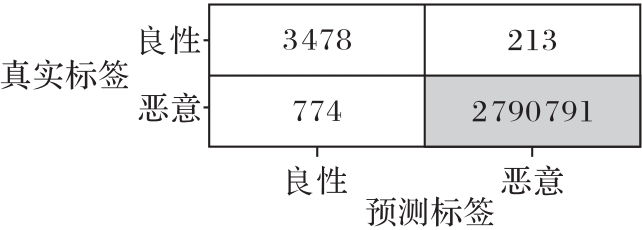
图5 MTIDS二分类预测结果
Fig.5 MTIDS binary classification prediction results
| 模型 | 准确率 | 精确率 | 召回率 | F1值 |
|---|---|---|---|---|
| MTIDS | 99.96 | 90.89 | 97.10 | 93.78 |
| w/o 阶段1 | 99.95 | 90.51 | 96.48 | 93.29 |
| w/o 阶段2 | 96.82 | 51.90 | 95.97 | 52.85 |
| w/o 阶段3 | 59.55 | 50.16 | 78.70 | 37.62 |
表7 消融实验结果 (%)
Tab. 7 Results of ablation experiments
| 模型 | 准确率 | 精确率 | 召回率 | F1值 |
|---|---|---|---|---|
| MTIDS | 99.96 | 90.89 | 97.10 | 93.78 |
| w/o 阶段1 | 99.95 | 90.51 | 96.48 | 93.29 |
| w/o 阶段2 | 96.82 | 51.90 | 95.97 | 52.85 |
| w/o 阶段3 | 59.55 | 50.16 | 78.70 | 37.62 |
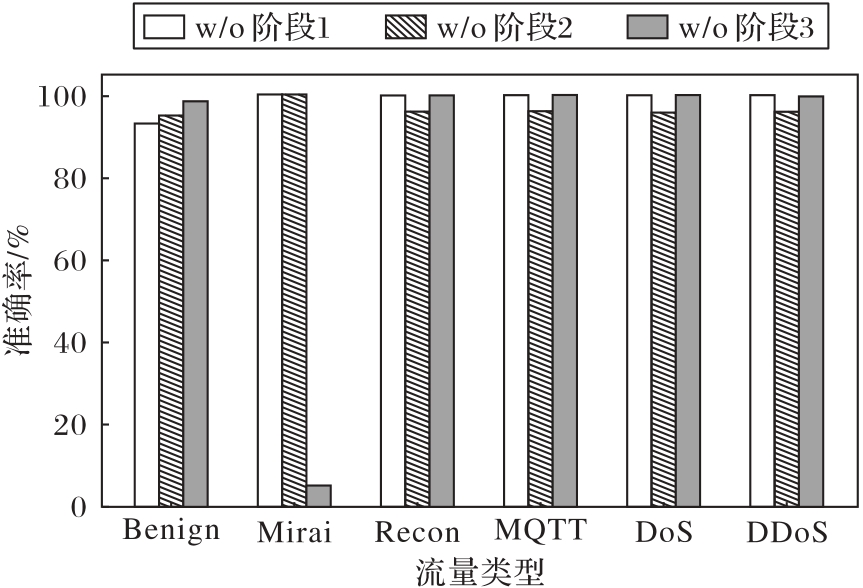
图6 消融实验的统计分析
Fig. 6 Statistical analysis of ablation experiments
| [1] | 王晨,谢礼梅,郭晓玲. 基于物联网的智慧医疗系统应用及其发展趋势分析[J]. 消费电子, 2024(11): 245-247. |
| WANG C, XIE L M, GUO X L. Application and development trend analysis of smart healthcare system based on Internet of Things[J]. Consumer Electronics Magazine, 2024(11): 245-247. | |
| [2] | HERNANDEZ-JAIMES M L, MARTINEZ-CRUZ A, RAMÍREZ-GUTIÉRREZ K A, et al. Artificial intelligence for IoMT security: a review of intrusion detection systems, attacks, datasets and Cloud-Fog-Edge architectures[J]. Internet of Things, 2023, 23: No.100887. |
| [3] | HINDY H, BAYNE E, BURES M, et al. Machine learning based IoT intrusion detection system: an MQTT case study (MQTT-IoT-IDS2020 dataset)[C]// Proceedings of the 2020 International Networking Conference, LNNS 180. Cham: Springer, 2021: 73-84. |
| [4] | HORE S, GHADERMAZI J, SHAH A, et al. A sequential deep learning framework for a robust and resilient network intrusion detection system[J]. Computers and Security, 2024, 144: No.103928. |
| [5] | KUMAR P, GUPTA G P, TRIPATHI R. An ensemble learning and fog-cloud architecture-driven cyber-attack detection framework for IoMT networks[J]. Computer Communications, 2021, 166: 110-124. |
| [6] | GHOURABI A. A security model based on LightGBM and Transformer to protect healthcare systems from cyberattacks[J]. IEEE Access, 2022, 10: 48890-48903. |
| [7] | SAHEED Y K, AROWOLO M O. Efficient cyber attack detection on the internet of medical things-smart environment based on deep recurrent neural network and machine learning algorithms[J]. IEEE Access, 2021, 9: 161546-161554. |
| [8] | NANDY S, ADHIKARI M, KHAN M A, et al. An intrusion detection mechanism for secured IoMT framework based on swarm-neural network[J]. IEEE Journal of Biomedical and Health Informatics, 2022, 26(5): 1969-1976. |
| [9] | ZACHOS G, ESSOP I, MANTAS G, et al. An anomaly-based intrusion detection system for internet of medical things networks[J]. Electronics, 2021, 10(21): No.2562. |
| [10] | THAMILARASU G, ODESILE A, HOANG A. An intrusion detection system for internet of medical things [J]. IEEE Access, 2020, 8: 181560-181576. |
| [11] | CHOWDHURY R R, IDRIS A C, ABAS P E. A deep learning approach for classifying network connected IoT devices using communication traffic characteristics[J]. Journal of Network and Systems Management, 2023, 31(1): No.26. |
| [12] | HADY A A, GHUBAISH A, SALMA T, et al. Intrusion detection system for healthcare systems using medical and network data: a comparison study [J]. IEEE Access, 2020, 8: 106576-106584. |
| [13] | CHAGANTI R, MOURADE A, RAVI V, et al. A particle swarm optimization and deep learning approach for intrusion detection system in internet of medical things[J]. Sustainability, 2022, 14(19): No.12828. |
| [14] | RAVI V, PHAM T D, ALAZAB M. Deep learning-based network intrusion detection system for internet of medical things [J]. IEEE Internet of Things Magazine, 2023, 6(2): 50-54. |
| [15] | DADKHAH S, NETO E C P, FERREIRA R, et al. CICIoMT2024: a benchmark dataset for multi-protocol security assessment in IoMT[J]. Internet of Things, 2024, 28: No.101351. |
| [16] | ZUKAIB U, CUI X, ZHENG C, et al. Meta-IDS: meta-learning-based smart intrusion detection system for Internet of Medical Things (IoMT) network[J]. IEEE Internet of Things Journal, 2024, 11(13): 23080-23095. |
| [17] | ElSAYED Z, ElSAYED N, BAY S. A novel zero-trust machine learning green architecture for healthcare IoT cybersecurity[C]// Proceedings of the IEEE SoutheastCon 2024. Piscataway: IEEE, 2024: 686-692. |
| [18] | DONG Y, LI Q, WU K, et al. HorusEye: a realtime IoT malicious traffic detection framework using programmable switches[C]// Proceedings of the 32nd USENIX Security Symposium. Berkeley: USENIX Association, 2023: 571-588. |
| [19] | AHMED M, BYREDDY S, NUTAKKI A, et al. ECU-IoHT: a dataset for analyzing cyber attacks in internet of health things [J]. Ad Hoc Networks, 2021, 122: No.102621. |
| [20] | ZUBAIR M, GHUBAISH A, UNAL D, et al. Secure bluetooth communication in smart healthcare systems: a novel community dataset and intrusion detection system[J]. Sensors, 2022, 22(21): No.8280. |
| [21] | HUSSAIN F, ABBAS S G, SHAH G A, et al. A framework for malicious traffic detection in IoT healthcare environment[J]. Sensors, 2021, 21(9): No.3025. |
| [22] | RADOGLOU-GRAMMATIKIS P, ROMPOLOS K, SARIGIANNIDIS P, et al. Modeling, detecting, and mitigating threats against industrial healthcare systems: a combined software defined networking and reinforcement learning approach[J]. IEEE Transactions on Industrial Informatics, 2022, 18(3): 2041-2052. |
| [1] | 边小勇, 袁培洋, 胡其仁. 双编码空频混合的红外小目标检测方法[J]. 《计算机应用》唯一官方网站, 2026, 46(1): 252-259. |
| [2] | 昝志辉, 王雅静, 李珂, 杨智翔, 杨光宇. 基于SAA-CNN-BiLSTM网络的多特征融合语音情感识别方法[J]. 《计算机应用》唯一官方网站, 2026, 46(1): 69-76. |
| [3] | 李维刚, 邵佳乐, 田志强. 基于双注意力机制和多尺度融合的点云分类与分割网络[J]. 《计算机应用》唯一官方网站, 2025, 45(9): 3003-3010. |
| [4] | 许志雄, 李波, 边小勇, 胡其仁. 对抗样本嵌入注意力U型网络的3D医学图像分割[J]. 《计算机应用》唯一官方网站, 2025, 45(9): 3011-3016. |
| [5] | 张宏俊, 潘高军, 叶昊, 陆玉彬, 缪宜恒. 结合深度学习和张量分解的多源异构数据分析方法[J]. 《计算机应用》唯一官方网站, 2025, 45(9): 2838-2847. |
| [6] | 李进, 刘立群. 基于残差Swin Transformer的SAR与可见光图像融合[J]. 《计算机应用》唯一官方网站, 2025, 45(9): 2949-2956. |
| [7] | 殷兵, 凌震华, 林垠, 奚昌凤, 刘颖. 兼容缺失模态推理的情感识别方法[J]. 《计算机应用》唯一官方网站, 2025, 45(9): 2764-2772. |
| [8] | 景攀峰, 梁宇栋, 李超伟, 郭俊茹, 郭晋育. 基于师生学习的半监督图像去雾算法[J]. 《计算机应用》唯一官方网站, 2025, 45(9): 2975-2983. |
| [9] | 彭鹏, 蔡子婷, 刘雯玲, 陈才华, 曾维, 黄宝来. 基于CNN和双向GRU混合孪生网络的语音情感识别方法[J]. 《计算机应用》唯一官方网站, 2025, 45(8): 2515-2521. |
| [10] | 张硕, 孙国凯, 庄园, 冯小雨, 王敬之. 面向区块链节点分析的eclipse攻击动态检测方法[J]. 《计算机应用》唯一官方网站, 2025, 45(8): 2428-2436. |
| [11] | 廖炎华, 鄢元霞, 潘文林. 基于YOLOv9的交通路口图像的多目标检测算法[J]. 《计算机应用》唯一官方网站, 2025, 45(8): 2555-2565. |
| [12] | 葛丽娜, 王明禹, 田蕾. 联邦学习的高效性研究综述[J]. 《计算机应用》唯一官方网站, 2025, 45(8): 2387-2398. |
| [13] | 索晋贤, 张丽萍, 闫盛, 王东奇, 张雅雯. 可解释的深度知识追踪方法综述[J]. 《计算机应用》唯一官方网站, 2025, 45(7): 2043-2055. |
| [14] | 王震洲, 郭方方, 宿景芳, 苏鹤, 王建超. 面向智能巡检的视觉模型鲁棒性优化方法[J]. 《计算机应用》唯一官方网站, 2025, 45(7): 2361-2368. |
| [15] | 齐巧玲, 王啸啸, 张茜茜, 汪鹏, 董永峰. 基于元学习的标签噪声自适应学习算法[J]. 《计算机应用》唯一官方网站, 2025, 45(7): 2113-2122. |
| 阅读次数 | ||||||
|
全文 |
|
|||||
|
摘要 |
|
|||||
